Secrecy and power

True believers in secrecy know that its most staunch defenders are secrecy’s worst enemies. They know that the inevitable consequence of the rampant proliferation of a secrecy culture, will be to feed doubt that secrecy itself has any legitimacy. The assumption will take hold that secrecy’s one and only function is the protection of power.

Secrecy is maintained by constructing barriers between those who can know and those who can’t. The powers of a Security State have less to do with protecting secrets than with controlling the barriers of secrecy and determining who can be allowed in and who must be kept out. In other words, secrecy ends up having more to do with maintaining inequities in the distribution of power than in protecting the public interest.

In the multitude of ways that the Obama administration has mishandled the WikiLeaks drama, none is worse than the signal it has just sent out to a generation of young Americans: if you have an inquiring mind, don’t bother applying for a job with the US government. If however you are happy to blindly follow orders and have a slavish admiration for institutional authority — who knows, maybe one day you could become president.

Yesterday, TPMMuckraker reported:

The Office of Management and Budget today directed all federal agencies to bar unauthorized employees from accessing the Wikileaks web site and its leaked diplomatic cables.

In an email to federal agencies obtained by TPM, the OMB’s general counsel directed the agencies to immediately tell their employees to “safeguard classified information” by not accessing Wikileaks over the Internet.

Classified information, the OMB notes, “remains classified … until it is declassified by an appropriate U.S. Government authority.” Employees may not view classified info over a non-classified system (i.e., the Internet), the OMB says, “as doing so risks that material still classified will be placed onto non-classified systems.”

Reading a classified document appearing in the New York Times presents the risk that the designation of its secrecy will lose effect in the minds of those who are required to maintain a reverential respect for rubber stamps.

Meanwhile, the State Department, apparently hoping it might be able to lobotomize a few young minds in preparation for government service, sent out some friendly advice:

Students of Columbia University’s School of International and Public Affairs were warned this week not to spread the Wikileak cables online if they ever wanted a job at the State Department.

The warning came through the office of career services, from an unnamed alumnus who now works at State and wanted to pass along the message.

“The documents released during the past few months through Wikileaks are still considered classified documents. He recommends that you DO NOT post links to these documents nor make comments on social media sites such as Facebook or through Twitter,” reads the email, sent by the office of career services. Engaging in these activities would call into question your ability to deal with confidential information, which is part of most positions with the federal government.”

Oh the irony, that any of us could have been so naive as to imagine that the Bush era might be followed by a more enlightened administration. Instead, a cast of colorful characters who were easy to demonize has been replaced by something worse: technocratic zombies who have normalized and solidified the power grabs initiated by their Machiavellian predecessors.

And this is what it has come to under Obama’s leadership: that the surest way of predicting how this administration will act, is simply to ask: what would be the most cowardly course of action? For that is the direction in which we can be sure it will proceed.

If this failing was merely that of a particular president or political party, America might not be in such bad shape, but the test came on 9/11 and America has been failing ever since.

Danger always poses a challenge. Will fear scream so loudly that nothing else can be heard?

“Courage is the ability to follow your principles even when you’re scared to death,” said Lt Cmdr Charles Swift after successfully challenging the Bush administration before the Supreme Court in Hamdan v. Rumsfeld.

Swift appears in Secrecy — a documentary no less relevant now than when it came out in 2008. (If you’re a Netflix subscriber you can “watch instantly.”)

Last year (before WikiLeaks had acquired such prominence), the film’s directors Peter Galison and Robb Moss joined professors Jack Goldsmith (author of The Terror Presidency and former Assistant Attorney General in the Bush administration) and Martha Minow from Harvard Law School, for a discussion on the documentary, moderated by Jonathan Zittrain from Harvard’s Berkman Center for Internet & Society.

Ever since 9/11, protecting America has been the name of the political game, yet there has been no consensus about what constitutes that which is under threat and in need of protection. Global hegemony? Rampant consumerism?

What has gradually become clear is that it is American democracy itself which faces the greatest challenge and if the issue of secrecy is to be addressed in a way that supports rather than undermines democracy, it will be approached using the same principles that shape the whole operation of government, with checks and balances, for these are the principles which if not applied will fall into disrepair, leaving an America armed to protect everything while no longer standing for anything.


Facebooktwittermail

Why should Iran trust President Obama?

Flynt Leverett and Hillary Mann Leverett write:

In the run-up to a new round of nuclear talks between the P5+1 and Iran on Monday, Western commentators are re-hashing old arguments that the Islamic Republic is either too politically divided or too dependent on hostility toward the United States for its legitimacy to be seriously interested in a nuclear deal. From this perspective, the Obama administration has been more than forthcoming in its efforts to “engage” Tehran; the obstacles to diplomatic progress are all on the Iranian side.

But a sober examination of the Obama administration’s interactions with Iran since President Obama took office in 2009 reveals a dismaying mix of incompetence and outright duplicity that has done profound damage to American interests and credibility. In light of this record, the question is not whether the United States should have any confidence it can productively engage the Islamic Republic. The real question is: why should Iranian officials believe they can trust President Obama and his administration to deal with them straightforwardly and with a genuine interest in finding a diplomatic solution to the nuclear standoff?

The recent release of the Wikileaks cables confirms the assessment we have been offering since May 2009: The Obama administration has failed to follow up on President Obama’s early rhetorical overtures to Tehran with bold steps and substantive proposals to demonstrate its seriousness about rapprochement. Strategic engagement — think Nixon and China — is not the same as “carrots and sticks”. In fact, strategic engagement requires a self-conscious effort by the United States to put “sticks” aside in order assure Iran that it is serious about realigning relations. And that is something the Obama administration has never been willing to do. (Obama’s vague letters to Iran’s Supreme Leader, Ayatollah Ali Khamenei — dispatched as Obama ignored two letters sent by Iranian President Mahmoud Ahmadinejad — were seen in Tehran as just the latest U.S. attempt to “game” Iran’s political system rather than to come to terms with it.)

Facebooktwittermail

Ron Paul: ‘In a free society we’re supposed to know the truth’

Politico reports:

Rep. Ron Paul (R-Texas) is taking a stand as one of Julian Assange’s few defenders in Washington, arguing that the WikiLeaks founder should get the same protections as the media.

Attorney General Eric Holder said this week that the Justice Department is examining whether Assange can be charged with a crime for posting hundreds of thousands of leaked government intelligence documents and diplomatic cables.

Many Republicans have gone even further in their attacks on Assange, especially former Arkansas GOP Gov. Mike Huckabee, who said this week that the source who leaked to the WikiLeaks founder should be tried for treason and executed if found guilty.

But in a Thursday interview with Fox Business, Paul said the idea of prosecuting Assange crosses the line.

“In a free society we’re supposed to know the truth,” Paul said. “In a society where truth becomes treason, then we’re in big trouble. And now, people who are revealing the truth are getting into trouble for it.”

Facebooktwittermail

Obama and GOPers worked together to kill Bush torture probe

David Corn reports:

In its first months in office, the Obama administration sought to protect Bush administration officials facing criminal investigation overseas for their involvement in establishing policies the that governed interrogations of detained terrorist suspects. A “confidential” April 17, 2009, cable sent from the US embassy in Madrid to the State Department—one of the 251,287 cables obtained by WikiLeaks—details how the Obama administration, working with Republicans, leaned on Spain to derail this potential prosecution.

The previous month, a Spanish human rights group called the Association for the Dignity of Spanish Prisoners had requested that Spain’s National Court indict six former Bush officials for, as the cable describes it, “creating a legal framework that allegedly permitted torture.” The six were former Attorney General Alberto Gonzales; David Addington, former chief of staff and legal adviser to Vice President Dick Cheney; William Haynes, the Pentagon’s former general counsel; Douglas Feith, former undersecretary of defense for policy; Jay Bybee, former head of the Justice Department’s Office of Legal Counsel; and John Yoo, a former official in the Office of Legal Counsel. The human rights group contended that Spain had a duty to open an investigation under the nation’s “universal jurisdiction” law, which permits its legal system to prosecute overseas human rights crimes involving Spanish citizens and residents. Five Guantanamo detainees, the group maintained, fit that criteria.

Soon after the request was made, the US embassy in Madrid began tracking the matter. On April 1, embassy officials spoke with chief prosecutor Javier Zaragoza, who indicated that he was not pleased to have been handed this case, but he believed that the complaint appeared to be well-documented and he’d have to pursue it. Around that time, the acting deputy chief of the US embassy talked to the chief of staff for Spain’s foreign minister and a senior official in the Spanish Ministry of Justice to convey, as the cable says, “that this was a very serious matter for the USG.” The two Spaniards “expressed their concern at the case but stressed the independence of the Spanish judiciary.”

Facebooktwittermail

John F Kennedy’s opposition to secrecy

The President and the Press: Address before the American Newspaper Publishers Association
President John F. Kennedy, Waldorf-Astoria Hotel, New York City, April 27, 1961

Ladies and gentlemen, the very word secrecy is repugnant, in a free and open society, and we are as a people, inherently and historically, opposed to secret societies, to secret oaths and secret proceedings.

We decided long ago that the dangers of excessive and unwarranted concealment of pertinent facts far outweigh the dangers which are cited to justify it.

Even today there is little value in opposing the threat of a closed society by imitating it’s arbitrary restrictions.

Even today there is little value in ensuring the survival of our nation, if our traditions do not survive with it.

And there is very grave danger that an announced need for increased security will be seized upon by those anxious who wish to expand it’s meaning to the very limits of official censorship and concealment.

That I do not intend to permit, to the extent that it is in my control.

And no official of my administration whether his rank is high or low, civilian or military, should interpret my words here tonight, as an excuse to censor the news, to stifle dissent, to cover up our mistakes, or to withhold from the press and the public the facts they deserve to know.

For we are opposed, around the world, by a monolithic and ruthless conspiracy, that relies primarily on covet means for expanding it’s fear of influence, on infiltration instead of invasion, on subversion instead of elections, on intimidation, instead of free choice, on guerrillas by night, instead of armies by day.

It is a system which has conscripted, vast human and material resources into the building of a tightly knit, highly efficient machine that combines military, diplomatic, intelligence, economic, scientific, and political operations.

Its preparations are concealed, not published. It’s mistakes are buried, not headlined. Its dissenters are silenced, not praised. No expenditure is questioned. No rumor is printed. No secret is revealed.

No president should fear public scrutiny of his program. For from that scrutiny comes understanding. And from that understanding comes support or opposition, and both are necessary.

I am not asking your newspaper to support an administration. But I am asking your help in the tremendous task of informing and alerting the American people. For I have complete confidence in the response and the dedication of our citizens whenever they are fully informed.

I not only could not stifle controversy from your readers — I welcome it. This administration intends to be candid about its errors. For as a wise man once said, “an error doesn’t become a mistake until you refuse to correct it”.

We intend to accept full responsibility for our errors and we expect you to point them out when we miss them. Without debate, without criticism, no administration and no country can succeed. And no republic can survive.

That is why the Athenian lawmaker Solon decreed it a crime for any citizen to shrink from controversy. And that is why our press was protected by the first amendment, the only business in America specifically protected by the constitution, not primarily to amuse or entertain, not to emphasize the trivial and sentimental, not to simply give the public what it wants, but to inform, to arouse, and to reflect, to state our dangers and our opportunities, to indicate our crises and our choices, to lead, mould, and educate and sometimes even anger public opinion.

This means greater coverage and analysis of international news, for it is no longer far away and foreign, but close at hand and local. It means greater attention to improved attention to greater understanding of the news, as well as improved transmission, and it means finally, that government at all levels, must meet its obligation, to provide you with it’s possible information, outside the narrowest limits of national security.

And so it is to the printing press, to the recorder of man’s deeds, the keeper of his conscience, the courier of his news, that we look for strength, and his assistance, confident that with your help, Man will be what he was born to be: free and independent.

Facebooktwittermail

Moscow’s bid to blow up WikiLeaks

Philip Shenon writes:

American intelligence and law-enforcement agencies, outraged by their inability to stop WikiLeaks and its release this week of hundreds of thousands of sensitive U.S. diplomatic cables, are convinced that the whistleblowing website is about to come up against an adversary that will stop at nothing to shut it down: the Russian government.

National-security officials say that the National Security Agency, the U.S. government’s eavesdropping agency, has already picked up tell-tale electronic evidence that WikiLeaks is under close surveillance by the Russian FSB, that country’s domestic spy network, out of fear in Moscow that WikiLeaks is prepared to release damaging personal information about Kremlin leaders.

“We may not have been able to stop WikiLeaks so far, and it’s been frustrating,” a U.S. law-enforcement official tells The Daily Beast. “The Russians play by different rules.” He said that if WikiLeaks and its founder, Julian Assange, follow through on threats to post highly embarrassing information about the Russian government and what is assumed to be massive corruption among its leaders, “the Russians will be ruthless in stopping WikiLeaks.”

Facebooktwittermail

Wikileaks live again. Resolves DNS, moves to Switzerland

TNW Media reports:

Just hours after Wikileaks announced it was down when its DNS provider EveryDNS.net stopped providing DNS support, the whistle-blowing website is live again, this time available via a new Swiss domain name; Wikileaks.ch and a number of other domain suffixes, redirecting to a specific IP address: http://213.251.145.96/.

The Wikileaks.org website went down worldwide around 11:25 PST, leaving visitors only able to access the website via a specific IP address.

For updates on WikiLeaks, check Twitter.

Facebooktwittermail

Did US Special Operations Forces want to ‘target’ refugee camps in Pakistan?

Jeremy Scahill writes:

In the fall of 2008, the US Special Operations Command asked top US diplomats in Pakistan and Afghanistan for detailed information on refugee camps along the Afghanistan Pakistan border and a list of humanitarian aid organizations working in those camps. On October 6, the US ambassador to Pakistan, Anne Patterson, sent a cable marked “Confidential” to Defense Secretary Robert Gates, Secretary of State Condoleezza Rice, the CIA, US Central Command and several US embassies saying that some of the requests, which came in the form of emails, “suggested that agencies intend to use the data for targeting purposes.” Other requests, according to the cable, “indicate it would be used for “NO STRIKE” purposes.” The cable, which was issued jointly by the US embassies in Kabul and Islamabad, declared: “We are concerned about providing information gained from humanitarian organizations to military personnel, especially for reasons that remain unclear. Particularly worrisome, this does not seem to us a very efficient way to gather accurate information.”

What this cable says in plain terms is that at least one person within the US Special Operations Command actually asked US diplomats in Kabul and/or Islamabad point-blank for information on refugee camps to be used in a targeted killing or capture operation. It also seems possible whoever made that request actually put it in an email (FOIA anyone?). It is no longer a publicly deniable secret that US special operations forces and the CIA have engaged in offensive operations in Pakistan, but this cable is evidence that they sought to exploit the US embassies’ humanitarian aid operations through back channel communications to conduct potentially lethal operations. Needless to say, this type of request is extremely dangerous for aid workers because it reinforces the belief that USAID and other nongovernmental organizations are fronts for the CIA. In November 2009, a US military intelligence source told me that some Blackwater contractors working for US special operations forces in Pakistan have posed as aid workers. “Nobody even gives them a second thought,” he said. Blackwater, at the time, denied it was operating in Pakistan.

Facebooktwittermail

Nigeria to charge Dick Cheney in pipeline bribery case

Bloomberg reports:

Nigeria will file charges against former U.S. Vice President Dick Cheney and officials from five foreign companies including Halliburton Co. over a $180 million bribery scandal, a prosecutor at the anti-graft agency said.

Indictments will be lodged in a Nigerian court “in the next three days,” Godwin Obla, prosecuting counsel at the Economic and Financial Crimes Commission, said in an interview today at his office in Abuja, the capital. An arrest warrant for Cheney “will be issued and transmitted through Interpol,” the world’s biggest international police organization, he said.

Peter Long, Cheney’s spokesman, said he couldn’t immediately comment when contacted today and said he would respond later to an e-mailed request for comment.

Facebooktwittermail

Cables from Beirut

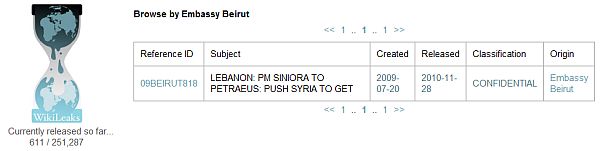
Is WikiLeaks diversifying its cable supply line? As of 8.00PM US Eastern, the WikiLeaks Cablegate site lists just one cable originating from the US Embassy in Beirut.

The Lebanese newspaper Al Akhbar however, has published two other cables from Beirut, here and here. This might imply that WikiLeaks has picked out a handful of cables that it is going to feed to news outlets other than The Guardian, El País, Le Monde, and Der Spiegel.

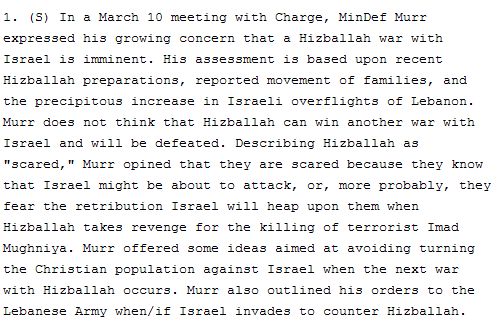
The summary below comes from a March 2008 secret cable and describes a meeting with Elias Murr, then Lebanon’s defense minister and now also deputy prime minister:

Lebanon's Defense Minister Elias Murr told the US the Lebanese army would remain in their bases if Israel launched an assault on Hezbollah

Elias Muhanna on his blog Qifa Nabki, writes:

In the cable mentioned, the Lebanese Minister of Defense Elias al-Murr discusses with U.S. Embassy officials his preparations for an impending war with Israel, which involved sequestering the Lebanese Army in its bases until Hizbullah is destroyed…

What makes this leak especially damning is the fact that al-Murr specifically mentions his meeting with General Michel Sleiman (who, in March 2008, was still the commander of the Lebanese Army, and not yet the President of Lebanon) and talks about sharing his plans with him. Today, al-Murr is considered to be one of the President’s key ministers, so it’s quite possible that the toxic nature of this scandal will spread beyond the Ministry of Defense all the way to the Presidential Palace.

There has been a lot of noise over the past few weeks from March 8 circles to the effect that President Sleiman is no longer considered a “consensual” president (because of his support for Hariri’s bid to table the false witness file until after the STL indictment is released). The Wikileaks scandal is going to provide the perfect excuse for Hizbullah and Aoun to go on the offensive again against the STL and the March 14 camp. I would not be surprised if Sleiman demands al-Murr’s resignation, just to save his own position.

As for whether Hezbollah or anyone else in Lebanon would actually find these machinations surprising, one of Qifa Nabki‘s commenters, “Shai,” is probably right on target when saying:

Seems to me Hezbollah is perfectly happy when the Lebanese Army stays out of the game. What better than to be deemed the sole “defender of Lebanon”? Who could ask such a defender to put down their arms, when the so-called “official army” stays indoors to watch the war on TV?

For Hezbollah, it’s a win-win.

Facebooktwittermail

US State Department now afraid of its own shadow

Craig Murray, former British Ambassador to Uzbekistan, notes:

[D]iplomats as a class very seldom tell unpalatable truths to politicians, but rather report and reinforce what their masters want to hear, in the hope of receiving preferment.

There is therefore [in the cables released by WikiLeaks] a huge amount about Iran’s putative nuclear arsenal and an exaggeration of Iran’s warhead delivery capability. But there is nothing about Israel’s massive nuclear arsenal. That is not because wikileaks have censored criticism of Israel. It is because any US diplomat who made an honest and open assessment of Israeli crimes would very quickly be an unemployed ex-diplomat.

WikiLeaks’ Julian Assange when asked by Time magazine what effect he is seeing from the publication of the diplomatic cables said, among other things:

[W]e can see the Israeli Prime Minister [Benjamin] Netanyahu coming out with a very interesting statement that leaders should speak in public like they do in private whenever they can. He believes that the result of this publication, which makes the sentiments of many privately held beliefs public, are promising a pretty good [indecipherable] will lead to some kind of increase in the peace process in the Middle East and particularly in relation to Iran.

But if Assange actually believes Netanyahu is rallying to the cause of transparency, he’ll be disappointed to read this from Sami Moubayed:

Last summer, Israeli Prime Minister Benjamin Netanyahu signed off on a law extending classification of state archives related to the early years of the Jewish State’s foundation. That means all documents related to the war of 1948 and its monumental aftermath will remain under lock and key until 2018, exactly 70 years after what the Arabs refer to as the Palestinian Nakba, or “Catastrophe.”

Documents about the 1967 Arab-Israeli war will, therefore, remain classified until 2037, while anything related to the 1982 siege of Beirut will remain off-limits until 2052. Records of Yasser Arafat’s 2004 death will not be opened until 2074 while Israeli archives of what happened in Beirut on that fateful day in February 2005, when a massive bomb killed Lebanon’s Prime Minister Rafiq al-Hariri, will hauntingly remain labeled “top secret”” until 2075.

Meanwhile, US government employees are being instructed to shield their eyes from the corrupting influence of US government documents. Christian Science Monitor reports that both State and Defense department employees have been instructed not to visit the WikiLeaks website.

At The Nation, Tom Hayden writes:

Informed sources say that the current deluge of Wikileaks documents will continue for another week and grow in significance.

Leading US human rights lawyers Leonard Weinglass and Michael Ratner have joined the defense team for Julian Assange and Wikileaks. US officials are employing cyber-warfare and prosecutorial steps to deny any safe haven for the Wikileaks operation with a fervor comparable to their drone attacks on Al Qaeda havens in Pakistan and Yemen. WikiLeaks’ Julian Assange was placed on Interpol’s “most wanted” list as US authorities intensified efforts to suppress the whistleblower organization’s deluge of classified US diplomatic cables. Assange’s location was not immediately known. His choices are to turn himself in or be tracked down by local police. If outside of Sweden, he could face extradition on charges to stand trial there. Or the US could seek his extradiction on charges of espionage or theft of classified documents.

Two cyber-attacks have been reported against WikiLeaks servers this week. The Justice Department is seeking indictments on espionage charges from a grand jury quietly impaneled this week in arch-conservative Alexandria, Virginia. Assange is in London, facing rape and sexual harrassment charges in Sweden, which he denies. Extradition could be sought by the United States at any time from either venue.

Why is this drama important? Not because of “life-threatening” leaks, as claimed by the establishment, but because the closed doors of power need to be open to public review. We live increasingly in an Age of Secrecy, as described by Garry Wills in Bomb Power, among recent books. It has become the American Way of War, and increasingly draws the curtains over American democracy itself.

Facebooktwittermail

Controversial drug given to all Guantanamo detainees akin to “pharmacologic waterboarding”

At Truthout, Jason Leopold and Jeffrey Kaye report:

The Defense Department forced all “war on terror” detainees at the Guantanamo Bay prison to take a high dosage of a controversial antimalarial drug, mefloquine, an act that an Army public health physician called “pharmacologic waterboarding.”

The US military administered the drug despite Pentagon knowledge that mefloquine caused severe neuropsychiatric side effects, including suicidal thoughts, hallucinations and anxiety. The drug was used on the prisoners whether they had malaria or not.

The revelation, which has not been previously reported, was buried in documents publicly released by the Defense Department (DoD) two years ago as part of the government’s investigation into the June 2006 deaths of three Guantanamo detainees.

Army Staff Sgt. Joe Hickman, who was stationed at Guantanamo at the time of the suicides in 2006, and has presented evidence that demonstrates the three detainees could not have died by hanging themselves, noticed in the detainees’ medical files that they were given mefloquine. Hickman has been investigating the circumstances behind the detainees’ deaths for nearly four years.

Interviews with mefloquine and malaria experts and a review of peer-reviewed journals and government documents show there were no preexisting cases where mefloquine was ever prescribed for mass presumptive treatment of malaria.

Facebooktwittermail

WikiLeaks reveals British government colluded with the US to deceive the British parliament and evade cluster bomb ban

The Guardian reports:

British and American officials colluded in a plan to hoodwink parliament over a proposed ban on cluster bombs, the Guardian can disclose.

According to leaked US embassy dispatches, David Miliband, who was Britain’s foreign secretary under Labour, approved the use of a loophole to manoeuvre around the ban and allow the US to keep the munitions on British territory.

Unlike Britain, the US had refused to sign up to an international convention that bans the weapons because of the widespread injury they cause to civilians.

Seumas Milne writes:

[B]eyond the dispatches on Prince Andrew’s crass follies and Colonel Gaddafi’s “weirdness”, the leaks do paint a revealing picture of an overstretched imperial system at work, as its emissaries struggle to keep satraps in line and enemies at bay.

Much has been made of the appalling damage supposedly done to the delicate business of diplomacy. No doubt the back channels will survive the shock of daylight. But in any case the United States is the centre of a global empire, a state with a military presence in most countries which arrogates to itself the role of world leader and policeman.

When genuine checks on how it exercises that entirely undemocratic power are so weak at home, let alone in the rest of the world it still dominates, it’s both inevitable and right that people everywhere will try to find ways to challenge and hold it to account.

After the Russian revolution, the secret tsarist treaties with Britain and France were published to expose and challenge the colonial carve-ups of the day. In the 1970s, the publication of the Pentagon papers cut the ground from beneath the US case for the Vietnam war. Now technology is allowing such exposures on a far grander scale.

Clinton complained this week that the leaks “tore at the fabric” of government and good relations between states. Far more damaging is her own instruction to ordinary US diplomats to violate the treaties the US government has itself signed and spy on UN officials, along with any other public figure they happen to meet: down to their credit card details, biometric records – and even frequent-flyer account numbers.

Not surprisingly, US allies and client states come out badly from the leaks.

Facebooktwittermail