The new McCarthyism sweeping Israel

The Independent reports:

It’s hard, sitting on the other side of the office table from which Naomi Chazan is picking at her modest hummus and salad snack lunch, to believe that the amiable 63-year-old university professor with a self-deprecating sense of humour has suddenly become the most discussed, not to say demonised, woman in Israel.

Ms Chazan is president of a long-established agency with large numbers of Jewish donors in the US and Britain, which is committed to fighting for “social justice and equality for all Israelis”. The New Israel Fund has over the last 30 years disbursed some $200m to around 800 charitable, social and human rights groups, and justly claims much of the credit for building modern Israel’s still vibrant civil society.

But in the last fortnight the former Knesset member who by her own account loves her native Israel “without reservation” has been sacked as a columnist on the Jerusalem Post after 14 years, had rowdy demonstrators outside her house brandishing a chilling caricature of her with a horn obtruding from her forehead, and most far-fetched of all, been accused, in a newspaper article circulated to foreign journalists by the Government Press Office, of “serving the agenda of Iran and Hamas”.

Facebooktwittermail

Obama’s secret prisons in Afghanistan endanger us all

Johann Hari writes:

Osama Bin Laden’s favourite son, Omar, recently abandoned his father’s cave in favor of spending his time dancing and drooling in the nightclubs of Damascus. The tang of freedom almost always trumps Islamist fanaticism in the end: three million people abandoned the Puritan hell of Taliban Afghanistan for freer countries, while only a few thousand faith-addled fanatics ever traveled the other way. Osama’s vision can’t even inspire his own kids. But Omar Bin Laden says his father is banking on one thing to shore up his flailing, failing cause — and we are giving it to him.

The day George W. Bush was elected, Omar says, “my father was so happy. This is the kind of president he needs — one who will attack and spend money and break [his own] country.” Osama wanted the US and Europe to make his story about the world ring true in every mosque and every mountain-top and every souq. He said our countries were bent on looting Muslim countries of their resources, and any talk of civil liberties or democracy was a hypocritical facade. The jihadis I have interviewed — from London to Gaza to Syria — said their ranks swelled with each new whiff of Bushism as more and more were persuaded. It was like trying to extinguish fire with a blowtorch.

The revelations this week about how the CIA and British authorities handed over a suspected jihadi to torturers in Pakistan may sound at first glance like a hangover from the Bush years. Barack Obama was elected, in part, to drag us out of this trap — but in practice he is dragging us further in. He is escalating the war in Afghanistan, and has taken the war to another Muslim country. The CIA and hired mercenaries are now operating on Obama’s orders inside Pakistan, where they are sending unmanned drones to drop bombs and sending secret agents to snatch suspects. The casualties are overwhelmingly civilians. We may not have noticed, but the Muslim world has: check out al-Jazeera any night.

Facebooktwittermail

New light cast on the recent murder of an Iranian physicist

The Economist reports:

When a motorcycle was blown up by remote control in Tehran last month, killing Masoud Alimohammadi, a professor of physics, the regime blamed “the triangle of wickedness”—Israel, America and their “hired agents”.

It is no secret that America, Israel and European countries are seeking to impede Iran’s nuclear plans, overtly and covertly. Yet the assassination theory was widely dismissed. The professor’s known works on particle and theoretical physics did not seem central to Iran’s nuclear programme. And his name had appeared on a list of Iranian academics favouring Iran’s protest movement. So, ran the prevailing theory, Israel or America had little reason to kill him, though Iranian hardliners may have wanted to do so.

But listen to the whispers of Western spies and diplomats, and the Iranian regime may turn out to be right. Well-placed sources in two Western countries now say the professor was “one of the most important people involved in the programme”.

Such conclusions, admit some, are based on “imperfect insight” into the workings of Iran’s nuclear establishment that includes the public and ostensibly civil projects run by the Atomic Energy Organisation of Iran (AEOI) and an overlapping but secret organisation run by the ministry of defence that focuses more on turning fissile material into nuclear weapons.

The AEOI said it had not employed Mr Alimohammadi. Several Iran-watchers said they had never heard of him until his death. But a Western counter-proliferation source says he “is known to have worked closely” with two key figures in Iran’s ministry of defence, Mohsen Fakhrizadeh-Mahabadi and Fereidoun Abbasi-Davani. Both are on the UN’s sanctions list of Iranians whose assets are to be seized and whose travels must be reported to the UN.

Facebooktwittermail

Atomic agency views Iran’s stepped-up enrichment of uranium as a violation

The New York Times reported:

Iran’s surprise move this week to begin enriching its uranium to a level closer to weapons-grade violated an agreement with atomic inspectors in Vienna, diplomats said, very likely providing the United States with another piece of evidence that Iran is not living up to its international commitments on its nuclear program.

The breach involved Iran’s starting the enrichment process in the absence of atomic inspectors — something that the International Atomic Energy Agency had specifically asked Iran not to do. Narrowly, the violation was viewed as technical in nature. But it caused resentment at the atomic agency’s headquarters in Vienna because Iran had acted so quickly and with such apparent contempt of the agreement.

“There’s a feeling of pique and annoyance,” said a European diplomat who works with the agency and spoke on condition of anonymity, because he was not authorized to speak with reporters.

Facebooktwittermail

How the Obama administration ended up where Franklin Roosevelt began

At TomDispatch, Steve Fraser writes:

On March 4, 1933, the day he took office, Franklin Roosevelt excoriated the “money changers” who “have fled from their high seats in the temples of our civilization [because…] they know only the rules of a generation of self-seekers. They have no vision and where there is no vision, the people perish.”

Rhetoric, however, is only rhetoric. According to one skeptical congressional observer of FDR’s first inaugural address, “The President drove the money-changers out of the Capitol on March 4th — and they were all back on the 9th.”

That was essentially true. It was what happened after that, in the midst of the Great Depression, which set the New Deal on a course that is the mirror image of the direction in which the Obama administration seems headed.

Buoyed by great expectations when he assumed office, Barack Obama has so far revealed himself to be an unfolding disappointment. On arrival, expectations were far lower for FDR, who was not considered extraordinary at all — until he actually did something extraordinary.

Facebooktwittermail

Former boy soldier, youngest Guantanamo detainee, heads toward military tribunal

The Washington Post reported:

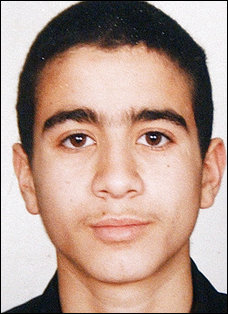
Omar Khadr, the youngest detainee at Guantanamo Bay, Cuba, was 15 when he allegedly threw a grenade that killed a U.S. Special Forces medic in Afghanistan. Now, more than seven years later, Khadr is drawing the Obama administration into a fierce debate over the propriety of putting a child soldier on trial.

The struggle against al-Qaeda has thrown up few detainees with as baleful and unlikely a background as Khadr’s — a father who moved his family to Afghanistan and inside Osama bin Laden’s circle of intimates when Omar was 10; a mother and sister who said the Sept. 11, 2001, attacks were deserved; and a brother, the black sheep of the clan, who said he became a CIA asset after his capture in Afghanistan.

This background has convinced U.N. officials, human rights advocates and defense lawyers that Khadr, a Canadian citizen, was an indoctrinated child soldier and, in line with international practice in other conflicts, should be rehabilitated, not prosecuted.

Facebooktwittermail

The 700 military bases of Afghanistan

Nick Turse writes:

In the nineteenth century, it was a fort used by British forces. In the twentieth century, Soviet troops moved into the crumbling facilities. In December 2009, at this site in the Shinwar district of Afghanistan’s Nangarhar Province, U.S. troops joined members of the Afghan National Army in preparing the way for the next round of foreign occupation. On its grounds, a new military base is expected to rise, one of hundreds of camps and outposts scattered across the country.

Nearly a decade after the Bush administration launched its invasion of Afghanistan, TomDispatch offers the first actual count of American, NATO, and other coalition bases there, as well as facilities used by the Afghan security forces. Such bases range from relatively small sites like Shinwar to mega-bases that resemble small American towns. Today, according to official sources, approximately 700 bases of every size dot the Afghan countryside, and more, like the one in Shinwar, are under construction or soon will be as part of a base-building boom that began last year.

Existing in the shadows, rarely reported on and little talked about, this base-building program is nonetheless staggering in size and scope, and heavily dependent on supplies imported from abroad, which means that it is also extraordinarily expensive. It has added significantly to the already long secret list of Pentagon property overseas and raises questions about just how long, after the planned beginning of a drawdown of American forces in 2011, the U.S. will still be garrisoning Afghanistan.

Facebooktwittermail

Pakistan is said to pursue role in U.S.-Afghan talks

The New York Times reported:

Pakistan has told the United States it wants a central role in resolving the Afghan war and has offered to mediate with Taliban factions who use its territory and have long served as its allies, American and Pakistani officials said.

The offer, aimed at preserving Pakistan’s influence in Afghanistan once the Americans leave, could both help and hurt American interests as Washington debates reconciling with the Taliban.

Pakistan’s army chief, Gen. Ashfaq Parvez Kayani, made clear Pakistan’s willingness to mediate at a meeting late last month at NATO headquarters with top American military officials, a senior American military official familiar with the meeting said.

Facebooktwittermail

Iraq orders former Blackwater security guards out

The Associated Press reported:

Iraq has ordered hundreds of private security guards linked to Blackwater Worldwide to leave the country within seven days or face possible arrest on visa violations, the interior minister said Wednesday.

The order comes in the wake of a U.S. judge’s dismissal of criminal charges against five Blackwater guards who were accused in the September 2007 shooting deaths of 17 Iraqis in Baghdad.

The New York Times reported:

Two former employees of Blackwater Worldwide have accused the private security company of defrauding the government for years by filing bogus receipts, double billing for the same services and charging government agencies for strippers and prostitutes, according to court documents unsealed this week.

In a December 2008 lawsuit, the former employees said top Blackwater officials had engaged in a pattern of deception as they carried out government contracts in Iraq and Afghanistan, and in Louisiana in the aftermath of Hurricane Katrina.

The lawsuit, filed under the False Claims Act, also asserts that Blackwater officials turned a blind eye to “excessive and unjustified” force against Iraqi civilians by several Blackwater guards.

Facebooktwittermail

Maliki faulted on using army in Iraqi politics

The New York Times reports:

The Iraqi Army’s Fourth Division cordoned off the provincial council building here overnight on Tuesday and showed no sign on Wednesday of leaving. It was the latest in a series of actions by the government of Prime Minister Nuri Kamal al-Maliki that have infuriated his political opponents, while raising doubts about the strength of the country’s laws and democratic institutions.

In a dispute over the provincial council’s legal powers to appoint a governor, Mr. Maliki ordered in the military here — for the second time — to exert his influence. American military commanders and diplomats expressed alarm at his willingness to use force.

“You have the law on your side,” Col. Henry A. Arnold III, commander of the First Infantry Division’s Fourth Brigade, told a council member outside the besieged building on Wednesday morning. “Maliki knows it. The Americans know it. And they’re going to keep reminding him of it.”

Facebooktwittermail

Gaza: BBC takes Obama to the streets

Mariam Hamed writes:

“[After] one year of Obama… What has changed?”

The BBC has raised this question 430 times in banners featuring U.S. President Barack Obama in key locations across Gaza. The banners confront Gazans on morning and evening commutes, and as a result Obama has become the talk of the town.

Gaza’s BBC correspondent Shohdy Al-Kashef explains the banners are part of an ad campaign for a recent a BBC Arabic-language program, and the Obama banners have gone up in cities across the Palestinian territories. The BBC called on Palestinians to interact with the program, especially asking for comments about the Obama presidency one year later, via text and interactive internet forum. Said Al-Kashef, “The main goal is for… the people to ask questions [about Obama] without restrictions.”

I wandered up to a number of people looking at the Obama banners and asked them to answer the question the signs raise.

Abu Mohammed, a falafel vendor, sees the BBC sign everyday, as it is suspended on the side of the street opposite his. About the question, he answers, “There is nothing new under the sun. Obama’s sleeping in honey – [he has gotten comfortable where he is], and he does not mind ruin of the Palestinian people.”

Facebooktwittermail

Iran hails nuclear advance on Revolution Day

Australia’s ABC News reported:

Hundreds of thousands of people have rallied across Iran to make the anniversary of the country’s Islamic revolution.

President Mahmoud Ahmadinejad used a massive pro-government rally in Tehran to boast that the Islamic republic is now a nuclear state and on the brink of having the means to produce weapons grade uranium.

He was addressing a crowd of tens of thousands of government supporters who turned out in the capital’s Freedom Square to celebrate the 31st anniversary of the Islamic revolution, when Ayatollah Ruhollah Khomeini ousted Shah Mohammed Reza Pahlavi.

“By God’s grace it was reported that the first consignment of 20 per cent enriched uranium was produced and was put at the disposal of the scientists”, Mr Ahmadinejad told the crowd.

The Associated Press reported:

Iran expects to produce its first batch of higher enriched uranium within a few days but its effort is modest, using only a small amount of feedstock and a fraction of its capacities, according to a confidential document shared with The Associated Press.

The internal International Atomic Energy Agency document was significant in being the first glimpse at Iran’s plan to enrich uranium to 20 percent that did not rely on statements from Iranian officials.

Iran says it wants to enrich only up to 20 percent – substantially below the 90 percent plus level used in the fissile core of nuclear warheads – as a part of a plan to fuel its research reactor that provides medical isotopes to hundreds of thousands of Iranians undergoing cancer treatment.

But the West says Tehran is not capable of turning the material into the fuel rods needed by the reactor. Instead it fears that Iran wants to enrich the uranium to make nuclear weapons.

The IAEA confidential document (made public by Arms Control Wonk) states:

1. Further to the Director General’s report of 8 February 2010 (GOV/INF/2010/1), the Agency received on 8 February 2010 a separate letter from Iran, dated 8 February 2010, informing the Agency that the operator of the Fuel Enrichment Plant (FEP) intended to transfer a small amount (about 10 kg) of low enriched uranium (LEU) produced at FEP from a large container into a smaller container for feeding into PFEP, and that these activities were to be performed on 9 February 2010. Iran requested that the Agency be present on the site on that date.

2. In a letter dated 8 February 2010, the Agency sought clarification from Iran regarding the timetable for the production process (including the starting date and the expected duration of the campaign), along with other technical details. In light of Article 45 of Iran’s Safeguards Agreement, the Agency requested that no LEU be fed into the process at PFEP before the Agency was able to adjust its existing safeguards procedures at that facility.

3. After the arrival of Agency inspectors at FEP on 9 February 2010, Iran transferred the LEU into the smaller container and moved the material from FEP to the feeding autoclave at PFEP. On 10 February 2010, when the Agency inspectors arrived at PFEP, they were informed that Iran had begun to feed the LEU into one cascade at PFEP the previous evening for purposes of passivation. They were also told that it was expected that the facility would begin to produce up to 20% enriched UF6 within a few days. It should be noted that there is currently only one cascade installed in PFEP that is capable of enriching the LEU up to 20%.

Arms Control Wonk provides this explanation of what “passivation” means:

One of the preparatory processes that is required before using a centrifuge component for the first time is “passivation” – which basically involves bathing any UF6 exposed bits in UF6 so that anything with a remaining potential to react will react in a controllable environment rather than in the vacuum system.

Facebooktwittermail

In Iran ‘a big anticlimax’ for Green movement

From Tehran Bureau on protests that were anticipated to coincide with today’s anniversary of the revolution in Iran:

Everyone we have spoken to so far this morning has said about the same thing — in a word or two: “A big anticlimax,” “defeat,” “An overwhelming presence from the other side. People were terrified.”

In fact, it appears that the regime was so confident, it did not feel the need to disrupt cellphone or messaging services, or even the internet for that matter.

One Tehran Bureau correspondent relayed the following:

Today has been a bust. Lots of people left town, left the country. There was extra security. I was down at Azadi Square, and they [regime] couldn’t even get the huge crowd they wanted. It didn’t matter though, because the Greens either didn’t show up or authorities were successful in keeping them out.

The square was crowded, but not super crazy. There were definitely a lot of people, but compared to the way it’s been filled by Greens a couple of times, it was much less than that. One could move around and it wasn’t the crush of people you sometimes see (except in the front). I think they used all their resources to get people there, but the fact is this was a five-day weekend this year and many people (even from their side) just decided to get out of town. They also blocked all of the entryways into the area, so it was hard to get in without permission.

In terms of actual numbers, it’s hard to say… Of course tens of thousands (from the non-Green side), but I have seen bigger crowds here from both sides.

Yesterday, the New York Times reported:

In recent weeks, security officials have unleashed an epidemic of arrests across Iran in an effort to neutralize the political opposition, silence critical voices and head off widespread protests when the nation observes the anniversary of the revolution on Thursday, Iran analysts inside and outside the country said.

Though the government has refrained from arresting the principal leaders of the opposition, the category of people it has pursued has grown broader over time.

While a number of well-known reformists were detained shortly after the contested presidential election last June, the ranks of those imprisoned now include artists, photographers, children’s rights advocates, women’s rights activists, students and scores of journalists. Iran now has more journalists in prison than any other country in the world, with at least 65 in custody, according to Reporters Without Borders.

Facebooktwittermail

The transformation of ‘anti-Semitism’

In recent years, right-wing Israeli political leaders and their supporters have warned of the rise of a “new anti-Semitism”, rife across Europe and in left-wing political circles. The new anti-Semites are critics of Israel. They don’t target Jews; they target the Jewish state. (I say “they” but of course I should say “we” because I too would surely be branded as being among the ranks of this hateful group.)

Still, this term “new anti-Semitism” hasn’t really caught on. Instead, something much more significant has happened: the term “anti-Semitic” has taken on new meaning not because it actually has a new meaning but because what it signals has become more important than what it targets.

Glenn Greenwald warns that those who so freely scream “anti-Semite” are “cheapening and trivializing ‘anti-semitism’ to the point of irrelevance.”

Joe Klein has called on his friend Leon Wieseltier to apologize to Andrew Sullivan for suggesting that the latter had shown “venomous hostility toward Israel and Jews.” Wieseltier didn’t use the word anti-Semite, but the insinuation was transparent.

A shift has indeed taken place and it is not merely that the charge of anti-Semitism has become so overused that it is losing its meaning, it is this:

The new anti-Semitism does not identify expanding ranks of Jew-haters; it signals a new class of hysterical and hateful Jews.

Anti-Semitism no longer points at its intended target; it points at itself.

Facebooktwittermail

White House ‘deeply disappointed’ after British court upholds the law. Judge says MI5 operates ‘culture of suppression’

The story of Binyam Mohamed is probably one of the most under-reported stories of the war on terrorism — it has still only partially been told. If, as the former Guantanamo prisoner alleges, he had his genitals sliced with a scalpel after being captured by the US, then the defenders of so-called “harsh interrogation techniques” should finally be rendered mute and duly shamed.

The Daily Mail said:

By any measure, the treatment meted out to Binyam Mohamed was medieval in its barbarity.

Shackled in total blackness in the CIA’s ‘dark prison’ in Kabul, he was forced to listen to ear-splitting music 24 hours a day for a month.

In Morocco he was hung from walls and ceilings and repeatedly beaten, his penis and chest were sliced with a scalpel and hot, stinging liquid poured into the open wounds.

‘They cut all over my private parts,’ he wrote in his diary. ‘One of them said it would be better just to cut it off, as I would only breed terrorists.’

The Obama administration, which has consistently acted like putty in the hands of the intelligence services, regards the exposure of criminal actions by those services as a national security threat. In truth it is the US-sanctioned use of torture that poses a much more serious threat to this nation.

As The Guardian noted, the ruling by three of Britain’s most senior judges, “shattered the age-old ­convention that the courts cannot ­question claims by the government relating to national security, whatever is done in its name, in an unprecedented ruling that is likely to cause deep anxiety among the security and intelligence agencies.”

This is how democracy is supposed to work. Both in Britain and the US, all too often the phrase “national security” really means protection of the power-holders. A judiciary that is truly independent cannot allow any government to protect its own interests at the expense of the nation it serves.

Afua Hirsch describes in greater legal detail how the British government disregarded 400 years of legal precedence in its effort to suppress revelations about the use of torture.

The Guardian reported:

MI5 faced an unprecedented and damaging crisis tonight after one of the country’s most senior judges found that the Security Service had failed to respect human rights, deliberately misled parliament, and had a “culture of suppression” that undermined government assurances about its conduct.

The condemnation, by Lord Neuberger, the master of the rolls, was drafted shortly before the foreign secretary, David Miliband, lost his long legal battle to suppress a seven-paragraph court document showing that MI5 officers were involved in the ill-treatment of a British resident, Binyam Mohamed.

Amid mounting calls for an independent inquiry into the affair, three of the country’s most senior judges – Lord Judge, the lord chief justice, Sir Anthony May, president of the Queen’s Bench Division, and Lord Neuberger – disclosed evidence of MI5’s complicity in Mohamed’s torture and unlawful interrogation by the US.

So severe were Neuberger’s criticisms of MI5 that the government’s leading lawyer in the case, Jonathan Sumption QC, privately wrote to the court asking him to reconsider his draft judgment before it was handed down.

The judges agreed but Sumption’s letter, which refers to Neuberger’s original comments, was made public after lawyers for Mohamed and media organisations, including the Guardian, intervened.

They argued that Neuberger had privately agreed with Sumption to remove his fierce criticisms without giving then the chance to contest the move.

At The Atlantic, Marc Ambinder said:

The White House hinted today that it may have to alter long-standing intelligence sharing arrangements with the United Kingdom after the release of information provided to the Brits about the confinement and interrogation of one of its citizens, Binyam Mohamed.

“The United States government made its strongly held views known throughout this process. We appreciate that the UK Government stood by the principle of protecting foreign government intelligence in its court filings,” said Ben LaBolt, a White House spokesperson. “We’re deeply disappointed with the court’s judgment today, because we shared this information in confidence and with certain expectations.”

LaBolt’s statement hinted that the US might reevaluate the type of information it shares with British counterterrorism and intelligence agencies.

“As we warned, the court’s judgment will complicate the confidentiality of our intelligence-sharing relationship with the UK, and it will have to factor into our decision-making going forward. This just means that we need to redouble our efforts to work through this challenge, because the UK remains a key partner in our collective efforts to suppress terrorism and other threats to our national security.”

With respect to LaBolt, I think this is a bluff. The US shares more raw data and polished intel product with Britain on a daily basis than any other country in the world, and that’s not going to change. Perhaps the US will be more careful in certain documents that might find their way into the UK court system — but it’s hard to imagine that intelligence cooperation between the two countries will really be damaged by today’s revelation.

Facebooktwittermail

Iran plans to get one small step away from producing weapons-grade nuclear fuel

Iran’s formal notification on Monday to the IAEA that it is going to start producing 20 percent enriched uranium in order to supply its research reactor that produces medical isotopes, means that it will be taking a major stride towards producing weapons-grade fuel.

The Washington Post reports:

…enriching uranium under the guise of medical needs will get Tehran much closer to possessing weapons-grade material. Iran insists it has no interest in nuclear weapons. But Albright said 70 percent of the work toward reaching weapons-grade uranium took place when Iran enriched uranium gas to 3.5 percent. Enriching it further to the 19.75 percent needed for the reactor is an additional “15 to 20 percent of the way there.”

Once the uranium is enriched above 20 percent, it is considered highly enriched uranium. The uranium would need to be enriched further, to 60 percent and then to 90 percent, before it could be used for a weapon. “The last two steps are not that big a deal,” Albright said. They could be accomplished, he said, at a relatively small facility within months.

Jeffrey Lewis provides a more detailed explanation of why 20 percent HEU is much closer to 90 percent than 3.5 percent LEU is to 20 percent.

Facebooktwittermail

Why the Rahm administration betrayed the Obama campaign

Zack Exley on why the Rahm administration betrayed the Obama campaign:

Policy and political strategy in American politics have been completely divorced from one another. The political strategists who ran Obama’s campaign allowed him — or maybe it was just that kid Jon Favreau? — to run on a big, clear, inspiring mission: “A nation healed. A world repaired. An America that believes again.” Note: I didn’t say detailed, just big and inspiring! But after the victory, like Garibaldi they took their applause and walked into the sunset (or OFA). In fact, they had to: because, according to the caste system of American politics they knew about the romance of campaigning, but not the realpolitik of governing.

The American people, like people everywhere, are hopeful. They gave Obama a chance to make good on such big words as “hope” and “change” in office. But then the policy wonks took over. Big, clear policies worth fighting for were unthinkable for these particular people, because they see industry and Wall Street as more important than the American people. To be fair, most of them are just trying to be realistic, not malicious: they would prefer to stand up for the American people, but industry and Wall Street are simply more powerful and must be appeased.

Therefore, neither “Medicare for Everyone,” nor a direct bailout for tens of millions of Americans who were victimized by Wall Street were ever a possibility. But in ruling out those kinds of pro-people policies, the administration deactivated the American people. The massive grassroots organization that propelled Obama to victory seemed to evaporate into thin air in the months after the election.

Facebooktwittermail

The anti-Semitism card is turning worthless

Glenn Greenwald writes:

What’s most striking about this attack [by literary editor of The New Republic, Leon Wieseltier, against Andrew Sullivan] is how inconsequential it is. It was once the case, not all that long ago, that an accusation of “anti-semitism” was the nuclear weapon of political debates, rendering most politicians and pundits (especially non-Jewish ones) petrified of being so accused. A 4,300-word prosecution brief published by The New Republic, accusing a major political writer of being a Jew-hater, would have been taken quite seriously, generated all sorts of drama, introspection and debate, and seriously tarnished the reputation of the accused.

No longer. Neoconservatives have so abused and cynically exploited the “anti-semitism” charge for rank political gain — to bully those who would dare criticize Israeli actions or question U.S. policy towards Israel — that it has lost its impact. Ironically, nobody has done more to trivialize and cheapen anti-semitism accusations than those who anointed themselves its guardians and arbiters.

Facebooktwittermail