Carter derides racist tone against Obama

Carter derides racist tone against Obama

Visit msnbc.com for Breaking News, World News, and News about the Economy

Editor’s Comment — The difference between racism in America now and its earlier incarnations is that we now live in a society largely cleansed of racial slurs. Bigotry hides behind a facade of civility. Whenever the facade slips, it can quickly be re-hoisted while those who point an accusatory finger will themselves be accused of prejudice.

What we have failed to recognize is that lack of candor is actually more corrosive than bigotry. Bigotry paraded in the open can be challenged, but bigotry well-tutored in all the lessons of political correctness gets free reign.

Facebooktwittermail

Israel rejects call for Gaza inquiry

Israel rejects call for Gaza inquiry

Israeli officials on Wednesday bluntly dismissed one of the main recommendations of the United Nations fact-finding mission’s report on the three-week war in Gaza last winter: a call for the Israeli government to begin an independent investigation of “serious violations” of international humanitarian and human rights law, including evidence of war crimes, during the military campaign.

Mark Regev, a spokesman for the Israeli prime minister, Benjamin Netanyahu, said that the internal military investigations into the Israeli army’s conduct in Gaza already under way were “a thousand times more serious” than the investigation just completed by the United Nations mission led by Richard Goldstone. [continued…]

‘My father is a Zionist, loves Israel’

Nicole Goldstone, the daughter of Richard Goldstone, whose report on Operation Cast Lead alleged that Israel committed war crimes in Gaza, maintained on Wednesday that her father “is a Zionist and loves Israel.”

Speaking from Toronto, where she now lives, Nicole told Army Radio she had many conversations with her father when he was asked to head the UN inquiry into the Gaza conflict.

“I know better than anyone else that he thought however hard it was to accept it, he was doing the best thing for everyone, including Israel,” she said. “He is honest, tells things how he sees them and wants to uncover the truth.” [continued…]

Experts: Goldstone report may lead to private lawsuits

Attorney Michael Sefarad, who specializes in human rights international law, was more cautious: “The Goldstone report is highly unusual, since it states Israel’s inquests into the operation were unworthy. The bottom line is that this report brings us one step closer to seeing foreign courts hear war crimes cases involving Israeli officials.”

Sefarad too said the report carries no immediate repercussions, adding that it does, however, correlate with previous reports – all of which could potentially lead to the conclusion that war crimes were indeed committed during Operation Cast Lead.

“The report may prompt Western countries to detain and try Israeli officers and officials. The UN Security Council can delegate the ICC to launch an official probe, but the US’ veto power renders that unlikely as well.”

Sefarad said that a “true, comprehensive investigation of the operation and the allegations of war crimes by Israel and the IDF, could have prevented any international proceedings.” [continued…]

Facebooktwittermail

How to put pressure on Netanyahu

How to put pressure on Netanyahu

Faced with the Israeli prime minister’s delaying tactics, President Obama, who has displayed both determination and extreme caution on this issue, is well aware that he may not be able to reduce the financial aid or lay so much as a finger on the military assistance provided by the United States to Israel every year. A decision of this kind, were it to be made, would immediately be perceived as a serious attack on Israel’s security and would inevitably result in an American Israel Public Affairs Committee intervention in Congress. While the pro-Israel lobbyists may feel uncomfortable about the Jewish settlements and can hardly contest the principle of a Palestinian state, at the same time they seem prepared to stand up to the White House in order to secure continued U.S. material and financial aid to Israel.

The Obama administration, nevertheless, has a number of effective levers that it can use to make the Israeli government give way. First, it can refrain from the systematic use of its Security Council veto in favor of Israel, and thus intensify the Jewish state’s diplomatic isolation. It can then gradually reduce the level of military cooperation in crucial areas where Israel is very dependent on the United States, such as intelligence, space, communications, detection and nuclear power.

It can also insist publicly that Israel join the Non-Proliferation Treaty review conference next year, as suggested by the State Department in May. This could force Israel to acknowledge openly its nuclear arsenal and to formalize a deterrence doctrine that could be applied against its potential adversaries — steps that so far the Israelis have refused to take.

Lastly, it can reduce its loan guarantees to Israel along the lines of the measures taken by James Baker in 1991-1992 to make Yitzhak Shamir agree to the Oslo peace process.

There is of course another simple, effective and relatively painless way to put pressure on the Israeli government without going to such extremes: The Obama administration merely needs to make the Israeli government understand that the strategic interests of the two countries no longer necessarily converge. It should then leave the Israelis out of the negotiations with Iran, informing them neither of the status of discussions nor of their content.

In so doing, U.S. negotiators would convey directly to the Israeli authorities the message that not all the issues of concern to Israel necessarily dominate Washington’s agenda and should not jeopardize the outcome of negotiations as a whole. This is guaranteed to make Jerusalem edgy. [continued…]

Editor’s Comment — The question is: does Obama have the will to apply any of these types of pressure?

Facebooktwittermail

‘Nuclear-free zone impossible in anti-Israel Mideast’

‘Nuclear-free zone impossible in anti-Israel Mideast’

[Shaul Chorev, chairman of Israel’s Atomic Energy Commission, in an address to the International Atomic Energy Association in Vienna] stressed that in order for the Middle East to function as a nuclear-free zone, the Arab states in the region needed to alter that approach to Israel.

“Progress toward realizing this vision cannot be made without a fundamental change in regional circumstances, including a significant transformation in the attitude of states in the region toward Israel,” he said.

“The constant efforts by member states in the region to single out the State of Israel in blatantly anti-Israel resolutions in this General Conference is a clear reflection of such hostile attitude. [continued…]

Editor’s Comment — Chorev made the proforma declaration that Israel would not be the first to introduce nuclear weapons into the region yet by voicing Israel’s reluctance to make the Middle East a nuclear-free zone implicity and unambiguously confirmed that such a goal would require Israel’s disarmament.

Clinton lays out Iran requirements

When the United States sits down with Iran early next month for face-to-face talks, the Iranian nuclear program will be at the top of the American agenda, even though Iranian officials insist it is off the table, Secretary of State Hillary Rodham Clinton said Tuesday.

“Iran says it has a number of issues it wishes to discuss with us,” Mrs. Clinton told reporters. “But what we are concerned about is discussing with them the questions surrounding their nuclear program and ambitions.”

She said the meeting, to be held Oct. 1, would fulfill President Obama’s pledge to engage with Iran. But she insisted that the United States would not be drawn into a lengthy and fruitless diplomatic dance with Iran, as some analysts have warned. [continued…]

Facebooktwittermail

Who’s afraid of a terrorist haven?

Who’s afraid of a terrorist haven?

Rationales for maintaining the counterinsurgency in Afghanistan are varied and complex, but they all center on one key tenet: that Afghanistan must not be allowed to again become a haven for terrorist groups, especially al-Qaeda. Debate about Afghanistan has raised reasons to question that tenet, one of which is that the top al-Qaeda leadership is not even in Afghanistan, having decamped to Pakistan years ago. Another is that terrorists intent on establishing a haven can choose among several unstable countries besides Afghanistan, and U.S. forces cannot secure them all.

The debate has largely overlooked a more basic question: How important to terrorist groups is any physical haven? More to the point: How much does a haven affect the danger of terrorist attacks against U.S. interests, especially the U.S. homeland? The answer to the second question is: not nearly as much as unstated assumptions underlying the current debate seem to suppose. When a group has a haven, it will use it for such purposes as basic training of recruits. But the operations most important to future terrorist attacks do not need such a home, and few recruits are required for even very deadly terrorism. Consider: The preparations most important to the Sept. 11, 2001, attacks took place not in training camps in Afghanistan but, rather, in apartments in Germany, hotel rooms in Spain and flight schools in the United States.

In the past couple of decades, international terrorist groups have thrived by exploiting globalization and information technology, which has lessened their dependence on physical havens.

By utilizing networks such as the Internet, terrorists’ organizations have become more network-like, not beholden to any one headquarters. A significant jihadist terrorist threat to the United States persists, but that does not mean it will consist of attacks instigated and commanded from a South Asian haven, or that it will require a haven at all. Al-Qaeda’s role in that threat is now less one of commander than of ideological lodestar, and for that role a haven is almost meaningless. [continued…]

Facebooktwittermail

Afghanistan’s other front

Afghanistan’s other front

Allegations of ballot-stuffing in the presidential election in Afghanistan last month are now so widespread that a recount is necessary, and perhaps even a runoff. Yet this electoral chicanery pales in comparison to the systemic, day-to-day corruption within the administration of President Hamid Karzai, who has claimed victory in the election. Without a concerted campaign to fight this pervasive venality, all our efforts there, including the sending of additional troops, will be in vain.

I have just returned from Afghanistan, where I spent seven months as a special adviser to NATO’s director of communications. On listening tours across the country, we left behind the official procession of armored S.U.V.’s, bristling guns and imposing flak jackets that too often encumber coalition forces when they arrive in local villages. Dressed in civilian clothes and driven in ordinary cars, we were able to move around in a manner less likely to intimidate and more likely to elicit candor.

The recurring complaint I heard from Afghans centered on the untenable encroachment of government corruption into their daily lives — the homeowner who has to pay a bribe to get connected to the sewage system, the defendant who tenders payment to a judge for a favorable verdict. People were so incensed with the current government’s misdeeds that I often heard the disturbing refrain: “If Karzai is re-elected, then I am going to join the Taliban.” [continued…]

Can we bribe our way to victory?

…the unlikely figure of Sen. Lindsey Graham, R-S.C., raised the key issue of the day. He began his questioning of Adm. Mullen by asking whether the Taliban had any tanks. No, Mullen replied. Graham then asked how many airplanes they have. None, the admiral answered, perhaps wondering where this line of inquiry was going.

Then Graham zeroed in. If that’s the case, he asked, how is it that the Taliban are gaining ground? The problem isn’t the Taliban, it’s the Afghan government, isn’t that right?

Mullen agreed. The problem, he said, “is clearly the lack of legitimacy of the government.”

Graham pushed the matter. “We could send a million troops, and that wouldn’t restore legitimacy in the government?” he asked.

Mullen replied, “That is correct.”

A few minutes later, under questioning from Sen. Susan Collins, R-Maine, Mullen elaborated: “The Afghan government needs to have some legitimacy in the eyes of the people. The core issue is the corruption. … It’s been a way of life for some time, and it’s just got to change. That threat is every bit as significant as the Taliban.” [continued…]

Editor’s Comment — Fred Kaplan’s proposal — that the US government can “legitimize” an Afghan government by heavily bribing its officials — is, I imagine he would say, “counter-intuitive”. I’d call it stupid. It presupposes that everyone is bribable — everyone has their price. That certainly applies to those who are already corrupt, but I see no reason to view all Afghans as corruptable. On the contrary, those who have the strongest allegiance to their country or their tribe are least likely to have any interest in doing the bidding of an American paymaster.

Maybe the real solution requires that the Americans have the humility to accept that homegrown solutions are ultimately the only ones that take root.

Call for an Afghan surge

America’s top military officer endorsed sending more U.S. troops to Afghanistan, a shift in Pentagon rhetoric that heralds a potential deepening of involvement in the Afghan war despite flagging support from the public and top Democrats in Congress. [continued…]

Afghan recount presents huge task

One out of every seven ballots in last month’s Afghan presidential elections — and possibly many more — will be examined as part of a huge recount and fraud audit that may force the incumbent, Hamid Karzai, into a runoff, Afghan election officials said Tuesday.

A United Nations-backed commission serving as the ultimate arbiter of the election ordered the recount from around 10 percent of the country’s polling stations because of suspected fraud, the head of the panel said Tuesday, though the number of actual votes covered by the order is much higher, numbers from a top Afghan election official showed.

The Aug. 20 ballot was racked by egregious voting fraud and ballot stuffing, international and Afghan election observers have said, throwing Afghanistan into an electoral crisis even as the Taliban gains ground in the rugged countryside. [continued…]

Facebooktwittermail

Iran arrests children of dissident clerics

Iran arrests children of dissident clerics

Authorities in Iran have arrested at least seven children and grandchildren of senior clerics in the religious city of Qum and threatened to arrest the son of Ali Akbar Hashemi Rafsanjani, the powerful cleric and a former president, in what appeared to be fresh pressure on religious leaders who sympathize with the opposition.

The arrests, reported by several opposition Web sites on Tuesday but apparently carried out on Monday, coincided with a harsh rebuke of Iran’s supreme leader, Ayatollah Ali Khamenei, from a senior cleric who is an outspoken dissident, Grand Ayatollah Hossein Ali Montazeri, who urged colleagues to support the opposition movement.

Ayatollah Khamenei has the final say on state matters and has issued fierce warnings against Iranians who have challenged the June 12 election, which the incumbent, Mahmoud Ahmadinejad, officially won by a landslide. [continued…]

Facebooktwittermail

Is Bagram Obama’s new secret prison?

Is Bagram Obama’s new secret prison?

On Monday, one day after the New York Times and the Washington Post reported that the Obama administration was planning to introduce tribunals for the prisoners held in the U.S. prison at Bagram airbase, Afghanistan, the reason for the specifically timed leaks that led to the publication of the stories became clear.

The government was hoping that offering tribunals to evaluate the prisoners’ status would perform a useful PR function, making the administration appear to be granting important rights to the 600 or so prisoners held in Bagram, and distracting attention from the real reason for its purported generosity: a 76-page brief to the Court of Appeals for the District of Columbia [.pdf], submitted yesterday, in which the government attempted to claim that “Habeas rights under the United States Constitution do not extend to enemy aliens detained in the active war zone at Bagram Airfield in Afghanistan.”

The main reason for this brazen attempt to secure a PR victory before the appeal was filed is blindingly obvious to anyone who has been studying the Bagram litigation over the last five months. In April, Judge John D. Bates ruled that three foreign prisoners seized in other countries and “rendered” to Bagram, where they have been held for up to six years, had the right to challenge the basis of their detention in U.S. courts. [continued…]

Obama supports extending Patriot Act provisions

The Obama administration supports extending three key provisions of the Patriot Act that are due to expire at the end of the year, the Justice Department told Congress in a letter made public Tuesday.

Lawmakers and civil rights groups had been pressing the Democratic administration to say whether it wants to preserve the post-Sept. 11 law’s authority to access business records, as well as monitor so-called “lone wolf” terrorists and conduct roving wiretaps.

The provision on business records was long criticized by rights groups as giving the government access to citizens’ library records, and a coalition of liberal and conservative groups complained that the Patriot Act gives the government too much authority to snoop into Americans’ private lives. [continued…]

Facebooktwittermail

Me talk presidential one day

Me talk presidential one day

If my colleagues at the White House were even momentarily scared straight about McCain over the convention fracas, the clarity wore off just as quickly as it came when the very conservative governor of Alaska, Sarah Palin, was picked as McCain’s running mate. I didn’t have anything against Governor Palin from what I knew about her, which was next to nothing. The instantaneous reaction to Palin at the White House, however, was almost frenzied. I think what was really going on was that everyone secretly hated themselves for supporting McCain, so they latched onto Palin with over-the-top enthusiasm. Even the normally levelheaded Raul Yanes, the president’s staff secretary, was overtaken by Palin mania. He’d been slightly annoyed with me for not jumping on the McCain bandwagon and for saying aloud that I thought McCain would lose. Now, of course, I had to be enthusiastic about the ticket. “You still think we’re going to lose?” he asked me laughingly.

“Yep,” I replied.

Raul looked incredulous. “Well, you obviously don’t believe in facts!”

I was about to be engulfed by a tidal wave of Palin euphoria when someone—someone I didn’t expect—planted my feet back on the ground. After Palin’s selection was announced, the same people who demanded I acknowledge the brilliance of McCain’s choice expected the president to join them in their high-fiving tizzy. It was clear, though, that the president, ever the skilled politician, had concerns about the choice of Palin, which he called “interesting.” That was the equivalent of calling a fireworks display “satisfactory.”

“I’m trying to remember if I’ve met her before. I’m sure I must have.” His eyes twinkled, then he asked, “What is she, the governor of Guam?”

Everyone in the room seemed to look at him in horror, their mouths agape. When Ed told him that conservatives were greeting the choice enthusiastically, he replied, “Look, I’m a team player, I’m on board.” He thought about it for a minute. “She’s interesting,” he said again. “You know, just wait a few days until the bloom is off the rose.” Then he made a very smart assessment.

“This woman is being put into a position she is not even remotely prepared for,” he said. “She hasn’t spent one day on the national level. Neither has her family. Let’s wait and see how she looks five days out.” It was a rare dose of reality in a White House that liked to believe every decision was great, every Republican was a genius, and McCain was the hope of the world because, well, because he chose to be a member of our party. [continued…]

Facebooktwittermail

Israel’s war against human rights

UN: Evidence Israeli ‘war crimes’ and ‘crimes against humanity’ a ‘result of deliberate planning and policy decisions’

A United Nations fact-finding mission investigating the three-week war in Gaza issued a lengthy, scathing report [PDF] on Tuesday that concluded that both the Israeli military and Palestinian armed groups “committed actions amounting to war crimes,” and possibly crimes against humanity.

The four-member mission, led by Justice Richard Goldstone, a widely respected South African judge, also concluded that neither Israel nor the Palestinian groups had carried out any “credible investigations” into the alleged violations. If that did not change within six months, the United Nations Security Council should refer the situation to the International Criminal Court in the Hague for possible prosecution, the panel concluded.

“The prolonged situation of impunity has created a justice crisis in the Occupied Palestinian Territory that warrants action,” the members said in their 574-page report on the war, during which some 1,200 Palestinians were killed, including at least several hundred civilians, and 13 Israelis died, 10 soldiers and 3 civilians. [continued…]

Editor’s Comment — Perhaps the report’s most disturbing finding says less about the past than it portends for Gaza and Israel’s future:

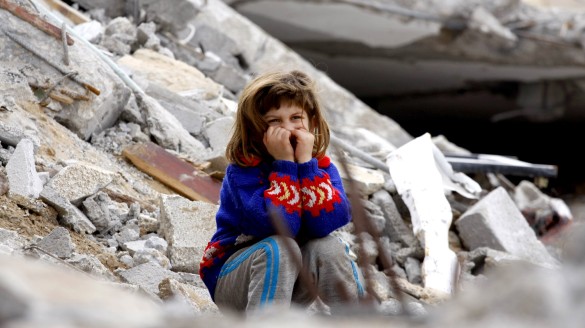
Some 30 per cent of children screened at UNRWA schools had mental health problems, while some 10 per cent of children had lost relatives or friends or lost their homes and possessions. WHO estimated that some 30,000 children would need continued psychological support and warned of the potential for many to grow up with aggressive attitudes and hatred.

Judge Goldstone and the pollution of argument

The despicable attacks on human rights organisations investigating Israel’s Gaza offensive in January confirm Churchill’s observation: “A lie gets halfway around the world before the truth has a chance to get its pants on.” The mission led by the South African judge Richard Goldstone to investigate international human rights and international humanitarian law violations during Israel’s offensive, established by the UN Human Rights Council (UNHRC), is the latest victim. His findings are about to be made public. The knives have been out for the mission for months. Now they are being plunged into him and his colleagues. Until the report is out Goldstone can’t defend it. So the smears and misrepresentation are left free to pollute public discourse.

The New York-based Human Rights Watch (HRW) has assiduously responded to a deluge of scurrilous attacks on its credibility and staff, yet totally unfounded allegations – for example, about accepting Saudi government funding and failing to give a critical report to the Israel Defence Forces before releasing it to the public – are constantly being recycled. HRW messed up by failing to see that the nerdy and, to most people, disturbing hobby of its weapons expert Marc Garlasco (he collects German and American second world war memorabilia) could be used to discredit his role as author of highly critical reports of Israel’s military conduct in Gaza. But when this story broke last week, the equation implied in some allegations – “Nazi” object-collector plus “Israel-basher” equals “antisemite” – was baseless and defamatory. That he also worked on reports critical of Hamas and Hezbollah was ignored. As another excuse to attack HRW, and deflect attention from its reports’ findings, the Garlasco affair was a gift.

The human rights world is not beyond reproach. UNHRC has hardly been impartial on Israel. Goldstone accepted his role only after the council president agreed to the alteration of the mission’s mandate to cover all parties to the conflict, not just Israel. But mistrust alone does not explain the extraordinary scale of the attacks on human rights organisations, including all Israeli ones, for their reports on Israel. [continued…]

Facebooktwittermail

Withdrawal without winning?

Withdrawal without winning?

Most discussion about Afghanistan has concentrated on whether and how we can defeat the Taliban. Less attention has been paid to the probable consequences of a withdrawal without winning, an option toward which I incline. What is most striking is not that what I take to be the majority view is wrong, but that it has not been adequately defended. This is especially important because the U.S.has embarked on a war that will require great effort with prospects that are uncertain at best. Furthermore, it appears that Obama’s commitment to Afghanistan was less the product of careful analysis than of the political need to find a “tough” pair to his attacks on the war in Iraq during the presidential campaign. It similarly appears that in the months since his election he has devoted much more attention to how to wage the war than to whether we need to wage it.

The claim that this is a “necessary war” invokes two main claims and one subsidiary one. The strongest argument is that we have to fight them there so that we don’t have to fight them here. The fact that Bush said this about Iraq does not make it wrong, and as in Iraq, it matters what we mean by “them.” Presumably if we withdrew the Taliban would take over much of southern and eastern Afghanistan.This would be terrible for the inhabitants, but would it harm us? I don’t think anyone believes that the Taliban would launch attacks against us or our allies, so that the menace is not a direct one.

Instead, the fear is of a repetition of the pre-2001 situation in which al Qaeda would have bases that would facilitate attacks. Obviously,this is a danger, but how great a one? The Taliban would not want to repeat what happened after 2001, and so I do not think one can simply assume that Taliban control would automatically lead to al Qaeda control. Nor is Afghanistan the only country that might permit an al Qaeda presence. Somalia is perhaps as troublesome, and yet no one calls for the U.S.to re-intervene there. Furthermore, al Qaeda has some sort of base of operations in Pakistan now (and is not likely to lose it even in the best outcome across the border); how much worse would it be if we withdrew? Continue reading

Facebooktwittermail

UN chief Peter Galbraith is removed in Afghanistan poll clash

UN chief Peter Galbraith is removed in Afghanistan poll clash

America’s top diplomat at the United Nations mission in Afghanistan has been ordered out of the country after a row with his boss over how to respond to last month’s fraud-riddled presidential elections, it has been alleged.

The alleged quarrel is threatening to spark a mutiny within the UN mission. At least a dozen senior staff are backing the American, Peter Galbraith, in the dispute with his Norwegian superior, Kai Eide.

Mr Galbraith, a close friend of the US special envoy Richard Holbrooke, left for Boston on Sunday after a heated meeting with Afghan election officials. His “pointed” questions to the Independent Election Commission (IEC) were evidence of a much tougher line towards the Afghan authorities than the “softly-softly” approach of Mr Eide, who heads the UN mission to Kabul.

“The relationship between Kai and Peter has completely broken down,” said a diplomat in Kabul. “Peter has left the country. The official line is that he’s on a three-week mission to New York. But Kai just turned round to Peter and said, ‘I want you out’.” [continued…]

Facebooktwittermail

U.S. kills top Qaeda militant in southern Somalia

U.S. kills top Qaeda militant in southern Somalia

American commandos killed one of the most wanted Islamic militants in Africa in a daylight raid in southern Somalia on Monday, according to American and Somali officials, an indication of the Obama administration’s willingness to use combat troops strategically against Al Qaeda’s growing influence in the region.

Western intelligence agents have described the militant, Saleh Ali Saleh Nabhan, as the ringleader of a Qaeda cell in Kenya responsible for the bombing of an Israeli hotel on the Kenyan coast in 2002. Mr. Nabhan may have also played a role in the attacks on two American embassies in East Africa in 1998.

American military forces have been hunting him for years, and on Monday, around 1 p.m., villagers near the town of Baraawe said four military helicopters suddenly materialized over the horizon and shot at two trucks rumbling through the desert.

The trucks were carrying leaders of the Shabab, an Islamist extremist group fighting to overthrow Somalia’s weak but internationally recognized government. The Shabab work hand-in-hand with foreign terrorists, according to Western and Somali agents, and in the past few months, as the battle for control of Somalia has intensified, the group seems to be drawing increasingly close to Al Qaeda. [continued…]

Facebooktwittermail

Iran agrees to meeting on nuclear program

Iran agrees to meeting on nuclear program

The Obama administration, hoping to persuade Tehran to curtail its nuclear program and initiate a dialogue that focuses on other issues, will have its first formal meeting since it took office with Iran on Oct. 1.

The four other United Nations Security Council permanent members — China, Russia, France, and the U.K. — along with Germany will participate in the meeting, which was brokered Monday in a call between Javier Solana, the European Union’s foreign-policy chief, and Saeed Jalili, Iran’s main nuclear negotiator.

The event, whose location hasn’t been decided, won’t be a “formal negotiation,” a spokeswoman for Mr. Solana said. There will be no set agenda or specific goals. Instead, she said, it will serve as an opportunity to question Iran on a proposal it released last week calling for a discussion with the international community on a range of security and development issues. [continued…]

Facebooktwittermail

Terror group builds big base under Pakistani officials’ noses

Terror group builds big base under Pakistani officials’ noses

A Pakistani terrorist group that’s allied with al Qaida and sends jihadists to Afghanistan to fight U.S. and government troops is building a huge new base in full view of the authorities in Pakistan’s most heavily populated province, locals and officials told McClatchy.

Jaish-e-Mohammad (“Army of Mohammad”), which is linked to a series of atrocities, including an attack on the Indian parliament in Delhi and the murder of American journalist Daniel Pearl, has walled off a 4.5-acre compound three miles outside the town of Bahawalpur in the far south of the Pakistan’s heartland Punjab province.

Jaish, which the State Department designated a “foreign terrorist organization” in December 2001 and Pakistan banned in 2002, already has a headquarters and a seminary in the town’s center. However, the new facility, surrounded by a high brick and mud wall, has a tiled swimming pool, stabling for more than a dozen horses, an ornamental fountain and even swings and a slide for children. [continued…]

Pakistan army said to be linked to Swat killings

Two months after the Pakistani Army wrested control of the Swat Valley from Taliban militants, a new campaign of fear has taken hold, with scores, perhaps hundreds, of bodies dumped on the streets in what human rights advocates and local residents say is the work of the military.

In some cases, people may simply have been seeking revenge against the ruthless Taliban, in a society that tends to accept tit-for-tat reprisals, local politicians said.

But the scale of the retaliation, the similarities in the way that many of the victims have been tortured and the systematic nature of the deaths and disappearances in areas that the military firmly controls have led local residents, human rights workers and some Pakistani officials to conclude that the military has had a role in the campaign. [continued…]

Facebooktwittermail

Iraqi shoe thrower says he was tortured in jail

Iraqi shoe thrower says he was tortured in jail

Hours after his release from prison, the Iraqi journalist who hurled his shoes at former President George W. Bush said that he had been tortured while in jail, and his family said that he would flee Iraq, fearing for his life.

“Here I am free, and my country is still captured,” said the journalist, Muntader al-Zaidi, during a news conference Tuesday at the television station where he had worked.

He said that he was beaten with pipes and steel cables, and that he received electric shocks while in custody. He added that there were many who would like to see him dead, including members of unidentified American intelligence agencies. [continued…]

Facebooktwittermail

The point of no return

The point of no return

Let’s just ask ourselves what would have happened in Israel itself without what is known as the “settlement enterprise.” Where would another half a million women, children, and men live within the 1967 borders? How many new towns, neighborhoods, and communities would have to be built? What kind of infrastructure would have to be built? How many additional roads would we need to pave, instead of the ones paved in the West Bank, some of them for Israelis only? And what would have happened to the population density in central Israel and in western Jerusalem?

The evacuation of 8,000 Jewish settlers from the Gaza Strip and their absorption in Israel cost taxpayers NIS 10 billion. Those interested in turning back time and evacuating Israelis from the areas beyond the 1967 borders would have to invest NIS 600 billion [$160 billion] for that end. An unreal figure.

Without the Palestinians grasping the process, and without most of Israeli citizens giving it some thought, the areas beyond the 1967 borders have become the main absorption area for new Israeli citizens: New immigrants from the former Soviet Union, young Jerusalemites, haredim facing economic distress, etc. The “territories” served as Israel’s territorial backbone, and played this role with great success.

Israel’s Leftist camp believes that it has the upper hand, referring as ultimate proof to Likud Prime Minister Benjamin Netanyau’s declaration in favor of a Palestinian state, albeit with some conditions. Yet the Left is wrong: While it was engaged in the futile “diplomatic process,” the active Rightist camp, with the backing and assistance of all of Israel’s governments with the exception of one, engaged in developing Jewish settlements in the territories.

Half a million Jews beyond the Green Line constitute the point of no return. The talk about a “construction freeze” or “construction suspicion” at certain settlements are a joke and an insurance policy for the leaders – in Israel, in Palestine, and in the world – who know deep in their hearts that the decision had been made.

What we have here is two peoples that cannot be divided: A mixture of Jews and Palestinians that cannot be separated. It’s too late. [continued…]

Editor’s Comment — When Benjamin Netanyahu uttered the phrase, “Palestinian state”, it should have been taken as a signal that the two-state solution was well and truly dead.

Shimon Peres now says Salam Fayyad is a “Palestinian Ben-Gurion”. A Ben-Gurion or a Pétain?

The state Fayyad envisions may indeed provide the means for the effective pacification of the majority of Palestinians. And as a Haaretz commenter put it, the Palestinians may end up being able “to elect their own dog catchers, … issue Palestinian stamps and sing their own anthem and even have an Olympic ping-pong team.” What they will not gain is sovereignty.

As a Jewish 36-year-old mother of five told The National recently when asked whether her Palestinian neighbors had any right to their shared water supply:

“We should take care of the foreigners here, and give them running water and help them survive and live the proper way,” she says firmly, like a schoolmarm. “But we should do this only after they understand we are the rulers of this country. Until they deserve it, they can’t have the best conditions.”

Cap in hand, the Palestinians must ask their masters if they can be given a state — a little patchwork one without any real power.

Maybe they’d be better off simply asking for a vote.

EU sources: Terms set for renewal of Israel-PA talks

Negotiations between Israel and the Palestinians will resume next month on the basis of an understanding that the establishment of a Palestinian state will be officially announced in two years.

Palestinian and European Union sources told Haaretz that talks will initially focus on determining the permanent border between Israel and the West Bank.

Due to the Palestinians’ reservations over establishing a state with temporary borders, as was proposed during the second stage of the road map, this step will probably be defined as “early recognition” of Palestine. [continued…]

Borders first?

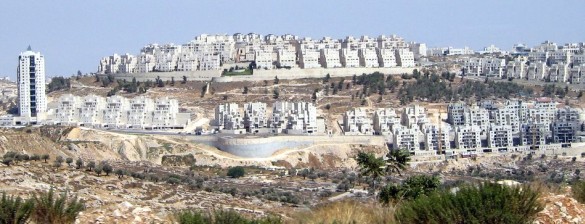
The most immediate issue raised by ‘borders first’ is whether it will deal with the Greater Jerusalem border. The issue here is not the Old City, the central focus of so much emotion and identity. It is the large central area of the West Bank, an area far beyond the old municipal boundaries of the city which extends deep into the central West Bank. Israel has developed huge settlements and a massive infrastructure which now almost surrounds East Jerusalem and which all but prevents any meaningful connection between the north and the south, and between the West Bank and East Jerusalem.

Will the negotiated border between the West Bank and Israel deal with the Jerusalem area? If the negotiated borders ratify the Israeli settlements and infrastructure as currently configured and proposed (including the controversial E-1 area), then the supposed Palestinian state would be essentially non-viable. It’s hard to imagine a government led by Netanyahu agreeing to remove existing settlements around the Greater Jerusalem area. But no Palestinian leader is likely to be able to sell a deal which ignores or ratifies the Greater Jerusalem settlement areas to his people, even if pressured to accept. If the negotiated borders ignore or defer the Jerusalem area – an idea I’ve heard in circulation – then the outcome would be meaningless and counter-productive. [continued…]

Dividing war spoils: Israel’s robbery of Palestinian property

While the news headlines were occupied with the freeze or suspension of Jewish settlements in the Occupied Palestinian Territories or with the competition for positions in the sixth Fateh conference in Bethlehem, Israel is putting into effect the most devastating operation since the ethnic cleansing of Palestine in al Nakba of 1948. This new operation aims to eliminate irrevocably Palestinian rights and historical roots in Palestine.

Ironically, Arab and Palestinian leaderships remain oblivious to these cataclysmic developments. In particular, the Palestinian leadership, whose main duty is to defend Palestinian rights, is bogged down with the assignment of internal political posts and fighting what it sees as its primary enemy, Hamas.

The Zionist leadership in Israel felt bold enough to transform the ideological slogan of ‘Jewish Israel’ into a reality on the ground. The Knesset, the Israel Parliament, passed a law on August 3rd, 2009, after its second and third readings, which allowed the sale of “Absentees” Palestinian refugees’ land to Jewish individuals and Jewish institutions exclusively anywhere in the world. Thus, the legal right of the original Palestinian owner to his land would be severed through creating a barrier between the owner and his property. The passing of the new law represents an audacious initiative by the current Israeli government that no previous Israeli government dared contemplate or venture into. [continued…]

Wobbly stools

There no question anymore that the only recipe for healing the Israeli-Palestinian wound is the termination of the occupation and the establishment of peace between the State of Israel and the new State of Palestine beside it. This demands meaningful and intense negotiations, within a fixed time span. That is impossible if at the same time settlements continue to expand. As the Palestinian lawyer Michael Tarasi aptly put it: ‘We are negotiating about the division of a pizza and in the meantime Israel is eating the pizza.’

That’s why Obama has presented the Israeli government with an unequivocal demand: an immediate stop to all building in the settlements, including East Jerusalem. A clear and logical demand. But while pressuring Netanyahu, he himself is exposed to heavy pressure at home over the health insurance system and the Afghan war…

The Americans recognise, of course, that our government is trying to deceive them. If they allow the building of just another 500 houses in the settlement blocks, and the completion of just another 2500 houses whose construction has already begun, and just a few more in East Jerusalem, in practice the building will go on unchecked.

The settlers know perfectly well that their whole enterprise has been based on deceit and trickery, house after house and neighbourhood after neighbourhood, and they are happy to allow Netanyahu to continue with this method. For the time being, they do not cry out, they are not worried, the more so as no large Israeli public movement has yet arisen in support of Obama’s peace efforts. [continued…]

Facebooktwittermail

Obama’s tough choice on Iran

Obama’s tough choice on Iran

The U.S. and its allies are not saying Iran is currently developing nuclear weapons; they’re warning that allowing Iran to assemble the full nuclear fuel cycle to which it is entitled as a signatory of the Non Proliferation Treaty — particularly uranium enrichment — gives it an infrastructure that could quickly be converted to produce bomb materiel. Stating Washington’s case at the International Atomic Energy Agency in Vienna this week, Ambassador Glyn Davies warned that Iran had already created enough low-enriched uranium that, if it kicked out nuclear inspectors and reconfigured its enrichment plant, could be re-enriched to provide materiel for a single bomb. “We have serious concerns that Iran is deliberately attempting, at a minimum, to preserve a nuclear option,” Davies said.

Moscow sees the problem in terms of strengthening the safeguards against Iran weaponizing nuclear materials, rather than trying to prevent it attaining “breakout” capacity by denying its right to enrich uranium.

President Mahmoud Ahmadinejad reiterated this week that Iran no intention of ending uranium enrichment, or of negotiating away its nuclear rights. That doesn’t necessarily preclude a diplomatic solution to the standoff, but it underscores the likelihood that the Western powers might have to compromise on their own demands in order to achieve one. In some previous rounds of negotiation, Iran has been more open to discussing strengthening of the IAEA monitoring regime and other safeguards against weaponization. Right now, however, it’s far from clear that Iran is in an accommodating mood, given its fierce and ongoing domestic power struggle. [continued…]

Secret Iranian missile memos

I have been given a series of what appear to be internal secret Iranian documents by sources I trust. If authentic, and I believe they are, they provide important insights into Iran’s missile development program and have important implications for North Korea’s as well. Unfortunately, to protect my sources and the Iranians who spirited these documents out to the West, I cannot be too explicit about their contents. The following examination of these memos contains both information from and my analysis of them. I have tried to explicitly point out what is my speculation.

The memos cover, in a somewhat sketchy way, a lot of ground. Perhaps the most important aspects are those that deal with how several countries collaborate in either developing missiles or selling missile technology to Iran. The memos use codes for the different collaborator countries but I think I know the meanings of the codes. If my understanding is correct, they indicate that representatives from North Korea and China have been present at all phases of production and flight testing. Iran has also gotten important help from Russia, though Russians do not appear to have been as ubiquitous as the Chinese and the North Koreans. The evidence from the memos indicates that this help is on the governmental level rather than “rogue” individuals. This includes Russian help though Russia has been particularly vocal in its denials of such assistance. Despite these denials, the evidence of foreign assistance, both images of engines and turbopumps that are obviously of Russian origin—either their actual production or at the very least their designs—and these internal Iranian memos, make the case overwhelmingly. [continued…]

Facebooktwittermail