CNN reports: The White House said Thursday that removing FBI Director James Comey from his post may hasten the agency’s investigation into Russian meddling.
“We want this to come to its conclusion, we want it to come to its conclusion with integrity,” said deputy press secretary Sarah Sanders, referring to the FBI’s probe into Moscow’s interference in last year’s election. “And we think that we’ve actually, by removing Director Comey, taken steps to make that happen.”
The statement was a surprising admission from the White House that Comey’s sudden dismissal on Tuesday may have an effect on the Russia probe. Officials have insisted the removal came because of Comey’s handling of an investigation into Hillary Clinton’s email server, and was unrelated to his oversight of the look into Russia’s election hacking and possible ties between Trump advisers and Russian operatives.
Sanders said Thursday that Trump would “love nothing more for this investigation to continue to its completion.”
But Trump himself has cast doubt on the investigation, suggesting any question of ties between his campaign and Russia are a “hoax.”
Earlier in her briefing Thursday, Sanders claimed that Comey’s firing had not altered the Russia investigation at all. [Continue reading…]
FBI Russia investigation may continue while starved of necessary resources
Julia Ioffe writes: The abrupt and strange way Comey was fired, as well as the lack of a nominee to replace him, “is a very political decision, and the message it sends seems to be to back off the investigation,” said Amy Zegart, the co-director for Stanford’s Center for International Security and Cooperation and senior fellow at the conservative Hoover Institution.
If that’s the case, there are many ways the bureau could “back off” without actually looking like it has backed off or even stopped investigating Russian interference. According to the former FBI agent Clinton Watts, the limbs of the beheaded bureau will keep doing their work. “The investigative part is independent,” said Watts. But even if the work goes on, what will that work look like? “The investigation will go forward in the short run,” said Jack Goldsmith, a professor at Harvard Law School and an assistant attorney general under George W. Bush. “The question is how vigorous it will be.”
One factor that may determine the answer is money. According to multiple reports, which a spokeswoman from the Department of Justice denied, Comey had asked the department for more resources to pursue the Russia investigation right before he was fired. What happens to the FBI’s resources now? A new FBI director “can’t shut the investigation down,” said Watts, “but can decide how resources are allocated and how time is spent.” Eric Columbus served from 2009 to 2014 in the office of the deputy attorney general—a position now occupied by Rod Rosenstein, whose letter describing Comey’s handling of the Clinton email investigation was cited by Trump as the reason for Comey’s dismissal. Columbus said that though a new director would have the legal authority to shut the Russia investigation down, “the smarter ploy would be to slow walk it and starve it of resources and not have it be the focus of leadership. … You can investigate things forever and have it never go anywhere. If you want to kill something, the most effective way to kill it is to just have it on a slow simmer rather than a rolling boil.”
In other words, the investigation could keep going but be so starved of money and manpower that it is not much of an investigation at all. [Continue reading…]
Uncertain future for FBI Russia investigation
McClatchy reports: The FBI-led probe into whether Russian influence operations helped put Donald Trump in the White House is on a knife’s edge and could easily veer into either of two distinct directions.
One possibility is that investigators will feel galvanized by President Donald Trump’s abrupt firing of FBI director James Comey and burrow ever deeper into a probe in which they see the reputation of the bureau at stake.
Or, with the FBI temporarily rudderless, Trump loyalists in the Justice Department could put the brakes on the investigation in multiple ways.
“They could just say, ‘We’ve got 60 days to tie this up. I’m not spending more person power inside the bureau. . . . Let’s just say wrap it up unless we’ve got a smoking gun,’ ” said Christopher H. Schroeder, a former assistant attorney general who headed the Office of Legal Policy.
Agents could be reassigned, Schroeder said, “and you could slow walk it by starving it.”
New indications arose Wednesday that Comey, whom Trump axed Tuesday, ostensibly for the way he handled the probe into Hillary Clinton’s use of a private email server while serving as secretary of state, was seeking to expand the investigation into Trump’s inner circle and its ties to Russia. [Continue reading…]
Trump official: We ‘let the biggest perpetrator of fake news into the Oval Office’ (apart from Trump himself)

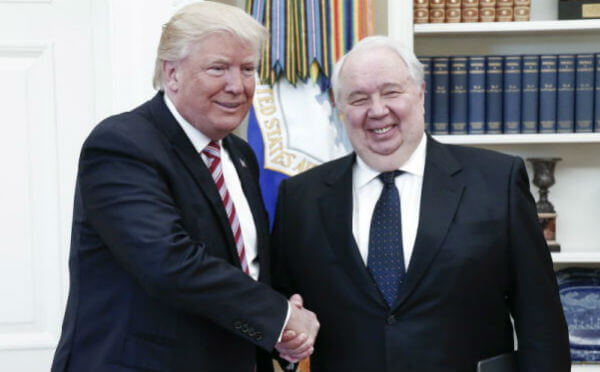
The Daily Beast reports: Senior members of the Trump administration are livid that the White House allowed the Russian government to steer the narrative of the president’s Wednesday meeting with top Russian diplomats by giving Kremlin-backed media exclusive access to the event.
The White House did not allow American press into the meeting between President Donald Trump, Russian foreign Minister Sergey Lavrov, and Russia’s ambassador to Washington, Sergey Kislyak. But it did admit a photographer from TASS, a state-owned Russian news service. Its photos were subsequently posted on TASS’s website, giving that outlet a monopoly on publishable visuals of the meeting.
Russian government Twitter accounts shared photos of the event shortly after its conclusion. They revealed Kislyak’s presence—a fact that was not even mentioned in the official White House readout of the meeting. Some U.S. officials suspect Kislyak, whose conversations with Trump’s former National Security Adviser have fed an FBI investigation of his campaign, is a Kremlin spy—or at least spy-adjacent.
Two senior administration officials, one an Obama holdover and the other a Trump appointee, told The Daily Beast that the resulting reliance of U.S. media on a propaganda arm of a foreign government let Russia set the public tone of the meeting and embarrassed the administration amid already contentious discussions with Russian diplomats.
Both officials spoke on condition of anonymity in order to candidly express their views. The White House did not immediately respond to a request for comment.
“This isn’t an ‘America First’ policy,” one of the officials fumed of the White House’s decision “to let the biggest perpetrator of fake news into the Oval Office.” Trump, the official added, is “either in bed with the Russians or too stupid to understand the severity of this mistake. Either way, the implications are truly terrifying.” [Continue reading…]
Europeans are less likely to share fake news. Here’s why
PRI reports: If you picked up a newspaper in the UK on Monday, you might have encountered an unusual advertisement offering tips on how to spot “false news.”
Facebook published the full-page ads in major newspapers — including the Guardian and the Times of Londn — ahead of the country’s general elections next month. Last month, it published the same ads in Germany and France, ahead of elections in those countries.
“People want to see accurate information on Facebook and so do we. That is why we are doing everything we can to tackle the problem of false news,” Simon Milner, Facebook’s Director of Policy for the UK, wrote in a statement.
Research indicates that Internet users in some European countries are less likely than Americans to share fake news online. Still, Facebook and other social media companies have been facing mounting pressure from European leaders to address fake news, as well as other hateful, racist and violent posts.
“I think Europe has within living memory much more understanding of the consequences of letting hateful propaganda spread,” said Zeynep Tufekci, an associate professor at the University of North Carolina who studies the effect of technology on politics and society. “They lived through World War I and World War II, and they have a deeper visceral reaction to the consequences of letting hate speech, incitement to violence, misinformation, propaganda — the whole range of things that we see online today — going unchecked.” [Continue reading…]
Music: National Health — ‘Shining Water’
Acting FBI Director McCabe refutes White House claim that rank and file FBI employees had ‘lost confidence’ in Comey
In hearings before the Senate Intelligence Committee today, when asked about claims that Director Comey had “lost the confidence of rank and file FBI employees,” Acting FBI Director McCabe responded, “No, sir. That is not accurate.” He added, “Director Comey enjoyed broad support within the FBI. And still does to this day.”
On Tuesday night, Deputy White House Press Secretary Sarah Huckabee Sanders claimed Comey was fired because he had “lost the confidence” of the “rank-and-file” FBI employees.
By his actions (or inaction) Deputy Attorney General Rod Rosenstein will now demonstrate his true loyalties
In an open letter, the New York Times editorial board says: Dear Deputy Attorney General Rod Rosenstein:
It’s rare that any single person has to bear as much responsibility for safeguarding American democracy as you find yourself carrying now. Even before President Trump’s shocking decision on Tuesday to fire the F.B.I. director, James Comey, a dark cloud of suspicion surrounded this president, and the very integrity of the electoral process that put him in office. At this fraught moment you find yourself, improbably, to be the person with the most authority to dispel that cloud and restore Americans’ confidence in their government. We sympathize; that’s a lot of pressure.
Given the sterling reputation you brought into this post — including a 27-year career in the Justice Department under five administrations, and the distinction of being the longest-serving United States attorney in history — you no doubt feel a particular anguish, and obligation to act. As the author of the memo that the president cited in firing Mr. Comey, you are now deeply implicated in that decision.
It was a solid brief; Mr. Comey’s misjudgments in his handling of the F.B.I. investigation of Hillary Clinton’s private email server were indeed serious. Yet you must know that these fair criticisms were mere pretext for Mr. Trump, who dumped Mr. Comey just as he was seeking more resources to investigate ties between the Trump campaign and the Russian government.
You must also know that in ordering you to write the memo, Mr. Trump exploited the integrity you have earned over nearly three decades in public service, spending down your credibility as selfishly as he has spent other people’s money throughout his business career. We can only hope that your lack of an explicit recommendation to fire Mr. Comey reflects your own refusal to go as far as the president wanted you to.
In any case, the memo is yours, and that has compromised your ability to oversee any investigations into Russian meddling. But after Attorney General Jeff Sessions recused himself from these matters, because of his own contacts during the campaign with the Russians, the power to launch a truly credible investigation has fallen to you, and you alone. [Continue reading…]
Inside Trump’s anger and impatience — and his decision to fire Comey
The Washington Post reports: Every time FBI Director James B. Comey appeared in public, an ever-watchful President Trump grew increasingly agitated that the topic was the one that he was most desperate to avoid: Russia.
Trump had long questioned Comey’s loyalty and judgment, and was infuriated by what he viewed as the director’s lack of action in recent weeks on leaks from within the federal government. By last weekend, he had made up his mind: Comey had to go.
At his golf course in Bedminster, N.J., Trump groused over Comey’s latest congressional testimony, which he thought was “strange,” and grew impatient with what he viewed as his sanctimony, according to White House officials. Comey, Trump figured, was using the Russia probe to become a martyr.
Back at work Monday morning in Washington, Trump told Vice President Pence and several senior aides — Reince Priebus, Stephen K. Bannon and Donald McGahn, among others — that he was ready to move on Comey. First, though, he wanted to talk with Attorney General Jeff Sessions, his trusted confidant, and Deputy Attorney General Rod J. Rosenstein, to whom Comey reported directly. Trump summoned the two of them to the White House for a meeting, according to a person close to the White House.
The president already had decided to fire Comey, according to this person. But in the meeting, several White House officials said Trump gave Sessions and Rosenstein a directive: to explain in writing the case against Comey.
The pair quickly fulfilled the boss’s orders, and the next day Trump fired Comey — a breathtaking move that thrust a White House already accustomed to chaos into a new level of tumult, one that has legal as well as political consequences.
Rosenstein threatened to resign after the narrative emerging from the White House on Tuesday evening cast him as a prime mover of the decision to fire Comey and that the president acted only on his recommendation, said the person close to the White House, who spoke on the condition of anonymity because of the sensitivity of the matter. [Continue reading…]
Trump’s feeble effort to hide behind Rosenstein
A New York Times columnist, writes: the White House needed the cover of an honorable man making an honest case against Comey to disguise its own case against him, which is neither honorable nor honest. How do we know? By following @realDonaldTrump on Twitter.
“F.B.I. Director Comey was the best thing that ever happened to Hillary Clinton in that he gave her a free pass for many bad deeds!” the president wrote on May 2. “The phony Trump/Russia story was an excuse used by the Democrats as justification for losing the election. Perhaps Trump just ran a great campaign?”
Tell: After the president publicly impugned his own F.B.I. director, it meant Rosenstein’s memo was a pro forma, pretextual exercise.
Tell: When the president boasts about his great campaign, you know he’s less than sure about just how great it really was.
Tell: When the president calls news “fake” or a story “phony,” you know the truth quotient is likely to be high. And, again, you know he knows you know it.
All the more so thanks to reporting from The Times’s Matthew Rosenberg and Matt Apuzzo, who revealed Wednesday that Comey had only recently asked Rosenstein “for a significant increase in resources for the bureau’s investigation into Russia’s interference in the presidential election.” For the record, the Justice Department denies the claim.
For the administration’s apologists, the fallback line is that the Russia investigation will continue no matter who succeeds Comey. That might be credible if, say, the former New York Police Department commissioner Ray Kelly gets the job. And if Chris Christie or Rudy Giuliani gets it?
In all this, the riddle wrapped in a mystery inside an enigma is Russia.
Golf courses: Russia. Mike Flynn’s lies to the vice president: Russia. Jeff Sessions’s lies to the Senate: Russia. Paul Manafort, Carter Page and Roger Stone: Russia. WikiLeaks: Russia. Donald Trump Jr.: Russia. The Bayrock Group: Russia. Erik Prince’s diplomatic back channel: Russia.
No one piece in this (partial) list is incriminating. And with Trump, the line between incompetence and nefariousness, misjudgment and misdirection, is usually a blurry one.
Still, Jim Comey’s firing now brings two points into high relief. First, the administration is not being truthful when it claims the director was dismissed for what he did last summer. Second, Donald Trump is afraid. A president who seeks to hide a scandal may be willing to risk an uproar. [Continue reading…]
The columnist? Bret Stephens.
I’ll confess, it’s the only column of his I’ve read from beginning to end, but it illustrates (at least for me) why any argument or piece of writing is best judged on its own merits rather than the predisposition the reader feels towards the author.
Trump meets Russia’s foreign minister at Vladimir Putin’s insistence
Susan Glasser writes: When President Donald Trump hosted Russian Foreign Minister Sergey Lavrov in the Oval Office Wednesday just hours after firing the FBI director who was overseeing an investigation into whether Trump’s team colluded the Russians, he was breaking with recent precedent at the specific request of Russian President Vladimir Putin.
The chummy White House visit—photos of the president yukking it up with Lavrov and Russian Ambassador to the United States Sergey Kislyak were released by the Russian Foreign Ministry since no U.S. press was allowed to cover the visit—had been one of Putin’s asks in his recent phone call with Trump, And indeed the White House acknowledged this to me later Wednesday. “He chose to receive him because Putin asked him to,” a White House spokesman said of Trump’s Lavrov meeting. “Putin did specifically ask on the call when they last talked.”
The meeting was Lavrov’s first in the White House since 2013—and came after several years of the Obama administration’s flat-out refusal to grant him an Oval Office audience, two former senior White House officials told me. “The Russians were begging us for years to do that,” one of the former officials said. “They were constantly pushing for it and we were constantly saying no.”
The images of Trump putting his arm genially on Lavrov’s back—and a later White House official readout of the meeting that said Trump “emphasized his desire to build a better relationship between the United States and Russia”—couldn’t have come at a more fraught political moment for Trump, amid a barrage of bipartisan criticism of his firing of FBI director James Comey. On Wednesday morning before meeting with Trump, Lavrov even cracked a joke about his hosts’ political predicament, laughingly claiming not to have heard of the Comey firing while standing alongside Trump’s Secretary of State Rex Tillerson.
In other words, Lavrov was right where he has always wanted to be Wednesday: mocking the United States while being welcomed in the Oval Office by the president himself. [Continue reading…]
Senate Intelligence Committee subpoenas Flynn
Politico reports: The Senate Intelligence Committee has subpoenaed any Russia-related documents from former national security adviser Michael Flynn for its continuing probe into the Kremlin’s efforts to manipulate the 2016 election.
The legal order, announced by the panel’s bipartisan leaders Sens. Richard Burr (R-N.C.) and Mark Warner (R-Va.), went out Wednesday after Flynn’s attorneys informed the panel they would not cooperate with the probe unless the embattled former general was granted immunity, a congressional source told POLITICO.
Flynn had been asked, along with a spate of other former and current Trump associates, at the end of last month to provide the Intelligence Committee with any documents potentially related to the panel’s Russia probe. The investigation is examining, among other questions, whether Flynn or other Trump associates had improper contact with the Russian government throughout the course of the campaign or the transition period. [Continue reading…]
White House lawyers warned Trump: Stay away from Michael Flynn
The Daily Beast reports: White House lawyers have had to warn President Donald Trump repeatedly against reaching out to his fired National Security Adviser Michael Flynn, two people familiar with the matter tell The Daily Beast.
Trump, angered by press coverage of the Russia investigation and Gen. Flynn, has asked senior staff and the White House counsel’s office multiple times if it was appropriate to reach out to the fired National Security Adviser, according to a source close to Flynn and a Trump administration official with direct knowledge of the exchanges.
“While the president does not regret firing Gen. Flynn, he feels he is a good man who served his country bravely and honorably and who is being treated unfairly by the press and the Democrats on Capitol HIll,” another Trump administration official said. These officials requested anonymity as a condition of discussing legal advice to the president.
A White House staffer also stressed Trump’s personal affinity for his former aide. The president “clearly feels bad about how things went down,” the staffer said, referring to Flynn’s firing in February. [Continue reading…]
Days before firing, Comey asked for more resources for Russia inquiry
The New York Times reports: Days before he was fired, James B. Comey, the former F.B.I. director, asked the Justice Department for a significant increase in resources for the bureau’s investigation into Russia’s interference in the presidential election, according to four congressional officials, including Senator Richard J. Durbin.
Mr. Comey made his appeal to Rod J. Rosenstein, the deputy attorney general, who also wrote the Justice Department’s memo that was used to justify the firing of Mr. Comey this week, the officials said.
“I’m told that as soon as Rosenstein arrived, there was a request for additional resources for the investigation and that a few days afterwards, he was sacked,” said Mr. Durbin, a Democrat of Illinois. “I think the Comey operation was breathing down the neck of the Trump campaign and their operatives, and this was an effort to slow down the investigation.” [Continue reading…]
After Comey, here are the options for an independent Russia inquiry
The New York Times reports: President Trump’s firing of the F.B.I. director, James B. Comey, on Tuesday escalated calls among Democrats to appoint a special counsel to oversee the investigation into the Trump campaign’s contacts with Russia, especially given Russian interference in the 2016 election.
Deputy Attorney General Rod J. Rosenstein, who is overseeing that investigation, was also the face of Mr. Trump’s decision to fire Mr. Comey: The administration released a lengthy memo from Mr. Rosenstein recommending that Mr. Comey be removed, citing the way he handled the investigation into Hillary Clinton’s use of a private email server while secretary of state.
Late on Tuesday, Senator Patrick J. Leahy, Democrat of Vermont, said Mr. Rosenstein “now has no choice but to appoint a special counsel.”
“His integrity, and the integrity of the entire Justice Department, are at stake,” Mr. Leahy continued.
Senator Mark Warner of Virginia, the top Democrat on the Intelligence Committee, which is also investigating the Trump-Russia question, called it “deeply troubling” that Mr. Trump had fired Mr. Comey during an active counterintelligence investigation. He said the move had made it “clear to me that a special counsel also must be appointed.”
The developments have heightened interest in several related legal issues. [Continue reading…]
By firing James Comey, Trump has put impeachment on the table
Matthew Yglesias writes: The old saw that the cover-up is worse than the crime often obscures more than it reveals. But in the case of President Donald Trump’s firing of FBI Director James Comey, it carries an important element of truth. It escalates the administration’s Russia scandal, and, for the first time, provides indications of impeachable offenses.
Nothing we’ve seen credibly reported thus far about Trump and Russia would amount to an impeachable offense, and indeed, it’s not really clear what allegations of “collusion” on the campaign trail would really amount to even if proven.
Firing the FBI director in order to obstruct an ongoing investigation would be different.
That obstruction charge is, of course, unproven as of Wednesday afternoon. But the probable cause is everywhere. And it makes a sham of the notion that replacing Comey with a well-qualified director or continuing with existing congressional inquiries is a sufficient remedy. [Continue reading…]
Hackers came, but the French were prepared
The New York Times reports: Everyone saw the hackers coming.
The National Security Agency in Washington picked up the signs. So did Emmanuel Macron’s bare-bones technology team. And mindful of what happened in the American presidential campaign, the team created dozens of false email accounts, complete with phony documents, to confuse the attackers.
The Russians, for their part, were rushed and a bit sloppy, leaving a trail of evidence that was not enough to prove for certain they were working for the government of President Vladimir V. Putin but which strongly suggested they were part of his broader “information warfare” campaign.
The story told by American officials, cyberexperts and Mr. Macron’s own campaign aides of how a hacking attack intended to disrupt the most consequential election in France in decades ended up a dud was a useful reminder that as effective as cyberattacks can be in disabling Iranian nuclear plants, or Ukrainian power grids, they are no silver bullet. The kind of information warfare favored by Russia can be defeated by early warning and rapid exposure.
But that outcome was hardly assured on Friday night, when what was described as a “massive” hacking attack suddenly put Mr. Macron’s electoral chances in jeopardy. To French and American officials, however, it was hardly a surprise.
Testifying in front of the Senate Armed Services Committee in Washington on Tuesday, Adm. Michael S. Rogers, the director of the National Security Agency, said American intelligence agencies had seen the attack unfolding, telling their French counterparts, “Look, we’re watching the Russians. We’re seeing them penetrate some of your infrastructure. Here’s what we’ve seen. What can we do to try to assist?”
But the staff at Mr. Macron’s makeshift headquarters in the 15th Arrondissement at the edge of Paris didn’t need the N.S.A. to tell them they were being targeted: In December, after the former investment banker and finance minister had emerged as easily the most anti-Russian, pro-NATO and pro-European Union candidate in the presidential race, they began receiving phishing emails.
The phishing mails were “high quality,” said Mr. Macron’s digital director, Mounir Mahjoubi: They included the actual names of members of the campaign staff, and at first glance appeared to come from them. Typical was the very last one the campaign received, several days before the election on Sunday, which purported to have come from Mr. Mahjoubi himself.
“It was almost like a joke, like giving us all the finger,” Mr. Mahjoubi said in interview on Tuesday. The final email enjoined recipients to download several files “to protect yourself.”
Even before then, the Macron campaign had begun looking for ways to make life a little harder for the Russians, showing a level of skill and ingenuity that was missing in Hillary Clinton’s presidential campaign and at the Democratic National Committee, which had minimal security protections and for months ignored F.B.I. warnings that its computer system had been penetrated. [Continue reading…]

South Korea’s new president says his election completes the ‘candlelight revolution’
Tim Shorrock reports: Moon Jae-in, a human rights and labor lawyer who came of age protesting authoritarian military governments backed by the United States, assumed South Korea’s presidency Wednesday after a snap election that repudiated 10 years of right-wing conservative rule.
Moon, 64, took office after securing about 41 percent of a total popular vote of 32.8 million, far ahead of his closest rival, the conservative Hong Joon-pyo, who ended up with 24 percent. It was the largest margin in Korean election history, the wire service Yonhap reported.
“I will restore a government based on principle and justice,” Moon declared Tuesday night in a nationally broadcast speech from Seoul’s Gwanghwamun district, which is famous for its political protests. “I will be the proud president of a proud nation.”
After being sworn in Wednesday, he startled the nation with a ringing declaration calling for a new foreign policy based on negotiations and dialogue. “I will do whatever it takes to help settle peace on the Korean Peninsula,” including visiting North Korea, Moon told the National Assembly. In a nod to Washington, he also declared he would “further strengthen the alliance between South Korea and the United States.”
Moon’s election was the direct result of the impeachment of his predecessor, Park Geun-hye, who had embraced Washington’s hard-line policies toward Pyongyang. She was brought down after millions of citizens angry about corruption, economic mismanagement, abuse of power, and the uncertain future of Korean youth flooded the streets of Seoul and other major cities in a peaceful movement now known as the “candlelight revolution.” [Continue reading…]