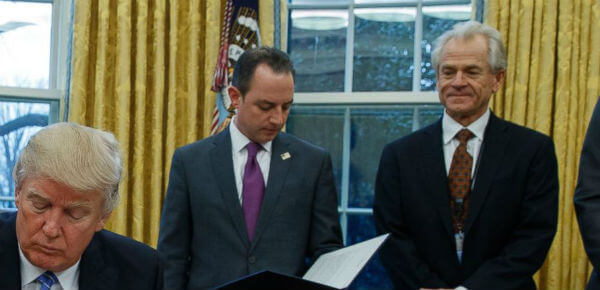
How Canada established its dominance above the United States


It’s reasonable to assume that Trump planted his daughter in his seat (he’s already thinking about the Trump dynasty):


But who placed Ivanka next to Trudeau at the conference table? I’ll bet she did.

Facebooktwittermail

The Kremlin is starting to worry about Trump

Ivan Krastev and Stephen Holmes write: There is no way of knowing if Russian interference contributed decisively to Trump’s upset victory. But it’s fair to say that the Kremlin viewed the outcome as a divine gift. Since at least 2011-2012, when Russia witnessed widespread popular protests, and particularly after the Ukrainian Maidan uprising — events that elicited heartfelt praise and encouragement from then-Secretary of State Hillary Clinton — Russia’s leadership had been convinced that her election would spell disaster for Russia and that it might even lead to war. So Russians did what they could to prevent Clinton from getting into the White House. But while they welcomed her defeat, they were wholly unprepared for the ensuing regime change in Washington.

Now that Trump is in power, political elites in Moscow have stopped cheering. They recognize that Russia’s position has become abruptly and agonizingly complex.

It’s true that Trump’s accession opens up the possibility of “normalizing” Russia’s relations with the West, beginning with a reduction or even elimination of sanctions. It also validates many of Russia’s ideological criticisms of the liberal order and may perhaps foreshadow policy reversals that Moscow has long hoped for: from Washington’s disengagement from the Ukraine crisis to its dissolution of the Cold War Western alliance. Russians also celebrate Trump’s unfiltered stream-of-consciousness diatribes as signaling a welcome end to America’s hypocrisy and condescension.

But Trump’s revolution is also ushering in a period of turmoil and uncertainty, including the likelihood of self-defeating trade wars. Still traumatized by the disintegration of the Soviet Union, Russia’s present leadership has no appetite for global instability.

With Trump in the White House, moreover, Putin has lost his monopoly over geopolitical unpredictability. The Kremlin’s ability to shock the world by taking the initiative and trashing ordinary international rules and customs has allowed Russia to play an oversized international role and to punch above its weight. Putin now has to share the capacity to keep the world off balance with a new American president vastly more powerful than himself. More world leaders are watching anxiously to discover what Trump will do next than are worrying about what Putin will do next. Meanwhile, using anti-Americanism as an ideological crutch has become much more dubious now that the American electorate has chosen as their president a man publicly derided as “Putin’s puppet.”

What the Kremlin fears most today is that Trump may be ousted or even killed. His ouster, Kremlin insiders argue, is bound to unleash a virulent and bipartisan anti-Russian campaign in Washington. Oddly, therefore, Putin has become a hostage to Trump’s survival and success. This has seriously restricted Russia’s geopolitical options. The Kremlin is perfectly aware that Democrats want to use Russia to discredit and possibly impeach Trump while Republican elites want to use Russia to deflate and discipline Trump. The Russian government fears not only Trump’s downfall, of course, but also the possibility that he could opportunistically switch to a tough anti-Moscow line in order to make peace with hawkish Republican leaders in Congress. [Continue reading…]

Facebooktwittermail

Beyond Flynn, other ties bind the White House to the Kremlin

Ishaan Tharoor writes: Long gone are the days when Communist Moscow backed leftist movements around the world. Instead, Putin’s post-Soviet ideologues see Russia at the vanguard of global Christian nationalist conservatism. In this struggle, they’ve found common cause with Europe’s far-right parties as well as key figures within the Trump administration.

In 2014, current White House chief strategist Stephen K. Bannon told a gathering of European conservatives that “we, the Judeo-Christian West, really have to look at what [Putin]’s talking about as far as traditionalism goes — particularly the sense of where it supports the underpinnings of nationalism.” That same year, a group of fringe American white nationalists joined a conference in Hungary that featured Russian nationalist Alexander Dugin, a philosopher sometimes dubbed “Putin’s Rasputin.” Dugin hailed Trump as “the American Putin” last year.

American journalist Casey Michel has assiduously tracked the connections between right-wing American evangelicals and kindred spirits in Russia, who both champion anti-gay laws and the primacy of Christianity in the identity of Western nations.

“In the same sense that Russia’s [anti-LGBT] laws came about in 2013, we’ve seen similar sorts of laws proposed in Tennessee, for example,” said Cole Parke, an LGBT researcher with Political Research Associates, to Michel last week. “It’s difficult to say in a chicken-and-egg sort of way who’s inspiring whom, but there’s definitely a correlation between the two movements.”

Western “traditionalists,” whether in the U.S. or Europe, now style themselves as Putin’s fellow travelers.

“Putin may be seeing the future with more clarity than Americans still caught in a Cold War paradigm,” wrote Patrick Buchanan, the right-wing, ethno-nationalist American politician, in 2013. He went on to suggest that the new fault line in global politics would be between “conservatives and traditionalists in every country arrayed against the militant secularism of a multicultural and transnational elite.” [Continue reading…]

Facebooktwittermail

Chaos, competing factions, and a culture of fear, plague the Trump White House

The Washington Post reports: With President Trump in his fourth full week in office, the upheaval inside the administration that West Wing officials had optimistically dismissed as growing pains is now cementing itself as standard operating procedure.

Trump — distracted by political brushfires often of his own making — has failed to fill such key posts as White House communications director, while sub-Cabinet positions across agencies and scores of ambassadorships around the globe still sit empty.

Upset about damaging leaks of his calls with world leaders and other national security information, Trump has ordered an internal investigation to find the leakers. Staffers, meanwhile, are so paranoid about being accused of talking to the media that some have resorted to a secret chat app — Confide — that erases messages as soon as they’re read.

The chaos and competing factions that were a Trump trademark in business and campaigning now are threatening to plague his presidency, according to interviews with a dozen White House officials as well as other Republicans. Most requested anonymity in order to candidly discuss internal White House dynamics and deliberations.

Some senior officials are worried about their own standing with the president, who through his casual conversations with friends and associates sometimes seems to hint that a shake-up could come at a moment’s notice. Aides said they strive to avoid appearing “weak” or “low-energy” — two of Trump’s least favorite attributes.[Continue reading…]

Facebooktwittermail

Stephen Miller: ‘the powers of the president … will not be questioned’


Univision News: Some of the students who knew Miller in high school said he had no interests other than radical politics, and that he always seemed unhappy.

“He had a lot of grudges. He didn’t go out of his way to go to dances or to have girlfriends,” de la Torre said. “I don’t remember ever seeing him smile.”

The Atlantic: “Miller had two very well earned reputations: as an aggressive self-promoter and as a bomb thrower,” said one friend of Miller’s from Duke who holds him in high regard and requested anonymity for professional reasons. “He was extremely effective at both. He sustained himself on liberal tears and hysteria. Some Duke [College Republicans] used to call him the ‘Miller Outrage Machine.’ You might say he was the Trump campaign 10 years before the Trump campaign.”


Facebooktwittermail

Mar-a-Lago serves as stage for showing off the spectacle of Trump’s presidency

The New York Times reports: Trump appears to enjoy presenting the spectacle of his presidency to those at his privately held club, where members pay $200,000 to join. While the club is not open to the public, Mr. Trump’s dinner with Mr. Abe was in the club’s dining room, where any member or their guests were likely to be.

Individual club members can invite guests, submitting a list of names of table guests for security clearance to officials ahead of time.

In addition to the pictures of the North Korea conversation, Mr. DeAgazio also posted pictures of himself standing with a person he described as Mr. Trump’s military aide responsible for carrying the nuclear “football” — the briefcase with codes for launching nuclear weapons. [Continue reading…]

Facebooktwittermail

This is why conservative media outlets like the Daily Mail are ‘unreliable’

Dana Nuccitelli writes: Wikipedia editors recently voted to ban the Daily Mail tabloid as a source for their website after deeming it “generally unreliable.” To put the severity of this decision in context, Wikipedia still allows references to Russia Today and Fox News, both of which display a clear bias toward the ruling parties of their respective countries.

It thus may seem like a remarkable decision for Wikipedia to ban the Daily Mail, but fake news stories by David Rose in two consecutive editions of the Mail on Sunday – which echoed throughout the international conservative media – provide perfect examples of why the decision was justified and wise.

On February 5th, Rose ran a story alleging scandalous behavior by NOAA scientists in a 2015 paper. The story was based on an interview with retired NOAA scientist John Bates, who was not involved in the study. However, in follow-up interviews with real science journalists, Bates clarified that he was in no way disputing the quality or accuracy of the data, even going as far as to make this damning comment:

I knew people would misuse this. But you can’t control other people.

Most importantly, the scientific integrity of the NOAA data is indisputable. The organization’s global temperature data is nearly identical to that of other scientific groups like NASA, the Hadley Centre, and Berkeley Earth. [Continue reading…]

Facebooktwittermail

How I got arrested while reporting on the Dakota Access pipeline

Jenni Monet writes: The morning after I was bonded out of the Morton County jail, I took to Twitter and posted a detail that I only could have known from actually being on the inside.

“#MniWiconi is inscribed everywhere,” I tweeted. And it’s true.

The signature slogan of the movement to try and stop the controversial Dakota Access Pipeline has been scrawled, carved and etched throughout the jail  — on cinderblock walls, paint-chipped tabletops, cold metal doors. In Lakota, it loosely translates to “Water is Life.”

Since August, hundreds of protesters, known as water protectors, have passed through those cellblocks as a form of punishment for their unwavering commitment to protect the Missouri River from a potential oil spill. According to the Morton County Sheriff’s Department, it has processed a total of 696 protest-related arrests.

On Wednesday, February 1, I became one of them. [Continue reading…]

Facebooktwittermail

Trump’s Mar-a-Lago insecure Situation Room where club members and staff can eavesdrop freely

CNN reports: The iceberg wedge salads, dripping with blue cheese dressing, had just been served on the terrace of Mar-a-Lago Saturday when the call to President Donald Trump came in: North Korea had launched an intermediate-range ballistic missile, its first challenge to international rules since Trump was sworn in three weeks ago.

The launch, which wasn’t expected, presented Trump with one of the first breaking national security incidents of his presidency. It also noisily disrupted what was meant to be an easygoing weekend of high-level male bonding with the more sobering aspects of global diplomacy.

Sitting alongside Japanese Prime Minister Shinzo Abe, with whom he’d spent most of the day golfing, Trump took the call on a mobile phone at his table, which was set squarely in the middle of the private club’s dining area.

As Mar-a-Lago’s wealthy members looked on from their tables, and with a keyboard player crooning in the background, Trump and Abe’s evening meal quickly morphed into a strategy session, the decision-making on full view to fellow diners, who described it in detail to CNN.

Swanning through the club’s living room and main dining area alongside Abe, Trump was — as is now typical — swarmed with paying members, who now view dinner at the club as an opportunity for a few seconds of face time with the new President.

But as he sat down for the planned working dinner with Abe, whose country is well within range of North Korea’s missiles, it was clear his counterpart felt it necessary to respond to the test. The launch occurred just before 8 a.m. on Sunday morning in Japan.

Trump’s National Security Adviser Michael Flynn and chief strategist Steve Bannon left their seats to huddle closer to Trump as documents were produced and phone calls were placed to officials in Washington and Tokyo.

The patio was lit only with candles and moonlight, so aides used the camera lights on their phones to help the stone-faced Trump and Abe read through the documents. [Continue reading…]

Facebooktwittermail

Is Peter Navarro the most dangerous man in Trump world?

While considering the danger posed by the head of Trump’s National Trade Council, Jacob Heilbrunn writes: To counter the manifold economic and military threats the United States faces, Navarro recommends a sweeping revision of U.S. foreign policy. He wants high tariffs, the repudiation of trade pacts and, above all, a massive military buildup against China. One of Navarro’s aspirations is to beef up military ties with Taiwan, which Beijing considers part of China. Calling the Obama administration’s treatment of Taipei “egregious,” Navarro declared in Foreign Policy that it has been “repeatedly denied the type of comprehensive arms deal it needs to deter China’s covetous gaze.” At the same time, Navarro wants to end sequestration on defense and go on an all-out shipbuilding binge for the U.S. Navy. Nor does Navarro seem to see a bomber that he would not like to build.

The hysterical economic warnings, the scary prescriptions and the self-defeating proposals would simply be fanciful nonsense if Navarro weren’t whispering in the ear of the most powerful man in the world. The fact that he is makes them dangerous. Of course, where Trump will actually head still remains an open question. After his initial questioning of a “one China” policy, Trump, in a phone call with Chinese President Xi Jinping on Thursday, seems to have endorsed it. But at the same time, Trump is clearly seeking to use Japan to balance Chinese power, which is why he is hosting Japanese Prime Minister Shinzo Abe this weekend. On Friday, Abe even promised to invest in America and joked that he would help build a Maglev train that would convey the president within an hour from Washington to his Manhattan aerie.

Like not a few presidential advisers in history, Navarro may not be able to enact everything he proposes. Perhaps he will breathe fire about the perfidy of China and other countries but not decisively influence economic policy. In this scenario, Navarro would serve as a convenient release valve for ventilating frustration about the further loss of manufacturing jobs that is likely to continue under Trump, thanks mostly to the inexorable rise of artificial intelligence and automation. In the Washington Post, Ed Hess, a professor of business administration at the University of Virginia, predicts that tens of millions of jobs will be destroyed in the next five to 15 years by emerging technologies, and 47 percent wiped out over the next 10 to 15 years.

Another possibility is that Navarro doesn’t get free rein but has to jockey for power with the other economic players in the administration, including Steven Mnuchin at Treasury, a former Goldman Sachs executive who has no history of China antagonism. In this scenario, Trump doesn’t jettison NAFTA but rather accedes to some cosmetic changes that don’t fundamentally alter the pact. At the same time, he retreats from his bogus charge that Beijing is depressing its currency — it isn’t — and initiates trade talks with the Chinese while also working with them to corral North Korean nuclear ambitions.

But there’s a third possibility — one that we shouldn’t dismiss. In this scenario, the Navarro line prevails. Trump unilaterally slaps draconian tariffs on Mexico and China. In turn, the World Trade Organization says they’re illegal. Trump, never one to defer to the courts, pulls the U.S. out of the WTO, and the international economic order is upended. With tariffs high and Trump bailing out of international institutions, it doesn’t take long before we end up in a global depression. The last time something like this occurred it led directly to the rise of fascist regimes in Germany, Italy and Japan, with nationalist leaders promising that domestic repression and external expansion were a quick and easy remedy to their nation’s woes. [Continue reading…]

Facebooktwittermail

Will Flynn go quietly?

The New York Times reports: These are chaotic and anxious days inside the National Security Council, the traditional center of management for a president’s dealings with an uncertain world.

Three weeks into the Trump administration, council staff members get up in the morning, read President Trump’s Twitter posts and struggle to make policy to fit them. Most are kept in the dark about what Mr. Trump tells foreign leaders in his phone calls. Some staff members have turned to encrypted communications to talk with their colleagues, after hearing that Mr. Trump’s top advisers are considering an “insider threat” program that could result in monitoring cellphones and emails for leaks.

The national security adviser, Michael T. Flynn, has hunkered down since investigators began looking into what, exactly, he told the Russian ambassador to the United States about the lifting of sanctions imposed in the last days of the Obama administration, and whether he misled Vice President Mike Pence about those conversations. His survival in the job may hang in the balance.

Although Mr. Trump suggested to reporters aboard Air Force One on Friday that he was unaware of the latest questions swirling around Mr. Flynn’s dealings with Russia, aides said over the weekend in Florida — where Mr. Flynn accompanied the president and Japan’s prime minister, Shinzo Abe — that Mr. Trump was closely monitoring the reaction to Mr. Flynn’s conversations. There are transcripts of a conversation in at least one phone call, recorded by American intelligence agencies that wiretap foreign diplomats, which may determine Mr. Flynn’s future. [Continue reading…]

Increasingly, the question seems not to be if Flynn will go, but how he will go?

As a top official dumped by two administrations, he’s quite likely to feel victimized and thus bitter — and perhaps therefore sooner or later willing to go public with a damning and detailed portrait of the dysfunctionality of the Trump administration.

Facebooktwittermail

‘The knives are out for Flynn,’ says Trump administration official

The Washington Post reports: White House national security adviser Michael Flynn is under increasing political pressure and risks losing the confidence of some colleagues following reports that he misled senior administration officials about his discussion of sanctions with a Russian envoy shortly before President Trump took office.

As White House aides scramble to get their stories straight about the exact nature of those communications and as Democrats call for Flynn’s security clearance to be suspended or revoked, neither Trump nor his advisers have publicly defended Flynn or stated unequivocally that he has the president’s confidence.

Privately, some administration officials said that Flynn’s position has weakened and support for him has eroded largely because of a belief that he was disingenuous about Russia and therefore could not be fully trusted going forward.

“The knives are out for Flynn,” said one administration official who, like others interviewed for this report, spoke on the condition of anonymity in order to speak candidly.

On Sunday, the top White House aide dispatched to represent the administration on the political talk shows pointedly declined to defend Flynn. [Continue reading…]

Facebooktwittermail

North Korean nuclear ambitions to be defining issue for Trump

Bloomberg reports: Trump will be forced to deal with ongoing threats from North Korea as that country gains the ability to threaten the continental U.S. with a nuclear strike, an official said on Sunday, hours after Pyongyang fired a ballistic missile into nearby seas.

North Korea will probably develop its ballistic missile technology enough to pair with its nuclear weapons to reach the U.S. during Trump’s tenure, said Richard Haass, president of the Council on Foreign Relations.

Either the U.S. gets the Chinese to help increase pressure on North Korea through sanctions, or Trump will have “a truly consequential decision,” Haass said on CNN’s “Fareed Zakaria GPS” on Sunday.

“Trump is going to have to face a truly fateful decision about whether we’re prepared to live with that, a North Korea that has that capability against us, or we are going to use military force one way or another to destroy their nuclear missile capability,” Haass said. [Continue reading…]

The New York Times reports: South Korea’s Foreign Ministry said the test, the first by the North this year, demonstrated the “maniacal obsession” of the North Korean leader, Kim Jong-un, with developing a nuclear-tipped ballistic missile.

The test came less than two days after Mr. Trump said on Friday that defending against the nuclear and missile threats from North Korea was a “very, very high priority.” Mr. Trump made the comment at a news conference with Mr. Abe at the White House. In their joint statement, the two leaders had urged North Korea “to abandon its nuclear and ballistic missile programs and not to take any further provocative actions.” [Continue reading…]

David Wright writes: The missile was apparently launched eastward from the Panghyon air base near Kusong, northwest of Pyongyang and traveled 500 km, splashing down in the Sea of Japan. According to the South Korean military, it flew on a lofted trajectory, reaching an apogee of about 550 km.

A missile flown on this trajectory would have a range of 1,200-1,250 km if flown on a standard trajectory with the same payload.

That range is similar to that of the North Korean Nodong missile, which was first tested in the early 1990s and has been launched repeatedly since then. Another launch of the Nodong would not be particularly useful for advancing Pyongyang’s missile program, so if that was what was launched it would have had a political motivation.

However, as Jeffrey Lewis points out, the trajectory is very similar to the trajectory the submarine-launched KN-11 missile flew in its first successful test last August. While similar in range to the Nodong, the KN-11 has the advantage that it uses solid rather than liquid fuel, which means it would take less preparation time before a launch. The North is likely to be interested in developing and testing a land-based version of the missile.

If this is what was launched, it would represent a useful developmental step for North Korea, no matter what may have driven the timing of the launch. [Continue reading…]

Facebooktwittermail

U.S. coastal cities could flood three times a week by 2045

Climate Central reports: The lawns of homes purchased this year in vast swaths of coastal America could regularly be underwater before the mortgage has even been paid off, with new research showing high tide flooding could become nearly incessant in places within 30 years.

Such floods could occur several times a week on average by 2045 along the mid-Atlantic coastline, where seas have been rising faster than nearly anywhere else, and where lands are sagging under the weight of geological changes.

Washington and Annapolis, Md. could see more than 120 high tide floods every year by 2045, or one flood every three days, according to the study, published last week in the journal PLOS ONE. That’s up from once-a-month flooding in mid-Atlantic regions now, which blocks roads and damages homes.

“The flooding would generally cluster around the new and full moons,” said Erika Spanger-Siegfried, a Union of Concerned Scientists analysts who helped produce the new study. “Many tide cycles in a row would bring flooding, this would peter out, and would then be followed by a string of tides without flooding.”

The analysis echoed findings from previous studies, though it stood out in part because of its focus on impacts that are expected within a generation — instead of, say, by the end of the century.

It showed high tide floods along southeastern shorelines are expected to strike nearly as often as they will in the mid-Atlantic, portending a fast-looming crisis for more than 1,000 miles of coastal America. [Continue reading…]

Facebooktwittermail

American husbands are incomparably more deadly than terrorists

Nicholas Kristof writes: It’s true that Muslim Americans — both born in the United States and immigrants from countries other than those subject to Trump’s restrictions — have carried out deadly terrorism in America. There have been 123 such murders since the 9/11 attacks — and 230,000 other murders.

Last year Americans were less likely to be killed by Muslim terrorists than for being Muslim, according to Charles Kurzman of the University of North Carolina. The former is a risk of approximately one in six million; the latter, one in one million.

The bottom line is that most years in the U.S., ladders kill far more Americans than Muslim terrorists do. Same with bathtubs. Ditto for stairs. And lightning.

Above all, fear spouses: Husbands are incomparably more deadly in America than jihadist terrorists.

And husbands are so deadly in part because in America they have ready access to firearms, even when they have a history of violence. In other countries, brutish husbands put wives in hospitals; in America, they put them in graves. [Continue reading…]

Facebooktwittermail

Germany picks anti-Trump president as trans-Atlantic bonds fray

The Washington Post reports: Frank-Walter Steinmeier, the former German foreign minister who was a vocal critic of Donald Trump during the U.S. campaign, was elected Sunday as the country’s 12th postwar president.

The Social Democrat, who served two stints as foreign minister under Chancellor Angela Merkel, emerged as her governing coalition’s candidate in November as their parties sought to avoid a political spat over the appointment in an election year. With the support of Merkel’s Christian Democratic-led bloc and the Social Democrats in a special assembly on Sunday, Steinmeier was elected in the first round to the mostly ceremonial post.

While Merkel steered clear of sharing her views on Trump before his election as president, her top diplomat vociferously derided what he saw as a campaign that broke taboos and threatened trans-Atlantic bonds. At one point, Steinmeier called Trump a “hate preacher.” As head of state, Steinmeier will be Trump’s counterpart, according to protocol, even though the German presidency lacks the political or policymaking power held by the chancellor.

The day after Trump’s surprise election victory, Merkel issued a couched warning that offered the new U.S. president German cooperation based on joint values, including democracy, respect for the rule of law and for human dignity “independent of origin, skin color, religion, gender, sexual orientation or political views.” Steinmeier was less diplomatic.

“The result is not what most Germans would have wished,” Steinmeier said Nov. 9. “I don’t want to sugarcoat anything. Nothing will be easier, many things will become more difficult.”

Steinmeier shunned political tension or any mention of Trump in an eight-minute speech after his election, though he cited Germany as an “anchor of hope” in an increasingly unsettled world. [Continue reading…]

Facebooktwittermail

Israel bulldozes democracy

Ayman Odeh writes: Prime Minister Benjamin Netanyahu of Israel is expected to visit Washington this week to meet with President Trump, presumably to discuss the political philosophy they share: power through hate and fear. A government that bars refugees and Muslims from entering the United States has much in common with one that permits Israeli settlers to steal land from Palestinians, as a new law that Mr. Netanyahu’s coalition pushed through Parliament last week did.

Like Mr. Trump, Mr. Netanyahu used blatant race-baiting tactics to win his last election, in 2015. Since then, he has made discrimination against Palestinian citizens of Israel central to his agenda. This takes many forms; a particularly painful one is his government’s racist, unjust land use and housing policies.

Arabs make up one-fifth of Israel’s population, yet only 2.5 percent of the state’s land is under Arab jurisdiction. And since the founding of the state, more than 700 new towns and cities have been built for Jews, while no new cities have been built for Arabs.

In Arab towns, the government has made building permits so difficult to obtain, and grants them so rarely, that many inhabitants have resorted to constructing new housing units on their properties without permits just to keep up with growing families that have nowhere else to go. As a result, Arab communities have become more and more densely populated, turning pastoral villages into concrete jungles. [Continue reading…]

Facebooktwittermail