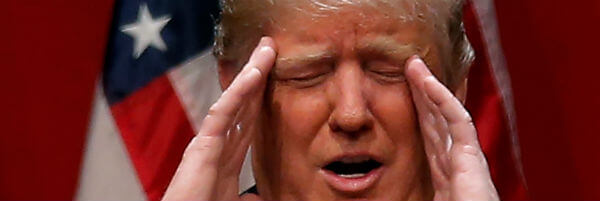
David Roberts writes: It’s been almost three weeks now. The news cycle has moved on. But I, for one, have not fully processed the news that Donald J. Trump is going to be president.
Those words still sound like nonsense to me. I can’t shake the sense of surreality. And I know I’m not alone.
Before we’re entirely swept up in the Trump Outrage of the Day, I want to at least pause, take stock, and attempt to answer a simple question: What the fuck just happened?
To begin, I should acknowledge just how wrong I was about this election. I never once questioned my confident prediction that Donald Trump would never become president. “Just because Trump makes no sense doesn’t mean common sense has become worthless,” I wrote after Trump won some early primaries. “One black swan does not foretell a flock of black swans.” (Yeah. About that.)
I was overconfident, even more so than most in media. US political and media institutions were just as unprepared for this result as UK elites were for the Brexit vote — but at least UK elites hadn’t already witnessed the Brexit vote. Almost no one really thought it could happen here, even after we watched it happen there. [Continue reading…]
Music: Les Hommes — ‘Touched By The Hand Of Tenorio’
François Fillon and France’s lurch towards Russia
Manuel Lafont Rapnouil writes: François Fillon has just won the French conservative primaries by a huge margin. Now, he will be trying to capitalise on the momentum he has gained from his win to deliver the result he wants in the upcoming presidential election. And with his foreign policy option, this presidential vote will pose a formidable challenge to Europe’s unity. Fillon’s views on Russia, in particular, fly in the face of the current European consensus. But neither foreign policy nor Europe are at the centre of the campaign, and domestic issues are much more likely to prevail when French voters make their choice in the spring of next year.
Fillon, a former prime minister under Nicolas Sarkozy, made his position on Russia clear long before the primary campaign even began, and he has stuck to it ever since. He believes French policy has been too aligned with the US, whether on Ukraine or the Middle East – in spite of the countries’ significant differences in opinion on these issues. And that, with ISIS and Islamism being the top security priorities for France following the terror attacks since January 2015, an alliance with Vladimir Putin’s Russia is badly needed, even at the price of conflating ISIS and other terrorist groups with any other forces fighting against the Assad government.
Worryingly, he calls not only for the ‘re-establishment’ of a political dialogue with Russia – a dialogue that was actually never interrupted – but also for the EU to lift all sanctions against Russia, including those adopted as a consequence of the forceful and unlawful Russian annexation of Crimea.
The French public’s opinion on the Russia question differs from Fillon’s. The majority have no confidence in Vladimir Putin and support maintaining economic sanctions against Russia on the Ukraine issue. Fillon’s critics add that, rather ironically, his desired relationship with Russia mirrors the alleged alignment with the US that he has attacked so fervently.
If both Fillon and the Front National’s leader, Marine Le Pen, reach the second round of the presidential election, a rapprochement with Putin’s Russia will become the order of the day for French foreign policy. At the moment it seems that a majority of presidential candidates will run on a pro-Russia or at least anti-sanctions platform. [Continue reading…]
Russia has been in contact with Trump team over Syria, senior diplomat says
The Washington Post reports: Russia has been in contact over Syria with the team of President-elect Donald Trump, a senior Russian diplomat said Wednesday, suggesting that Moscow is already looking past the current administration when it comes to the crisis in Syria.
Deputy Foreign Minister Mikhail Bogdanov was quoted by the TASS news agency as saying that Russia had been in contact with “several people that we have known for a long time.”
Bogdanov, who is President Vladimir Putin’s special representative for the Middle East and Africa, declined to name specific Trump team members, adding only that Moscow hoped the relations with Washington over Syria would improve under the new administration.
Kremlin spokesman Dmitry Peskov said he was unable “to confirm information about contacts” between Russia and Trump’s team. “As far as we know, the new team of the president-elect has yet to be formed,” Peskov said. He added that negotiations about Syria and other conflict areas “are continuing with our partners of the current administration of the U.S. president.” [Continue reading…]
Making Twitter secure for Trump is more difficult than modifying a Blackberry for Obama

It was a rough day at the NSA when President Trump asked for his Twitter account to be made secure.
“It just really bothered a lot of people — nobody wanted to put anything out there that wasn’t completely secure,” said NSA technical director Richard “Dickie” George in an interview with CNNMoney.
George’s role was to review the president’s neural pathways and write and engineer diagrams for securing the commander in chief’s brain.
In response to Trump’s request, the NSA set up a lab where dozens of experts planned surgery for several months on a high-profile patient: the soon-to-be presidential Trump brain. The course of treatment was to manipulate the organ’s structure to weed out potential threats to secure communication.
The effort turned out to be fruitless. There would be only one possible solution, the NSA concluded: delete Trump’s Twitter account.
“This isn’t a flaw in the technology,” George said, “It’s a problem with the user: we can’t fix his brain.”
(As they say in Hollywood: based on a true story.)
Michael Flynn, Trump’s choice as national security adviser, imagines China and North Korea have ties to jihadists
The New York Times reports: What if someone were to tell you that China and North Korea are allied with militant Islamists bent on imposing their religious ideology worldwide?
You might not agree. After all, China and North Korea are officially secular Communist states, and China has blamed religious extremists for violence in Muslim areas of its Xinjiang region.
But such an alliance is the framework through which retired Lt. Gen. Michael T. Flynn, the pick of President-elect Donald J. Trump for national security adviser, views the two East Asian countries. To the list of pro-jihadist anti-Western conspirators, General Flynn adds Russia, Cuba and Venezuela, among others. (Never mind that he has recently had close financial and lobbying relationships with conservative Russian and Turkish interests.)
By appointing General Flynn, Mr. Trump has signaled that he intends to prioritize policy on the Middle East and jihadist groups, though the Obama administration seems to have stressed to Mr. Trump the urgency of dealing with North Korea’s nuclear program. General Flynn is an outspoken critic of political Islam and has advocated a global campaign led by the United States against “radical Islam.” He once posted on Twitter that “Fear of Muslims is RATIONAL.”
General Flynn is about to take on what many consider the most important foreign policy job in the United States government. He is expected to coordinate policy-making agencies, manage competing voices and act as Mr. Trump’s main adviser, and perhaps arbiter, on foreign policy. [Continue reading…]
How stable are democracies? ‘Warning signs are flashing red’
Amanda Taub writes: Yascha Mounk is used to being the most pessimistic person in the room. Mr. Mounk, a lecturer in government at Harvard, has spent the past few years challenging one of the bedrock assumptions of Western politics: that once a country becomes a liberal democracy, it will stay that way.
His research suggests something quite different: that liberal democracies around the world may be at serious risk of decline.
Mr. Mounk’s interest in the topic began rather unusually. In 2014, he published a book, “Stranger in My Own Country.” It started as a memoir of his experiences growing up as a Jew in Germany, but became a broader investigation of how contemporary European nations were struggling to construct new, multicultural national identities.
He concluded that the effort was not going very well. A populist backlash was rising. But was that just a new kind of politics, or a symptom of something deeper?
To answer that question, Mr. Mounk teamed up with Roberto Stefan Foa, a political scientist at the University of Melbourne in Australia. They have since gathered and crunched data on the strength of liberal democracies.
Their conclusion, to be published in the January issue of the Journal of Democracy, is that democracies are not as secure as people may think. Right now, Mr. Mounk said in an interview, “the warning signs are flashing red.” [Continue reading…]
A national outbreak of hate inspired by Donald Trump’s victory
Southern Poverty Law Center reports: Just a week before the November 8th election, attackers set a church in Greenville, Mississippi, on fire. The historically black church was targeted in what authorities believe was an act of voter intimidation, its walls spray-painted with the phrase “Vote Trump.”
“This kind of attack happened in the 1950s and 1960s,” Greenville’s mayor said, “but it shouldn’t happen in 2016.”
The incident was just a harbinger of what has become a national outbreak of hate, as white supremacists celebrate Donald Trump’s victory.* In the ten days following the election, there were almost 900 reports of harassment and intimidation from across the nation. Many harassers invoked Trump’s name during assaults, making it clear that the outbreak of hate stemmed in large part from his electoral success.
People have experienced harassment at school, at work, at home, on the street, in public transportation, in their cars, in grocery stores and other places of business, and in their houses of worship. They most often have received messages of hate and intolerance through graffiti and verbal harassment, although a small number also have reported violent physical interactions. Some incidents were directed at the Trump campaign or his supporters.
Of course, hate crimes and lower-level incidents of racial or ethnically charged harassment have long been common in the United States. But the targets of post-election hate incidents report that they are experiencing something quite new.
“I have experienced discrimination in my life, but never in such a public and unashamed manner,” an Asian-American woman reported after a man told her to “go home” as she left an Oakland train station. Likewise, a black resident whose apartment was vandalized with the phrase “911 nigger” reported that he had “never witnessed anything like this.” A Los Angeles woman, who encountered a man who told her he was “Gonna beat [her] pussy,” stated that she was in this neighborhood “all the time and never experienced this type of language before.” Not far away in Sunnyvale, California, a transgender person reported being targeted with homophobic slurs at a bar where “I’ve been a regular customer for 3 years — never had any issues.” [Continue reading…]
The coming war on ‘radical Islam’
Uri Friedman writes: Where Obama sees a weak enemy that is getting weaker, his critics see a strong enemy that is getting stronger. Where Obama sees limits to what the U.S. can do on its own to eradicate radical interpretations of Islam, his critics see an appalling lack of effort by the U.S. government. Where Obama sees a serious but manageable national-security threat, his critics see an ideological and civilizational challenge to the free world.
Trump has gone further than many other Republican leaders in advancing the counterargument to Obama — not just in his proposed policies, like banning or severely restricting Muslim immigration to the United States, but also in his rhetoric. “I think Islam hates us,” Trump said earlier this year. Asked if he was referring to “radical Islam,” he responded, “It’s radical, but it’s very hard to define. It’s very hard to separate. Because you don’t know who’s who.”
Several members of Trump’s emerging team have described the threat in similarly stark and broad ways. “We’re in a world war against a messianic mass movement of evil people, most of them inspired by a totalitarian ideology: Radical Islam. But we are not permitted to speak or write those two words, which is potentially fatal to our culture,” writes Michael Flynn, Trump’s pick for national-security adviser, in a book he published this summer with the conservative writer Michael Ledeen.
“I don’t believe all cultures are morally equivalent, and I think the West, and especially America, is far more civilized, far more ethical and moral, than the system our main enemies want to impose on us,” Flynn adds.
“Not all the world’s 1.6 billion Muslims are extremists or terrorists. Not by a long shot,” wrote Flynn’s incoming deputy, K.T. McFarland, in March. “But even if just 10 percent of 1 percent are radicalized, that’s a staggering 1.6 million people bent on destroying Western civilization and the values we hold dear. The fascists wanted to control the world. So did the communists. But the Islamists want to brutally kill a significant percentage of the world — and that is anyone standing in the way of their end-times caliphate.” Jeff Sessions, Trump’s choice for attorney general, has invoked America’s “containment” strategy during the Cold War, noting that there “can be no compromise with this form of radical Islam.”
As the head of Breitbart News, Steve Bannon hosted a radio show featuring numerous guests who claimed that radical Muslim ideologues were clandestinely infiltrating the U.S. government and trying to extend their belief system across the country. (Flynn has similarly warned, falsely, that Islamic Sharia law is encroaching on the U.S. legal system.) In a 2014 speech to the Human Dignity Institute in the Vatican, Bannon, who will be Trump’s chief strategist in the White House, characterized the current war against “jihadist Islamic fascism” as the latest stage of an existential, centuries-old struggle between the Judeo-Christian West and the Islamic world: [Continue reading…]
Maneuvering a new reality for U.S. journalism
Nic Dawes writes: Dear friends in American journalism,
Ordinarily, it is you who offer the rest of the world advice about press freedom, and the accountability architecture of democratic societies, so I understand that it may be strange to hear it coming back at you, but this will not be the last inversion that the election of Donald Trump delivers.
You have some deep resources to draw on for the battle that is closing around you. For starters there is your Constitution, which offers stronger protections than just about any comparable legal framework. And your money, greatly diminished, and unevenly distributed to be sure, but orders of magnitude more plentiful than what your counterparts elsewhere have to call upon. You also have reserves of talent, creativity, and commitment far larger than you are given credit for by your critics, and right now by angry, bewildered, and wounded friends.
But one thing you don’t have, is experience of what to do when things start to get genuinely bad.
Take it from those of us who have worked in places where the institutional fabric is thinner, the legal protections less absolute, and the social license to operate less secure. Not outright dictatorships, but majoritarian democracies where big men—and they are usually men—polish their image in the mirror of state media or social media, while slowly squeezing the life out of independent institutions.
When Donald Trump ditched his press pool twice within days of being elected, and launched a series of Twitter attacks on The New York Times, a lot of you sounded surprised. As if you expected him to become a different person once the anointing oil of the Electoral College had touched his brow. Of course there was nothing surprising about his conduct. Rule number 1 of surviving autocracy, as Masha Gessen reminds us, is “Believe the Autocrat.”
When Mr. Trump threatened during the campaign to review America’s libel law framework, he was setting out his stall, not bluffing. When he threatened to sue, when he mocked a disabled reporter, when he made clear his affinity for Vladimir Putin and Peter Thiel, he was issuing a warning.
Of course, not being surprised doesn’t mean you shouldn’t be outraged. As Gessen also wrote, to survive autocracy, you have to preserve outrage, and your free press is a beautiful, important thing, even when it is besieged and bedraggled. Perhaps especially then.
The rest of us get irritated with you at times, in the manner of less privileged relatives, but you have given the rest of us a good deal over the years, standards to aspire to, innovation to build on, voices of great clarity. Here is some advice in return, mostly from India and South Africa, where an ostensibly free press is confronted with regulatory, economic, and political pressures that come with majoritarianism. [Continue reading…]

Who made the Arab Spring into an Arab crisis?
Yezid Sayigh writes: A recent news item on the BBC’s English website neatly captured the sharp contrast in how, five years later, various Arab rulers, citizens and non-Arab observers view the popular uprisings that swept leaders from power in several Arab states and challenged others. The headline read “Arab Spring ‘cost region $600bn’ in lost growth, UN says”, but what the latter actually said differed substantially.
In its Survey of Economic and Social Developments in the Arab Region 2015-2016 (PDF), the United Nation’s Economic and Social Commission for Western Asia (ESCWA), which covers 18 Arab countries, attributed a net loss of $613.8bn in economic activity and an aggregate fiscal deficit of $243.1bn not to the attempt to bring about democratic political transition, but to the armed conflicts now involving nearly a dozen Arab states.
Whether intentionally or not, the BBC’s headline echoes those who portray the chaos and bloodshed suffered by several Arab states since 2011 as the direct result – indeed the essence – of the Arab Spring. But, there was nothing inevitable about this.
Rather, the current reality, or potential threat of state failure and civil war in Arab states, is the outcome of their problematic past trajectories prior to 2011 and of the choices made by those in power on how to respond to evolving political, socioeconomic and institutional challenges since then. [Continue reading…]
Assad’s also winning in Damascus
The Daily Beast reports: The battle for eastern Aleppo, Syria’s largest city, is not even over yet but forces backing Syrian President Bashar al-Assad already have their sights on their next target; the nation’s capital, Damascus.
Russia has ramped up its airstrikes and regime forces have more aggressively attacked rebel-held areas around Damascus, taking several villages and suburbs in the last week alone.
And yet, the growing regime grip around the capital has gone largely unnoticed as the focus has been on eastern Aleppo’s apparent imminent collapse. The regime is therefore poised to take new territory around Damascus regardless of whether its forces can seize and hold the rest of Aleppo city. If the regime can hold onto Aleppo, it would control nearly every major provincial capital in the country — Damascus, Homs, Hama and Latakia — and would be able to devote all its resources to taking the rural and suburbans towns around them, which opposition forces are in greater concentration. [Continue reading…]
The mounting death toll in Mosul forces questions about the battle plan
The Washington Post reports: They came to the clinic in Humvees or beat-up cars, twisted in pain or far beyond saving. An Iraqi special forces soldier, his body gutted by an explosion. Four children with lacerated faces, survivors of a car bomb that had set their house on fire. Another soldier, who had stumbled into a booby trap, pale on his stretcher with a hole in his chest.
The luckier ones trudged past the facility in eastern Mosul, looking for shelter. “The mortars are falling,” said an elderly man, one of hundreds of people displaced by the grisly battles on this side of the city. There was no water or electricity in his neighborhood, he said, and no way to stay home.
“The mortars,” he repeated.
Civilian and military casualties are mounting as misery spreads in Mosul six weeks after the Iraqi army launched an offensive to capture the city from the Islamic State. Nearly 600 civilians have been killed, according to one estimate, along with dozens of Iraq’s elite, U.S.-trained special forces soldiers — the vanguard fighters in the deadliest battle yet during Iraq’s two-year struggle to vanquish the extremists. [Continue reading…]
Music: Julia Kent — ‘Invitation to the Voyage’
For Bashar al-Assad, victory will mean ruling over an economic wasteland while suppressing a never-ending insurgency
The New York Times reports: With the Syrian government making large territorial gains in Aleppo on Monday, routing rebel fighters and sending thousands of people fleeing for their lives, President Bashar al-Assad is starting to look as if he may survive the uprising, even in the estimation of some of his staunchest opponents.
Yet, Mr. Assad’s victory, if he should achieve it, may well be Pyrrhic: He would rule over an economic wasteland hampered by a low-level insurgency with no end in sight, diplomats and experts in the Middle East and elsewhere say.
As rebel forces in Aleppo absorbed the harshest blow since they seized more than half the city four years ago, residents reported seeing people cut down in the streets as they searched frantically for shelter. The assault punctuated months of grinding battle that has destroyed entire neighborhoods of the city, once Syria’s largest and an industrial hub.
If Aleppo fell, the Syrian government would control the country’s five largest cities and most of its more populous west. That would leave the rebels fighting Mr. Assad with only the northern province of Idlib and a few isolated pockets of territory in Aleppo and Homs Provinces and around the capital, Damascus.
But analysts doubted that would put an end to five years of war that have driven five million Syrians into exile and killed at least a quarter of a million people. [Continue reading…]
Jimmy Carter: America must recognize Palestine
Jimmy Carter writes: We do not yet know the policy of the next administration toward Israel and Palestine, but we do know the policy of this administration. It has been President Obama’s aim to support a negotiated end to the conflict based on two states, living side by side in peace.
That prospect is now in grave doubt. I am convinced that the United States can still shape the future of the Israeli-Palestinian conflict before a change in presidents, but time is very short. The simple but vital step this administration must take before its term expires on Jan. 20 is to grant American diplomatic recognition to the state of Palestine, as 137 countries have already done, and help it achieve full United Nations membership.
Back in 1978, during my administration, Israel’s prime minister, Menachem Begin, and Egypt’s president, Anwar Sadat, signed the Camp David Accords. That agreement was based on the United Nations Security Council Resolution 242, which was passed in the aftermath of the 1967 war. The key words of that resolution were “the inadmissibility of the acquisition of territory by war and the need to work for a just and lasting peace in the Middle East in which every state in the area can live in security,” and the “withdrawal of Israel armed forces from territories occupied in the recent conflict.”
The agreement was ratified overwhelmingly by the Parliaments of Egypt and Israel. And those two foundational concepts have been the basis for the policy of the United States government and the international community ever since.
This was why, in 2009, at the beginning of his first administration, Mr. Obama reaffirmed the crucial elements of the Camp David agreement and Resolution 242 by calling for a complete freeze on the building of settlements, constructed illegally by Israel on Palestinian territory. Later, in 2011, the president made clear that “the borders of Israel and Palestine should be based on the 1967 lines,” and added, “negotiations should result in two states, with permanent Palestinian borders with Israel, Jordan and Egypt, and permanent Israeli borders with Palestine.”
Today, however, 38 years after Camp David, the commitment to peace is in danger of abrogation. Israel is building more and more settlements, displacing Palestinians and entrenching its occupation of Palestinian lands. Over 4.5 million Palestinians live in these occupied territories, but are not citizens of Israel. Most live largely under Israeli military rule, and do not vote in Israel’s national elections.
Meanwhile, about 600,000 Israeli settlers in Palestine enjoy the benefits of Israeli citizenship and laws. This process is hastening a one-state reality that could destroy Israeli democracy and will result in intensifying international condemnation of Israel.
The Carter Center has continued to support a two-state solution by hosting discussions this month with Israeli and Palestinian representatives, searching for an avenue toward peace. Based on the positive feedback from those talks, I am certain that United States recognition of a Palestinian state would make it easier for other countries that have not recognized Palestine to do so, and would clear the way for a Security Council resolution on the future of the Israeli-Palestinian conflict. [Continue reading…]
Trump gives Petraeus a pass
Politico reports: Donald Trump said Hillary Clinton’s use of a private server for classified State Department emails made her unfit for high office. But that isn’t stopping him from considering David Petraeus, who pleaded guilty to knowingly leaking secret government files — and lying to the feds about it — for secretary of state.
Trump’s hourlong meeting Monday with Petraeus, a retired general and former CIA director, to discuss the Cabinet position is the latest in the president-elect’s outreach to retired military leaders who have clashed with President Barack Obama on foreign policy and national security.
But it also calls into question the sincerity of Trump’s stance on the importance of safeguarding the nation’s secrets, according to former government officials and intelligence experts — a stance that was driven home with campaign trail chants of “Lock her up.”
“The very consideration of Petraeus for a senior position reveals that the Trump campaign’s rhetoric regarding Hillary Clinton was totally bogus,” said Steven Aftergood, a specialist on government classification at the Federation of American Scientists. “Candidate Trump was generating hysteria over Clinton’s handling or mishandling of classified information that he likely never believed or took seriously himself.
“Petraeus admitted lying to the FBI, which distinguished his case from Clinton’s and made his case a good deal worse,” Aftergood added. “I think once again President-elect Trump is revealed as a rather hypocritical figure.” [Continue reading…]
Ohio State attacker complained bitterly in Facebook post of treatment of Muslims ‘everywhere,’ reports say
The Washington Post reports: Just minutes before an 18-year-old Somali college student used a car and butcher knife to attack people on the Ohio State University campus Monday morning, he said in a Facebook post that he’d reached a “boiling point” and was “sick and tired” of seeing Muslims around the globe “killed and tortured,” law enforcement officials told CNN and NBC.
The post said the U.S. should stop “interfering” in the Muslim world and referenced “lone wolf” attacks.
The post appeared to be on the Facebook page of the alleged attacker, Ohio State student Abdul Razak Ali Artan, and has since been disabled, reported ABC News. The Post could not independently confirm the story.
On Twitter, CNN’s Jake Tapper shared the full text of the post, which he said law enforcement officials confirmed was connected to Artan.
It began with a general denunciation of violence against Muslims “everywhere,” then referenced specifically the Rohingya Muslim community in Burma, who have been long-persecuted and are denied citizenship and basic rights. While the struggles of the Rohingya Muslims receive little publicity in the U.S., their situation has attracted more attention in recent weeks, as the Post’s Annie Gowen reported. Thousands of them have been fleeing into the forests and neighboring Bangladesh on the heels of a brutal military crackdown that followed a terrorist attack on police posts Oct. 9, allegedly carried out by Rohingya militants.
This week, a United Nations refugee agency official told the BBC that Burmese troops were “killing men, shooting them, slaughtering children, raping women, burning and looting houses, forcing these people to cross the river” into Bangladesh.
The official claimed the government’s goal was “ethnic cleansing of the Muslim minority.” [Continue reading…]