Der Spiegel reports: The Bullingdon and other dinner clubs are seeds of power in the United Kingdom, and not just because membership provides influence. Members also gain access to a group of like-minded individuals who will later assume leading roles — allies for life, just as it has always been.
If there is a stable core of British society that has remained unchanged for centuries, it is the upper class. Unlike the elites on the European continent, the leadership clique in Britain was largely spared from revolutions and uprisings. For generations, the children of the country’s powerful families have attended boarding schools like Eton, Winchester and Harrow, followed by the Universities of Oxford and Cambridge. It is a form of patronage that Britons simply refer to as tradition.
Not everyone has fond memories of those colorful student days. David Cameron was not only a member of the Bullingdon Club, but also of the Piers Gaveston Society, a club for younger students well known for its excesses. If a new biography about the premier is to be believed, Cameron, during one Gaveston party, placed his private parts into the mouth of a dead pig as part of an initiation ritual. The affair was lampooned in the press as “Pig-gate,” and had the entire country laughing at the prime minister. Cameron initially kept mum about the incident before explicitly denying it and his spokeswoman refuses to dignify the book with an official statement.
The most amazing part of the story isn’t the story as such, but the fact that most in Britain think it could be true. Few in the UK are surprised anymore by the excesses and affairs of the powerful at Westminster, a place that has long been viewed as sleazy and tainted. In the summer, to name just one recent example, the Sun published photos of Baron Sewel, a member of the House of Lords, who was photographed, half-naked, snorting cocaine with prostitutes.
There is a direct relationship between the excesses of these men and their lives as university students. One of the traditions at the Bullingdon Club was to invite prostitutes to a group breakfast. Excesses are part of the careers of these men rather than exceptions; they are part of the British elite’s DNA. [Continue reading…]
Music: Marcin Wasilewski Trio — ‘Diamonds and Pearls’
‘Hands off Syria’ applies to Russia too
In a newly released statement, leading Syrian activists and others condemn the Russian intervention:
As people and groups from many countries, united by a common commitment to peace, justice and human rights, we condemn the military offensive that began with air strikes launched by Russia in Syria on 30 September 2015 and accelerating subsequently.
While the Russian government has said that these operations were directed against the Islamic State (ISIS), most were on areas with no ISIS presence. The focus of the Russian military offensive appears to have been on opposition communities in the northern Homs region, a continuing center of resistance to the Assad Regime.
The victims of the Russian aggression on 30 September were predominantly civilians, including many children. Humanitarian conditions were dire in the area before Russia launched its offensive because it has long been under siege by the regime for its resistance.
The Assad Regime has wreaked havoc across Syria. The civil war it started by shooting democracy protesters has killed over a quarter-million Syrians, forced half the population from their homes and made millions of refugees. In the course of doing this, it has lost control of half the country. Although peace can never be restored by the regime that destroyed it, it would appear that Russia is now going to directly use its military might to further prop up a regime that would have collapsed years ago without foreign backing. This operation by Russian forces can only deepen the agony of the Syrian people, increase the flow of refugees, and strengthen the hand of extremist forces like ISIS.
To read the complete statement, see the list of signatories, and to lend your support, please visit Pulse Media.
Why Russia’s intervention in Syria is unlikely to lead to a major shift in the balance of power
Worst job in Syria being given to Cubans
Update: The Cuban government denies these reports.
*
The Institute for Cuban and Cuban-American Studies has received information that General Leopoldo Cintra Frias, Head of the Cuban Armed Forces, visited Syria recently leading a group of Cuban military personnel sent by Cuba in support of Syria’s dictator Assad and Russian involvement in that country.
The Cuban military contingent will be primarily deployed in Syria manning Russian tanks provided to Assad by the Russians.
“An Arab military officer at the Damascus airport reportedly witnessed two Russian planes arrive there with Cuban military personnel on board. When the officer questioned the Cubans, they told him they were there to assist Assad because they are experts at operating Russian tanks, according to Jaime Suchlicki, the institute’s executive director,” reports Fox News.
As well as providing expertise in their assigned task, the Cubans enter the war with two other “advantages”: they don’t speak Arabic and thus won’t be exposed to dispiriting battlefield accounts from their Syrian counterparts, and prior to their arrival in Syria they almost certainly had no access to YouTube (Cuba has very limited broadband internet access) so may not be aware of the high toll American-made anti-tank missiles have taken in recent weeks.
The Ankara bomber owned one of Turkey’s most well-known ISIS hangouts
Bloomberg reports: The person named as a suicide bomber in Turkey’s deadliest terror attack was the owner of an Islamic State gathering place well known to Turkish authorities and Turkish media, which had been sounding the alarm about his cell for more than two years.
Yunus Emre Alagoz, identified on Thursday by newspapers including the pro-government Yeni Safak as one of two who killed 99 people at a peace march in Turkey’s capital on Saturday, was the older brother of Seyh Abdurrahman Alagoz, a suicide bomber who killed 33 pro-Kurdish activists in the town of Suruc on July 20. The two brothers had operated a cafe called the “Islam Tea House” in the southeastern city of Adiyaman, a nexus of Islamic State activity in Turkey. Orhan Gonder, who was charged with bombing a rally for a pro-Kurdish party in Diyarbakir on June 5, was a friend of the two brothers from the tea house, according to a field report from Adiyaman in August by the main opposition party known as the CHP.
While war between Islamic State and Kurdish forces rages across the border in Syria, the three increasingly bold attacks by the Adiyaman cell show the threat is coming home to Turkey. The latest attack also illustrates how Islamist radicals are being groomed in plain sight in Turkey, as President Recep Tayyip Erdogan’s ruling party focuses its security and intelligence efforts on Kurdish militants and the pro-Kurdish political party instead. [Continue reading…]
How ISIS became a petrostate
The Financial Times reports: Minutely managed, Isis’ oil company actively recruits skilled workers, from engineers to trainers and managers.
Estimates by local traders and engineers put crude production in Isis-held territory at about 34,000-40,000 bpd. The oil is sold at the wellhead for between $20 and $45 a barrel, earning the militants an average of $1.5m a day.
“It’s a situation that makes you laugh and cry,” said one Syrian rebel commander in Aleppo, who buys diesel from Isis areas even as his forces fight the group on the front lines. “But we have no other choice, and we are a poor man’s revolution. Is anyone else offering to give us fuel?”
Isis’ oil strategy has been long in the making. Since the group emerged on the scene in Syria in 2013, long before they reached Mosul in Iraq, the jihadis saw oil as a crutch for their vision for an Islamic state. The group’s shura council identified it as fundamental for the survival of the insurgency and, more importantly, to finance their ambition to create a caliphate. [Continue reading…]
Frederic Hof: I got Syria so wrong
I did not think it inevitable that Assad — a computer-savvy individual who knew mass murder could not remain hidden from view in the 21st century — would react to peaceful protest as violently as he did, with no accompanying political outreach. And as Syria began to descend into the hell to which Assad was leading it, I did not realize that the White House would see the problem as essentially a communications challenge: getting Obama on “the right side of history” in terms of his public pronouncements. What the United States would do to try to influence Syria’s direction never enjoyed the same policy priority as what the United States would say.
Frederic C. Hof joined the State Department in 2009, where he advised Special Envoy George Mitchell on the full range of Arab-Israeli peace issues falling under his purview and focusing on Syria-Israel and Israel-Lebanon matters. Weeks before the popular uprising in Syria in 2011, Hof had won Bashir al-Assad’s provisional support for a peace deal with Israel which, if supported by Israel, would have resulted in the return of all Syrian territory lost in 1967.
Assad, told me in late February 2011 that he would sever all anti-Israel relationships with Iran, Hezbollah and Hamas and abstain from all behavior posing threats to the State of Israel, provided all land lost by Syria to Israel in the 1967 war — all of it — was returned. My conversation with him was detailed in terms of the relationships to be broken and the behavior to be changed. He did not equivocate. He said he had told the Iranians that the recovery of lost territory — the Golan Heights and pieces of the Jordan River Valley — was a matter of paramount Syrian national interest. He knew the price that would have to be paid to retrieve the real estate. He implied that Iran was OK with it. He said very directly he would pay the price in return for a treaty recovering everything.
Israeli Prime Minister Benjamin Netanyahu was interested. He was not at all eager to return real estate to Syria, but he found the idea of prying Syria out of Iran’s grip fascinating. And the negative implications for Hezbollah of Lebanon following Syria’s peace accord with Israel were not lost on him in the least. Although there were still details to define about the meaning of “all” in the context of the real estate to be returned, Netanyahu, too, knew the price that would ultimately have to be paid to achieve what he wanted. [Continue reading…]
Young Palestinians sound off on current unrest, Israeli occupation
Al Jazeera reports: While media headlines focus on the dramatic stabbing attacks by Palestinians and Israelis on one another in recent weeks, thousands of young Palestinians have at the same time taken to the streets of Israel, East Jerusalem, the West Bank and Gaza Strip to demand an end to Israel’s decades-long occupation, protest violence by Israeli forces and settlers, and call for recognition of their human rights.
The stabbings are a new element, of course, while protests are an old story — except that today they involve a new generation of Palestinians, those who’ve grown up in the era of the Oslo Peace process and its attendant frustrations and failures. Like the protests of the First Intifada uprising of 1987, some of today’s demonstrations are peaceful, but others have transformed into clashes with Israeli forces.
As Palestinian veterans and analysts grapple with the question of whether current events bear the hallmarks of a new intifada, Al Jazeera reached out to a number of Palestinians under the age of 30 throughout the region. We asked them two questions:
(1) Where do you see the current unrest headed?
(2) If these protests and clashes continue, how do you expect Israeli forces, settlers and the Palestinian Authority to respond? [Continue reading…]
Mother of Saudi man sentenced to crucifixion begs Obama to intervene
The Guardian reports: The mother of a Saudi protester sentenced to death by beheading and crucifixion has begged Barack Obama to intervene to save her son’s life.
In her first interview with foreign media, Nusra al-Ahmed, the mother of Ali Mohammed al-Nimr, whose case has made headlines around the world, described the intended punishment as savage and “backwards in the extreme”.
Human rights groups including Amnesty International and Reprieve, the US talkshow host Bill Maher and the British prime minister, David Cameron, have all weighed in with calls for clemency to stop Nimr, who was 17 at the time of his arrest, from being beheaded and then crucified. [Continue reading…]
Old and new: How the brain evokes a sense of familiarity
Science News reports: It’s happened to all of us at one time or another: You’re walking through a crowd, and suddenly a face seems incredibly familiar — so much so that you do a double-take. Who is that? How do you know them? You have no idea, but something about their face nags at you. You know you’ve seen it before.
The reason you know that face is in part because of your perirhinal cortex. This is an area of the brain that helps us to determine familiarity, or whether we have seen an object before. A new study of brain cells in this area finds that firing these neurons at one frequency makes the brain treat novel images as old hat. But firing these same neurons at another frequency can make the old new again.
“Novelty and familiarity are both really important,” says study coauthor Rebecca Burwell, a neuroscientist at Brown University in Providence, R.I. “They are important for learning and memory and decision making.” Finding a cache of food and knowing it is new could be useful for an animal’s future. So is recognizing a familiar place where the pickings were good in the past.
But knowing that something is familiar is not quite the same thing as knowing what that thing is. “You’re in a crowd and you see a familiar face, and there’s a feeling,” Burwell explains. “You can’t identify them, you don’t know where you met them, but there’s a sense of familiarity.” It’s different from recalling where you met the person, or even who the person is. This is a sense at the base of memory. And while scientists knew the perirhinal cortex was involved in this sense of familiarity, how that feeling of new or old was coded in the brain wasn’t fully understood. [Continue reading…]
Music: Marcin Wasilewski Trio — ‘Song For Świrek’
Iran and Hezbollah losing senior commanders in Syria at a rapid rate
The Daily Beast reports: With the aid of Russian airstrikes, Iranian-backed foreign fighters, and a combination of Syrian dictator Bashar al-Assad’s regular and militia forces are on the march. Yet Iran and its proxies have taken some significant high-ranking casualties since the start of their recruitment and deployment drives to Syria.
These losses all serve to map out the current offensive being launched in the northwest of the country, including Idlib, Hama, and Aleppo. While other significant losses had been suffered in past engagements, deaths of key members were often more sporadic or concentrated on one group during a specific battle. If the goal is to secure an Assad-led coastal Syrian rump-state, it is coming at high cost to Assad’s Iranian ally.
The most well known of Tehran’s casualties was the 67 year old Islamic Revolutionary Guard Corps (IRGC) Brigadier General, Hossein Hamedani. Announced as having been killed on October 9th, Hamedi was reportedly killed in Aleppo. Officially, he was described by the Iranians as a, “high-ranking military advisor” to Assad. But to write Hamedani off as merely an “advisor” would be the equivalent of referring to Napoleon as just, “a French general.” [Continue reading…]
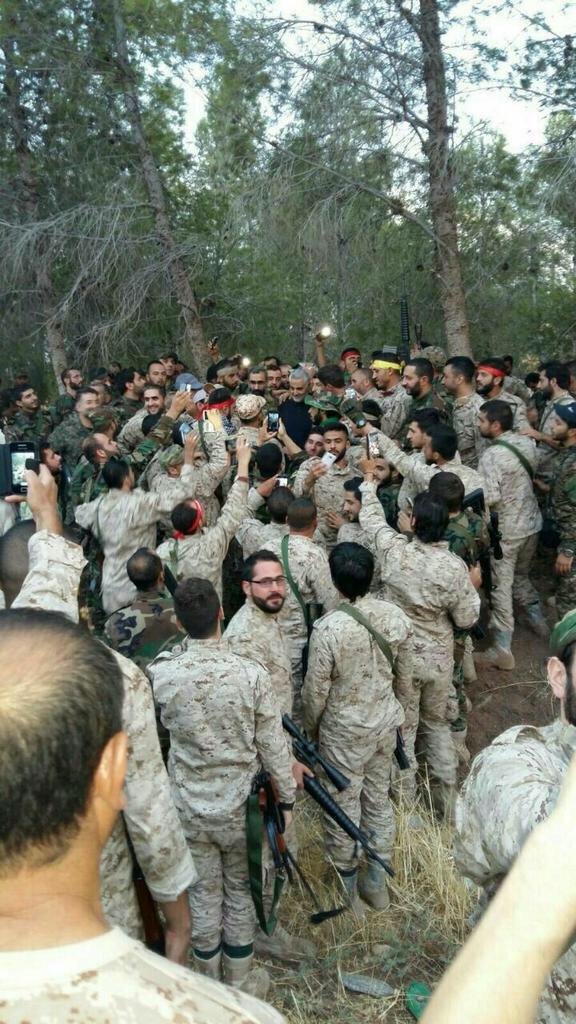
In what appears to have been a morale-boosting effort, General Qassem Soleimani, the commander of Iran’s elite Qods Forces, has made an appearance in a location open to question, where soldiers took the opportunity to take selfies with the man widely viewed as the architect of the current Russian-led campaign.

Russia's sending its only aircraft carrier Admiral Kuznetsov to Syria, it carries many more planes for potential strikes.
— Joshua Landis (@joshua_landis) October 14, 2015
Iran sends thousands of troops to Syria to bolster the planned ground offensive in Aleppo
Reuters reports: A delegation of Iranian lawmakers arrived in Damascus on Wednesday in the build-up to a joint operation against insurgents in northwest Syria, and said U.S.-led efforts to fight rebels had failed.
The visit, led by the chairman of the Iranian parliament’s National Security and Foreign Policy Commission, Alaeddin Boroujerdi, came as Iranian troops prepared to bolster a Syrian army offensive that two senior officials told Reuters would target rebels in Aleppo.
The attack, which the officials said would be backed by Russian air strikes, underlined the growing involvement in the civil war of Syrian President Bashar al-Assad’s two main allies, which has alarmed a U.S.-led coalition opposed to the president that is bombing Islamic State militants.
“The international coalition led by America has failed in the fight against terrorism. The cooperation between Syria, Iraq, Iran and Russia has been positive and successful,” Boroujerdi was quoted as saying by Iran’s state broadcaster IRIB as he arrived at Damascus airport.
The delegation was due to meet Assad, said officials.
Iran has sent thousands of troops into Syria in recent days to bolster the planned ground offensive in Aleppo, the two officials told Reuters. [Continue reading…]
Putin says U.S. fails to cooperate in Syria
The New York Times reports: President Vladimir V. Putin of Russia criticized the United States and others on Tuesday for what he said was their lack of cooperation with the Russian military campaign in Syria, suggesting that they had “mush for brains.”
Mr. Putin was responding to widespread accusations in the West that Russian warplanes were targeting practically every group opposed to the Syrian government except the Islamic State, also known as ISIS or ISIL. He complained that while the Russian government had asked for the coordinates of the groups that should or should not be attacked, the United States had not responded to either request.
“Recently, we have offered the Americans: ‘Give us objects that we shouldn’t target.’ Again, no answer,” he said. “It seems to me that some of our partners have mush for brains.” [Continue reading…]
Anger over Ankara response is a product of Turkish government’s past record
By Cemal Burak Tansel, University of Sheffield
Turkish voters will go to the polls on November 1, still reeling from the horrific bombings at a peace demonstration in Ankara on October 10.
The labour, peace and democracy rally in Ankara was planned as an intervention into the cycle of conflict that has engulfed the country since the parliamentary elections in June. Those who gathered did not get the chance to shout their calls for peace. A dual explosion went off, leaving at least 97 dead and more than 500 wounded.
In the aftermath of the attack, there have been mass protests against the government. The public anger, it seems, is being directed not at the perpetrators of the attack but at the people in charge of the country.
ISIS confirms killing of number two in U.S. air strike
AFP reports: The Islamic State group’s spokesman confirmed on Tuesday the killing of the jihadist organisation’s second in command in a US air strike earlier this year.
“America is rejoicing over the killing of Abu Mutaz al-Qurashi and considers this a great victory,” Abu Mohamed al-Adnani said in an audio recording posted on jihadist websites.
“I will not mourn him… he whose only wish was to die in the name of Allah… he has raised men and left behind heroes who, God willing, are yet to harm America,” he added.
Adnani did not say, however, in what circumstances Qurashi died. [Continue reading…]
Where are the anti-war protesters now?
Haid Haid writes: Russia’s recent military intervention in Syria doesn’t seem to have provoked the same reaction worldwide as the one the US faced against Assad in retaliation to the chemical gas attacks in Syria in August 2013. While the demonstration against the US airstrikes brought together the left and the right in major world cities, Russia’s intervention hasn’t prompted a strong reaction even from those who are considered ‘friends of Syria.’ This is not the first time that the reactions of anti-war coalitions and peace movements differ on the Syrian conflict, based on the actors calling for them. Iranian support to the Assad regime, for instance, with armed militias, weaponry, money, military experts, etc., has also gone unnoticed.
This selective approach by anti-war movements to foreign military interventions raises many questions about what they consider a war to be. Should we consider all military interventions bad? Does the actor’s identity matter more than the action itself? Can we be selective about acting upon our principles? When is it acceptable to favor someone’s interests over the miseries of others? [Continue reading…]