New U.S. standards will improve fuel efficiency for trucks and cut pollution

Union of Concerned Scientists reports: Unlike passenger cars and other light-duty vehicles, the fuel economy of heavy-duty vehicles has been largely unregulated for decades. Tractor trailers, delivery vans, and other heavy-duty trucks have kept roughly the same fuel economy since the 1970s — just 6 miles per gallon. Years of non-regulation and slow investment now mean that heavy-duty vehicles consume 25 percent of all fuel, despite only accounting for 7 percent of vehicles on the road.

First-ever standards were finally passed in 2011, putting in place a series of fuel economy targets for different types of vehicles — but more can be done.

Using existing, affordable technology, new trucks could be up to 40 percent more efficient compared to today, reducing annual fuel consumption by billions of gallons and preventing millions of metric tons of global warming emissions. For truckers, fleet operators, and America’s largest companies — including Walmart, Coke, Pepsi, UPS, and FedEx—a strong federal standard also means good business: annual shipping costs could fall by at least $135 per American household, and likely much more. [Continue reading…]

The Guardian reports: The Obama administration is issuing new rules intended to improve fuel efficiency for medium and heavy-duty trucks and cut pollution blamed for global warming.

The proposed standards are expected to lower carbon dioxide emissions by about 1bn metric tons, cut fuel costs by about $170bn and reduce oil consumption by up to 1.8bn barrels over the lifetime of vehicles sold under the rule.

The long-expected rules were announced on Friday, one day after Pope Francis issued a teaching document calling for the world to take action to slow climate change. [Continue reading…]

Facebooktwittermail

Before Charleston’s church shooting, a long history of attacks

Douglas R. Egerton writes: In 1868, three men assassinated the Rev. Benjamin Randolph in broad daylight as he was boarding a train in Abbeville County, South Carolina. Randolph, a black man, had recently won a seat in the State Senate and was then campaigning for the Republican slate. Having served as an Army chaplain with the 26th Regiment United States Colored Troops, Randolph asked the Freedmen’s Bureau to send him “where he can be most useful to his race.” He settled in South Carolina in time to take part in the 1865 rededication of the Emanuel African Methodist Episcopal Church in Charleston. It was that church’s long history of spiritual autonomy and political activism that caught the attention of the white vigilantes who gunned him down and rode away. Randolph’s fate was repeated yesterday with the murder of nine people, including the pastor of the church, the Rev. Clementa Pinckney, who, like Randolph, also served as a state senator.

Reports of yesterday’s tragedy have invariably noted that an earlier incarnation of the Emanuel Church was home to Denmark Vesey, a lay minister who was one of the church’s founders, but the connections between Vesey, the congregation’s long history of activism and the events of June 17 run far deeper than that.

South Carolina was unique in early America for its black majority. No other Southern colony or state had a white minority until 1855, when Mississippi also earned that particular status. In 1822, Charleston housed 24,780 people, only 10,653 of whom were white. Free people of color were a tiny percentage, at 623, and most of them were the mixed-race offspring of white fathers and black mothers. One of the few free blacks in the city was a former slave turned carpenter, Denmark Vesey.

Vesey’s early life was so unusual that if it were the plot of a novel or film, most would regard the saga as an absurd fiction. (The fact that his story has not attracted modern filmmakers is in itself curious, and perhaps a commentary on Hollywood’s disinclination to wrestle seriously with the American past.) Born around 1767 on what was then the Danish island of St. Thomas, he was purchased in 1781 by Capt. Joseph Vesey, who shipped slaves around the Caribbean. Vesey briefly kept the child as a cabin boy, but upon reaching the French sugar colony of St. Domingue — modern Haiti — he sold the child, whom he had rechristened Telemaque, to French planters. Even by the standards of slave societies, St. Domingue was hell on earth. Telemaque pretended to have epileptic fits, rendering him unfit for the fields. When the captain returned with another cargo of humans, he had to take the child back, at which time the fits stopped. Captain Vesey, who settled in Charleston after the British evacuation in 1783, kept Telemaque — whose name had evolved into Denmark — as a domestic servant and assistant.

Denmark’s life took yet another turn in the fall of 1799, when he won $1,500 in the city lottery. The captain might simply have confiscated the earnings of his human property, but instead he agreed to sell Denmark his freedom for $600. The bargain was completed on New Year’s Eve, and Denmark Vesey woke up in the new century as a free man. But his wife, and therefore his two sons, Robert and Sandy, remained enslaved by a man named James Evans. At length, with his wife in bondage, Vesey married another woman, named Susan, and Vesey was able to buy her freedom. Their children grew up free in their rented house on Bull Street.

A practicing Presbyterian, Vesey was outraged by the pro-slavery brand of Christianity preached from the city’s pulpits. White ministers were advised to lecture their black congregants on “their duties and obligations” and avoid troublesome stories, like the exodus out of Egypt, or Christ’s sermons on human brotherhood. When 4,376 black Methodists quit their white-controlled church in protest over the elders’ decision to construct a hearse house — a garage — over a black cemetery, Vesey was an early convert. As a carpenter, he may even have assisted in constructing the first Emanuel Church, which stood not far from the present building.

The African Church, as black Charlestonians called it, promptly attracted the animosity of the authorities. As a lay minister, Vesey, in his off hours, taught congregants to read and write — a violation of the state’s ban on black literacy. State and city ordinances allowed for blacks to worship only in daylight hours and only with a majority of white congregants. City authorities raided the church in 1818, arresting and whipping 140 “free Negroes and Slaves,” one of them presumably Vesey. In 1819 they again shuttered the church, and in 1820 the City Council warned the Rev. Morris Brown not to allow his church to become “a school for slaves.”

Had the city not declared war on Emanuel, Vesey might not have participated in the plot that got him killed in 1822. Enslaved Carolinians were never content with their lot, of course, but every slave in the state knew the odds of a successful rebellion. To protect the region’s white minority, the city militia was ever active, and Secretary of War John C. Calhoun always stood ready to ship soldiers to his native state. But the assaults on the church, which the Old Testament taught was a capital offense, reminded blacks that authorities would never allow them even the smallest spiritual freedom.

President Jean-Pierre Boyer of Haiti had recently placed advertisements in American newspapers, urging free blacks to bring their tools and skills and start life anew in his black republic. So, meeting in Vesey’s Bull Street home and within the walls of the Emanuel, Vesey and his lieutenants called for domestic slaves to kill their masters in their beds and fight their way to the docks, where they would seize ships and sail south. Originally, the plan was set for July 14, 1822 — Bastille Day — but the plot began to unravel, and Vesey moved the plans forward to the night of June 16. The uprising would begin when the city’s churches tolled midnight, meaning that the actual black exodus out of Charleston would take place on June 17. Either the shooter in Charleston yesterday knew the importance of this date, or the selection of June 17 was a ghastly coincidence. [Continue reading…]

Facebooktwittermail

Double standards on reporting about nuclear weapons in the Middle East

Dan Drollette, Jr. writes: A country in the Middle East has a clandestine nuclear development program, involving facilities hidden in the desert. After several years, the country is on the verge of acquiring nuclear weapons, even though the United States has been using all its resources to prevent that from happening. Frantic communications fly behind the scenes, between Washington and Tel Aviv.

And where is the nuclear program located? Israel.

Although Iran’s nuclear program dominates the headlines now (and did apparently have a military dimension at one time), that program has yet to produce a nuclear weapon, judging from the available public evidence. Meanwhile, the country pushing most aggressively for complete elimination of any prospect of an Iranian bomb—Israel—has an unacknowledged nuclear arsenal of its own. Although others project higher numbers, nuclear arsenal experts Hans M. Kristensen and Robert S. Norris estimate that Israel has roughly 80 warheads, built in secret.

It is noteworthy that while negotiations over limiting Iran’s enrichment program have taken center stage in news coverage—and will likely dominate the headlines as a final agreement is or is not reached at the end of this month—the history of Israel’s covert nuclear program draws relatively little media attention. [Continue reading…]

Facebooktwittermail

Divided loyalties: Iraq’s controversial Shiite militias fight among themselves

Mustafa Habib writes: Last Saturday was the anniversary of senior Iraqi spiritual leader, Ali al-Sistani’s call to arms. The cleric, who is seen as the leader of Shiite Muslims in Iraq and further afield, called upon all Iraqis to take up arms and defend the country against the extremist group known as the Islamic State, which had just taken control of the northern city of Mosul.

Since then the locals who did as al-Sistani asked have become the last bulwark against the approach of the Islamic State, or IS, group’s fighters. The volunteer militias are now known locally as the Hashd al-Shaabi, or Popular Mobilization Units, and have become both a cause for celebration – as they achieve victories and push the IS group back – and controversy, as they are accused of illegal acts of revenge, looting and generally taking the law into their own hands. The militias are mainly made up of Iraq’s Shiite Muslims and the IS group bases its ideology on a form of Sunni Islam – so the militias’ importance in the fight against the IS group has also become a source of sectarian tension inside the country.

But the tensions do not just exist between Iraq’s Shiite and Sunni Muslims. As the Shiite militias become more powerful, tensions are also increasing within the group. They may have a common enemy and share a religious sect but these militias are far from united. Basically the Shiite militias are split along the same lines as opinions in the main Shiite Muslim political parties. And their disagreements are not just military, they are based on present and future economic and political power. [Continue reading…]

Facebooktwittermail

ISIS-imposed fuel embargo threatens Syria’s medical centers

The New York Times reports: Islamic State fighters are preventing fuel shipments from reaching rebel-held parts of northern Syria, causing severe shortages that are grounding ambulances, paralyzing medical centers and shutting down bakeries, according to antigovernment activists and aid workers.

Adding to the misery, international aid groups said, the forces of Syria’s president, Bashar al-Assad, are targeting medical centers in opposition areas, killing some workers and forcing facilities to shut down.

The fuel shortages highlight how more than four years of war in Syria have ravaged the economy and allowed the warring parties to use the country’s scarce resources as a vise to squeeze their enemies. [Continue reading…]

Facebooktwittermail

Saudis’ war effort struggles on three fronts

Dr. Madawi Al-Rasheed writes: Saudi Arabia’s aggressive, interventionist foreign policy has so far led it to wage two external wars in addition to an ongoing battle on the domestic front. The government does not appear to be fighting the three campaigns with the same degree of commitment and dedication, but more important, none of its battles is yet to result in victory.

Riyadh’s war against the Islamic State (IS) in Syria and Iraq — being fought through a commitment to the US-led international coalition challenging the group destabilizing the Levant — has spilled over into the heartland of the kingdom’s oil-rich Eastern Province, prompting the necessity of fighting IS terrorism within its own borders as well as in the Levant. Recent attacks in Saudi Arabia have dismissed any doubt about the limits of IS’ reach. Meanwhile, to the south, the kingdom has been launching airstrikes against the Houthis in Yemen under an umbrella of 10 reluctant, mainly Arab states.

King Salman bin Abdul-Aziz Al Saud has delegated the management of these multiple wars to two key princes. His son Mohammed, deputy crown prince and minister of defense, is in charge of the Yemeni war, and it seems he has also been asked to improve Saudi foreign relations. He recently visited Russia with the goal, according to Saudi sources, of bolstering relations. The multiple tasks handed the prince seem to blur the boundaries between his role in the war on Yemen and that as foreign envoy. This is not unusual in the kingdom, as previous princes in key positions also combined several roles into one, but this multitasking cannot mask the stalemate of the Yemeni war. After several months and one cease-fire, fighting continues unabated, with neither party able to claim victory. [Continue reading…]

Facebooktwittermail

How the UAE operates as a police state

Matt J. Duffy, PhD writes: Through a series of overt and covert actions, the security forces of the United Arab Emirates have created an environment in which internal criticism is practically nonexistent and external critics are targeted.

The result is a shiny veneer of liberalism — propped up by partnerships with Western organizations such as the Louvre, Guggenheim and New York University — while in reality the country operates like a modern police state.

For the average Emirati, the security forces are a well-known, if enigmatic, institution. One Emirati said, “If you say the wrong thing here, then they’ll come and make you disappear.” [Continue reading…]

Facebooktwittermail

The West’s betrayal of Egypt will reap a bitter harvest

Amr Darrag writes: When the former Egyptian president Mohamed Morsi was sentenced to 20 years in April, in a trial internationally condemned as unconstitutional, unfair and deeply politicised, many saw it as a test of the international community’s resolve to stand up to the series of show trials currently under way in Egypt. For those who back democracy and human rights, the wall of silence from the international community was as predictable as it was tragic. At that time, I predicted that such silence would be interpreted by the Sisi regime as a green light to a death sentence for Morsi.

Where once politicians from Downing Street to the White House lauded the ideals and actions of the 2011 revolutionaries, now they were rendered mute as Egypt’s first democratically elected president was effectively sentenced to a life behind bars. Many also saw the sentence as a nail in the coffin for the ideals and dreams of the Arab Spring.

This week, the gradual purge of this first democratic government in Egypt took a darker turn. The Sisi regime, buoyed by the clear apathy of its international partners, upheld a death sentence handed down in May to Morsi and more than 100 people. The trial was nothing but a farce. Amnesty International called it a grossly unfair charade, which demonstrated a “complete disregard for human rights”. [Continue reading…]

Facebooktwittermail

In report on data collection practices, WhatsApp and AT&T fail the test

The New York Times reports: In the post-Snowden era, tech companies are increasingly being rated not only for the quality of their gadgets and services, but also for how they handle government requests for customer data. In the Electronic Frontier Foundation’s annual report on data collection practices, tech companies like Yahoo, Apple and Adobe earned top marks, while WhatsApp and AT&T came in last.

The report this week from the E.F.F., a nonprofit that focuses on digital rights, evaluated companies based on factors including their transparency to consumers about data requests and data retention, as well as their public positions on so-called back doors that grant government agencies access to customer data.

Apple, Adobe, Yahoo, Dropbox and Sonic.net were among those that scored highly. AT&T and WhatsApp, which earned the lowest marks, with one out of five stars, did not immediately have comments. Verizon Communications, which earned two stars in the report (down from four stars last year when the report had slightly different criteria) declined to comment. [Continue reading…]

Facebooktwittermail

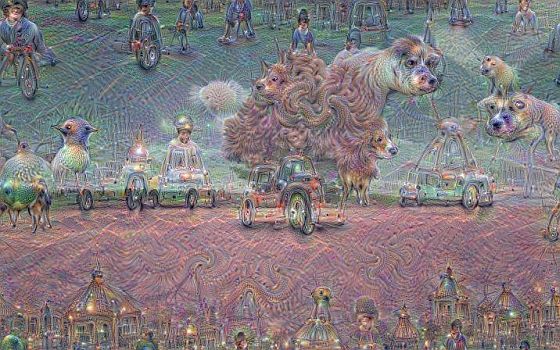
Artificial neural networks on acid

red-tree-small-long-unsmoothed

Quartz reports: American sci-fi novelist Philip K. Dick once famously asked, Do Androids Dream of Electric Sheep? While he was on the right track, the answer appears to be, no, they don’t. They dream of dog-headed knights atop horses, of camel-birds and pig-snails, and of Dali-esque mutated landscapes.

Google’s image recognition software, which can detect, analyze, and even auto-caption images, uses artificial neural networks to simulate the human brain. In a process they’re calling “inceptionism,” Google engineers sought out to see what these artificial networks “dream” of — what, if anything, do they see in a nondescript image of clouds, for instance? What does a fake brain that’s trained to detect images of dogs see when it’s shown a picture of a knight?

Google trains the software by feeding it millions of images, eventually teaching it to recognize specific objects within a picture. When it’s fed an image, it is asked to emphasize the object in the image that it recognizes. The network is made up of layers — the higher the layer, the more precise the interpretation. Eventually, in the final output layer, the network makes a “decision” as to what’s in the image.

But the networks aren’t restricted to only identifying images. Their training allows them to generate images as well. [Continue reading…]

Facebooktwittermail

Pope Francis on how we are trashing our home

Pope Francis writes: The Earth, our home, is beginning to look more and more like an immense pile of filth. In many parts of the planet, the elderly lament that once beautiful landscapes are now covered with rubbish. Industrial waste and chemical products utilised in cities and agricultural areas can lead to bioaccumulation in the organisms of the local population, even when levels of toxins in those places are low. Frequently no measures are taken until after people’s health has been irreversibly affected.

These problems are closely linked to a throwaway culture which affects the excluded just as it quickly reduces things to rubbish. To cite one example, most of the paper we produce is thrown away and not recycled. It is hard for us to accept that the way natural ecosystems work is exemplary: plants synthesise nutrients which feed herbivores; these in turn become food for carnivores, which produce significant quantities of organic waste which give rise to new generations of plants. But our industrial system, at the end of its cycle of production and consumption, has not developed the capacity to absorb and reuse waste and by-products. We have not yet managed to adopt a circular model of production capable of preserving resources for present and future generations, while limiting as much as possible the use of non-renewable resources, moderating their consumption, maximizing their efficient use, reusing and recycling them. A serious consideration of this issue would be one way of counteracting the throwaway culture which affects the entire planet, but it must be said that only limited progress has been made in this regard.

The climate is a common good, belonging to all and meant for all. At the global level, it is a complex system linked to many of the essential conditions for human life. A very solid scientific consensus indicates that we are presently witnessing a disturbing warming of the climatic system. In recent decades this warming has been accompanied by a constant rise in the sea level and, it would appear, by an increase of extreme weather events, even if a scientifically determinable cause cannot be assigned to each particular phenomenon. Humanity is called to recognise the need for changes of lifestyle, production and consumption, in order to combat this warming or at least the human causes which produce or aggravate it. It is true that there are other factors (such as volcanic activity, variations in the Earth’s orbit and axis, the solar cycle), yet a number of scientific studies indicate that most global warming in recent decades is due to the great concentration of greenhouse gases (carbon dioxide, methane, nitrogen oxides and others) released mainly as a result of human activity. Concentrated in the atmosphere, these gases do not allow the warmth of the sun’s rays reflected by the Earth to be dispersed in space. The problem is aggravated by a model of development based on the intensive use of fossil fuels, which is at the heart of the worldwide energy system. Another determining factor has been an increase in changed uses of the soil, principally deforestation for agricultural purposes.

Many of those who possess more resources and economic or political power seem mostly to be concerned with masking the problems or concealing their symptoms, simply making efforts to reduce some of the negative impacts of climate change. However, many of these symptoms indicate that such effects will continue to worsen if we continue with current models of production and consumption. There is an urgent need to develop policies so that, in the next few years, the emission of carbon dioxide and other highly polluting gases can be drastically reduced, for example, substituting for fossil fuels and developing sources of renewable energy. Worldwide there is minimal access to clean and renewable energy. There is still a need to develop adequate storage technologies. Some countries have made considerable progress, although it is far from constituting a significant proportion. Investments have also been made in means of production and transportation which consume less energy and require fewer raw materials, as well as in methods of construction and renovating buildings which improve their energy efficiency. But these good practices are still far from widespread. [Continue reading…]

The complete text of the encyclical, Laudato Si: On the Care of the Common Home, from which the extract above was taken, can be read here.

Did Pope Francis actually write this 180 page document? John Hooper explains that it was a team effort and that “much of the work was delegated to the Pontifical Council for Justice and Peace, the Vatican department that most closely resembles an overseas aid and development ministry in a secular government.” Nevertheless, it was the pope who did the final editing.

Facebooktwittermail

Pope Francis on the dehumanizing effect of social media and information overload

[W]hen media and the digital world become omnipresent, their influence can stop people from learning how to live wisely, to think deeply and to love generously. In this context, the great sages of the past run the risk of going unheard amid the noise and distractions of an information overload. Efforts need to be made to help these media become sources of new cultural progress for humanity and not a threat to our deepest riches. True wisdom, as the fruit of self-examination, dialogue and generous encounter between persons, is not acquired by a mere accumulation of data which eventually leads to overload and confusion, a sort of mental pollution. Real relationships with others, with all the challenges they entail, now tend to be replaced by a type of internet communication which enables us to choose or eliminate relationships at whim, thus giving rise to a new type of contrived emotion which has more to do with devices and displays than with other people and with nature. Today’s media do enable us to communicate and to share our knowledge and affections. Yet at times they also shield us from direct contact with the pain, the fears and the joys of others and the complexity of their personal experiences. For this reason, we should be concerned that, alongside the exciting possibilities offered by these media, a deep and melancholic dissatisfaction with interpersonal relations, or a harmful sense of isolation, can also arise. [Source: Laudato Si: On the Care of the Common Home]

Facebooktwittermail

How religion can do economics a favor

Andrew Simms writes: The world’s major religions all have economic teachings that apply to how we treat the planet and each other, and which often starkly contradict orthodox economic models.

Modern economics views itself as value free, but that wasn’t always the case and the major faiths all view economic prosperity through a moral lens. If that makes business leaders or economists squirm, it’s worth remembering that the grandfather of market economics, Adam Smith, wrote about The Theory of Moral Sentiments. To him, the economy was rooted in an explicitly moral universe. Whether we’re aware of it or not, and regardless of the fulminations of anti-environmental, extreme, right wing Republican Christians in the US, the economic teachings and moral frameworks of the great faiths profoundly shape how we view the path to prosperity, sometimes in surprising ways.

On this, the Catholic Church has form. Small is Beautiful by EF Schumacher is probably the most influential text on green economics ever written. As a collection of essays by a former industrial economist, who for two decades after the second world war was chief economic adviser to the National Coal Board, it did more than anything else to reimagine economics as servant to a convivial society living in balance with the environment.

But its most enduring idea from which the book’s title is derived, about the importance of scale, was taken straight from a papal encyclical. Schumacher took subsidiarity, the principle that things are always best done at the lowest practical level, from an encyclical of Pope Pius XII issued in 1931 in the wake of the economic catastrophe of the Great Depression. It is an injustice and disturbance of right order to push power up rather than down, it said, insisting that nations which do the latter will be happier and more prosperous. Today local democracy, decentralised food and energy systems and local participatory budgeting are arguably better paths for progress. [Continue reading…]

Facebooktwittermail

There is no conflict between our faiths and the science of climate change

Cardinal John Onaiyekan, Rabbi David Rosen and Professor Dr M Din Syamsuddin write: On Thursday, Pope Francis issued a powerful and timely encyclical on the environment, urging humanity to come to its senses and cease its reckless onslaught against God’s creation. He addressed this letter not only to his fellow Catholics, but to all people of the world, asking people of different religious traditions to unite in common purpose to save our planet.

As religious figures, we too accept the overwhelming scientific consensus that global warming comes from human activity, as we see no conflict between faith and reason.

And, coming from the three great Abrahamic faiths – Judaism, Christianity and Islam – we stand together on the need to be good stewards of the earth. All of our traditions affirm the inherent goodness of all creation, and the binding obligation on human beings to protect our common home, the planet that sustains us. The Hebrew Scriptures state clearly that the Earth belongs to God alone, and that we are merely sojourners – we do not have ownership on a permanent basis: the fruits of the earth belong to all, including the poor. This ancient teaching is affirmed by both Christianity and Islam. Christians also view the world through a sacramental lenses, believing that the redemption of Christ has in turn redeemed all of creation. And Islam can be thought of as a religion of nature, with 750 verses in the holy Qur’an speaking about our responsibility to the environment and our relationship with all creatures. Islam too recognizes that everything in the heavens and the earth belong to God, and that we are mere trustees and vice-regents.

We must agree with Pope Francis that we have violated this most sacred trust. This is evident with the scandal of climate change, which comes predominantly from the relentless burning of fossil fuels to power our global economy. The path we are on is a path of destruction. [Continue reading…]

Facebooktwittermail

Pope Francis calls on Christians to undergo an ‘ecological conversion’

The rich heritage of Christian spirituality, the fruit of twenty centuries of personal and communal experience, has a precious contribution to make to the renewal of humanity. Here, I would like to offer Christians a few suggestions for an ecological spirituality grounded in the convictions of our faith, since the teachings of the Gospel have direct consequences for our way of thinking, feeling and living. More than in ideas or concepts as such, I am interested in how such a spirituality can motivate us to a more passionate concern for the protection of our world. A commitment this lofty cannot be sustained by doctrine alone, without a spirituality capable of inspiring us, without an “interior impulse which encourages, motivates, nourishes and gives meaning to our individual and communal activity”. Admittedly, Christians have not always appropriated and developed the spiritual treasures bestowed by God upon the Church, where the life of the spirit is not dissociated from the body or from nature or from worldly realities, but lived in and with them, in communion with all that surrounds us.

“The external deserts in the world are growing, because the internal deserts have become so vast”. For this reason, the ecological crisis is also a summons to profound interior conversion. It must be said that some committed and prayerful Christians, with the excuse of realism and pragmatism, tend to ridicule expressions of concern for the environment. Others are passive; they choose not to change their habits and thus become inconsistent. So what they all need is an “ecological conversion”, whereby the effects of their encounter with Jesus Christ become evident in their relationship with the world around them. Living our vocation to be protectors of God’s handiwork is essential to a life of virtue; it is not an optional or a secondary aspect of our Christian experience. [Source: Laudato Si: On the Care of the Common Home]

Facebooktwittermail

Those who believe godless science must be met by holy resistance

Gary Wills writes: When a Republican politician, asked about climate change, says, “I’m not a scientist,” most of us hear just a cowardly way of dodging the question; but the politician’s supporters hear a brave defiance of an alien force. When we hear only “science,” they hear “godless science,” the kind that wants to rob them of their belief in creation and force evolution into their minds. That science is marching in a battalion of forces—the media, the academy, the government—that has them besieged. “I’m not a scientist” does not mean, “I have not heard enough about the science, and need to hear more,” but “I know the evil intent or effect of science, and I will not let it affect me.” They summon a courage not to know.

Now Pope Francis, with his encyclical on climate change, has introduced a concern for the poor into the environmental discussion. But conservative Catholics (including five actual or potential candidates for president) forgive him, since he knows nothing about science—if he did, he would realize its anti-biblical animus. He does not know, as the conservatives do, that the masked godless thing must be met by a holy resistance. This is what the French anthropologist Olivier Roy calls “holy ignorance.” It is not a failure of intelligence, but a proud refusal to know things tainted by the arrogance of inevitability. He writes: “There is a close link between secularization and religious revivalism, which is not a reaction against secularization, but the product of it. Secularism engenders religion.” The defenders of the lost cause feel persecuted, and the more support there is for their opponents, the grander they are in their lonely war. [Continue reading…]

Facebooktwittermail

Ruled by ISIS: Creating a nation of fear

The Associated Press reports: When the Islamic State fighters burst into the Iraqi village of Eski Mosul, Sheikh Abdullah Ibrahim knew his wife was in trouble.

Buthaina Ibrahim was an outspoken human rights advocate who had once run for the provincial council in Mosul. The IS fighters demanded she apply for a “repentance card.” Under the rule of the extremist group, all former police officers, soldiers and people whose activities are deemed “heretical” must sign the card and carry it with them at all times.

“She said she’d never stoop so low,” her husband said.

Buthaina Ibrahim was an outlier in her defiance of the Islamic State. It would cost her dearly.

The “caliphate,” declared a year ago, demands obedience. Untold numbers have been killed because they were deemed dangerous to the IS, or insufficiently pious; 5-8 million endure a regime that has swiftly turned their world upside down, extending its control into every corner of life to enforce its own radical interpretation of Islamic law, or Shariah.

The Islamic State is a place where men douse themselves with cologne to hide the odor of forbidden cigarettes; where taxi drivers or motorists usually play the IS radio station, since music can get a driver 10 lashes; where women must be entirely covered, in black, and in flat-soled shoes; where shops must close during Muslim prayers, and everyone found outdoors must attend.

There is no safe way out. People vanish — their disappearance sometimes explained by an uninformative death certificate, or worse, a video of their beheading. [Continue reading…]

Facebooktwittermail