Collective punishment: easier to condemn in Gaza than Yarmouk

The Palestinian refugee camp of Yarmouk in Damascus has been under siege by forces of the Assad regime since last July and 28 of the residents have already starved to death. Yet the pro-Palestinian movement which never fails to raise its voice in outrage about the effects of an Israeli siege on Gaza, is reluctant to takes sides when it comes to Syria.

Talal Alyan writes: While you were insisting on neutrality about Yarmouk, the Syrian regime dropped barrel bombs on it. Mohammad Al Far. Husam Abo Ahmad. Mohammad Tafori. Mohammad Suhaib Al Qides. Ala’a Fri’j. These men are all dead. Mohammad Taha would later die too when he, along with a larger demonstration, approached a regime checkpoint in frustration after the carnage rained on them from above.

The Pro-Palestinian movement was delayed in picking up on the tragic unraveling of Yarmouk. It took the work of a great deal of dedicated activists to force it into the forefront of the solidarity movement’s agenda. What couldn’t be predicted, however, was that, in the place of silence, an ugly neutrality would hover over the new-founded concern. And that said the neutrality was often an unconvincing veil for something much more vile. Perhaps, in our naivety, we believe that when Yarmouk became visible, it would be nearly impossible to omit the clear fact that the siege was being imposed by the Syrian regime. Instead, it was the oppositional fighters in the camp who fell under the spotlight. A chorus emerged, one familiar enough to evoke a surreal sense of Déjà vu.

Yarmouk had transformed into Gaza. But this time, it was our side that was rationalizing the blockage, entertaining and validating the motives offered for collective punishment, instead of flatly rejecting it as a cruel practice. [Continue reading…]

Facebooktwittermail

Egyptian editor backtracks after saying ‘Americans will be killed in streets’

The Guardian reports: A prominent Egyptian editor who threatened that Americans could be slaughtered in the streets has been forced to backtrack on his remarks after they were reported by western media.

In an extreme example of the growing xenophobic rhetoric by media outlets who back the country’s army chief, General Abdel Fatah al-Sisi, Mostafa Bakry made the threat on a major TV talkshow, also warning the US president, Barack Obama, and his “puppets” that “we will enter their houses, and we will kill them one by one”.

Bakry speculated that the US government planned to assassinate Sisi, who ousted Egypt’s first democratically elected leader, Mohamed Morsi, last July after mass protests against his one-year rule.

“There is a plot to kill General Sisi, and the security services know it well,” said Bakry – a pro-regime journalist known for his provocative behaviour. He then suggested that a similar US-backed plot had led to the assassination of Pakistani politician, Benazir Bhutto.

Such a scenario would lead the Egyptian people to rise up in a “revolution to kill the Americans in the streets”, he said.

Egypt’s foreign ministry later forwarded the following clarification from Bakry himself: “These comments were made regarding terrorism and the terrorist group that is waging a war against Egypt. I am opposed to any violence, including any violence against US citizens, and I would like to make it clear that we have no enmity with or hostility towards the American people at all.

“The intention of my comments was to highlight Egyptian independence, and our adamant refusal to allow any outside party, be that the US or any other party, to interfere in internal Egyptian affairs.”

Facebooktwittermail

In keeping grip on data pipeline, Obama does little to reassure industry

The New York Times reports: Google, which briefly considered moving all of its computer servers out of the United States last year after learning how they had been penetrated by the National Security Agency, was looking for a public assurance from President Obama that the government would no longer secretly suck data from the company’s corner of the Internet cloud.

Microsoft was listening to see if Mr. Obama would adopt a recommendation from his advisers that the government stop routinely stockpiling flaws in its Windows operating system, then using them to penetrate some foreign computer systems and, in rare cases, launch cyberattacks.

Intel and computer security companies were eager to hear Mr. Obama embrace a commitment that the United States would never knowingly move to weaken encryption systems.

They got none of that. [Continue reading…]

Facebooktwittermail

Tepid global reaction to Obama’s NSA vow

The Washington Post reports: After months of revelations that strained U.S. relations with allies and cast a harsh light on the National Security Agency’s global surveillance reach, President Obama’s speech Friday was aimed at least in part at reassuring the world of American intentions.

But the initial reaction overseas suggested he still has a significant way to go to heal the rifts, with many wondering why he didn’t offer more specific protections.

In Germany, where revelations that the NSA had been eavesdropping on the calls of Chancellor Angela Merkel stirred deep anger and unusually tough criticism of Washington, Obama’s promises to rein in the excesses of U.S. spying were met with a tepid welcome from the German government — and scorn from some analysts.

Government spokesman Steffen Seibert tweeted that the government would appreciate better safeguards of the rights of non-U.S. citizens but would need more time to review Obama’s words in detail. [Continue reading…]

Facebooktwittermail

Obama’s restrictions on NSA surveillance rely on narrow definition of ‘spying’

Barton Gellman reports: President Obama said Friday, in his first major speech on electronic surveillance, that “the United States is not spying on ordinary people who don’t threaten our national security.”

Obama placed restrictions on access to domestic phone records collected by the National Security Agency, but the changes he announced will allow it to continue — or expand — the collection of personal data from billions of people around the world, Americans and foreign citizens alike.

Obama squares that circle with an unusually narrow definition of “spying.” It does not include the ingestion of tens of trillions of records about the telephone calls, e-mails, locations and relationships of people for whom there is no suspicion of relevance to any threat.

In his speech, and an accompanying policy directive, Obama described principles for “restricting the use of this information” — but not for gathering less of it.

Alongside the invocation of privacy and restraint, Obama gave his plainest endorsement yet of “bulk collection,” a term he used more than once and authorized explicitly in Presidential Policy Directive 28. In a footnote, the directive defined the term to mean high-volume collection “without the use of discriminants.” [Continue reading…]

Facebooktwittermail

Obama’s (still) unanswered question on phone spying

National Journal reports: Ending bulk data collection, which the NSA claims is authorized under Section 215 of the Patriot Act, has been the top priority for civil liberties groups.

Obama announced on Friday that he will end the program “as it currently exists.”

Starting immediately, NSA analysts will need approval from the Foreign Intelligence Surveillance Court every time they want to access the phone database. Obama also said he plans to eventually move the database out of the government’s hands. The president directed Attorney General Eric Holder and top intelligence officials to come up with a plan by March 28 for turning over control of the database.

But no matter who stores the data, the NSA will want to ensure that its analysts can still access it when they want to map the connections of a potential terrorist group. That could mean the administration will ask Congress to enact a mandate requiring phone companies to store their customers’ data on behalf of the NSA.

Privacy advocates warn that a data retention mandate would turn phone companies into agents of the NSA.

“To the contrary, companies should be working on ways to store less user data for less time—decreasing the risks from data breaches and intrusions like the one that just happened to Target,” wrote Cindy Cohn and Rainey Reitman of the Electronic Frontier Foundation. “Data retention heads in the wrong direction for our security regardless of whether the government or private parties store the information.”

Kevin Bankston, a policy director for the New American Foundation, said that if the alternative to government storage is mandatory data retention or a requirement for phone companies to turn the data over to some other third party, “the President should be prepared for a major legislative battle with key members of Congress, the technology industry and the privacy community arrayed against him.” [Continue reading…]

Facebooktwittermail

U.S. officials dream of murdering Edward Snowden

Buzzfeed reports: Edward Snowden has made some dangerous enemies. As the American intelligence community struggles to contain the public damage done by the former National Security Agency contractor’s revelations of mass domestic spying, intelligence operators have continued to seethe in very personal terms against the 30-year-old whistle-blower.

“In a world where I would not be restricted from killing an American, I personally would go and kill him myself,” a current NSA analyst told BuzzFeed. “A lot of people share this sentiment.”

“I would love to put a bullet in his head,” one Pentagon official, a former special forces officer, said bluntly. “I do not take pleasure in taking another human beings life, having to do it in uniform, but he is single-handedly the greatest traitor in American history.”

That violent hostility lies just beneath the surface of the domestic debate over NSA spying is still ongoing. Some members of Congress have hailed Snowden as a whistle-blower, the New York Times has called for clemency, and pundits regularly defend his actions on Sunday talk shows. In intelligence community circles, Snowden is considered a nothing short of a traitor in wartime.

“His name is cursed every day over here,” a defense contractor told BuzzFeed, speaking from an overseas intelligence collections base. “Most everyone I talk to says he needs to be tried and hung, forget the trial and just hang him.” [Continue reading…]

Facebooktwittermail

What happened to AIPAC’s seventy senators?

AIPAC-senators

In 2005, AIPAC’s Steven Rosen when prompted by Jeffrey Goldberg to assess the level of the lobby’s influence famously said: “In twenty-four hours, we could have the signatures of seventy senators on this napkin.”

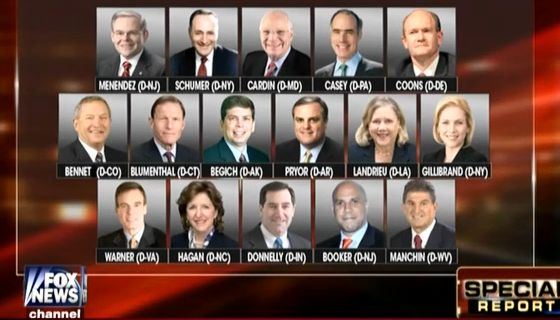
The “Nuclear Weapon Free Iran Act of 2013” sponsored by Democratic Senator Robert Menedez has the support of fifty-nine senators. That’s a dangerously large majority but just short of a veto-proof sixty-seven votes and well short of Rosen’s seventy.

Does that mean that AIPAC is refraining from pulling its weight or is it just not as powerful as Rosen declared?

I called my Democratic Senator Kay Hagan, one of the co-sponsors of the bill, to tell her that if she follows through and casts a vote in favor, she won’t have my vote in November. Interestingly, her staffer was at pains to underline the fact that this is still in process and hasn’t gone to a vote. I got a strong sense that Hagan, perhaps like many other senators both Democratic and Republican, would be content demonstrating her loyalty to AIPAC without actually casting a vote.

In the report below, Republican Senator Roy Blunt essentially says that every senator’s hands have been tied by Senate leader Harry Reid and far from striking a defiant tone, Blunt seems content to be rendered powerless.

If the bill got just one more supporter, would Reid bow to pressure and let it go to a vote? And can’t AIPAC with all its influence turn just one more senator in its favor?

I get the sense that for everyone involved — including AIPAC — this is all political theater. They want to act tough, but at the end of the day, they probably don’t want to be held responsible for sabotaging the most significant diplomatic opening in a decade.

National Journal reports: Senate Iran hawks have lots of votes to back their sanctions legislation. What they lack is a plan to get the bill to the floor.

Fifty-nine senators — including 16 Democrats — have signed onto sanctions legislation from Democratic Sen. Robert Menendez and Republican Sen. Mark Kirk. The measure would punish Iran with sanctions if it reneges on an interim nuclear agreement or if that agreement does not ultimately abolish any nuclear-weapons capabilities for Iran.

That count has climbed rapidly since the bipartisan pair introduced their legislation in late December. But now it’s unclear whether that support will be enough to clear the bill’s next major hurdle: Senate Majority Leader Harry Reid.

Reid is siding with the White House, which has put intense pressure on lawmakers not to act on sanctions, arguing it could result in both a nuclear-armed and hostile Iranian state. And without Reid’s backing, supporters of the Menendez-Kirk bill are unsure how to move the measure to the floor.

“I assume that if the Democrat senators put enough pressure on Senator Reid he might bring it to the floor,” said Missouri Republican Sen. Roy Blunt. “But, you know, we are at a moment in the Senate where nothing happens that Senator Reid doesn’t want to happen; and this is something at this moment that Senator Reid doesn’t want to happen.”

And for now, sanctions supporters are still mulling their strategy.

“We are talking amongst ourselves. There is a very active debate and discussion ongoing about how best to move forward,” said Democratic Sen. Richard Blumenthal of Connecticut, a cosponsor of the bill. “There are a number of alternative strategies, but we’re deliberating them.”

While Reid has, at least for now, foiled their policy plans, sanctions supporters are still scoring the desired political points on the issue. They can report their efforts to their constituents while blaming Reid for the inaction.

Jon Stewart, comparing these senators to egg-throwing Justin Bieber, is perfectly clear about which “constituents” they are trying to represent: AIPAC and Israel. (It’s a shame that Daily Show writers, having crafted a strong piece then felt compelled to add some “balance” by treating Rouhani’s tweet with scorn: “World powers surrendered to Iran’s national will.” If he can placate his hawkish critics just with a tweet, I’m sure Obama is envious.)

Facebooktwittermail

9/11 mastermind says Quran ‘forbids’ violence to spread Islam

Huffington Post reports: The mastermind of the Sept. 11, 2001, terrorist attacks now says that the use of violence to spread Islam is forbidden by the Quran, a major shift away from the more militaristic view he had put forward previously.

Khalid Sheikh Mohammed’s thinking is detailed in a first-of-its-kind 36-page manifesto obtained by The Huffington Post. In a departure from his previous stance, which led the Guantanamo Bay prisoner to tell a military commission, “it would have been the greatest religious duty to fight you over your infidelity,” KSM, as he’s known in intelligence circles, instead seeks to convert the court to Islam through persuasion and theological reflection, going so far as to argue that “The Holy Quran forbids us to use force as a means of converting” and that reaching “truth and reality never comes by muscles and force but by using the mind and wisdom.”

“Don’t believe the media that the Mujahedeen believe that Islam spread in the past and will prevail in the future with the sword,” writes KSM, who has previously admitted to his role in the 9/11 attacks that killed thousands of Americans. He uses the bulk of the manifesto to put his newfound principle into practice, attempting to persuade his captors, prosecutors and lawyers that the path to true happiness lies in Islam. [Continue reading…]

Facebooktwittermail

U.N. warns inaction on climate change will be costly

The New York Times reports: Nations have dragged their feet in battling climate change so much that the situation has grown critical and the risk of severe economic disruption is rising, according to a UN draft report. Another 15 years of failure to limit carbon emissions could make the problem virtually impossible to solve with current technologies, the experts found.

Delay would probably force future generations to develop the capability to suck greenhouse gases out of the atmosphere and store them underground to preserve the livability of the planet, the report found. But it is not clear whether such technologies will ever exist at the necessary scale, and even if they do, the approach would probably be wildly expensive compared with taking steps now to slow emissions.

The report said that governments of the world were still spending far more money to subsidize fossil fuels than to accelerate the shift to cleaner energy, thus encouraging continued investment in projects like coal-burning power plants that pose a long-term climate risk.

While the spread of technologies like solar power and wind farms might give the impression of progress, the report said, such developments are being overtaken by rising emissions from fossil fuels over the past decade, especially in fast-growing countries like China. And one of the most important sources of low-carbon energy, nuclear power, is actually declining over time as a percentage of the global energy mix, the report said.

“The fundamental drivers of emissions growth are expected to persist despite major improvements in energy supply” and in the efficiency with which energy is used, the report declared.

The new warnings come in a draft report from the Intergovernmental Panel on Climate Change, a panel of climate experts that won the Nobel Peace Prize in 2007 for its efforts to analyze and communicate the risks of climate change. The report is not final, but a draft dated Dec. 17 leaked this week and was first reported by Reuters. The New York Times obtained a copy independently. [Continue reading…]

Facebooktwittermail

In Egypt the old state has won, to great applause

Sarah Carr writes: A referendum on the constitution is rarely about the document itself, but more than any previous plebiscite this vote is about sticking two fingers up at the Brotherhood and expressing varying levels of confidence/adoration in the army and more specifically the person of Commander-in-Chief Abdel Fatah el Sisi.

Voters repeatedly linked a “yes” to the constitution with a “yes to Sisi” yesterday. His picture was everywhere, and in some quarters he is regarded as the second coming. One man actually said this, that Sisi was “sent” to protect Egypt. I remembered 2011, and the Islamists and their rhetoric, a “yes” vote is a vote for Islam. It’s still all about interchangeable deities in the end.

One interesting aspect of all this is that Mubarak was noticeably absent from the military effigies (Nasser, Sadat, Sisi) plastered everywhere, but his spirit permeated everything. He bequeathed the current situation to Egypt, after all, the us vs. them mindset, the suspicion of political or cultural otherness, that idea that Egypt, and Egyptian identity, must be a fortress against interlopers and the ease with which the threat of such interlopers, real or imagined, can steer the country’s course.

This referendum is part of that legacy. It is another brick in the wall of the security state and its relentless homogeneity. In January 2011, there was a small crack put in that wall and we were given a glimpse of a new possibility, of new faces, and new political forces. But through a tragic and increasingly inevitable combination of their own inexperience, blind trust and the public’s unwillingness to back an unknown entity, they were eventually shut out of the public space and we were reduced to the same old tired binary of Islamists and the old state — just like Mubarak promised us.

Now the old state has won, to great applause, and there is absolutely no room for difference, all in the name of stability and progress. [Continue reading…]

Facebooktwittermail

In Egypt journalists are held in detention for practicing journalism

Mada Masr: The public prosecution has accused three journalists working for the Qatar-based satellite channel Al Jazeera English of producing fabricated news with the intent of harming Egypt’s image abroad, reported on Thursday the state-owned Middle East News Agency (MENA).

The journalists were arrested last month after the National Security Apparatus accused them of using two hotel rooms to hold meetings with Muslim Brotherhood members and “broadcast news that harms national security as well as spread false information for Al Jazeera without the approval of relevant authorities,” according to a statement issued by the Ministry of Interior in late December.

The defendants include Mohamed Fahmy, Al Jazeera’s English-language bureau chief, correspondent Peter Greste and producer Baher Mohamed. Fahmy is of Egyptian origin but holds a Canadian passport, while Greste is Australian. Mohamed is an Egyptian.

The prosecution accused the defendants of fabricating news stories that Egypt was going through a civil war to serve the interests of the Muslim Brotherhood group, which was recently designated a banned, terrorist organization in Egypt; as well as inciting the international community against the nation.

The journalists have been charged with possession of wireless communication devices and broadcasting equipment without the required authorization, spreading false news to threaten public security and possession of fake footage they intended to use to harm Egypt’s image and reputation, according to the statement.

The prosecution dismissed allegations that the journalists’ arrest was a violation of freedom of the press, and asserted that the laws regulating media were carefully taken into consideration in the case.

The “prosecution is not concerned with conflicts among different political fractions,” the statement added. [Continue reading…]

Al Jazeera has denied that its journalists detained in Egypt since December 29, 2013, have confessed to the charges levelled against them.

Egypt’s prosecutor’s office said on Thursday that some of the journalists – producers Mohamed Fahmy, Baher Mohamed, and correspondent Peter Greste – confessed to being members of the Muslim Brotherhood, without specifying who.

Muslim Brotherhood was designated as a terrorist organisation by Egypt’s military-led interim government after its leader Mohamed Morsi was deposed on July 3 in a coup.

Facebooktwittermail
