NSA collects millions of text messages daily in ‘untargeted’ global sweep

The Guardian reports: The National Security Agency has collected almost 200 million text messages a day from across the globe, using them to extract data including location, contact networks and credit card details, according to top-secret documents.

The untargeted collection and storage of SMS messages – including their contacts – is revealed in a joint investigation between the Guardian and the UK’s Channel 4 News based on material provided by NSA whistleblower Edward Snowden.

The documents also reveal the UK spy agency GCHQ has made use of the NSA database to search the metadata of “untargeted and unwarranted” communications belonging to people in the UK.

The NSA program, codenamed Dishfire, collects “pretty much everything it can”, according to GCHQ documents, rather than merely storing the communications of existing surveillance targets.

The NSA has made extensive use of its vast text message database to extract information on people’s travel plans, contact books, financial transactions and more – including of individuals under no suspicion of illegal activity. [Continue reading…]

Facebooktwittermail

The truth about Israel’s secret nuclear arsenal

Julian Borger reports: Deep beneath desert sands, an embattled Middle Eastern state has built a covert nuclear bomb, using technology and materials provided by friendly powers or stolen by a clandestine network of agents. It is the stuff of pulp thrillers and the sort of narrative often used to characterise the worst fears about the Iranian nuclear programme. In reality, though, neither US nor British intelligence believe Tehran has decided to build a bomb, and Iran’s atomic projects are under constant international monitoring.

The exotic tale of the bomb hidden in the desert is a true story, though. It’s just one that applies to another country. In an extraordinary feat of subterfuge, Israel managed to assemble an entire underground nuclear arsenal – now estimated at 80 warheads, on a par with India and Pakistan – and even tested a bomb nearly half a century ago, with a minimum of international outcry or even much public awareness of what it was doing.

Despite the fact that the Israel’s nuclear programme has been an open secret since a disgruntled technician, Mordechai Vanunu, blew the whistle on it in 1986, the official Israeli position is still never to confirm or deny its existence.

When the former speaker of the Knesset, Avraham Burg, broke the taboo last month, declaring Israeli possession of both nuclear and chemical weapons and describing the official non-disclosure policy as “outdated and childish” a rightwing group formally called for a police investigation for treason.

Meanwhile, western governments have played along with the policy of “opacity” by avoiding all mention of the issue. In 2009, when a veteran Washington reporter, Helen Thomas, asked Barack Obama in the first month of his presidency if he knew of any country in the Middle East with nuclear weapons, he dodged the trapdoor by saying only that he did not wish to “speculate”. [Continue reading…]

Facebooktwittermail

Nuclear weapons and the illusion of ‘safe hands’

At the beginning of 2004, Graham Allison wrote:

The Bush administration has yet to develop a coherent strategy for combating the threat of nuclear terror. Although it has made progress on some fronts, Washington has failed to take scores of specific actions that would measurably reduce the risk to the country. Unless it changes course — and fast — a nuclear terrorist attack on the United States will be more likely than not in the decade ahead.

A decade later hardly anyone seems to be pushing that particular panic button and yet the world still bristles with an estimated 17,300 nuclear weapons.

Apart from the fewer than 10 weapons North Korea is estimated to possess, the rest of the world’s nuclear arsenal is supposedly protected by ‘safe hands.’ How safe those might be in Pakistan is highly debatable and likewise there is little reason to have complete confidence in nuclear security in India, Russia, or Israel. But most Americans are probably confident that the nuclear arsenal in this country is the most carefully protected in the world, and maybe it is — on paper.

But it turns out — and this should come as no surprise — that the real nuclear peril here and everywhere else derives not from the designs of madmen, but rather from human frailty. Or to put it in words every American understands: because shit happens.

We already know that in 1961 two hydrogen bombs with a combined power of more than 500 Hiroshimas were accidentally dropped over North Carolina. Subsequently, a “secret investigation concluded that in the case of one of the devices only a single low-voltage switch stood between the US and catastrophe.”

The New York Times now reports that 34 of the U.S. Air Force officers who are directly in control of launching nuclear weapons have been suspended because they were found to be cheating on “proficiency tests that assess their knowledge of how to operate the warheads.”

This comes just weeks after an Air Force general was fired because of his drunken antics.

The officer, Maj. Gen. Michael J. Carey, was removed as commander of the 20th Air Force, which maintains and operates intercontinental ballistic missiles, after being accused of drinking heavily, insulting his guests, consorting with someone identified as the “cigar shop lady,” and slurring his speech while weaving in Red Square, “pouting and stumbling.”

Last May the Air Force disclosed that it removed 17 officers assigned to stand watch over nuclear-tipped Minuteman missiles after finding safety violations, potential violations in protecting codes and attitude problems.

And last November, The Associated Press reported that Air Force officers with nuclear launch authority had twice been caught napping with the blast door open. That is a violation of security regulations meant to prevent a terrorist or intruder from entering the underground command post and compromising secret launch codes.

When these are the vulnerabilities of the U.S. nuclear arsenal, there’s little reason to assume that these weapons are being guarded any more carefully elsewhere.

Posit a threat as external and no effort or expense will be spared to erect every imaginable barrier whose claimed effect will be to enhance everyone’s safety.

But when a much larger threat comes from within and comes from the simple fact that people make mistakes — that no system is absolutely unbreakable — and the only rational solution is one that hardly any politician has the guts to advocate: global nuclear disarmament.

It isn’t a question of whether this can be accomplished; it’s simply a question of whether this will happen before or after a catastrophic nuclear accident.

Facebooktwittermail

An Iran hawk’s case against new Iran sanctions

Jeffrey Goldberg is arguably the most influential liberal Zionist in America, so it’s worth taking note when he speaks out against the efforts of the Israel lobby and its lackeys inside the U.S. Senate.

For years, Iran hawks have argued that only punishing sanctions, combined with the threat of military force, would bring Tehran to the nuclear negotiating table. Finally, Iran is at the table. And for reasons that are alternately inexplicable, presumptuous and bellicose, Iran hawks have decided that now is the moment to slap additional sanctions on the Iranian regime.

The bill before the U.S. Senate, which has 59 co-sponsors at last count, will not achieve the denuclearization of Iran. It will not lead to the defunding of Hezbollah by Iran or to the withdrawal of Iranian support for Syrian president Bashar al-Assad. What it could do is move the U.S. closer to war with Iran and, crucially, make Iran appear — even to many of the U.S.’s allies — to be the victim of American intransigence, even aggression. It would be quite an achievement to allow Iran, the world’s foremost state sponsor of terrorism, to play the role of injured party in this drama. But the Senate is poised to do just that.

Facebooktwittermail

Don’t trust Jonathan Pollard

M.E. Bowman writes: Jonathan Jay Pollard liked to imagine his life was greater than it was. He told fanciful tales to peers while at Stanford in the 1970s, including that he was a Mossad officer and that he had once been captured and tortured by Arabs.

After graduation, he lied to superiors and friends about his exploits and his qualifications. By the mid-1980s, he had used his position as a civilian naval intelligence analyst to become an enthusiastic and willing spy for profit by passing state secrets to Israel.

The Department of Justice was prepared to file a variety of charges against him, but in a plea agreement all except the most serious were dropped. Mr. Pollard pleaded guilty to espionage in 1987.

At the time of his arrest and trial, I was the liaison officer for the Department of Defense to the Department of Justice, and the coordinator of an investigation into the damage Mr. Pollard’s treachery had done to the American intelligence community.

Every few years, there is an orchestrated attempt to forge popular support for Mr. Pollard’s release. It is now happening again. In addition to calls for clemency coming from across the Israeli political spectrum, Lawrence J. Korb, the assistant secretary of defense at the Pentagon at the time of Mr. Polland’s arrest, has said that his punishment was disproportionate to his offense. R. James Woolsey, a former director of central intelligence echoed that sentiment at a security conference in November. Last month, when Secretary of State John Kerry traveled to Israel, there was a rash of hopeful reports in the Israeli press that he was considering releasing Mr. Pollard in exchange for Israeli concessions.

Mr. Pollard’s apologists portray him as a sort of dual patriot: loyal to the United States, but also motivated to help Israel. In fact, he was primarily a venal and selfish person who sought to get rich. [Continue reading…]

Facebooktwittermail

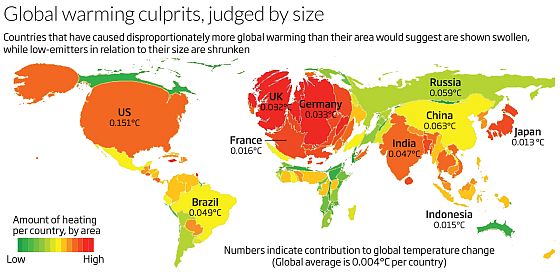
The United States’ disproportionate impact on global warming

global-warming-culprits

New Scientist reports: It’s a chart that no one wants to top, but global warming’s worst offenders, in absolute terms, are the US, China, Russia, Brazil, India, Germany and the UK. New calculations suggest that these nations are responsible for more than 60 per cent of the global warming between 1906 and 2005.

Damon Matthews of Concordia University in Montreal, Canada, and his colleagues calculated national contributions to warming by weighting each type of emission according to the atmospheric lifetime of the temperature change it causes. Using historical data, they included carbon dioxide from burning fossil fuels and changes in land use – such as deforestation. They also accounted for methane, nitrous oxide and sulphate aerosols. These together account for 0.7 °C of the world’s 0.74 °C warming between 1906 and 2005.

The US is the clear leader, responsible for 0.15 °C, or 22 per cent of the 0.7 °C warming. China accounts for 9 per cent, Russia for 8 per cent, Brazil and India 7 per cent each, and Germany and the UK for 5 per cent each. [Continue reading…]

Facebooktwittermail

Administration retreats on environmental protection in talks on Pacific trade

The New York Times reports: The Obama administration is retreating from previous demands of strong international environmental protections in order to reach agreement on a sweeping Pacific trade deal that is a pillar of President Obama’s strategic shift to Asia, according to documents obtained by WikiLeaks, environmentalists and people close to the contentious trade talks.

The negotiations over the Trans-Pacific Partnership, which would be one of the world’s biggest trade agreements, have exposed deep rifts over environmental policy between the United States and 11 other Pacific Rim nations. As it stands now, the documents, viewed by The New York Times, show that the disputes could undo key global environmental protections.

The environmental chapter of the trade deal has been among the most highly disputed elements of negotiations in the pact. Participants in the talks, which have dragged on for three years, had hoped to complete the deal by the end of 2013.

Environmentalists said that the draft appears to signal that the United States will retreat on a variety of environmental protections — including legally binding pollution control requirements and logging regulations and a ban on harvesting sharks’ fins — to advance a trade deal that is a top priority for Mr. Obama. [Continue reading…]

Facebooktwittermail

Understanding the psychology shaping negotiations with Iran

“The only way for interaction with Iran is dialogue on an equal footing, confidence-building and mutual respect as well as reducing antagonism and aggression,” Iranian President Hassan Rouhani said in a speech after taking the oath of office last August.

“If you want the right response, don’t speak with Iran in the language of sanctions, speak in the language of respect.”

In the following article, Nicholas Wright and Karim Sadjadpour describe how an understanding of neuroscience — or lack of it — may determine the outcome of negotiations with Iran.

The whole piece is worth reading, but keep this in mind: every single insight that gets attributed to neuroscience has been clearly established without the need to conduct a single brain scan. Indeed, everything that is here being attributed to the “exquisite neural machinery” of the brain can be understood by studying the workings of the human mind and how thought shapes behavior.

It is important to draw a sharp distinction between the examination of the mind and observing the workings of the brain because the latter is totally dependent on the output of intermediary electronic scanning devices, whereas minds can study themselves and each other directly and through shared language.

One of the insidious effects of neuroscience is that it promotes a view that understanding the ways brains work has greater intrinsic value than understanding how minds work. What the negotiations with Iran demonstrate, however, is that the exact opposite is true.

To the extent that through the development of trust, negotiations are able to advance, this will have nothing to do with anyone’s confidence about what is happening inside anyone’s brain. On the contrary, it will depend on a meeting of minds and mutual understanding. No one will need to understand what is happening in their own or anyone else’s insula cortex, but what will most likely make or break the talks will be whether the Iranians believe they are being treated fairly. The determination of fairness does not depend on the presence or absence of a particular configuration of neural activity but rather on an assessment of reality.

Treat us as equals, Iran’s president said — and that was almost 15 years ago!

Nicholas Wright and Karim Sadjadpour write: “Imagine being told that you cannot do what everyone else is doing,” appealed Iranian Foreign Minister Javad Zarif in a somber YouTube message defending the country’s nuclear program in November. “Would you back down? Would you relent? Or would you stand your ground?”

While only 14 nations, including Iran, enrich uranium (e.g. “what everyone else is doing”), Zarif’s message raises a question at the heart of ongoing talks to implement a final nuclear settlement with Tehran: Why has the Iranian government subjected its population to the most onerous sanctions regime in contemporary history in order to do this? Indeed, it’s estimated that Iran’s antiquated nuclear program needs one year to enrich as much uranium as Europe’s top facility produces in five hours.

To many, the answer is obvious: Iran is seeking a nuclear weapons capability (which it has arguably already attained), if not nuclear weapons. Yet the numerous frameworks used to explain Iranian motivations—including geopolitics, ideology, nationalism, domestic politics, and threat perception—lead analysts to different conclusions. Does Iran want nuclear weapons to dominate the Middle East, or does it simply want the option to defend itself from hostile opponents both near and far? While there’s no single explanation for Tehran’s actions, if there is a common thread that connects these frameworks and may help illuminate Iranian thinking, it is the brain.

Although neuroscience can’t be divorced from culture, history, and geography, there is no Orientalism of the brain: The fundamental biology of social motivations is the same in Tokyo, Tehran, and Tennessee. It anticipates, for instance, how the mind’s natural instinct to reject perceived unfairness can impede similarly innate desires for accommodation, and how fairness can lead to tragedy. It tells us that genuinely conciliatory gestures are more likely and natural than many believe, and how to make our own conciliatory gestures more effective.

Distilled to their essence, nations are led by and comprised of humans, and the success of social animals like humans rests on our ability to control the balance between cooperation and self-interest. The following four lessons from neuroscience may help us understand the obstacles that were surmounted to reach an interim nuclear deal with Iran, and the enormous challenges that still must be overcome in order to reach a comprehensive agreement. [Continue reading…]

Facebooktwittermail

Al Qaeda’s real impotence and the threat from Iraq’s prime minister Maliki

A lot of ink has been spilled in recent weeks about the rising power of al Qaeda.

“Fallujah fall just the beginning — Al Qaeda virus is virulent and spreading,” an op-ed by the Heritage Foundation’s Peter Brookes, captures the spirit of this perception of a resurgence of what some people portray as the greatest source of evil ever to appear on Planet Earth.

The thing is, viral growth of any kind cannot be reliably measured by the ability to grab headlines. However widely dispersed groups branded as al Qaeda affiliates become, the feature that distinguishes each of them is that their predilection for violence makes them unpopular. They are like psychopathic gatecrashers. Everyone knows when they show up at a party and everyone wishes they’d go some place else.

Scaring everyone around you is a good way of getting noticed but it’s not a good way of making friends and at the end of the day, whatever else one might say about these men of violence, they have profound problems making and sustaining meaningful relationships. Their dysfunctionality makes it impossible for them to become the driving force behind any popular social movement; their direct impact on the wider world will never be more than marginal.

The real global impact of al Qaeda is not one that it has the capacity to generate itself; it is the impact created by governments which either cynically or paranoiacally react to a threat whose scope they been blown out of all proportion.

Anthony H. Cordesman writes: No one can deny that al Qaeda is a violent extremist threat wherever it operates. It poses a threat in terms of transnational terrorism in the United States and Europe, and a far more direct threat to the people who live in every area it operates. It has consistently been horribly repressive, violent, and often murderous in enforcing its political control and demands for a form of social behavior that reflect the worst in tribalism and offers almost nothing in terms of real Islamic values.

Like all extreme neo-Salafi movements, al Qaeda is also an economic and social dead end. It does not offer any practical way of operating and competing in a global economy, it is too dysfunctional to allow meaningful education and social interaction, and it finances itself largely through extortion in ways that cripple the existing local economy. Moreover, it does not tolerate competition even from other Islamist fighters. In Syria, it has provoked its own civil war with other hardline Islamist movements – a civil war it now seems to be decisively losing to other Sunni rebel factions.

It is precisely that type of behavior, however, which should lead U.S. officials, analysts, and media to do a far, far better job of reporting on exactly what has really happened in Anbar, and in cities like Fallujah and Ramadi. Bad as Al Qaeda in Iraq (AQI) is, far too much of the evidence points to Prime Minister Maliki as an equal threat to Iraq and to U.S. interests. Ever since the 2010 election, he has become steadily more repressive, manipulated Iraq’s security forces to serve his own interests, and created a growing Sunni resistance to his practice of using Shi’ite political support to gain his own advantage.

He has refused to honor the Erbil power-sharing agreement that was supposed to create a national government that could tie together Arab Sunni and Arab Shi’ite, and he has increased tensions with Iraq’s Kurds. As the U.S. State Department human rights reports for Iraq, Amnesty International, and the United Nations Assistance Mission for Iraq (UNAMI) make all too clear; Maliki’s search for power has steadily repressed and alienated Iraq’s Sunnis on a national level. It has led to show trials and death sentences against one of Iraq’s leading Sunni politicians including former Vice President Taqris al-Hashimi, who has been living in asylum in Turkey since being convicted and sentenced to death in absentia by an Iraqi court. It has shifted the promotion structure in the Iraqi Security Forces to both give the Prime Minister personal control and has turned them into an instrument he can use against Sunnis.

Al Qaeda in Iraq – nor its recent incarnation the Islamic State of Iraq and Syria (ISIS) or the Islamic State of Iraq and the Levant (ISIL) – has not risen up as a rebirth of the opposition the U.S. faced in 2005-2008. In spite of attempts by the Maliki government to label virtually any major Sunni opposition as terrorists, the steady increase in that opposition orginated primarily in the form of peaceful and legitimate political protests against Maliki’s purges of elected Iraqi Sunni leaders, and a regular exclusion of Sunnis from the government – including the Sons of Iraq in areas like Anbar. It came because Maliki used the Iraqi Security Forces against segments of his own population in the name of fighting terrorists and extremists. It came because of the failure to use Iraq’s oil wealth effectively and fairly – resulting with an economy that the CIA ranks Iraq 140th in the world in per capita income. The opposition to Maliki’s government also resulted from corruption so extreme that in December 2013 Transparency International ranked Iraq the seventh most corrupt country in the world, with only Libya, South Sudan, Sudan, Afghanistan, North Korea, and Somalia ranking worse than Iraq in terms of corruption.

Any analysis or news report that focuses only on al Qaeda’s very real abuses is little more than worthless – it encourages the tendency to demonize terrorism without dealing with the fact that terrorism almost always only succeeds when governments fail their people. Just as serious counterinsurgency can never be successful if it only addresses the military dimension, counterterrorism cannot succeed if it is not coupled with an effort to address the quality of the nation’s political leadership and governance, and the legitimate concerns of its people.

Any failure to analyze Maliki’s actions since the 2010 election – his disregard for the Erbil agreement that called for a true national government, his manipulation of the courts to create multiple trails and death sentences for political oppponents, including one of Iraq’s vice presidents – Tariq al-Hashemi; his use of temporary appointments to take control of key command positions in the Iraqi Security Forces; his efforts to bribe senior Iraqi Sunni politicians to support him with ministerial posts; and his steadily increasing suppression of Sunni popular opposition and protests – is dishonest, lazy, intellectual rubbish. [Continue reading…]

Facebooktwittermail

Egypt’s security state is triumphant once again

Jared Malsin reports from Cairo: Dozens of men lined the sidewalk outside a school in Cairo’s upper-class Mohandessin neighborhood on Tuesday morning, the first day of voting on Egypt’s new constitution. Soldiers in tan fatigues armed with AK-47s motioned for the men to enter, four or five at a time. Inside the gates, one group of mostly elderly men argued with the army officer in charge. “We can’t find our names on the list!” shouted one man. The officer dialed his cell phone, assuring the man he would find his polling station.

The proposed constitution, drafted under a military-backed government in the months since the ouster of President Mohamed Morsi in July, further insulates the police and armed forces from civilian control and could enshrine the military’s power within the Egyptian state for decades. Nearly three years after a popular uprising forced autocrat Hosni Mubarak from power, Egypt’s security state is triumphant once again. Since Morsi’s removal, more than a thousand people have been killed in a government crackdown on supporters of Morsi’s Muslim Brotherhood and its allies. Hundreds of others have been jailed, including journalists and leading activists who opposed Mubarak and Morsi. With most of the media backing the current regime, and much of the public either voicing support for the military or simply resigned to the reality of the current political arrangement, the forces of the 2011 revolution are struggling to be heard.

At three separate polling stations on Tuesday, every voter interviewed backed the constitution. “I believe that this constitution is a very good constitution, and this is just to give a message that we don’t want the Muslim Brotherhood. We want a new regime of freedom and democracy,” says Inas Mazen, a 60-year-old doctor, at a women’s polling station in Mohandessin. Egypt’s Elections Committee on Monday reported that 15% of voters had turned out so far, according to the leading news site Ahram Online. Nine people were killed in violence at polling stations as security forces clashed with protesters, and an explosion hit a courthouse in Cairo’s Imbaba district, causing no reported injuries.

In spite of criticism from rights groups and political dissidents about both the content of the constitution and the integrity of the voting process, the document is expected to be approved by a majority of voters. Recent history suggests voters will choose a concrete constitutional option and the prospect of political stability over the chaos of a no vote. Majorities also voted yes in constitutional referendums in Egypt in 2011 and 2012.

This week’s referendum is also taking place amid government harassment of those opposed to the document. One of the only groups actively urging a no vote, the Strong Egypt Party, suspended its campaign on Sunday after 11 activists were arrested in three separate incidents hanging posters and distributing campaign materials. “It’s a referendum with one choice only, and it’s yes. No is not allowed,” says Strong Egypt Party representative Fekry Nabil. “This process is not free and not fair, and we cannot join it.” [Continue reading…]

Facebooktwittermail

If you want Obama to rein in the NSA, you’re about to be disappointed

James Oliphant writes: President Obama has a rare opportunity this week to reshape the nation’s counterterrorism strategy. He won’t take it.

The White House has been trying to lower expectations for the president’s planned Friday speech for days now. He’ll outline a series of reforms to the National Security Agency’s surveillance programs in an address at the Justice Department, but Obama will do nothing to diminish the government’s capacity to root out terror networks, aides say.

Ever since the flood of disclosures regarding the NSA from former contractor Edward Snowden, Obama and his team have tried to walk a careful public line: appearing to cherish Americans’ privacy while defending the agency’s actions, particularly the bulk collection of telephone records, the so-called “metadata.”

But it’s been evident all along that the White House has more or less been dragged into the reform debate. At a press conference back in August, for example, the president maintained, amid heavy criticism, that the programs are valuable and that a public skeptical about their reach simply needs reassurance that they won’t be abused.

That’s still Obama’s view. And in the days leading to Friday’s speech, Jay Carney and others in the White House have referred to the issue as one of transparency and disclosure, not of reining in government power. “The president has been clear throughout this review process that we will not harm our national security or our ability to face global threats,” Obama’s press secretary said last week. “And our intelligence-gathering activities are directly related to our ability to face those global threats and protect our national security.”

To lay the groundwork for that position, aides to the president told the Los Angeles Times this weekend that the NSA’s metadata collection scheme could have prevented the Sept. 11 attacks. What’s more, Obama has adopted that “9/11 justification” for the NSA program, the paper reported.

That’s a blinking-red signal that the administration is not about to be accused of making the country more vulnerable by tampering with such a preventive weapon. [Continue reading…]

Facebooktwittermail

Edward Snowden isn’t the only truth teller who deserves clemency

Michael Ratner, the U.S. attorney for Julian Assange, writes: Last week, both the New York Times and the Guardian released editorials supporting clemency for NSA leaker Edward Snowden. Considering the important nature of Snowden’s revelations, clemency is definitely in order – and it’s about time that majorww outlets recognize that.

However, the focus on Snowden’s singular case seriously deflects from the fact that the Obama administration has been a nightmare for whistleblowers and truth tellers, and that several others currently in prison or in exile deserve the same clemency or clear assurances they will not be prosecuted.

So why is the media now calling for mercy for Edward Snowden, while other truth tellers including Chelsea Manning and Julian Assange, continue to face persecution (and prosecution)?

If you apply the criteria established by both the New York Times and the Guardian to Manning and Assange – as well as other truth tellers including Jeremy Hammond, currently in prison serving a 10-year sentence after exposing corporate spy networks – a clear double standard emerges. [Continue reading…]

Facebooktwittermail

NSA devises radio pathway into computers

The New York Times reports: The National Security Agency has implanted software in nearly 100,000 computers around the world that allows the United States to conduct surveillance on those machines and can also create a digital highway for launching cyberattacks.

While most of the software is inserted by gaining access to computer networks, the N.S.A. has increasingly made use of a secret technology that enables it to enter and alter data in computers even if they are not connected to the Internet, according to N.S.A. documents, computer experts and American officials.

The technology, which the agency has used since at least 2008, relies on a covert channel of radio waves that can be transmitted from tiny circuit boards and USB cards inserted surreptitiously into the computers. In some cases, they are sent to a briefcase-size relay station that intelligence agencies can set up miles away from the target.

The radio frequency technology has helped solve one of the biggest problems facing American intelligence agencies for years: getting into computers that adversaries, and some American partners, have tried to make impervious to spying or cyberattack. In most cases, the radio frequency hardware must be physically inserted by a spy, a manufacturer or an unwitting user.

The N.S.A. calls its efforts more an act of “active defense” against foreign cyberattacks than a tool to go on the offensive. But when Chinese attackers place similar software on the computer systems of American companies or government agencies, American officials have protested, often at the presidential level. [Continue reading…]

Facebooktwittermail

The net neutrality battle has been lost. Now we can win the war

Marvin Ammori writes: The D.C. Circuit Court of Appeals just issued its long-awaited decision striking down the FCC’s network neutrality rule. This is the second time in four years that this court struck down the FCC’s attempt to adopt a network neutrality rule. It is now legal for AT&T or Verizon to block Slate, your blog, or any other site.

Even though the Internet touches every part of our lives, one person is to blame for potentially destroying its potential for innovation and freedom of expression: former FCC Chairman Julius Genachowski.

The court loss was even more emphatic and disastrous than anyone expected. But this defeat comes with a silver lining: It may force the new FCC chairman to act.

“Network neutrality” is sometimes called “Internet freedom” or “Internet openness” and is a legal principle that would forbid cable and phone companies like AT&T, Verizon, and Comcast from blocking some websites or providing special priority to others. It would forbid Comcast from blocking Facebook or Bing. It would forbid Verizon from, say, charging the Huffington Post for special service to load more quickly than Slate.

Without network neutrality, cable and phone companies could stifle innovation. Imagine if, years ago, MySpace or AltaVista had cut deals with cable companies to block Facebook and Google. Without network neutrality, telecom and cable companies could also stifle free expression. They’d have the legal right to block articles like this one. [Continue reading…]

Facebooktwittermail

Egypt’s military rulers plot to provoke uprising in Gaza

Reuters reports: After crushing the Muslim Brotherhood at home, Egypt’s military rulers plan to undermine the Palestinian militant group Hamas, which runs the neighboring Gaza Strip, senior Egyptian security officials told Reuters.

The aim, which the officials say could take years to pull off, includes working with Hamas’s political rivals Fatah and supporting popular anti-Hamas activities in Gaza, four security and diplomatic officials said.

Since it seized power in Egypt last summer, Egypt’s military has squeezed Gaza’s economy by destroying most of the 1,200 tunnels used to smuggle food, cars and weapons to the coastal enclave, which is under an Israeli blockade.

Now Cairo is becoming even more ambitious in its drive to eradicate what it says are militant organizations that threaten its national security.

Intelligence operatives, with help from Hamas’s political rivals and activists, plan to undermine the credibility of Hamas, which seized control of Gaza in 2007 after a brief civil war against the Fatah movement led by Western-backed Palestinian President Mahmoud Abbas.

According to the Egyptian officials, Hamas will face growing resistance by activists who will launch protests similar to those in Egypt that have led to the downfall of two presidents since the Arab Spring in 2011. Cairo plans to support such protests in an effort to cripple Hamas.

“Gaza is next,” said one senior security official, who requested anonymity because of the sensitivity of the issue. “We cannot get liberated from the terrorism of the Brotherhood in Egypt without ending it in Gaza, which lies on our borders.” [Continue reading…]

Facebooktwittermail

Washington ready to send $1.5 billion aid to Egypt’s military rulers

The Daily Beast reports: Congress is preparing to allow the Obama administration to give more than $1 billion dollars to the Egyptian government and military, despite the fact the generals perpetrated a coup last summer and are suppressing opposition ahead of a nation-wide constitutional referendum.

The House and Senate are set to unveil a year-long spending bill that will loosen restrictions on U.S. aid to Egypt and negate the law that prevents the U.S. from funding a foreign military that has conducted a coup against a democratically elected government. The Obama administration has been lobbying Congress for permission to give the aid to the Egyptian government. Several senior senators had been working to make sure that aid was conditioned on the Egyptian government pursing a path toward democracy and respect for the rule of law.

But now, with the Egyptians speeding toward a Constitutional referendum that will cement the rule of the military-led regime and with the Egyptian government’s crackdown on the opposition ongoing, most of those conditions could be lifted by Congress or waived by the Obama administration.

For experts and congressional officials who have followed the Obama administration’s clumsy and often incoherent policy on Egypt, the potential easing of restrictions on aid represents only the latest unfortunate twist in a failed effort to preserve U.S. influence in the Arab world’s most populous country.

“When the omnibus bill is passed, there’s going to be legislation in it that in effect is going to give the administration a waiver from the coup provisions and allow them to restore aid to Egypt,” said Michele Dunne, senior associate at the Carnegie Endowment for International Peace.

Ever since the Egyptian military ousted and jailed ex-president Mohamed Morsi last July and began its campaign of arresting opposition leaders and protesters, the Obama administration and Congress have been withholding most of the $1.5 billion in annual aid the U.S. gives Egypt, most of which goes directly to the country’s army.

“I think there’s a sense of giving up on Egypt [inside of the Obama administration], on the Hill as well,” said Dunne. “There’s a sense that ‘Oh well they tried a democratic transition, it didn’t work, but we don’t want to cut ourselves off from Egypt as a security ally, so let’s just forget about the whole democracy and human rights thing except for giving it some lip service from time to time.’” [Continue reading…]

Facebooktwittermail