Wikileaks: On November 13, 2013, WikiLeaks released the secret negotiated draft text for the entire TPP (Trans-Pacific Partnership) Intellectual Property Rights Chapter. The TPP is the largest-ever economic treaty, encompassing nations representing more than 40 per cent of the world’s GDP. The WikiLeaks release of the text comes ahead of the decisive TPP Chief Negotiators summit in Salt Lake City, Utah, on 19-24 November 2013. The chapter published by WikiLeaks is perhaps the most controversial chapter of the TPP due to its wide-ranging effects on medicines, publishers, internet services, civil liberties and biological patents. Significantly, the released text includes the negotiation positions and disagreements between all 12 prospective member states.
The TPP is the forerunner to the equally secret US-EU pact TTIP (Transatlantic Trade and Investment Partnership), for which President Obama initiated US-EU negotiations in January 2013. Together, the TPP and TTIP will cover more than 60 per cent of global GDP. Both pacts exclude China.
Since the beginning of the TPP negotiations, the process of drafting and negotiating the treaty’s chapters has been shrouded in an unprecedented level of secrecy. Access to drafts of the TPP chapters is shielded from the general public. Members of the US Congress are only able to view selected portions of treaty-related documents in highly restrictive conditions and under strict supervision. It has been previously revealed that only three individuals in each TPP nation have access to the full text of the agreement, while 600 ‘trade advisers’ – lobbyists guarding the interests of large US corporations such as Chevron, Halliburton, Monsanto and Walmart – are granted privileged access to crucial sections of the treaty text. [Continue reading…]
Feinstein promotes bill to strengthen NSA’s hand on warrantless searches
The Guardian reports: A Senate bill promoted as a surveillance reform would codify the ability of the National Security Agency to search its troves of foreign phone and email communications for Americans’ information, and permit law enforcement agencies to search the vast databases as well.
The Fisa Improvements Act, promoted by Dianne Feinstein, the California Democrat who chairs the Senate intelligence committee, would both make permanent a loophole permitting the NSA to search for Americans’ identifying information without a warrant – and, civil libertarians fear, contains an ambiguity that might allow the FBI, the DEA and other law enforcement agencies to do the same thing.
“For the first time, the statute would explicitly allow the government to proactively search through the NSA data troves of information without a warrant,” said Michelle Richardson, the surveillance lobbyist for the ACLU.
“It may also expand current practices by allowing law enforcement to directly access US person information that was nominally collected for foreign intelligence purposes. This fourth amendment back door needs to be closed, not written into stone.” [Continue reading…]
Eric Holder doesn’t see any basis to prosecute Glenn Greenwald… for now
Mike Masnick writes: It’s not a complete promise, but in an interview with the Washington Post, Attorney General Eric Holder suggested that, while he disagrees with some of what Glenn Greenwald is doing, he still thinks it’s legitimate journalism and he’s not looking to prosecute him for anything related to the Ed Snowden NSA leaks:
Holder indicated that the Justice Department is not planning to prosecute former Guardian reporter Glenn Greenwald, one of the journalists who received documents from Snowden and has written a series of stories based on the leaked material. Greenwald, an American citizen who lives in Brazil, has said he is reluctant to come to the U.S. because he fears detention and possible prosecution.
“Unless information that has not come to my attention is presented to me, what I have indicated in my testimony before Congress is that any journalist who’s engaged in true journalistic activities is not going to be prosecuted by this Justice Department,” Holder said.
“I certainly don’t agree with what Greenwald has done,” Holder said. “In some ways, he blurs the line between advocate and journalist. But on the basis of what I know now, I’m not sure there is a basis for prosecution of Greenwald.”
That’s not exactly a ringing endorsement of freedom of the press, nor is it probably enough to make Greenwald feel comfortable. [Continue reading…]
Libya protest turns deadly as militias open fire
The New York Times reports: Dozens of people were killed in the Libyan capital, Tripoli, on Friday after militiamen opened fire on unarmed protesters, setting off some of the worst violence in the capital since the revolt against Col. Muammar el-Qaddafi almost three years ago.
The bloodshed at the protest on Friday afternoon quickly devolved into clashes involving armed citizens and rival militias, witnesses said. At hospitals, bodies arrived mangled by heavy-weapons fire. Air force jets flew sorties over the city, as pickup trucks carrying reinforcements of fighters raced to the clashes.
The protest that led to the violence was part of a rising tide of citizen anger against Libya’s multitude of militias, made up of thousands of men who fought Colonel Qaddafi’s forces and never laid down their arms. The militias have fed Libya’s chronic insecurity, fighting among themselves while exerting control over vital installations and even resources like oil. Fighters pledge loyalty to their commanders, tribes or towns, rather than the weak central government.
Yet the nature of the violence on Friday seemed to represent an especially ominous turn for the country, dragging it back to the winter three years ago when Colonel Qaddafi’s soldiers, roaming the capital in jeeps, gunned down protesters in the streets. [Continue reading…]
Syrian Army Retakes important towns in Aleppo, Homs and Damascus. Both Salah and Salameh, leaders of largest Aleppo militia, wounded
Syria Comment: The Syrian Army has gone on the offensive, retaking a key town – al-Sfireh – on the south-east of Aleppo. On Monday, the town of Tal Aran, on the Safira-Aleppo road, also fell. The army then secured the area around the city’s airport and retook a strategically important base nearby, named Base 80, a large military position which rebels had held since February. Analysts claim that the base will help regime troops move on opposition-held areas of Aleppo.
The response of rebel militas was immediate. A statement by the Islamic State of Iraq and the Levant (ISIS) urged “all brigades and Muslims to face off against the enemy.” Liwa al-Tawhid urged people in Aleppo to “face up to regime attacks” and called for a mass mobilisation in Aleppo to halt a government advance. They claimed that government forces backed by fighters from the Lebanese Shia Islamist movement Hezbollah, Iranian Revolutionary Guards and members of Abu al-Fadl Abbas, an Iraqi Shia militia, had launched a “fierce offensive to reoccupy” Aleppo.
Within a few days, The Syrian Army killed a number of the leaders of Aleppo’s largest militia – Liwaa al-Tawhid. Its top leaders, Abd al-Qader al-Saleh & Abd Aziz Salehmeh were both injured, but are in good condition. The unit commander Youssef al-Abbas was killed. The regime bombed a meeting of Liwaa al-Tawhid leaders, suggesting it has improved its intelligence operations. Liwaa la-Tawhid has about 25-30 unit commanders joined at the top by Saleh/Salame, the majority stationed in the Aleppo region. [Continue reading…]
Music: Gustavo Santaolalla — ‘Deportation/Iguazu’
Has Iran outwitted Netanyahu?
Rajan Menon writes: The much-anticipated breakthrough in the negotiations aimed at preventing Iran from building nuclear weapons has yet to materialize. But Israeli prime minister Binyamin Netanyahu, who believes that a wily Iran is outwitting its gullible interlocutors, isn’t breathing any easier; instead, he’s breathing fire. The statements from those involved in the talks (Iran and the P5+1) indicating that the obstacles to an interim accord are being overcome have incensed Netanyahu. And he has made his displeasure known — publicly and without pulling punches — even though the first-step agreement with Iran couldn’t be reached in the end.
As the upbeat reports streamed in last week, Netanyahu declared that a compromise with Iran would be a betrayal of Israel as well as a strategic blunder that would eventually bring grief to other states as well. He continues to insist that Israel will neither be bound by any deal, short of one that ensures denuclearization, that the P5+1 reaches with Iran nor rule out any response (read: a military strike) it deems necessary to defend its interests.
What are those Israeli interests? While Iranian leadership remains adamant about retaining an independent nuclear fuel cycle, which it regards as its right under the terms of the NPT, Israel has made it just as plain that Iran’s acquisition of that capability is unacceptable — period. That’s because the Israeli leadership is convinced that any accord that permits Iran to enrich uranium to a level needed for generating electricity, even under strict verification, enables it to gain, and pretty quickly, the capacity to dash across the nuclear threshold when it wishes to do so.
While this perspective explains Netanyahu’s scorn for the negotiations, he risks becoming isolated should the dealmakers eventually start viewing him as an obstreperous maximalist who is heedless of the risk of war. Moreover, he doesn’t have sure-fire options for dismantling Iran nuclear complex, which consists of many facilities, widely dispersed and well protected. [Continue reading…]
Iran slows nuclear advances in possible goodwill gesture
Barbara Slavin reports: Although Iran and the international community failed to achieve a breakthrough in Geneva last week, Iran has slowed its nuclear program in what could be a goodwill gesture intended to show that it will abide by a nuclear agreement.
According to the latest quarterly report by the International Atomic Energy Agency (IAEA), Iran has added only four rudimentary centrifuges to its main uranium enrichment plant at Natanz since August, for a total of 15,240 — of which about 10,000 are operating. In the previous reporting period of May to August, Iran put more than 1,800 new centrifuges into Natanz.
The Iranians continued to enrich uranium and now have a stockpile of more than 7,000 kilograms of uranium enriched to 5% U-235. But its stockpile of 20% uranium — perilously close to weapons grade — remains largely in a form difficult to further enrich, according to the IAEA. Iran added only 10 kilograms to its stockpile of greatest concern, for a total of 196 kilograms – still below the Israeli “red line” of 240 kilograms sufficient, if further processed, to make a nuclear weapon.
The report comes at an extremely sensitive time, with negotiations due to resume in Geneva next week between Iran and the five permanent members of the UN Security Council plus Germany (the P5+1) on an agreement that would pause much of the Iranian program and roll back some of it in return for moderate sanctions relief. The Barack Obama administration is trying to convince the US Senate not to approve more sanctions while the negotiations continue; this IAEA report could help its case. [Continue reading…]
National Security State: FBI and DHS warn Congress about the domestic threat
The Washington Post reports: FBI Director James B. Comey testified Thursday that the risk of cyberattacks is likely to exceed the danger posed by al-Qaeda and other terrorist networks as the top national security threat to the United States and will become the dominant focus of law enforcement and intelligence services.
Appearing before the Senate Homeland Security Committee, Comey said he expected Internet-related attacks, espionage and theft to emerge as the most consuming security issue for the United States by the end of his 10-year FBI term.
“We have connected all of our lives — personal, professional and national — to the Internet,” Comey said. “That’s where the bad guys will go because that’s where our lives are, our money, our secrets.”
The warning underscored the growing sense of alarm among officials in Washington over the nation’s vulnerability to online attacks as well as the diminished ability of al-Qaeda to mount plots against the United States after more than a decade of CIA drone strikes and other counterterrorism operations.
Rand Beers, the acting homeland security secretary, said his agency is working with European allies to identify and track militants from Western nations who may travel to Syria and then seek to return.
Despite that potential danger, officials said that the main terrorist threat inside the United States is that U.S. citizens or residents could adopt militant ideologies and develop plans for domestic attacks without communicating with terrorist networks or traveling overseas.
Tamerlan and Dzhokhar Tsarnaev, ethnic Chechen brothers accused of carrying out the bombings at the Boston Marathon this year, had “no formal or direct ties to al-Qaeda” but had embraced aspects of the terrorist group’s ideology, Olsen said. He added that cooperation with Russian intelligence services has improved since the Boston attacks.
The officials said counterterrorism efforts had been damaged by leaks of U.S. intelligence operations by former National Security Agency contractor Edward Snowden, and they warned of the impact of the budget cuts known as sequestration. Comey said the FBI is in the process of eliminating 3,500 positions because of budget pressures.
Despite concern about “homegrown extremists,” Comey said that he had concluded after just two months on the job that cyberthreats are likely to be more worrisome in the long term.
“That is why we anticipate that in the future, resources devoted to cyber-based threats will equal or even eclipse the resources devoted to non-cyber-based terrorist threats,” Comey said.
CIA collecting data on international money transfers, officials say
The New York Times reports: The Central Intelligence Agency is secretly collecting bulk records of international money transfers handled by companies like Western Union — including transactions into and out of the United States — under the same law that the National Security Agency uses for its huge database of Americans’ phone records, according to current and former government officials.
The C.I.A. financial records program, which the officials said was authorized by provisions in the Patriot Act and overseen by the Foreign Intelligence Surveillance Court, offers evidence that the extent of government data collection programs is not fully known and that the national debate over privacy and security may be incomplete.
Some details of the C.I.A. program were not clear. But it was confirmed by several current and former officials, who spoke on the condition of anonymity because the matter is classified.
The data does not include purely domestic transfers or bank-to-bank transactions, several officials said. Another, while not acknowledging the program, suggested that the surveillance court had imposed rules withholding the identities of any Americans from the data the C.I.A. sees, requiring a tie to a terrorist organization before a search may be run, and mandating that the data be discarded after a certain number of years. The court has imposed several similar rules on the N.S.A. call logs program.
Several officials also said more than one other bulk collection program has yet to come to light.
“The intelligence community collects bulk data in a number of different ways under multiple authorities,” one intelligence official said. [Continue reading…]
NSA and DHS try to suppress free speech

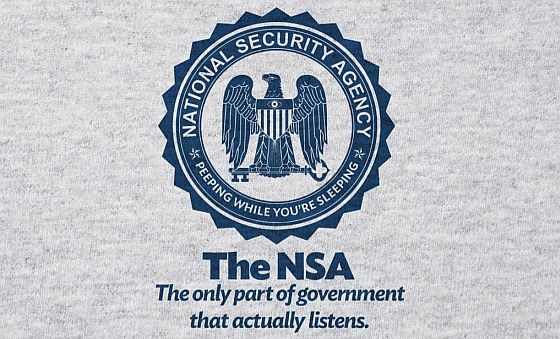
VOA reports: The U.S. National Security Agency and the Department of Homeland Security have threatened legal action to block the sale of T-shirts that ridicule these two powerful government agencies. But the T-shirt designer says NSA and DHS are the ones breaking the law by assaulting free speech, a pillar of democratic society.
A judge may decide who is right.
One T-shirt calls the NSA the “only part of the government that actually listens,” a joke that plays on the NSA’s controversial, and critics say overzealous, monitoring of communications worldwide. Americans tend to laugh out loud when they see the message.
Another shirt parodies the DHS logo, rewritten as the “Department of Homeland Stupidity.”
Agency officials have sent stern letters to the printer who makes and distributes these designs, demanding an immediate halt, according to T-shirt designer Dan McCall. He says the letters cite federal laws banning unauthorized use or defacement of official logos. [Continue reading…]
Google warns about the NSA threat to the U.S. economy
The New York Times reports: Google’s canned responses to reports of government spying have ranged from “concerned” to “outraged.” But some of its employees have been more outspoken.
One of Google’s top lawyers testified before Congress Wednesday about surveillance, demanding urgent reform of email privacy laws and warning of threats to the open Internet and to the United States economy. Meanwhile, Google engineers who work on security railed against the government online.
The backlash against government Internet surveillance could hurt the United States economy, partly because businesses and consumers could abandon United States cloud companies, said Richard Salgado, the director for law enforcement and information security at Google, in testimony before the Senate judiciary subcommittee on privacy, technology and the law.
He cited studies like one from Forrester that predicted the cloud computing industry could lose $180 billion, 25 percent of its revenue, by 2016. [Continue reading…]
Obama vs. the generals
Rosa Brooks writes: After a spate of news stories this summer citing tensions between President Barack Obama and his top military commanders over the possibility of U.S. intervention in Syria, White House chief of staff Denis McDonough hastened to assure the Washington Post that everything was, in fact, copacetic: The president “appreciates” candid military advice “above all else,” McDonough insisted, and has “close, and in some instances warm, relationships with his military chiefs,” as the Post put it. During my own time at the Pentagon, where I worked as an Obama appointee from the spring of 2009 until mid-2011, few seemed to hold this view. I recall asking one general, recently back from Afghanistan, if he’d shared his experiences and insights with the president. Rolling his eyes, he told me grimly that the White House preferred the military to be seen but not heard.
Curious about whether things had changed since then, I asked a dozen serving and recently retired senior military officers with high-level White House access, many of whom were not comfortable speaking on the record, if they knew of any military leaders with whom the president had a close and warm personal relationship. In every case, the initial response was a long silence. “That’s a great question,” said one retired senior officer, after a lengthy pause. “Good question. I don’t know,” said a second. “I don’t think he’s close to anyone,” commented a third. He just doesn’t seem to have any interest in “getting to know” the military, a retired general concluded.
Of course, there’s no law that requires the president to invite his top generals for pajama parties or rounds of golf, and being “close” to military leaders is no guarantee of sound decision-making. But all of this raises an increasingly relevant question: How has the president—the man who promised to “finish the job” in Afghanistan, close the door on the unpopular Iraq War and “end the mind-set that got us into the war in the first place”—managed a military he often seems to regard with mistrust and unease? [Continue reading…]
British press freedom under threat
In an editorial, the New York Times says: Britain has a long tradition of a free, inquisitive press. That freedom, so essential to democratic accountability, is being challenged by the Conservative-Liberal Democrat coalition government of Prime Minister David Cameron.
Unlike the United States, Britain has no constitutional guarantee of press freedom. Parliamentary committees and the police are now exploiting that lack of protection to harass, intimidate and possibly prosecute The Guardian newspaper for its publication of information based on National Security Agency documents that were leaked by Edward Snowden. The New York Times has published similar material, believing that the public has a clear interest in learning about and debating the N.S.A.’s out-of-control spying on private communications. That interest is shared by the British public as well.
In the United States, some members of Congress have begun pushing for stronger privacy protections against unwarranted snooping. British parliamentarians have largely ducked their duty to ask tough questions of British intelligence agencies, which closely collaborate with the N.S.A., and have gone after The Guardian instead.
Alan Rusbridger, the newspaper’s editor, has been summoned to appear before a parliamentary committee next month to testify about The Guardian’s internal editorial decision-making regarding the Snowden information. Members of Parliament have also demanded information on the newspaper’s decision to make some of the leaked information available to other journalists, including those at The Times. That should be none of Parliament’s business. Meanwhile, Scotland Yard detectives are pursuing a criminal investigation into The Guardian’s actions surrounding the Snowden leaks.
These alarming developments threaten the ability of British journalists to do their jobs effectively. Britain’s press has long lacked the freedoms enjoyed by American newspapers. Now it appears they are less free from government interference than journalists in Germany, where Der Spiegel has published material from the Snowden leaks without incurring government bullying.
The global debate now taking place about intelligence agencies collecting information on the phone calls, emails and Internet use of private citizens owes much to The Guardian’s intrepid journalism. In a free society, the price for printing uncomfortable truths should not be parliamentary and criminal inquisition.
Police tried to spy on Cambridge University students, secret footage shows
The Guardian reports: Police sought to launch a secret operation to spy on the political activities of students at Cambridge University, a covertly recorded film reveals.
An officer monitoring political campaigners attempted to persuade an activist in his 20s to become an informant and feed him information about students and other protesters in return for money.
But instead the activist wore a hidden camera to record a meeting with the officer and expose the surveillance of undergraduates and others at the 800-year-old institution.
The officer, who is part of a covert unit, is filmed saying the police need informants like him to collect information about student protests as it is “impossible” to infiltrate their own officers into the university.
The Guardian is not disclosing the name of the Cambridgeshire officer and will call him Peter Smith. He asks the man who he is trying to recruit to target “student-union type stuff” and says that would be of interest because “the things they discuss can have an impact on community issues”. [Continue reading…]
Hugh Muir writes: The specifics of the Cambridge case will shock, but there is a now familiar narrative of how the secret snoopy state seeks to monitor the legitimate activity of those who might ask questions of it. This appears to be activity undertaken with little or no public consent or oversight. How much of this is going on? What are the guidelines? Are they adhered to by forces up and down the country? Is there central control? Who controls the information and how long is it kept? No doubt the Association of Chief Police Officers has rules but what do you know of the legislative framework? Who keeps the practice honest and ensures that the objective is the maintenance of law and order rather than the policing of irksome ideology? This week we learned of Green party London Assembly member Jenny Jones being monitored by Scotland Yard for attending legitimate left-leaning protest events. Are others so targeted? We don’t know. We should.
But this is also another example of the attempt by those in power to enlist citizens as agents of the state. In universities up and down the country there has been a considerable effort to cultivate assets capable of monitoring young Muslim students considered at risk of radicalisation. The government’s Prevent programme, and its deradicalisation arm Channel, has drawn on the university establishments themselves: lecturers and bureaucrats as surveillance assets. The result is predictable. Yesterday Ratna Lachman, director of the human rights group Just West Yorkshire, told a Society for Educational Studies seminar of fears that some universities have become “Islamophobic spaces” for those who now regard them as “extensions of the security arm of the state”.
The government orders landlords to report illegal immigrants; property owners as surveillance assets. GPs to check the legal status of those they might treat; medical staff as surveillance assets. As the state shrinks in size, as the prime minister says it will, it needs an army of narks to engage in surveillance and policing in a different sphere. Maybe that’s part of his big society. [Continue reading…]
As powers push for talks, Syria balance tilts towards Assad
Reuters reports: More than two and a half years into the civil war devastating Syria, the United States and Russia are pushing the combatants to the negotiating table in Geneva, but on terms that mark a shift in favour of Bashar al-Assad against the increasingly fragmented rebels seeking to oust him.
Since the August 21 nerve gas attacks on rebel suburbs ringing Damascus, which brought the U.S. to the brink of a missile assault on Assad’s forces, the diplomatic tide has turned against the opposition, which briefly believed external intervention would enable its forces to launch a final offensive.
Instead, the combination of hesitation by President Barack Obama’s administration and an 11th hour deal brokered by Russia, a key Assad ally, to decommission Syria’s chemical arsenal, has wrong-footed the rebels, now under intense U.S. and European pressure to attend talks in Geneva with a vague agenda.
Syrian opposition advisers and independent analysts fear this could channel the Syrian conflict – like other intractable regional problems such as the Israeli-Palestinian conflict – into a lengthy and fruitless process. [Continue reading…]
The friendly ties between Egyptian intelligence and the CIA
David Ignatius writes: The U.S.-Egyptian relationship has been through some rocky months since the June 30 military coup that toppled President Mohamed Morsi and the Muslim Brotherhood. But the strain doesn’t seem to have diminished cooperation between the two countries’ intelligence services.
Gen. Mohammed Farid el-Tohamy, the director of Egypt’s General Intelligence Service, said had been “no change” in his organization’s relationship with U.S. spy agencies, despite delay of some U.S. weapons deliveries to the Egyptian military and talk of new Egyptian military contacts with Russia.
“Cooperation between friendly services is in a completely different channel than the political channel,” Tohamy said. “I’m in constant contact with [Director] John Brennan at the CIA and the local station chief, more than with any other service worldwide.” [Continue reading…]