
Daily Archives: January 25, 2008

NEWS, ANALYSIS & OPINION: Hamas calls the shots

Hamas accepts invite to host Hamas-Fatah talks in Cairo

Hamas on Friday accepted Egyptian President Hosni Mubarak’s offer to host talks between rival Palestinian Fatah and Hamas leaders in Cairo.

Mubarak’s offer was made in an apparent effort to raise his country’s role as Mideast peace broker and ease the pressure following an influx of Palestinians into Egypt from the Hamas-controlled Gaza Strip. [complete article]

Mubarak under pressure

In Egypt, as elsewhere, all politics is ultimately local, and one serious problem for Mubarak is the link between the Brotherhood and Hamas, the Palestinian Islamist movement that won the 2006 elections and has been running Gaza since last summer’s coup, while keeping up (or failing to stop) daily salvoes of Qassam rockets being fired across the border into Israel.

Khaled Mishal, the influential Hamas leader in Damascus, has reportedly been on the phone to Mahdi Akef, the Brotherhood leader, to coordinate protests and maintain pressure. Both know this episode has been good for Hamas, bad for Mahmoud Abbas, the Palestinian president and Fatah leader who is committed to talks with Israel, as well as for Mubarak – and that it plays well with the Arab “street.”

Solidarity rallies with the Palestinians have been held from Mauritania in the far west of the Maghreb down to the Gulf. Al-Jazeera, the Arabic satellite TV channel, has been bombarding its viewers with the dramatic scenes from Gaza. [complete article]
wall-turned-into-playground.jpg

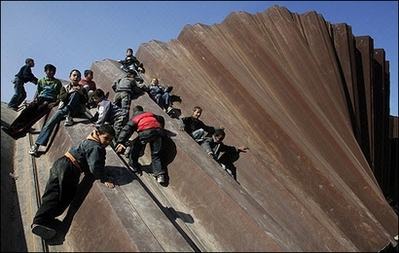
Wall comes tumbling down

There was some speculation today – for example, by the commentator Talal ‘Awkal in the Palestinian daily al-Ayyam – that Israel appeared to be hoping for a reversion to Gaza’s pre-67 status when it was controlled by Egypt, perhaps as a precursor to bringing the West Bank back into the Jordanian orbit. That followed the remarks by Israel’s deputy defence minister Matan Vilnai on Thursday that the opening of the Rafah border could pave the way for Israel permanently to hand over all responsibility for supplying Gaza to Egypt.

Neither is a serious option. The Palestinian national genie cannot be put back in the bottle, despite current divisions. And Israel remains the fully responsible occupying power in Gaza, controlling its land access, sea and air space and conducting regular military operations in the territory at will.

Those “incursions” are supposedly carried out to end rocket attacks from Gaza into southern Israel. If so, they are hopelessly ineffective. Benjamin Pogrund asked this week: what can Israel do to stop the rockets, which spread fear and demoralisation in towns like Sderot, even if – unlike Israeli attacks on Gaza – they rarely kill? The obvious answer is to end its illegal occupation of the Palestinian territories and negotiate a just settlement for the refugees, ethnically cleansed nearly 60 years ago, (who, with their families, make up a majority of the Gaza Strip’s population). [complete article]

Gazans with bulldozer defy Egypt’s efforts to close border

In a bold act of defiance, frustrated Palestinians trapped in the Gaza Strip on Friday confronted Egyptian security forces who were attempting to reseal the broken border, then brought in a bulldozer to open yet another breach.

As Egyptian forces in riot gear looked on, Palestinians rushed through the hole and abruptly halted Egypt’s attempts to close the border.

What was supposed to be the beginning of the end of a temporary escape valve for Gaza’s 1.5 million residents instead became a setback for Egyptian President Hosni Mubarak. [complete article]

See also, The Gaza ‘tea party’ (Sami Moubayed) and Hamas has gained from border breach, analysts say (Reuters).


Facebooktwittermail

NEWS: Bush administration still ambivalent about Iraqi sovereignty

U.S. asking Iraq for wide rights on war

With its international mandate in Iraq set to expire in 11 months, the Bush administration will insist that the government in Baghdad give the United States broad authority to conduct combat operations and guarantee civilian contractors specific legal protections from Iraqi law, according to administration and military officials.

This emerging American negotiating position faces a potential buzz saw of opposition from Iraq, with its fragmented Parliament, weak central government and deep sensitivities about being seen as a dependent state, according to these officials.

At the same time, the administration faces opposition from Democrats at home, who warn that the agreements that the White House seeks would bind the next president by locking in Mr. Bush’s policies and a long-term military presence. [complete article]

Iraq seeks sharp reduction in U.S. military role

… a senior member of the Iraqi negotiating team, which has been almost completely appointed, said they would seek to have U.S. troops — who for five years have conducted aggressive combat missions across the country against al-Qaida and other radical Muslim militias — largely confined to their bases.

U.S. troops would have only limited freedom of movement off base under Iraq’s position, leaving only when requested to provide intelligence, air support, equipment and other logistical support, the Iraqi negotiator said.

Plan would let Iraq fight its own battles
U.S. officials have long maintained that the Iraqi army is “all teeth and no tail,” meaning it is entirely focused on combat but is unable to operate independently because of equipment and intelligence shortfalls. The agreement, as envisioned by Iraq, would shift military operations inside the country to emphasize Iraq’s combat strength with sophisticated background support from U.S. units. [complete article]

Facebooktwittermail

NEWS: Is Nawaz Sharif the answer?

Sharif picked to tame Pakistan’s militancy

Seven years after the invasion of Afghanistan to oust the Taliban, Dell Dailey, the US State Department’s counterterrorism chief, reveals there are “gaps in intelligence” about militants in the Pakistani border regions and there is not enough information about what’s going on there.

There’s not enough information on al-Qaeda, on foreign fighters and on the Taliban, yet speculation is rife that nuclear-armed Pakistan will soon be under siege by Islamic militants. And Major General David Rodriguez, who commands US forces in eastern Afghanistan, warned this week that Taliban and al-Qaeda militants have postponed their spring offensive in Afghanistan as they want to focus their efforts on destabilizing the Pakistani government.

Therefore, given the assassination of the “great hope” Benazir Bhutto last month, the million-dollar question is: What political force can calm this visible storm raging in the country?

It is now emerging that Washington and London, the two major stakeholders in the “war on terror”, see former premier Nawaz Sharif as the answer. [complete article]

Facebooktwittermail

NEWS: Bombing in Beirut

Beirut blast kills counterterror official

A ranking Lebanese counterterrorism official was killed today in a powerful car bomb explosion in a mostly Christian suburb of the capital that left at least four others dead and 20 injured, officials said.

Inspector Wissam Eid, who died along with his bodyguard in the explosion, was the intelligence officer responsible for investigating a recent spate of bombings throughout the country for Lebanon’s Internal Security Forces, which is considered close to U.S.-backed politician Saad Hariri.

“Today a very important officer in the ISF was targeted,” Gen. Achraf Rifi, head of the division, told reporters at the site. “We continue our mission of protecting the country, and we will not be scared or stopped by any attack. We got the message. It is a message of terror.” [complete article]

Facebooktwittermail