
Daily Archives: November 1, 2009

Two-State Solution: The Broadway Musical

Two-State Solution: The Broadway Musical

Remember a mere five months ago when Hillary Clinton, with all the toughness she had displayed during her primary campaign, said bluntly: “[Obama] wants to see a stop to settlements — not some settlements, not outposts, not ‘natural growth’ exceptions”?

The whole administration — presumably with expert coaching by Rahm Emanuel — was sending a strong message to Israel: We know your games and we’re not going to take any crap.

Freezing settlements — this was the litmus test for Benjamin Netanyahu to demonstrate his ability to engage in the so-called peace process.

Within a few weeks the administration’s Iran policy was in disarray — in the aftermath of the disputed presidential election — and terrified of the charge that he was being tough on Israel while soft on Iran, Obama’s resolve withered. Netanyahu bounced back and he has been riding high ever since.

Back in June, Netanyahu was admonished for not doing his homework. Now he’s thrown it in the trash and gets praise for offering “restraint on the policy of settlements” — even as Israel demolishes Palestinian homes in East Jerusalem and Palestinian citizens of Israel protest against the ethnic cleansing of Jerusalem.

Meanwhile, as Netanyahu mocks the idea that Washington has the capacity or will to apply pressure on an Israeli government, J Street, “the political arm of the pro-Israel, pro-peace movement,” after launching itself onto the stage of mainstream American politics through its first national conference last week, must somehow strive to keep the two-state-solution dream alive.

The two-state solution is indeed the stuff of dreams — at least the dreams of Zionists who find the idea of equality between Jews and non-Jews abhorrent, or as J Street’s Jeremy Ben-Ami puts it, “a nightmare for the Jewish people.”

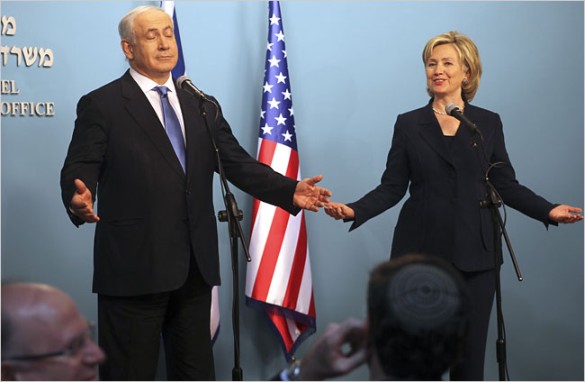
Perhaps Washington is not the best place for dream believers. Maybe it’s time for a glitzy Two-State Solution on Broadway.

Oh look!

Bibi and Hillary are already auditioning.
J Street: Do we really need another Jewish-only road?

If you’re Palestinian, you know about checkpoints. There are over 600 checkpoints in the West Bank alone. They block, obstruct, frustrate and kill. Women die in childbirth at checkpoints, students are kept from attending school, parents from visiting their children, laborers from going to work. No one can swim in the sea. Israeli Jews are waved through checkpoints. They can swim in the sea. No problem. Jews travel freely on a complex system of Jewish-only roads and live on the Jewish side of the Separation Barriers along hundreds of miles of walls and fortified fences that keep Palestinians out. Palestinians live in an open air prison. Sometimes there is a moment of spring and the guards open the gates. But spring never lasts long. Blockades, nightly incursions, full-scale invasions, imprisonment, collective punishment, land theft, water theft, denial of education, health care, an economic future, frequent beatings and no freedom of movement is the daily bread of Palestinians. You can’t travel more than three miles without encountering a check point. Talk about stress.

J Street was a place where Jews talked to Jews about the Israeli-Palestinian conflict. Few Palestinians were present. Apparently they didn’t make it through the checkpoint. The narrative of J Street, like most Jewish narratives about the Israeli-Palestinian conflict, reflects the nature of the conflict as seen through a Jewish lens: Palestinians are physically absent. A Jew who seeks to express her activism in solidarity with Palestinians is in danger of loosing her ‘I love Israel’ card at a mainstream Jewish checkpoint. There were checkpoints at J Street. Some people were allowed in but not officially asked to participate, some were dis-invited, and some were not considered to be part of the conversation in the first place. [continued…]

Editor’s Comment — As Ahmed Moor eloquently puts it:

A purely Jewish focus on a more-than-Jewish problem causes many leftist Jews to take a paternalistic view of Palestinians. Rather than equals whose inalienable rights form the crux of the case against Zionism, the Palestinians are the clay of Jewish humanism, waiting to be fully actualized by thoughtful and reflective Jewish hands.


Facebooktwittermail

America, stop sucking up to Israel

America, stop sucking up to Israel

Now is the time to say to the United States: Enough flattery. If you don’t change the tone, nothing will change. As long as Israel feels the United States is in its pocket, and that America’s automatic veto will save it from condemnations and sanctions, that it will receive massive aid unconditionally, and that it can continue waging punitive, lethal campaigns without a word from Washington, killing, destroying and imprisoning without the world’s policeman making a sound, it will continue in its ways.

Illegal acts like the occupation and settlement expansion, and offensives that may have involved war crimes, as in Gaza, deserve a different approach. If America and the world had issued condemnations after Operation Summer Rains in 2006 – which left 400 Palestinians dead and severe infrastructure damage in the first major operation in Gaza since the disengagement – then Operation Cast Lead never would have been launched.

It is true that unlike all the world’s other troublemakers, Israel is viewed as a Western democracy, but Israel of 2009 is a country whose language is force. Anwar Sadat may have been the last leader to win our hearts with optimistic, hope-igniting speeches. If he were to visit Israel today, he would be jeered off the stage. The Syrian president pleads for peace and Israel callously dismisses him, the United States begs for a settlement freeze and Israel turns up its nose. This is what happens when there are no consequences for Israel’s inaction. [continued…]

Justice Goldstone and the Jews

We Jews should be very proud of Richard Goldstone. In an ancient tradition of Jewish self-questioning and uncomfortable truth-telling, the author of the recent report from the UN Fact Finding Mission on the Gaza Conflict has braved personal vilification and institutional mendacity to describe the crimes committed by Israeli forces in the course of their invasion of Gaza in December 2008.

To be sure, the Goldstone Report also itemizes the crimes of Hamas, notably in its campaign of rocket-firing into Israel. But the scale of human rights abuses by Israel vastly outdoes anything Hamas could hope to have achieved: Israeli civilian victims of Hamas rocket attacks numbered less than ten. The attack on Gaza by the IDF resulted in at least 1,100 Palestinian civilian deaths. The major perpetrator of human rights abuses in this conflict is without question the State of Israel, and Justice Goldstone records as much.

That the Israel of Benjamin Netanyahu has chosen to conduct an international campaign against Justice Goldstone and his report need not surprise us. Israel refused to cooperate with the UN investigation; long before its conclusions were published, Netanyahu had set in motion a campaign to deny and denigrate them. More dispiriting, and of greater political consequence, is the pitiful and humiliating response of the Obama Administration. The “fierce urgency of now” apparently required that Washington join Tel Aviv in discrediting the Goldstone Report, and with it the UN inquiry. [continued…]

Israel wants to seek, not have, peace with Syria

It’s hard not to marvel at Defense Minister Ehud Barak’s rhetorical skills, how he constantly invents a new way – an original expression – to not say anything. Last week he described Syria as a “central brick in any stable peace agreement.” But there will be no peace with Syria because Israel, according to Barak, “has sought in the past and will continue to seek in the future ways to advance peace with Syria.”

Still, Syria will certainly earn a few more terms of endearment, maybe even move up from “central brick” to “cornerstone,” and if it behaves itself, “linchpin.” Who knows, Syria may even win the gold and become the “bedrock” of a stable peace agreement. But because Israel is so busy seeking ways to advance peace with Syria, there will be no peace. [continued…]

Gas from Gaza, mobile phones in Palestine and a $1m peace prize …Tony Blair and the Middle Eastern Eldorado

… a Mail on Sunday investigation reveals that [Tony Blair] has been mixing business with Middle East politics since the early years of his premiership and that, since becoming a part-time peace envoy on leaving office in 2007, he has exploited his superb contacts to pursue a multi-million-pound fortune.

Some of the most potentially lucrative of those relationships can be traced back to that BG Gaza gas deal – connections that helped pave the way to the opening up of the Arab world’s new Eldorado, the colossal and mostly untapped wealth of Colonel Gaddafi’s Libya.

‘In Arabic, there is a special word – “eghtina”,’ said Khadr Musleh, a political analyst in the Palestinian West Bank capital, Ramallah.

‘It means “self-enrichment through public office”. It doesn’t imply anything illegal and in the Middle East it’s considered totally normal. Yet it is a little surprising to see a former British Prime Minister and international peace envoy behaving in the same way.’

Blair’s Middle East-focused business career has been a triumph. The access to the region’s rulers conferred by his position as an ex-PM and peace envoy must have huge attraction for potential clients of Tony Blair Associates, the secretive ‘consultancy’ that does not publish accounts which he runs with Jonathan Powell, his former Downing Street chief of staff. Its first clients are two of the world’s richest families – the royals of Kuwait and Abu Dhabi.

Tony Blair Associates is modelled on Henry Kissinger Associates, an outfit led by President Nixon’s former Secretary of State. Fittingly, perhaps, Kissinger was on the jury that awarded Blair the $1million Dan David Prize earlier this year, the ‘Israeli Nobel Prize’. Like Blair, Kissinger is employed by American bank JP Morgan. The citation praised Blair’s ‘exceptional leadership’ and ‘moral courage’.

Blair has promised to give most of the prize to his Faith Foundation, a charity set up to promote religious understanding. Thanks to his lucrative contract to advise JP Morgan for a salary of £2million a year, he does not need the money. [continued…]

Prosecutor: top scientist Nozette admitted actual spying for Israel

Did a federal prosecutor just make the inflammatory accusation that top government scientist Stewart Nozette has admitted to giving classified information to the Israeli government?

By our reading of this AP story, that’s exactly what happened at a hearing in U.S. district court in Washington yesterday.

Nozette is accused of attempted espionage for allegedly selling classified information to an FBI employee posing as a Mossad agent. But the Feds have explicitly said that Israel is not accused of any wrongdoing. [continued…]

Facebooktwittermail

Afghan challenger drops out of runoff election

Afghan challenger drops out of runoff election

President Hamid Karzai’s challenger withdrew Sunday from next weekend’s runoff election, effectively handing the incumbent a victory but raising doubts about the government’s credibility at a time when the U.S. is seeking an effective partner in the war against the Taliban.

Former Foreign Minister Abdullah Abdullah said he made his decision after Karzai turned down his demands for changes to the Independent Election Commission and other measures that he said would prevent massive fraud, which marred the first round of balloting on Aug. 20.

Abdullah stopped short of calling for an electoral boycott and urged his followers “not to go to the streets, not to demonstrate.” [continued…]

U.S. combat injuries rise sharply

More than 1,000 American troops have been wounded in battle over the past three months in Afghanistan, accounting for one-fourth of those injured in combat since the U.S.-led invasion in 2001.

The dramatic increase in amputees and other seriously injured service members comes as October marks the deadliest month for U.S. troops in Afghanistan. [continued…]

Facebooktwittermail

Why the Iranian nuclear deal was bound to fail

Why the Iranian nuclear deal was bound to fail

The surest sign yet that the Iranian nuclear deal is in deep trouble is its endorsement by Israel’s prime minister, Benjamin Netanyahu.

“A positive first step,” Mr Netanyahu called the deal. This was in marked contrast to his own defence minister, Ehud Barak, who complained earlier that the agreement accorded Iran “legitimisation for enriching uranium for civilian purposes on its soil, contrary to the understanding that those negotiating with it have about its real plans”.

Mr Barak and Mr Netanyahu march in lockstep when it comes to Iran. The reason for their apparent disagreement is simple. Mr Barak dismissed the proposed deal when it looked as if Iran might accept it. Mr Netanyahu’s approval came only after Iran’s response was interpreted by the western powers as a “no”. [continued…]

Why Obama’s Iran policy will fail

While the tone of the Obama administration is different from that of its predecessor, and some of its foreign policies diverge from those of George W. Bush, at their core both administrations subscribe to the same doctrine: Whatever the White House perceives as a threat — whether it be Iran, North Korea, or the proliferation of long-range missiles — must be viewed as such by Moscow and Beijing.

In addition, by the evidence available, Barack Obama has not drawn the right conclusion from his predecessor’s failed Iran policy. A paradigm of sticks-and-carrots simply is not going to work in the case of the Islamic Republic. Here, a lesson is readily available, if only the Obama White House were willing to consider Iran’s recent history. It is unrealistic to expect that a regime which fought Saddam Hussein’s Iraq (then backed by the United States) to a standstill in a bloody eight-year war in the 1980s, unaided by any foreign power, and has for 30 years withstood the consequences of U.S.-imposed economic sanctions will be alarmed by Washington’s fresh threats of “crippling sanctions.” [continued…]

Facebooktwittermail

Turkey plans to dump dollar in trade with Iran

Turkey plans to dump dollar in trade with Iran

Turkey is seeking to switch to payments in national currencies for $10 billion worth of trade with neighbouring Iran to lessen exchange rate risks and bolster trade volumes, a Turkish government source said on Friday.

Turkey has made similar proposals to China and Russia in recent months.

Iran proposed earlier this week during a visit by Turkish Prime Minister Tayyip Erdogan that the two countries should conduct bilateral trade in their own currencies as part of widening economic ties.

Bilateral trade jumped to $10.3 billion in 2008 from $2.4 billion in 2003, with Turkey running a large deficit largely due to its gas imports. Ankara and Tehran aim to boost the volume to $20 billion in the next few years. [continued…]

Turkey, Iran sign strategic deal to carry gas to Europe

Iran and Turkey signed a number of deals on Wednesday to facilitate the efficient flow of gas through Turkey to Europe, including accords on allocating some of Iran’s South Pars gas field to the Turkish Petroleum Corporation (TPAO), allowing Iranian gas to be transported via Turkey and allowing Turkmenistan’s natural gas to be pumped to Turkey via Iran, during Turkish Prime Minister Recep Tayyip Erdoğan’s visit to Turkey’s southeastern neighbor.

Turkish Energy Minister Taner Yıldız said the deals provided advantages for Turkey in the use and the sale of some phases of the South Pars gas field. “Its conditions and prices will be negotiated later,” the minister added. Iran, which has the world’s second-largest natural gas reserves, is Turkey’s second-biggest supplier of natural gas after Russia. Turkey had signed a preliminary deal in November 2008 for Iranian gas to be exported to Europe through Turkey and for Turkey to produce gas in the South Pars field.

The investment would amount to $3.5 billion. But this deal has been delayed by objections from the United States, which opposes new energy deals in Iran as part of Western efforts to isolate Tehran over its nuclear program. [continued…]

Facebooktwittermail

Rory Stewart: A new kind of Tory

Rory Stewart: A new kind of Tory

Britain doesn’t make men like Rory Stewart any more. The former diplomat has trekked 6,000 miles across Asia; at 28, wrote a best-selling book, The Places in Between, about the walk; was governor of a province in Iraq at 29; and last year, as well as becoming a Harvard professor, was hailed by Esquire magazine as one of the 75 most influential people of the 21st century. Brad Pitt has already bought the rights to his biopic. And he’s only 36.

Now the man The New York Times once described as “living one of the most remarkable lives on record” has been selected for the safe Conservative seat of Penrith and the Border (the current MP, David Maclean, is stepping down because of ill-health). News of Stewart’s selection has been universally well-received, even by commentators on the Left: a Guardian columnist, no less, said Stewart was “a guy I’d vote for, whatever his party”.

“I’m absolutely over the moon,” says Stewart of his selection. He is about to fly to Harvard and hand in his resignation before returning to start work on his campaign. He wants to buy a home in the middle of the constituency – the largest in Britain – so that he can reach anywhere within a day by foot. Indeed, he has already spent 10 days walking from his parents’ home in Crieff to Penrith to familiarise himself with the landscape. He is tickled by my suggestion that he might become known as “The Walking MP”. [continued…]

Facebooktwittermail

An ugly peace in Iraq

An ugly peace

In December 2008 I flew Royal Jordanian from Amman to Iraq’s southern city of Basra. Because of the Muslim holiday of Eid, embassies were closed; a contact in the British military promised to obtain visas for me and a colleague upon arrival. The Iraqi customs officials were offended that we did not follow procedure, but a letter from the British commander got us in. It might not have been necessary: when the five Iraqi policemen who examined luggage at the exit saw my colleague’s copy of Patrick Cockburn’s excellent book on the Shia cleric Muqtada al Sadr, they turned giddy. One of them kissed the picture of Muqtada’s face on the cover and asked if he could keep the book. It was not their sentiment that surprised me, but rather their comfort expressing it publicly.

Since the occupation began, Muqtada has been the most controversial public figure in Iraq. A populist anti-American leader, he came from a lineage of revolutionary Shia clerics who opposed the Saddam’s regime and who gave voice to Iraq’s poor Shia majority. Capitalizing on his slain father’s network of mosques and the family name, Muqtada and his followers, called Sadrists, seized control of Shia areas in Iraq when Baghdad fell, especially the slums of Basra and the capital. He rallied marginalized Shias against the occupation, its puppet government, and eventually against Sunni extremists as well. His movement provided social services, and his militia, Jeish al Mahdi—the Mahdi Army or JAM—fought the Americans and defended Shias from extremist Sunni terrorism.

But the Mahdi Army and its rivals eventually propagated sectarian violence, fighting in the civil war and expelling or killing innocent Sunnis. After the February 2006 bombing of the Samarra shrine, a Shia holy site, the two-year-old civil war intensified. With attacks against Sunnis escalating, the largely Shia Iraqi police often looked the other way. The bloodshed was indiscriminate. [continued…]

Facebooktwittermail

Iran’s Sunni militants carve secretive path

Iran’s Sunni militants carve secretive path

Seven years ago, a little-known group called Jundallah emerged in Iran with claims to fight for the rights of minority Sunnis in the unruly tribal areas near the border with Pakistan.

But just last week, Iranian leaders say, this shadowy group with reported connections to countries as diverse as the U.S., Pakistan and Saudi Arabia delivered a devastating attack on Iran’s elite Revolutionary Guard. The Oct. 18 suicide bombing in an Iranian border village killed at least 42 people, including top Revolutionary Guard commanders.

The bombing suggests that ambitions by Jundallah — the Soldiers of God — have risen, and that the group is moving toward a wider uprising. Jundallah’s attack on a Shiite mosque in May and recent use of suicide bombers could point to the growing influence of militant Islamic groups seeking a Sunni revolt against Shiite control in Iran, experts say. [continued…]

Facebooktwittermail

1,600 are suggested daily for FBI’s list

1,600 are suggested daily for FBI’s list

Newly released FBI data offer evidence of the broad scope and complexity of the nation’s terrorist watch list, documenting a daily flood of names nominated for inclusion to the controversial list.

During a 12-month period ended in March this year, for example, the U.S. intelligence community suggested on a daily basis that 1,600 people qualified for the list because they presented a “reasonable suspicion,” according to data provided to the Senate Judiciary Committee by the FBI in September and made public last week.

FBI officials cautioned that each nomination “does not necessarily represent a new individual, but may instead involve an alias or name variant for a previously watchlisted person.”

The ever-churning list is said to contain more than 400,000 unique names and over 1 million entries. The committee was told that over that same period, officials asked each day that 600 names be removed and 4,800 records be modified. Fewer than 5 percent of the people on the list are U.S. citizens or legal permanent residents. Nine percent of those on the terrorism list, the FBI said, are also on the government’s “no fly” list. [continued…]

Facebooktwittermail