
Daily Archives: November 29, 2009

The European minaret-missile threat

The European minaret-missile threat

Bigotry is on the rise in “the westerly excrescence of the continent of Asia.”

That unpoetic but topographically-precise description of Europe comes from the Oxford archeologist, Barry Cunliffe.

Whenever voices declaring that European culture is under threat are at their most strident, it’s always worth remembering the actual nature of Europe’s physical form.
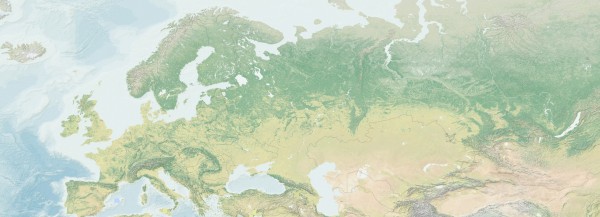
As a continent it is nothing more than a malleable contrivance with its ambiguous, historically shifting eastern edge. As a result, it is and always has been, an ethnic and cultural melting pot.

Thus the irony when Europe’s self-appointed protectors take a firm stand in the name of its defense: they so often lack a real appreciation for the very thing to which they have pledged their allegiance.

Why is it that the people who most easily become possessed by ideas about cultural purity are themselves so often culturally impoverished?

Because culture in its richness and complexity is not the real issue.

This is about how individuals respond to the other.

Does the unfamiliar prompt interest and curiosity?

Or does it provoke fear?

Fear in response to the other says more about the fearful than it says about the objects they fear.

The fear of the foreign is at its root a fear of becoming foreign. It is a fear of becoming a stranger in one’s own land.

* * *
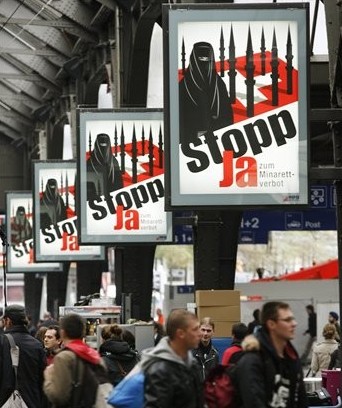
In the latest outbreak of European xenophobia, the minaret has become a missile in a campaign to ban their construction — that is, the construction of minarets, not missiles.

This is a curious iconic transformation. Is the Swiss People’s Party suggesting that Switzerland, in which currently there are only four minarets, is at risk of becoming a missile-minaret launching pad threatening the rest of Europe with Islamization? (After all, their posters depict missile-minarets ready for launch — not incoming missile-minarets about to explode.)

By Sunday it became apparent that Swiss voters had little interest in dissecting the visual absurdity of the campaign poster — a majority seemed to have bought the implicit message: Islam = violence, death and destruction.

The campaign’s final week of fear-mongering managed to raise support for the ban from 37% up to 57.5%, with passage in the majority of cantons meaning that a constitutional amendment will follow.

As The Guardian reported:

The controversial referendum on Sunday, accompanied by a prohibition campaign denounced as racist and in violation of human rights, is the latest tussle in Europe over the limits of multiculturalism and immigrant lifestyles.

Pushed by anti-immigrant rightwing populists, it has triggered months of debate in a country that uses direct democracy for single-issue politics. The referendum has turned into much more than a vote on architecture and urban planning.

“The minaret has got nothing to do with religion. It’s a symbol of political power, a prelude to the introduction of sharia law,” argued Ulrich Schlüer, of the rightwing Swiss People’s party, an architect of the campaign.

Two years ago the SPP became the strongest party in Switzerland, with an anti-immigrant election campaign that featured posters of three white sheep kicking a black sheep off a red and white Swiss flag. UN experts and human rights activists condemned the campaign as overtly racist.

This time the SPP has plastered the country with posters showing the same flag as a base for several black minarets, portrayed as missiles, alongside a woman clad in a black burqa. Church leaders, the Jewish community and Muslim leaders have all opposed the campaign. The foreign minister, Micheline Calmy-Rey, warned that a vote in favour risked turning Switzerland into “a target for Islamic terrorism”. The city of Basel and other towns have proscribed the incendiary posters.

Amnesty International said: “Freedom of religious belief is a basic human right and changing the Swiss constitution to ban the construction of minarets would clearly breach the rights of the country’s Muslims.”

UN human rights experts have said the proposed ban violates freedom of religion and liberty. The Swiss justice minister, Eveline Widmer-Schlumpf, has agreed, declaring that it would breach anti-discrimination laws and rights to free religious observance, raising the question of why the campaign has been allowed.

Tariq Ramadan, Switzerland’s most famous Muslim, suggests that what his country’s Muslim population is being told is that the only good Swiss Muslim is an invisible Muslim.

Ramadan was recently interviewed by the Swiss magazine, L’illustré, where Arnaud Bédat asked him to comment on the fears of his fellow citizens. (Translation by Rashed Chowdhury.)

Tariq Ramadan: One must respect the fear of ordinary citizens, while one also must resist in civic fashion populist parties which are instrumentalising fear in order to win elections. The majority of our fellow Swiss citizens are not racists: they are afraid and they would like to understand. Swiss people of the Muslim faith have a real responsibility to communicate and explain…. At the same time, one must refuse to allow populism to install itself. The problem is that the UDC [the Democratic Union of the Centre, another name for the Swiss People’s Party] initiative is using the symbol of the minaret to target Islam as a religion. I have had debates with Mr. Freysinger. [Oskar Freysinger is a parliamentarian in the Swiss People’s Party and a driving force in the campaign.] What does he say? That “Islam is not integratable into Swiss society.” So he says to me, to me, and I am Swiss like him, that “You are not a good Swiss person, you cannot be one, since your quality of being a Muslim prevents you from being a good Swiss person.” That is the foundation of the debate: the problem is Islam, not minarets.

Arnaud Bédat: But the minaret, you write so yourself, is not a pillar of Muslim faith.

TR: Yes, but is that a reason to say “Since it is not an obligation, you don’t need it”?… Does it have to be that the only good Swiss Muslim is an invisible Muslim? Is this the future of our pluralism and of our living together?

AB: Numerous Islamic countries forbid other religions on their territory — there are no churches or synagogues in Saudi Arabia, for example. Is it not ultimately logical that part of the West reject Islam on its territory?

TR: This is the oft-repeated argument of reciprocity. It is untenable. Respect for the rights and dignity of people is not a question of trade. It falls to us, to us in Switzerland, to preserve our principles of respect, and to not allow ourselves to be colonised by the unacceptable practices of other societies. Let us say first of all that it is wrong to say that religious minorities are always discriminated against in Muslim-majority societies. There are synagogues, churches and temples [there]. However, one should not deny the fact that discrimination and the denial of rights do occur, as in Saudi Arabia. One cannot hold Swiss citizens and residents of Muslim faith responsible for the actions of certain dictatorial governments from which they have often, by the way, fled for political or economic reasons. What one can expect from them [Swiss Muslims], nevertheless, from a moral point of view, is a denunciation of discrimination and ill treatment. That is something I do not stop doing, which has closed the doors of several countries, such as Saudi Arabia, to me.

AB: Do you dream, as you detractors claim, of a world that is entirely Muslim?

TR: No. I was born, have lived and have studied in Switzerland; my whole philosophical education comes from that. I have always believed that those who do not share my beliefs allow me to be more myself. The absolute power or uniformisation of a religion on earth would mean corruption and death. The worst that could happen to Muslims is if the whole world became Muslim! That is not even what God’s project is. There has to be diversity and difference. Because difference teaches us humility and respect.

To which I would add: The cultural ecosystem, or the ethnosphere as Wade Davis has named it, thrives on diversity.

Monoculture is inherently unstable because it lacks the strength that comes from constant adaptation necessitated by complexity and constant change.

Think about it. What would Europe be had it never been open to the influence of foreign cultures?

Christianity wasn’t born in Zurich — it came from the Middle East!

Facebooktwittermail

Iraq Inquiry bombshell: Secret letter to reveal new Blair war lies

Iraq Inquiry bombshell: Secret letter to reveal new Blair war lies

An explosive secret letter that exposes how Tony Blair lied over the legality of the Iraq War can be revealed.

The Chilcot Inquiry into the war will interrogate the former Prime Minister over the devastating ‘smoking gun’ memo, which warned him in the starkest terms the war was illegal.

The Mail on Sunday can disclose that Attorney General Lord Goldsmith wrote the letter to Mr Blair in July 2002 – a full eight months before the war – telling him that deposing Saddam Hussein was a blatant breach of international law.

It was intended to make Mr Blair call off the invasion, but he ignored it. Instead, a panicking Mr Blair issued instructions to gag Lord Goldsmith, banned him from attending Cabinet meetings and ordered a cover-up to stop the public finding out.

He even concealed the bombshell information from his own Cabinet, fearing it would spark an anti-war revolt. The only people he told were a handful of cronies who were sworn to secrecy. [continued…]

Jeremy Greenstock, UK diplomat, says US was ‘hell bent’ on Iraq invasion

The United States was “hell bent” on a 2003 military invasion of Iraq and actively undermined efforts by Britain to win international authorization for the war, a former British diplomat told an inquiry Friday.

Jeremy Greenstock, British ambassador to the United Nations from 1998 to 2003, said that President George W. Bush had no real interest in attempts to agree on a U.N. resolution to provide explicit backing for the conflict.

The ex-diplomat, who served as Britain’s envoy in Iraq after the invasion, said serious preparations for the war had begun in early 2002 and took on an unstoppable momentum. [continued…]

Why Turkey was the Iraq war’s real winner

Turkey’s economy has more than doubled in the past decade, converting the nation from a backwater to a regional powerhouse. At the same time, its financial focus has moved closer to home: Turkey now conducts more trade with Russia, Iraq, and Iran than it does with the EU. Energy politics have also favored the Turks, who find themselves astride no fewer than three competing energy supply routes to Europe—from Russia, from the Caspian, and from Iran. Years of reform and stability are paying off as well. Ankara is on the verge of a historic deal with its Kurdish minority to end an insurgency that has left 35,000 dead in the past quarter century. In turn, Turkey is making peace with neighboring countries that once supported the insurgents, such as Syria, Iran, and Armenia. The principle is simple, says a senior Erdogan aide who’s not authorized to speak on the record: “We can’t be prosperous if we live in a poor neighborhood. We can’t be secure if we live in a violent one.”

The advantages keep compounding. Thanks to judicious diplomacy and expanding business ties throughout the region, Turkey is close to realizing what Davutoglu calls his “zero-problems-with-neighbors policy.” The new stance has boosted Ankara’s influence even further; the Turks have become the trouble-ridden region’s mediators of choice, called in to help with disputes between the Palestinian factions Hamas and Fatah, between Iraq and Syria—even, before Erdogan’s outburst in Davos, between Israel and Syria. Speaking at a recent press conference in Rome, Erdogan expressed little hope that Turkey could do more for Syria and Israel. “[Prime Minister Benjamin] Netanyahu doesn’t trust us,” he said. “That’s his choice.” But others in the region still welcome Ankara’s assistance: Turkish diplomats are excellently trained in conflict resolution. [continued…]

Facebooktwittermail

Zardari turns over nuclear authority

Zardari turns over nuclear authority

Pakistan’s embattled president, Asif Ali Zardari, has transferred command of the country’s nuclear arsenal to the prime minister, as he comes under increasing pressure to step down.

The dramatic move signaled that Mr. Zardari was willing to give up some of his powers to defuse the escalating opposition to him. The move came as an amnesty protecting him and some of his key ministers from corruption charges expired on Saturday. Mr. Zardari shed his powers as chairman of the National Command Authority through a presidential decree issued late Friday night, giving the responsibility to Prime Minister Yousaf Raza Gilani.

The transfer of authority to the prime minister won’t make much practical difference as Pakistan’s nuclear-weapon program is effectively controlled by the country’s powerful military. [continued…]

Facebooktwittermail

Secret jails and torture under Obama’s watch

2 Afghans allege abuse at U.S. site

Two Afghan teenagers held in U.S. detention north of Kabul this year said they were beaten by American guards, photographed naked, deprived of sleep and held in solitary confinement in concrete cells for at least two weeks while undergoing daily interrogation about their alleged links to the Taliban.

The accounts could not be independently substantiated. But in successive, on-the-record interviews, the teenagers presented a detailed, consistent portrait suggesting that the abusive treatment of suspected insurgents has in some cases continued under the Obama administration, despite steps that President Obama has said would put an end to the harsh interrogation practices authorized by the Bush administration after the Sept. 11, 2001, attacks.

The two teenagers — Issa Mohammad, 17, and Abdul Rashid, who said he is younger than 16 — said in interviews this week that they were punched and slapped in the face by their captors during their time at Bagram air base, where they were held in individual cells. Rashid said his interrogator forced him to look at pornography alongside a photograph of his mother. [continued…]

Afghans detail detention in ‘black jail’ at U.S. base

An American military detention camp in Afghanistan is still holding inmates, sometimes for weeks at a time, without access to the International Committee of the Red Cross, according to human rights researchers and former detainees held at the site on the Bagram Air Base.

The site, known to detainees as the black jail, consists of individual windowless concrete cells, each illuminated by a single light bulb glowing 24 hours a day. In interviews, former detainees said that their only human contact was at twice-daily interrogation sessions.

“The black jail was the most dangerous and fearful place,” said Hamidullah, a spare-parts dealer in Kandahar who said he was detained there in June. “They don’t let the I.C.R.C. officials or any other civilians see or communicate with the people they keep there. Because I did not know what time it was, I did not know when to pray.”

The jail’s operation highlights a tension between President Obama’s goal to improve detention conditions that had drawn condemnation under the Bush administration and his stated desire to give military commanders leeway to operate. While Mr. Obama signed an order to eliminate so-called black sites run by the Central Intelligence Agency in January, it did not also close this jail, which is run by military Special Operations forces. [continued…]

Matthew Hoh speaks grim truth to power

The rare resignation on principle is always telling in American government. When Matthew Hoh recently left the State Department — a Marine Captain in Iraq who became a diplomat in Afghanistan — his act was significant far beyond the first reports.

Hoh speaks grim truth to power. His message is that to pursue the Afghan war policy in any guise — regardless of the troop level President Obama now chooses — will be utter folly, trapping America in an unwinnable civil war in the Hindu Kush, and only fueling terrorism. [continued…]

Senate report explores 2001 escape by bin Laden from Afghan mountains

As President Obama vows to “finish the job” in Afghanistan by sending more troops, the Senate Foreign Relations Committee has completed a detailed look back at a crucial failure early in the battle against Al Qaeda: the escape of Osama bin Laden from American forces in the Afghan mountains of Tora Bora in December 2001.

“Removing the Al Qaeda leader from the battlefield eight years ago would not have eliminated the worldwide extremist threat,” the committee’s report concludes. “But the decisions that opened the door for his escape to Pakistan allowed bin Laden to emerge as a potent symbolic figure who continues to attract a steady flow of money and inspire fanatics worldwide.”

The report, based in part on a little-noticed 2007 history of the Tora Bora episode by the military’s Special Operations Command, asserts that the consequences of not sending American troops in 2001 to block Mr. bin Laden’s escape into Pakistan are still being felt.

The report blames the lapse for “laying the foundation for today’s protracted Afghan insurgency and inflaming the internal strife now endangering Pakistan.”

Its release comes just as the Obama administration is preparing to announce an increase in forces in Afghanistan. [continued…]

Facebooktwittermail

Israel is lying to itself about ‘united Jerusalem’

Israel is lying to itself about ‘united Jerusalem’

Those types have always been seen on big-city streets, talking to themselves, asking and answering, shouting, speaking in a low voice, deliberating and pontificating. As children, we were afraid of them. They were “crazy.” That’s exactly what Israeli public discourse is like. We are talking to ourselves, inventing bogus axioms and sticking with them as if they were decreed from on high, convinced that the whole world accepts them. But we are only talking to ourselves. No one else accepts them. The Israeli collective is not only talking to itself, it’s deceiving itself completely.

Jerusalem is a perfect example of this. It’s a neglected city, filthy and in parts frightfully ugly, stricken by poverty and ignorance. Nationalist, religious and social tensions are tearing it asunder, and part of the city is under the burden of occupation with all its most violent characteristics. The purported education, culture, openness and prosperity – far from the actual situation – are the locus of our national aspirations.

It’s a capital city which not a single country in the world recognizes, but it’s “our eternal capital,” in the words of the prime minister. It’s a relatively marginal city, certainly when compared to Tel Aviv. From many standpoints it’s a city on the margins which secular Israelis don’t exactly flock to for a good time. It’s a city even the prime minister preaches about. But he doesn’t practice what he preaces when he flees the city for the weekend, whenever he can. It’s the “heart of the nation,” but a city that has gradually become the city of the ultra-Orthodox and the Arabs, society’s two poorest minorities. Continue reading

Facebooktwittermail

Release of secret reports delayed

Release of secret reports delayed

President Obama will maintain a lid of secrecy on millions of pages of military and intelligence documents that were scheduled to be declassified by the end of the year, according to administration officials.

The missed deadline spells trouble for the White House’s promises to introduce an era of government openness, say advocates, who believe that releasing historical information enforces a key check on government behavior. They cite as an example the abuses by the Central Intelligence Agency during the Cold War, including domestic spying and assassinations of foreign officials, that were publicly outlined in a set of agency documents known as the “family jewels.’’

The documents in question – all more than 25 years old – were scheduled to be declassified on Dec. 31 under an order originally signed by President Bill Clinton and amended by President George W. Bush. [continued…]

Facebooktwittermail
