Yearly Archives: 2010

How Wikileaks amplifies the Pentagon echo chamber

At Columbia Journalism Review, Ali Gharib writes:

A source provides details to the American government about the nefarious activities of a Middle Eastern country. That information ends up in scores of secret U.S. government documents. Subsequently, the information winds up on the front pages of major newspapers, and is heralded by war hawks in Washington as a casus belli.

Sound familiar? It should, but perhaps not in the way you’re thinking. Here’s a hint: It’s not 2003, but 2010. This is the story of what happened recently to Iran in the wake of the latest WikiLeaks document release, where U.S military field reports from Iraq made their way into major national newspapers and painted the Islamic Republic as a force out to murder U.S. soldiers in Iraq.

While the WikiLeaks document dump provided a useful way to glean historic details of the seven-year-old occupation, much of the prominent media coverage focused closely on the extent of Iranian support for anti-U.S. forces in Iraq and Iran’s alleged role.

“Leaked Reports Detail Iran’s Aid for Iraqi Militias,” blared the headline on a front page story in The New York Times, which went on to report on several incidents recounted in WikiLeaks documents that journalist Michael Gordon called “the shadow war between the United States and Iraqi militias backed by Iran’s Revolutionary Guards.”

“The field reports also provide a detailed account of what American military officials on the ground in Iraq saw as Iran’s shadowy role training and equipping Iraqi Shiite militias to fight the U.S.,” wrote Julian Barnes in The Wall Street Journal. “American intelligence believed the training was provided not only by the Islamic Revolutionary Guards Corps in Iran, but also by Hezbollah, their Lebanese ally.”

And the hawks went wild.

Facebooktwittermail

Dahieh: flashpoint of the colonial and anti-colonial struggle

Rami G Khouri writes:

Who would have thought that a gynecologist’s office in the Hizbullah-dominated southern Beirut suburb of Dahieh would be the symbolic place where the colonial and anti-colonial struggles of the past century would reach their confrontational peak and bring to a head this long-simmering war? Hizbullah leader Hassan Nasrallah’s call Thursday night for all Lebanese to stop cooperating with the Special Tribunal for Lebanon (STL), which is investigating and will soon indict those it believes killed former Prime Minister Rafik Hariri and 22 others five years ago, followed an attempt by STL officers to examine patient files in the doctor’s office in Dahieh a few days ago, presumably because the STL has evidence it believes implicates some Hizbullah personnel in the assassinations. Hizbullah supporters, mostly women, beat back the STL party and quickly heightened the political confrontation that has been brewing in the country for months.

Nasrallah’s open call to boycott and actively oppose the STL marks an historical moment of reckoning that is as dangerous as it was inevitable. This is because Hizbullah and the STL represent perhaps the two most powerful symbols of the two most important forces that have defined the Middle East for the past century or more: On the one hand, Western (including Israeli) interests and interventions that seek to shape this region in a manner that suits Western aims more than it suits indigenous rights, and, on the other hand, native Arab-Islamic-nationalist resistance that seeks to shape our societies according to Arab-Islamic worldviews as defined by a consensus of local actors, identities and forces.

Stripped to its core, this tension between Hizbullah and the STL is a microcosm of the overarching fact of the modern era in which Western-manufactured Arab statehood has generally failed to gain either real traction or sustained credibility; thus it has fallen on groups like Hizbullah to play a leading role in confronting Israeli and Western power in a manner that most Arab governments have been unable or unwilling to do.

Facebooktwittermail

Knesset member Haneen Zoabi: “No chance” for two-state solution

Ali Abunimah reports:

There is now “no chance” for a two-state solution in Palestine. So said Haneen Zoabi, a Palestinian member of Israel’s parliament, the Knesset, in an interview with The Electronic Intifada (EI) on 29 October in Chicago (video).

“The reality goes more toward the one state solution,” Zoabi said, “whether a democratic one-state solution, or a binational one-state solution.”

Elected in 2009, Zoabi represents the National Democratic Alliance, and is the first woman to be elected on the list of an Arab party in Israel.

“We are struggling for a normal state,” Zoabi explained, “which is a state for all of its citizens, [in] which the Palestinians and the Israeli Jews can have full equality. I recognize religious, cultural and national group rights for the Israelis, but inside a democratic and neutral state.”

Facebooktwittermail

Iran’s Revolutionary Guards slam Ahmadinejad

RFE/RL reports:

In an unprecedented move, Iran’s Islamic Revolutionary Guards Corps (IRGC) has directly blasted President Mahmud Ahmadinejad over controversial comments he made recently, including saying that parliament is not on top of the country’s affairs.

Ahmadinejad was also criticized for promoting an “Iranian school of thought” instead of an Islamic one.

Ahmadinejad has in recent weeks come under fire by his hard-line allies and conservatives over his new nationalistic rhetoric. So far, the IRGC, whose power and influence has grown since Ahmadinejad came to power, had not publicly criticized the Iranian president.

The unusual attack by the IRGC, coming in one of its main publications, is seen by analysts as a warning issued to Ahmadinejad from Iran’s supreme leader, Ayatollah Ali Khamenei, with the intention of trying to tame the Iranian president.

Facebooktwittermail

‘We don’t want to be Iraq’

Steven Sotloff writes:

Though the foiled plot to mail packages filled with bombs to synagogues in Chicago has bumped congressional midterm elections as the top story in the United States, here in Yemen it has caused barely a ripple. While Washington focuses on combating the regional al-Qaeda affiliate believed to be behind the plot, Yemenis are much more concerned with a sectarian rebellion in the north, a secession movement in the south and the economic crisis that has crippled the country.

Most Yemenis are unaware that the packages that caused heightened concerns in the United States originated in their country, because the Saleh government has muted coverage of the story in the local press.

Washington’s policies of drone strikes coupled with high-profile military and diplomatic visits risk further alienating an already hostile Yemeni population and driving them into the arms of al-Qaeda in the Arabian Peninsula (AQAP), the local al-Qaeda affiliate the Obama administration is so focused on neutralizing.

“Americans come here and attack without knowing what is going on,” as one Yemeni put it. “We don’t want to be Iraq. This is an American war, not Yemen’s, and we don’t want to be a part of it.”

Facebooktwittermail

The phantom left

Chris Hedges writes:

The American left is a phantom. It is conjured up by the right wing to tag Barack Obama as a socialist and used by the liberal class to justify its complacency and lethargy. It diverts attention from corporate power. It perpetuates the myth of a democratic system that is influenced by the votes of citizens, political platforms and the work of legislators. It keeps the world neatly divided into a left and a right. The phantom left functions as a convenient scapegoat. The right wing blames it for moral degeneration and fiscal chaos. The liberal class uses it to call for “moderation.” And while we waste our time talking nonsense, the engines of corporate power—masked, ruthless and unexamined—happily devour the state.

The loss of a radical left in American politics has been catastrophic. The left once harbored militant anarchist and communist labor unions, an independent, alternative press, social movements and politicians not tethered to corporate benefactors. But its disappearance, the result of long witch hunts for communists, post-industrialization and the silencing of those who did not sign on for the utopian vision of globalization, means that there is no counterforce to halt our slide into corporate neofeudalism. This harsh reality, however, is not palatable. So the corporations that control mass communications conjure up the phantom of a left. They blame the phantom for our debacle. And they get us to speak in absurdities.

The phantom left took a central role on the mall this weekend in Washington. It had performed admirably for Glenn Beck, who used it in his own rally as a lightning rod to instill anger and fear. And the phantom left proved equally useful for the comics Jon Stewart and Stephen Colbert, who spoke to the crowd wearing red-white-and-blue costumes. The two comics evoked the phantom left, as the liberal class always does, in defense of moderation, which might better be described as apathy. If the right wing is crazy and if the left wing is crazy, the argument goes, then we moderates will be reasonable. We will be nice. Exxon and Goldman Sachs, along with predatory banks and the arms industry, may be ripping the guts out of the country, our rights—including habeas corpus—may have been revoked, but don’t get mad. Don’t be shrill. Don’t be like the crazies on the left.

“Why would you work with Marxists actively subverting our Constitution or racists and homophobes who see no one’s humanity but their own?” Stewart asked. “We hear every damn day about how fragile our country is—on the brink of catastrophe—torn by polarizing hate, and how it’s a shame that we can’t work together to get things done. But the truth is we do. We work together to get things done every damn day. The only place we don’t is here [in Washington] or on cable TV.”

The rally delivered a political message devoid of reality or content. The corruption of electoral politics by corporate funds and lobbyists, the naive belief that we can somehow vote ourselves back to democracy, was ignored for emotional catharsis. The right hates. The liberals laugh. And the country is taken hostage.

Facebooktwittermail

Bill Maher’s fear of Muslims

Upon learning that in the UK last year, Mohammed (including its variant spellings) was the most popular name for baby boys, this was the reaction of comedian Bill Maher:

Am I a racist to feel alarmed by that? Because I am. And it’s not because of the race, it’s because of the religion. I don’t have to apologize, do I, for not wanting the Western world to be taken over by Islam in 300 years?

Maybe Maher thinks that as an expression of cultural integration Muslim parents in Britain should be naming their boys after English football stars like Wayne Rooney or David Beckham (and I dare say some do) but he should hardly be surprised that the name of the Prophet remains a favorite. The racist thought that he dared not utter but surely thought was this: at the rate they’re reproducing, it’s just a matter of time before the Muslims take over.

But Bill Maher — like Pastor Terry Jones — thinks the way to avoid being branded a racist when it comes to expressing ones Islamophobia is to suggest that you have nothing against Muslims, you just don’t like their religion. Thus Maher doesn’t express concern about the size of Britain’s Muslim population — simply the way they are choosing to name their babies.

Maher’s parochiality is most evident however, not simply in the focus of his alarm but because of the context he places it in: the condition of the Western world 300 years from now.

If 300 years ago any of the leading figures of the Enlightenment could have been given a glimpse of the West as it is now, I doubt that any would have felt reassured that Western Civilization had been preserved — least of all when they saw the jokers who have assumed the role of its defenders.

If 300 years hence, civilization exists in any form, humanity will have advanced in ways hard to anticipate. On its current trajectory, the West and the rest of the world is heading in a direction where the names parents choose for their babies should be the least of our concerns.

As for how that parenting task is being engaged now in America, what is striking about the popular choices is not so much the cultural sources of the names as the difference between genders: Old Testament and/or grandiose names for boys and mostly secular names for girls — Jacob, Isabella, Ethan, Emma, Michael, Olivia, Alexander, Sophia, William, Ava, Joshua, Emily, Daniel, Madison, Jayden, Abigail, Noah, Chloe, Anthony, Mia.

I don’t imagine that Bill Maher will be too concerned that among these 2009 top ten names for boys and girls not one of them is a New Testament Christian name, but it’s certainly curious that in a country whose population so strongly identify themselves as Christian, the apostles, their disciples and other prominent figures from Christian scripture have apparently gone out of style. Don’t blame the Muslims.

But here’s what will come as the biggest shock to the Islamophobes: the most popular name for girls in Iran in 2009 turns out to be Maryam — the Arabic and Farsi equivalent of Mary, mother of Jesus. What do you make of that, Bill?

Facebooktwittermail

Broder and Israel’s Goldilocks war against Iran

What kind of institutional entity do the hacks in Washington constitute such that they can have a “dean”?

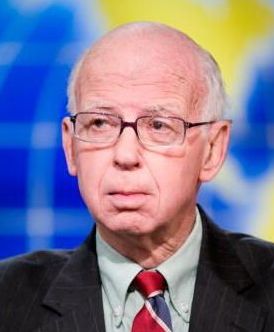
When David Broder is referred to as the dean of the Washington press corps, I guess it’s just a complimentary way of saying the old guy. But Broder’s nine years younger than Helen Thomas. How come she never rose to the same stature? Is baldness a requirement?

In spite of his institutional stature, Broder’s mental capacities have in recent years come into question and his op-ed in the Washington Post on Sunday provides yet another occasion to wonder what is going on inside this man’s brain as he pushes for war against Iran.

He writes:

War and peace influence the economy.

Look back at FDR and the Great Depression. What finally resolved that economic crisis? World War II.

Here is where Obama is likely to prevail. With strong Republican support in Congress for challenging Iran’s ambition to become a nuclear power, he can spend much of 2011 and 2012 orchestrating a showdown with the mullahs. This will help him politically because the opposition party will be urging him on. And as tensions rise and we accelerate preparations for war, the economy will improve.

I am not suggesting, of course, that the president incite a war to get reelected. But the nation will rally around Obama because Iran is the greatest threat to the world in the young century. If he can confront this threat and contain Iran’s nuclear ambitions, he will have made the world safer and may be regarded as one of the most successful presidents in history.

So another war is going to rescue the economy? But just a minute — if war’s such an excellent economic tonic, how come we aren’t already in great shape? A decade of war just hasn’t been quite enough?

It’s easy to mock Broder’s prescription and even to wonder whether he’s lost his grip on reality, but maybe he’s not quite as crazy as he sounds. Read more carefully, this is not actually a call for war — it is a call for the continuously escalating threat of war.

This is indeed the most likely “lesson” that some have drawn from the experience of Iraq: that the best kind of war is the one that has yet to be fought. A war that can be budgeted for, equipped for, and around which politicians can construct their postures of strength, resolution and righteousness. The context is one in which we have been encouraged to think that war is normal. War is in fact so normal that Washington pundits can now present it as a useful economic tool.

Washington’s lead comes from Israel, which has less interest in starting a war with Iran than in promoting the idea that war might be just over the horizon — a kind of Goldilocks war, not too far away and not too close, but just close enough. In this delicately modulated threat of mayhem, Iran itself remains politically and economically boxed in, while issues which merit more urgent attention — namely the intractable Israeli-Palestinian conflict — can be shunted to one side.

Two countries so heavily invested in manufacturing the means for engaging in war, actually have less interest in wars being fought than in a war-footing constantly being maintained. The problem is, a war posture can only be maintained for so long and momentum only be built up so much before a turning point is reached: war either then becomes inevitable or a real alternative has to be pursued.

Only through the hubris which metastasizes inside the brains of those trapped inside the Washington bubble, can anyone fail to see that the process of backing Iran into a corner risks the United States becoming trapped by the narrow logic of its own strategy. War is not normal. It is a failure of imagination.

Facebooktwittermail

The conflict that could tear the Jewish people apart

“Affirmation of Israel’s Jewishness… is the very foundation of peace, its DNA,” claims Michael Oren, Israel’s ambassador to the United States.

Well, if that’s really true then one can only conclude that Israel will never exist in peace — not because it will fail in getting the affirmation it demands from its Palestinian neighbors but because Jews themselves can’t agree on the nature of Israel’s Jewishness. And if Jews can’t agree on this, what business does Israel have in demanding such recognition from anyone else?

AssociatedPress reports:

When Hillary Rubin immigrated from the U.S. to Israel, the granddaughter of Holocaust survivors and descendant of a famed Zionist visionary felt that she had finally arrived in her true home.

But now that religious authorities are questioning the 29-year-old Michigan native’s Jewish pedigree and refusing to recognize her marriage, she’s having second thoughts.

Rubin is at the center of a deepening rift between the world’s two biggest Jewish communities – the American and Israeli. Religious life in Israel is dominated by the strict ultra-Orthodox establishment, which has growing political power and has become increasingly resistant to any inroads by the more liberal movements that predominate among American Jews.

Many Americans – whose faith is seen by the ultra-Orthodox as blurred by intermarriage and fading adherence to tradition – are feeling rejected and unwelcome.

“I feel like I am caught in the middle of these two worlds,” said Rubin, who was raised in a liberal Jewish home in a Detroit suburb. “On the one hand I’m far too traditional for American society. On the flip side, I am not religious enough for the rabbinate in Israel.”

It’s a far cry from the days when American Jews looked to Israel as a source of pride and inspiration and Israel could rely on America’s Jews as a source of unconditional moral support and fundraising. With ultra-Orthodox Jews the fastest growing sector in Israel, often holding the balance of power in coalition governments, open strains between the communities are now far more common.

Over the summer, a proposed law that would have consecrated the Orthodox monopoly over conversion in Israel caused an uproar among Diaspora Jews. Prime Minister Benjamin Netanyahu was forced to shelve the bill in hopes of finding a compromise.

Last week, American and Israeli Jewish leaders held a conference in Jerusalem aiming at ironing out their differences. But the closed-door sessions were tense and all sides stuck to their positions, said one participant, American Rabbi Jerome Epstein, of the Conservative movement.

He warned that the conflict could “tear the people apart” if no compromise is found.

“There are a lot of Americans who normally would not get involved in Israeli politics but who are saying, ‘What you are doing is delegitimizing me. It is not enough to want my support and want my money, you have to be willing to recognize me as a human being and as a Jew,’ and they feel that is not happening,” he said.

But an Israeli state that delegitimizes Palestinians who can prove their ancestral and property claims and that depends on tax dollars paid by non-Jewish Americans — that’s OK?

Facebooktwittermail

Sunshine in America – a tea party with scones

Rally to Restore Sanity and/or Fear
Jon Stewart – Moment of Sincerity
www.comedycentral.com
Rally to Restore Sainty and/or Fear The Daily Show The Colbert Report

Do you want to know why I am here and what I want from you? I can only assure you of this: You have already given it to me. Your presence was what I wanted.

Sanity will always be and has always been in the eyes of the beholder, and to see you here today, and the kind of people that you are, has restored mine.

With these words, Jon Stewart wrapped up his Rally to Restore Sanity in Washington DC yesterday afternoon.

If images of division were at the root of the political malaise of these times, then Stewart’s rally was a suitable palliative. His metaphor of America — the willingness of drivers to give way to one another as they enter the Lincoln Tunnel — fittingly represents the civility of American society. Indeed, many Americans who travel overseas for the first time may well be surprised to discover that despite this country’s reputation for being brash and uncultured, its population turns out to be among the world’s most mild-mannered as they conduct themselves in daily life.

“The country’s 24-hour-politico-pundit-perpetual-panic-conflictinator did not cause our problems, but its existence makes solving them that much harder.”

True.

“If we amplify everything, we hear nothing.”

True.

“The image of Americans that is reflected back to us by our political and media process is false.”

True.

OK. So Americans aren’t doing such a bad job at getting along. And the image of American society ripped apart by political polarization is a distortion. Where do these observations get us?

Another way of saying this is to say that Americans no longer live in a representative democracy. We are not represented in Congress or in the media.

But Stewart says he feels good — good knowing that the America he sees, is radically different from the twisted representation that the media conveys. His rally thus ended as an America-affirmation event with the chants “U-S-A, U-S-A, U-S-A…”

Still, what he, and no doubt many of those gathered with him in Washington yesterday represent, may be a different kind of political malaise: that in which it is possible to make astute observations about the problems we face and yet feel comfortable in doing nothing more than make these observations.

The America that is getting along, dealing with the problems it faces is also an America that has turned away from many of the problems of its own making.

A decade of conflict in which hundreds of thousands have died has persisted precisely because massive slaughter could so easily be shut out of American consciousness.

Assessing the political significance of rallies in Washington invariably comes down to crunching the numbers — doing the body count. The good news from yesterday is that Jon Stewart seems to have much stronger crowd appeal than Glenn Beck — though with New York City so close by, Stewart clearly had a home team advantage.

But for me, another comparison comes to my mind — that being with the only rally I’ve attended in Washington, which happened to be at exactly the same time of year, late October, eight years ago. Fewer than half as many people showed up to protest against an imminent war against Iraq — and that was at a point when the antiwar movement had growing vitality.

How many would show up now to call for American troops to be pulled out of Afghanistan and Iraq? A rally in March drew, by the organizers’ own estimation, a mere 10,000 people.

Is America really at greater risk from the false image that it is being ripped apart by polarization, or, from the fact that its political torpor persists with so little comment?

Facebooktwittermail

The wisdom of insecurity

If Barack Obama came into office with a secret ambition, it was quite likely a desire to succeed where George Bush failed: to kill Osama bin Laden — preferably in the run-up to the 2012 election. Obama’s drone war in Pakistan now appears to make that prospect less unlikely.

According to Noman Benotman — the only expert who has an insider’s knowledge of al Qaeda — bin Laden’s personal courier, Mohammed Uthman, was one of the few people likely to know the al Qaeda leader’s whereabouts. Uthman was killed in a drone strike this month and its unclear whether the US even knew who they were targeting, reports Der Spiegel.

Uthman’s death reveals one of the fundamental flaws in the war on terrorism: killing so-called high-value targets makes it more difficult to track the operations of organizations whose structure is simultaneously adapting while under assault. The information that needs to be found is being lost while the ideology that needs to be transformed is being perpetuated.

The latest terror scare, is — the official line would have it — a reminder of the constant need to maintain vigilance. But it is also a reminder that in the course of the last decade, not a single politician has risen to face the real challenge: talking about terrorism in terms that acknowledge the capacity of adults to understand what constitutes a tolerable level of risk, while underlining the need for democratic governments to exercise only limited powers.

Instead the US government through a decade of war has fueled rather than diminished international terrorism and at the same time chosen to advise Americans when they should be moderately afraid, very afraid or terrified. What would be far more useful would be an ongoing audit of the government’s own efforts such that they can be seen to be doing more to generate awareness than hysteria or complacency and that the incentives for terrorism are diminishing rather than growing. On such a basis an under-performance alert could be issued in response to warnings such as this one, sent out on October 3: “The State Department alerts U.S. citizens to the potential for terrorist attacks in Europe.” They might as well just have said: “If something bad happens soon, don’t tell us you weren’t warned.”

If there’s one event in response to which President Obama should already have a carefully crafted plan, it is how he will handle a major terrorist attack — including one in Europe. So far, all the indications are that in such an event Obama’s response will simply reinforce the Bush paradigm: that a president must do everything in his power to make Americans safe and that new dangers can only be met by greater presidential powers. The only difference will be that he will act with technocratic ease and without Bush’s swagger. In that difference we should take no comfort.

Facebooktwittermail

How the US is being outmaneuvered by Iran and Saudi Arabia

Zvi Bar’el writes:

“Iran is not the enemy, Israel is the enemy,” the head of the Center for Strategic Studies in Saudi Arabia declared in an interview with Al Jazeera. This was his response to a question on whether the $60 billion arms deal between Riyadh and Washington was meant to deter Iran. The American efforts to portray the deal as aimed against Tehran doesn’t fit with the Saudi point of view, and it seems this isn’t the only subject over which these two countries fail to see eye to eye.

Iranian President Mahmoud Ahmadinejad spoke with King Abdullah of Saudi Arabia twice last week, and Iran reported that a senior Iranian official would visit Riyadh soon. It’s not clear if it will be Foreign Minister Manouchehr Mottaki or the head of the National Security Council, Saeed Jalili.

But the frequent contacts between Iran and Saudi Arabia are not over the big arms deal or Iran’s nuclear plans. The two countries have concluded that they need to reach an agreement on two other issues regarding their sphere of influence in the region: Iraq and Lebanon.

Regarding Lebanon, Iran is trying to persuade Saudi Arabia to help stop the work of the special international tribunal investigating the assassination of former Lebanese Prime Minister Rafik Hariri. This would prevent the collapse of the Lebanese regime. While Iran is worried about Hezbollah’s status, it also doesn’t want Lebanon to collapse or fall into another civil war, whose results cannot be ensured.

In this respect, Tehran doesn’t have to make too great an effort to get Riyadh’s support. This became clear last week to Jeffrey Feltman, the U.S. Assistant Secretary of State for Near Eastern Affairs and a former U.S. ambassador to Beirut, when he visited Riyadh. During his meeting with King Abdullah, the monarch tried to figure out America’s position if the international court’s work were stopped. Arab sources say Feltman was “furious but restrained,” and made it clear to the king that Washington was determined to support the tribunal.

With all due respect to the American insistence, if the client that is supposed to pay Washington $60 billion decides it’s vital to halt the tribunal’s work, it won’t make do with consulting the Americans. It will throw its full weight behind the efforts. Meanwhile, the indictment the tribunal is due to publish is not expected before February.

Facebooktwittermail

The worst-kept secret: Israel’s bargain with the bomb

Noam Sheizaf writes:

“Ambiguity,” the key word used in describing Israel’s relationship vis-a-vis nuclear weapons, existed from the start. “There was a secret even before there was anything to hide,” states Avner Cohen, an Israeli-born philosopher and historical researcher who is an expert in Israel’s nuclear policy, in his new book.

“During the early 1950s, and even before then, there were those in Israel who dreamed about a nuclear project, but in reality there was almost nothing,” explains Dr. Cohen in an interview with Haaretz, from his Washington, D.C. home. “Some students were sent overseas to study nuclear physics, and a group started to look for uranium in the Negev. There was none. Nonetheless, this small group, which merely had a vision, already maintained a cult of secrecy.

“In those years, there was not yet an international regime against nuclear proliferation – this was a decade before the nuclear Non-Proliferation Treaty. But even then, when theoretically anything was allowed, there was a sense of taboo. That the subject could not be discussed. [David] Ben-Gurion and [Shimon] Peres understood that in this sphere you don’t really want to state your objectives precisely. The sense was that designating goals would, in itself, stir an argument, and that it was better to avoid such debates, both internal and external. The idea was that it was crucial not to raise these questions.”

For Cohen, ambiguity in this realm is not merely a theoretical subject, it is the central issue which has fashioned his life. After an academic article he authored was disqualified by military censors in the 1990s, he left Israel. After publishing a book called “Israel and the Bomb” (Columbia University Press, 1999 ), an investigation was launched against him and he was barred from returning to Israel for several years. Cohen even played a certain role in the Yitzhak Yaakov affair – the case in which Yaakov, a retired IDF brigadier general, was indicted and detained for more than a year for harming national security by writing two books on Israel’s weapons development program.

Cohen’s newest work, “The Worst-Kept Secret: Israel’s Bargain with the Bomb” (Columbia University Press, 2010 ), is dedicated to two figures who represent two different poles in Israel’s culture of nuclear secrecy: Yaakov, who tried to share “prohibited” memories with the world and paid for it with a long detention, and Shalheveth Freier, a top official in the Israel Atomic Energy Commission (IAEC ), and one of the people who created the secret with their own hands.

In his new book, Cohen calls on Israel and Israelis to discuss anew the policy of ambiguity and its implications. In his view, for the past several years, the costs of such a policy have outweighed its utility. He does not believe that Israel should disarm, but rather that it should, in clear, simple terms, acknowledge these weapons and talk about them. That is precisely what he is trying to do in his research, and in this present article. Cohen is currently conducting research in the U.S. (right now he is a senior fellow at the James Martin Center for Nonproliferation Studies at the Monterey Institute of International Studies ); his book (unlike this article ) was not submitted to the Israeli censor.

Facebooktwittermail

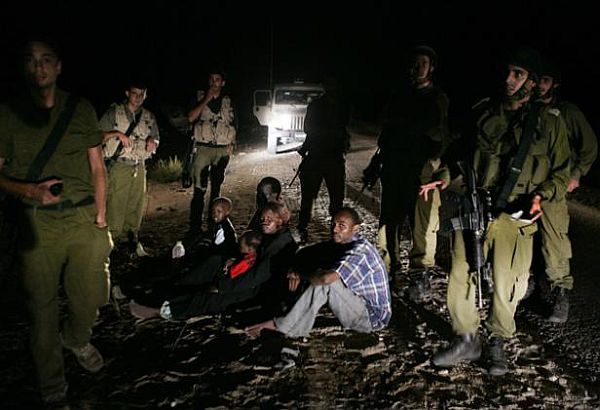
Israel wants to expel thousands of African refugees

Haaretz reports:

Jerusalem is ready to renew its offer to pay millions of dollars to any African or Western country willing to absorb the influx of migrants attempting to infiltrate Israel, a senior official said on Wednesday.

During deliberations with his political-security cabinet, Prime Minister Benjamin Netanyahu ordered the Foreign Ministry to renew its contacts with Western and African states to see if any would be willing to take in these migrant workers.

The Foreign Ministry has already held a round of talks on the matter with a number of states with whom Israel has diplomatic relations, but has not yet received a sufficient response to the request. Even those states willing to take in migrant workers are not prepared to absorb the numbers of people presented by Israel.

Netanyahu also ordered the defense establishment to begin immediate construction of a barrier on the Egyptian border and said he expected a report on the matter within a month. The works were due to start in July, but following disagreements on budgeting have been delayed by over three months.

The premier also said that alternatives needed to be found to reduce the flow of infiltrators before the barrier was in place.

The barrier is meant to prevent Islamic militants, drug dealers, African migrants and other asylum seekers from entering Israel from Egypt. At least 1,000 people enter the country illegally from Egypt each month, according to Israeli estimates.

Facebooktwittermail

Did the Palestinian Authority kill the Goldstone report?

Jared Malsin writes:

Israeli soldiers shot a mentally ill Palestinian man in the leg when he ventured near the Erez crossing, in the northern Gaza Strip on Tuesday. Last Wednesday, a 65-year-old man was shot in the neck in the same area. A week earlier the soldiers shot a 17-year-old, who entered the 300 to 500 meter “buffer zone” in northern Gaza to collect construction scrap which he hoped to sell for a few dollars. Human rights groups say there is a direct link between these daily shootings and the international community’s failure to hold Israel accountable for past violations, especially during its 2008-2009 offensive on Gaza, which left more than 1,300 Palestinians dead, most of them noncombatants. 13 Israelis also died. “The attacks [are] still going on, and the Israelis are taking the same stance as during Cast Lead. They’re failing to distinguish between civilian and military targets,” said Mahmoud Abu Rahma, of the Al-Mezan Center for Human Rights in Gaza.

Last month, under US and Israeli pressure, the Palestinian Authority (PA), once again delayed the process of accountability. This came at a September 29 vote at the UN Human Rights Council in Geneva, in which the PA backed a resolution to give Israel and Hamas officials in Gaza six more months to investigate crimes documented in Richard Goldstone’s UN Fact Finding Mission report. According to Palestinian and international human rights groups, the Palestinian Authority has decided that the Goldstone report must remain in Geneva, away from the relatively more powerful UN bodies in New York. This is a position identical to that of the US State Department, which wants to keep pressure off Israel during the newly re-launched political negotiations.

By adopting this position, rights groups say, the PA is placing itself in open conflict with the interests of its own people. “What’s very clear now is that the PA wants the report to stay in Geneva,” said Fred Abahams of Human Rights Watch. “We thought there was a lot of progress made in New York and this was a step backwards…with peace talks going, they don’t want Goldstone anywhere near the agenda,” Abrahams said on the phone from New York.

Facebooktwittermail

Israeli secret police out in force in Arab-Israeli town

As President Obama’s Middle East peace initiative appears destined for failure, there is increasing speculation that a third intifada may follow, but whereas the first two Palestinian uprisings took place primarily inside the occupied territories, the third uprising may well start inside Israel. The Israeli-Arab town of Umm al Fahm is now a tinder box.

In The National, Jonathan Cook reports:

Israeli police and stone-throwing Arabs clashed in northern Israel yesterday as a group of Jewish right-wing extremists tried to march through the Arab-Israeli town of Umm al Fahm.
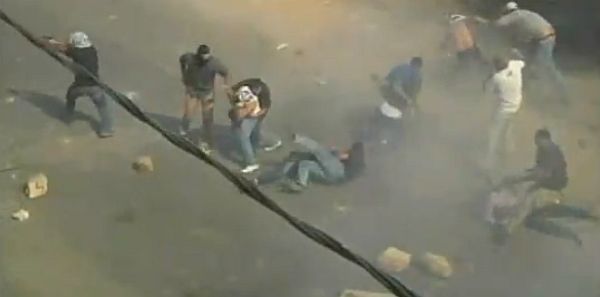
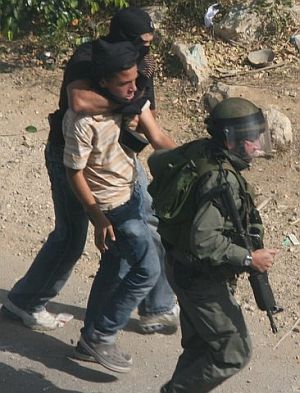
Two Arab legislators were injured in the violence. Afu Aghbaria, an Arab MP with the joint Jewish-Arab Communist party, said he had been hit in the leg.

Haneen Zoubi, a parliament member who has received hundreds of death threats since her participation in an aid flotilla to Gaza in the summer, also was among those hurt.

Ms Zoubi reported being hit in the back and neck by rubber bullets as she fled the area after police opened fire. In an interview with The National, she said she believed that she had been specifically targeted by police snipers after they identified her.

Israel deployed a secret police “mistaravim” unit (a Hebrew term meaning “disguised as an Arab”) in Umm al Fahm. In the image below, at least half a dozen such undercover operatives can be seen taking down demonstrators. The one on the far left appears to be firing a hand gun. The image is grabbed from news footage in a sequence that starts 38 seconds into the video shown below.

Dominic Waghorn at Sky News adds:

Israeli border police tactics in this week’s clashes in Umm al Fahm are being scrutinised.

The concentration and intensity of stun grenades and tear gas volleys unleashed on a few hundred Israeli Arab was unprecedented in many observers’ experience.

The police say they launched it as soon as the first stones were thrown. One Israeli Arab Knesset member claims the stones were thrown by undercover Israeli police masquerading as Arabs in the crowd.
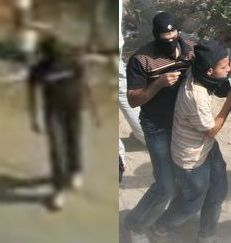
Israeli Channel 2 reported claims the tear gas volleys were fired in such a way because the crowd had just started turning on a suspected undercover police officer.

As Sameer Bazbaz captured in this sequence later [see image on the right], the undercover police were very active later, hiding among the crowd then pouncing on Israeli Arabs as uniformed colleagues swarmed to join them.

The undercover officer shown in the image above with his right arm firmly gripped around a teenager’s neck appears to be the same individual who can be seen at the beginning of the video above who 10 seconds in, can be seen at the road’s edge apparently picking up a stone to throw at Israeli police.

Facebooktwittermail

Leasehold settlements?

Haaretz reports:

Israel is conducting secret negotiations with the U.S. on establishing the future borders of a Palestinian state, the London-based Arabic language daily Asharq al-Awsat reported on Friday.

According to the report, Palestinian sources confirmed that the two sides discussed an option wherein Israel may lease lands in East Jerusalem from the Palestinians in exchange for the establishment of an independent Palestinian state.

Israel would lease the territories from the Palestinian state for a period of 40 to 99 years.

The Palestinian sources said that the talks are an American initiative that has been going on for some time in order to obtain an understanding with Israel regarding the terms surrounding a future Palestinian state.

The Palestinian Authority apparently has only recently been made aware of the talks and hasn’t been given the details of the proposal.

An Egyptian source told the newspaper that the negotiations are “more quiet than secret, and are meant to try to save the peace process.”

Neither the Prime Minister’s Office nor the U.S. government agreed to comment on the report.

Israel in secret negotiations with the US? I guess this confirms what has long appeared to be the case: that the Palestinians are regarded as being peripheral to the conflict. But I really don’t know what to make of this lease proposal. Britain held Hong Kong on a lease, but once the lease expired Hong Kong went back to China. Somehow I don’t see a Palestinian state ever having quite as much leverage as China. Neither, given its disregard for UN resolutions, do I see Israel feeling a heavy obligation to honor a legal contract limiting its occupation of East Jerusalem. The Israelis’ interests have always seemed to be focused on the so-called facts no the ground rather than legal issues of ownership.

Facebooktwittermail