Yearly Archives: 2010

The 9/11 holocaust and the ground zero mosque

The monument at the hypocentre of the Nagasaki atomic bomb blast

Another way of saying “sacred” is to say “off-limits.”

Something can be sanctified by placing a barrier around it constructed from rigid taboos. The most extreme among those taboos dictates not only silence but also exclusion.

In such a way, for many Americans, 9/11 has been sanctified. The sacred idea occupies a sacred space and only those willing to display sufficient awe and reverence can be allowed to enter.

Yet there are limits on how high this sacred narrative can be raised. We do not, by and large, talk about the 9/11 holocaust — and rightfully so. To link a day on which 3,000 Americans died, to a period during which 6 million Jews were systematically slaughtered, would be absurd and obscene.

When on 9/11 Benjamin Netanyahu said it was “very good” — because it would generate sympathy for Israelis — his response would no doubt have been rather different had he been asked whether the attacks would help Americans now better understand the significance of the Holocaust.

So we don’t talk about a 9/11 holocaust. Instead, with little to no comment, the attacks have another but equally perverse association: with the nuclear devastation brought down on Hiroshima on August 6, 1945.

The more obvious World War Two association — with the December 7 attack on Pearl Harbor in 1941 — was initially referenced through headlines that reinvoked Roosevelt’s description of that day as “a date which will live in infamy,” but beyond the date — 9/11 — the name that stuck was “ground zero.”

The rubble and dust at the crushed feet of the World Trade Center might have conjured images of nuclear devastation yet little sense that a stolen word required a buried memory.

If Americans were polled today and asked which city they associate with “ground zero,” would any answer “Hiroshima” or “Nagasaki”? Most likely, very few — even though the anniversary of the nuclear bombings has only just passed.

On August 6, a ceremony marking the 65th anniversary of the bombing that killed 140,000 people in Hiroshima, was attended for the first time by a representative of the US government, the US ambassador to Japan, John Ross. This was not the first time an American official had been allowed to attend — it was the first time an invitation had been accepted. So far, no sitting American president has ever visited Hiroshima.

Within a decade of the nuclear attacks, the Catholic Memorial Cathedral for World Peace had been opened in Hiroshima. The Japanese raised few objections to the construction a church close to the original ground zero.

Meanwhile, Pearl Harbor is being invoked once again in a vain effort to conceal the Islamophobia that permeates objections to the New York mosque.

Dr Richard Land, president of the Southern Baptist Convention’s Ethics and Religious Liberty Commission, and a member of the federally created United States Commission on International Religious Freedom, “insists that his opposition to the Cordoba House project is principled — that he would and has opposed similar efforts when they upset local populations.”

“There is a Japanese Shinto shine, I am told, blocks from the USS Arizona,” Land said. “That isn’t appropriate even 60 years later. Three-thousand Americans died there and they died at the hands of people acting on behalf of the Japanese Empire.”

There isn’t, in fact, a Shinto shrine near Pearl Harbor [writes Brian Beutler], though many conservatives use this hypothetical as an example of a non-Muslim shrine they’d oppose for similar reasons.

Around the same time that Western dignitaries gathered in Japan in order to commemorate the ghastly effects of nuclear destruction, another group of public figures embarked on an equally historic pilgrimage.

Eight Muslim-American imams, along with President Obama’s envoy to combat anti-Semitism, Hannah Rosenthal, traveled to the sites of the former Dachau and Auschwitz concentration camps in Germany and Poland.

“These Muslim leaders were experiencing something they knew nothing about,” Rosenthal told Politico. She had many family members at Auschwitz, including her grandparents. “I can’t believe anyone walks into Auschwitz and leaves the same person. I watched them break down. I broke down in front of suitcases. … It is the cemetery of my whole family.”

The American imams later released a statement saying:

We bear witness to the absolute horror and tragedy of the Holocaust where over twelve million human souls perished, including six million Jews.

We condemn any attempts to deny this historical reality and declare such denials or any justification of this tragedy as against the Islamic code of ethics.

We condemn anti-Semitism in any form. No creation of Almighty God should face discrimination based on his or her faith or religious conviction.

We stand united as Muslim American faith and community leaders and recognize that we have a shared responsibility to continue to work together with leaders of all faiths and their communities to fight the dehumanization of all peoples based on their religion, race or ethnicity. With the disturbing rise of anti-Semitism, Islamophobia, and other forms of hatred, rhetoric and bigotry, now more than ever, people of faith must stand together for truth.

Strangely, the Anti-Defamation League’s Abe Foxman and the Investigative Project’s Steve Emerson, author of “American Jihad,” lobbied U.S. officials against participating in the trip.

Perhaps if those now concerned about the Cordoba House project gave more attention to what it means to enter a sacred space, rather than how to keep others out, they would understand that a real sense of the sacred springs from keeping ones eyes open — not sealing them closed.

Facebooktwittermail

Defending sacred ground

At Foreign Policy, Stephen Walt enters the fray on the Cordoba House controversy and notes that America’s founders understood that “trying to impose religious orthodoxy on the new republic was a recipe for endless strife.”

The principle of religious tolerance is not a piece of clothing that one can don or doff at will, or as the political winds shift. Indeed, it is most essential not when we are dealing with groups whose beliefs are close to our own and therefore familiar; the whole idea of “religious tolerance” is about accepting communities of faith that are different from our own and that might strike us at first as alien or off-putting. Tolerance doesn’t mean a thing if we apply it only to people who are already just like us.

The latest example of tortured reasoning on this subject was New York Times columnist Ross Douthat’s column a couple of days ago. Douthat explained the controversy as a struggle between “two Americas”: one of them based on the liberal principle of tolerance and the other based on the defense of a certain understanding of “Anglo-Protestant” culture.

In addition to glossing over the latter’s dark underbelly (slavery, anti-Semitism, anti-Catholic prejudice, etc.), Douthat’s main error was to view these two aspects of American society as of equal moral value. In his view, it’s legitimate to object to the community center because we have to respect the feeling of those Americans (including Douthat himself, one assumes) who believe that the United States is at its heart an “Anglo-Protestant/Catholic/Judeo-Christian” nation.

Even if one accepts this simplistic dichotomy, what Douthat fails to realize is that the history of the United States is the story of the gradual triumph of the first America over the second. The United States may have been founded (more-or-less) by a group of “Anglo-Protestants,” and defenders of that culture often fought rear-guard actions against newcomers whose practices were different (Jews, Catholics, Japanese, Chinese, etc.). But the founding principle of religious tolerance gradually overcame the various Anglo-Protestant prejudices, which allowed other groups to assimilate and thrive, to the great benefit of the country as a whole. The two America’s are not morally equivalent, and we should all be grateful that when those two Americas have come into conflict, it is the second America that has steadily given way to a broader vision of a free and open democracy.

The final disappointment, of course, has been the response of some prominent Democrats, despite the salutary example that Mayor Bloomberg set for them. President Obama gave a powerful defense of his own last week, and then promptly diluted his initial statement with some ill-advised waffling. (Obama’s desire to find common ground is sometimes admirable, but someone needs to remind him that when one side is right and the other is wrong, moving towards the middle is movement in the wrong direction.)

Even more disappointing was Senate Majority Leader Harry Reid’s cowardly dissembling, in which he simultaneously claimed to support religious freedom but said he thought the community center should nonetheless be moved somewhere else.

Here’s the challenge I would pose to anyone pushing the “sensitivity” argument: How far from the site of the World Trade Center is an appropriately sensitive distance for constructing an Islamic center? Is some place else a few more blocks away or in another city? And what kinds of construction are or are not permissible inside the sensitivity zone?

These are of course redundant questions because the sanctity of so-called hallowed ground is not the issue. This is not about sacred ground; it’s about appealing to unreasoned sentiment. The demographic where politicians (and the press) make the easiest sale is filled with people who discern more clarity in their feelings than their thoughts. If it don’t feel right what more need one think or say? This is the sacred ground — untroubled by complexity — that the mosque’s critics so jealously defend.

Facebooktwittermail

“Ground Zero mosque” is the new “death panels”

Jeffrey Feldman writes:

Cordoba House is not some sudden and new issue, but the latest attempt by the Republican Party to displace meaningful political debate with pitch-fork-and-torches style mass hysteria.

The themes of these newest wave of delirium are familiar: Muslim conspiracy; infiltration by foreign terrorists; Liberal collusion.

Are we a nation ruled by mass hysteria — a nation that sees conspiracy behind every unfamiliar face? Or are we a nation that raises above the tyranny of the mob roused to rid the village of those in league with the Devil? Those are the questions that the Mayor and President should have asked, but nobody seems to be asking them.

When mass hysteria has been allowed in the past to drive public policy it lead inexorably to shameful results that destroyed lives and weakened democratic society.

William Dalrymple writes:

Feisal Abdul Rauf of the Cordoba Initiative is one of America’s leading thinkers of Sufism, the mystical form of Islam, which in terms of goals and outlook couldn’t be farther from the violent Wahhabism of the jihadists. His videos and sermons preach love, the remembrance of God (or “zikr”) and reconciliation. His slightly New Agey rhetoric makes him sound, for better or worse, like a Muslim Deepak Chopra. But in the eyes of Osama bin Laden and the Taliban, he is an infidel-loving, grave-worshiping apostate; they no doubt regard him as a legitimate target for assassination.

For such moderate, pluralistic Sufi imams are the front line against the most violent forms of Islam. In the most radical parts of the Muslim world, Sufi leaders risk their lives for their tolerant beliefs, every bit as bravely as American troops on the ground in Baghdad and Kabul do. Sufism is the most pluralistic incarnation of Islam — accessible to the learned and the ignorant, the faithful and nonbelievers — and is thus a uniquely valuable bridge between East and West.

The great Sufi saints like the 13th-century Persian poet Rumi held that all existence and all religions were one, all manifestations of the same divine reality. What was important was not the empty ritual of the mosque, church, synagogue or temple, but the striving to understand that divinity can best be reached through the gateway of the human heart: that we all can find paradise within us, if we know where to look. In some ways Sufism, with its emphasis on love rather than judgment, represents the New Testament of Islam.

Facebooktwittermail

In Iraq, Western clocks, but Middle Eastern time

Anthony Shadid writes:

Iraq today is replete with American-ordered deadlines, timetables and benchmarks that sought to create realities where realities never existed. The administration is leaving now on its own terms. Perhaps staying would make an already traumatized Iraq worse; much of its dysfunction dates to the American occupation and its earliest days. But the very nature of America’s departure — with no government formed, an unpredictable Iraqi military, and deep popular disenchantment with a hapless political elite — underscores one of the most enduring traits of American strategy in the Middle East.

Powerful but fickle, the United States has never seemed to understand time, at least not in the way it is acknowledged by Islamic activists willing to serve decades in jail, Syrian presidents assured that American policies will eventually change, and Iraq’s neighbors, who bide their turn to fill the vacuum left by an American departure.

Its policies — support for Israel and authoritarian Arab governments, the invasion of Iraq and war in Afghanistan — may shape sentiments toward it. But time, an American measure of it, often shapes the way it acts.

“It certainly is American politics and it is American culture, the sense that we are an impatient people,” said Ryan C. Crocker, a former ambassador to Iraq and veteran diplomat in the Arab world. “ ‘Tomorrow or the day after tomorrow, at the latest, and if that’s not going to happen, we’re going to move on.’ ”

The Middle East has long suffered under a peculiarly American notion that if the world’s greatest power wants something, it will somehow come to pass, on its schedule. In Lebanon, the Palestinian territories and Syria, the messy realities never quite fit. Since 2003, they rarely have in Iraq, either.

Facebooktwittermail

Goldberg willing to bet on a “better” chance that Israel will strike Iran

Fox News reports:

Israel has until the weekend to launch a military strike on Iran’s first nuclear plant before the humanitarian risk of an attack becomes too great, former U.S. Ambassador to the United Nations John Bolton said Tuesday.

A Russian company is expected to help Iran start loading nuclear fuel into its plant starting on Saturday, after which an attack on the Bushehr reactor could trigger harmful radiation, which Israel wants to avoid, Bolton said. So unless the Israelis act immediately to shut down the facility, it will be too late.

“Once it’s close to the reactor … the risk is when the reactor is attacked, there will be a release of radiation into the air,” Bolton told FoxNews.com. “It’s most unlikely that they would act militarily after fuel rods are loaded.”

The attack Iran story gets increasingly bizarre. Now we have neocon commentators like Bolton watching the clock as though this was some kind of sporting event and at the same time, presenting Israel as a thoroughly responsible player. While Israel might be willing to destabilize the whole region, it wouldn’t want to risk spreading nuclear fallout into the Gulf. But as Marsha Cohen points out, the risks from fallout would not simply be humanitarian — they would be economic:

Besides the catastrophic human and environmental toll of such an attack, the sea lanes through which much of the world’s oil supplies pass would be endangered.

Iranians know this. In 1980, Iran bombed Iraq’s Osirak nuclear power plant before it contained any radioactive material. Osirak was quickly repaired by the French contractors who built it. Eight months later Osirak was partially destroyed by Israeli jets, aided by Iranian intelligence.

Meanwhile, at The Atlantic, Jeffrey Goldberg and Robin Wright are now placing bets on the likelihood of an attack — not in the next few days, but the coming months.

“By July next year, I’ll wager that neither Israel nor the United States will have bombed Iran,” says Wright.

“I, of course, believe that there is a better than 50 percent chance Israel will strike …Iran by this time next year,” says Goldberg.

Note the phrasing chosen by the man who just a few days ago expressed “profound, paralyzing ambivalence” about whether on attack on Iran would be a good idea. He doesn’t now simply reiterate his expectation that an attack is more likely but that it looks like a “better” than 50 percent chance.

Casually chosen words? Maybe, but if Goldberg was being asked how likely another 9/11 attack might be and he thought it more likely than not to happen, I doubt that he would say there is a better than 50 percent chance of such an attack, would he?

Facebooktwittermail

Is Israel’s legitimacy under challenge?

Henry Siegman writes:

When a state’s denial of the individual and national rights of a large part of its population becomes permanent — a permanence that has been the goal of Israel’s settlement project from its very outset (and that many believe has been achieved) — that state ceases to be a democracy. When the reason for that double disenfranchisement is that population’s ethnic and religious identity, the state is practicing a form of apartheid or racism. The democratic dispensation that Israel provides for its mostly Jewish citizenry cannot hide its changing (or changed) character. A political arrangement that limits democracy to a privileged class and keeps others behind military checkpoints, barbed-wire fences and separation walls does not define democracy. It defines its absence.

The claim that Israel is the incarnation and defender of Jewish values is contradicted by its treatment of an Arab population that has now lived for over two generations under Israel’s military subjugation – treatment that Moshe Arens, a former Likud Defense and Foreign Minister, has warned is turning that population into a permanent underclass of “carriers of water and hewers of wood.” It is entirely at odds with Biblical admonitions and Prophetic exhortations warning against injustices committed by the privileged and the powerful against the stranger and the powerless.

Israel’s problem is not the Palestinian or Arab refusal to recognize it as a Jewish state. It is, rather, the increasing difficulty of Jews familiar with Jewish values to recognize it as a Jewish state. Rather than demanding that Palestinians declaim on Israel’s democratic and Jewish identity, or conjuring non-existent threats to Israel’s existence, Netanyahu and his government would be better advised adjusting Israel’s policies toward a people that has lived under its unforgiving military occupation in a way that honors their country’s democratic and Jewish beginnings. That would contribute far more to its “legitimacy” and to its long-range security than its present undemocratic and very un-Jewish course.

Whether it is in response to a purported campaign of de-legitimization against Israel or a more broadly defined “new anti-Semitism”, the ploy that Israel’s defenders employ is invariably the same: it is to deflect criticism of Israeli actions by treating them as attacks on Jewish identity.

It is not what we do; it is who we are — and that we are powerless to change.

Facebooktwittermail

Do most Israeli Jews consider non-Jews to be sub-human?

The question I pose here is prompted by a post by the Israeli blogger, Yossi Gurvitz.

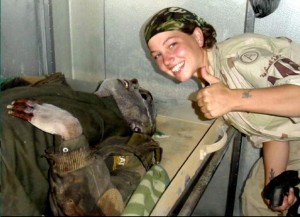
After the blogosphere lit up yesterday in reaction to photographs of a young Israeli soldier, Second Lieutenant Eden Aberjeel, posing alongside Palestinian prisoners, Gurvitz wrote:

There is nothing out of the ordinary about Aberjeel, who refused to speak with several bloggers because she “doesn’t speak with leftists”: she describes herself as holding rightwing political views and being religious (i.e., an observant Jewish Orthodox); she’s also a member of several religious groups, particularly of “born again” (hozrim bi’tshuva) Jews, quite a few “Bring Gilad Shalit home” groups — and the group “I, too, hate the Hamas”.

In short, she’s a good representative of a large portion of the IDF’s soldiers — and, more worryingly, officers. Like Lynndie England, she’s become a face for the banality of evil; unlike England, she doesn’t seem to understand she did something wrong, and didn’t think twice before posting those pictures.

And why would she? After all, like most Israeli Jews, she considers non-Jews — Arabs in particular — to be subhuman.

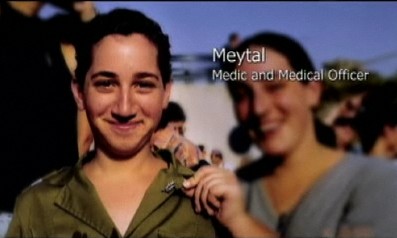
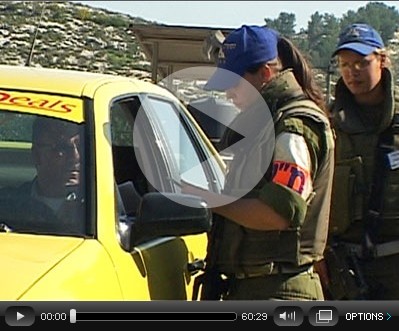
In order to refute an official statement which claimed that Aberjeel’s behavior was an exception, the Israeli human rights group, Breaking the Silence, has now released photographs showing other IDF soldiers sitting alongside handcuffed and blindfolded Palestinian detainees. Indeed, anyone who has watched the documentary To See If I Am Smiling (released in 2007) in which six young Israeli women recount their experiences of military service in the occupied Palestinian territories, knows that this is a familiar story.

The title of the film comes from a story told by Meytal, a medic and medical officer. Having described how cleaning the corpses of Palestinians after they had been brutalized by Israeli soldiers had become a routine part of her job, she goes on to recount a particular moment that still haunts her: when she posed for a photograph next to a corpse.

I’m not sure when it was, but at some point I became very ashamed of that picture. And I didn’t tell anyone about it, that it existed. I forgot about it a little. But I would like to see it. To see if I look different. I want to see if I’m still smiling.

The photograph is not shown in the documentary, but in the mind’s eye of many Americans it must evoke memories of Abu Ghraib.

Such images are iconic because they capture the moment in which a soldier discovers that he or she has become the very thing they fear. The dehumanized other is a vortex from which there is no escape.

If a nation can have such a thing as a soul, To See If I Am Smiling, reveals how profoundly Israel’s soul has been scarred by 43 years of occupation. A fully militarized society has shackled itself to a conviction — we have no choice — whereby each individual can then bury their own awareness of complicity and moral responsibility under a collective weight of irresistible necessity.

But before anyone jumps to conclusions about what all of this says about Israelis, it’s worth remembering what Americans have shown themselves capable of when they come to regard their enemies as subhuman.

Abu Ghraib is still fresh in most people’s minds as an indication of the depravity soldiers can descend into once the enemy has been sufficiently dehumanized, but to the extent that the war in Iraq is now broadly considered a mistake, Abu Ghraib is likewise easily seen as some kind of aberration.

Better then to be reminded of some of the barbarity that members of “the greatest generation” engaged in while fighting the “good war” — World War Two.

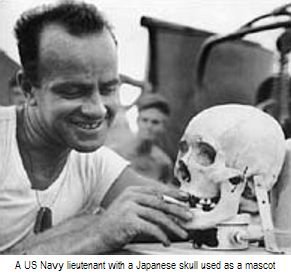
In the fight against the Japanese, the practice of “trophy hunting” went far beyond posing for photographs next to captives of the dead. “[B]oiling the flesh off enemy [Japanese] skulls to make souvenirs was a not uncommon practice. Ears, bones and teeth were also collected,” writes the historian, Niall Ferguson.

And the context in which this occurred? One in which among Americans, the Japanese had come to be regarded as subhuman. “To the historian who has specialized in German history, this is one of the most troubling aspects of the Second World War: the fact that Allied troops often regarded the Japanese in the same way that Germans regarded Russians — as Untermenschen,” writes Ferguson.

In each of these scenarios we witness the shadow of exceptionalism: that when individuals, nations, tribes or ethnic groups see themselves as superior to others, they also unleash their own depravity.

Facebooktwittermail

Hamas supports the right of Muslims to pray in mosques — even in New York

Hamas has leaped into the New York mosque controversy — well, actually, not so much leaped as diffidently tiptoed when pressed to express an opinion on the issue.

In an interview on New York’s WABC radio (audio can be heard here), Mahmoud al-Zahar, a co-founder of Hamas who is in the Gaza political leadership, was asked by Aaron Klein to comment on the construction of the mosque.

Without addressing the question directly, Zahar chose to respond by pointing out that Muslims in America are like Muslims elsewhere, living in accordance with Islam, fasting (during Ramadan), praying and so forth. He then went on to say that Hamas is being misrepresented by those who would liken it to the Taliban and that it is recognized across the Islamic world as a moderate organization.

Klein, however, wanted to focus on the mosque controversy and returned to that question:

Klein: What do you think about the new initiative to build a mosque near the World Trade Center in New York, which is a major point of controversy on all sides?

Zahar: We have to build the mosque as you are allowed to build the church and the Israeli are building their holy places. We have to build everywhere — in every area we have muslims, we have to pray, and this mosque is the only site of prayer especially for the people when they are looking to be in the group — not individual.

Muslims should be allowed to worship in mosques, just like Christians going to church and Jews going to the synagogue.

Not much controversy there, right?

Well, the New York Post seems eager to pour fuel on the fire by inserting a few words in order to imply that Hamas (and Muslims in general) are engaged in territorial expansion.

A leader of the Hamas terror group yesterday jumped into the emotional debate on the plan to construct a mosque near Ground Zero — insisting Muslims “have to build” it there.

“We have to build everywhere,” said Mahmoud al-Zahar, a co-founder of Hamas and the organization’s chief on the Gaza Strip.

“In every area we have, [as] Muslim[s], we have to pray, and this mosque is the only site of prayer,” he said on “Aaron Klein Investigative Radio” on WABC.

“In every area we have Muslims, we have to pray,” which is to say, wherever Muslims live they have a religious obligation to gather for prayer and they do this in mosques.

But then we get the New York Post twist: “In every area we have, [as] Muslims[s], we have to pray,” conjures up a completely different picture. Lower Manhattan is now an area that Muslims claim as their own — at least the New York Post appears to want to promote this lie.

Let’s see whether anyone in the mainstream media is willing to correct this flagrant distortion. I’m not holding my breath.

Facebooktwittermail

America’s flawed Afghanistan strategy

By Dr Steven Metz

Despite the lavish time and attention that the Obama administration devoted to reviewing its Afghanistan strategy, the result was more continuity than change. The administration adjusted U.S. troops levels and shifted some operational methods but accepted the most basic — and questionable — assumptions of the Bush strategy. Unfortunately, these do not hold up under close scrutiny. The new strategy, like the old one, totters on a dangerously flawed foundation.

Both the Bush and Obama strategies assume that al-Qaeda needs state support or sanctuary. That, after all, is the fundamental rationale for continued American involvement in Afghanistan. But throughout the “war on terror,” no one has made a persuasive case that the September 11, 2001, attacks would not have happened had al-Qaeda not had bases in Afghanistan. While it may take meetings and phone calls to plot terrorism, these can be done from nearly anywhere. Al-Qaeda’s Afghanistan sanctuary was a convenience, not a necessity. Destroying the sanctuary has not stopped bin Laden and his henchmen from plotting new attacks.

Why, then, should the United States devote billions of dollars fighting the Taliban in Afghanistan if doing so has little effect on al-Qaeda’s ability to launch terrorism? The answer says more about the way Americans think than it does about how terrorists operate. The United States has expended great effort to eradicate al-Qaeda’s bases and training camps less because they were important than because we are effective at it. There is an old saying that, “when all you have is a hammer, every problem looks like a nail.” America has an amazing hammer — its military — which is very good at seizing and controlling territory. So, we reasoned, eradicating bases and training camps will cripple al-Qaeda. Yet there is no evidence to validate this idea.

The Obama strategy also assumes that without U.S. and NATO troops in Afghanistan, the Taliban will regain control. But the Taliban came to power in 1996 because the warlords opposing it had little outside support and, more importantly, because Afghans did not understand just what Taliban rule would mean and thus did little to resist it. Now they do know and will resist, at least outside Afghanistan’s Pashtun areas. Simply funding the Afghan government and providing it with training and advice can prevent an outright Taliban victory without a large U.S. military presence.

The Obama strategy then assumes that if the Taliban regains control of Afghanistan, it will again provide bases and sanctuary to al-Qaeda. The Pentagon’s newly released Quadrennial Defense Review warned of al-Qaeda “regaining sanctuary in Afghanistan.” In his December 2009 speech at West Point, President Obama stated that al-Qaeda would “operate with impunity” if the region “slides backward.” This is only true if the Taliban is remarkably stupid. Before September 11, 2001, the Taliban allowed al-Qaeda to train and plot in Afghanistan because it was profoundly ignorant of American intentions and power. The United States, Taliban leaders believed, understood enough history to not intervene in Afghanistan. Now they know better. If the Taliban somehow returned to power, it would face enemies enough without provoking another American assault or intervention by giving al-Qaeda a free hand.

Finally, the Obama strategy assumes that if the Taliban regained control of some or all of Afghanistan and did, for some reason, provide support and sanctuary to al-Qaeda, this would increase the threat to the United States and the other NATO countries. Again, this overlooks history. Al-Qaeda was able to plot terrorism from Afghanistan because the United States was unaware of the impending danger. Had America known what was coming, it certainly would have rendered al-Qaeda’s Afghanistan bases useless even without a full scale invasion. There is no reason to believe that if al-Qaeda somehow recreated its pre-September 11 Afghanistan sanctuary that the United States would not quickly destroy it.

Ultimately, then, the basic rationale of American strategy in Afghanistan is questionable. Certainly America cannot ignore that country as it did before September 11, 2001, and should continue supporting the national government and other Afghans opposed to the Taliban. But in strategy, balance is the key — the expected security benefits of any action must justify the costs and risks. Today, America’s Afghanistan strategy, with its flawed assumptions, is badly out of balance.

Dr Steven Metz is a Research Professor of National Security Affairs at the Strategic Studies Institute of the United States Army War College. The views expressed in this op-ed are those of the author and do not necessarily reflect the official policy or position of the Department of the Army, the Department of Defense, or the U.S. Government.

Reprinted with permission of the Strategic Studies Institute Newsletter, U.S. Army War College.

Facebooktwittermail

Harvard University cuts its losses and dumps all investments in Israel

Update: Harvard explains Israel share sales: it wasn’t divestment, it’s just that Israel is no longer an emerging market (Business Insider).

Did the Boycott, Divestment and Sanctions for Palestine movement just make a historic advance? Harvard University has sold close to $40 million of shares in Israeli companies:

In another blow to Israeli shares, the Harvard Management Company notified the US Securities and Exchange Commission (SEC) on Friday that it had sold all its holdings in Israeli companies during the second quarter of 2010. No reason for the sale was mentioned. The Harvard Management Company manages Harvard University’s endowment.

Harvard Management Company stated in its 13-F Form that it sold 483,590 shares in Teva Pharmaceutical Industries Ltd. (Nasdaq: TEVA; TASE: TEVA) for $30.5 million; 52,360 shares in NICE Systems Ltd. (Nasdaq: NICE; TASE: NICE) for $1.67 million; 102,940 shares in Check Point Software Technologies Ltd. (Nasdaq: CHKP) for $3.6 million; 32,400 shares in Cellcom Israel Ltd. (NYSE:CEL; TASE:CEL) for $1.1 million, and 80,000 Partner Communications Ltd. (Nasdaq: PTNR; TASE: PTNR) shares for $1.8 million.

Some commentators plausibly argue that Harvard’s decision was purely financial and not a political decision. Indeed, were it actually an explicit act of divestment there would surely have been a carefully crafted statement explaining their decision.

Even so, the effectiveness of the BDS movement may well depend less on persuading capital to move with principal (it never does) but on companies, institutions, artists and other players coming to the self-interested conclusion that doing business with Israel is bad for business.

Facebooktwittermail

Obama’s defense of religious freedom

On Friday, Glenn Greenwald wrote:

This is one of the most impressive and commendable things Obama has done since being inaugurated:

President Obama delivered a strong defense on Friday night of a proposed Muslim community center and mosque near ground zero in Manhattan, using a White House dinner celebrating Ramadan to proclaim that “as a citizen, and as president, I believe that Muslims have the same right to practice their religion as anyone else in this country” . . . .

“I understand the emotions that this issue engenders. Ground zero is, indeed, hallowed ground,” the president said in remarks prepared for the annual White House iftar, the sunset meal breaking the day’s fast.

But, he continued: “This is America, and our commitment to religious freedom must be unshakable. The principle that people of all faiths are welcome in this country, and will not be treated differently by their government, is essential to who we are” . . . .

What makes this particularly commendable is there is virtually no political gain to be had from doing it, and substantial political risk. Polls shows overwhelming opposition to the mosque nationwide (close to 70% opposed), and that’s true even in New York, where an extraordinary “50% of Democrats, 74% of Republicans, and 52% of ‘non-enrolled’ voters, don’t want to see the mosque built.” The White House originally indicated it would refrain from involving itself in the dispute, and there was little pressure or controversy over that decision. There was little anger over the President’s silence even among liberal critics. And given the standard attacks directed at Obama — everything from being “soft on Terror” to being a hidden Muslim — choosing this issue on which to take a very politically unpopular and controversial stand is commendable in the extreme.

On Saturday, Obama was questioned by CNN on the reaction provoked by his speech the night before. Obama responded:

My intention was to simply let people know what I thought. Which was that in this country, we treat everybody equally in accordance with the law. Regardless of race. Regardless of religion. I was not commenting on and will not comment on the wisdom of making a decision to put a mosque there. I was commenting very specifically on the right that people have that dates back to our founding. That’s what our country’s about and I think it’s very important that as difficult as some of these issues are, we stay focused on who we are as a people and what our values are all about.

Fair enough?

Well not if you’re a journalist who wants to construct a story about the president who “seemed to contradict himself.”

In a country that has a constitution that protects religious freedom by separating Church and State, what business does any politician have in expressing an opinion about the wisdom of building a house of worship anywhere? Just because this is a representative democracy doesn’t mean elected politicians have an obligation to reflect the bigotry of their constituents.

Facebooktwittermail

Obama’s secret war

The Bush administration was well known for its lack of accountability and its disregard for international law, yet if the lead proponents of outlaw governance — men such as Dick Cheney and his chief of staff David Addington — preferred to operate in the shadows, there was a political form of accountability in as much as their approach was seen as an integral feature of the neoconservative agenda — an agenda that got roundly criticized in many quarters.

This is what makes President Obama’s approach in some ways more dangerous than that of the neocons.

The New York Times reports on Obama’s secret war being conducted in Yemen and elsewhere which discredited neocons must now be applauding not only because this administration has in in so many ways adopted their approach but because this approach has now become institutionalized and legitimized by an administration that is not weighed down by the ideological baggage of its predecessor.

A convergence between the CIA — operating increasingly as a paramilitary organization — and the Pentagon — conducting more and more clandestine operations — has produced an American killing machine that operates with minimal political and legal oversight. As the Times says: “the American military campaign in Yemen began without notice in December and has never been officially confirmed.”

“Where we want to get is to much more small scale, preferably locally driven operations,” said Representative Adam Smith, Democrat of Washington, who serves on the Intelligence and Armed Services Committees.

“For the first time in our history, an entity has declared a covert war against us,” Mr. Smith said, referring to Al Qaeda. “And we are using similar elements of American power to respond to that covert war.”

Some security experts draw parallels to the cold war, when the United States drew heavily on covert operations as it fought a series of proxy battles with the Soviet Union.

And some of the central players of those days have returned to take on supporting roles in the shadow war. Michael G. Vickers, who helped run the C.I.A.’s campaign to funnel guns and money to the Afghanistan mujahedeen in the 1980s and was featured in the book and movie “Charlie Wilson’s War,” is now the top Pentagon official overseeing Special Operations troops around the globe.

Facebooktwittermail

Why silence over Kashmir speaks volumes

Pankaj Mishra writes:

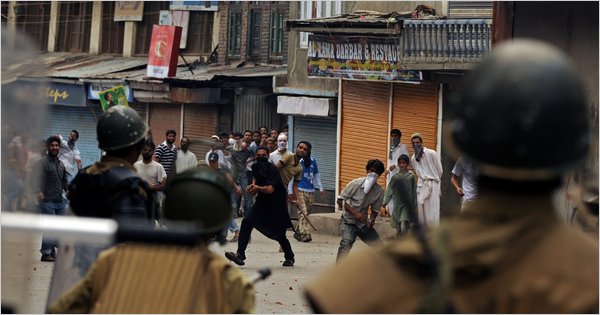
Once known for its extraordinary beauty, the valley of Kashmir now hosts the biggest, bloodiest and also the most obscure military occupation in the world. With more than 80,000 people dead in an anti-India insurgency backed by Pakistan, the killings fields of Kashmir dwarf those of Palestine and Tibet. In addition to the everyday regime of arbitrary arrests, curfews, raids, and checkpoints enforced by nearly 700,000 Indian soldiers, the valley’s 4 million Muslims are exposed to extra-judicial execution, rape and torture, with such barbaric variations as live electric wires inserted into penises.

Why then does the immense human suffering of Kashmir occupy such an imperceptible place in our moral imagination? After all, the Kashmiris demanding release from the degradations of military rule couldn’t be louder and clearer. India has contained the insurgency provoked in 1989 by its rigged elections and massacres of protestors. The hundreds of thousands of demonstrators that fill the streets of Kashmir’s cities today are overwhelmingly young, many in their teens, and armed with nothing more lethal than stones. Yet the Indian state seems determined to strangle their voices as it did of the old one. Already this summer, soldiers have shot dead more than 50 protestors, most of them teenagers.

The New York Times this week described the protests as a comprehensive “intifada-like popular revolt“. They indeed have a broader mass base than the Green Movement does in Iran. But no colour-coded revolution is heralded in Kashmir by western commentators. The BBC and CNN don’t endlessly loop clips of little children being shot in the head by Indian soldiers. Bloggers and tweeters in the west fail to keep a virtual vigil by the side of the dead and the wounded. No sooner than his office issued it last week, the UN secretary general, Ban Ki-moon, hastened to retract a feeble statement expressing concern over the situation in Kashmir.

New York Times: Phone cameras fuel Kashmir’s ‘intifada.’

Facebooktwittermail

A campaign for war with Iran begins

In response to Jeffrey Goldberg’s Atlantic article, “The Point of No Return,” Trita Parsi writes in Salon:

Whether characterizing it as “mainstreaming war with Iran” or “making aggression respectable,” Goldberg’s article serves to create a false narrative that claims that the two failed meetings held between the U.S. and Iran last October constitute an exhaustion of diplomacy, that deems the Obama administration’s crippling, indiscriminate sanctions on Iran a failure only weeks after they’ve been imposed, and that then leaves only one option remaining on the table: an American or Israeli military strike. And on top of that, if President Obama doesn’t green light a bombing campaign, Israel will have no choice but to bomb itself, even though it isn’t well-equipped to do so, according to Goldberg.

It is important to note that the aim of this unfolding campaign may not be to pressure Obama into military action. It could just as much serve to portray Obama as weak and indecisive on national security issues that are of grave concern to the U.S. and that are of existential nature to Israel. This portrayal will give the Republicans valuable ammunition for the November congressional elections as well as for the 2012 presidential race.

Indeed, the likely political motivation for this unfolding campaign should not be underestimated. Just as much that the building blocks of the Iraq war were put into place under the Clinton years — most importantly with the passage of the Iraq Liberation Act in 1998 — serious preparation for selling an Iran war to the American public under a Republican president (Palin?) in 2013 must be undertaken now, both to establish the narrative for that sell and to use the narrative to remove any obstacles in the White House along the way.

Facebooktwittermail

What would George Orwell say about the US withdrawal from Iraq?

By Hannah Gurman

As the Second World War drew to a close, George Orwell looked back on the various prognoses of war and peace that had emerged in recent years:

“All political thinking for years past has been vitiated in the same way,” he observed. “People can foresee the future only when it coincides with their own wishes, and the most grossly obvious facts can be ignored when they are unwelcome.”

Over the next several years, Orwell would elaborate a dystopian vision of the emerging Cold War, a vision in which warring superpowers would use distorted and self-serving political rhetoric to battle each other and their citizens.

In recent weeks, we have reached another historic juncture. The Iraq War, or at least the American military’s role in it, is drawing to a symbolic close. To mark this moment, the U.S. Ministry of Information has put its spin machine in high gear. Orwell would have had a field day with this one. He could not have invented a more Orwellian tale than the actual story of the U.S. withdrawal from Iraq.

Here is the official version, championed in its earlier moments by Bush, Petraeus, and other congressional hawks, and now trumpeted almost as loudly by the White House and State Department: Violence is down. Iraqis are finally (it’s about time, guys) taking responsibility for their own security. The March elections were a great step forward. Iraq, we can safely say, is on the path to a brighter future.

This story marks the last chapter in the surge narrative that took root in 2006, a narrative in which General David Petraeus is credited with turning the war around. Proponents of this story know better than to declare victory, a word that has largely fallen out of the official lexicon. But the word success, which has taken its place, is everywhere. And while it doesn’t quite afford that nationalist sense of superiority to which Americans have long been accustomed, success does provide a certain contentment and satisfaction over a job well done. It allows for that perennial optimism that never quite goes out of fashion in the American way of war.

It is telling though not surprising that Obama chose a military audience to deliver his official remarks on the nominal end of America’s seven-year occupation of Iraq. Like all American, and especially all Democratic presidents, Obama rarely misses a moment to pay tribute to the troops — perhaps the only thing that no loyal American can question regardless of how unjust the wars America fights may be. “As we mark the end of America’s combat mission in Iraq,” President Obama declared, “a grateful America must pay tribute to all who served there.”

There is nothing fundamentally new in this story. It is just the latest version of a longstanding nationalist narrative in which, no matter how the story begins, the U.S. always ends up on the right side of history. For the most loyal devotees of this narrative, even Vietnam is not an exception. Were it not for that cheap congress, those pesky journalists, and those traitorous anti-war activists, they insist, we would’ve won that war too. Never mind that we had allied ourselves with a corrupt government that cared little about the people of Vietnam. Never mind that the enemy saw this as just the latest in a decades-long war against foreign occupiers. Never mind that, as Daniel Ellsberg has said, we were not just “on the wrong side” of this war. “We were the wrong side.”

As with the hawk’s version of Vietnam’s ignominious conclusion, the tale of America’s withdrawal from Iraq is characterized by contradictions, half-truths, and huge blind spots. It is a story told by officials with jobs and reputations to protect. It is a myth bought and sold by Americans who want to believe in a benevolent image of their country in the world. And most important of all, it is a fairy tale that systematically elevates the good news about Iraq and avoids any talk of the long-term devastation this war has wreaked on the people there.

In recent months, as the deadline for troop withdrawal has neared, Ambassador Christopher Hill has become a more visible prop in the administration’s official spin machine, deflecting any arrows aimed at the armor that is the official success narrative. When NPR’s Steve Inskeep asked him whether Iraq might still collapse, Hill said that he looked at the situation “in pretty optimistic terms.” That’s easy for Hill to say. He is leaving Iraq this month to become the dean of the international relations program at Denver University.

The success story is a bit harder to feed to the Iraqis who actually experience the realities on the ground in Iraq, and who, unlike Hill, will continue to face these realities on a daily basis. In an interview on Al Jazeera’s “Inside Iraq” television show in April, Jassim Al-Assawi challenged the ambassador’s rosy assessment of the March parliamentary elections, pointing out that a number of elected ex- Baathist officials had been denied seats in parliament. When questioned about the legality of this measure, as well as other serious problems of Iraqi governance, Hill tried to convince his interviewer that he was not the Iraqi government. “I’m just the US ambassador,” he said. “I’m not the prime minister” of Iraq. “I’m not a judge in Baghdad.”

Good thing. Because, according to the most recent Brookings index of Iraq, 135 of 869 judges in Iraq have been removed on charges of corruption. Overall, when it comes to corruption, Iraq ranks 176 out of 180 countries. Thus, it should come as no surprise that nine billion dollars of oil revenue intended for reconstruction has gone missing.

Of course, the state of Iraq’s political and judicial institutions has never been the strongest thread in the success narrative. The security story, on the other hand, is ostensibly on firmer ground, and has therefore figured prominently in the official version of the story. Here’s Obama on the progress of security in Iraq:

Today – even as terrorists try to derail Iraq’s progress – because of the sacrifices of our troops and their Iraqi partners, violence in Iraq continues to be near the lowest it’s been in years. And next month, we will change our military mission from combat to supporting and training Iraqi security forces. In fact, in many parts of the country, Iraqis have already taken the lead for security.

In this effort to play up the security achievements of Iraq, Obama bracketed the spikes in violence in recent months and used the word terrorist to avoid the deeper and more complex political history of both the Sadrist and Sunni insurgencies.

There is no denying that violence is down from its highest levels, and that is a good thing. But the Ministry of Information distorts all reality when it suggests that the Iraqi army and police are ready to “take the lead” in maintaining this security. As of December 2009, there were 664,000 Iraqi security forces. This reflects only the number of authorized personnel, however, and is not an indicator of operational readiness.

In September 2009, the Iraqi Army had close to 250 battalions. But only about 50 of them were deemed capable of planning, executing, and sustaining counterinsurgency operations on their own. The rest were either completely incapable or required assistance from coalition forces. This isn’t news to Iraqi military leaders. Lieutenant General Babker Zerbari, Iraq’s most senior military officer, has said that his security forces won’t be able to take the lead until 2020 and has asked the US to delay its planned withdrawal.

While the weavers of the success story have distorted the security situation in Iraq, they have hardly said a peep about the disaster that is Iraq’s infrastructure and essential services. As of February 2009, 80 percent of the population still lacked access to sanitation services, 55 percent lacked access to potable water, and 50 percent still had serious electricity shortages. As late as May 2010, Brookings estimated that 30,000-50,000 private generators were making up for shortages in the national grid.

Healthcare is also in dire straits. New studies reveal soaring cancer rates in Fallujah and other cities that were heavily targeted by U.S. forces. This news comes against the backdrop of a mass exodus of doctors from the country. Twenty thousand of Iraq’s thirty-four thousand registered physicians left Iraq after the US invasion. As of April 2009, fewer than 2,000 returned, the same as the number who were killed during the course of the war.

The shortage of doctors in Iraq is just one facet of the much bigger population displacement as a result of the war. As of January 2009, there were still 2 million Iraqi refugees living outside of the country, and as of April 2010, there were 2,764,000 internally displaced people living in Iraq.

    “War against a foreign country only happens when the moneyed classes think they are going to profit from it.” –George Orwell, New Statesmen (1937)

In 2002, the State Department’s “Future of Iraq” group predicted that the toppling of the Saddam regime would usher in a period of great economic boom. That turned out not to be the case, at least not initially. Iraq’s instability kept multinational corporations out of Iraq for awhile, but in recent years, that’s been changing. In 2008 and 2009, Foreign Direct Investment went up tenfold in Iraq. Not surprisingly, officials have been framing this as great news for the country. In 2009, the website of Operation Iraqi Freedom proudly advertised that the governor of Anbar was named FDI magazine’s “Global Personality of the Year.” What the website does not advertise is that the huge oil and natural gas companies competing for Anbar’s natural resource wealth have little interest in helping the people of Anbar, but are instead focused on their bottom lines. That entails plans for using cheap foreign labor from China and other countries. It is unlikely that anything more than a small portion of their earnings will actually trickle down to ordinary Iraqis.

The oil and gas companies are not the only ones who will profit from the postwar order in Iraq. The United States military and defense industry will make out well too. Despite claims to the contrary, this is not the end of the US military presence in Iraq. In addition to the several bases that will remain active, housing the soldiers and private contractors whose titles will change to advisors, there will be an indefinite state of dependency on US-manufactured weapons and technology. Defense companies, such as ARINC will continue to make hundreds of millions providing Mi-17 helicopters and other military hardware and logistics to Iraq.

While the Ministry of Information does not advertise the reality of America’s enduring military presence in Iraq, it is quick to announce a civilian “surge” in the country. Along these lines, officials have been boasting about the massive US embassy in Baghdad. “Along with the Great Wall of China,” said Ambassador Hill, “its one of those things you can see with the naked eye from outer space. I mean it’s huge.” Indeed. At 104 acres, it is the largest U.S. embassy in the world. In addition to six apartment buildings, it has a luxury pool, as well as a water and sewage treatment plan. Stop for a second and reflect on these last two amenities. They give you some measure of what American officials really know but aren’t saying about the state of drinking water and sanitation in Iraq. The State Department has requested a mini-army to protect this Fortress America — including 24 Black Hawk helicopters and 50 bomb-resistant vehicles. Again, stop for a minute and ask yourself what this says about security in Iraq. This shadow army says a lot about what American officials really think about the state of security in Iraq.

    “Who Controls the Past Controls the Future. Who Controls the Present Controls the Past” –George Orwell, 1984 (1949)

Given all the damage that remains in Iraq, it is no wonder that some Iraqis are confused and angry at the rosy pronouncements about Iraq’s path to progress. Without masking his hostility and frustration, Jassim Al-Assawi pressed ambassador Hill to explain why, despite all the problems Iraq is currently experiencing, he remains so optimistic. After waxing poetic about the heroism and drive of the Iraqi people, Hill simply insisted, “There’s no going back, only forward.”

This last statement encapsulates what is perhaps the most important function of the success narrative. All this talk about moving forward is also an insistence on not looking back, especially not to 2003. The U.S. has sought to control the past of the Iraq War by rejecting and effectively erasing it, willfully marginalizing the very act that got this whole story going in the first place. The Bush administration needed to scratch 2003 out in order to minimize its own role in the destruction of Iraq and the suffering of its people. Now, the Obama administration has picked up the eraser in order to convince everyone that this is a “responsible” withdrawal.

No matter how much the U.S government erases the past or predicts the future of Iraq, ordinary Iraqis will continue to face the more messy and complicated realities of the present. I dare Obama and everyone else in the spin machine to go to Iraq and look a child in the eyes. A child who, seven years after the US invasion, still lacks adequate housing, drinking water, sanitation, electricity, and education. Now, tell that child that the war in Iraq was a success.

Hannah Gurman is an Assistant Professor at New York University’s Gallatin School.

Facebooktwittermail

Fears of al Qaida return in Iraq as US-backed fighters defect

The Guardian reports:

Al-Qaida is attempting to make a comeback in Iraq by enticing scores of former Sunni allies to rejoin the terrorist group by paying them more than the monthly salary they currently receive from the government, two key US-backed militia leaders have told the Guardian.

They said al-Qaida leaders were exploiting the imminent departure of US fighting troops to ramp up a membership drive, in an attempt to show that they are still a powerful force in the country after seven years of war.

Al-Qaida is also thought to be moving to take advantage of a power vacuum created by continuing political instability in Iraq, which remains without a functional government more than five months after a general election.

Sheikh Sabah al-Janabi, a leader of the Awakening Council – also known as the Sons of Iraq – based in Hila, 60 miles south of Baghdad, told the Guardian that 100 out of 1,800 rank-and-file members had not collected their salaries for the last two months: a clear sign, he believes, that they are now taking money from their former enemies.

“Al-Qaida has made a big comeback here,” he said. “This is my neighbourhood and I know every single person living here. And I know where their allegiances lie now.”

Facebooktwittermail

What do Arabs really think about Iran?

At Foreign Policy, Amjad Atallah writes:

Ever since Iran’s revolution in 1979, Arab governments have been concerned about the possibility of the revolution being exported. The idea that millions of citizens of a state would engage in mass scale non-violent resistance against a U.S.-backed authoritarian government kept Arab leaders awake at night. The fear was so palpable that almost all the Arab states (along with the U.S. and many European states) supported Saddam Hussein’s invasion of Iran in 1980 in the hopes of quashing the new model of governance that Ayatollah Khomeini was overseeing. One decade and one million lives later, Arab governments were reassured that Iran could not extend its influence into their countries, but quickly turned on their benefactor, Saddam Hussein, when they realized that he had become the regional behemoth as a result of their support for him during the war (as evidenced by his takeover of Kuwait). In 1991, the Arab states turned around and supported the United States as we destroyed Iraq’s military and civilian infrastructure. But they drew the line at regime change — Arab states were not prepared to support the U.S. in overthrowing the Baathist government and urged the U.S. to allow Saddam to crush the popular uprising throughout the country to overthrow him on the tail of the U.S. war. Estimates indicate that as many as a quarter of a million Iraqis were killed. As a result, both Iran and Iraq were “contained.”

Are Arab governments considering yet another war? Despite the repeated unconfirmed reports about anonymous Arab leaders urging Obama to follow Israel’s lead, the circumstances today are very different than 1979 or 1991. There is no threat from either Iraq or Iran toward any neighboring Arab state, not real or imagined. Iran’s unique blend of western parliamentary democracy and the “rule of jurisprudents” hasn’t really gained any adherents outside Iran. The two other Shia majority states, Iraq and Lebanon, have effectively adopted western parliamentary forms of government without any clerical overlay. And the popularity of Iran’s leaders has been eclipsed — not by any Arab leader — but by the Turkish Prime Minister Tayyip Erdogan whose ambitious and vigorous diplomacy in the region (combined with very real economic engagement) has made him a superstar — draining the air out of the Ahmadinejad bubble. The final popping of that bubble for Arab states will not come from a disastrous U.S. attack on Iran, but from resolution of the Israeli-Arab conflict. And finally, of course, no one in the region believes that Iran will invade any other country.

Jonathan Steele reviews some of the findings from a recent Zogby poll conducted in six Arab states:

On Iran a majority were not convinced by Tehran’s denials of having a nuclear weapons programme. The Obama administration will presumably be pleased to learn that 57% think Iran is trying to make a bomb. What will be more troubling for the White House is the finding that only 20% think foreign countries are entitled to put pressure on Iran to stop its nuclear programme and, even more strikingly, that 57% believe it would be positive for the region for Iran to have the bomb.

This is astonishing, at least for anybody who took at face value the Washington line that Iran is perceived as the biggest threat within the region. Bush and Cheney spent years trying to ally Arab states against Iran, including by attempting to make Shia/Sunni differences a major political issue. Iran is of course a Shia country. Obama continued the policy, but it has backfired. With the exception of Lebanon, the countries in the poll not only have huge Sunni majorities, they are the very countries on which Washington has spent most effort to build an anti-Iranian alliance. Their rulers may take the US line, but their people do not.

It’s true that support for Iran having nuclear weapons may simply mean “Leave Iran alone”. It may also be a message to Obama not to go on falling for Netanyahu’s diversionary ruse that resolving Israel’s dispute with the Palestinians is a sideshow compared to the issue of Iran getting the bomb. Most Arabs refuse to accept that order of priorities, which is why the poll found 88% of its respondents named Israel as the world’s biggest threat, followed by the US at 77%. Only 10% cited Iran.

Facebooktwittermail