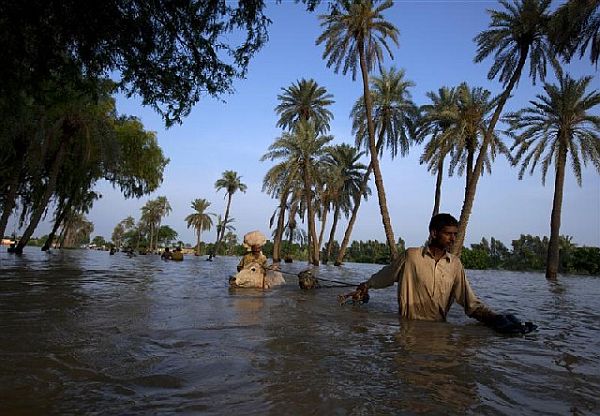
At The Atlantic, Max Fisher looks at five long-term effects of the Pakistan floods:
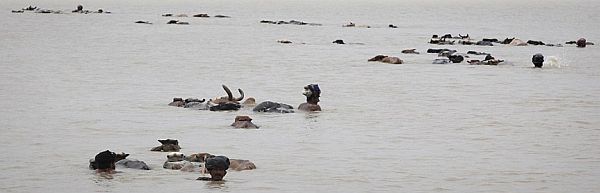
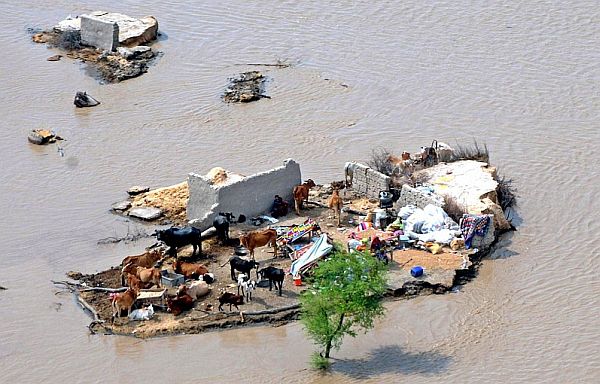
After weeks of flooding in Pakistan displaced two million people and left more than 10 million at risk of disease outbreak because they lack access to clean water, renewed flooding in Pakistan has displaced an additional one million people over the past 48 hours alone, setting back a relief effort that has struggled due to paltry donations. The displaced, often physically inaccessible to relief workers due to Pakistan’s badly damaged infrastructure, face threats of disease, starvation, and dehydration. But even once the immediate humanitarian crises of the flood pass, experts say the floods will leave their impact on Pakistan and the region for years or decades.
Rebecca Barber, from Oxfam, recounts some of the personal losses incurred by individuals:
In a camp in Khairpur, in Sindh, a man told me that he had paid 20,000 rupees ($A260) to evacuate himself and his family from his village when the flood warning came. To cover the costs, he sold the household’s entire crop of wheat. Between himself, his father and his uncle, the family had owned 13 buffalo. But they couldn’t afford to bring them with them when they evacuated, and all drowned when the floodwaters washed through the village. Three of his brothers have stayed behind, camping out on some nearby high land to keep an eye on what’s left of their homes. The village is under more than 1.5 metres of water, and he says he thinks it will be two years before they’ll be able to cultivate again.
In another camp, a man told me that his family had left behind eight goats, two cows and two buffalo when the army evacuated them. He and his family were “tenant farmers” – living on and cultivating the landlord’s land. In addition to the goats, cows and buffalo, they’d owned a small vegetable plot. They’d subsisted day to day on the small profits from the livestock, the vegetables they grew themselves, and a small potion of the landlord’s crops. But the work won’t start again until January next year, when the time for harvesting sugarcane comes around. Until then, he says he’ll go to one of the cities and look for casual labouring work. He won’t get more than 100 rupees (a bit over $1) a day though, nothing like enough to feed a family of 10. And there’s no savings to see them through. His daughter said she’d lost the dowry she’d kept in a trunk for six years: clothes, gold, cooking utensils, and cash.
The CIA is making secret payments to multiple members of President Hamid Karzai’s administration, in part to maintain sources of information in a government in which the Afghan leader is often seen as having a limited grasp of developments, according to current and former U.S. officials.
The payments are long-standing in many cases and designed to help the agency maintain a deep roster of allies within the presidential palace. Some aides function as CIA informants, but others collect stipends under more informal arrangements meant to ensure their accessibility, a U.S. official said.
The CIA has continued the payments despite concerns that it is backing corrupt officials and undermining efforts to wean Afghans’ dependence on secret sources of income and graft.
The U.S. official, speaking on condition of anonymity, said a significant number of officials in Karzai’s administration are on the payroll. Paul Gimigliano, a CIA spokesman, disputed that characterization, saying, “This anonymous source appears driven by ignorance, malice or both.”
A former agency official said the payments were necessary because “the head of state is not going to tell you everything” and because Karzai often seems unaware of moves that members of his own government make.
The disclosure comes as a corruption investigation into one of Karzai’s senior national security advisers – and an alleged agency informant – puts new strain on the already fraying relationship between Washington and Kabul.
Four years after a flurry of predictions about the “Lebanonization” of Iraq, they may be coming true. “Lebanonization” was a derogatory term, a hint at imminent civil war, political deadlock, Iran’s hand in local militias and on many domestic levers. The columns and commentary on Iraq’s “Lebanonization” issued a collective “uh oh,” warning the state would fall apart like Lebanon did from 1975-1991.
What moved the term through officialdom was a perception that Iran and Syria were playing Iraq the way they played Lebanon in 1980s: perpetuating a status quo of chaos, then profiting from the melee. The Sadrists were like Hezbollah-in-waiting, tied to Tehran and using force to stymie Iraq’s government, if they couldn’t control it outright.
“What prompted me to use the term was the external dynamic … and it has still has some validity,” said Ambassador Ryan Crocker, who has served as the top U.S. diplomat in both Iraq and Lebanon. He concedes that at present, in Iraq as in Lebanon, Iran has a virtual veto – influence enough to block any major decision that crosses its interests.
“Iran can’t call the shots in Iraq. They can’t make things happen, but they can screw things up. And they play a long game … they’re waiting for us to be gone to make life harder for Iraqis.”
Today the “Lebanonization” of Iraq is a different story, in which the parallels are mostly political. In Iraq’s March election and its tussled aftermath — there’s still no government in place and likely won’t be one until after Ramadan — analysts see a repeat of Lebanon’s 2009 parliamentary poll. In both cases a “pro-U.S.” leader edges out the Iran-backed alliance, but it’s a watered-down win. The country triangulates the interests of its three main blocs (Iraq: Shiite, Sunni, Kurd; Lebanon: Sunni, Shiite, Christian) through a long negotiation (this week talks in Baghdad broke down). Then a government theoretically comes together, balancing power among its political actors, whose voters cluster around their ethnic or religious base.
“The comparison holds. Today, Iraq has a Lebanon-style government: tribes with guns and a state that’s not able to provide what a state should provide, like basic security,” said Paul Salem from the Carnegie Endowment’s Beirut office. In the vacuum, violent groups from al Qaeda in Iraq to Salafist movements in Northern Lebanon undo law and order.
At Middle East Report, Yüksel Taşkın from Marmara University in Istanbul writes:
Under the government of Prime Minister Recep Tayyip Erdoğan, Turkey is carving out a greater role for itself in Middle Eastern affairs. Since 2008, Turkey has sought the role of Middle East intermediary in trying to broker a peace agreement between Israel and Syria and to resolve the Iranian nuclear crisis. This more independent and assertive foreign policy has put Turkey increasingly at odds with two of its long-standing allies, Israel and the United States. A crucial ally for the US in its war on Iraq, Turkey now refuses to comply with US policy on Iran. The Turkish government also has become more outspoken against Israeli violations of Palestinian rights in the West Bank and Gaza, placing it on a diplomatic collision course with Israel. Three months after the Israeli assault on a Gaza-bound Turkish aid vessel, the Obama administration is reportedly warning Turkey that if its relations with Israel do not improve, and if Turkey does not temper its opposition to US policy on Iran, Congress may halt arms sales to Turkey.[1]
The deterioration in relations between Turkey and its Western allies has led many commentators to conclude that there has been a decidedly eastward shift in Turkish foreign policy. In fact, Turkey’s positions have inspired many journalists and policy analysts to postulate that Turkey is pursuing an “Islamic” agenda that entails a deliberate distancing from the West. This hypothesis has seemed plausible to some because the ruling Justice and Development Party (AKP, by its Turkish acronym) is rooted in the banned Islamist parties of the 1980s and 1990s. The historian Bernard Lewis, for instance, speculated that in a decade Turkey might resemble the Islamic Republic of Iran.[2] New York Times columnist Thomas Friedman opined that “Turkey’s Islamist government [is] seemingly focused not on joining the European Union but the Arab League — no, scratch that, on joining the Hamas-Hezbollah-Iran resistance front against Israel.”[3] Similar interpretations emanate from the secular establishment in Turkey. Oktay Ekşi, a columnist for the Hurriyet newspaper, argues that the AKP’s concerted efforts to attain Turkish accession to the EU were a ploy to gain “support in the West to overcome the secularists.”[4] Some analysts have even suggested that the AKP is pursuing a “neo-Ottomanist” agenda, seeking to claim the mantle of the last great Islamic empire. Johns Hopkins University professor (and former Bush administration official) Eliot Cohen wrote, “A combination of Islamist rule, resentment at exclusion from Europe and a neo-Ottomanist ideology that envisions Turkey as a great power in the Middle East have made Turkey a state that is often plainly hostile not only to Israel but to American aims and interests.”[5]
Such analyses misinterpret the AKP government’s objective, which is not to break with Turkey’s traditional cooperation with the US and EU but to increase Turkey’s relative autonomy vis-à-vis those powers. Rather than a rupture with the past, Turkey’s new approach marks a change in tactics in pursuit of the same goal.
The opponents of Park51, the so-called “Ground Zero mosque,” have decided that the litmus test for identifying “good Muslims” is to ask them whether they regard Hamas as a terrorist organization.
Andy McCarthy, one of the lead knights in the crusade to stop “the Islamization of America,” strikes the latest blow — this time against a rather guileless Imam Dawoud Kringle. This is how McCarthy recounts the crucial part of his “debate” on the fair-and-balanced Fox News:
Then came the moment of truth: the very simple question, “Is Hamas a terrorist organization?” Have a look at the YouTube clip below. Like his friend Imam Feisal Rauf, Imam Kringle won’t answer the question. I pressed him, pointing out that it is a very simple question. And it is: Quite apart from the fact that Hamas is formally designated as a terrorist organization under U.S. law, Hamas’s own charter makes abundantly clear — indeed, wears like a badge of honor — that Hamas exists solely for the purpose of driving Israel out of Palestine by violent jihad. Yet the imam cannot bring himself to say Hamas is a terrorist organization.
Perhaps Kringle would have held surer footing if he had first addressed the reliability of the US government in identifying terrorists.
It was only two years ago that Nelson Mandela and the African National Congress were removed from the US terrorism watch list — that was 15 years after Mandela had been awarded the Nobel Peace Prize.
The terrorism watch list — like the Nobel Peace Prize — is not in and of itself a reliable indicator of someone’s current willingness to use violence in pursuit of a political cause.
Likewise, the fact that in the 1980s the Reagan administration regarded Afghanistan’s mujahideen as “freedom fighters” — not terrorists — had everything to do with who they were fighting (the Soviets) and nothing to do with the methods they employed or the causes those particular jihadists might subsequently espouse.
Terrorism and terrorist — as everyone knew until they suddenly forgot on 9/11 — are mutable designations that more clearly specify the relationship between the designator and the designee than they say much else.
Is Hamas a terrorist organization? As far as the US government is concerned, the answer it yes. It’s on the list. Yet not all organizations listed terrorist are the same — and like most objective foreign policy analysts, the US government like every other government knows this: these organizations are as diverse in their political aims as they are in their geographical distribution.
Hamas has been presented with a set of conditions which, if fulfilled, would allow it to participate in the peace process. In other words, even from the perspective of those governments who currently describe it as a terrorist organization there is an exit ramp for Hamas to shed its “terrorist” label. In contrast, there are no conditions under which any government will enter talks with al Qaeda.
Contrary to what McCarthy and others insinuate, Hamas and al Qaeda are not two peas in the same pod. They are in fact sworn enemies.
But given that so far no one has pointed to any direct connection between Park51 and Hamas, one has to wonder why those affiliated with the proposed Islamic center are being asked their views on the Palestinian movement?
The answer has much less to do with Park51 than it does with the myth that America’s interests are indistinguishable from those of Israel.
Whether McCarthy describes himself as a Zionist, he is certainly pushing a Zionist agenda when he claims: “Hamas exists solely for the purpose of driving Israel out of Palestine by violent jihad.”
In fact, Hamas’ leadership has explicitly supported the creation of a Palestinian state based on the 1967 borders if Israel ends the occupation. But this politically pragmatic position is one that McCarthy and his ilk refuse to acknowledge because it conflicts with a narrative that pits Israel and its allies against an ideologically unyielding and anti-Semitic foe. Characterize the conflict that way and there is no compromise a peace-loving Israel could make which would satisfy its enemies.
Indeed, elsewhere McCarthy has made it clear that he subscribes to the right-wing Zionist school of thought which sees a resolution to the Israeli-Palestinian conflict as contingent solely on the ability of Israel to crush its opponent.
As he wrote during the war on Gaza: “What Israel needs is to be allowed to win: to finish the grisly work of ‘breaking the will of the Palestinians, of Hamas, to continue to fire at Israel,’ as Israeli Interior Minister Meir Sheetrit so aptly put it.”
As for Palestinian national aspirations in general, McCarthy says: “On the political front, it is high time to acknowledge the failure of the fantasy that the Palestinians are legitimate actors worthy of statehood and its privileges.” He says: “we must halt the mindless ‘two state solution’ rhetoric.” Scorning those who he calls “democracy devotees,” McCarthy says: “Let’s be blunt: we are looking at a generation or more before the Palestinians might be prepared to assume the obligations of sovereignty. So we should stop talking about it.”
Daniel Luban in an article in which he describes Islamophobia as the “new anti-Semitism,” notes the central role that McCarthy has assumed as an ideologue now marshaling opposition to Islam in America.
The mosque furor is only the most recent and revealing demonstration of the anti-jihadists’ political influence; from the beginning of the controversy, McCarthy and his allies have dictated the terms of debate on the right. In his July 28 statement attacking the Islamic center, Newt Gingrich cited [McCarthy’s book] The Grand Jihad and framed the controversy in McCarthy’s terms of Western civilization under siege from creeping sharia. More recently, the American Family Association — a leading fundamentalist Christian group — cited the book to argue that no more mosques should be built anywhere in the United States because “each Islamic mosque is dedicated to the overthrow of the American government.” A campaign spearheaded by Pamela Geller, the right-wing blogger who was previously most notorious for publishing a lengthy piece alleging that Obama is the illegitimate child of Malcolm X, will place ads on New York City buses opposing the Islamic center. On September 11, she and Gingrich will lead a major rally against the center that will also feature [Geert] Wilders, the Islamophobic Dutch politician. What was once a lunatic fringe now appears to be running the show, aided and abetted by mainstream figures like Gingrich.
It is quite possible that the next Republican president will also be a party to what can justly be called the new McCarthyism; for that reason alone, McCarthy and his allies deserve our attention. But even more important is the impact of this steady stream of anti-Muslim vitriol on the popular consciousness. Cynical politicians like Gingrich may know that all the talk of the Islamic center as a “9/11 victory monument” and of ordinary Muslims as stealth sharia operatives is mere agitprop designed to win votes in an election year, but ordinary citizens may take them at their word and act accordingly.
Given that McCarthy and his cohorts want to associate Park51 with Hamas, it’s worth considering what Hamas has to say about the plans for the Islamic center.
In an interview on New York’s WABC radio (audio can be heard here), Mahmoud al-Zahar, a co-founder of Hamas who is in the Gaza political leadership, was asked by Aaron Klein to comment on the construction of the center.
Without addressing the question directly, Zahar chose to respond by pointing out that Muslims in America are like Muslims elsewhere, living in accordance with Islam, fasting (during Ramadan), praying and so forth. He then went on to say that Hamas is being misrepresented by those who would liken it to the Taliban and that it is recognized across the Islamic world as a moderate organization.
Klein, however, wanted to focus on the mosque controversy and returned to that question:
Klein: What do you think about the new initiative to build a mosque near the World Trade Center in New York, which is a major point of controversy on all sides?
Zahar: We have to build the mosque as you are allowed to build the church and the Israeli are building their holy places. We have to build everywhere — in every area we have muslims, we have to pray, and this mosque is the only site of prayer especially for the people when they are looking to be in the group — not individual.
Muslims should be allowed to worship in mosques, just like Christians going to church and Jews going to the synagogue.
Not much controversy there, right?
Well, the New York Post seemed eager to pour fuel on the fire by inserting a few words implying that Hamas (and Muslims in general) are engaged in territorial expansion.
A leader of the Hamas terror group yesterday jumped into the emotional debate on the plan to construct a mosque near Ground Zero — insisting Muslims “have to build” it there.
“We have to build everywhere,” said Mahmoud al-Zahar, a co-founder of Hamas and the organization’s chief on the Gaza Strip.
“In every area we have, [as] Muslim[s], we have to pray, and this mosque is the only site of prayer,” he said on “Aaron Klein Investigative Radio” on WABC.
Zahar actually said, “In every area we have Muslims, we have to pray,” which is to say, wherever Muslims live they have a religious obligation to gather for prayer and they do this in mosques.
The New York Post twisted this into: “In every area we have, [as] Muslims[s], we have to pray,” which conjures up a completely different picture. Lower Manhattan is now an area that Muslims claim as their own — at least the New York Post appears to want to promote this lie.
Those who now man the barricades in response to what they call the Islamization of America, reveal in the shadow of their fears the scope of their ambitions.
On 9/11, four groups of hijackers took control of four aircraft resulting in the horrific deaths of 3,000 people. The same day, another group of hijackers took control of the aftermath of the attacks and began a war in which hundreds of thousands have died and millions been displaced. The campaign of those hijackers continues and Park51 is merely its latest target.
That sounds like damning material. Plans to insert US-trained terrorists into Iran or Venezuela perhaps? Is Wikileaks exposing yet more dirty secrets from the CIA’s ugly history?
No.
Indeed, if we are to define a leak as the revelation of confidential information in which the public has a compelling interest — information that must be published as a matter of conscience — then the latest offering from Wikileaks hardly qualifies being described as a leak. Indeed, the US intelligence community may actually regard the release of such a report as something that overall enhances their public image.
This Red Cell report has a couple of interesting details — confirmation that there are those in the US government who understand that Jewish terrorism has played a significant role in triggering Palestinian terrorism, and (reading between the lines) that CIA officers engaged in kidnapping can be perceived as American terrorists — but the overarching topic here is not a secret acknowledgment that the US government has been involved in promoting and exporting terrorism.
If Wikileaks wants to provide the best public service it is capable of, it needs to focus attention on improving its image. It has made the medium more important than the message as though we should be more interested in Wikileaks than the leaks. Instead of the brand “Wikileaks” signalling the release of important information, it now signals a theatrical drama in which Julian Assange demands a spotlight while he is supposedly jousting with the dark forces of government. Is that what he and his cohorts want to be known as? A band of attention seekers?
Whistleblowing is a noble exercise in which individuals follow the dictates of their conscience and place public interest above personal interest. I assume that Wikileaks was created as a way of honoring such a spirit.
A missile strike on December 17 in Yemen last year that killed 41 people including 21 children and 14 women was most likely the result of a US cruise missile strike — an opening shot in a US military campaign that began without notice and has never been officially confirmed.
Amnesty International says it has obtained photographs apparently showing the remnants of missiles known to be held only by U.S. forces at the site of the air strike against al Qaeda suspects.
“The Yemeni authorities have a duty to ensure public safety and to bring to justice those engaged in attacks that deliberately target members of the public, but when doing so they must abide by international law,” said Malcolm Smart, Amnesty International’s Director for the Middle East and North Africa Programme. “Enforced disappearances, torture and other ill-treatment, and extrajudicial executions are never permissible, and the Yemeni authorities must immediately cease these violations.”
“It is particularly worrying that states such as Saudi Arabia and the USA are directly or indirectly aiding the Yemeni government in a downward spiral away from previously improving human rights record.”
The Washington Post now reports that the CIA is likely to have a larger role in President Obama’s expanding war in Yemen.
Proponents of expanding the CIA’s role argue that years of flying armed drones over Pakistan have given the agency expertise in identifying targets and delivering pinpoint strikes. The agency’s attacks also leave fewer telltale signs.
“You’re not going to find bomb parts with USA markings on them,” the senior U.S. official said.
When American and Pakistani agents captured Abdul Ghani Baradar, the Taliban’s operational commander, in the chaotic port city of Karachi last January, both countries hailed the arrest as a breakthrough in their often difficult partnership in fighting terrorism.
But the arrest of Mr. Baradar, the second-ranking Taliban leader after Mullah Muhammad Omar, came with a beguiling twist: both American and Pakistani officials claimed that Mr. Baradar’s capture had been a lucky break. It was only days later, the officials said, that they finally figured out who they had.
Now, seven months later, Pakistani officials are telling a very different story. They say they set out to capture Mr. Baradar, and used the C.I.A. to help them do it, because they wanted to shut down secret peace talks that Mr. Baradar had been conducting with the Afghan government that excluded Pakistan, the Taliban’s longtime backer.
In the weeks after Mr. Baradar’s capture, Pakistani security officials detained as many as 23 Taliban leaders, many of whom had been enjoying the protection of the Pakistani government for years. The talks came to an end.
The events surrounding Mr. Baradar’s arrest have been the subject of debate inside military and intelligence circles for months. Some details are still murky — and others vigorously denied by some American intelligence officials in Washington. But the account offered in Islamabad highlights Pakistan’s policy in Afghanistan: retaining decisive influence over the Taliban, thwarting archenemy India, and putting Pakistan in a position to shape Afghanistan’s postwar political order.
“We picked up Baradar and the others because they were trying to make a deal without us,” said a Pakistani security official, who, like numerous people interviewed about the operation, spoke anonymously because of the delicacy of relations between Pakistan, Afghanistan and the United States. “We protect the Taliban. They are dependent on us. We are not going to allow them to make a deal with Karzai and the Indians.”
My question: Did the New York Times really need six months to piece this story together?
The capture of the Taliban’s second in command, Mullah Abdul Ghani Baradar, has been hailed as a huge blow to the Taliban but it may turn out to deliver an even bigger blow to President Obama’s hopes for an early withdrawal of US troops from Afghanistan.
Hajji Agha Lalai, former head of the Afghan government-led reconciliation process in Kandahar, who has dealt with members of the Taliban leadership council for several years, said Mullah Baradar was “the only person intent on or willing for peace negotiations.”
Last month Baradar facilitated an inconclusive meeting in Dubai between midlevel Taliban commanders and Kai Eide, the departing top UN official in Kabul, according to McClatchy newspapers.
According to Vahid Mojdeh, a former Afghan official who worked under the Taliban, Baradar was instrumental in reining in insurgent violence, by banning sectarian killings and indiscriminate bombings.
“Baradar was an obstacle against al-Qaida, who wanted to make an operation in Afghanistan like they did in Iraq,” Mojdeh said. “But Baradar would not allow them to kill Shias” – the minority Muslim sect – “or set off explosions in crowded places.”
Pakistani analysts said Baradar’s capture suggested either that Islamabad had abandoned its attempt to promote peace talks or the Taliban number two had fallen afoul of the Pakistani authorities. Analysts said Baradar was the most likely point of contact for any future talks.
“This is inexplicable. Pakistan has destroyed its own credentials as a mediator between Taliban and Americans. And the trust that might have existed between Taliban and Pakistan is shattered completely,” said Rustam Shah Mohmand, a former Pakistani ambassador to Kabul after the overthrow of the Taliban.
The capture of Mullah Baradar has been widely reported as the result of a coordinated operation between the US and Pakistan, but so far the story seems very murky.
Pakistan has told the United States it wants a central role in resolving the Afghan war and has offered to mediate with Taliban factions who use its territory and have long served as its allies, American and Pakistani officials said.
The offer, aimed at preserving Pakistan’s influence in Afghanistan once the Americans leave, could both help and hurt American interests as Washington debates reconciling with the Taliban.
Pakistan’s army chief, Gen. Ashfaq Parvez Kayani, made clear Pakistan’s willingness to mediate at a meeting late last month at NATO headquarters with top American military officials, a senior American military official familiar with the meeting said.
The report said that General Kayani rebuffed US pressure to expand operations against the Taliban in North Waziristan because “the Pakistani Army still regarded India as its primary enemy and was stretched too thin to open a new front.”
Within days we learn of Mullah Baradar’s arrest in Karachi, Pakistan. His capture could cripple the Taliban’s military operations, at least in the short term, says Bruce Riedel, an adviser to the Obama administration. Others in Washington describe this as a huge blow to the Taliban.
The arrest followed weeks of signals by Pakistan’s military chief, Gen. Ashfaq Parvez Kayani — to NATO officials, Western journalists and military analysts — that Pakistan wanted to be included in any attempts to mediate with the Taliban.
Even before the arrest of the Taliban commander, Mullah Abdul Ghani Baradar, a senior Pakistani intelligence official expressed irritation that Pakistan had been excluded from what he described as American and Afghan approaches to the Taliban.
“On the one hand, the Americans don’t want us to negotiate directly with the Taliban, but then we hear that they are doing it themselves without telling us,” the official said in an interview. “You don’t treat your partners like this.”
Mullah Baradar had been a important contact for the Afghans for years, Afghan officials said. But Obama administration officials denied that they had made any contact with him.
Whatever the case, with the arrest of Mullah Baradar, Pakistan has effectively isolated a key link to the Taliban leadership, making itself the main channel instead.
While Washington denied prior negotiations with Baradar, a US intelligence official in Europe claimed otherwise:
“I know that our people had been in touch with people around him and were negotiating with him,” the official said, speaking on the condition of anonymity because he was not authorized to discuss the issue.
“So it doesn’t make sense why we bite the hand that is feeding us,” the official added. “And now the Taliban will have no reason to negotiate with us; they will not believe anything we will offer or say.”
Update (2/17/10): In an interview on NPR Ahmed Rashid speculated that now that Baradar is in custody he could be in a better position to negotiate. Why? Because he’s not going anywhere?
Much more plausible is that the Pakistanis pulled him in — Rashid acknowledges that Baradar’s whereabouts have never been unknown to the ISI — because they didn’t want to be cut out of the negotiating loop by Americans negotiating directly with the Taliban. In other words, Pakistan is not willing to see a deal agreed to end this war without being able to dictate some of the terms.
If that is the case, no wonder The White House asked its news outlet (the New York Times) to sit on the story for a few days while they decided how it should be told.
Aisha Ghani points out that much of the liberal defense of Park51 requires that the center be shown as presenting a sanitized form of Islam.
[I]t is clear that the kindergarten logic of “hear no evil, see no evil” is being utilized in order to sway public opinion in favor of the Center, but while the success of these maneuvers remains to be seen, its damage is immediately apparent. The message being sent is loud and clear: if Park51 ‘sounds’ nothing like mosque, claims to ‘be’ nothing like a mosque, and, ‘looks’ nothing like a mosque, then, and only then, does it emerge a defensible endeavor within the United States.
Apart from the fact that these maneuvers do little by way of providing Americans with a reason to be self-reflexive — that is, to ponder the possibility of coexistence with Muslims without requiring, first, that those Muslims sanitize their identities and their places of worship — yet another danger exists in the fact that if these additives, this supplementary discourse (of community center and interfaith dialogue) continues to be the basis upon which Park51 emerges worthy of defense, then on what grounds will other mosques — which do not claim to be anything more or (perhaps, in Park51’s case) ‘less’ than a mosque — be defended?
Other red flags emerge when we take note of how Imam Rauf and Daisy Khan’s ‘personal’ relationship to Islam (a relationship that associates itself with ‘sufi’ ideology and is identified as ‘moderate’ Islam) has been ascribed to Park51. When these disclaimers are showcased in the media, they are presented not as interesting facts about two individuals, but as some of Park51’s most ‘appealing’ features, a major ‘selling point’ in subsequent liberal discourse.
The narrative of fitting in, of assimilation and integration that is being established through Park51 produces a dangerous set of ‘if, then’ contingencies that we should all be wary of, and which index the precise problem of this moment in American history; a moment in which the terms and conditions being articulated in the Park51 debate have, in fact, already been established as the ground rules for determining who gets recognized as the ‘right’ kind of Muslim in America. Sadly, this ‘conditional’ recognition also suggests that only the claims of certain kinds of Muslims will be recognized as legitimate or worthy of defense.
In a society that trumpets its faith in equal opportunity, freedom and the power of the people — government of the people, by the people and for the people, and all that — it’s ironic that again and again, we discover that some of the most powerful people in America are men (invariably men) who we’ve never heard of — men such as Charles and David Koch. It isn’t modesty that makes them keep out of sight.
Their father built his wealth by helping create an oil industry for Joseph Stalin. Later, Jane Mayer tells us in her New Yorker feature:
In 1958, Fred Koch became one of the original members of the John Birch Society, the arch-conservative group known, in part, for a highly skeptical view of governance and for spreading fears of a Communist takeover. Members considered President Dwight D. Eisenhower to be a Communist agent. In a self-published broadside, Koch claimed that “the Communists have infiltrated both the Democrat and Republican Parties.” He wrote admiringly of Benito Mussolini’s suppression of Communists in Italy, and disparagingly of the American civil-rights movement. “The colored man looms large in the Communist plan to take over America,” he warned. Welfare was a secret plot to attract rural blacks to cities, where they would foment “a vicious race war.” In a 1963 speech that prefigures the Tea Party’s talk of a secret socialist plot, Koch predicted that Communists would “infiltrate the highest offices of government in the U.S. until the President is a Communist, unknown to the rest of us.”
The principal heirs of the Koch fortune who now run Koch Industries (“the largest company that you’ve never heard of”), Charles and David Koch, have been described as “the billionaires behind the hate,” for helping spawn the Tea Party movement and “the Standard Oil of our times,” for their efforts to thwart government regulation.
With his brother Charles, who is seventy-four, David Koch owns virtually all of Koch Industries, a conglomerate, headquartered in Wichita, Kansas, whose annual revenues are estimated to be a hundred billion dollars. The company has grown spectacularly since their father, Fred, died, in 1967, and the brothers took charge. The Kochs operate oil refineries in Alaska, Texas, and Minnesota, and control some four thousand miles of pipeline. Koch Industries owns Brawny paper towels, Dixie cups, Georgia-Pacific lumber, Stainmaster carpet, and Lycra, among other products. Forbes ranks it as the second-largest private company in the country, after Cargill, and its consistent profitability has made David and Charles Koch — who, years ago, bought out two other brothers — among the richest men in America. Their combined fortune of thirty-five billion dollars is exceeded only by those of Bill Gates and Warren Buffett.
The Kochs are longtime libertarians who believe in drastically lower personal and corporate taxes, minimal social services for the needy, and much less oversight of industry — especially environmental regulation. These views dovetail with the brothers’ corporate interests. In a study released this spring, the University of Massachusetts at Amherst’s Political Economy Research Institute named Koch Industries one of the top ten air polluters in the United States. And Greenpeace issued a report identifying the company as a “kingpin of climate science denial.” The report showed that, from 2005 to 2008, the Kochs vastly outdid ExxonMobil in giving money to organizations fighting legislation related to climate change, underwriting a huge network of foundations, think tanks, and political front groups. Indeed, the brothers have funded opposition campaigns against so many Obama Administration policies — from health-care reform to the economic-stimulus program — that, in political circles, their ideological network is known as the Kochtopus.
In a statement, Koch Industries said that the Greenpeace report “distorts the environmental record of our companies.” And David Koch, in a recent, admiring article about him in New York, protested that the “radical press” had turned his family into “whipping boys,” and had exaggerated its influence on American politics. But Charles Lewis, the founder of the Center for Public Integrity, a nonpartisan watchdog group, said, “The Kochs are on a whole different level. There’s no one else who has spent this much money. The sheer dimension of it is what sets them apart. They have a pattern of lawbreaking, political manipulation, and obfuscation. I’ve been in Washington since Watergate, and I’ve never seen anything like it. They are the Standard Oil of our times.”
The lesson of the famous Millennium 2002 Challenge was that a cumbersome military machine that over-invests in high tech weaponry is vulnerable to swarming attacks. In the $250 million war game such an attack resulted in most of the US fleet being sunk within hours.
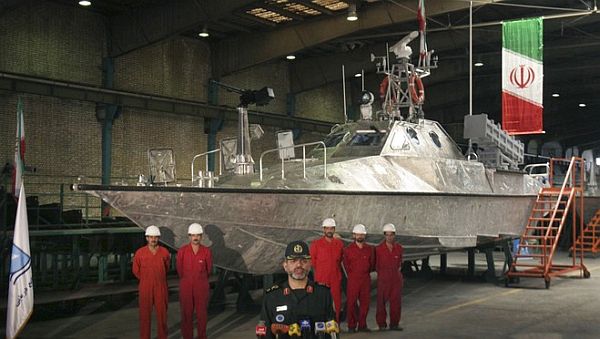
With the development of the F-35 Joint Strike Fighter — the most expensive defense program ever — going ahead, it looks like the Pentagon is still stuck in the past. Iran on the other hand — the country that grasps the jugular vein through which most of the world’s oil supply flows (the Strait of Hormuz) — today made clear that it knows exactly how to flex its muscles in that arena and it will do so with vessels designed for lethal swarming.
Iran began mass-producing two high-speed variants of missile-launching assault boats on Monday, warning its enemies not to “play with fire” as it boosts security along its coastline.
The inauguration of the production lines for the Seraj and Zolfaqar speedboats comes a day after President Mahmoud Ahmadinejad unveiled Iran’s home-built bomber drone, which he said would deliver “death” to Iran’s enemies.
The United States expressed concern about the Islamic republic’s growing military capabilities.
Iran’s state news agency IRNA reported that the Seraj (Lamp) and Zolfaqar (named after Shiite Imam Ali’s sword) boats would be manufactured at the marine industries complex of the defence ministry.
Defence Minister Ahmad Vahidi opened the assembly lines, saying the vessels would help to strengthen Iran’s defences, IRNA said.
“Today, the Islamic Republic of Iran is relying on a great defence industry and the powerful forces of Sepah (Revolutionary Guards) and the army, with their utmost strength, can provide security to the Persian Gulf, the Sea of Oman and Strait of Hormuz,” Vahidi said.
He issued a stern warning to Iran’s foes.
“The enemy must be careful of its adventurous behaviour and not play with fire because the Islamic Republic of Iran’s response would be unpredictable,” IRNA quoted him as saying.
“If enemies attack Iran, the Islamic Republic of Iran’s reaction will not be restricted to one area. The truth of our defence doctrine is that we will not attack any country and that we extend our hand to all legitimate countries.”
Meanwhile, in yet another response to Jeffrey Goldberg’s prediction of an Israeli attack on Iran, the former UN chief weapons inspector, David Kay, suggests that Israel is using the issue in order to press the Obama administration to ease its pressure on settlements and the need to make concessions to the Palestinians.
… Israel is engaged in psychological warfare with the Obama administration — and it only partly concerns Iran.
With regard Iran, Israel clearly understands that any unilateral military action it took against Iran without U.S. knowledge and support could have consequence of strategic importance for Israel and might even make an attack on Iran of limited benefit. Israel would much rather have the U.S. with it in an attack on Iran, or, even better, would be if the U.S. executed the attack entirely on its own.
But beyond Iran, of probably greater importance to the current Israeli government is avoiding the Obama administration pushing it into a choice between settlements and territorial arrangements with the Palestinians that it is unwilling to make and permanent damage to its relationship with the U.S. Hyping the Iranian nuclear program and the need for early military action is a nice bargaining counter. The U.S. certainly cannot join or lead an attack on Iran while pushing the Israeli government to the brink on settlements and concessions to the Palestinians. Or if the U.S. wants to avoid an imminent Israeli strike, it must make concessions to Israel on the Palestinian issues.
In the current climate of escalating rhetoric through which hostility towards Muslims is now being unleashed across America, there is a tendency to pay greater attention to the fact that this makes America look bad, than that it reveals real fractures and failings inside American society.
Responding to the Manhattan Islamic-center controversy, Evan Kohlmann, an independent terrorism consultant at Flashpoint Partners who monitors jihadist websites, told the Wall Street Journal: “We are handing al Qaeda a propaganda coup, an absolute propaganda coup.”
But what if we could be assured that hatred of Muslims did not increase the risk of terrorism? Should we be any less concerned?
A couple of years ago, ABC‘s Prime Time conducted a revealing experiment to see how ordinary Americans respond to expressions of hostility directed at American Muslims. Watch the video below:
As encouraging as it might be to see that twice as many individuals tried to correct an injustice rather than supported it, the silent majority did nothing. And keep in mind: this was in response to the mistreatment of an American Muslim. Muslims born elsewhere who may speak little or no English can only fare worse in similar circumstances.
The pernicious effect of political correctness is that it exaggerates the value of cosmetic changes. A socially acceptable code can prevail, yet barely beneath the surface, bigotry festers both in spite of and to some extent because it no longer finds free expression.
The current up-swell of hatred towards Muslims in America says, I would contend, less about changing sentiments than it does about people’s willingness to express what they previously thought they must conceal. We should be less concerned about what people are now saying than what this reveals about what they think.
Glenn Greenwald comments on the demonstration that took place in Manhattan yesterday, as shown in this video:
The animosity and hatred so visible here extends far beyond the location of mosques or even how we treat American Muslims. So many of our national abuses, crimes and other excesses of the last decade — torture, invasions, bombings, illegal surveillance, assassinations, renditions, disappearances, etc. etc. — are grounded in endless demonization of Muslims. A citizenry will submit to such policies only if they are vested with sufficient fear of an Enemy. There are, as always, a wide array of enemies capable of producing substantial fear (the Immigrants, the Gays, and, as that video reveals, the always-reliable racial minorities), but the leading Enemy over the last decade, in American political discourse, has been, and still is, the Muslim.
That’s why the population is willing to justify virtually anything that’s done to “them” without much resistance at all, and it’s why very few people demand evidence from the Government before believing accusations that someone is a Terrorist: after all, if they’re Muslim, that’s reason enough to believe it. Hence, the repeated, mindless mantra that those in Guantanamo — or those on the Government’s “hit list” — are Terrorists even in the absence of evidence and charges, and even in the presence of ample grounds for doubting the truth of those accusations.
And there’s no end in sight: the current hysteria over Iran at its core relies — just as the identical campaign against Iraq did — on the demonization of a whole new host of Muslim villains.
This may turn out to be one of the most important tests of Barack Obama’s presidential leadership. His inclination and that of his political advisers is likely to lean heavily in favor of weathering out the storm — especially since he appeared to walk back from his initial intervention. But the test of leadership is the willingness and ability to act in conformity with the dictates of the circumstance and not those of political prudence.
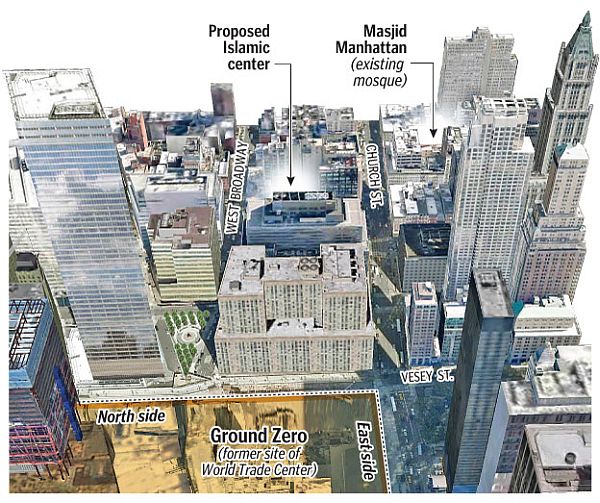
Masjid Manhattan wants to keep a low profile — which is understandable. At the top of their home page is a bold disclaimer:
Please be advised that we are by no means affiliated with any other organization trying to build anything new in the area of downtown Manhattan.
That blanket disclaimer is their way of distancing themselves from the controversial Park51 project (aka Cordoba House, aka the Ground Zero mosque).
It’s sad that Masjid Manhattan feels the need to do this when it could reasonably describe itself as the Ground Zero mosque that was there before Ground Zero.
If two blocks away from the site of the World Trade Center can be described as “at Ground Zero” then so can three blocks away.
Do those who now object to the construction of a new Islamic center also favor that the existing mosque be removed?
In all likelihood, most Americans who object to Park51 don’t even know that there is already a mosque nearby — one that opened the same year as the World Trade Center and now lacks sufficient space for all those Muslims living and working in the area who wish to gather for prayer. Neither would they know that one of the staunchest defenders of the project is the Jewish Congressman who represents the district, Jerry Nadler.
Unlike the rest of the Democrats in the New York congressional delegation, who have said as little as possible about the issue, Nadler has unabashedly supported the congregation’s right to build the mosque.
“It’s only a slap in the face if you think that the people in the congregation are responsible for al-Qaeda,” Nadler said as he sat in his office, where outdated posters, some featuring the Twin Towers, hung on the wall.
A staunch defender of Israel, Nadler said that it is logical that he is fighting for the rights of a Muslim congregation that he said he might very well vehemently disagree with. “Jews, of all people, should know that we have to support religious liberty,” he said. “Because if you can block a mosque, you can block a synagogue.”
And lest there be any doubt that the current controversy has been fomented by political opportunists, Frank Rich notes:
We owe thanks to Justin Elliott of Salon for the single most revealing account of this controversy’s evolution. He reports that there was zero reaction to the “ground zero mosque” from the front-line right or anyone else except marginal bloggers when The Times first reported on the Park51 plans in a lengthy front-page article on Dec. 9, 2009. The sole exception came some two weeks later at Fox News, where Laura Ingraham, filling in on “The O’Reilly Factor,” interviewed Daisy Khan, the wife of the project’s organizer, Imam Feisal Abdul Rauf. Ingraham gave the plans her blessing. “I can’t find many people who really have a problem with it,” she said. “I like what you’re trying to do.”
Joshua Holland lays out some of the evidence that a wave of Islamophobia is sweeping America.
In May, a man walked into the Jacksonville Islamic Center in Northeast Florida during evening prayers and detonated a pipebomb. Fortunately, there were no injuries. (If the man had been Muslim and the House of worship a Christian church, the incident would have garnered wall-to-wall coverage, but while the story got plenty of local press it was ignored by CBS News, Fox, CNN and MSNBC.)
It was the most serious of a series of incidents in which mosques far from the supposedly hallowed earth of Ground Zero have been targeted. A mosque in Miami, Florida, was sprayed with gunfire last year. Mosques have been vandalized or set aflame in Brownstown, Michigan; Nashville, Tennessee; Arlington, Texas (where the mosque was first vandalized and then later targeted by arsonists); Taylor, South Carolina; Pittsburgh, Pennsylvania; Eugene, Oregon; Cape Girardeau, Missouri; Tempe, Arizona; and in both Northern and Southern California. A mosque in a suburb of Chicago has been vandalized four times in recent years.
In May, an Arab man was brutally beaten in broad daylight in New York by four young men. According to the victim’s nephew, “They used the bad word. ‘The mother bleeping Muslim, go back to your country.’ They started beating him and after that he don’t know what happened.” A Muslim woman in Chicago was assaulted by another woman who took offense at her headscarf. A Muslim teacher in Florida was sent a white powdery substance in the mail. In San Diego, a man in his 50s became so incensed by the sight of an American of Afghan descent praying that he assaulted him after screaming, “You idiot, you mother f**ker, go back to where you came from.”
Just imagine if the targets described above were not mosques and Muslims but Jews and synagogues. Abraham Foxman and the Anti-Defamation League would be leading the charge demanding Congress, opinion-makers, public-policy makers, the media and all Americans of conscience to take a stand on what would be described as one of the most urgent moral issues of our time.
Daniel Lubin, writing in The Tablet, sees the up-swell in Islamophobia as a “new anti-Semitism” and notes that:
[M]any of the tropes of classic anti-Semitism have been revived and given new force on the American right. Once again jingoistic politicians and commentators posit a religious conspiracy breeding within Western society, pledging allegiance to an alien power, conspiring with allies at the highest levels of government to overturn the existing order. Because the propagators of these conspiracy theories are not anti-Semitic but militantly pro-Israel, and because their targets are not Jews but Muslims, the ADL and other Jewish groups have had little to say about them. But since the election of President Barack Obama, this Islamophobic discourse has rapidly intensified.
While the political operatives behind the anti-mosque campaign speak the language of nativism and American exceptionalism, their ideology is itself something of a European import. Most of the tropes of the American “anti-jihadists,” as they call themselves, are taken from European models: a “creeping” imposition of sharia, Muslim allegiance to the ummah rather than to the nation-state, the coming demographic crisis as Muslims outbreed their Judeo-Christian counterparts. In recent years the call-to-arms about the impending Islamicization of Europe has become a well-worn genre, ranging from more sophisticated treatments like Christopher Caldwell’s Reflections on the Revolution in Europe to cruder polemics like Mark Steyn’s America Alone and Bat Ye’or’s Eurabia.
It would be a mistake to seek too precise a correspondence between the new Islamophobia and the old anti-Semitism, which differ in some key respects. Jews have never threatened to become a numerical majority, or even a sizable minority, in any European country, so anxiety about Jewish power naturally gravitated toward the myth of the shadowy elite manipulating the majority from behind the scenes. By contrast, anti-Muslim anxiety has focused on the supposed demographic threat posed by Muslims, in which the dusky hordes overwhelm the West by sheer weight of numbers. (“The sons of Allah breed like rats,” as the late Italian journalist Oriana Fallaci put it.) It may be that in many ways this Islamophobia shares more of the tropes of traditional anti-Catholicism than classic anti-Semitism.
But if the tropes do not always line up, there is some notable continuity in the players involved. One of the most striking stories of recent years has been the realignment of segments of the European far right behind a form of militant support for Israel.
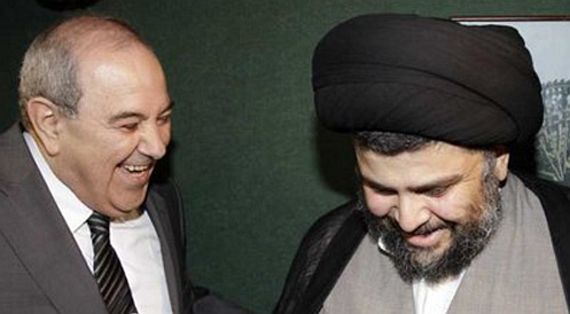
After Moqtada al-Sadr’s recent meeting with Ayad Allawi — a top contender for the prime minister post in Iraq — Babak Dehghanpisheh considers Sadr’s current position as a kingmaker in Iraqi politics and his larger ambitions.
Sadr can, rightfully, claim that his movement is one of the few on the Iraqi political scene that’s homegrown. Compare this to the Sadrists’ top rivals in the Islamic Supreme Council of Iraq (ISCI). For years, they’ve tried to fight the image that they were brought in on American tanks and are beholden to both Washington and Tehran, even changing their name because the Supreme Council for the Islamic Revolution in Iraq sounded too Iranian. They tried appropriating the image of Iraq’s most senior cleric, Ayatollah Ali Sistani, to woo more supporters (there are still posters up around Baghdad showing the late ISCI leaders Ayatollah Mohammad Baqer Hakim and Abdul Aziz Hakim beside Sistani). Nothing worked. ISCI got wiped out at the polls in March and also had a pretty dismal showing during provincial elections last year.
The Sadrists, by contrast, aren’t going anywhere — which puts Washington, among others, in a bind. Sadr’s supporters are more than just a political party. The cleric is clearly following the Hezbollah model, creating a populist political movement backed by a battle-hardened militia. The language Sadr uses when discussing the U.S. presence in Iraq — resistance, occupation, martyrdom — could easily have been taken from a speech by Hezbollah’s leader, Hassan Nasrallah. All this has discouraged U.S. officials from holding talks with Sadr — something they’ve never done since 2003. It’s not exactly like Sadr has gone out of his way to open up a dialogue, either. In fact, Sadr and many of his top aides have made it clear that the Mahdi Army won’t disarm as long as there are American troops on Iraqi soil.
[…]
Sadr’s ambitions don’t cover Iraq’s domestic agenda alone. His high-profile trips to Jordan, Turkey, Lebanon, Saudi Arabia and elsewhere indicate that he wants to be seen as a prominent regional player. He would like to promote his Mahdi Army as a member of the so-called “axis of resistance” made up by Hezbollah and Hamas, both of which have made their names by confronting the United States and Israel.
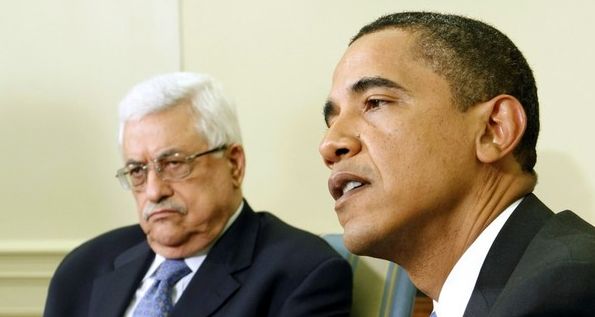
If you’re wondering how seriously to take the latest peace process gambit, this, from the Los Angeles Times, sums up the spirit of the latest move:
One White House official on Friday described peace talks as a “tradition” in which every American president must participate.
“This is something that there has been a long-standing U.S. commitment to engage with the Israelis and Palestinians on,” said John Brennan, assistant to the president for counter-terrorism and homeland security. “Previous administrations have dedicated much effort and energy to this, and the Obama administration is carrying this tradition on.”
There is little confidence — close to none — on either side that the Obama administration’s goal of reaching a comprehensive deal in one year can be met.
Instead, there is a resigned fatalism in the air. Most analysts view the talks as pairing the unwilling with the unable — a strong right-wing Israeli coalition led by Prime Minister Benjamin Netanyahu with no desire to reach an agreement against a relatively moderate Palestinian leadership that is too weak and divided to do so.
“These direct negotiations are the option of the crippled and the helpless,” remarked Zakaria al-Qaq, vice president of Al Quds University and a Palestinian moderate, when asked his view of the development. “It is an act of self-deception that will lead nowhere.”
And Nahum Barnea, Israel’s pre-eminent political columnist, said in a phone interview: “Most Israelis have decided that nothing is going to come out of it, that it will have no bearing on their lives. So why should they care?”
That such a dismissive tone comes not from the known rejectionists — the Islamists of Hamas who rule in Gaza and the leadership of the Israeli settler community in the West Bank — but from mainstream thinkers is telling of the mood.
Some Israelis who have spent their professional lives on peace talks with the Palestinians were upset by the fear that failed talks could prove worse than no talks. Yossi Beilin, for example, who left politics in 2008 after years as a leftist member of Parliament and government minister, said Friday that the Obama administration was wrong to set a one-year goal without consequences.
“I think this is a huge mistake by the U.S. administration,” he said by telephone. “There is not a chance in the world that in a year — or two or three — peace can be achieved. The gap between the sides is too big. Netanyahu did not come to power to divide Jerusalem or find a solution to the Palestinian refugees.”
Pakistan’s Foreign Minister Shah Mehmood Qureshi presented the U.N.’s members with a stark challenge: Help Pakistan recover from its most devastating natural disaster in modern history or run the risk of surrendering a key front in the war on terror.
“This disaster has hit us hard at a time, and in areas, where we are in the midst of fighting a war against extremists and terrorists,” Qureshi warned foreign delegates, including U.S. Secretary of State Hillary Rodham Clinton, at a U.N. donor’s conference on the Pakistani flood. “If we fail, it could undermine the hard won gains made by the government in our difficult and painful war against terrorism. We cannot allow this catastrophe to become an opportunity for the terrorists.”
Qureshi provided one of his darkest assessments to date of the political, economic and security costs of Pakistan’s floods, which have placed more than 20 million people in need of assistance, destroyed more than 900,000 homes and created financial losses of over $43 billion. “We are the people that the international community looks towards, as a bulwark against terrorism and extremism,” he said, adding that Pakistan “now looks towards the international community to show a similar determination and humanity in our hour of need.”
“[A] humanitarian disaster of monumental proportions,” says US Secretary of State Hillary Clinton; renewed evidence of the devastating impact of global warming — but what’s the real danger? The threat that should worry all Americans? Terrorism.
This — the word “terrorism” — has become a mind-numbing drug that cuts us off from humanity and even the fate of the planet.
In a gesture presumably designed in part to pacify American fears, the Pakistani government announced today it will clamp down on the relief work of Islamist charities, even though they have responded to the crisis more effectively than the government itself. The move would seem likely to even further alienate a population that already feels abandoned by its own government.
The death toll is much smaller than in past disasters: About 1,600 are believed dead so far. But experts say initial assessments show the scale of damage and human suffering left by torrential monsoon rains over the past three weeks dwarfs the 2004 Indian Ocean tsunami, 2005 Kashmir earthquake, 2008 Cyclone Nargis disaster in Burma, and Jan. 12 earthquake in Haiti — combined.
“What we face in Pakistan today is a natural calamity of unprecedented proportions,” Pakistan’s foreign minister, Makhdoom Shah Mahmood Qureshi, said during a special U.N. session to address the crisis, held here yesterday. “These are the worst monsoon floods in living memory.”
Debate is heating up over what caused the catastrophe, with experts pointing to deforestation, intensive land-use practices or mismanagement of the Indus River as possible causes. But top U.N. and Pakistani government officials are now clearly pointing to climate change as the principal culprit.
If there was a ministry of information it would release reports like this: “US Assures Israel That Iran Threat Is Not Imminent.” But why would Washington need to create such an agency when the New York Times so gladly provides the service?
In a report transparently written as a quasi-official response to Jeffrey Goldberg’s “The Point of No Return,” we learn that contrary to all the feverish speculation about an imminent strike on Iran, it turns out everything’s cool.
And maybe it is — though the Times’ Mazzetti and Sanger could do more credible reporting if they made an effort not to sound like a mouthpiece for the administration.
The one priceless quote in their article comes from Gary Samore, President Obama’s top adviser on nuclear issues, who when referring to an anticipated one year “dash time” that the Iranians would need to convert nuclear material into a working weapon, said: “A year is a very long period of time.”
Israeli officials said their assessments were coming into line with the American view, but they remain suspicious that Iran has a secret enrichment site yet to be discovered.
American officials said, in contrast to a year ago, that Iran’s nuclear program was not currently the central focus of discussions between top leaders in Washington and Jerusalem. During the last visit to Washington by Prime Minister Benjamin Netanyahu of Israel in early July, the Iranian program was relatively low on the agenda, according to one senior administration official.
The next time Netanyahu takes questions from the press, maybe someone can ask him whether he agrees with the White House’s assessment about the nature of time and that a year is indeed a very long period.
Another issue the article touches upon is the breakout capacity for the long-delayed National Intelligence Estimate. Since the White House seems eager to say what the NIE will say even before its been released, can we interpret this as an effort to shape the report that is itself supposed to shape the administration’s policy?
Finally, just to be sure that the Israel lobby does not become too despondent when they hear another war might not be just around the corner (despite their best efforts), the article closes by saying:
Even as American and Israeli officials agree that the date that Iran is likely to have a nuclear weapon has been pushed into the future, that does not mean that Israel has abandoned the idea of a possible military strike.
American officials said that Israel was particularly concerned that, over time, Iran’s supreme leader could order that nuclear materials be dispersed to secret locations around the country, making it less likely that an Israeli military strike would significantly cripple the program.
So have no fear — the option of a strike is still on the table, or to be precise, at some indeterminate point in the future there might be a strike and it could happen sooner rather than later because at some point (future or past) the Iranians could hide everything and maybe they already have secret facilities in which case the opportunity to destroy them has already past. Clear?
This website or its third-party tools use cookies, which are necessary to its functioning. By closing this banner, you agree to the use of cookies.