Monthly Archives: November 2010

YouTube bows to political pressure and removes Awlaki videos

On Wednesday, The Guardian reported:

Hundreds of videos inciting violence, including some linked to the suspected al-Qaida mastermind of the cargo plane bomb plot, were removed from YouTube today.

The videos were highlighted after the conviction of Roshonara Choudhry for attempting to kill the former [British] government minister Stephen Timms. She was radicalised watching internet sermons by Anwar al-Awlaki, an Islamist cleric now in Yemen who the US suspects masterminded several terrorist plots.

In a private speech in the US last week, the security minister, Lady Neville-Jones, called on the White House to “take down this hateful material” in cases where servers were located within its jurisdiction.

“When you have incitement to murder, when you have people actively calling for the killing of their fellow citizens and when you have the means to stop that person doing so, then I believe we should act,” she said. “Those websites would categorically not be allowed in the UK. They incite cold-blooded murder and as such are surely contrary to the public good.”

Will YouTube also now be looking at videos conveying messages of hate from people like Michael Savage?

When Byron Williams went on a shooting spree in California this summer, his desire to “start a revolution” was inspired in part, it was reported, by Savage’s talk radio rants. Speaking about the ACLU, Savage had warned: “They will kill us all if they’re not stopped.” Williams aimed to do just that by killing the ACLU’s leaders.

In 2006, Savage called for the killing of 100 million Muslims:

There are too many RDDBs [red-diaper doper babies, Savage’s term for people supposedly raised by Marxist parents] in high places and in the media and in the courts for us to stand up to this fanatical enemy. And so unless the RDDB is reined in somehow or taken out of power, we’re going to die as a nation. I swear to God that’s what people are saying to me. And these are intelligent people, wealthy people. They are very depressed by the weakness that America is showing to these psychotics in the Muslim world. They say, “Oh, there’s a billion of them.” I said, “So, kill 100 million of them, then there’ll be 900 million of them.” I mean, would you rather die — would you rather us die than them? I mean, what is it going to take for you people to wake up? Would you rather we disappear or we die? Or would you rather they disappear and they die? Because you’re going to have to make that choice sooner rather than later.

In 2008, after the Mumbai attacks, Savage advocated genocide, referring to the tribal areas of Western Pakistan, saying: “[T]here’s no question that entire region needs to be annihilated and stripped off the earth.”

From Michael Savage, to Pastors John Hagee, Rod Parsley and Terry Jones, America has no shortage of hate-mongers whose words are capable of inciting violence. Should YouTube and other publishers and media outlets be policing their operations so that none of these men can find an easily available platform from which to vent their anger?

Not if we want to protect the First Amendment.

In 1969 in Brandenburg v. Ohio, the Supreme Court ruled that “the constitutional guarantees of free speech and free press do not permit a State to forbid or proscribe advocacy of the use of force or of law violation except where such advocacy is directed to inciting or producing imminent lawless action and is likely to incite or produce such action.” The ruling went on to cite Noto v United States (1961) which said: “the mere abstract teaching … of the moral propriety or even moral necessity for a resort to force and violence, is not the same as preparing a group for violent action and steeling it to such action.”

On this basis, it seems pretty clear that lectures by Anwar al-Awlaki, available on YouTube, and Michael Savage’s talk-radio rants, are both examples of free speech protected by the First Amendment.


Facebooktwittermail

Reading al Qaeda’s signals from Yemen — and Pakistan

David Ignatius writes:

Behind the latest terrorism plots is an al-Qaeda leadership that is getting battered in Pakistan but that is determined to strike back wherever it can – using a dispersed network and new tactics that are harder to detect.

The package bombs sent last week from Yemen are one face of al-Qaeda’s continuing campaign. The Yemeni operatives are nimble, adaptive and “frustratingly clever,” says a U.S. counterterrorism official. “They have one main goal, which is to mess with us.”

We’ve got all sorts of metaphors going here. Al Qaeda is up against the ropes — but it’s punching back. It used to wait in caves, ready to be smoked out — even while it was on the run. But just in case its persistent ability to outwit US intelligence services might make the latter look unintelligent, we are duly reminded that our cavebound-boxing-running nemesis is actually very smart.

Now, with a melodramatic Hollywood-style flourish, France’s interior minister, Brice Hortefeux, adds that one of the printer bombs was defused just 17 minutes before it was due to explode! Let’s not forget (or maybe we are meant to forget) that British investigators took 20 hours to figure out that one of these devices was actually a bomb.

What’s the common thread here? That when officials and commentators talk about al Qaeda, the structure of their own thinking is much more in evidence than any understanding of the strategic thinking that probably connects a set of seemingly disparate events. My hunch is that the string of “failed” operations emanating from Yemen have actually accomplished most of their objectives.

Consider, for instance, this detail in the printer bombs: the way they were addressed — with names linked to the Crusades at out-of-date locations for two synagogues in Chicago.

We are told the bombs were designed to blow up on board the cargo aircraft that carried them, so why use addresses that could prematurely flag the parcels? If on the other hand the bombs were meant to reach the synagogues, in a meticulously planned operation such as this, wouldn’t we expect valid addresses to have been used? The addresses provide a clue that these were bombs meant to be found rather than explode.

Let’s not forget how the attack was actually averted — not through an NSA intercept but thanks to a tip from a former Guantanamo inmate who had a change of heart just in time.

Perhaps the object of the exercise here was neither to blow up synagogues nor bring down aircraft but simply generate fear around both possibilities. Indeed, al Qaeda is currently demonstrating that bombs which don’t explode can in many ways be just as effective and in some ways more effective than those that wreak havoc.

The choice of synagogues in Chicago may simply have been a way of making sure that some of President Obama’s most influential supporters — such as Lester Crown — would be pressing the White House to do everything necessary to tackle the threat from Yemen.

But why would al Qaeda be wanting America’s attention to now focus on Yemen?

Ignatius quotes a US official who claims that bin Laden’s response to Obama’s expansion of drone warfare in Pakistan was to send out a directive which could be summarized: “Undertake operations however and wherever you can. We need to prove ourselves again.”

Even if such a directive went out — one that portrays this fight simply as a contest in the expression of power — I find it hard to believe that this actually reveals much about al Qaeda’s strategic thinking. After all, as grandiose as their ambitions might be, they surely have few illusions about the nature of the power differential they face as Hellfire missiles come raining down.

Bin Laden’s more pressing concern, I would suggest, is to find a way of getting the hell out of Waziristan and lining up a new base for operations — a move precipitated not just as a result of drone warfare but more importantly because of the likelihood that any process of reconciliation that brings about an end to the war in Afghanistan will result in al Qaeda losing its sanctuary in Pakistan.

The conventional wisdom is that al Qaeda in the Arabian Peninsula (AQAP) operates independently from Pakistan-based commanders, but the Australian counterterrorism expert, Leah Farrall, thinks otherwise. AQAP, she writes:

… is not an affiliate, not a franchise, and not a network. Rather it is an operating branch of AQ, which means that while it may have authority for attacks in its area of operations (the Arabian Peninsula), it comes under AQ’s strategic command and control for external attacks outside of this area of operation. And it has always done so, right back to 02.

To the extent that the message coming out of Washington for most of the last year has been that Yemen is now the epicenter of the al Qaeda threat, this may reflect less about the depth of US intelligence than it does about al Qaeda’s own messaging. In other words, al Qaeda very much wants to be equated with Yemen.

Why? This much should be obvious to everyone: wherever the US sees a terrorist threat emanating from, its primary response is military. Yemen is no exception. Ignatius confirms that in the wake of Obama’s expanding drone war in Pakistan:

[a] similar escalation is likely in Yemen, with soldiers from the U.S. Joint Special Operations Command working with Yemeni government forces. The JSOC sums up its lethal approach with the phrase ‘find, fix, finish,’ but a U.S. official says it has been hard to keep track of al-Qaeda targets in Yemen’s tribal villages and cities.

The Pentagon’s thinking no doubt, is that a sufficiently “robust” response will ensure that the burgeoning threat from al Qaeda in Yemen can be nipped in the bud. Al Qaeda’s strategic view however, may well be radically different.

Farrall points out that al Qaeda in Iraq began with only 16 operatives. Thanks to the blundering American military machine, the jihadists were able to tap into enough local hostility that they were eventually able to trigger a civil war.

Even though the US is not contemplating invading Yemen, operations it conducts in collaboration with a compliant Yemeni government will do more to weaken that already weak government and thereby make the country an even more hospitable environment for al Qaeda HQ to relocate its operations.

Yemenis, far from sharing Washington’s concerns, view them with a mix of skepticism and suspicion. As the New York Times reports:

For now, most Yemenis seem to dismiss reports of Al Qaeda killings as a “masrah,” or drama, staged by the government and its American backers. The suspicion runs so deep that any action by the Yemeni government seems to confirm it: counterterrorist raids are often described as punitive measures against domestic foes, and the failure to act decisively is derided as collusion.

“This latest episode with the packages is only making it worse,” said Mr. Faqih, the Sana University professor. “Many people think it was all about the elections in the U.S., or an excuse for American military intervention here.”

If there is a set of assumptions that al Qaeda’s strategists can reliably make about their American adversaries it is that the Americans find it next to impossible to respond to acts of terrorism without recourse to military violence; that they pay insufficient attention to the motives of those they choose to fight; that patience is their most easily exhausted asset; and that without fail a fear-bound America can always be guaranteed to overreact.

Meanwhile, what passes for strategic thinking in Washington still takes seriously this bizarre idea: that it is possible to simultaneously bomb a country and assist in its development.

And people still wonder how it’s possible for a tiny militant organization to challenge American might? Because America makes it far too easy.

Facebooktwittermail

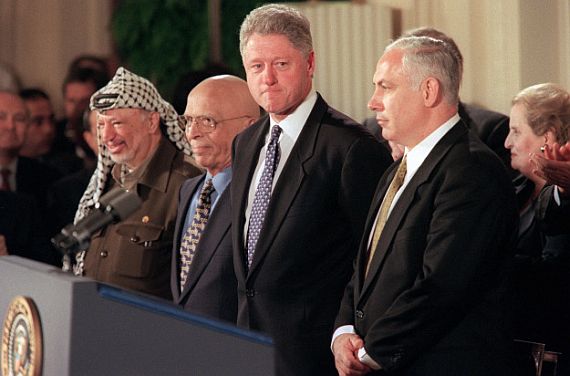
Bill Clinton’s prayer for peace

Bill Clinton referring to Benjamin Netanyahu in 1996: 'Who the fuck does he think he is? Who's the fucking superpower here?'

Less than two weeks ago, while observers gathered around the fetid corpse of the Middle East peace process, once again looking to see whether it might miraculously spring back to life, Laura Rozen reported:

[T]he New America Foundation’s Steve Clemons said he is convinced that the man who can help Obama bring peace to the Middle East is former President Bill Clinton. That is the spouse of Obama’s Secretary of State Hillary Clinton.

“Bill Clinton is the only guy I can think of who is trusted and liked by all sides,” Clemons told Politico. “He is the only guy I know who successfully wrestled and pushed Netanyahu to do what he wants to do. And Clinton has spectacular popularity in Israel and Obama doesn’t.”

The former president “has granular understanding of every deal and piece of the deal – behind the scenes stuff that has been distorted and reframed,” Clemons continued. “No one has a better grasp, … sees the opportunity and has the global stature to both cajole, seduce and embarrass” the parties towards an agreement.

And under that scenario, which Clemons concedes is a float though one influenced by some kibitzing on the peace process with Bill Clinton at an event last week, how would Obama control the force that is Bill Clinton?

“Why would you want to control him,” Clemons responded. The Israeli-Palestinian conflict “has become a global fault line in the eyes of the world, and a manifestation of America’s weakness today. It has far greater significance” strategically “than northern Ireland. My bet is this is one of several defining issues” for the U.S. and the Obama administration, Clemons continued.

And how would Hillary Clinton not lose her authority as Secretary of State if her husband played such a role?

“Hillary Clinton should embrace and support what he does, giving him the latitude to be a creative player,” Clemons responded. “He can outmaneuver” the obstacles to an agreement and “all their corks will rise.”

Lo and behold the force that is Bill Clinton has appeared like a comet soaring over the horizon, shining light when all seemed consumed by darkness. Or maybe not.

In his remembrance of Yitzhak Rabin who was assassinated 15 years ago, Clinton’s main message seems to be that Rabin could have delivered on the implementation of the two-state solution — but he got shot, and the rest is history.

In Clinton’s view, all the necessary pieces for a resolution to the conflict are now lined up — everyone just needs to get on with the work at hand.

Let us pray on this anniversary that [Rabin’s] service and sacrifice will be redeemed in the Holy Land and that all of us, wherever we live, whatever our capacity, will do our part to build a world where cooperation triumphs over conflict. Rabin’s spirit continues to light the path, but we must all decide to take it.

Those are not the words of an unstoppable force. “We must all decide” is really just a positive construction on the assertion that has been repeated so many times before: “We can’t want peace more than the parties themselves.”

If Clinton is laying groundwork here it is not for his own entry into the fray; it is instead the path along which Obama can gracefully bow out by saying, I did what I could but the time was not right.

Facebooktwittermail

Obama is through with Middle East peacemaking — at least for now

Larry Derfner writes:

Whatever the Obama administration may say, it is through with Middle East peacemaking, at least for this term. It has zero leverage over Israel’s right-wing government because the roaring Republicans love this government and especially its prime minister. The Republicans love the settlements, love Israeli rule over the West Bank, love the blockade of Gaza and, no less important, hate Palestinians and the rest of the Muslim world.

These are the political forces that have Obama in check. Well before the Tea Party surfaced, the GOP had lurched to the right on Israel/Palestine, lining up squarely with Likud and the Council of Jewish Communities in Judea, Samaria and the Gaza Strip, and now these people are in the catbird’s seat in Washington.

If you were a Palestinian, would you trust that the US could even soften the Netanyahu government in negotiations now, much less “deliver” it? No, you wouldn’t, and neither would I, so I don’t see why the Palestinians should be expected to go on playing with Israel when America is the dealer. If the game wasn’t rigged against them before, it obviously is after Tuesday.

And since Israel isn’t going to budge and America can’t force it to, that means the ball is in the Palestinians’ court.

What are they going to do, now that Pax Americana is not an option for them, not for at least two years and maybe a lot longer? Hopefully, they’re not going to return to violence. Hopefully, Palestinian Authority President Mahmoud Abbas and Prime Minister Salam Fayyad will not resign, nor be overthrown by Hamas in the West Bank like they were in the Gaza Strip.

The best-case scenario is that the PA will make good on its threat to seek UN recognition for statehood, knowing that even if the US vetoes such a resolution, it would be a show of strength. It would create a sense of urgency. Challenging the occupation in the UN might shake the moderate West into acting as a counterweight to Tea Party America in the conflict.

Hopefully, the PA will also keep pressing its claim on Arab east Jerusalem nonviolently, as Fayyad sought to do this week, with some success. And hopefully, the moderate West will show its support, as British Foreign Secretary William Hague did yesterday by meeting Palestinian activists on the city’s Arab side.

Ynet reports:

British Foreign Minister William Hague on Wednesday met with the Palestinian prime minister and Israeli foreign minister, but his visit with Palestinian activists made the most headlines.

Hague met with three senior Palestinian activists spearheading the popular struggle against Jewish settlements and the West Bank security fence, and expressed his support in their non-violent struggle.

“Hague told us that he supports the non-violent popular struggle, similarly to the official statement made by the European Union,” Mahmud Zuhari, one of the activists, told Ynet.

The meeting was held in the West Bank town of Bitunia, just south of Ramallah, in an area overlooking the security fence and Ofer Prison, where many activists are jailed.

Facebooktwittermail

Tea Party going to Israel

Ynet reports:

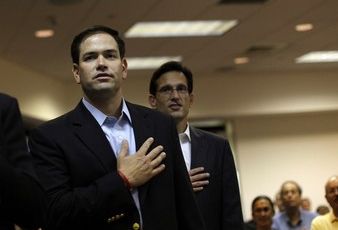
First they took Washington, now they’ll take Jerusalem? With victory in the congressional elections less than a day old, Florida Senator Marco Rubio (Rep.) who considers himself a ‘Tea Party’ member, is set to arrive in Israel on Sunday. Rubio’s visit so soon after the election win is a move that strengthens assessments that the congress in its current form will continue where it left off – at least where Israel is concerned.
The pro-Israeli AIPAC lobby applauded the election results, congratulated the winners and said: “It is abundantly clear that the 112th Congress will continue America’s long tradition of staunch support for a strong, safe and secure Israel and an abiding friendship between the United States and our most reliable ally in the Middle East.”

AIPAC expressed satisfaction over the fact that most pro-Israel senators were reelected and sent messages of congratulations to senators and congress members from both parties.

In a speech delivered to the Republican Jewish Coalition in June, soon after the Mavi Marmara flotilla massacre, Rubio said:

If Israel’s right to self-defense is undermined by efforts to lift its legal and necessary blockade of Gaza, which serves to stop Hamas from arming itself with deadly weapons, there will be lasting consequences, not just for Israel but also for the United States and ultimately for the world.

Israel’s enemies are — or will soon be — America’s enemies as well. They are emboldened any time they sense any sort of daylight between the United States and Israel. And now more than any other time, it is important that America has a firm and clear relationship with Israel.

In late August, Rubio said on Fox News (as he has said repeatedly) that Israel is America’s “best friend in the world.”

Facebooktwittermail

Israel lobby claims election victory

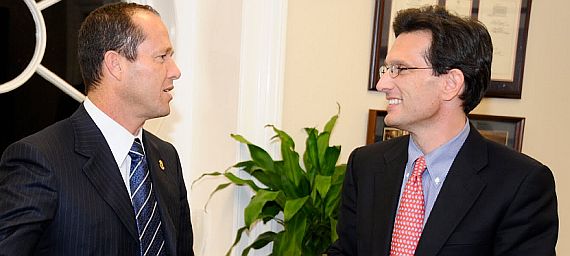
Jerusalem Mayor Nir Barkat meeting Rep. Eric Cantor, the presumptive Republican leader following the midterm elections. They are shown meeting in Washington DC last year.

Whatever the outcome of yesterday’s election had been, the Israel lobby had good reason to claim victory. Josh Rogin writes:

One prominent pro-Israel lobbying group in Washington is already praising the GOP takeover of the House of Representatives as a net benefit for Israel.

“While Democrats are likely to keep control of the U.S. Senate, Republicans will take over the U.S. House of Representatives following Tuesday’s elections. This is likely to have implications for Israel-related issues such as Israel’s relationship with the United States and the push for sanctions against Iran,” said an e-mail blasted out by The Israel Project only minutes after news stations called the turnover of House control a certainty.

“The takeover of the House by Republicans is great news for Israel and her supporters,” the email quotes Ari Fleischer, White House spokesman under President George W. Bush, as saying. “The House leadership and almost every single GOP member is rock-solid behind Israel. At times like this, Israel needs friends everywhere.”

But the Israel Project’s e-mail then quickly turns on its head and praises Congressional Democrats in the House and Senate for their staunch support of Israel.

“The House Democratic leadership has been powerfully supportive of Israel, and Speaker Pelosi has been nothing short of passionate in her successful pursuit of biting sanctions against Iran – a key interest of the pro-Israel community,” The Israel Project quotes David Harris, president and CEO of the National Jewish Democratic Council, as saying.

So which is it? Is The Israel Project saying that Republicans or Democrats are better for Israel?

“American voters on both sides of the aisle support Israel,” Jennifer Laszlo Mizrahi, founder and president of The Israel Project, says in the e-mail.

See also: 10 Republicans who are about to become the new foreign-policy power brokers.

Facebooktwittermail

How Wikileaks amplifies the Pentagon echo chamber

At Columbia Journalism Review, Ali Gharib writes:

A source provides details to the American government about the nefarious activities of a Middle Eastern country. That information ends up in scores of secret U.S. government documents. Subsequently, the information winds up on the front pages of major newspapers, and is heralded by war hawks in Washington as a casus belli.

Sound familiar? It should, but perhaps not in the way you’re thinking. Here’s a hint: It’s not 2003, but 2010. This is the story of what happened recently to Iran in the wake of the latest WikiLeaks document release, where U.S military field reports from Iraq made their way into major national newspapers and painted the Islamic Republic as a force out to murder U.S. soldiers in Iraq.

While the WikiLeaks document dump provided a useful way to glean historic details of the seven-year-old occupation, much of the prominent media coverage focused closely on the extent of Iranian support for anti-U.S. forces in Iraq and Iran’s alleged role.

“Leaked Reports Detail Iran’s Aid for Iraqi Militias,” blared the headline on a front page story in The New York Times, which went on to report on several incidents recounted in WikiLeaks documents that journalist Michael Gordon called “the shadow war between the United States and Iraqi militias backed by Iran’s Revolutionary Guards.”

“The field reports also provide a detailed account of what American military officials on the ground in Iraq saw as Iran’s shadowy role training and equipping Iraqi Shiite militias to fight the U.S.,” wrote Julian Barnes in The Wall Street Journal. “American intelligence believed the training was provided not only by the Islamic Revolutionary Guards Corps in Iran, but also by Hezbollah, their Lebanese ally.”

And the hawks went wild.

Facebooktwittermail

Dahieh: flashpoint of the colonial and anti-colonial struggle

Rami G Khouri writes:

Who would have thought that a gynecologist’s office in the Hizbullah-dominated southern Beirut suburb of Dahieh would be the symbolic place where the colonial and anti-colonial struggles of the past century would reach their confrontational peak and bring to a head this long-simmering war? Hizbullah leader Hassan Nasrallah’s call Thursday night for all Lebanese to stop cooperating with the Special Tribunal for Lebanon (STL), which is investigating and will soon indict those it believes killed former Prime Minister Rafik Hariri and 22 others five years ago, followed an attempt by STL officers to examine patient files in the doctor’s office in Dahieh a few days ago, presumably because the STL has evidence it believes implicates some Hizbullah personnel in the assassinations. Hizbullah supporters, mostly women, beat back the STL party and quickly heightened the political confrontation that has been brewing in the country for months.

Nasrallah’s open call to boycott and actively oppose the STL marks an historical moment of reckoning that is as dangerous as it was inevitable. This is because Hizbullah and the STL represent perhaps the two most powerful symbols of the two most important forces that have defined the Middle East for the past century or more: On the one hand, Western (including Israeli) interests and interventions that seek to shape this region in a manner that suits Western aims more than it suits indigenous rights, and, on the other hand, native Arab-Islamic-nationalist resistance that seeks to shape our societies according to Arab-Islamic worldviews as defined by a consensus of local actors, identities and forces.

Stripped to its core, this tension between Hizbullah and the STL is a microcosm of the overarching fact of the modern era in which Western-manufactured Arab statehood has generally failed to gain either real traction or sustained credibility; thus it has fallen on groups like Hizbullah to play a leading role in confronting Israeli and Western power in a manner that most Arab governments have been unable or unwilling to do.

Facebooktwittermail

Knesset member Haneen Zoabi: “No chance” for two-state solution

Ali Abunimah reports:

There is now “no chance” for a two-state solution in Palestine. So said Haneen Zoabi, a Palestinian member of Israel’s parliament, the Knesset, in an interview with The Electronic Intifada (EI) on 29 October in Chicago (video).

“The reality goes more toward the one state solution,” Zoabi said, “whether a democratic one-state solution, or a binational one-state solution.”

Elected in 2009, Zoabi represents the National Democratic Alliance, and is the first woman to be elected on the list of an Arab party in Israel.

“We are struggling for a normal state,” Zoabi explained, “which is a state for all of its citizens, [in] which the Palestinians and the Israeli Jews can have full equality. I recognize religious, cultural and national group rights for the Israelis, but inside a democratic and neutral state.”

Facebooktwittermail

Iran’s Revolutionary Guards slam Ahmadinejad

RFE/RL reports:

In an unprecedented move, Iran’s Islamic Revolutionary Guards Corps (IRGC) has directly blasted President Mahmud Ahmadinejad over controversial comments he made recently, including saying that parliament is not on top of the country’s affairs.

Ahmadinejad was also criticized for promoting an “Iranian school of thought” instead of an Islamic one.

Ahmadinejad has in recent weeks come under fire by his hard-line allies and conservatives over his new nationalistic rhetoric. So far, the IRGC, whose power and influence has grown since Ahmadinejad came to power, had not publicly criticized the Iranian president.

The unusual attack by the IRGC, coming in one of its main publications, is seen by analysts as a warning issued to Ahmadinejad from Iran’s supreme leader, Ayatollah Ali Khamenei, with the intention of trying to tame the Iranian president.

Facebooktwittermail

‘We don’t want to be Iraq’

Steven Sotloff writes:

Though the foiled plot to mail packages filled with bombs to synagogues in Chicago has bumped congressional midterm elections as the top story in the United States, here in Yemen it has caused barely a ripple. While Washington focuses on combating the regional al-Qaeda affiliate believed to be behind the plot, Yemenis are much more concerned with a sectarian rebellion in the north, a secession movement in the south and the economic crisis that has crippled the country.

Most Yemenis are unaware that the packages that caused heightened concerns in the United States originated in their country, because the Saleh government has muted coverage of the story in the local press.

Washington’s policies of drone strikes coupled with high-profile military and diplomatic visits risk further alienating an already hostile Yemeni population and driving them into the arms of al-Qaeda in the Arabian Peninsula (AQAP), the local al-Qaeda affiliate the Obama administration is so focused on neutralizing.

“Americans come here and attack without knowing what is going on,” as one Yemeni put it. “We don’t want to be Iraq. This is an American war, not Yemen’s, and we don’t want to be a part of it.”

Facebooktwittermail

The phantom left

Chris Hedges writes:

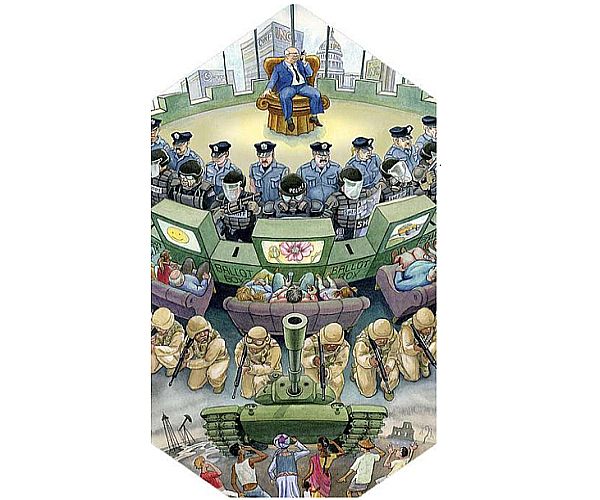
The American left is a phantom. It is conjured up by the right wing to tag Barack Obama as a socialist and used by the liberal class to justify its complacency and lethargy. It diverts attention from corporate power. It perpetuates the myth of a democratic system that is influenced by the votes of citizens, political platforms and the work of legislators. It keeps the world neatly divided into a left and a right. The phantom left functions as a convenient scapegoat. The right wing blames it for moral degeneration and fiscal chaos. The liberal class uses it to call for “moderation.” And while we waste our time talking nonsense, the engines of corporate power—masked, ruthless and unexamined—happily devour the state.

The loss of a radical left in American politics has been catastrophic. The left once harbored militant anarchist and communist labor unions, an independent, alternative press, social movements and politicians not tethered to corporate benefactors. But its disappearance, the result of long witch hunts for communists, post-industrialization and the silencing of those who did not sign on for the utopian vision of globalization, means that there is no counterforce to halt our slide into corporate neofeudalism. This harsh reality, however, is not palatable. So the corporations that control mass communications conjure up the phantom of a left. They blame the phantom for our debacle. And they get us to speak in absurdities.

The phantom left took a central role on the mall this weekend in Washington. It had performed admirably for Glenn Beck, who used it in his own rally as a lightning rod to instill anger and fear. And the phantom left proved equally useful for the comics Jon Stewart and Stephen Colbert, who spoke to the crowd wearing red-white-and-blue costumes. The two comics evoked the phantom left, as the liberal class always does, in defense of moderation, which might better be described as apathy. If the right wing is crazy and if the left wing is crazy, the argument goes, then we moderates will be reasonable. We will be nice. Exxon and Goldman Sachs, along with predatory banks and the arms industry, may be ripping the guts out of the country, our rights—including habeas corpus—may have been revoked, but don’t get mad. Don’t be shrill. Don’t be like the crazies on the left.

“Why would you work with Marxists actively subverting our Constitution or racists and homophobes who see no one’s humanity but their own?” Stewart asked. “We hear every damn day about how fragile our country is—on the brink of catastrophe—torn by polarizing hate, and how it’s a shame that we can’t work together to get things done. But the truth is we do. We work together to get things done every damn day. The only place we don’t is here [in Washington] or on cable TV.”

The rally delivered a political message devoid of reality or content. The corruption of electoral politics by corporate funds and lobbyists, the naive belief that we can somehow vote ourselves back to democracy, was ignored for emotional catharsis. The right hates. The liberals laugh. And the country is taken hostage.

Facebooktwittermail

Bill Maher’s fear of Muslims

Upon learning that in the UK last year, Mohammed (including its variant spellings) was the most popular name for baby boys, this was the reaction of comedian Bill Maher:

Am I a racist to feel alarmed by that? Because I am. And it’s not because of the race, it’s because of the religion. I don’t have to apologize, do I, for not wanting the Western world to be taken over by Islam in 300 years?

Maybe Maher thinks that as an expression of cultural integration Muslim parents in Britain should be naming their boys after English football stars like Wayne Rooney or David Beckham (and I dare say some do) but he should hardly be surprised that the name of the Prophet remains a favorite. The racist thought that he dared not utter but surely thought was this: at the rate they’re reproducing, it’s just a matter of time before the Muslims take over.

But Bill Maher — like Pastor Terry Jones — thinks the way to avoid being branded a racist when it comes to expressing ones Islamophobia is to suggest that you have nothing against Muslims, you just don’t like their religion. Thus Maher doesn’t express concern about the size of Britain’s Muslim population — simply the way they are choosing to name their babies.

Maher’s parochiality is most evident however, not simply in the focus of his alarm but because of the context he places it in: the condition of the Western world 300 years from now.

If 300 years ago any of the leading figures of the Enlightenment could have been given a glimpse of the West as it is now, I doubt that any would have felt reassured that Western Civilization had been preserved — least of all when they saw the jokers who have assumed the role of its defenders.

If 300 years hence, civilization exists in any form, humanity will have advanced in ways hard to anticipate. On its current trajectory, the West and the rest of the world is heading in a direction where the names parents choose for their babies should be the least of our concerns.

As for how that parenting task is being engaged now in America, what is striking about the popular choices is not so much the cultural sources of the names as the difference between genders: Old Testament and/or grandiose names for boys and mostly secular names for girls — Jacob, Isabella, Ethan, Emma, Michael, Olivia, Alexander, Sophia, William, Ava, Joshua, Emily, Daniel, Madison, Jayden, Abigail, Noah, Chloe, Anthony, Mia.

I don’t imagine that Bill Maher will be too concerned that among these 2009 top ten names for boys and girls not one of them is a New Testament Christian name, but it’s certainly curious that in a country whose population so strongly identify themselves as Christian, the apostles, their disciples and other prominent figures from Christian scripture have apparently gone out of style. Don’t blame the Muslims.

But here’s what will come as the biggest shock to the Islamophobes: the most popular name for girls in Iran in 2009 turns out to be Maryam — the Arabic and Farsi equivalent of Mary, mother of Jesus. What do you make of that, Bill?

Facebooktwittermail

Broder and Israel’s Goldilocks war against Iran

What kind of institutional entity do the hacks in Washington constitute such that they can have a “dean”?

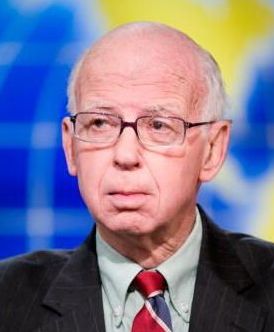
When David Broder is referred to as the dean of the Washington press corps, I guess it’s just a complimentary way of saying the old guy. But Broder’s nine years younger than Helen Thomas. How come she never rose to the same stature? Is baldness a requirement?

In spite of his institutional stature, Broder’s mental capacities have in recent years come into question and his op-ed in the Washington Post on Sunday provides yet another occasion to wonder what is going on inside this man’s brain as he pushes for war against Iran.

He writes:

War and peace influence the economy.

Look back at FDR and the Great Depression. What finally resolved that economic crisis? World War II.

Here is where Obama is likely to prevail. With strong Republican support in Congress for challenging Iran’s ambition to become a nuclear power, he can spend much of 2011 and 2012 orchestrating a showdown with the mullahs. This will help him politically because the opposition party will be urging him on. And as tensions rise and we accelerate preparations for war, the economy will improve.

I am not suggesting, of course, that the president incite a war to get reelected. But the nation will rally around Obama because Iran is the greatest threat to the world in the young century. If he can confront this threat and contain Iran’s nuclear ambitions, he will have made the world safer and may be regarded as one of the most successful presidents in history.

So another war is going to rescue the economy? But just a minute — if war’s such an excellent economic tonic, how come we aren’t already in great shape? A decade of war just hasn’t been quite enough?

It’s easy to mock Broder’s prescription and even to wonder whether he’s lost his grip on reality, but maybe he’s not quite as crazy as he sounds. Read more carefully, this is not actually a call for war — it is a call for the continuously escalating threat of war.

This is indeed the most likely “lesson” that some have drawn from the experience of Iraq: that the best kind of war is the one that has yet to be fought. A war that can be budgeted for, equipped for, and around which politicians can construct their postures of strength, resolution and righteousness. The context is one in which we have been encouraged to think that war is normal. War is in fact so normal that Washington pundits can now present it as a useful economic tool.

Washington’s lead comes from Israel, which has less interest in starting a war with Iran than in promoting the idea that war might be just over the horizon — a kind of Goldilocks war, not too far away and not too close, but just close enough. In this delicately modulated threat of mayhem, Iran itself remains politically and economically boxed in, while issues which merit more urgent attention — namely the intractable Israeli-Palestinian conflict — can be shunted to one side.

Two countries so heavily invested in manufacturing the means for engaging in war, actually have less interest in wars being fought than in a war-footing constantly being maintained. The problem is, a war posture can only be maintained for so long and momentum only be built up so much before a turning point is reached: war either then becomes inevitable or a real alternative has to be pursued.

Only through the hubris which metastasizes inside the brains of those trapped inside the Washington bubble, can anyone fail to see that the process of backing Iran into a corner risks the United States becoming trapped by the narrow logic of its own strategy. War is not normal. It is a failure of imagination.

Facebooktwittermail