Monthly Archives: December 2010

Press freedom threatened by the Obama administration

Glenn Greenwald writes:

During the Bush era, I frequently wrote about escalating attacks by the U.S. Government on press freedoms. The Bush DOJ vowed to prosecute whistleblowers while steadfastly refusing to do the same for the high-level criminals they exposed. Alberto Gonzales openly threatened that the DOJ could prosecute editors and reporters of The New York Times for revealing the illegal NSA spying program. CIA Director Porter Goss vowed to subpoena journalists who publish classified information in order to compel them to disclose their sources or go to prison.

And, worst of all, Bush officials sought for the first time in American history to obtain an espionage conviction — under the Espionage Act of 1917 — against non-government-employees who had received and disseminated classified information. About that case — brought against two AIPAC officials who had passed classified information they received from a Pentagon official to the Government of Israel (the Pentagon official pled guilty) — I wrote about “the Bush Administration’s broader, unprecedented assault on a free press of which the AIPAC prosecution is but a part,” and argued that “the Bush Administration is seeking to criminalize the very act which defines what an investigative journalist does and has always done in America.” The Washington Post‘s Walter Pincus reported at the time, quoting a legal expert, that “administration officials ‘want this case as a precedent so they can have it in their arsenal’ and added: ‘This is a weapon that can be turned against the media’.” After a series of adverse judicial rulings against the Government, the DOJ finally abandoned that AIPAC prosecution.

Amazingly, the Obama administration is surpassing its predecessor when it comes to assaults on whistle-blowing and a free press. As Politico’s Josh Gerstein reported, “President Barack Obama’s Justice Department has taken a hard line against leakers. . . .’They’re going after this at every opportunity and with unmatched vigor,’ said Steven Aftergood of the Federation of American Scientists.” The New York Times similarly documented: “the Obama administration is proving more aggressive than the Bush administration in seeking to punish unauthorized leaks.” The Obama DOJ has launched nothing less than a full-on war against whistleblowers; its magnanimous “Look Forward, Not Backward” decree used to shield high-level Bush criminals from investigations is manifestly tossed to the side when it comes to those who reveal such criminality. And they even revitalized an abandoned Bush-era subpoena issued to The New York Times‘ James Risen, demanding that he disclose his source for an article in which he revealed an embarrassingly botched attempt to infiltrate and sabotage Iran’s nuclear program.

Facebooktwittermail

No act of rebellion is wasted

Chris Hedges writes:

I stood with hundreds of thousands of rebellious Czechoslovakians in 1989 on a cold winter night in Prague’s Wenceslas Square as the singer Marta Kubišová approached the balcony of the Melantrich building. Kubišová had been banished from the airwaves in 1968 after the Soviet invasion for her anthem of defiance, “Prayer for Marta.” Her entire catalog, including more than 200 singles, had been confiscated and destroyed by the state. She had disappeared from public view. Her voice that night suddenly flooded the square. Pressing around me were throngs of students, most of whom had not been born when she vanished. They began to sing the words of the anthem. There were tears running down their faces. It was then that I understood the power of rebellion. It was then that I knew that no act of rebellion, however futile it appears in the moment, is wasted. It was then that I knew that the Communist regime was finished.

“The people will once again decide their own fate,” the crowd sang in unison with Kubišová.

I had reported on the fall of East Germany before I arrived in Prague. I would leave Czechoslovakia to cover the bloody overthrow of the Romanian dictator Nicolae Ceausescu. The collapse of the Communist regimes in Eastern Europe was a lesson about the long, hard road of peaceful defiance that makes profound social change possible. The rebellion in Prague, as in East Germany, was not led by the mandarins in the political class but by marginalized artists, writers, clerics, activists and intellectuals such as Vaclav Havel, whom we met with most nights during the upheavals in Prague in the Magic Lantern Theater. These activists, no matter how bleak things appeared, had kept alive the possibility of justice and freedom. Their stances and protests, which took place over 40 years of Communist rule, turned them into figures of ridicule, or saw the state seek to erase them from national consciousness. They were dismissed by the pundits who controlled the airwaves as cranks, agents of foreign powers, fascists or misguided and irrelevant dreamers.

I spent a day during the Velvet Revolution with several elderly professors who had been expelled from the Romance language department at Charles University for denouncing the Soviet invasion. Their careers, like the careers of thousands of professors, teachers, artists, social workers, government employees and journalists in our own universities during the Communist witch hunts, were destroyed. After the Soviet invasion, the professors had been shipped to a remote part of Bohemia where they were forced to work on a road construction crew. They shoveled tar and graded roadbeds. And as they worked they dedicated each day to one of the languages in which they all were fluent—Latin, Greek, Italian, French, Spanish or German. They argued and fought over their interpretations of Homer, Virgil, Dante, Goethe, Proust and Cervantes. They remained intellectually and morally alive. Kubišova, who had been the most popular recording star in the country, was by then reduced to working for a factory that assembled toys. The playwright Havel was in and out of jail.

The long, long road of sacrifice, tears and suffering that led to the collapse of these regimes stretched back decades. Those who made change possible were those who had discarded all notions of the practical. They did not try to reform the Communist Party. They did not attempt to work within the system. They did not even know what, if anything, their protests would accomplish. But through it all they held fast to moral imperatives. They did so because these values were right and just. They expected no reward for their virtue; indeed they got none. They were marginalized and persecuted. And yet these poets, playwrights, actors, singers and writers finally triumphed over state and military power. They drew the good to the good. They triumphed because, however cowed and broken the masses around them appeared, their message of defiance did not go unheard. It did not go unseen. The steady drumbeat of rebellion constantly exposed the dead hand of authority and the rot and corruption of the state.

Facebooktwittermail

The expiration of the ‘peace process’: where now for the Middle East?

Alastair Crooke writes:

A ‘peace process’ that, from its inception, took Israel’s self-definition of its own security needs as the sole determinate of the walls within which any solution for Palestinians was to be conducted, has reached exhaustion. Based on such a reductive premise, its arrival at this deathly nadir, with no more than a prospect of disjointed alleviated occupation, possessing the most hollow trappings of statehood as its final security-led outcome, should evoke no surprise.

The non-solution to which such a premise would take us would defuse nothing: indeed, it might well prove to be the spark that could exacerbate or explode simmering regional animosities — even if these animosities were not ostensibly linked directly to the Palestinian issue.

Any thought that such a hollowed-out solution — alleviated occupation, posing as statehood — will defuse anti-American sentiment in the Muslim world is likely to prove to be resoundingly misplaced. On this, the critics from the political Right are correct: a flawed Israeli-Palestinian agreement, per se, will not drain-off anti-western regional sentiment; it will exacerbate it. It will feed it. But the corollary the Right pushes in its place, that defeating Iran somehow precisely is that elusive magic bullet the West so ardently desires (the key to soothing regional tensions and defusing hostility towards the West) represents an even greater pathology and disassociation from reality. It is one that is no less illusory for having the apparent endorsement of America’s Arab clients, whose talk is no more than a reflection back into the looking-glass of American diplomacy, as it stares at its own face.

What these American protégés really fear is the growing groundswell of scorn — scorn towards the western élites on whom these interlocutors wholly depend — but more precisely it is fear of the parallel disdain, directed towards these pro-American, self-enriching élites, themselves. Any show of western muscularity indirectly gives these anxious oligarchs, feeling their authority decay beneath them, a further lease on survival. Thus they speak their deeper fears into the American looking-glass in its own thinking. All these worrying, popular stirrings can only be Iranian: for they fear they carry the gene of revolution.

The peace process solution-phantasm has not only divided the Palestinians; but also shaped the political structure for the region for the last decades: polarizing the region — on the false premise — between those who were ‘opposed’ to peace and those who ‘supported’ peace. Many of those who were termed opposed to peace in reality were opposed more to Israel’s self-referencing security-led paradigm — than to a peaceful solution per se.

Contrary to general western expectations, there will be many in the region who welcome evidence of the clinical death of ‘the process’. They will see its passing away as a welcome and necessary catharsis that opens new possibilities; new politics. Already the polarized cold war architecture of the peace process has begun to dissolve: Turkey’s shift of orientation is one example of the shifts taking place — as the former regional division into two sculptural solids, spoilers versus supporters of peace, melts into a much more fluid and mobile regional mass. [Continue reading]

Facebooktwittermail

An open letter from Afghanistan experts to Barack Obama

An open letter from Afghanistan experts to Barack Obama:

To the President of the United States: Mr. President, We have been engaged and working inside Afghanistan, some of us for decades, as academics, experts and members of non-governmental organisations. Today we are deeply worried about the current course of the war and the lack of credible scenarios for the future. The cost of the war is now over $120 billion per year for the United States alone.

This is unsustainable in the long run. In addition, human losses are increasing. Over 680 soldiers from the international coalition – along with hundreds of Afghans – have died this year in Afghanistan, and the year is not yet over. We appeal to you to use the unparalleled resources and influence which the United States now brings to bear in Afghanistan to achieve that longed-for peace.

Despite these huge costs, the situation on the ground is much worse than a year ago because the Taliban insurgency has made progress across the country. It is now very difficult to work outside the cities or even move around Afghanistan by road. The insurgents have built momentum, exploiting the shortcomings of the Afghan government and the mistakes of the coalition. The Taliban today are now a national movement with a serious presence in the north and the west of the country. Foreign bases are completely isolated from their local environment and unable to protect the population. Foreign forces have by now been in Afghanistan longer than the Soviet Red Army.

Politically, the settlement resulting from the 2001 intervention is unsustainable because the constituencies of whom the Taliban are the most violent expression are not represented, and because the highly centralised constitution goes against the grain of Afghan tradition, for example in specifying national elections in fourteen of the next twenty years.

The operations in the south of Afghanistan, in Kandahar and in Helmand provinces are not going well. What was supposed to be a population-centred strategy is now a full-scale military campaign causing civilian casualties and destruction of property. Night raids have become the main weapon to eliminate suspected Taliban, but much of the Afghan population sees these methods as illegitimate. Due to the violence of the military operations, we are losing the battle for hearts and minds in the Pashtun countryside, with a direct effect on the sustainability of the war. These measures, beyond their debatable military results, foster grievance. With Pakistan’s active support for the Taliban, it is not realistic to bet on a military solution. Drone strikes in Pakistan have a marginal effect on the insurgency but are destabilising Pakistan. The losses of the insurgency are compensated by new recruits who are often more radical than their predecessors.

Facebooktwittermail

Richard Holbrooke’s final words: “You’ve got to stop this war in Afghanistan.”

Richard Holbrooke died this evening. The Washington Post looked back at his career.

Mr. Holbrooke was sent to Vietnam in 1963, assigned to the lower Mekong Delta as a field officer for the U.S. Agency for International Development, a post that would later give him unique perspective on reconstruction efforts and provincial stabilization in Afghanistan.

His insights drew the attention of the U.S. Embassy in Saigon, and he was soon moved there to serve as a staff assistant to two ambassadors, Maxwell D. Taylor and Henry Cabot Lodge Jr.

In 1966, he joined the Vietnam staff in the Johnson White House, where had a front-row seat for what came to be considered an unwise escalation of U.S. military forces based on deceptive assessments.

“Our beloved nation sent into battle soldiers without a clear determination of what they could accomplish and they misjudged the stakes. And then we couldn’t get out,” he said that year at a State Department conference on the American experience in Southeast Asia. “. . . We fought bravely under very difficult conditions. But success was not achievable. Those who advocated more escalation or something called ‘staying the course’ were advocating something that would have led only to a greater and more costly disaster afterwards.”

Facebooktwittermail

The FBI’s effort to silence political dissent in America

In These Times reports:

September 24 began like any other Friday for Joe Iosbaker and Stephanie Weiner. Then, at 7 a.m., FBI agents knocked on the door of the Chicago couple’s house in the city’s North Side.

Armed with a search warrant, more than 20 agents examined the couple’s home, photographing every room and combing through notebooks, family videos and books, even their children’s drawings. Some items were connected to their decades of anti-war and international solidarity activism, but others were not. “Folders were opened, letters were pulled out of envelopes,” says Weiner, an adult education professor at Wilbur Wright College. “They had rubber gloves and they went through every aspect of our home.”

Ten hours after their arrival, as television news crews filmed and activist supporters stood on the sidewalk, the agents drove away with nearly 30 boxes of material, including t-shirts and a photograph of Malcolm X. By that time, Iosbaker and Weiner had been served subpoenas to appear before a grand jury investigating “material support” for “foreign terrorist organizations.” And they knew theirs wasn’t the only home invaded that day. More than 70 FBI agents had raided seven residences in Chicago and Minneapolis and questioned activists in Michigan, California and North Carolina, serving subpoenas to 11 people. A few days later, the Justice Department subpoenaed members of the Minnesota Anti-War Committee (AWC), whose office was also raided on September 24, raising the number to 14. (Editor’s note: five additional Chicago-area activists were subpoenaed in early December; see update below.)

The grand jury and FBI are looking for evidence that connects the 14 activists and their “potential co-conspirators” to two organizations: the Revolutionary Armed Forces of Colombia (FARC) and the Popular Front for the Liberation of Palestine (PFLP), which are both on the State Department’s “Foreign Terrorist Organizations” list. None of the 14 has been charged with a crime, and all deny providing “material support,” including money, to any foreign organization.

Citing the Fifth Amendment, all 14 are refusing to testify before the grand jury, which they say is a secretive arm of a government intent on silencing critics.

Facebooktwittermail

Visa, Mastercard and PayPal help fund Israel’s illegal settlements

Crikey reports:

Visa, Mastercard and PayPal all enable donations to be made to US-registered groups funding illegal Israeli settlements in the West Bank in defiance of international law.

It appears at least one of the major credit cards also enables donations to an extremist Jewish group that has placed a bounty on the lives of Palestinians.

All three have in the last week ceased enabling donations to WikiLeaks. Neither Mastercard nor Visa have explained the basis for their decision to do so. PayPal has backed away from its initial claim that the US State Department told PayPal WikiLeaks had broken the law after the claim was discredited. This is the third occasion on which PayPal has suspended payment services for WikiLeaks.

Israel subsidises over 100 settlements in the West Bank in defiance of international law. Another 100+ are “illegal outposts” even under Israeli law. All benefit from extensive support from the United States, channelled through a range of Jewish and right-wing Christian bodies, all of which have charitable status under US law. The International Crisis Group’s report on settlements in July 2009 identified the important role played by US charities. Israeli newspaper Haaretz has investigated the strong support provided via US charities, and Israeli peace groups have also targeted the generous support provided via private donations from the US and Canada.

Credit card transactional systems play a key role in facilitating this support for illegal settlements.

Facebooktwittermail

$52bn of American aid and still Afghans are dying of starvation

Patrick Cockburn reports:

The most extraordinary failure of the US-led coalition in Afghanistan is that the expenditure of tens of billions of dollars has had so little impact on the misery in which 30 million Afghans live. As President Barack Obama prepares this week to present a review of America’s strategy in Afghanistan which is likely to focus on military progress, US officials, Afghan administrators, businessmen and aid workers insist that corruption is the greatest threat to the country’s future.

In a series of interviews, they paint a picture of a country where $52bn (£33bn) in US aid since 2001 has made almost no impression on devastating poverty made worse by spreading violence and an economy dislocated by war. That enormous aid budget, two-thirds for security and one-third for economic, social and political development, has made little impact on 9 million living in absolute poverty, and another 5 million trying to survive on $43 (£27) a month. The remainder of the population often barely scrapes a living, having to choose between buying wood to keep warm and buying food.
[…]
Fake photographs are often the only evidence that companies have carried out expensive projects located in parts of Afghanistan too dangerous for donors to visit.

“I went to see a food processing plant in the east of the country which was meant to employ 250 women,” says an Afghan who used to work for an American government aid organisation. “We had started the project and were paying for the equipment and the salaries. But all I found was a few people working on a vegetable plot the size of a small room.”

When he complained he was told by a local official to keep his mouth shut. He said that “if I did not keep quiet there would be trouble on the road back to Jalalabad – in other words they would kill me.”

US officials admit privately that the torrent of aid money that has poured into Afghanistan has stoked corruption and done ordinary Afghans little good. Afghanistan was identified as the third most corrupt country out of 178 in the world in a report released last week by Transparency International.

Facebooktwittermail

Australia does not see Iran as “rogue state”; fears Israel could trigger nuclear war

Australia’s The Age, reports

Australia’s intelligence agencies fear that Israel may launch military strikes against Iran and Tehran’s pursuit of nuclear capabilities could draw the US and Australia into a potential nuclear war in the Middle East.

Australia’s peak intelligence agency has also privately undercut the hardline stance towards Tehran of the US, Israeli and Australian governments, saying its nuclear program is intended to deter attack and it is a mistake to regard Iran as a rogue state.

The warnings about the dangers of nuclear conflict in the Middle East are given in a secret US embassy cable obtained by WikiLeaks and provided exclusively to The Age. They reflect views obtained by US intelligence liaison officers in Canberra from Australian intelligence agencies.

”The AIC’s [Australian intelligence community’s] leading concerns with respect to Iran’s nuclear ambitions centre on understanding the time frame of a possible weapons capability, and working with the United States to prevent Israel from independently launching unco-ordinated military strikes against Iran,” the US embassy in Canberra reported to Washington in March last year.

”They are immediately concerned that Iran’s pursuit of nuclear capabilities would lead to a conventional war – or even nuclear exchange – in the Middle East involving the United States that would draw Australia into a conflict.”

Facebooktwittermail

America’s alliances with Central Asia’s despots

The Guardian reports:

The post-Soviet state of Uzbekistan is a nightmarish world of “rampant corruption”, organised crime, forced labour in the cotton fields, and torture, according to the leaked cables.

But the secret dispatches released by WikiLeaks reveal that the US tries to keep President Islam Karimov sweet because he allows a crucial US military supply line to run into Afghanistan, known as the northern distribution network (NDN).

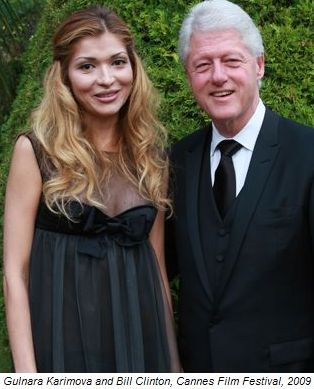
Many dispatches focus on the behaviour of Karimov’s glamorous and highly controversial daughter Gulnara, who is bluntly described by them as “the single most hated person in the country”.

She allegedly bullied her way into gaining a slice of virtually every lucrative business in the central Asian state and is viewed, they say, as a “robber baron”. Granted diplomatic status by her father, Gulnara allegedly lives much of the time in Geneva, where her holding company, Zeromax, was registered at the time, or in Spain.

She also sings pop songs, designs jewellery and is listed as a professor at Tashkent’s University of World Economy and Diplomacy.

The British ambassador in Tashkent, Rupert Joy, was criticised by human rights groups in October when he helped boost Gulnara’s image by appearing with her on a fashion show platform.

Der Spiegel reports:

The US is anxious to broaden its influence in Central Asia — and limit that of Russia. The result, however, are questionable alliances with some of the strangest despots in the world.

The secret country assessment from the US Embassy in the Tajikistan capital of Dushanbe, prepared for General David Petraeus on Aug. 7, 2009 ahead of his visit later that month, described a country on the brink of ruin. Tajikistan, a country of 7.3 million people on the northern border of Afghanistan, is a dictatorship ruled by Emomali Rakhmon, a former collective farm boss and notorious drunkard. “Parliament acts as a rubber stamp, barely discussing important legislation such as the national budget,” the dispatch noted.

Some of the state’s revenues were from criminal sources: “Tajikistan is a major transit corridor for Southwest Asian heroin to Russia and Europe.” The country had “chronic problems with Uzbekistan,” its neighbor, and the impoverished former Soviet republic faced the prospect of civil war fomented by Islamists in the east of the country.
Nevertheless, Petraeus, at the time head of US Army Central Command, was urged to court Rakhmon. The US needed his help in Afghanistan. The US had other ambitious goals in the region as well. The US, in recent years, has serenaded several former Soviet republics in Central Asia — oil interests, counter-terrorism assistance and American influence in the region inform the approach. As a result, US diplomats have had to cozy up to a collection of decidedly shady characters.

In the case of Tajikistan, Petraeus’ task was clear: “Secure Rakhmon’s agreement to accept transit of lethal materials to Afghanistan through Tajikistan” — arms and ammunition for US troops. In return, the US could offer assistance in quelling the Islamists: “Assure Tajikistan of our support as it works to contain militants in the east of the country.”

Facebooktwittermail

PEN International statement on WikiLeaks

International PEN, the worldwide association of writers, has released a statement in support of WikiLeaks:

PEN International champions the essential role played by freedom of expression in healthy societies and the rights of citizens to transparency, information and knowledge.

The Wikileaks issue marks a significant turning point in the evolution of the media and the sometimes conflicting principles of freedom of expression and privacy and security concerns. The culture of increasing secrecy in governments and the rise of new technology will inevitably lead to an increasing number of transparency issues of this sort. PEN International believes it is important to acknowledge that while the leaking of government documents is a crime under U.S laws, the publication of documents by Wikileaks is not a crime. Wikileaks is doing what the media has historically done, the only difference being that the documents have not been edited.

PEN International urges those voicing opinions regarding the Wikileaks debate to adopt a responsible tone, and not to play to the more extreme sections of society. In a world where journalists are regularly physically attacked, imprisoned and killed with impunity, calling for the death of a journalist is irresponsible and deplorable.

PEN International is also concerned by reports that some web sites, fearing repercussions, have stopped carrying Wikileaks, and that individuals, under threat of legal action, have been warned against reading information provided by the organization. PEN International condemns such acts and calls upon corporations and states to avoid breaches of the right to free expression. Governments cannot call for unlimited internet freedom in other parts of the world if they do not respect this freedom themselves.

The Wikileaks matter is a dynamic issue which we shall continue to monitor closely and on which we will refine our position as the situation requires. We welcome this debate and look forward to further discussion with the worldwide PEN membership.

WL Central adds this note:

The statement that “the documents have not been edited” is incorrect. All Cablegate documents published by WikiLeaks on its website have been redacted by the media partners. Please see this report by the Associated Press on the redaction process. Please also see our report on the redaction of the Afghanistan and Iraq war logs.

Facebooktwittermail

The end of hypocrisy

Carne Ross has provided one of the most concise and cogent analyses of the impact of the WikiLeaks cables release and concludes that the challenge this event has thrown up can only be met with one solution: “that governments must close the divide between what they say, and what they do.”

A knee-jerk response to the prospect that diplomacy might not enjoy the confidentiality that it supposedly requires has been the assertion that this confidentiality is the basis of trust. Confidentiality, we are told, fosters candor. Behind closed doors, everyone becomes honest. Right.

On the contrary, what the cables actually reveal is what one might expect: that absent the political accountability that comes from publicly declaring ones objectives, confidentiality provides space for adventurism and for the promotion of policies that might be disowned if ever made public.

The cables reveal leaders across the Middle East — leaders all of whom have been blessed by the United States as “moderates” — whose overriding interest is the protection of their own autocratic power in the name of American-backed “regional stability.”

Even when it comes to candid assessments delivered by diplomats to their own government, such honesty often comes loaded with bias. Consider, for instance, this cable from Ambassador James Jeffrey while he served in Ankara. Referring to the foreign policy objectives outlined by Turkey’s foreign minister Ahmet Davutoglu representing the ruling AKP, Jeffrey writes sourly:

[T]he AKP’s constant harping on its unique understanding of the region, and outreach to populations over the heads of conservative, pro-US governments, have led to accusations of “neo-Ottomanism.” Rather than deny, Davutoglu has embraced this accusation. Himself the grandson of an Ottoman soldier who fought in Gaza, Davutoglu summed up the Davutoglu/AKP philosophy in an extraordinary speech in Sarajevo in late 2009 (REF A). His thesis: the Balkans, Caucasus, and Middle East were all better off when under Ottoman control or influence; peace and progress prevailed. Alas the region has been ravaged by division and war ever since. (He was too clever to explicitly blame all that on the imperialist western powers, but came close). However, now Turkey is back, ready to lead — or even unite. (Davutoglu: “We will re-establish this (Ottoman) Balkan”).

If Hillary Clinton did not rely on her ambassador’s confidential opinion but actually read Davutoglu’s speech, she might have come to a different conclusion.

The Turkish foreign minister said: “We want to have a new Balkan region, based on political dialogue, economic interdependency and cooperation, integration and cultural harmony and tolerance.”

The thrust of his argument was that the Balkans had thrived not by virtue of Ottoman rule per se, but because of the dynamism fostered by “multicultural coexistence.” Likewise, he portrayed contemporary Turkey’s strength as being multicultural: “Turkey is a small Balkan, a small Middle East, a small Caucasus. We have more Bosnians living in Turkey than in Bosnia, more Albanians living in Turkey than in Albania, more Chechens living in Turkey than in Chechnya, more Abkhazians living in Turkey than in Abkhazia, and we have Kurds, Arabs, Turks together.”

Is this the perspective of a man enthralled by a romanticized Ottoman golden age, or is Davutoglu offering a glimpse at the kind of multicultural future on which the region and the world surely depends?

But enough of my preamble — here’s what Ross writes:

It will take a long time, perhaps many years, for the full impact of the WikiLeaks disclosure of thousands of US diplomatic cables to become known. Make no mistake: this is an event of historic importance — for all governments, and not only the US.

As politicians of all sides bellow their condemnation of WikiLeaks, governments are with some desperation trying to pretend that it’s business as usual. But the truth is that something very dramatic in the world of diplomacy has just taken place, and thus indeed in the way that the world runs its business. History may now be dated pre- or post-WikiLeaks.

The mainstream press has as usual missed the story, with their obsession with Iran or Qaddafi’s voluptuous nurse or Karzai’s corruption — which, incidentally, is reported by US diplomats in excruciating detail. But this event carries a much deeper significance than merely the highly-embarrassing and in some cases dangerous revelations in the enormous trove of documents. No one, and neither the US State Department nor WikiLeaks, can say with any confidence whether the effects of this massive disclosure will be good or bad, for in truth no one can know. There will be many and long-lasting consequences. That is all that can be known with any certainty at this point.

The presumption that governments can conduct their business in secret with one another, out of sight of the populations they represent, died this week. Diplomats and officials around the world are slowly realizing that anything they say may now be one day published on the Internet. Governments are now frantically rushing to secure their data and hold it more tightly than ever, but the horse has bolted. If a government as technically sophisticated and well protected as the US can suffer a breach of this magnitude, no government is safe. Politicians can demand the prosecution of Julian Assange or — absurdly — that WikiLeaks be designated as a terrorist organization, but the bellows of anger are tacit admission that government’s monopoly on its own information is now a thing of the past.

Hillary Clinton has described the WikiLeaks disclosures as an attack on the “international community.” But in truth this is something else: an attack on the governments that make up the current international system of diplomacy. The deep-seated assumption, both among the public and political classes, that governments have business that they should conduct in secret with one another has been shattered. Pause, incidentally, to observe the politicians and commentators declaring the need for governments to operate in secrecy, when they don’t even know what government is keeping secret. From this day forward, it will be ever more difficult for governments to claim one thing, and do another. For in making such claims, they are making themselves vulnerable to WikiLeaks of their own.

Why? Because the most damaging thing about the WikiLeaks disclosures is not the fact that they happened (though this is bad enough for the US government) but the revelation, long suspected but now proven, of the yawning discrepancy between US words and actions in that most contested area, the Middle East. Cable after cable details the extraordinarily intimate and co-dependent relations between the US and various despotic and unpleasant Arab regimes. One Arab intelligence chief plots with American officials to target Iranian groups, or confront Hezbollah. Another undemocratic Arab leader invites US bombers to attack targets in his own territory. It is this discrepancy — between word and deed — that will keep the wind in WikiLeaks’ sails, and others like them, for long to come.

Governments around the world are this week telling each other that nothing has really changed and that if they restrict the circulation of those really sensitive telegrams and glue up all the USB slots in their computers, that this won’t happen to them. But it will. There will be more such revelations, not about the US (which so far has been the main target of WikiLeaks’ somewhat arbitrary attentions), but others — British, Chinese? — for the reality is that electronic data is formidably difficult to protect.

The reason is simple. In order to be effective as organizations, governments and foreign offices are required to circulate sensitive data, so that their officials and diplomats actually know what’s going on. One reason why the UN is ineffective as an organization is because nothing is secret there, and as a result no one circulates anything sensitive. Don’t buy the argument that the really important stuff is kept Top Secret and hasn’t been compromised. Even a cursory perusal of the WikiLeaks archive reveals cables that are the very meat and drink of diplomacy — what foreign leaders and governments really think, and what they really want in their relations with the US.

Governments are therefore confronted with an insoluble conundrum. If they restrict and protect the data, and perhaps even stop recording the most delicate information (as no doubt some diplomats are now considering), they will inevitably reduce their operational effectiveness. If they circulate the data widely, as the US did before WikiLeaks, they will risk compromise on this devastating scale.

There is in fact only one enduring solution to the WikiLeaks problem and this is perhaps the goal of WikiLeaks, though this is sometimes hard to discern. That is that governments must close the divide between what they say, and what they do. It is this divide that provokes WikiLeaks; it is this divide that will provide ample embarrassment for future leakers to exploit. The only way for governments to save their credibility is to end that divide and at last to do what they say, and vice versa, with the assumption that nothing they may do will remain secret for long. The implications of this shift are profound, and indeed historic.

Facebooktwittermail

Talk to terrorists

Thanassis Cambanis writes:

Ronald Reagan framed the debate over whether to talk to terrorists in terms that still dominate the debate today. “America will never make concessions to terrorists. To do so would only invite more terrorism,” Reagan said in 1985. “Once we head down that path there would be no end to it, no end to the suffering of innocent people, no end to the bloody ransom all civilized nations must pay.”

America, officially at least, doesn’t negotiate with terrorists: a blanket ban driven by moral outrage and enshrined in United States policy. Most government officials are prohibited from meeting with members of groups on the State Department’s foreign terrorist organization list. Intelligence operatives are discouraged from direct contact with terrorists, even for the purpose of gathering information.

President Clinton was roundly attacked when diplomats met with the Taliban in the 1990s. President George W. Bush was accused of appeasement when his administration approached Sunni insurgents in Iraq. Enraged detractors invoked Munich and ridiculed presidential candidate Barack Obama when he said he would meet Iran and other American adversaries “without preconditions.” The only proper time to talk to terrorists is after they’ve been destroyed, this thinking goes; any retreat from the maximalist position will cost America dearly.

Now, however, an increasingly assertive group of “engagement hawks” — a group of professional diplomats, military officers, and academics — is arguing that a mindless, macho refusal to engage might be causing as much harm as terrorism itself. Brushing off dialogue with killers might look tough, they say, but it is dangerously naive, and betrays an alarming ignorance of how, historically, intractable conflicts have actually been resolved. And today, after a decade of war against stateless terrorists that has claimed thousands of American lives and hundreds of thousands of foreign lives, and cost trillions of dollars, it’s all the more important that we choose the most effective methods over the ones that play on easy emotions.

Facebooktwittermail

‘Our lives became something we’d never dreamt’: The former Israeli soldiers who have testified against army abuses

Donald Macintyre reports:

For anyone who has covered Israel, the West Bank and Gaza over the past few years, reading Occupation of the Territories, the new book from the Israeli ex-soldiers organisation Breaking the Silence, can be an eerily evocative experience.

A conscript from the Givati Brigade, for example, describes how troops in the company operating next to his inside Gaza during 2008 had talked about an event earlier in the day. After knocking on the door of a Palestinian house and receiving no immediate answer, they had placed a “fox” – military slang for explosives used to break through doors and walls – outside the front door. At that very moment, the woman of the house had reached the door to open it. “Her limbs were smeared on the wall and it wasn’t on purpose,” the soldier recalls. “And then her kids came and saw her. I heard it during dinner after the operation, someone said it was funny, and they cracked up from the situation that the kids saw their mother smeared on the wall…”

A second-hand story, of course; one without names, dates or supporting detail. Except that it stirred a memory I had of reporting the death of a Palestinian UN schoolteacher east of Khan Younis. Wafer Shaker al-Daghma was killed when the Israel Defence Forces (IDF) commandeered her house during an incursion in May 2008. Her husband had been out at the time. When we came to the house five days later, another incursion was under way and we could hear, uncomfortably close, the gunfire from Israeli armoured military vehicles while Majdi al-Daghma described his wife’s death at the age of 34. When she realised troops were nearby, she’d ordered ‘ the children, Samira, 13, Roba, four, and Qusay, two, into the bedroom, put on a headscarf and prepared to open the door. “Samira heard a loud explosion and there was a lot of smoke,” he explained. “She looked for her mother but couldn’t see her.”

It was surely the same incident. You have to assume that the laughter alluded to by the conscript was a nervous reaction, a manifestation of delayed shock from the soldiers. They had, after all, had the presence of mind to cover Mrs al-Daghma’s mutilated body with a carpet, and to keep the children confined to the bedroom for the five hours they had remained in the house. Samira said she had asked one of them, “Where is my mother?” but had not understood his reply in Hebrew. She explained how, when the soldiers finally left after nightfall, “There were still tanks outside our house… I tried to call my father on my mother’s Jawwal [mobile phone] but there was no line. I lifted the carpet and saw a bit of my mother’s clothes. She was not moving. I did not see her head.”

The point of this is not just that the soldier’s story is shocking, but that it is so apparently corroborated. Especially given that the conscript’s short account – unlike many others in the book, some every bit as disquieting – is based on hearsay, it is powerfully suggestive of the testimonies’ authenticity as a portrait of a 43-year-old occupation. These testimonies, checked and cross-checked, of young Israeli men and women struggling to come to terms, sometimes years after the event, with their military service in the West Bank and Gaza, add up to an unprecedented inside account, as the book’s introduction puts it, of “the principles and consequences of Israeli policy in the [Palestinian] territories”.

Facebooktwittermail

Republicans who excused extremism in the name of victory have unleashed a monster

Christopher Hitchens writes:

It is often in the excuses and in the apologies that one finds the real offense. Looking back on the domestic political “surge” which the populist right has been celebrating since last month, I found myself most dispirited by the manner in which the more sophisticated conservatives attempted to conjure the nasty bits away.

Here, for example, was Ross Douthat, the voice of moderate conservatism on the New York Times op-ed page. He was replying to a number of critics who had pointed out that Glenn Beck, in his rallies and broadcasts, had been channeling the forgotten voice of the John Birch Society, megaphone of Strangelovian paranoia from the 1950s and 1960s. His soothing message:

These parallels are real. But there’s a crucial difference. The Birchers only had a crackpot message; they never had a mainstream one. The Tea Party marries fringe concerns (repeal the 17th Amendment!) to a timely, responsible-seeming message about spending and deficits.

The more one looks at this, the more wrong it becomes (as does that giveaway phrase “responsible-seeming”). The John Birch Society possessed such a mainstream message — the existence of a Communist world system with tentacles in the United States — that it had a potent influence over whole sections of the Republican Party. It managed this even after its leader and founder, Robert Welch, had denounced President Dwight D. Eisenhower as a “dedicated, conscious agent” of that same Communist apparatus. Right up to the defeat of Barry Goldwater in 1964, and despite the efforts of such conservatives as William F. Buckley Jr. to dislodge them, the Birchers were a feature of conservative politics well beyond the crackpot fringe.

Now, here is the difference. Glenn Beck has not even been encouraging his audiences to reread Robert Welch. No, he has been inciting them to read the work of W. Cleon Skousen, a man more insane and nasty than Welch and a figure so extreme that ultimately even the Birch-supporting leadership of the Mormon Church had to distance itself from him. It’s from Skousen’s demented screed The Five Thousand Year Leap (to a new edition of which Beck wrote a foreword, and which he shoved to the position of No. 1 on Amazon) that he takes all his fantasies about a divinely written Constitution, a conspiratorial secret government, and a future apocalypse. To give you a further idea of the man: Skousen’s posthumously published book on the “end times” and the coming day of rapture was charmingly called The Cleansing of America. A book of his with a less repulsive title, The Making of America, turned out to justify slavery and to refer to slave children as “pickaninnies.” And, writing at a time when the Mormon Church was under attack for denying full membership to black people, Skousen defended it from what he described as this “Communist” assault.

So, Beck’s “9/12 Project” is canalizing old racist and clerical toxic-waste material that a healthy society had mostly flushed out of its system more than a generation ago, and injecting it right back in again. Things that had hidden under stones are being dug up and re-released. And why? So as to teach us anew about the dangers of “spending and deficits”? It’s enough to make a cat laugh. No, a whole new audience has been created, including many impressionable young people, for ideas that are viciously anti-democratic and ahistorical. The full effect of this will be felt farther down the road, where we will need it even less.

Facebooktwittermail

Embedded with the Taliban

For an American cable news organization to embed reporters with the Taliban would be a bold move. CNN isn’t bold. But on Saturday evening it took the moderately risky move of airing a Norwegian journalist’s film of life with Taliban fighters.

“Some people might see this and think that you are trying to humanize this force which is attacking American troops,” Anderson Cooper says to Paul Refsdal. The problem being that if we see a Taliban commander embracing his children we might make a dreadful connection: such a scene must have preceded many a drone attack in which militants and their families have been eliminated. Refsdal simply says: “I show what I saw. I show the everyday life of the Taliban.”

Supporters of the war, however, better shield their eyes from such images — at least if they want to cling to the fiction that American forces are pitted against fanatical inhuman monsters.

As for the attack that is shown in the clip below, the Pentagon claims no such attack occurred. Cooper seems to infer from this that the Taliban has an inflated view of its own capacities. That’s one way of reading it. Another is to recognize that attacks against coalition forces are so frequent that the only ones worth recording are those that do damage — as though the only bullets a soldier need worry about are the ones that hit their target.

However CNN might have attempted to insulate themselves from criticism for airing this documentary, it’s likely impact will be this: that many Americans come away seeing the Taliban for what they are — an indigenous fighting force defending their homeland. In America’s war of independence, the militiamen who drove out the British, no doubt saw themselves in exactly the same way.

Facebooktwittermail

Radical jihadism is not a mental disorder

Stephen N. Xenakis warns that the US government is sliding in the direction of the Soviet Union when it uses psychiatrists, willing to spout pseudoscience for the purpose of identifying “enemies of the state.”

The case of Omar Khadr was the first war crimes prosecution of the Obama administration, and it could set a dangerous precedent for how mental health professionals are used in terrorism trials.

I attended the proceedings in October – the first American tribunal for a child soldier since World War II – because I had been working with Khadr’s defense team for two years. I am a child and adolescent psychiatrist and a retired Army brigadier general; the defense had asked me to evaluate Khadr’s physical and mental health, as well as advise on military procedure.

As I listened to the prosecution’s expert testimony depicting Khadr’s state of mind, I was reminded of psychiatry and the politicization of mental health under the Soviet regime. Those were the years when political dissidents were accused of insanity simply because they had the audacity to challenge the Soviet system. The medical profession, especially psychiatry, was a political instrument of control and repression.

Facebooktwittermail

America: the panoptic shiver

At Open Democracy, Paul Rogers writes:

Among the most compelling nuggets of information contained in the batch of United States diplomatic documents released by WikiLeaks and published in leading international newspapers is the list of installations in more than fifty countries which the state department in Washington deems to be a US security concern.

Some of the locations seem obvious (major oil-and-gas processing-plants and pipeline terminuses, for example); but others are far harder to fit any evident national-security frame (such as an Australian pharmaceutical plant specialising in anti-snake-venom treatments, and cobalt-mines in the Democratic Republic of Congo).

But even the more unlikely sites are relevant to a country that sees itself as the world’s sole superpower with interests across the globe. The anti-snake-venom plant in Australia almost certainly has the expertise and equipment to make antidotes to other toxins, and this could be highly significant in the event of a biological-warfare threat.

The cobalt-mines around Kolwezi and Mutshatsha in the southern DRC extract the world’s most important deposits of cobalt ores, and ferro-alloys containing cobalt have the specific property of retaining their shape at very high temperatures. They are therefore much in demand for the guidance-vanes of missile-engines and other elements of modern weapons-systems.

The more surprising elements of the list as much as the expected ones thus illustrate the continued reach of the United States’s strategic and security ambitions. But they also reveal something more: its new vulnerabilities. The increased inter-state competition across much of the global south from China and other rising states is one, familiar, source of these; another and perhaps less visible source is the challenge posed by insurgent groups to these prime targets. Indeed, central Africa may be a good place to begin to track this superpower dilemma.

Facebooktwittermail