Monthly Archives: June 2011

AIPAC from the inside — Part 1: isolating Iran

Robert Dreyfuss writes:

In August 2005, two lobbyists with the American Israel Public Affairs Committee (AIPAC), Steve Rosen and Keith Weissman, were indicted on charges of illegally conspiring to collect and disseminate classified secrets to journalists and to Israeli diplomats. The case, in which the two men were charged under a World War I-era espionage law along with Larry Franklin, a midlevel Iran analyst at the Department of Defense, was intimately linked to efforts by the AIPAC officials and others to improperly influence U.S. policy toward Iran, said prosecutors, and it caused a political firestorm in Washington. However, in 2009, the case fell apart, and the Justice Department withdrew all charges.

Now, for the first time, one of the two AIPAC officials, Keith Weissman, is speaking out. In a series of extended interviews with Tehran Bureau, Weissman tells his story. He’s come forward, he says, because he’s concerned that if a confrontation between the United States, Israel, and Iran leads to war, it will be a disaster — one that Weissman fears will be blamed on the American Jews.

“The reason why I want to tell this story now is, we may be going down a path, helped along by the American Jewish community, and maybe even Israel, that is going to be worse even than the one we’re on now – some sort of military confrontation with Iran. That worries me. Because they will be able to blame [it] on the Jews, to a great extent,” says Weissman, who worked at AIPAC from 1993 until 2005, much of that time as the group’s deputy director of foreign policy. Though Weissman disagrees sharply with those who say that AIPAC played a critical role in pushing for the 2003 U.S. decision to invade Iraq, he believes a war with Iran — which he says “would be the stupidest thing I ever heard of” — might well be blamed on AIPAC’s leaders and their constituents. “What the Jews’ war will be is Iran,” he says. “Not Iraq.”

Although Weissman’s comments might seem startling to those who don’t know him, they’re part and parcel of who he is, he says. From his days in college at the University of Chicago in the late 1970s, Weissman was in sympathy with a wide range of progressive causes, and, unusually for a man who’d end up working at AIPAC, he sported a “Free Palestine” bumper sticker on his car back then. (Last month, at a conference held by the Washington Institute for Near East Policy, a think tank founded with support from AIPAC, I mentioned to Steve Rosen that I’d talked to Weissman. “Of course!” replied Rosen, who knows that I usually write for progressive publications. “He thinks just like you do!”) During much of his tenure at AIPAC, Weissman served as a kind of unofficial liaison to various Palestinian officials, diplomats, and academics. Later, when he became AIPAC’s chief Iran specialist, he insists that he quietly did what he could to steer the group away from direct calls for regime change in Iran, even though AIPAC was working hard to push the United States into ever stronger action against the Islamic Republic, including diplomatic isolation and tough sanctions to dissuade Iran from pursuing its nuclear program and supporting Hamas, Hezbollah, and other anti-Israel groups. [Continue reading…]


Facebooktwittermail

“Price tag” pogroms go under the radar

Yossi Gurvitz writes:

When a post mortem on the collapse of Israeli democracy will take place, there’s a good chance that the “Ha’Kol Ha’Yehudi” will be considered Israel’s Radio Rwanda, which encouraged and led the murderers to the victims during the genocide there.

The site (Hebrew), whose name means “The Jewish Voice”, is operated by the Yehudim Smechim (“Happy Jews”) Association (Hebrew), which is the active front of the students of the “Od Yoseph Khai” yeshiva in Yizhar. Led by Yizhak Ginzburg, this is in all likelihood the most extreme yeshiva around. It became famous, or rather infamous, when two of its rabbis wrote “Tortah Ha’Melekh”, a treatise on the proper way according to Jewish law of killing gentiles. The Ministry of Education even stopped funding it for a while after that.

Ha’Kol Hayehudi reports steadily and enthusiastically about the pogroms carried out by settlers under the code name of “price tag”. One wonders how involved is the site in those activities: When me and Itamar Sha’altiel tried to find out, two months ago, why price tag activity went drastically down for some two weeks, we found these weeks correlated to the time the yeshiva was on Passover vacation.

Facebooktwittermail

‘Many killed’ amid fresh Syria protests

Al Jazeera reports:

At least 23 people have been killed by security forces in Syria, many of them when the army attacked a northernwestern town, activists say.

A Syrian opposition figure told the AP news agency by telephone that tanks shelled had Maarat al-Numan on Friday, after thousands of protesters overwhelmed security officers and torched the courthouse and police station.

Syria’s state-run television appeared to confirm at least part of the report, saying gunmen had opened fire on security headquarters in the town, in Idlib province, causing casualties among security officials.

Al Jazeera also reports:

Thousands of Syrians have fled to Turkey to escape violence and more are sheltering near the border, officials say.

A senior Turkish diplomat said 4,300 Syrians had crossed the border as of Saturday morning and that Turkey was prepared for a further influx.

“Turkey welcomed a great many number of guests in the past in their times of most dire need. We can do that again,” Foreign Ministry Deputy Undersecretary Halit Cevik was quoted as saying by state-run Anatolian news agency.

Most of those fleeing come from the town of Jisr al-Shughur and nearby villages, where Syrian troops backed by tanks, helicopters and heavy armour have been operating for several days, trying to crush a nearly three-month anti-government uprising.

Facebooktwittermail

Police brutality haunts post-revolt Egypt, says rights group

Al-Masry Al-Youm reports:

A rights organization said on Saturdaythat police brutality is marring Egypt’s transition to democracy. The statement comes after four people allegedly died at the hands of the police in less than three weeks.

Human rights organizations have claimed that three Egyptians from Cairo and one from Fayoum have been brutalized by security forces since May.

In a statement, the Cairo-based Nadeem Center for the Rehabilitation of Torture Victims said Egypt is about “to drown in a wave of torture, death resulting from police brutality and random firing at citizens.”

Facebooktwittermail

Bahrain opposition rally draws more than 10,000

The Associated Press reports:

More than 10,000 demonstrators joined Bahrain’s first public rally in months Saturday as the leader of the Gulf nation’s main Shiite political party urged backers to press ahead with peaceful protests for greater political rights after fierce crackdowns by security forces.

The event carried twin messages in a nation wracked by unrest since February when protesters took to the streets, inspired by successful uprisings in Egypt and Tunisia.

The Sunni monarchy controlling Bahrain allowed the rally in a bid to ease tensions and open dialogue with Shiite-led groups. For opposition forces, the gathering was a chance to voice their demands and show resolve after facing relentless pressure from the Western-backed government, including martial law-style rules removed earlier this month.

Facebooktwittermail

DC law firm defends Bahrain on human rights crackdown

Justin Elliot reports:

The Bahraini government’s brutal crackdown on a Shiite protest movement has shifted from the public scenes of police attacking protesters in the streets to the detention and prosecution of opposition figures and doctors.

And now the Bahraini regime has inked a contract with a high-priced Washington law firm to help fight a labor complaint filed by the AFL-CIO about an under-reported aspect of the crackdown: the firing of hundreds of workers and union leaders for participating in strikes and other pro-democracy actions. Sorini, Samet & Associates will be paid at a rate as high as $550 per hour, plus expenses, to help Bahrain’s Ministry of Foreign Affairs lobby against the April complaint submitted by the AFL-CIO under the U.S.-Bahrain Free Trade Agreement.

The firm will help Bahrain craft a response to the allegations of human rights violations, support the regime’s “engagement of U.S. administration officials and members of Congress,” and help reach out to “think tanks and scholars … and the media,” according to a foreign agents registration filing from late last month.

Facebooktwittermail

Time to disband the Bahrain-based U.S. Fifth Fleet

Toby Jones writes:

After months of popular protests against the regime, Bahraini officials are desperate to convince anyone who will listen, and most importantly to their long time allies in Washington, that the Persian Gulf island nation is returning to normal. On Tuesday Crown Prince Salman bin Hamad al-Khalifa visited the White House, where he offered assurances that the regime is serious about political reform and engaging in a “national dialogue” with the country’s beleaguered opposition. Although it has directed muted criticism toward the Bahraini government, the Obama administration has offered repeated reassurances that it intends to stand by the ruling family. The White House appears to believe, or is banking on hope, that the Crown Prince is both willing and able to shepherd the country through the current crisis. But it may be time for the U.S. to reconsider its largest commitment to the Bahraini monarchy — the massive U.S. Fifth Fleet docked on the island — and the complicated relationship of mutual dependency that got us here in the first place.

Whatever opening there was for real dialogue in Bahrain, it appears to have closed. While the Crown Prince is busy touring Europe and the U.S. promoting himself as a force for moderation, it’s the hardliners in the royal family who currently hold power. Rather than reconciliation, their priority continues to be to oppressing — and often punishing – the protesters calling for a more representative government. The regime has taken extreme, frequently violent measures to destroy the country’s political opposition and defeat the forces of democracy.

Over the last few months, as the regime’s security forces have cracked down ever more brutally, the prospects for meaningful reform may well have passed. Since mid-March, when Saudi Arabia sent a contingent of its National Guard into Bahrain to help violently clear the streets of protesters, Bahrain has been the scene of terrible suffering. Hundreds languish in the country’s dungeons, where they are subject to horrifying torture and the humiliation of being paraded in front of military tribunals. Thousands of others have been sacked from their jobs.

The island’s Shiite majority, long politically marginalized and discriminated against, is paying the heaviest price. They have been stunned into silence by the vicious behavior of the Sunni regime. Bahraini politics have been polarized by sectarianism and the country’s rulers are systematically creating an apartheid state. Reconciliation, let alone accountability for those responsible for the violence, is a remote possibility. So deeply ingrained are mutual antagonisms that, if this conflict continues, the most likely outcome may be an enduring hostility and the potential for perennial violence.

Facebooktwittermail

Ex-NSA aide gains plea deal in leak case; setback to U.S.

The New York Times reports:

A former spy agency employee agreed late Thursday to plead guilty to a minor charge in a highly publicized leak prosecution, undercutting the Obama administration’s unusual campaign to prosecute government officials who disclose classified information to the press.

The National Security Agency official, Thomas A. Drake, had faced a possible 35 years in prison if convicted on felony charges under the Espionage Act. Instead, he agreed to admit to a misdemeanor of misusing the agency’s computer system by providing “official N.S.A. information” to an unauthorized person, a reporter for The Baltimore Sun. Prosecutors said in the written plea agreement that they would not oppose a sentence under which Mr. Drake would serve no time.

A formal plea hearing was set for Friday morning in Baltimore. The presiding judge, Richard D. Bennett of the district court, could impose a sentence of up to a year in prison. But legal experts said it would be highly unusual to impose a prison term when the Justice Department was not seeking incarceration.

The deal represented the almost complete collapse of the government’s effort to make an example of Mr. Drake, who was charged last year in a 10-count indictment that accused him of obstructing justice and lying to investigators. It is uncertain whether the outcome will influence the handling of three pending leak cases or others still under investigation.

The case against Mr. Drake is among five such prosecutions for disclosures to the news media brought since President Obama took office in 2009: one each against defendants from the National Security Agency, the C.I.A., the F.B.I., the military and the State Department. In the past, such prosecutions have been extremely rare — three or four in history, depending on how they are counted, and never more than one under any other president.

Facebooktwittermail

Syria in turmoil as resistance turns to insurrection

Robert Fisk writes:

Syria’s revolt against the rule of President Bashar al-Assad is turning into an armed insurrection, with previously peaceful demonstrators taking up arms to fight their own army and the “shabiha” – meaning “the ghosts”, in English – of Alawi militiamen who have been killing and torturing those resisting the regime’s rule.

Even more serious for Assad’s still-powerful supporters, there is growing evidence that individual Syrian soldiers are revolting against his forces. The whole edifice of Assad’s Alawi dictatorship is now in the gravest of danger.

In 1980, Assad’s father, Hafez, faced an armed uprising in the central city of Hama, which was put down by the Special Forces of Hafez’s brother Rifaat – who is currently living, for the benefit of war crimes investigators, in central London – at a cost of up to 20,000 lives. But the armed revolt today is now spreading across all of Syria, a far-mightier crisis and one infinitely more difficult to suppress. No wonder Syrian state television has been showing the funerals of up to 120 members of the security services from just one location, the northern town of Jisr al-Shughour.

Facebooktwittermail

Egyptian woman tells of ‘virginity tests’

Der Spiegel reports:

On the day Husseini Gouda was arrested, Hosni Mubarak, the country’s deposed president, had been in self-imposed exile in the seaside resort of Sharm el-Sheik for nearly four weeks. A month before the arrest, the masses at Tahrir Square had cheered for the military, which took over power in the country after Mubarak resigned. “The people and the army are one,” demonstrators shouted, dancing and celebrating in front of the tanks. Mothers pressed their babies into soldiers’ arms for pictures. The world watched Egypt with amazement, seeing men and women, Muslims and Christians, fighting side by side for freedom. Then, 18 days later, the revolution was, the pharaoh chased off. The people were victorious. It was a triumph that belonged to women as well — or so it seemed at the time.

When Husseini Gouda arrived at the military prison on March 9, she says she was led to a small room together with two other women. There they were forced to undress and allow their clothing to be searched. Then they noticed a soldier standing outside the open window, photographing them naked. “I was afraid they would use the pictures to make us look like prostitutes,” Husseini Gouda says.

That night, the women were locked in a cell and given water and bread that stank of kerosene. The next day, they saw a stretcher in the hallway outside their cell. Here, an officer announced, a doctor would inspect the unmarried women for virginity. “We couldn’t believe it,” Husseini Gouda says. “We asked if it could at least be a female doctor, but he said no. One girl who tried to resist was plied with electroshocks.”

Several human rights organizations are investigating the events that occurred at the military prison in Heikstep northeast of Cairo between March 9 and 13. Amnesty International has called on Egyptian authorities to “stop the shocking and degrading treatment of women protesters.” The European Parliament denounced the “forced virginity tests” as torture.

Psychiatrist Mona Hamed, from El Nadeem Center for Rehabilitation of Victims of Violence, has documented statements from several of the women who were arrested on March 9, including Husseini Gouda. Hamed’s conclusion: “What’s new is that it isn’t the police or the secret police behind this, but the military.” The virginity tests, she says, send a message to the people, because the army wants to control citizens’ freedom of movement. If a woman at a demonstration were beaten or arrested, Hamed says, her family would perhaps be able to accept that — but not the charge that their daughter is a prostitute. “That’s an unthinkable humiliation for the woman and her family,” she explains.

Facebooktwittermail

Secret cables show Israel’s battle plan over Palestinian UN bid

Haaretz reports:

Israel has started mobilizing its embassies for the battle against UN recognition of a Palestinian state in September, ordering its diplomats to convey that this would delegitimize Israel and foil any chance for future peace talks.

Envoys are being asked to lobby the highest possible officials in their countries of service, muster support from local Jewish communities, ply the media with articles arguing against recognition and even ask for a call or quick visit from a top Israeli official if they think it would help.

Foreign Ministry Director General Rafael Barak and the heads of various ministry departments sent out classified cables outlining the battle plan to the embassies over the past week, after earlier ordering all the country’s diplomats to cancel any vacations planned for September. The contents of the cables reached Haaretz and are reported here in full.

“The goal we have set is to have the maximum number of countries oppose the process of having the UN recognize a Palestinian state,” Barak wrote to Israel’s ambassadors in his cable, which was sent June 2. “The Palestinian effort must be referred to as a process that erodes the legitimacy of the State of Israel…

“The primary argument is that by pursuing this process in the UN, the Palestinians are trying to achieve their aims in a manner other than negotiations with Israel, and this violates the principle that the only route to resolving the conflict is through bilateral negotiations.”

Each envoy was ordered to prepared a focused plan for the country in which he or she serves and present it to the Foreign Ministry by today, June 10.

Facebooktwittermail

The Saudi counter-revolutionaries

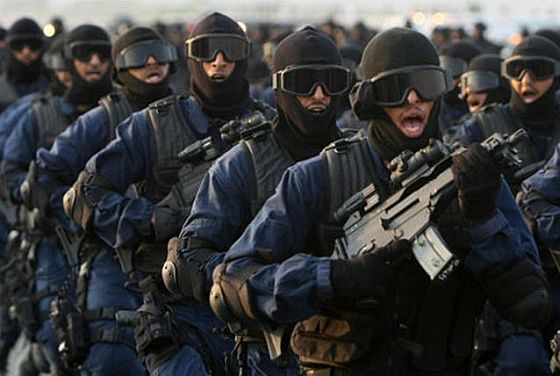
Saudi special security forces

Nawaf Obaid, a Senior Fellow at the King Faisal Center for Research & Islamic Studies in Riyadh, is confident that Saudi Arabia has the military and economic strength sufficient to crush the aspirations for political freedom that threaten Saudi and other autocratic rulers across the region.

The so-called “Arab Spring” has not brought new life to the Middle East, but leaderless anarchy, creating a virtual pan-regional movement that is alarmingly dangerous and ultimately unsustainable.

Recognizing the threat that the spread of this movement represents, Saudi Arabia is expanding its role internationally and mobilizing its vast resources to help countries facing domestic upheaval.

As the birthplace of Islam and the leader of the Muslim and Arab worlds, Saudi Arabia has a unique responsibility to aid states in the region, assisting them in their gradual evolution toward more sustainable political systems and preventing them from collapsing and spreading further disorder.

That the Kingdom has the ability to implement this foreign policy goal should not be in doubt – it is backed by significant military and economic strength.

The foundation for this more robust strategic posture is Saudi Arabia’s investment of around $150 billion in its military. This includes a potential expansion of the National Guard and Armed Forces by at least 120,000 troops, and a further 60,000 troops for the security services at the Interior Ministry, notably in the special and various police forces. A portion of these will join units that could be deployed beyond the Kingdom’s borders.

In addition, approximately 1,000 new state-of-the-art combat tanks may be added to the Army, and the Air Force will see its capabilities significantly improve with the doubling of its high quality combat airplanes to about 500 advanced aircraft.

A massive new missile defense system is in the works. Finally, the two main fleets of the Navy will undergo extensive expansion and a complete refurbishment of existing assets.

As part of this new defense doctrine, the leadership has decided to meet the country’s growing needs for new equipment by diversifying among American, European and Asian military suppliers.

Facebooktwittermail

What have Obama and Netanyahu wrought?

Henry Siegman writes:

What conclusions are to be drawn about the state of Middle East peacemaking from the extraordinary spectacle of the adversarial encounter between President Barack Obama and Israeli Prime Minister Benjamin Netanyahu and their several major adversarial addresses in the second half of May?

The spectacle did not bring an Israeli-Palestinian peace agreement any closer. Indeed, Netanyahu’s address to the U.S. Congress, no less than Congress’s reaction to that speech, effectively buried the Middle East peace process for good. For what America’s solons were jumping up and down to applaud so wildly as they pandered pathetically to the Israel lobby was Netanyahu’s rejection of a two-state solution to the Israel-Palestine conflict, thus endorsing his determination to maintain permanently Israel’s colonial project in the West Bank.

If Netanyahu succeeds in his objective, these members of Congress will be able to take credit for an Israeli apartheid regime that former Prime Ministers Ehud Barak, Ariel Sharon, and Ehud Olmert predicted would be the inescapable consequence of policies the congressmen cheered and promised to continue to support as generously as they have in the past.

Unfortunately, it is an outcome made more likely by Obama’s insistence that a United Nations resolution could never bring about Palestinian statehood. He was wrong about that. That the United Nations can create a state was affirmed and celebrated not by enemies of Israel but in Israel’s own Declaration of Independence of 1948. It is the U.N. Partition Resolution of 1947, not negotiations between the Jews and Arabs of Palestine, that is cited in that declaration as having brought about the state of Israel and the source of its legitimacy.

It is the United Nations, not Netanyahu nor even the United States, that can and should bring the state of Palestine into being — and would do so if the United States were not to prevent it. The bilateral talks with Netanyahu that Obama is insisting Palestinians return to will only continue to serve, as they have in the past, as cover for the expansion of Israeli settlements whose purpose it is to annex (i.e., steal) enough Palestinian territory to preclude the possibility of Palestinian statehood.

Facebooktwittermail

Hamas to participate in any future Palestinian government, senior official says

DPA reports:

Hamas will participate in any future Palestinian government, a senior official from the Islamist group said Thursday, refuting press reports that it might opt not to take part in a future administration.

“Nothing would prevent us” from participating in any government after new elections, Salah al-Bardaweel, a high-ranking Hamas leader in the Gaza Strip told the German Press Agency DPA.

The comments came after earlier media reports Thursday that Hamas might exclude itself from a future government – even if it won in elections – if that helped such a government to avoid international isolation.

“This is totally incorrect and totally untrue,” said al- Bardaweel, arguing that the reports were intended to isolate Hamas politically and diplomatically.

Facebooktwittermail