Monthly Archives: August 2011

Quantitative easing ‘is good for the rich, bad for the poor’

The Observer reports:

Quantitative easing (QE) – the Bank of England’s recession-busting policy of buying up billions of pounds of bonds – may have contributed to social unrest by exacerbating inequality, according to one City economist.

As the Bank of England considers unleashing a fresh round of QE, Dhaval Joshi, of BCA Research, argues the approach of creating electronic money pushes up share prices and profits without feeding through to wages.

“The evidence suggests that QE cash ends up overwhelmingly in profits, thereby exacerbating already extreme income inequality and the consequent social tensions that arise from it,” Joshi says in a new report.

He points out that real wages – adjusted for inflation – have fallen in both the US and UK, where QE has been a key tool for boosting growth. In Germany, meanwhile, where there has been no quantitative easing, real wages have risen.

As the Bank waded into the financial markets to spend its £200bn of newly created money, mostly on government bonds, the price of many assets, including shares and commodities such as oil, was driven up.

That helped to boost companies’ revenues, but Joshi argues that with the labour market remaining weak, employees have had little hope of bidding up their wages. “The shocking thing is, two years into an ostensible recovery, [UK] workers are actually earning less than at the depth of the recession. Real wages and salaries have fallen by £4bn. Profits are up by £11bn. The spoils of the recovery have been shared in the most unequal of ways.”

Facebooktwittermail

Turkey doesn’t rule out international intervention in Syria

Hurriyet Daily News reports:

Turkey isn’t ruling out international intervention in Syria if the Bashar al-Assad regime doesn’t stop using violence against its own people, a Turkish official speaking on condition of anonymity told the Hürriyet Daily News on Friday.

The source also said that a letter from Turkish President Abdullah Gül to Assad delivered by Turkish Foreign Minister Ahmet Davutoğlu on Tuesday was considered by Ankara as an “ultimatum” to Damascus that, if violence by Syrian troops continued, Assad would no longer be able to rely on Turkey’s friendship.

“Up until eight months ago, we were trying to convince our Western allies to give some more time for Assad to implement reforms. We were as friendly as to convene joint Cabinet meetings and lift visas,” the source told the Daily News. “But if a regime is not listening to the advice of its friend and neighbor and continues opening fire on its own people, that regime can no longer be Turkey’s friend.”

Facebooktwittermail

Assad orders tanks into rebel towns as Syria’s brutal crackdown intensifies

The Guardian reports:

Syrian tanks and gunmen have swept through two towns to root out anti-government protesters amid heavy firing that has sent many fleeing to safer areas.

Three people were reported to have died in the violence, the latest in an escalating campaign of repression by President Bashar al-Assad’s regime against an uprising that erupted in mid-March. The heaviest assault was reported in the coastal city of Latakia, where a day earlier thousands turned out to demand the president’s removal. At least 20 tanks and armoured personnel fanned out into the city’s el-Ramel district as intense gunfire rang out, according to Rami Abdul-Rahman, the head of the London-based Syrian Observatory for Human Rights.

Shooting and explosions were also heard in the town’s Slaibeh neighbourhood, according to the Observatory and the Local Co-ordination Committees of Syria, an activist group that documents protests. Two people were killed in the shooting, they said. Scores of security agents and pro-government gunmen, known as Shabiha, entered the town of Qusair, near the border with Lebanon, and several nearby villages, arresting scores of residents, Abdul-Rahman said. LCC Syria said that one person was killed in the shooting. It was not possible to verify the reports.

Facebooktwittermail

Christian supremacism and Michele Bachmann’s leap of faith

The New York Times reports:

The race for the Republican presidential nomination entered a new phase on Saturday as Gov. Rick Perry of Texas declared his candidacy in South Carolina and Michele Bachmann won a closely watched poll of voters in Iowa.

With Republican enthusiasm swelling over the prospect of defeating President Obama next year, thousands of party activists and voters converged here for the Iowa straw poll. The outcome provided a snapshot of the campaign that could help reorder the top tier of contenders as candidates move into a critical five-month stretch before the nominating contest begins.

“We did this together,” Mrs. Bachmann said, standing outside her campaign bus after she was declared the winner. “This is the very first step toward taking the White House in 2012.”

Ryan Lizza writes about how Bachmann has been deeply influenced by the evangelist and theologian Francis Schaeffer who produced a film series, “How Should We Then Live?”

Schaeffer died in 1984. I asked his son Frank, who directed the movies—and who has since left the evangelical movement and become a novelist—about the change in tone [as the film series shifts from from art history and philosophy to conspiracy]. He told me that it all had to do with Roe v. Wade, which was decided by the Supreme Court while the film was being made. “Those first episodes are what Francis Schaeffer is doing while he was sitting in Switzerland having nice discussions with people who came through to find Jesus and talk about culture and art,” he said. But then the Roe decision came, and “it wasn’t a theory anymore. Now ‘they’ are killing babies. Then everything started getting unhinged. It wasn’t just that we disagreed with the Supreme Court; it’s that they’re evil. It isn’t just that the federal government may be taking too much power; now they are abusing it. We had been warning that humanism followed to its logical conclusion without Biblical absolutes is going to go into terrible places, and, look, it’s happening right before our very eyes. Once that happens, everything becomes a kind of holy war, and if not an actual conspiracy then conspiracy-like.”

Francis Schaeffer instructed his followers and students at L’Abri that the Bible was not just a book but “the total truth.” He was a major contributor to the school of thought now known as Dominionism, which relies on Genesis 1:26, where man is urged to “have dominion over the fish of the sea, and over the fowl of the air, and over the cattle, and over all the earth, and over every creeping thing that creepeth upon the earth.” Sara Diamond, who has written several books about evangelical movements in America, has succinctly defined the philosophy that resulted from Schaeffer’s interpretation: “Christians, and Christians alone, are Biblically mandated to occupy all secular institutions until Christ returns.”

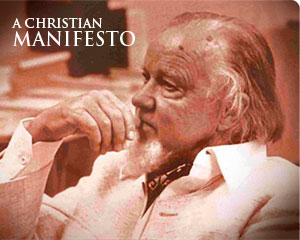
In 1981, three years before he died, Schaeffer published “A Christian Manifesto,” a guide for Christian activism, in which he argues for the violent overthrow of the government if Roe v. Wade isn’t reversed. In his movie, Schaeffer warned that America’s descent into tyranny would not look like Hitler’s or Stalin’s; it would probably be guided stealthily, by “a manipulative, authoritarian élite.”

Today, one of the leading proponents of Schaeffer’s version of Dominionism is Nancy Pearcey, a former student of his and a prominent creationist. Her 2004 book, “Total Truth: Liberating Christianity from Its Cultural Captivity,” teaches readers how to implement Schaeffer’s idea that a Biblical world view should suffuse every aspect of one’s life. She tells her readers to be extremely cautious with ideas from non-Christians. There may “be occasions when Christians are mistaken on some point while nonbelievers get it right,” she writes in “Total Truth.” “Nevertheless, the overall systems of thought constructed by nonbelievers will be false—for if the system is not built on Biblical truth, then it will be built on some other ultimate principle. Even individual truths will be seen through the distorting lens of a false world view.”

When, in 2005, the Minneapolis Star Tribune asked Bachmann what books she had read recently, she mentioned two: Ann Coulter’s “Treason,” a jeremiad that accuses liberals of lacking patriotism, and Pearcey’s “Total Truth,” which Bachmann told me was a “wonderful” book.

This spring, during one of her trips to Iowa, Bachmann asked the audience if anyone had heard of or seen “How Should We Then Live?” Many people applauded. She continued:

That also was another profound influence on Marcus’s life and my life, because we understood that the God of the Bible isn’t just about Bible stories and about Bible knowledge, or about just church on Sunday. He is the Lord of all of life. Every bit of life, including sociology, theology, biology, politics. You name the area and walk of life. He is the Lord of life. And so, as we went back to our studies, we looked at studying in a completely different light. Not for the purpose of a career but for a purpose of wondering, How does this fit into creation? How does this fit into the code and all of life that is about to come in front of us? And so we had new eyes that were opened up as we understood life now from a Biblical world view.

Schaeffer “was a tremendous philosopher,” Bachmann told me. “He wrote marvellous books and was very inspirational.” She said that Schaeffer “took Christianity beyond the Bible,” and that he showed “how the application of living according to Christian principles has helped the culture for the better.” She added, “He really tried to call Christians to do more than just go to church, to have an application to how they live their lives, to have Christians think that whether they are called to be a dentist, or whether they are a doctor, or whether they are an artist, or whether they are a sculptor—whatever it is that they’re called to do—to give it everything that they have and to have a bigger purpose, a bigger meaning in all of it.”

Facebooktwittermail

Libyan rebels advance into gateway to Tripoli

The Associated Press reports:

Libyan rebels fought their way into the strategic city of Zawiya west of Tripoli on Saturday in their most significant advance in months, battling snipers on rooftops and heavy shelling from Moammar Gadhafi’s forces holding the city.

Zawiya, 30 miles (50 kilometers) from the capital, is a key target for rebels waging a new offensive launched from the mountains in the far west of Libya, an attempt to break the deadlock in combat between the two sides that has held for months in the center and east of the country.

A credible threat from the rebels in the west could strain Gadhafi’s troops, which have been hammered for months by NATO airstrikes. Defending Zawiya is key for the regime but could require bringing in better trained forces who are currently ensuring its hold over its Tripoli stronghold or fighting rebels on fronts further east.

A group of about 200 exuberant rebel fighters, advancing from the south, reached a bridge on Zawiya’s southwestern outskirts, and some rebels pushed farther into the city’s central main square. They tore down the green flag of Gadhafi’s regime from a mosque minaret and put up two rebel flags. An Associated Press reporter traveling with the rebels saw hundreds of residents rush into the streets, greeting the fighters with chants of “God is great.”

Gadhafi’s forces then counterattacked, unleashing rounds of heavy shelling and gunfire could be heard as rebels and government troops battled.

Regime snipers were firing down from rooftops on the rebels, said one resident, Abdel-Basset Abu Riyak, who joined to fight alongside the rebels when they entered the city. He said Gadhafi’s forces were holed up in several pockets in the city and that there were reports of reinforcements coming from Tripoli, though there was no sign of them yet. He said NATO airstrikes had hit Libyan military positions near the city the night before.

Rebel spokesman Gomaa Ibrahim claimed that the opposition’s fighters controlled most of Zawiya by nightfall. “What remains are few pockets (of Gadhafi forces) in the city,” he said. “The road is now open all the way from the western mountains to Zawiya, we can send them supply and reinforcement anytime.”

Zawiya’s residents rose up and threw off regime control when Libya’s anti-Gadhafi revolt first began in February. But Gadhafi’s forces retaliated and crushed opposition in the city in a long and bloody siege in March. Many of Zawiya’s rebels fled into the mountains — and were among the lead forces advancing on the city Saturday — while others like Abu Riyak remained in the city, lying low.

Speaking to the AP by telephone, Abu Riyak said residents were now joining up with the rebels’ assault, saying, “95 percent of Zawiya’s people are with the revolution.”

“There is shooting from all sides,” said another rebel, 23-year-old Ibrahim Akram. “The people joined us. Fierce clashes are still ongoing, but thank God our numbers are great.”

But Gadhafi is likely to fight hard to keep control of Zawiya. The city of about 200,000 people on the Mediterranean coast is key because it controls the main supply road to the capital from the Tunisian border and is the site of the sole remaining oil refineries in the west still under the regime’s control.

Facebooktwittermail

Tribal rifts threaten to undermine Libya uprising

The New York Times reports:

Saddled with infighting and undermined by the occasionally ruthless and undisciplined behavior of its fighters, the six-month-old rebel uprising against Col. Muammar el-Qaddafi is showing signs of sliding from a struggle to overthrow an autocrat into a murkier contest between factions and tribes.

The increase in discord and factionalism is undermining the effort to overthrow Colonel Qaddafi, and it comes immediately after recognition of the rebel government by the Western powers, including the United States, potentially giving the rebels access to billions of dollars in frozen Libyan assets, and the chance to purchase more modern weaponry.

The infighting could also erode support for the rebels among members of the NATO alliance, which faces a September deadline for renewing its air campaign amid growing unease about the war’s costs and direction. That air support has been a factor in every significant rebel military goal, including fighting on Saturday in which rebel forces were challenging pro-Qaddafi forces in or near three critical towns: Brega, an oil port in the east, Zawiya, on the outskirts of Tripoli, and Gharyan, an important gateway to southern Libya.

While the rebels have sought to maintain a clean image and to portray themselves as fighting to establish a secular democracy, several recent acts of revenge have cast their ranks in a less favorable light. They have also raised the possibility that any rebel victory over Colonel Qaddafi could disintegrate into the sort of tribal tensions that have plagued Libya for centuries.

In recent weeks, rebel fighters in Libya’s western mountains and around the coastal city of Misurata have lashed out at civilians because their tribes supported Colonel Qaddafi, looting mountain villages and emptying a civilian neighborhood. In the rebels’ provisional capital, Benghazi, renegade fighters assassinated their top military commander, Gen. Abdul Fattah Younes, apparently in revenge for his previous role as Colonel Qaddafi’s security chief.

In response, the chief of General Younes’s powerful tribe threatened to retaliate against those responsible, setting off a crisis in the rebels’ governing council, whose members were dismissed en masse last week.

Facebooktwittermail

Abbas calls for a Palestinian Awakening in September

Marc Gopin and Aziz Abu Sarah write:

In his speech to the Central Council of the PLO in Ramallah, Palestinian President Mahmoud Abbas announced his strategy to end the occupation. The President stressed in his speech that he will not retreat from seeking recognition of the Palestinian state from the United Nations. Abbas had been under enormous pressure to withdraw the request for recognition of a Palestinian State on borders of June 1967. He announced that 122 nations are already in favor of the draft submitted to the UN. Concerning US opposition, he referred to the fact that this has not been communicated in a formal manner.

President Abbas surprised many of his listeners when he spoke about another element of his strategy. Perhaps for the first time Abbas highlighted clearly his vision of the Palestinian people’s active participation to achieve the dream of a Palestinian state. He called upon the Palestinian people to go out to the streets and demonstrate in an Arab-style revolution.

I insist on popular resistance, and insist it is an unarmed popular resistance so no one misunderstand us. We follow the example demonstrated in the Arab Awakening, which says, ‘Selmiya, Selmiya’, ‘Peaceful, Peaceful.’

The Arab Awakening in Egypt and Tunisia proved that popular masses in the streets, shoulder-to-shoulder in a coherent, peaceful movement, can accomplish anything. What seemed impossible in the past is possible today.

The challenge is that most of the Palestinian demonstrations until now have focused on fighting the Separation Wall, and on resisting the expansion of the settlements at the expense of Palestinian villages. These protests are still limited in the number of participants, and they do not exceed tens of protestors, or hundreds in the best scenarios. This is not enough to create the political change that is necessary now.

President Abbas did not hide his disappointment about the Palestinian popular resistance movement’s inability to grow to a national level.

We talk about the Resistance, but when we see what is happening in these demonstrations, frankly we don’t find anyone talking about it.

Clearly, he wants to see this grow on a national level, and he wants this reality to become an established fact that will impact the global conversation and debate about the future of Palestine.

The success of the Palestinian Popular Resistance movement has apparently become a key factor in the Palestinian strategy for achieving independence. The diplomatic efforts to gain recognition worldwide are going to be fruitless if they are not coupled with a strong nonviolent movement in the Palestinian territories, which will make the march to independence an irresistible and newsworthy drama of unprecedented proportions.

Facebooktwittermail

J14 tent protests: What about the occupation?

Joseph Dana writes:

Largely shielded from the European and American financial crises, the Israeli economy has been growing at an astonishing rate over the past five years: 4.7 per cent in 2010 alone. But the wealth isn’t evenly distributed: most Israelis living inside the 1967 borders struggle to make ends meet because of the high cost of living and relatively high taxes, which are largely spent on security and the occupation of the West Bank and Gaza.

Last month, a group of Tel Aviv residents in their twenties set up camp in the centre of Rothschild Boulevard to protest against housing costs in the city. They didn’t have a serious plan for political change, but the protest tapped into nationwide discontent. Within a few days, hundreds more people had joined them. The momentum spread quickly through the country, with camps appearing everywhere from Eilat on the Red Sea to Kiryat Shmona on the Lebanese border.

On Saturday, 250,000 Israelis marched in Tel Aviv and 10,000 marched to the prime minister’s residence in Jerusalem, demanding ‘social justice’. Netanyahu, the main target of the demonstrators’ placards, was quick to paint the protests as a misdirected reincarnation of the ‘radical left’. But this stale tactic didn’t stop an overwhelming majority of Israelis supporting the protests. According to recent opinion polls, 87 per cent see the demands for economic reform as legitimate.

The protester’s working definition of ‘social justice’, however, is unclear and full of contradictions. Most glaringly, they have yet to address the question of the Occupied Territories. From the start, organisers maintained that their protests were a rare instance of ‘apolitical’ social organising. The Palestinian issue was understood to be too divisive to be included under the umbrella of Israel’s social justice revolution, and there’s no doubt that, had protesters connected their struggle for social justice to the occupation, many fewer Israelis would have joined the protests.

Facebooktwittermail

Does J14 herald a new political era in Israel?

In a discussion, 972 Magazine poses the question: Does social unrest and emerging tent city protest movement signify the dawn of a new political era in Israel?

Avrum Burg, author and former Knesset Speaker, responds:

“It’s not political,” protesters are shouting but they want politics to change their lives. In a few months they won’t be here and it’s the old politics that will remain to clean up the mess on the streets. All that will be left of the protest will be memories and the lists of things accomplished. With time, the following truths will be recognized: that the defamed “Tel Aviv state” is the only one that can move mountains and hills here.

It will also be recognized that it is easier for people to whine over the price of cheese than to change the economic system and the values which drive it. By saying “no politics” one avoids the most fatal of our diseases – the war we have subjected ourselves to in the West Bank, also due to short term economical interests.

Over there – on the hills of Judea and Samaria – the government does build, and subsidize, and give benefits – for Jews. Those who wish to disconnect the tent protests from this war also disconnect their struggle from the real opportunity to change the internal process which has brought us here.

And to the protesters: don’t shy away from politics. Take part in it, take it over. Offer a complete social alternative and not just a struggle over another Shekel in the price of cheese. Don’t run away from the occupation – end it before it swallows us all.

Facebooktwittermail

Israeli tent protests ignore link between neoliberalism, occupation

Max Ajl writes:

What have thus far been mostly absent [during Israel’s J14 protests] are calls to end the occupation, a silence that speaks eloquently to the composition of Israeli society, in which a call to end the occupation or dismantle the racist juridical structure is perceived as an attack on the state religion: militarist nationalism. Such a call would be “political,” as opposed to the current protests, which are merely “social” in nature.

It is yet early, but two things seem clear. One, this movement will not break the Israeli structure of power. Two, this is an early fracture – a foretaste of later ruptures – within Zionism.

It would be wonderful to be wrong about the first point. One could not predict the fall of the Iranian shah from the Peacock Throne in 1977 before months-long street melees sent him into flight. The rise of Hugo Chavez was not prefigured in the caracazo, the countrywide riots against Venezuelan neoliberal austerity measures, of 1989. Revolutions are inherently unpredictable, as people move out of the gentle ebbs and flows, the quotidian cycles, of their lives, and move to messianic time. At such moments, belief in their own power, a kind of “collective effervescence,” can create opportunities that no one would have predicted or believed possible just weeks before, and radical change becomes a kind of a mirage that one suddenly wills into being real. Such sparks of human creativity and the instinct for freedom kindle flames within structures designed to douse them.

Still, the fractures within those structures are real. The average apartment is unaffordable for 90 percent of the population, what academic and housing researcher Danny Ben Shahar calls a “social time-bomb,” in part the result of housing inflation as a jet-setting Jewish transnational elite flits into Tel Aviv and Jerusalem for the summer, stays at their “ghost apartment,” then returns to Paris and Los Angeles. Inflation is not restricted to the housing market. As Histadrut Labor Federation Chairman Ofer Eini said, “If once I was able to go to the supermarket and make a NIS 700 purchase, today I pay double. And that is not linked to the CPI. If the CPI rises 3 percent, the supermarket prices rise 30 percent. The one benefiting from these rising prices is the government.”

The question of the “government” benefiting from rising prices is dubious. Inflation might be partially pushed by the government, but historically, Israeli inflation has led to a redistribution of economic clout from the bottom and middle of Israeli society to its upper echelons. The upper class, welded solidly into transnational capital circuits, is the real beneficiary, behind the veneer of the state and the politicians it pushes into office. And it frequently does not bother with the veneer: amidst a cartelized economy, prices are pushed higher and higher by the corporations that set prices, while wages do not come close to keeping pace with price increases.

Facebooktwittermail

State Dept funding neocon-Zionist propaganda outfit

Ali Gharib reports:

On Thursday, the U.S. State Department announced a $200,000 grant to the Middle East Media Research Institute (MEMRI), a Middle East media watchdog closely aligned with U.S. neoconservatives and Israel’s hawkish security establishment and rightist Likud Party. The grant was awarded “to conduct a project that documents anti-Semitism, Holocaust denial and Holocaust glorification in the Middle East.” The announcement continues:

This grant will enable MEMRI to expand its efforts to monitor the media, translate materials into ten languages, analyze trends in anti-Semitism and Holocaust denial and glorification, and increase distribution of materials through its website and other outlets.

Finding examples of anti-Semitism is already a robust MEMRI project and one wonders why exactly they needed the cash: According to publicly available tax filings, MEMRI had nearly $5 million in revenue in 2007 and more than $4.5 million in revenue in 2008.

What’s more troubling, MEMRI has faced accusations of mistranslating items and cherry-picking incendiary sources to portray regional media and attitudes in an overly-negative fashion. One of the most common issues has been with MEMRI’s mistranslations which appear to show anti-Semitism on thin evidence. In 2007, CNN correspondent Atika Shubert checked MEMRI’s translations of a Palestinian children’s program against those provided by the cable news channel’s own interpreters:

Media watchdog MEMRI translates one caller as saying – quote – ‘We will annihilate the Jews.’ But, according to several Arabic speakers used by CNN, the caller actually says ‘The Jews are killing us.’ MEMRI told us it stood by its translation.

In other instances, MEMRI has been accused of twisting translations to portray criticisms of Israel and its driving ideology, Zionism, as anti-Semitic..

Facebooktwittermail

Capitol Hill’s representatives for Israel

Josh Ruebner writes:

Nearly 20 percent of the constituents of Rep. Jesse Jackson, Jr. (D-IL) live under the poverty line, and nearly 15 percent are unemployed. Jackson’s congressional district, covering parts of the south side of Chicago and its southern suburbs, has been hit harder than many others by the crises plaguing the economy. Many of his constituents are looking at even more cutbacks in social services, higher prices for food and fuel, and ever scarcer jobs.

During this August congressional recess, Rep. Jackson, Jr. should be at home, meeting with constituents and proposing to them how he will help them cope with their difficult circumstances. Instead, the politician is proudly gallivanting around Israel, in one of three separate congressional delegations heading there this month on all-expense-paid junkets organized by the American Israel Education Foundation (AIEF), a so-called charitable affiliate of the American Israel Public Affairs Committee (AIPAC), the most influential of the myriad pro-Israel lobbying outfits.

In total, 81 representatives, nearly one-fifth of the entire House, will participate in these jaunts, which, according to The Washington Post, include “a round-trip flight in business class for lawmakers and their spouses (that alone is worth about $8,000), fine hotels and meals, side trips, and transportation and guides.

Of course, these congressional delegations are not all fun and games. Members of Congress will be expected to sing for their lavish dinners by honoring President Bush’s 2007 pledge to provide the Israeli military with $30 billion of tax-payer-funded weapons between 2009 and 2018. So far, proposed increases in military aid to Israel have been spared from the budgetary chopping block by President Obama and a compliant Congress that treats Israeli militarism as more sacrosanct than medical care for seniors. This despite the fact that Israel misuses the funds, in violation of the Arms Export Control Act, to commit human rights abuses against Palestinians living under its illegal 44-year military occupation of the West Bank, East Jerusalem, and Gaza Strip.

Facebooktwittermail

My Fellow American

About My Fellow American:

My Fellow American is an online film and social media project that calls upon concerned Americans to pledge and spread a message that Muslims are our fellow Americans. It asks people of other backgrounds to pledge, and share a real life story about a Muslim friend, neighbor, or colleague that they admire. Using the power of social media, My Fellow American seeks to change the narrative – from Muslims as the other, to Muslims as our fellow Americans.

Most Americans have never met an American Muslim. Many only know Muslims through the way they are portrayed in the media. American Muslims are so often vilified as “the other” that it is possible not to recognize that most were born in the U.S. Or that those who immigrated here came seeking the same freedoms and opportunities that have always attracted people to America.

Muslims are our fellow Americans, who today face threats to their civil rights and even their personal safety because of the fearful and often hateful rhetoric that would not be tolerated were it uttered about any other minority group.

Facebooktwittermail

Tariq Jahan’s is the patriotic voice of a first-generation Muslim migrant

Faisal Hanif writes:

Tariq Jahan has been hailed as a voice of reason. Only hours after holding his dead son in his arms, the grief-stricken father has provided hope for a peaceful resolution to a most horrific tragedy. His voice, full of pain, urged his community to stay away from any reprisal attacks for the killing of his son Haroon and two fellow young Muslim men.

If Jahan’s is a voice of reason then his message is of patriotism. Jahan is of my late father’s generation. They belonged to the first generation of Pakistani Muslims who migrated in large numbers during the 60s, 70s and 80s to find economic prosperity in the land of their once masters. For many, the plan had been to seek the riches that they could only dream of in the villages back home and return as made men to a life of bliss.

Of course, it never quite worked out like this. While in Britain, these men saw beyond the short-term gain that a return to village life with relatively vast sums of money would bring them and their expanding families. Britain offered stable jobs, relative prosperity, healthcare and the freedom as a minority to practice their faith openly by allowing the building of mosques and community centres. Their children had a chance to gain education and attend universities – a dream for many village and even city folk in Pakistan.

My father also told me that subconsciously there was also a great appreciation of the law and order that Britain had. It was a far cry from the endemic police corruption and unpredictability that is a hallmark of a Pakistani villager’s life.

Having seen both sides of the proverbial coin these men are fiercely protective of their adopted homeland. They cherish the stability and the peaceful lives they are able to live. It makes them proud to be British. In some instances, more so than their children who are born here. It is noticeable that the actions of some hardline young Muslims who turn to fundamentalist teachings are almost always at odds with the views of their parents, many of whom have seen less fortunate times.

I experienced this personally when as a conflicted teenager I adopted a deeply anti-British stance, much to the disapproval of my father. My dad would often say: “You’ll realise one day how fortunate you are that this is your home.”

Facebooktwittermail

The CIA, lies and intelligence

After a recent speech, John Brennan, a longtime former CIA officer and currently President Obama’s counter-terrorism advisor, took a question from John Hopkins professor of strategic studies, Elliot Cohen, on the US policy of so-called targeted killing. Brennan responded by highlighting the “surgical” precision that Obama has insisted upon when the US chooses its targets.

If there are terrorists who are in an area where there are women and children or others, we do not take such action that might put those innocent men, women and children in danger. In fact I can say that the types of operations that the US has been involved in — in the counter-terrorism realm — that nearly for the past year there hasn’t been a single collateral death because of the exceptional proficiency, precision, of the capabilities that we have been able to develop.

Brennan might have been repeating what he had been told by the CIA and their reports may have stated that in each drone attack over the said period no civilians were knowingly killed. But ignorance is no defense.

Indeed, the CIA’s lack of interest in the truth is evident in the fact that they have been eager to refute the findings on the latest research on civilian casualties from drone attacks on the tribal areas of Pakistan before such findings had even been published.

  • One in seven of all US strikes appear to have resulted in child fatalities.
  • Between 2,292 and 2,863 people have died in the attacks.
  • Since Obama took office, those attacks have occurred on average once every four days.
  • Among those killed only 126 militants have been named.
  • Credible news reports indicate that between 385-775 civilians have been killed, including 164 children.

The New York Times reports:

On May 6, a Central Intelligence Agency drone fired a volley of missiles at a pickup truck carrying nine militants and bomb materials through a desolate stretch of Pakistan near the Afghan border. It killed all the militants — a clean strike with no civilian casualties, extending what is now a yearlong perfect record of avoiding collateral deaths.

Or so goes the United States government’s version of the attack, from an American official briefed on the classified C.I.A. program. Here is another version, from a new report compiled by British and Pakistani journalists: The missiles hit a religious school, an adjoining restaurant and a house, killing 18 people — 12 militants, but also 6 civilians, known locally as Samad, Jamshed, Daraz, Iqbal, Noor Nawaz and Yousaf.

The report, “Drone War Exposed – the complete picture of CIA strikes in Pakistan,” comes from The Bureau of Investigative Journalism.

CIA drone strikes have led to far more deaths in Pakistan than previously understood, according to extensive new research published by the Bureau. More than 160 children are among at least 2,292 people reported killed in US attacks since 2004. There are credible reports of at least 385 civilians among the dead.

In a surprise move, a counter-terrorism official has also released US government estimates of the numbers killed. These state that an estimated 2,050 people have been killed in drone strikes – of whom all but an estimated 50 are combatants.

The Bureau’s fundamental reassessment of the covert US campaign involved a complete re-examination of all that is known about each US drone strike.

The study is based on close analysis of credible materials: some 2,000 media reports; witness testimonies; field reports of NGOs and lawyers; secret US government cables; leaked intelligence documents, and relevant accounts by journalists, politicians and former intelligence officers.

The Bureau’s findings are published in a 22,000-word database which covers each individual strike in Pakistan in detail. A powerful search engine, an extensive timeline and searchable maps accompany the data.

The result is the clearest public understanding so far of the CIA’s covert drone war against the militants. Yet US intelligence officials are understood to be briefing against the Bureau’s work, claiming ‘significant problems with its numbers and methodologies.’

Iain Overton, the Bureau’s editor said: ‘It comes as no surprise that the US intelligence services would attack our findings in this way. But to claim our methodology is problematic before we had even published reveals how they really operate. A revelation that is reinforced by the fact that they cannot bring themselves to refer to non-combatants as what they really are: civilians and, all too often, children’.

The Bureau’s data reveals many more CIA attacks on alleged militant targets than previously reported. At least 291 US drone strikes are now known to have taken place since 2004.

The intended targets – militants in the tribal areas – appear to make up the majority of those killed. There are 126 named militants among the dead since 2004, though hundreds are unknown, low-ranking fighters. But as many as 168 children have also been reported killed among at least 385 civilians.

More than 1,100 people are also revealed to have been injured in the US drone attacks – the first time this number has been collated.

In the wake of the Bureau’s findings Amnesty International has called for more CIA transparency.

But transparency is not what intelligence agencies trade in — “transparency” is for them nothing more than another name for public relations.

Facebooktwittermail

In Middle East tumult, new hope for Palestinian cause

The New York Times reports:

In the Palestinian refugee camp of Shatila, a corner of Beirut bearing the scars of massacres and an enduring despair, the words of a young barber hinted at an emerging optimism about what the Arab revolts could mean for a central issue of the last half century in the Middle East: the fate of Palestinians.

The barber, Mohammed Assad, was not naïve; life here is too grim for that. But in a region whose politics are being recalculated, he celebrated the rising influence of popular will on governments that long ignored it.

“There is hope,” he said.

In all the tumult of the Arab revolts, one of the most striking manifestations of change is a rejuvenated embrace of the Palestinian cause. The burst in activism in Egypt, Lebanon and even Tunisia has offered a rebuttal to an old bromide of Arab politics, that authoritarian leaders cynically inflamed sentiments over Israel and Palestine to divert attention from their own shortcomings.

But the embrace of the issue also helped confirm its status as a barometer of justice and freedom for many Arabs and Muslims. And now, the demands of an empowered public raise the possibility of a significant change in the region’s foreign policies which, at least tacitly, capitulated to the dictates of the United States and Israel.

“We always said, ‘If you want to liberate Palestine, you need to liberate yourselves,’ ” said Gamal Eid, founder of the Arabic Network for Human Rights Information, in Cairo.

In Tunisia, activists have insisted on an article in the Constitution banning normalization with Israel and making support for Palestinians state policy. Through a vibrant social media network, Lebanese and Palestinian youths have organized marches and sought ways to have a greater say in decisions of the Palestinian leadership. Protesters in Egypt have urged officials to let boats sail from Egyptian ports to break the partial blockade against Gaza; one boat docked in Alexandria last month before the Israeli military boarded and seized it.

“Even if the revolutions fail to achieve full and thorough regime change, there is no Arab government that can ignore its people now,” said Rashid Khalidi, a professor of modern Arab studies at Columbia University. “All the rulers — the kings of Morocco and Jordan, all the dictators and all the autocrats — they’re scared blind of their own people.”

Facebooktwittermail

Not the Israeli summer… yet

Mark LeVine writes:

Somewhere in the afternoon of this past Saturday, while hundreds of thousands of Israelis celebrated their renewed civic spirit and sense of national solidarity through their participation in the rapidly escalating protests against high housing prices and social inequality, a car approached the Shavei Shomron checkpoint north of Nablus. Inside were Rami Hwayel and several other cast members of a new production of “Waiting for Godot”. The play, which is being directed by famed Israeli auteur Udi Aloni is in rehearsals in Ramallah, but the cast was heading home to Jenin, to their home base at the Jenin Freedom Theatre.

When they reached the checkpoint, soldiers demanded to see their ID cards, after which, without warning, they pulled Hwayel out of the car, blindfolded him and threw him in an army vehicle to be taken away. As of Sunday no one had been told why he was detained. The military has slapped a gag order on all reporting about his detention inside Israel, and he can be held without charge or even access to a lawyer for up to a month. He is the third member of the Freedom Theatre to be detained in the last few weeks, all without official explanation or due process. According to an Israeli attorney who’s met with them, at least one of the captives has been “treated inhumanely”.

These two events – one “history-making”, the other all too mundane – point to the long journey Israelis will have to traverse before their increasingly massive protests against sky high housing prices and other social injustices becomes the revolution many already believe it to be.

Facebooktwittermail