Author Archives: News Sources

Occupy Albany’s demand

Statement:

We have joined together to Occupy as an affirmation of the future of democracy where each person has an equal voice in shaping our common future. While we come from diverse backgrounds and worldviews, we stand united in the recognition that our current system of governance is failing us- the voice of the People is drowned out by the corrupting influence that concentrated economic power exerts on the government. The interests of those who purchase influence are rewarded at the expense of the People, from whom the government’s just power is derived. We believe that this failure in our system is at the core of many interconnected issues we face as a society, and its resolution is key to a just future. We therefore demand true democracy, unshackled from the corrosive influence of concentrated economic power, and call all who share in this common goal to stand with us and take action toward this end.

Facebooktwittermail

What can prevent state failure for Egypt?

An editorial in Al-Masry Al-Youm says: Downtown Cairo is once again a battlefield, and this time, the military is not just a silent facilitator, but an active participant — beating, dragging, shooting, and assaulting civilians. The latest round of brutality has led us to not only question the military’s handling of the transition period, but also the nature of the modern Egyptian state, which is associated with a strong military.

We are at a juncture whereby the revolution has begun to challenge the centrality of the military to the modern state, a legacy dating back to Mohammed Ali’s rule.

When the ruling military junta presented its own version of recent events at a press conference on Monday, the generals, yet again, raised the terrifying prospect of “state failure,” saying that the Supreme Council of the Armed Forces (SCAF) and the army are the sole protectors of the state and everything they do is justified in the name of preventing its dissolution at the hands of those who want to undermine it.

This self-assigned supremacy is rapidly losing even the pretense of legitimacy.

The army’s violence and cruelty has been thoroughly documented by eyewitnesses, in photos and videos. We will not soon forget the image of two soldiers dragging a woman, half naked, by her clothes while a third stands ready to stomp on her chest. When skeptics condemn descriptions of soldiers resorting to violence, they cite how the army was provoked, or how paid infiltrators are allegedly plotting chaos and instability for Egypt. But what can provoke an organized professional army to engage in disorganized, unprofessional street fighting against civilian protesters?

The SCAF claims that “thuggery” and “chaos” have marred the purity of the 25 January revolution. After watching the events of the past five days, we have to agree. The state’s prestige has been irreparably undermined by soldiers urinating on protesters from atop a government building, sexually assaulting women, throwing furniture and flatware from government offices, making lewd sexual gestures, and turning sites of heritage and democracy — such as the Egyptian Museum and the parliament building — into temporary torture centers.

Facebooktwittermail

How Egypt’s prime minister tries to cover up state brutality

Parallel Dimensions from arabist on Vimeo.

Meanwhile, AFP reports: A US official voiced outrage Tuesday after an adviser to Egypt’s military said that some protesters facing down troops in Cairo should be “thrown into Hitler’s incinerators.”

Retired general Abdelmoneim Kato’s “anti-Semitic comments are outrageous, offensive and clearly unacceptable,” Hannah Rosenthal, the US special envoy against anti-Semitism, wrote on Twitter.

Kato, who advises the military, faced criticism from human rights groups and dissidents after saying that some protesters in Cairo’s Tahrir Square were “street kids who deserve to be thrown into Hitler’s incinerators.”

Presidential hopeful and former UN nuclear watchdog chief Mohamed ElBaradei said such statements showed “a deranged and criminal state of mind.”

The Arabic Network for Human Rights Information said Kato’s comments “incite hatred and justify violence against citizens.”

Facebooktwittermail

Arms suppliers urged to halt transfers to the Egyptian army

Global arms suppliers must halt the transfer of small arms, ammunition and other repressive equipment to the Egyptian military and security forces, Amnesty International said today after the army again violently dispersed protests in Cairo.

The organization condemned the excessive use of force against protesters and called for a cessation of all transfers of small arms, light weapons and related munitions and equipment to Egypt, as well as a halt to all internal security equipment that could be used to violently suppress human rights, such as tear gas, rubber and plastic bullets and armoured vehicles.

“It can no longer be considered acceptable to supply the Egyptian army with the types of weaponry, munitions and other equipment that are being used to help carry out the brutal acts we have seen used against protesters,” said Hassiba Hadj Sahraoui, Deputy Director for the Middle East and North Africa at Amnesty International.

“It is clear that either the military police has been given orders to disperse demonstrators at any cost, or the Supreme Council of the Armed Forces does not control the army and security forces. Either scenario is equally worrying.”

Facebooktwittermail

Israel: Publishing in a country that has outlawed free speech

In its relentless slide towards outright fascism, Israel has imposed an effective prohibition on political debate around the issue of boycott, divestment and sanctions (BDS). At +972, Dimi Reider describes the effect of the new law by answering the question, What is +972‘s stance on BDS?

The simple answer is that we don’t have one. The website is a collective of authors, each of whom have their own opinions about BDS. Some oppose it, some support it; some, like yours truly, support the D but are not particularly fond of the BS. But unfortunately, our ability to freely discuss this key aspect of the fight against the occupation has been severely and deliberately crippled by recent legislation. We may still carry opinions on BDS; but outright calls for boycott, divestment and sanctions hold far too great a risk for our site – a risk we are not in the financial position to take. Since we are legally responsible for all content appearing on the website, this obligates us to erase outright calls, and only outright calls for BDS from the comment thread as well.

Here is how it works: In May 2011, the Knesset passed the notorious “Boycott Law”. The Boycott Law does not make it a criminal offence or even misdemeanour to call for boycott. Neither any of us, nor any of readers will go to jail for making such a call. But the law does allow anyone who feels they have been materially impaired by that hypothetical call to sue us for damages – without actually proving any damages were suffered. In other words, if a reader was to publish a comment explicitly calling for BDS, tomorrow the website could be slammed with a massive lawsuit by some other reader or a right-wing “lawfare” organisaton. Even if we won the case in the long run, the legal fees would have sunk us very quickly – our budget is minimal, not to say minute, and we have no assets we can liquify and throw into the fight.

Facebooktwittermail

Egyptian women march against military rule

Sarah Carr reports: It was an image that shocked Egypt and within hours went viral: the woman in the exposed blue bra being beaten and kicked by a gang of soldiers during an attack on Tahrir Square protesters.

In a press conference on Sunday, General Adel Emara, a member of the ruling Supreme Council of the Armed Forces (SCAF), downplayed the incident, telling reporters that “they should consider all the circumstances” before judging.

On Tuesday, women responded. Some 4000 took to the streets in a march organized by the Mohamed ElBaradei Campaign and the April 6 Youth Movement.

Later on Tuesday evening, the SCAF issued an apology to the “women of Egypt,” in its statement Number 91.

“The SCAF reaffirms its upmost respect and admiration for the women of Egypt and their right to protest and of positive participation in political life on the path of democratic change Egypt is currently witnessing,” the statement reads. “All legal measures have been taken to hold officials accountable for transgressions,” it continues.

In Tahrir Square, women gathered, surrounded by men whose linked hands formed a cordon to protect them. One of the men, Mohamed Fathy, said he supported the idea of a women-only march because “they are here defending their rights and have to have their say.”

After circling the square once the march proceeded through downtown Cairo — the scene in 2007 of horrific mass assaults during the Eid vacation when packs of youths sexually assaulted women.

Their chants, “Girls of Egypt are a red line” — a variation on the now-abandoned “The Egyptian army is a red line” — echoed around the street. From balconies, office workers clapped and cheered. The women chanted for them to join them saying, “Come down from your houses, Tantawi undressed your girls.” Field Marshal Hussein Tantawi is the head of the SCAF.

There was pervasive anger against the army, with frequent chants for the SCAF to leave power and condemnation of violence by military “riff-raff”.

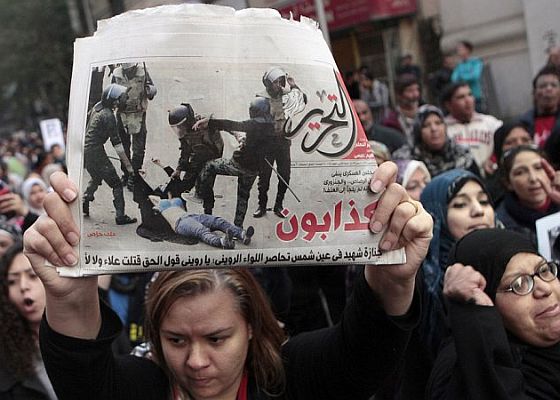
“Tantawi is the supreme commander of harassment and violation of honor,” one placard read. Other posters declared that the military consists of “liars” — a reference to the Sunday edition of independent newspaper Al-Tahrir, the front page of which made the accusation next to a picture of the woman in the blue bra.

Naglaa Talat marched carrying her two-year-old daughter.

“I had to come after I saw the picture of the naked girl in the newspapers — the images were enough to make any respectable person come. I have daughters and I came for them,” Talat told Egypt Independent.

Like many of the protesters, Talat insisted that Tantawi must leave power and the SCAF hand over power to civilian rule.

Facebooktwittermail

The secret program empowering Obama to kill anyone, anywhere, without any explanation

The Washington Post reports: Since September, at least 60 people have died in 14 reported CIA drone strikes in Pakistan’s tribal regions. The Obama administration has named only one of the dead, hailing the elimination of Janbaz Zadran, a top official in the Haqqani insurgent network, as a counterterrorism victory.

The identities of the rest remain classified, as does the existence of the drone program itself. Because the names of the dead and the threat they were believed to pose are secret, it is impossible for anyone without access to U.S. intelligence to assess whether the deaths were justified.

The administration has said that its covert, targeted killings with remote-controlled aircraft in Pakistan, Yemen, Somalia and potentially beyond are proper under both domestic and international law. It has said that the targets are chosen under strict criteria, with rigorous internal oversight.

It has parried reports of collateral damage and the alleged killing of innocents by saying that drones, with their surveillance capabilities and precision missiles, result in far fewer mistakes than less sophisticated weapons.

Yet in carrying out hundreds of strikes over three years — resulting in an estimated 1,350 to 2,250 deaths in Pakistan — it has provided virtually no details to support those assertions.

In outlining its legal reasoning, the administration has cited broad congressional authorizations and presidential approvals, the international laws of war and the right to self-defense. But it has not offered the American public, uneasy allies or international authorities any specifics that would make it possible to judge how it is applying those laws. [Continue reading…]

Facebooktwittermail

This bastardised libertarianism makes ‘freedom’ an instrument of oppression

George Monbiot writes: Freedom: who could object? Yet this word is now used to justify a thousand forms of exploitation. Throughout the rightwing press and blogosphere, among thinktanks and governments, the word excuses every assault on the lives of the poor, every form of inequality and intrusion to which the 1% subject us. How did libertarianism, once a noble impulse, become synonymous with injustice?

In the name of freedom – freedom from regulation – the banks were permitted to wreck the economy. In the name of freedom, taxes for the super-rich are cut. In the name of freedom, companies lobby to drop the minimum wage and raise working hours. In the same cause, US insurers lobby Congress to thwart effective public healthcare; the government rips up our planning laws; big business trashes the biosphere. This is the freedom of the powerful to exploit the weak, the rich to exploit the poor.

Rightwing libertarianism recognises few legitimate constraints on the power to act, regardless of the impact on the lives of others. In the UK it is forcefully promoted by groups like the TaxPayers’ Alliance, the Adam Smith Institute, the Institute of Economic Affairs, and Policy Exchange. Their concept of freedom looks to me like nothing but a justification for greed.

So why have we been been so slow to challenge this concept of liberty? I believe that one of the reasons is as follows. The great political conflict of our age – between neocons and the millionaires and corporations they support on one side, and social justice campaigners and environmentalists on the other – has been mischaracterised as a clash between negative and positive freedoms. These freedoms were most clearly defined by Isaiah Berlin in his essay of 1958, Two Concepts of Liberty. It is a work of beauty: reading it is like listening to a gloriously crafted piece of music. I will try not to mangle it too badly.

Put briefly and crudely, negative freedom is the freedom to be or to act without interference from other people. Positive freedom is freedom from inhibition: it’s the power gained by transcending social or psychological constraints. Berlin explained how positive freedom had been abused by tyrannies, particularly by the Soviet Union. It portrayed its brutal governance as the empowerment of the people, who could achieve a higher freedom by subordinating themselves to a collective single will.

Facebooktwittermail

Mass march by Cairo women in protest over soldiers’ abuse

The New York Times reports: Thousands of women massed in Tahrir Square here on Tuesday afternoon and marched to a journalists’ syndicate and back in a demonstration that grew by the minute into an extraordinary expression of anger at the treatment of women by the military police as they protested against continued military rule.

Many held posters of the most sensational image of violence over the last weekend: a group of soldiers pulling the abaya off a prone woman to reveal her blue bra as one raises a boot to kick her. The picture, circulated around the world, has become a rallying point for activists opposed to military rule, though cameras also captured soldiers pulling the clothes off other women.

The march, guarded by a cordon of male protesters, was a surprising turn. In Egypt, as in other countries swept by the revolts of the Arab Spring, women played important roles, raising hopes that broader social and political rights would emerge along with more accountable governments. But with the main popular focus on preparing for elections and protesting the military’s continued hold on power, women here had grown less politically visible.

The women’s protest came on the fifth day of violent clashes between Egyptian soldiers and protesters. The severity of the military’s defense of its hold on power, even as the newly elected Parliament begins to take shape, has restored a degree of unity that had been missing among the civilian political factions, liberal and Islamist, since the ouster of President Hosni Mubarak in February.

Facebooktwittermail

Sunni leader in Iraq denies ordering assassinations

The New York Times reports: The political crisis in Iraq deepened on Tuesday, as the Sunni vice president angrily rebutted charges that he had ordered his security guards to assassinate government officials, saying that Shiite-backed security forces had induced the guards into false confessions.

In a nationally televised news conference, the vice president, Tariq al-Hashimi, blamed the Shiite-led government of Prime Minister Nuri Kamal al-Maliki for using the country’s security forces to persecute political opponents, specifically Sunnis.

“The accusations have not been proven, so the accused is innocent until proven guilty,” Mr. Hashimi said at the news conference in Erbil, in the Kurdish north of Iraq. “I swear by God I didn’t do this disobedience against Iraqi blood, and I would never do this.”

He added: “The goal is clear, it is not more than political slander.”

Standing in front of an Iraqi flag, Mr. Hashimi questioned why Mr. Maliki had waited until the day after the American military withdrew its troops from Iraq to publicly lay out the charges.

Almost as significant as what Mr. Hashimi said was where he said it: in Erbil, the capital of the semi-autonomous northern region of Kurdistan. Because of the region’s autonomy, Mr. Maliki’s security forces cannot easily act on a warrant issued Monday to arrest Mr. Hashimi.

Mr. Hashimi said he would not return to Baghdad, effectively making him an internal exile. The case against him should be transferred to Kurdistan where he could face a fair trial, he said.

Facebooktwittermail

Fragile and unbalanced in 2012

Nouriel Roubini writes: The outlook for the global economy in 2012 is clear, but it isn’t pretty: recession in Europe, anaemic growth at best in the United States, and a sharp slowdown in China and in most emerging-market economies. Asian economies are exposed to China. Latin America is exposed to lower commodity prices (as both China and the advanced economies slow). Central and Eastern Europe are exposed to the eurozone. And turmoil in the Middle East is causing serious economic risks – both there and elsewhere – as geopolitical risk remains high and thus high oil prices will constrain global growth.

At this point, a eurozone recession is certain. While its depth and length cannot be predicted, a continued credit crunch, sovereign-debt problems, lack of competitiveness, and fiscal austerity imply a serious downturn.

The US – growing at a snail’s pace since 2010 – faces considerable downside risks from the eurozone crisis. It must also contend with significant fiscal drag, ongoing deleveraging in the household sector (amid weak job creation, stagnant incomes, and persistent downward pressure on real estate and financial wealth), rising inequality and political gridlock.

Elsewhere among the major advanced economies, the United Kingdom is double-dipping, as front-loaded fiscal consolidation and eurozone exposure undermine growth. In Japan, the post-earthquake recovery will fizzle out as weak governments fail to implement structural reforms.

Meanwhile, flaws in China’s growth model are becoming obvious. Falling property prices are starting a chain reaction that will have a negative effect on developers, investment and government revenue. The construction boom is starting to stall, just as net exports have become a drag on growth, owing to weakening US and especially eurozone demand. Having sought to cool the property market by reining in runaway prices, Chinese leaders will be hard put to restart growth.

They are not alone. On the policy side, the US, Europe and Japan, too, have been postponing the serious economic, fiscal and financial reforms that are needed to restore sustainable and balanced growth.

Facebooktwittermail

Israel’s emerging ‘Jewish Hezbollah’?

Mark Perry writes: Seven months ago, during the early morning hours of May 30, Jewish settlers visiting Joseph’s Tomb in Nablus in the Palestinian West Bank engaged in a shoving match with IDF soldiers deployed to protect them. Within minutes, the confrontation escalated; several soldiers were punched by Jewish worshippers and rocks rained down on the soldiers from settlers atop the tomb. A YouTube video of the incident was later circulated on the internet at the request of the IDF. The Nablus incident was among the first in a growing series of confrontations between settlers and the Israeli military — and it sent shock waves through the Israeli military establishment. Brig. General Yoav Mordechai called the settlers “irresponsible lawbreakers” and pointed out that the IDF in the West Bank was deployed to protect settlers from “terrorists.” His message was clear: the settler confrontation had placed the lives of his soldiers at risk.

Mordechai’s statement must have brought wry smiles to Palestinian villagers near Nablus, whose olive groves have been burned and mosques desecrated by the same settlers who attacked the IDF detachment. But the Joseph’s Tomb incident was only the beginning: throughout July and August, settlers from Yitzhar — a hotbed of settler extremism — forced a series of confrontations with the IDF until, in August, a stone-throwing incident pitting settlers against Palestinians threatened to get out of control, with the IDF pushing Palestinians away from the settlers in order to protect them from the violence — and not the other way around. “It was an amazing scene,” a Palestinian organizer who witnessed the incident said during a recent trip to Washington. “At one point, one of the IDF commanders turned to me and said, ‘why don’t you do us a favor and just shoot these people?'”

The settler-on-IDF confrontations have increased over the last weeks, sending ripples of concern through the Israeli establishment. While no senior Israeli elected official has yet to suggest that the program of settlement expansion needs to be rethought, the viewpoint is the subject of sotto voce reflections throughout the Jewish state. After all, the unstated goal of the national settlement enterprise is to put obstacles in the way of Palestinian national claims — not to seed a nascent and nasty internal conflict. Now, and particularly if the confrontations continue (or escalate), Israeli officials will have to ask themselves whether it is wise to continue a program that is providing the equivalent of a Palestinian fifth column. It’s not as if the Palestinians haven’t noticed. Asked about the recent settler-IDF dust-ups near Nablus, a serving Palestinian legislator waves away a question about whether or not Abu Mazen and company will return to the peace talks: “What we ought to do is sit back and watch,” he says, “while Israel starts to unravel.”

“I don’t want to exaggerate, but it’s time to call this what it is,” a veteran IDF officer noted in a recent telephone conversation on the Nablus incident. “It might be news in America, but it’s no secret in Israel. This is a very real crisis. What we have here is the birth of a state within a state. The birth of a kind of Jewish Hezbollah.” [Continue reading…]

Facebooktwittermail

Renewed threat of sectarian conflict as Iraq’s Sunni vice president faces arrest

As Al Jazeera reported yesterday and the New York Times reports today, Iraqis have given scant attention to the departure of the last American troops as the country heads into a deepening political crisis.

Iraq’s Shiite-dominated government was thrown into crisis on Monday night as authorities issued an arrest warrant for the Sunni vice president, accusing him of running a personal death squad that assassinated security officials and government bureaucrats.

The sensational charges against Tariq al-Hashimi, one of the country’s most prominent Sunni leaders, threatened to inflame widening sectarian and political conflicts in Iraq just one day after the last American convoy of American troops rolled out of the country into Kuwait.

The accusations were broadcast over Iraqi television, in a half-hour of grainy video confessions from three men identified as Mr. Hashimi’s bodyguards. They spoke of how they had planted bombs in public squares, driven up to convoys carrying Iraqi officials and opened fire.

Under the direction of Mr. Hashimi’s top aides, the men said, they gunned down convoys carrying Shiite officials and planted roadside bombs in traffic circles and wealthy neighborhoods of Baghdad, then detonated them as their targets drove by. One of the men said Mr. Hashimi had personally handed him an envelope with $3,000 after one of the attacks.

It was impossible to substantiate any of the accusations aired in the confessions.

An aide in Mr. Hashimi’s office said the three men had indeed worked for the vice president, but he denied all of the allegations. The aide said Mr. Hashimi was in the northern region of Kurdistan, meeting with Kurdish officials to defuse the worsening political standoff with Prime Minister Nuri Kamal al-Maliki.

Reidar Visser, an analyst of Iraqi politics and editor of the blog historiae.org, called the situation the worst crisis Iraq had faced in five years.

“Any leading Sunni politician seems now to be a target of this campaign by Maliki,” Mr. Visser said. “It seems that every Sunni Muslim or secularist is in danger of being labeled either a Baathist or a terrorist.”

Facebooktwittermail

The Arab Spring and the West: seven lessons from history

Seumas Milne writes: There’s a real sense in which, more than any other part of the former colonial world, the Middle East has never been fully decolonised. Sitting on top of the bulk of the globe’s oil reserves, the Arab world has been the target of continual interference and intervention ever since it became formally independent.

Carved into artificial states after the first world war, it’s been bombed and occupied – by the US, Israel, Britain and France – and locked down with US bases and western-backed tyrannies. As the Palestinian blogger Lina Al-Sharif tweeted on Armistice Day this year, the “reason World War One isn’t over yet is because we in the Middle East are still living the consequences”.

The Arab uprisings that erupted in Tunisia a year ago have focused on corruption, poverty and lack of freedom, rather than western domination or Israeli occupation. But the fact that they kicked off against western-backed dictatorships meant they posed an immediate threat to the strategic order.

Since the day Hosni Mubarak fell in Egypt, there has been a relentless counter-drive by the western powers and their Gulf allies to buy off, crush or hijack the Arab revolutions. And they’ve got a deep well of experience to draw on: every centre of the Arab uprisings, from Egypt to Yemen, has lived through decades of imperial domination. All the main Nato states that bombed Libya, for example – the US, Britain, France and Italy – have had troops occupying the country well within living memory.

If the Arab revolutions are going to take control of their future, then, they’ll need to have to keep an eye on their recent past. So here are seven lessons from the history of western Middle East meddling, courtesy of the archive of Pathé News, colonial-era voice of Perfidious Albion itself. [Continue reading…]

Facebooktwittermail