



Bloomberg reports: The clandestine arrangement worked smoothly for years. The Israeli company shipped its Internet- monitoring equipment to a distributor in Denmark. Once there, workers stripped away the packaging and removed the labels.
Then they sent it to a man named “Hossein” in Iran, an amiable technology distributor known to them only by his first name and impeccable English, say his partners in Israel and Denmark.
Israeli trade, customs and defense officials say their departments didn’t know that the systems for peering into Internet traffic, sold under the brand name NetEnforcer, had gone to a country whose leaders have called for the destruction of the Jewish state. Israel’s ban on trade with its enemy failed, even though a paper trail on the deals was available in Denmark.
[…]
Allot Communications Ltd., a Hod Hasharon, Israel-based firm whose stock trades on Nasdaq and the Tel Aviv Stock Exchange and which reported $57 million in sales last year, sold its systems to a Randers, Denmark-based technology distributor.Workers at that company, RanTek A/S, repackaged the gear and shipped it to Iran, according to four former employees of Allot and RanTek. The shipments were legal under Danish law.
Skirting a BanA sale as early as 2006 is corroborated by an export license application filed by RanTek, though the name of the customer in Iran was redacted by Danish authorities who provided the document to Bloomberg News.
The former employees identified the buyer as the technology distributor, Hossein.
The sales skirted a strict Israeli ban that prohibits “trading with the enemy,” including any shipments that reach Iran, Syria and Lebanon.
“This covers everything,” says Gavriel Bar, manager of the Middle East department at Israel’s Ministry of Industry, Trade and Labor. “Imports, exports, direct, indirect. An Israeli company is not allowed to trade with Iran in any way.”
Three former sales employees for Allot say it was well known inside the company that the equipment was headed for Iran. Allot officials say they have no knowledge of their equipment going there and are looking into RanTek’s sales.
The simplest explanation for what was going on here was that Allot wasn’t going to let a trade ban stand in the way of a business opportunity. At the same time, there is little reason to think that the current Israeli government would have misgivings about the Iranian government being provided with additional tools to suppress political dissent. A democratic Iran would be unlikely to abandon its nuclear programme, yet it could not be demonized in the same way as the current regime — Ahmadinejad remains Israel’s worst and best enemy.
The anonymous Arab journalist who blogs at The Arab Digest examines those reasons that support the idea that the Assad regime is behind these bombings, versus those reasons suggesting Free Syrian Army or Islamist involvement. In his view, the regime itself is more suspect.
One could say the regime is behind it for the following reasons:
1. Friday is a day off which means more civilians will die than security services.
2. Arab League observers just arrived in town, and such operations serve the regime’s reasoning of current events, and justifies to some extent its heavy handedness.
3. Precedence. The regime has allegedly used a suicide bomber in Lebanon’s Hariri assassination.
4. The FSA has denied its involvement, and accused the regime. The Syrian National Council has previously asked the FSA, and reportedly agreed with its leader Riyadh Al-Assaad, to restrict its role to protecting civilian demonstrators.But on the other hand, there is the following supporting the anti regime FSA/Islamists involvement:
1. The Free Syrian Army was not happy with the Arab League Observers arriving in Syria. They were counting on the Arab League increasing the international and regional isolation of Syria.
2. The Islamists have a history of attacking the Security apparatuses. These events are reminiscent of the 1980s showdown with the regime.
3. There is growing anger in the conservative cities and regions, against Damascus and Aleppo for not joining the revolution. This might be a warning.
4. The FSA is not an organised force. The Islamists have a different cell-based structure and might go about such operations without consulting anyone. In Iraq, they had no political calculations whatsoever except to ruin any political process, and promote Sectarian violence.Both are strongly supported. Still, I see the regime blamed for the bombings due to the timing, and for it being the main perpetrator in repression and violence (the stronger side in violence, and the violent one in repressing peaceful demonstrations). Also, the fact that the regime quickly accused Al-Qaeda and had a team of media people quickly reporting and analysing this, will draw more suspicions regarding its possible involvement.
Foreign Policy reports: Shortly before a wave of 15 bombings ripped through Baghdad on Thursday morning, killing more than 60 people, Iraqi Vice President Tareq al-Hashemi warned that a simultaneous political crisis in the country could spiral “beyond control.” In an interview with Foreign Policy on Wednesday from Sulaymaniyah in Kurdistan, a semi-autonomous region where the vice president has fled to evade an arrest warrant, Hashemi declared that the Iraqi political system is “drifting from building democracy to building an autocratic regime” — and implied that Iraq’s prime minister, Nouri al-Maliki, was becoming a new Saddam Hussein.
Earlier this week, Maliki, a Shiite Muslim, accused Hashemi, a Sunni, of running a hit squad targeting government officials during the height of sectarian strife in the country. In a press conference on Wednesday, Maliki went further, casting doubt on the sustainability of power-sharing in Iraq by threatening to replace the current unity government with a majority government if Hashemi’s largely Sunni Iraqiya bloc doesn’t end a boycott of parliament and the cabinet. The political crisis has sparked concern about sectarian violence returning to Iraq just days after the last U.S. troops withdrew from the country.
Hashemi has vehemently denied the charges against him, arguing that they are politically motivated and yet another effort by Maliki to consolidate power. When asked if Maliki has become a Saddam-like figure since assuming power in 2006, as fellow Iraqiya leaders Saleh al-Mutlak and Iyad Allawi have suggested, Hashemi noted that "many of Saddam’s behaviors are now being exercised by Maliki unfortunately." But he added that Saddam rebuilt Iraq in six months after the invasion of Kuwait and the Gulf War in the early 1990s. In contrast, under Maliki’s leadership, Hashemi pointed out, the consulting firm Mercer ranked Baghdad the worst city in the world in terms of quality of life.
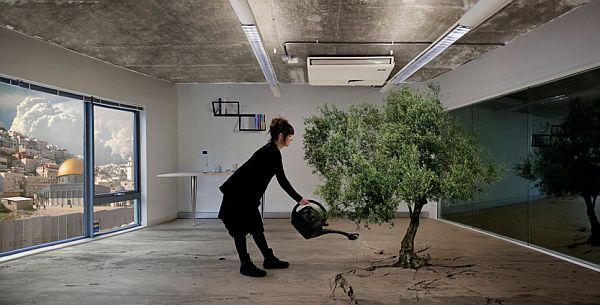
io9.com reports: Palestinian artist Larissa Sansour uses science fictional imagery to discuss her people’s stateless condition, so her work was always bound to cause some controversy. She’s done a host of short films playing with science fiction movie themes, and commenting on Middle Eastern politics.
But after Sansour’s “sci-fi photo series” Nation Estate became one of the finalists for the Lacoste Elysée Prize 2011 — a prestigious award that carries a payment of over $30,000 — the contest’s sponsor, Lacoste, insisted that her work be disqualified. (Yes, the company that makes those funny alligator shirts.) Sansour’s name was removed from the prize’s website, and the photos were removed from an upcoming issue of the magazine ArtReview.
The Nation Estate Project imagines the entire Palestinian people living in one giant high-rise building, sort of like a J.G. Ballard novel, with each floor representing a different city. It’s an offshoot of one of her science fictional short films. Sansour told the Daily Star:
I think the most shocking thing about this development, is that I didn’t apply for this prize… They nominated [me] only to revoke my nomination later on grounds that my work is ‘too pro-Palestinian.’
The Swiss gallery hosting the prize later issued a statement [PDF] explaining its decision to suspend the contest and disassociate itself from Lacoste’s choice:
The Musée de l’Elysée has based its decision on the private partner’s wish to exclude Larissa Sansour, one of the prize nominees. We reaffirm our support to Larissa Sansour for the artistic quality of her work and her dedication. The Musée de l’Elysée has already proposed to her to present at the museum the series of photographs “Nation Estate”, which she submitted in the framework of the contest.
For 25 years, the Musée de l’Elysée has defended with strength artists, their work, freedom of the arts and of speech. With the decision it has taken today, the Musée de l’Elysée repeats its commitment to its fundamental values.

Toby C. Jones writes: The U.S. is finally drawing down its military presence from Iraq, but why stop there? Why not reduce or outright remove our military presence from the entire Persian Gulf? The U.S. has been waging war in the Gulf for more than two and a half decades, since it took up arms against in Iran in the closing stages of the Iran-Iraq war. The human and environmental costs have been catastrophic. The presumptive gains of what has amounted to one long war have proven elusive at best. More often that not, the justifications for war have been either ill-conceived or manufactured. The Persian Gulf today is hardly stable or secure. But permanent war, and our militarization of the Gulf, isn’t so much a reflection of regional instability as it is the cause.
Today, it’s still not clear what the United States’ strategic priorities are in the Gulf. Are we there to secure access to oil? Protect friendly regimes from unfriendly ones? American policymaking is muddled, a combination of concern about energy security, Iranian aggression, and terrorism. This uncertainty is perilous. And the reality is that none of these challenges really require a significant military presence. Indeed, if recent history is any guide, a large military footprint in the Gulf will generate more rather than less risk.
Historically, oil and “energy security” have been at the heart of American strategy in the Gulf. It is home to the richest oil and natural gas deposits on the planet. It was President Jimmy Carter who most clearly made protecting the flow of oil to global markets a national priority. Carter declared oil a “vital interest” and that any assault on it would “be repelled by any means necessary, including military force.” Protecting oil meant protecting its producers. Indeed, much of the war-fighting of the last two decades has been rationalized as necessary to defend Kuwait and Saudi Arabia, and their oil, from neighborhood threats. The economic logic that has underpinned all this is based mostly on an assumption that oil is a scarce resource, that there is a tight gap between supply and demand, that ensuring supply is essential to stabilize prices and to protect the global economy from potentially devastating disruptions.
None of that is really true. For most of the 20th century, oil companies and oil producing states regularly collaborated to regulate supply in order to limit competition and control prices. There never has been a global oil market. Instead, oil’s production and delivery has been managed by a small network of corporate and national energy elites, whose primary concern has been serving their own interests and maintaining their bottom line.
Mac McClelland writes: Since June, I’ve been ruining my friends’ online-shopping lives. Back then, I reported on a vast warehouse in Ohio where goods bought from online retailers are sorted, boxed, and shipped to consumers. Unsurprisingly, this job does not pay well. A little more surprisingly, this job seems designed to crush employees’ spirits. During my visit, two people got fired within 10 minutes, one for talking to someone while he was working—"Where are you from?" was the offending comment—and one for going to the bathroom too much. So occasionally, and now more that it’s the holidays, my friends and family will call to complain that "Bleh, I want to order something from Amazon/Walmart/Staples/whatever, but I feel guilty about helping oppress workers."
Why would online retailers be so mean? Well, in the case of many, they have helpfully outsourced interaction with workers. When Walmart started selling its merchandise on the internet, it turned to third-party logistics contractors, or 3PLs, experts who could handle the, uh, logistics, like warehousing and transportation, of online sales. Take Exel, for example, the largest 3PL in the country, and a subsidiary of Deutsche Post DHL, one of the largest companies in the world. Exel alone has 86 million square feet of warehouse all over North America and processes literally millions of goods every single day. Other retailers directly perpetrate the oppression. Amazon.com made headlines earlier this year when 20 current and former employees of its Breinigville, Pennsylvania, warehouse told the local Morning Call that workers were fainting in stifling heat and getting yelled at for not meeting ridiculously high productivity goals and generally being "treated like a piece of crap." Employees who were sent home with heat exhaustion were disciplined; a local ER doc eventually called OSHA and reported "an unsafe environment."
Either way, many of the people actually loading and unloading trucks, packing boxes, and pasting labels work not for retailers, or for 3PLs, but for yet another company: temporary staffing agencies. When an online retailer (especially one that doesn’t actually make anything) wants to wring out the most profit possible, it helps to have a labor pool that is on demand, so it can order the exact number of humans it needs to fill that day’s number of orders if the humans are working at top capacity. That way, workers can’t unionize or be legally entitled to decent benefits. That way, the online retailer can give them outlandish productivity goals, like hundreds of orders and thousands of items per day apiece—and when workers burn out, just replace them with the next temp, who can join the rest of the ranks living in fear that they won’t make their numbers and might be incessantly berated for it, or simply fired. Even if you meet the outlandish goals, don’t necessarily expect to be rewarded by say, a real job. As with so many in the industry, the warehouse in Ohio are mostly "temps"—even though some of them have been working in the same place for more than a year.
The Washington Post reports: Buoyed by the success of Islamist movements in countries swept by the Arab Spring, Hamas, the militant Islamist group that rules the Gaza Strip, is showing signs of pragmatism as its sense of isolation fades.
The organization is jockeying to reposition itself amid shifting terrain in the Arab world. It is reported to be scaling down its presence in Syria, where its long-time patron, President Bashar al-Assad, is facing a popular uprising. At the same time, it is seeking to strengthen ties with Arab countries where moderate Islamists have made political gains.
Hamas officials are holding talks in Cairo this week with the rival Palestinian faction, Fatah, on implementing a reconciliation accord reached earlier this year, as some leaders of the organization suggest that it is ready for political pluralism at home and limiting violence against Israel.
Ismail Haniyeh, the Hamas prime minister in Gaza, is planning his first official trip outside the territory since the militant group seized power there in 2007. According to an aide, Haniyeh plans to visit Turkey, Bahrain, Qatar and Tunisia.
The Islamist surge, say Hamas officials and analysts, has boosted the group’s confidence, giving it more room to maneuver.
“This is an Islamic area, and once people are given a fair chance to vote for their real representatives, they vote for the Islamists,” said Mahmoud Zahar, a senior Hamas leader in Gaza, referring to the ascendance of Islamist parties in recent elections in Egypt, Tunisia and Morocco. “We feel strengthened by popular support.”
For Hamas, a sense of validation has replaced a siege mentality after years of international boycott and blockade by Israel and by Egypt under former president Hosni Mubarak.
“The rise of the Islamists could be seen as game-changer for Hamas,” said Fawaz Gerges, director of the Middle East Center at the London School of Economics. “Hamas no longer sees itself as a besieged island in a sea of hostility. This goes to the very psychology of the movement. . . . They feel that they have strategic depth now.”
On the domestic front, this has translated into a declared intention of following the model of the Islamist parties abroad, which have shown readiness to share power with secular and liberal parties in governing coalitions, and, in the case of Tunisia, have already struck such a deal.
The Islamists’ message of pluralism is now being echoed by officials of Hamas, which has mostly stifled dissent in the Gaza Strip since it took over the territory.
The example of the Islamist parties has had an impact on Hamas leaders and “opened their eyes to make coalitions with other Palestinian factions,” said Ghazi Hamad, deputy foreign minister of the government in Gaza. “This will create a new political Islam in which a coalition is the main goal, not to monopolize the regime. No one accepts one political color. The time of one-party rule has passed.”
Meanwhile, the Associated Press reports: The Hamas militant group has agreed to join the Palestine Liberation Organization — a key step toward unifying the long-divided Palestinian leadership.
Hamas’ leader Khaled Mashaal on Thursday joined a committee that will prepare for elections to the PLO leadership.
Those elections are likely years away but Mashaal’s move means he will work with Palestinian President Mahmoud Abbas, head of the rival Fatah party.
The PLO is the umbrella group of the Palestinian independence movement.
Thursday’s development is an important step toward reconciliation between Hamas and Fatah — which have been split since Hamas seized control of the Gaza Strip in 2007.
Separate elections in the West Bank and Gaza for a unified parliament are tentatively set for next year.
The Daily Telegraph reports: Military trucks stood parked at the end of the dark empty street. The electricity was cut, the phone signals out and apartment windows boarded up with whatever wood or metal people could find. It was to stop the bullets, activists explained.
Shouting and chanting of “down down Bashar al Assad” could be heard in the distance, interspersed with the crackle of gunfire.
This is not Homs, Idlib, or any of those Syrian towns that for months have been in the throes of rebellious unrest and violent crackdown. This is Douma, a large satellite town on the edge of Damascus, the heartland of support for President Assad’s regime.
Damascus Old City continues in relative normality with the bustle of daily life. Occasional power cuts and a shortage of gas are the principal signs that all is not well.
But less than seven miles away, Douma is in lockdown. Every Friday – when protests traditionally take place after prayers in the mosques, the suburb is under a military siege.
“Do you see the army?” said Ali, an activist who risked arrest and much more to show The Daily Telegraph the situation in his home town. “This is Douma, not Kandahar or Baghdad,” he added still incredulous at the scenes before him.
At the bottom of the street, locals had put up flaming barricades to halt the advance of military vehicles. Regime soldiers were positioned on the tops of the building.
Men huddled in the doorway of the Obeid mosque. Mustering courage, they leapt out in groups, hurling themselves across the central avenue that was in the snipers’ “kill zone”, and into the relative safety of the alleyway opposite. Those who had made it encouraged the others, adrenalin high, shouting “Freedom” and “down down down with the regime” at the top of their voices.
The New York Times reports: Syrian rights activists and opposition groups said on Wednesday that forces loyal to President Bashar al-Assad had killed at least 160 defecting soldiers, civilians and antigovernment activists over the last three days in northwestern Syria. If confirmed, the killings would constitute one of the worst spasms of violence in the nine-month-old uprising.
The killings, which the activists and opposition groups said had taken place near the city of Idlib in the Turkish border region, were reported a day before observers from the Arab League are to visit Syria for the first time to monitor pledges by Mr. Assad’s government to withdraw its troops from besieged areas.
The New York Times reports: A wave of coordinated explosions ripped across Baghdad early on Thursday, killing at least 63 people, wounding more than 180 and jolting a country already unsettled by a deepening political crisis and the absence of American troops.
Using car bombs and improvised explosives, insurgents attacked markets, grocery stores, schools and government buildings in a dozen neighborhoods in the central and eastern parts of the capital.
The attacks were the most significant violence in Iraq since the last American troops pulled out of the country earlier this week. So far, the withdrawal and the bitter fighting between Prime Minister Nuri Kamal al-Maliki, a Shiite, and his political foes in Parliament have not been accompanied by a rise in violence. But Thursday’s attacks raised the specter that the crisis inside the government could spill into the streets.
The attacks came a day after Mr. Maliki threatened to abandon an American-backed power-sharing government created a year ago. The prime minister’s words at a televised news conference on Wednesday threw a fragile democracy into further turmoil after the departure of American troops, potentially tarnishing what has been cast as a major foreign policy achievement for President Obama.
BBC News reports: Iraqi Prime Minister Nouri al-Maliki has urged Kurdish authorities in northern Iraq to hand over Iraq’s Sunni Vice-President, Tariq al-Hashemi.
An arrest warrant was issued for Mr Hashemi on Monday over terror charges.
Tariq al-Hashemi is Iraq’s most senior Sunni Arab politician. He says the allegations are “fabricated”.
Mr Hashemi is currently in the region of northern Iraq controlled by Kurdish authorities. The warrant was issued a day after US troops pulled out.
US Vice-President Joe Biden has urged Iraqi leaders to work together to avert renewed sectarian strife.
At a news conference broadcast live on Iraqi television, Mr Maliki, a Shia, said he would dismiss ministers belonging to the main Sunni political grouping, Iraqiyya, if they did not lift their boycott of parliament and cabinet.
Iraqiyya – which has been boycotting parliament in protest at Mr Maliki’s alleged authoritarian manner – has suspended its ministers’ participation in cabinet in response to the arrest warrant for Mr Hashemi.
Jeff Connaughton writes: Long silent and now contradictory, President Obama needs to deliver a clarifying speech about our financial markets and the rule of law. Speaking in Kansas on December 6, he said, “Too often, we’ve seen Wall Street firms violating major anti-fraud laws because the penalties are too weak and there’s no price for being a repeat offender.” Just five days later on 60 Minutes, he said, “Some of the least ethical behavior on Wall Street wasn’t illegal.” Which is it? Have there been no prosecutions because Wall Street acted legally (albeit unethically)? Or did Wall Street repeatedly violate major anti-fraud laws (and should thus find itself in the dock)?
The President is confusing “legal” with “difficult to prosecute successfully.” The Justice Department’s repeated decisions not to risk losing at trial against Wall Street executives don’t make these person’s actions legal. (If a district attorney can’t prove the actual thief stole your wallet, that doesn’t make stealing legal. It simply means that, regrettably, a malefactor goes unpunished.) As Securities and Exchange Commission Enforcement Director Robert Khuzami said in Senate testimony in 2009, Wall Street perpetrators “are smart people who understand that they are crossing the line” and “are plotting their defense at the same time they’re committing their crime.”
Moreover, the President is misleading us when he says that Wall Street firms violate anti-fraud law because the penalties are too weak. Repeat financial fraudsters don’t pay relatively paltry — and therefore painless — penalties because of statutory caps on such penalties. Rather, regulatory officials, appointed by Obama, negotiated these comparatively trifling fines. This week, the F.D.I.C. settled a suit against Washington Mutual officials for just $64 million, an amount that will be covered mostly by insurance policies WaMu took out on behalf of executives, who themselves will pay just $400,000. And recently a federal judge rejected the S.E.C.’s latest settlement with Citigroup, an action even the Wall Street Journal called “a rebuke of the cozy relationship between regulators and the regulated that too often leaves justice as an orphan.”
The Obama Justice Department hasn’t tried a single Wall Street executive in a criminal court. Against a handful, it decided to let the S.E.C. bring civil charges of fraud, which are easier to prove. So if defendants’ wrists are merely being slapped by the S.E.C. instead of cuffed by the Justice Department, Obama has only his appointees to blame.
For three important reasons, the President needs to explain why the Justice Department has filed away its investigations of big banks and Wall Street firms without indicting anyone. First, American confidence in the system is deeply shaken. Second, it strains credulity for millions of Americans — and has impelled thousands of them to occupy public places in protest — that no banking or insurance executive deserves criminal prosecution for the actions that brought on the financial crisis. Third, by failing to prosecute a single high-profile Wall Street actor today, the Administration is failing to deter financial fraud tomorrow.
Think Progress reports: The funding behind Newt Gingrich’s American Solutions for Winning the Future, an independent political committee, offers an intriguing clue into the financial deep pockets backing Gingrich’s candidacy. This week, McClatchy revealed that American Solutions footed the $8 million bill for private jet charters while Gingrich weighed whether to enter the 2008 and 2012 presidential races. Casino billionaire Sheldon Adelson was the biggest funder of American Solutions, contributing $7.65 million and rumored to have committed $20 million to a pro-Gingrich super PAC, a report denied by an Adelson spokesperson. Whether the report is true or not, the facts increasingly show that the billionaire casino magnate is a central figure in Newt Gingrich’s political career.
Sands Corporation CEO Sheldon Adelson is based in Las Vegas but has business and political interests in Macau, China and Israel. In Israel, Adelson’s importance stems from his close friendship with Israeli Prime Minister Benjamin Netanyahu and his ownership of Israel HaYom, a free daily newspaper which supports Netanyahu’s Likud party. Back in the U.S., Adelson sits on the board of the Republican Jewish Coalition and is outspoken about his views on the Israeli-Palestinian conflict.
During the George W. Bush presidency, Adelson opposed efforts to jump start peace talks between the Israelis and Palestinians and even took sides against the influential American Israel Public Affairs Committee (AIPAC) when the organization supported peace talks. “I don’t continue to support organizations that help friends committing suicide just because they say they want to jump,” Adelson told the Jewish Telegraph Agency.

Noam Sheizaf writes: Following the killing of Mustafa Tamimi in his village Nabi Saleh, Spokesperson for the IDF presented pictures of a slingshot Tamimi had on him when he was brought to the hospital. This was to be the indicting evidence that the protester was taking part in hostile action against the army – i.e. throwing stones – and therefore responsible for his own death.
Only in the context of the occupation can throwing stones at a bullet-proof army jeep be seen as an offense deserving the death penalty, carried out on the spot (clearly, the soldiers weren’t acting in self-defense). Furthermore, as recent attacks by settlers on soldiers – including a brick thrown from close range on the IDF regional commander – demonstrated, the army’s treatment of Jews is very different (to be clear, I don’t call for shooting Jewish stone-throwers either). But there is a larger issue here, concerning the whole notion of “legitimate” resistance to the occupation.
Facts and context are important: Israel took over the West Bank and Gaza more than 44 years ago. Since then, the Palestinians have been under military occupation, which denies their basic human and civil rights. The Palestinians can’t vote. They are tried in military court, where the conviction rate is astonishing. They don’t enjoy due process. Their property rights are limited, and their lands – including private lands – are regularly seized by Israel. All this is well-known and well-documented.
As far as Israel is concerned, this situation can go on forever. Israel is not attempting to leave the West Bank – it actually strengthens its hold on the territory – and it doesn’t plan to give the Palestinians equal rights within the state of Israel.
The Palestinians therefore have a moral right to resist the occupation. It’s as simple as that.
Bloomberg reports: Jamie Dimon, the highest-paid chief executive officer among the heads of the six biggest U.S. banks, turned a question at an investors’ conference in New York this month into an occasion to defend wealth.
“Acting like everyone who’s been successful is bad and because you’re rich you’re bad, I don’t understand it,” the JPMorgan Chase & Co. (JPM) CEO told an audience member who asked about hostility toward bankers. “Sometimes there’s a bad apple, yet we denigrate the whole.”
Dimon, 55, whose 2010 compensation was $23 million, joined billionaires including hedge-fund manager John Paulson and Home Depot Inc. (HD) co-founder Bernard Marcus in using speeches, open letters and television appearances to defend themselves and the richest 1 percent of the population targeted by Occupy Wall Street demonstrators.
If successful businesspeople don’t go public to share their stories and talk about their troubles, “they deserve what they’re going to get,” said Marcus, 82, a founding member of Job Creators Alliance, a Dallas-based nonprofit that develops talking points and op-ed pieces aimed at “shaping the national agenda,” according to the group’s website. He said he isn’t worried that speaking out might make him a target of protesters.
“Who gives a crap about some imbecile?” Marcus said. “Are you kidding me?”
‘Feels Lonely’The organization assisted John A. Allison IV, a director of BB&T Corp. (BBT), the ninth-largest U.S. bank, and Staples Inc. co- founder Thomas Stemberg with media appearances this month.
“It still feels lonely, but the chorus is definitely increased,” Allison, 63, a former CEO of the Winston-Salem, North Carolina-based bank and now a professor at Wake Forest University’s business school, said in an interview.
At a lunch in New York, Stemberg and Allison shared their disdain for Section 953(b) of the Dodd-Frank Act, which requires public companies to disclose the ratio between the compensation of their CEOs and employee medians, according to Allison. The rule, still being fine-tuned by the Securities and Exchange Commission, is “incredibly wasteful” because it takes up time and resources, he said. Stemberg called the rule “insane” in an e-mail to Bloomberg News.
“Instead of an attack on the 1 percent, let’s call it an attack on the very productive,” Allison said. “This attack is destructive.”