Marc Lynch writes: “Why does every nation on Earth move to change their conditions except for us? Why do we always submit to the batons of the rulers and their repression? How long will Arabs wait for foreign saviors?” That is how the inflammatory Al Jazeera talk-show host Faisal al-Qassem opened his program in December 2003. On another Al Jazeera program around that same time, Egyptian intellectuals Saad Eddin Ibrahim and Fahmy Howeidy debated whether it would take American intervention to force change in the Arab world. Almost exactly seven years later, Tunisians erupted in a revolution that spread across the entire region, finally answering Qassem’s challenge and proving that Arabs themselves could take control of their destiny.
Throughout this year of tumult, Arabs have debated the meaning of the great wave of popular mobilization that has swept their world as vigorously as have anxious foreigners. There is no single Arab idea about what has happened. To many young activists, it is a revolution that will not stop until it has swept away every remnant of the old order. To worried elites, it represents a protest movement to be met with limited economic and political reforms. Some see a great Islamic Awakening, while others argue for an emerging cosmopolitan, secular, democratic generation of engaged citizens. For prominent liberals such as Egypt’s Amr Hamzawy, these really have been revolutions for democracy. But whatever the ultimate goal, most would agree with Syrian intellectual Burhan Ghalyoun, who eloquently argued in March that the Arab world was witnessing “an awakening of the people who have been crushed by despotic regimes.”
In March, Egyptian writer Hassan Hanafi declared that the spread of the revolutions demonstrated finally that “Arab unity” — long a distant ideal in a region better known for its fragmentation and ideological bickering — “is an objective reality.” This unified narrative of change, and the rise of a new, popular pan-Arabism directed against regimes, is perhaps the greatest revelation of the uprisings. Not since the 1950s has a single slogan — back then Arab unity, today “The People Want to Overthrow the Regime” — been sounded so powerfully from North Africa to the Gulf. This identification with a shared fate feels natural to a generation that came of age watching satellite TV coverage of Palestine, Iraq, and Lebanon over the previous decade. Al Jazeera, since its rise to prominence in the late 1990s, has unified the regional agenda through its explicitly Arabist coverage — and its embrace of raucous political debates on the most sensitive issues.
The Washington Post reports: The writing was on the walls.
Death threats, spray-painted in red letters, covered the stairwell leading to the apartment of Hagit Ofran, an activist who monitors Israeli building in the West Bank and East Jerusalem for the anti-settlement group Peace Now.
“Hagit Ofran, R.I.P.,” said one message. “Ofran, Rabin is waiting for you,” said another, referring to Yitzhak Rabin, the Israeli prime minister assassinated in 1995 by a right-wing extremist opposed to his peace efforts with the Palestinians. The graffiti were discovered on Nov. 8, a day before Israel commemorated the Jewish calendar anniversary of Rabin’s death.
Ofran, 36, who prefers to work quietly in Peace Now’s unmarked office, was thrust uneasily into the limelight. The graffiti threats, following a similar incident at her home in September, generated intense media attention and were seen as emblematic of the extremist challenge to Israeli democracy and the unlearned lessons of the Rabin assassination.
Responding to a question in parliament this week about the threats against Ofran, the Israeli minister of public security, Yitzhak Aharonovitch, acknowledged that the authorities were worried about the possibility of another political killing. “The concern exists,” said Aharonovitch, who is from the rightist Yisrael Beiteinu party. “The concern is about the whole political spectrum.”
Yet much of the political violence in recent months has come from the extreme right, in the form of what militant Jewish settlers call “price tag” attacks on Palestinian mosques, cars, olive groves and fields in the West Bank in response to moves by the Israeli authorities to raze or remove unauthorized settlement outposts in the area.
The attacks have also spread to Israeli targets. A dozen vehicles in an army base in the West Bank were damaged in September, a mosque in an Israeli Arab village was torched in October, and a day before the defacing of Ofran’s apartment building, a bomb threat was made against the Peace Now office in Jerusalem. In all three cases, the words “price tag” were spray-painted on the targets.
The threats have come as rightist members of parliament are working to advance legislation that would restrict or heavily tax donations by foreign governments to Israeli non-profit groups. Critics call the move an attempt to cripple human rights organizations and leftist groups such as Peace Now that challenge the policies of Israel’s right-leaning government, particularly in the West Bank and East Jerusalem.
Another proposed bill would impose restrictions on access to the Israeli Supreme Court by human rights groups seeking to challenge alleged violations by the authorities.

The New York Times reports: Most of the biggest Occupy Wall Street camps are gone. But their slogan still stands.
Whatever the long-term effects of the Occupy movement, protesters have succeeded in implanting “We are the 99 percent,” referring to the vast majority of Americans (and its implied opposite, “You are the one percent” referring to the tiny proportion of Americans with a vastly disproportionate share of wealth), into the cultural and political lexicon.
First chanted and blogged about in mid-September in New York, the slogan become a national shorthand for the income disparity. Easily grasped in its simplicity and Twitter-friendly in its brevity, the slogan has practically dared listeners to pick a side.
“We are getting nothing,” read the Tumblr blog “We Are the 99 Percent” that helped popularize the percentages, “while the other one percent is getting everything.”
Within weeks of the first encampment in Zuccotti Park in New York, politicians seized on the phrase. Democrats in Congress began to invoke the “99 percent” to press for passage of President Obama’s jobs act — but also to pursue action on mine safety, Internet access rules and voter identification laws, among others. Republicans pushed back, accusing protesters and their supporters of class warfare; Newt Gingrich this week called the “concept of the 99 and the one” both divisive and “un-American.”
Perhaps most important for the movement, there was a sevenfold increase in Google searches for the term “99 percent” between September and October and a spike in news stories about income inequality throughout the fall, heaping attention on the issues raised by activists.
“The ‘99 percent,’ and the ‘one percent,’ too, are part of our vocabulary now,” said Judith Stein, a professor of history at the City University of New York.
Soon there were income calculators (“What Percent Are You?” asked The Wall Street Journal), music playlists (an album of Woody Guthrie covers, promoted as a “soundtrack for the 99 percent”) and cheap lawn signs. And, inevitably, there were ads: a storefront near Union Square peddles “Gifts for the 99 percent.” A trailer for a Showtime television series about management consultants, “House of Lies,” describes the lead characters as “the one percent sticking it to the one percent.” A Craigslist ad for a three-bedroom apartment in Brooklyn has the come-on “Live Like the One Percent!” (in this case, in Boerum Hill).
These days, the language of the Occupy movement is being reappropriated in new ways seemingly every day. CBS ran a radio spot last that invited viewers to “occupy your couch.” On Thanksgiving, people joked online about occupying the dinner table. Now, on Facebook, holiday revelers are inviting friends to “one percent parties.”
Slogans have emerged from American protest movements, successful and otherwise, throughout history. The American Revolution furnished the world with “Give me liberty or give me death” and the still-popular “No taxation without representation.” The equal rights movement in the 1960s used the phrase “59 cents” to point out the income disparities between women and men. The civil rights movement embraced the song “We Shall Overcome” as a slogan. During the Vietnam War, protesters called on politicians to “Bring ’em Home” and “Stop the Draft.”

Bloomberg reports: Pakistan stepped up its protests over a NATO airstrike that killed 24 of its soldiers, deciding to boycott an international conference on Afghanistan to be held in Germany next week.
The decision to pull out from the Dec. 5 summit in Bonn was agreed at a meeting of the federal Cabinet yesterday, according to a government statement. The nuclear-armed nation had already closed border crossings to trucks carrying supplies for U.S.-led forces in Afghanistan and ordered American personnel to vacate the Shamsi airbase in Pakistan’s southwest that has served as a launching point for Predator unmanned aircraft.
Pakistan still supports “stability and peace in Afghanistan and the importance of an Afghan-led, Afghan-owned process of reconciliation,” the government said in the statement. “In view of the developments and prevailing circumstances, the country has decided not to participate in the conference.”
The U.S. wants the Bonn meeting to cement a sustained international commitment to stabilize Afghanistan, and prevent any Taliban takeover, following the planned U.S. pullout of its main combat forces by 2014. The U.S. and Afghan governments have said Pakistan’s role is critical as it wields influence with the Taliban and could press the guerrillas for concessions in a peace process.
‘Beyond Rhetoric’Following the Nov. 25 airstrike, “there’s a lot of domestic pressure in Pakistan that’s forcing the government to move beyond rhetoric,” Shaheen Akhter, an analyst at the Institute of Regional Studies in Islamabad, said yesterday. Still, Pakistan can’t afford “to remain on the sidelines as the international community decides on the future of Afghanistan. They will be back at the table soon.”
The Economist‘s correspondent in Lahore notes: Pakistan’s leaders know the Americans are still deeply dependant on them. In the past few months NATO—and especially the Americans—have done an impressive job of reducing their reliance on land transport corridors through Pakistan to supply Western soldiers in Afghanistan. Over the past 120 days, for example, of the materiel received by the Americans in Afghanistan, around 30% was flown in and 40% was driven over Afghanistan’s northern borders from Central Asia, leaving just 30% to come via Pakistan’s roads. That is a sharp reduction on previous years. Thus the immediate and predictable closing of the Pakistan route, in response to the deaths on the border, should prove less disruptive than it once would have been.
But America relies on Pakistan in other ways. A military base, Shamsi, used by America inside Pakistan, apparently to launch drones, has been ordered closed within 15 days. That may be smoke and mirrors (it was quite possibly no longer used by the Americans anyway, after a previous clash), but is a sign of the sort of co-operation the Americans have quietly enjoyed on Pakistan’s account as they hunted al-Qaeda and other extremist leaders whom Pakistan does not regard as allies. Intelligence co-operation (however flawed) from Pakistan, against individuals plotting attacks on the West will also continue to be crucial in the coming years. Keeping close tabs on Pakistan’s large (perhaps 100-warhead strong) and fast-growing nuclear arsenal is also a long-term priority for the Americans.
Yet America and Pakistan could decide it is better to wind down their relationship to something minimal. A strong cohort within the Pentagon—especially after attacks on America’s embassy in Kabul, in September, by fighters seen as allied with Pakistan—has been demanding direct American military intervention in North Waziristan, possibly including American soldiers on the ground, even if Pakistan’s government opposes the idea. Pakistan is blamed for NATO and Afghan army forces’ failure to defeat the Taliban and other insurgents in Afghanistan, and for the Taliban’s refusal to consider peace talks. American lawmakers have also grown increasingly hostile over civilian and military aid to Pakistan, especially once it appeared that bin Laden had been harboured in Pakistan.
Within Pakistan, a breaking point could be near. One factor may be the rise of Imran Khan, a populist figure who makes a big deal of his opposition to America’s role in the ongoing fighting. As important may be the rise of younger, more religious army officers who are instinctively more anti-American than previous generals. After a year of crises and confrontations, the relationship, though troubled, survives. But the moment when one side or the other decides it is better to cut aid, reduce military co-operation and weaken diplomatic ties is growing nearer.
Nathan Brown writes: For years, Egypt’s Muslim Brotherhood has been taunted by its critics to demonstrate its democratic commitments. Of course, without free and fair elections in the country, it could only offer promises. But as Egyptians now go to the polls in the country’s most democratic parliamentary elections in many decades, the Islamists are finally able to grasp a golden opportunity to show their democratic credentials with deeds. And that may be precisely the problem: They may be far too successful for their own good (and for Egypt’s).
For many years, the Brotherhood has set a regional trend by running in rigged elections under dictatorships, using the slogan “participation, not domination.” In return for the right to participate, Islamists in the Arab world assured suspicious rulers that they did not seek to replace them. In fact, they usually ran for fewer seats than they would need for a majority. Of course, there were exceptions—in Algeria in 1992 and Palestine in 2006, Islamists went for the win. In both cases, the result was civil war. Their counterparts elsewhere were explicit: they had learned the lesson that they should not push too hard too quickly.
In the aftermath of Egypt’s January 25 revolution, Brotherhood leaders consistently claimed that they still took the lesson to heart. They would only seek one third of the seats; they would foreswear the presidency. And they enthusiastically pressed to give the people a chance to vote as soon as possible, moving Egyptian politics away from demonstrations in the public square and toward the polling booth. The only time they called their foot soldiers out to demonstrate was when various political forces tried to place limits on the democratic process in the form of partisan “constitutional principles” that were meant to bind those selected by the new parliament to write the country’s new constitution.
Over the years in Egypt, the Brotherhood’s self-restraint has set a model in the region. Even after the fall of authoritarian regimes, most Islamists’ preferred outcome in the short term is an election that gives them a plurality but not a majority. Controlling the largest bloc of parliamentarians, for instance, gives them a considerable voice in the political process and allows them the opportunity to develop political skills and experience without making them appear threatening or provoking a strong reaction inside and outside the country. Such an electoral result enables the preferred Islamist strategy of gradual change and lets movements escape the burden of full responsibility for the tremendous economic and security problems of societies in turmoil.
The recent Tunisian and Moroccan elections delivered just such an outcome. Islamist parties in both countries will be in the driver’s seat as Tunisia writes a constitution and Morocco experiments with limited constitutional reform.
To be sure, this strategy of demonstrating democratic credentials by working not to win elections is ironic and arguably undemocratic. In the Egyptian case, the Brotherhood sought to pursue the policy through a particularly strange and undemocratic device: it worked hard to build a coalition of political parties across the spectrum to submit to Egyptians as a single list. Instead of allowing voters to pick their representatives, the Brotherhood wanted to divvy up the seats in advance.
But in the months since the revolution, Egypt’s Muslim Brotherhood has been wriggling free of the pledges to demonstrate its democratic credentials in such undemocratic ways; it is showing signs of abandoning the tendency to pull its political punches. Over the short term, it may gain many votes as a result. In the long term, it might come to regret its decision.
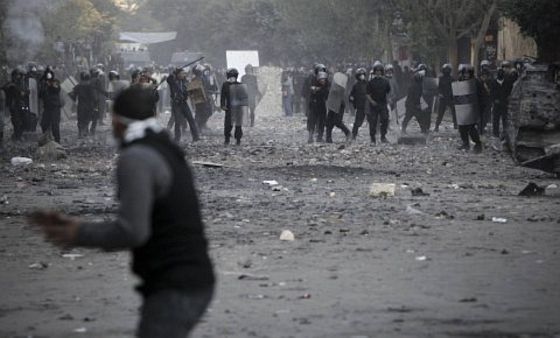
Al Jazeera reports: Not much is known about their organisation, but their presence is an accepted fact of Egyptian society. Most of them lack formal military training, or any training at all.
These are the Ultras, a group whose battle, usually reserved for the football stadium, has moved to the front line in the fight between anti-military protesters and government security forces in Egypt.
Often characterised as hooligans, the Ultras have been blamed for violence at football matches and are prone to clashes with police forces.
Even so, the membership in the group is a hard-won badge of honour for the young men gathered in Cairo’s Tahrir Square.
“It’s a way of life. You don’t just become one. You aren’t converted. You have to be an Ultra from within,” said Ahmed, a Cairo native and Ultra member who only agreed to an interview if his real name and appearance were not revealed.
The Ultras are notoriously media shy, even “anti-media”, according to Ahmed. He said they prefer to keep their identities secret, presumably to avoid unwanted police attention.
Ahmed is perched on the edge of a low stone wall, just to the south of Tahrir Square.
He and his fellow Ultras have pitched a number of tents there for their prolonged sit-in, along with thousands of other protesters demanding an end to military rule in the country.
Like many of the tents in the area, the Ultras’ lodgings are reinforced against the biting November wind with layers of blankets.
Their camp is set apart, however, by hastily sketched graffiti on the tents that proclaims their beliefs for those who know the code.
“A-C-A-B,” Ahmed said, reading aloud the red etchings on the outside of his tent. “All cops are bastards,” he explained.
According to Ahmed, the abbreviation is a motto for Ultras clubs around the world.
The phrase has particular meaning in Egypt, a country in which the police force is viewed with distrust and even outright loathing.
“Police are paid every month to serve us and help us and protect us, not to oppress us,” he said.
“I’m supposed to know when I go to a cop about a threat or harassment that I will get help, but that never used to happen. They should know they are here to serve us.”
It is sentiments such as this that brought hundreds of Ultras to central Cairo on November 19, the day Egyptian riot police entered Tahrir to forcibly disperse a sit-in by relatives of victims killed during the country’s January uprising.

Al-Masry Al-Youm reports: During ongoing anti-military protests that erupted last week, a clear divide has emerged between the Gandhis and the Gueveras, in other words, the thousands who chant and march peaceably in Tahrir Square and the hundreds who throw rocks, bottles and Molotov cocktails in downtown Cairo’s side streets.
“We’re fighting the police because they are thugs,” 17-year-old Mohamed Karam said at the time, as he prepared to launch a Molotov cocktail at the “thugs” down the street. “The thuggery of the Central Security Forces (CSF) is the same as it was during the days of Mubarak. In fact, they might have grown more repressive since the revolution,” he added. In the background, dozens of Karam’s comrades chanted, “The police are thugs!”
This sentiment was common among frontline fighters.
“The authorities are calling us thugs on state-owned radio and TV, but in reality it is the police who are thugs,” Ahmed Atwa, a 29-year-old street vendor, said. He pulled down the neck of his shirt to reveal a large scar on his left shoulder. “This is from the police officer and his soldiers who tortured me in the Helwan police station in 2001.”
Most — though certainly not all — of the Gueveras are like Karam and Atwa, working class or unemployed men in their teens or twenties from some of Cairo’s poorest neighborhoods who say they haven’t yet finished their educations.
Karam, a high-school dropout, participated in the 18-day uprising against then-President Hosni Mubarak. He said he returned to the streets on 19 October “because I saw how the Central Security Forces brutally assaulted the peaceful protesters camped in Tahrir Square on Saturday. It’s my duty to protect these people — and to teach the police a lesson.”
Another street fighter, who called himself “Hamdy Molotov,” clenched a petrol bomb in his hand. Like Karam, “Molotov” is unemployed.
“The police and army, acting on the orders of the Supreme Council of the Armed Forces, instigated these clashes by attacking peaceful protesters in the square,” he screamed over the din of the battle.
Referring to 19 October, when the most recent clashes began, “Molotov” said, “On Saturday the police attacked the families of those martyred in the revolution, along with wounded and disabled revolutionaries camping in the square. Have the police not done enough harm already?”
“Yesterday the Central Security Forces and the military police dragged the corpses of protesters they had killed and piled them up in a garbage heap,” the 23-year-old revolutionary said. “This is against the basic tenets of Islam and Christianity. Not even the Zionists commit such barbaric crimes.”
“We cannot accept such crimes from the police or the army. Our revolution was meant to put an end Mubarak’s corruption and to end police brutality,” the street fighter added. “Our revolution started on 25 January, which was Egyptian Police Day, and this is why we must make sure that the police do not resort to their old ways. This is why we are fighting.”
John Heilemann writes: In just two months of existence, OWS had scored plenty of victories: spreading from New York to more than 900 cities worldwide; introducing to the vernacular a potent catchphrase, “We are the 99 percent”; injecting into the national conversation the topic of income inequality. But OWS had also suffered setbacks. The less savory aspects of the occupations had provided the right with fuel for feral slander (Drudge: “Death, Disease Plague ‘Occupy’ Protests”) and casual caricature. Even among some protesters, there was a sense that stagnation had set in. Then came the Zuccotti clampdown—and the popular perception that it meant the end of OWS.
It’s perfectly possible that this perception will be borne out, that the raucous events of November 17 were the last gasps of a rigor-mortizing rebellion. But no one seriously involved in OWS buys a word of it. What they believe instead is that, after a brief period of retrenchment, the protests will be back even bigger and with a vengeance in the spring—when, with the unfurling of the presidential election, the whole world will be watching. Among Occupy’s organizers, there is fervid talk about occupying both the Democratic and Republican conventions. About occupying the National Mall in Washington, D.C. About, in effect, transforming 2012 into 1968 redux.
The people plotting these maneuvers are the leaders of OWS. Now, you may have heard that Occupy is a leaderless uprising. Its participants, and even the leaders themselves, are at pains to make this claim. But having spent the past month immersed in their world, I can report that a cadre of prime movers—strategists, tacticians, and logisticians; media gurus, technologists, and grand theorists—has emerged as essential to guiding OWS. For some, Occupy is an extension of years of activism; for others, their first insurrectionist rodeo. But they are now united by a single purpose: turning OWS from a brief shining moment into a bona fide movement.
That none of these people has yet become the face of OWS—its Tom Hayden or Mark Rudd, its Stokely Carmichael or H. Rap Brown—owes something to its newness. But it is also due to the way that Occupy operates. Since the sixties, starting with the backlash within the New Left against those same celebrities, the political counterculture has been ruled by loosey-goosey, bottom-up organizational precepts: horizontal and decentralized structures, an antipathy to hierarchy, a fetish for consensus. And this is true in spades of OWS. In such an environment, formal claims to leadership are invariably and forcefully rejected, leaving the processes for accomplishing anything in a state of near chaos, while at the same time opening the door to (indeed compelling) ad hoc reins-taking by those with the force of personality to gain ratification for their ideas about how to proceed. “In reality,” says Yotam Marom, one of the key OWS organizers, “movements like this are most conducive to being led by people already most conditioned to lead.”
And so in coffee shops and borrowed conference rooms around the city, far from the sound and fury in the park and on the streets, the prime movers have been doing just that—meeting, planning, talking (and talking) about the future of OWS. The debates between them have been fierce. Tensions have been laid bare, factions fomented, and ideological cleavages exposed—all of it a familiar recapitulation of the growing pains experienced by protesters of the past, from those in favor of civil rights and against the Vietnam War in the sixties to those fighting for workers’ rights in the thirties.
The New York Times reports: Defying the Obama administration’s threat of a veto, the Senate on Tuesday voted to increase the role of the military in imprisoning suspected members of Al Qaeda and its allies — including people arrested inside the United States.
By a vote of 61 to 37, the Senate turned back an effort to strip a major military bill of a set of disputed provisions affecting the handling of terrorism cases. While the legislation still has several steps to go, the vote makes it likely that Congress will eventually send to President Obama’s desk a bill that contains detainee-related provisions his national-security team has said are unacceptable.
The most disputed provision would require the government to place into military custody any suspected member of Al Qaeda or one of its allies connected to a plot against the United States or its allies. The provision would exempt American citizens, but would otherwise extend to arrests on United States soil. The executive branch could issue a waiver and keep such a prisoner in the civilian system.
A related provision would create a federal statute saying the government has the legal authority to keep people suspected of terrorism in military custody, indefinitely and without trial. It contains no exception for American citizens.
The New York Times reports: Tripoli is no longer the capital of a police state. But what it has become, in just a matter of weeks, can be both exhilarating and disturbing.
Hashish dealers are openly hawking their wares in the center of the city, Martyrs’ Square, known as Green Square before Col. Muammar el-Qaddafi was overthrown. Drivers run red lights without giving it a thought, while political demonstrations snarl traffic. Irregular militia members who have replaced the hated Tripoli police in many neighborhoods are still showing poor discipline with their weapons, firing them accidentally or into the air all too frequently.
Tripoli is a vibrant city of nearly two million people with a bustling port, and it is graced by Roman ruins and old fortification walls built by the Ottomans and other conquerors. But while it has gone through other abrupt changes over the centuries, what is happening these days was unthinkable only weeks ago when Colonel Qaddafi tried to control even the smallest details of daily life.
Tinted windows were prohibited on cars; now, drivers everywhere are pasting dark green tinted plastic on their windows to keep out the searing sun but also as a sign of their new liberty. Fruit and vegetable vendors were restricted from selling their wares on most streets; now, throngs of them are out selling bananas and oranges beneath highway overpasses and on the sides of traffic circles, helping them feed their families but also worsening congestion.
English was largely prohibited from public signs by Colonel Qaddafi. Now, English signs have sprung up almost everywhere around town, even though few Libyans understand what they say. The signs are another expression of liberation, as well as the country’s readiness to open itself to the outer world.
“Today, Tripoli Has a New Heartbeat,” says one billboard displaying two militiamen hugging, put up by the interim municipal government. Even much of the revolutionary graffiti, which is everywhere, is in English. “Libya Free” is the most common. Some even say “Thank you, NATO” for the Western military assistance that was crucial to overthrowing the old government.
And, of course, there are numerous freshly scrawled depictions of the late dictator in a clown outfit or as a caricatured head on top of the body of one kind of beast or another.
Most Tripoli residents say that they have never been happier, but there is still some trepidation.
The Washington Post reports: Turkey announced wide-ranging sanctions against Syria on Wednesday in response to the Syrian government’s continuing military crackdown on protests.
Turkish Foreign Minister Ahmet Davutoglu outlined measures including a freeze on Syrian assets in Turkey and a ban on transactions with the Syrian central bank, capping an eight-day stretch in which Turkish rhetoric against Syrian President Bashar al-Assad turned increasingly critical.
The sanctions by Turkey, one of Syria’s top trading partners, come as the Arab League and the European Union are enacting their own punitive measures — a triple blow that highlights the growing isolation of the Damascus government and that could significantly hurt Syria’s economy.
In Washington, the White House commended the Turkish government for imposing the sanctions, which it said will “undoubtedly increase the pressure on the Syrian regime.”
The Guardian reports: The foreign secretary, William Hague, has ordered the expulsion of Iranian diplomats from the UK and announced that the UK is closing its embassy in Tehran, saying that the storming of the mission on Tuesday had the backing of the regime.
Hague said Iranian diplomats would have to leave Britain within 48 hours, and that all British embassy staff in Tehran had now left Iran.
He said that the move would not mean the severance of all ties, as the two countries could continue to have a dialogue at international meetings, as the US has done since the seizure and closure of its embassy in 1979, but the move marks a new low in relations, which have been growing increasingly strained.
The foreign secretary said it was not possible to maintain an embassy in the current circumstances, adding that the estimated 200 protesters who invaded the embassy and the British diplomatic compound yesterday were “student basij militia”. The basiji operate as a youth wing of Iran’s Revolutionary Guards, one of the most powerful institutions in the country.
Hague said it would be “fanciful” to think that the embassy invasion could have taken place without “without some degree of regime consent”.
Matt Taibbi writes: In one of the more severe judicial ass-whippings you’ll ever see, federal Judge Jed Rakoff rejected a slap-on-the-wrist fraud settlement the SEC had cooked up for Citigroup.
I wrote about this story a few weeks back when Rakoff sent signals that he was unhappy with the SEC’s dirty deal with Citi, but yesterday he took this story several steps further.
Rakoff’s 15-page final ruling read like a political document, serving not just as a rejection of this one deal but as a broad and unequivocal indictment of the regulatory system as a whole. He particularly targeted the SEC’s longstanding practice of greenlighting relatively minor fines and financial settlements alongside de facto waivers of civil liability for the guilty – banks commit fraud and pay small fines, but in the end the SEC allows them to walk away without admitting to criminal wrongdoing.
This practice is a legal absurdity for several reasons. By accepting hundred-million-dollar fines without a full public venting of the facts, the SEC is leveling seemingly significant punishments without telling the public what the defendant is being punished for. This has essentially created a parallel or secret criminal justice system, in which both crime and punishment are adjudicated behind closed doors.
This system allows for ugly consequences in both directions. Imagine if normal criminal defendants were treated this way. Say a prosecutor and street criminal combe into a judge’s chamber and explain they’ve cooked up a deal, that the criminal doesn’t have to admit to anything or plead to any crime, but has to spend 18 months in house arrest nonetheless.
What sane judge would sign off on a deal like that without knowing exactly what the facts are? Did the criminal shoot up a nightclub and paralyze someone, or did he just sell a dimebag on the street? Is 18 months a tough sentence or a slap on the wrist? And how is it legally possible for someone to deserve an 18-month sentence without being guilty of anything?
Such deals are logical and legal absurdities, but judges have been signing off on settlements like this with Wall Street defendants for years.
Judge Rakoff blew a big hole in that practice yesterday. His ruling says secret justice is not justice, and that the government cannot hand out punishments without telling the public what the punishments are for. He wrote:
Finally, in any case like this that touches on the transparency of financial markets whose gyrations have so depressed our economy and debilitated our lives, there is an overriding public interest in knowing the truth. In much of the world, propaganda reigns, and truth is confined to secretive, fearful whispers. Even in our nation, apologists for suppressing or obscuring the truth may always be found. But the S.E.C., of all agencies, has a duty, inherent in its statutory mission, to see that the truth emerges; and if it fails to do so, this Court must not, in the name of deference or convenience, grant judicial enforcement to the agency's contrivances.
Notice the reference to how things are “in much of the world,” a subtle hint that the idea behind this ruling is to prevent a slide into third-world-style justice.

Jesse Eisinger writes: Last week, I had a conversation with a man who runs his own trading firm. In the process of fuming about competition from Goldman Sachs, he said with resignation and exasperation: “The fact that they were bailed out and can borrow for free — It’s pretty sickening.”
Though the sentiment is commonplace these days, I later found myself thinking about his outrage. Here was someone who is in the thick of the business, trading every day, and he is being sickened by the inequities and corruption on Wall Street and utterly persuaded that nothing had changed in the years since the financial crisis of 2008.
Then I realized something odd: I have conversations like this as a matter of routine. I can’t go a week without speaking to a hedge fund manager or analyst or even a banker who registers somewhere on the Wall Street Derangement Scale.
That should be a great relief: Some of them are just like us! Just because you are deranged doesn’t mean you are irrational, after all. Wall Street is already occupied — from within.
The insiders have a critique similar to that of the outsiders. The financial industry has strayed far from being an intermediary between companies that want to raise capital so they can sell people things they want. Instead, it is a machine to enrich itself, fleecing customers and exacerbating inequality. When it goes off the rails, it impoverishes the rest of us. When the crises come, as they inevitably do, banks hold the economy hostage, warning that they will shoot us in the head if we don’t bail them out.
A Documentary project in Cairo, Egypt by Lillie Paquette: Months before the momentous uprising in Egypt, many talked of a revolution – but no one knew when that day would come.
What we see in the 75 minute film are the highs and lows of the passionate leaders who toiled for years before seeing success from their sacrifice. It is an account of their struggle against extraordinary odds to remove an uncompromising authoritarian regime determined to stay in power.
“We Are Egypt” is the story behind the story of the Arab Spring.
This documentary goes beyond the headlines and highlights years of mounting political resentment against the ruling regime. The film follows the efforts of democracy activists and the political opposition as they used Facebook and Twitter to organize and express themselves in increasingly outspoken ways, even at great personal risk.
RESPONSE TO THE FILM
When Mubarak was ousted in early 2010, filmmaker Lillie Paquette began receiving invitations from universities across the US to screen a draft of the film, which has gained wide acclaim as the “backstory” to the Egyptian Revolution.
“To most of the world, the protests in Egypt looked like a spontaneous uprising. But according to filmmaker Lillie Paquette, it was actually the culmination of years of methodical organizing. We meet her and get a behind-the-scenes view of the buildup to a revolution.” — The Current, CBC
The film has been screened, in some cases multiple times at various universities including: George Washington, NYU, Columbia, Harvard, Northeastern, Tufts, Yale, Stanford, Virginia Tech, UMASS Lowell, and Georgetown. It has also been screened at various community centers and at the 2011 Boston Palestine Film Festival.
Audience response and participation has been outstanding, and Paquette has reworked the draft to include valuable suggestions for improvement and understanding by students, professors, filmmakers, authors, activists, journalists, and policy-makers.
“Not only has Paquette interviewed practically everybody who matters (no small feat), she does so in a way that communicates their personalities, their hopes, and their not insignificant senses of humor. … ‘We Are Egypt’ is not just a film about the raw materials of revolution, it is a film about the soul of a long suffering country yearning to throw off the yoke of an aging autocrat and take its place among democratic nations.” — Professor Tarek Masoud, Harvard University
A CALL FOR FUNDING
Paquette is now seeking financial contributions for post-production and distribution from individuals who have watched and shared their suggestions, as well as from others who look forward to seeing this film out there for a wider audience.
The plan is to make “We are Egypt” ready for global distribution by mid-January 2012 in order to help mark the one-year anniversary since the Egyptian Revolution, which began on January 25, 2011.
The timing of this film’s release is important for Egyptians and global communities alike.
For Egyptian citizens striving to rebuild their country and keep the Revolution alive, “We are Egypt” will help remind them of the steps that brought them to where they are now, which may serve as an encouragement to keep forging ahead in facing and overcoming new challenges on their path to democratic reform in Egypt.
The film will also be valuable for global communities who watched the Egyptian Revolution unfold in the news with bated breath. It will show how the events in January and February 2011 came as a result of years of activism and struggle against the regime.
The story also explores the history of U.S.-Egypt relations and why the U.S. has provided more than 30 years of political, economic, and military support to the dictatorship. It examines the more recent U.S. democracy promotion agenda for the Middle East, and addresses what the implications for the undergoing political changes in Egypt are for U.S. strategic interests in the Middle East region.
“We are Egypt” is a valuable history piece, and will be especially significant as communities worldwide join Egyptian citizens in celebrating the first anniversary since the toppling of their dictator and the ensuing “Arab Spring.”
This film is a reminder of the immense struggle that led to these moments in history. It is a reminder of the challenges still facing Egyptian people today.
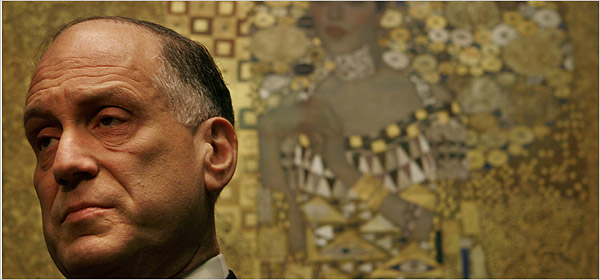
The New York Times reports: As he stood in the opulent marble foyer of a Fifth Avenue mansion late last month, greeting the coterie of prominent guests arriving at his private art gallery, Ronald S. Lauder was doing more than just being a gracious host.
To celebrate the 10th anniversary of the Neue Galerie, Mr. Lauder’s museum of Austrian and German art, he exhibited many of the treasures of a personal collection valued at more than $1 billion, including works by Van Gogh, Cézanne and Matisse, and a Klimt portrait he bought five years ago for $135 million.
Yet for Mr. Lauder, an heir to the Estée Lauder fortune whose net worth is estimated at more than $3.1 billion, the evening went beyond social and cultural significance. As is often the case with his activities, just beneath the surface was a shrewd use of the United States tax code. By donating his art to his private foundation, Mr. Lauder has qualified for deductions worth tens of millions of dollars in federal income taxes over the years, savings that help defray the hundreds of millions he has spent creating one of New York City’s cultural gems.
The charitable deductions generated by Mr. Lauder — whose donations have aided causes as varied as hospitals and efforts to rebuild Jewish identity in Eastern Europe — are just one facet of a sophisticated tax strategy used to preserve a fortune that Forbes magazine says makes him the world’s 362nd wealthiest person. From offshore havens to a tax-sheltering stock deal so audacious that Congress later enacted a law forbidding the tactic, Mr. Lauder has for decades aggressively taken advantage of tax breaks that are useful only for the most affluent.
The debate over whether to reduce tax shelters and preferences for the rich is one of the most volatile in Washington and will move to the presidential campaign, now that repeated attempts in Congress to strike a grand bargain over spending cuts and an overhaul of the tax code have failed.
There’s an interesting backstory to this article. Charles Finch notes that since the Lauder group of companies are among the most lucrative of the New York Times‘ advertisers, “endangering this cosmetic revenue stream seems suicidal at best.” But Finch goes on to note the fiercely competitive relationship between the Lauder brothers, Ronald and Leonard (both collectors of Klimt), and writes:
[T]o ascertain, perhaps, what is really going on, one must go back to the book of Genesis, specifically to the tale of Cain and Abel. There has always been a presumptive sense of art-collecting museo-competition between the czar of MoMA, Ron, and the head of the inferior Whitney Museum, Leonard. Ron has always won this battle convincingly, in spite of the fact that he has been (as copiously detailed in the Times article) a dilettante, while older brother Leonard has run the family business.
Additionally, Leonard’s deceased bride Evelyn was a major hands-on executive and new product innovator in the Lauder cream stream. So let’s look deeper into the Times‘ expose. First, Ron’s position as CEO of Clinique is characterized as a sinecure and his business skills, relative to the company, as nonexistent.
Elements of Ron’s checkered career, especially his short and troubled stint as Ronald Reagan’s Ambassador to Vienna and his multimillion-dollar run for NYC mayor, are elucidated. And who do you think the Lauder relatives were who lent all their company stock to Ronald for tax avoidance purposes? The Leonard Lauder family.
To conclude, dear readers, who would be the only source kosher enough to green light the Times expose of Ronald Lauder’s tax strategies, while keeping the paper’s relationship with Estée Lauder safe and enjoying a little fraternal revenge under a cloud of personal grief? Leonard Lauder, of course!