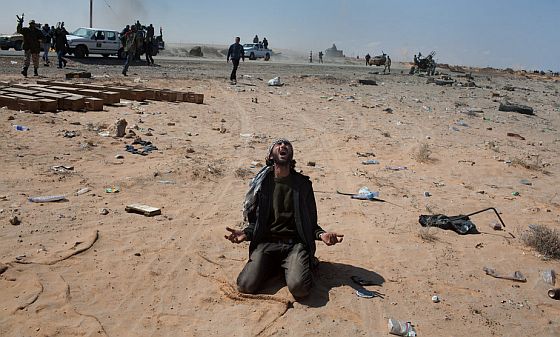
A fighter cried after an airstrike by government forces near the oil refinery in Ras Lanuf.
The New York Times reports:
Only days ago, rebels were boldly promising to march on Surt, Colonel Qaddafi’s hometown, then on to Tripoli, where opposition leaders predicted its residents would rise up. But the week has witnessed a series of setbacks, with a punishing government assault on Zawiyah, near the capital, and a reversal of fortunes in towns near Ras Lanuf, whose refinery makes it a strategic economic prize in a country blessed with vast oil reserves.
There was a growing sense among the opposition, echoed by leaders in opposition-held Benghazi and rebels on the front, that they could not single-handedly defeat Colonel Qaddafi’s forces.
“We can’t prevail unless there’s a no-fly zone,” said Anis Mabrouk, a 35-year-old fighter. “Give us the cover, and we’ll go all the way to Tripoli and kill him.”
That seemed unlikely, though. Even without warplanes, Colonel Qaddafi’s government could still marshal far superior tanks, armor and artillery, along with the finances and organization to prosecute a counteroffensive.
The Los Angeles Times reports:
President Obama signaled Friday that the U.S. military might intervene in Libya at the point that “defenseless civilians” are under attack by forces loyal to Col. Moammar Kadafi, but said even then he would weigh the costs of sending American personnel and carefully consider whether such an operation would be “sustainable.”
In a news conference at the White House, Obama pointedly declined to endorse a view expressed by his director of national intelligence, James Clapper, who testified before Congress this week that rebel forces probably will not be able to defeat Kadafi.
While Obama said the option of military force remains on the table, he made it clear he does not think the situation merits it yet. He said he would want to avoid “defenseless civilians who were massacred by Kadafi’s forces,” repeating past massacres in the Balkans and Rwanda.
Gaddafi has already likened his onslaught on his own population to Israel’s war on Gaza — a war President-elect Obama watched in silence — so perhaps he’ll restrain himself from bombing Benghazi and simply place the city under siege. He can be reasonably confident he’ll suffer no more than a verbal rebuke from Obama, since a massacre in slow motion won’t really look like a massacre.
Leon Wieseltier writes:
Darkness is descending on the Libyan struggle for freedom, and we are helping to lower it. While the various secretaries were articulating their abdications, Qaddafi was committing a slaughter in Zawiyah and employing his monopoly of the skies to drive the rebels out of Ras Lanuf. An eastern offensive is clearly imminent. (This is not a civil war. This is a war by a dictator upon his people. There is no other half of the Libyan population fighting for Qaddafi.) All this, of course, affects the sensitivities of the Libyan freedom fighters. “We’re waiting for the Americans to follow,” a rebel spokesman bitterly told Anthony Shadid and David Kirkpatrick of The New York Times about Sarkozy’s splendid decision to recognize the Libyan provisional government. (Morally America now lags behind France!) Shadid and Kirkpatrick also reported that “as NATO member nations met in Brussels to discuss options for Libya, the rebels cursed the United States and its allies for failing to impose a no-flight zone.” Why is the White House content to foment this variety of anti-Americanism? The answer is that it is so haunted by past Arab anger at American action in the Middle East that it cannot recognize present Arab anger at American inaction in the Middle East.
And the president? He declares that Qaddafi must go and that we will stand with the Libyan people, and then he does nothing. No, that’s not right. He consults and consults, and his staff works round the clock, and economic sanctions are instituted against the rampaging dictator who has tens of billions of dollars in cash. Obama is prepared to act, just not consequentially. He does not want the responsibility for any Arab outcome. He says they must do it for themselves. But they are doing it for themselves. They merely need help. And the help they need is easy for us to provide. (Jam their fucking communications.) And their cause is freedom, which is allegedly our cause. What they seek from Obama is an extended hand. What they are getting is a clenched fist. If Muammar Qaddafi takes Benghazi, it will be Barack Obama’s responsibility. That is what it means to be the American president. The American president cannot but affect the outcome. That is his burden and his privilege. He has the power to stop such an atrocity, so if the atrocity is not stopped it will be because he chose not to use his power. Perhaps that is why Obama has been telling people, rather tastelessly, that it would be easier to be the president of China. Obama will not be rushed. He is a man of the long game. But the Libyan struggle for freedom, and the mission of rescue, is a short game. That is the temporality of such circumstances. If you do not act swiftly, you have misunderstood the situation. Delay means disaster. Does Obama have any idea of what Qaddafi’s victory will mean for the region and its awakening?
We have flinched this way before. For many days I have had a sickening 1992–1995 feeling. Consider these sentences, from a book I lugubriously took off my shelf: “Why does the United States stand so idly by? The most common answer is, ‘We didn’t know.’ This is not true. … A second response to the question of why the United States did so little is that it could not have done much to stop the horrors. [But] the only way to ascertain the consequences of U.S. diplomatic, economic, or military measures would have been to undertake them. … If anything testifies to the U.S. capacity for influence, it is the extent to which the perpetrators kept an eye trained on Washington and other Western capitals as they decided how to proceed. … The real reason the United States did not do what it could and should have done to stop genocide was not a lack of knowledge or influence but a lack of will. Simply put, American leaders did not act because they did not want to.” The Libyan calamity is not genocide, but genocide is not the only horror that has a claim on American agency. I have taken those wise sentences from “A Problem from Hell,” Samantha Power’s sad, great study of earlier American failures to act against mass-murdering tyrants. Is Obama now writing his own chapter in that story? Why do we not still remember that story? It is disgusting, as the Libyan rebels are driven further and further back, to learn that we must discover it all over again.





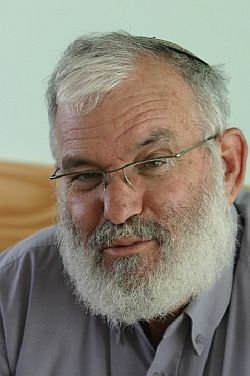 Israel’s Prime Minister Binyamin Netanyahu has reportedly decided to appoint an ultra-hawk, one of Israel’s leading national-religious icons, as his new national security adviser.