Author Archives: News Sources

Who does Mahmoud Abbas represent?

Mark Perry reports on the latest incident in the West Bank which indicates that the Palestinian acting president, Mahmoud Abbas, can now only impose his authority by force.

On Aug. 25, one week prior to the opening of Israeli-Palestinian peace negotiations, a group of Palestinians held a conference in Ramallah to discuss – and protest — President Mahmoud Abbas’s decision to travel to Washington to attend the talks. The Ramallah gathering, to be held at Ramallah’s Protestant Club meeting house, had been meticulously planned by a prominent coalition of political activists that included Palestinian businessmen, acknowledged leaders in Palestinian civil society and respected leaders of Palestinian political parties. “This was to be an open forum, an assembly to debate and discuss,” Munib al-Masri, the founder of the Palestine Forum and one of the meeting’s organizers said in an interview from his home in Nablus. “Our intention was to exercise our right to assemble and debate. Tragically, that’s not what happened.”

As the crowd of attendees (later estimated at between 250-300 people) began to gather at noon on Aug. 25, a group of about 100 non-uniformed officers from the Palestinian General Intelligence Service entered the hall carrying placards featuring Abbas’s picture and shouting pro-Abbas slogans. Across the street, at the headquarters of Al Haq — an independent human rights organization — Shawan Jabarin, the organization’s director (who had been invited to attend the meeting), heard of the commotion and decided to walk to the meeting hall. Jabarin described the scene: “This was going to be a large and important meeting,” he said, “so there were already 200 to 300 people in the hall at noon. But it was clear they wouldn’t be allowed to speak. The security people were shouting slogans, intimidating people. I saw a sign — ‘Stop Supporting Iran.'”

Inside the hall, those disrupting the meeting (Israeli journalist Amira Hess described them in Haaretz as “young men of similar appearance — well-developed muscles, civilian clothes and stern facial expressions”) began to shout down the first speaker, Dr. Mamdouh Al Aker, the director of the Palestinian Independent Commission for Human Rights (PICCR). When Aker asked for a moment of silence “in memory of those who gave their lives for the Palestinian people and the Arab nation” he was whistled down and the crowd of young men began to shout in unison: “With our blood and our souls, we will redeem you, Abu Mazen [Mahmoud Abbas].” The young men, now a phalanx of intimidating muscle and anger, began to push and shove the attendees out of the building. “People were frightened and were pushed outside, shoved out by the security people,” Al Haq’s Jabarin remembers. “It was outrageous, so I directed my staff to take pictures.”

Mustafa Barghouti, the head of the Palestinian National Initiative (a leading and increasingly strong political movement inside Palestine) and one of the most prominent leaders scheduled to speak at the meeting was in the crowd as it was pushed out of the meeting house. He attempted to maintain order and separate the meeting’s attendees from the group disrupting the gathering. “People were pushed into the street,” he remembers, “and that’s when the beatings began. It was very violent. The General Intelligence people were pushing people to the ground.” On the street in front of the Protestant Club, meanwhile, members of the Al Haq staff began to document the incident. “We had a camera, one of my staff members had a camera,” Jabarin says, “and we were trying to take pictures. But my staff member who had the camera was pushed down and the security official attempted to take the camera, to break it. This man was beating him and when one of my other staff members tried to help him, she was pushed to the ground and beaten. They got the camera.”

Standing nearby, Bassam al-Salhi, general secretary of the Palestine Peoples’ Party (and a former candidate for president), also attempted to stop the beatings. “This was mob violence,” he says. “But I thought that if we could somehow move up the street we could stop the confrontations.” Facing continued harassment, the group decided to walk to a nearby park, but were prevented from doing so by the Ramallah police. “They didn’t participate in the violence,” Salhi says of the police, “but they didn’t try to stop it either. Eventually, we had nowhere to go – so people just ran away. They had no choice.” The leaders of the conference, meanwhile, decided to take their protest of the incident to the headquarters of Watan, a local television station. But when they appeared on camera, a vocal group of security officials shouted them down, waving their placards in front of the Watan cameras. Inevitably, perhaps, the continued intimidation of the speakers was successful – and the crowd at Watan dispersed.

Meanwhile a Hamas commander, Iyad As’ad Shelbaya, was killed by the IDF on Thursday after Israeli soldiers claimed he ran towards them in a threatening way and ignored requests to stop. The Ma’an News Agency, however, reports that Shelbaya was shot in bed.

Israeli forces entered the home of a Hamas leader in Tulkarem on Friday morning and shot him three times in the neck and chest before withdrawing, family members said.

Medics at the Thabit Thabit Hospital in Tulkarem confirmed that 38-year-old Iyad As’ad Shelbaya, a known Hamas leader, was dead, killed by three bullets to the neck and chest.

However much these two reports conflict, the one thing about which we can be reasonably sure is that Shelbaya was not carrying a weapon — had he been armed there’s no question that the IDF would have highlighted that detail.

As for their claim that the incident is now being investigated, it’s also reasonable to assume that the investigation won’t reveal anything. As a B’Tselem report revealed this week, the decision by Israeli authorities to regard the West Bank as an area of armed conflict ever since the second intifada began in 2000, “effectively grants immunity to soldiers and officers, with the result that soldiers who kill Palestinians not taking part in hostilities are almost never held accountable for their misdeeds.”

Writing from Gaza, Laila El-Haddad says:

There is very little patience in Gaza for this latest set of talks. They are not only being conducted without a national consensus by what is broadly considered an illegitimate government, but they also completely marginalise the Gaza Strip and overlook the blockade and asphyxiation it has suffered for more than four years.

“When people started to talk about negotiations and going back to the peace process and all, I thought, wait a minute, who took our opinion before going there?” said Ola Anan, 25, a computer engineer from Gaza City. “I mean, Mahmoud Abbas is now a president who’s out of his presidential term. So in whose name is he talking? In the name of Palestinians? I don’t think so.”

Abu el-Abed, a 30-year-old fisherman who sells crabs in the coastal Gaza enclave of Mawasi said: “We hear about the negotiations on television, but we don’t see them reflected on the ground. They’re not feasible. Gaza’s completely marginalised as far as negotiations go. There’s no electricity, there’s no water. There’s no movement. Living expenses are high. And the borders are all closed.”

Ultimately, Gazans know very little or care very little about what is happening in Washington, because what’s happening in Washington cares very little about them, says Nader Nabulsi, a shopkeeper in Gaza City’s Remal neighbourhood: “These negotiations don’t belong to us, and we don’t belong to them.”

Nabulsi, like many others here, feels the negotiations are farcical given the fractured nature of the Palestinian leadership, but also given the fact that most consider Abbas’s government illegitimate and his term expired.

Reza Aslan writes:

As direct talks between the Israelis and Palestinians drag on in Jerusalem, it should not surprise anyone that militants in the Gaza Strip have stepped up their rocket and mortar attacks into southern Israel. Neither should it surprise anyone that the Israeli government is holding Hamas, which has ruled Gaza since seizing control of it in 2007, responsible for the attacks, accusing the group of trying to derail the peace process.

What is surprising, however, is that it may not be Hamas who is responsible for most of the rockets that have recently been launched into Israel. Rather, a group of Palestinian militants connected to al Qaeda has been repeatedly staging attacks against Israeli targets over the last year as a means of challenging Hamas’s rule over Gaza.

A civil war is brewing in the Gaza Strip between Hamas and a new crop of more radical militant groups like Jaish al-Umma, Ansar al-Sunna, and Jund Ansar Allah, who believe Hamas is not fighting the “Jewish enemy” as aggressively as it should be. According to the Economist, these Palestinian militants have been heavily influenced by time spent in Saudi Arabia, where they apparently absorbed the Kingdom’s ultra-orthodox (sometimes called “Salafist”) brand of Islam — a particularly conservative interpretation of Islam that, until recently, had not taken root in the Palestinian territories.

A spokesman for Jaish al-Umma says his group’s purpose is “to awaken the Islamic nation from the backwardness and the ignorance the tyrant regimes in Islamic countries have caused, and to free the Muslims from the despots.”

Although the leaders of this new movement tend to be doctors and university professors, they draw their rank and file membership from Hamas militants who have grown disenchanted with the group’s attempt to moderate its ideology and accommodate Israeli demands. Unlike Hamas, which has diligently kept its distance from al Qaeda and openly rejected its global ideology, many of these so-called “Salafist” groups are fervent supporters of al Qaeda, and some have referred to Osama bin Laden as their “righteous shepherd” (though a few continue to preach loyalty to the president of the Palestinian Authority, Mahmoud Abbas).


Facebooktwittermail

In the wake of 9/11, Israel put Iran into “Axis of Evil”

Marsha Cohen writes:

When, on September 11, 2001, two terrorist attacks occurred on U.S. soil, Israeli political figures anticipated that the Americans would now be better able to empathize with Israel’s vulnerability to its own random terror attacks. In the hours immediately following the attacks on the World Trade Center and the Pentagon, Israeli leaders envisioned a massive U.S. retaliation in which Israel was uniquely equipped to be a partner, even a mentor, of the U.S.

“The fight against terror is an international struggle of the free world against the forces of darkness who seek to destroy our liberty and our way of life,” then-Prime Minister Ariel Sharon declared in a televised statement just after midnight on September 12. “I believe that together we can defeat these forces of evil.”

But immediately, a spate of Israeli pronouncements proclaimed Israel’s own priorities. They drew upon a decade of Israeli assertions of Iranian complicity in terrorist attacks, and warnings of an imminent Iranian nuclear threat. A war of civilizations had begun. 9/11 was just the first strike of Islamic fundamentalists. The next might be a nuclear attack by Iran.

The pronouncements constituted the opening salvo in a months-long back-and-forth about how the U.S. would frame its new “global war on terror.” Would the U.S. choose the allegiance of regimes in Muslim majority countries — even enlisting hostile governments like Iran who might sympathize with the dangers of transnational Islamic fundamentalist terror — over Israel, which proclaimed itself a battle-hardened ally? Today, the outcome of those first months after September 11 speak for itself, but a review of the Israeli side of the wrangling may be instructive to how the U.S. arrived at its present positions.

Facebooktwittermail

Pastor Jones’ daughter says he’s a megalomaniac

In an interview with Der Spiegel, Pastor Terry Jones’ daughter Emma Jones describes her father as a megalomaniac who she characterizes as a delusional cult leader.

SPIEGEL ONLINE: How did you grow up?

Emma Jones: We were raised in a very Christian household, and it was very strict. But also very social. We received visits from people from all over the world and were open to everything.

SPIEGEL ONLINE: Former members of his church have spoken of psychological cruelty, forced work, financial irregularities and calls to beat ones own children.

Jones: My mother, Lisa Jones, died in 1996 of a heart attack. Shortly thereafter, my father remarried and I left the church at age 17. In 2005, he offered me a job as a bookkeeper in a company belonging to the church, which sold donated furniture on eBay. I gained a new insight, and realized that my father preached things and did things that I didn’t find to be in accordance with the Bible at all. He demanded that people completely obey him and his second wife, Sylvia. Both are extremely obsessed with power. I saw genuine religious delusion. A typical indication of a sect. Both of them wanted to control everything.

SPIEGEL ONLINE: Did you confront your father at the time?

Jones: Yes. I didn’t agree with those things which I saw as exploitation and psychological abuse. I repeatedly brought those things up. In the end, he called me into his office and said he received a message from God for me: God would take my children and then kill me. I stood up and left. Then I contacted members of the church and tried to open their eyes. And I was successful.

SPIEGEL ONLINE: It is true, then, that the church in Cologne ousted your father itself?

Jones: Yes.

SPIEGEL ONLINE: Did he leave Cologne willingly?

Jones: It was a mixture. We confronted him and demanded that he correct his errors. But he didn’t give in. When we brought up the church finances, he disappeared the next day.

SPIEGEL ONLINE: Are you still involved with the church that he left behind?

Jones: No.

SPIEGEL ONLINE: Do you believe your father is serious about burning the Korans?

Jones: I do. My father is not one to give up. As his daughter, I can see the good-natured core deep inside him. But I think he needs help.

SPIEGEL ONLINE: Is your father a megalomaniac?

Jones: I’m afraid he is. As his daughter, it is difficult for me to say that.

ABC News adds:

Shane Butcher, who was expelled from the church for disobeying Jones, told the paper [the Gainesville Sun] that he worked for the pastor’s company for up 72 hours a week without pay and meals were provided from a “food bank.”

Butcher said punishments for disobedience ranged from cleaning the barnacles off Jones’s boat in Tampa, to carrying a life-size wooden cross or writing out all of Psalm 119, the longest chapter in the Bible.

“We carried a card that said ‘obedience is always blessed,’ ” he was quoted as saying.

Indeed, the church has a laundry list of dicta, called the “Academy Rulebook.” Created by his Sylvia Jones in 2007, the rulebook directs students to sever most contact with family members. “Family occasions like wedding, funerals or Birthdays are no exception to this rule,” the rulebook says.

“No phone calls. Exceptions can be made under certain circumstances but only after receiving permission.”

The syntactically-challenged rulebook also barred “Singles” from having “romantic relationships to the opposite sex…Except work things, there is no need to talk at all, or even flirt!”

Sarah Posner sees beyond the drama surrounding Pastor Jones a crisis of much greater proportions — one that has come to permeate American society: the utter ordinariness of demeaning Islam.

That ordinariness, and the ordinariness of accepting it, is why an evangelical like Joel Rosenberg can on the one hand denounce the Qur’an burning but in the same breath write, “I believe those who follow Islam are mistaken and misguided and need to leave Islam and receive Jesus Christ by faith as their personal Savior and Lord.” It’s why Joe Lieberman can say that burning the Qur’an is “inconsistent with American values” yet stand shoulder to shoulder with John Hagee, who has said, “Islam in general — those who live by the Koran have a scriptural mandate to kill Christians and Jews,” and whose entire worldview is predicated on vanquishing Islam. Or why Sarah Palin can say burning the Qur’an is “antithetical to American ideals,” but equate it in provocativeness to “building a mosque at Ground Zero.” Or why she can defend Franklin Graham’s insistence that Islam is an “evil and wicked religion.”

Facebooktwittermail

What America left behind in Iraq

Nir Rosen reports from Iraq:

Hundreds of cars waiting in the heat to slowly pass through one of the dozens of checkpoints and searches they must endure every day. The constant roar of generators. The smell of fuel, of sewage, of kabobs. Automatic weapons pointed at your head out of military vehicles, out of SUVs with tinted windows. Mountains of garbage. Rumors of the latest assassination or explosion. Welcome to the new Iraq, same as the old Iraq — even if Barack Obama has declared George W. Bush’s Operation Iraqi Freedom over and announced the beginning of his own Operation New Dawn, and Iraq’s Prime Minister Nouri al-Maliki has declared Iraq sovereign and independent.

Iraq has had several declarations of sovereignty since the first one in June 2004. As with earlier milestones, it’s not clear what exactly this one means. Since the Americans have declared the end of combat operations, U.S. Stryker and MRAP vehicles can be seen conducting patrols without Iraqi escorts in parts of the country and the Americans continue to conduct unilateral military operations in Mosul and elsewhere, even if under the guise of “force protection” or “countering improvised explosive devices.” American military officers in Iraq told me they were irate with the politically driven announcement from the White House that combat troops had withdrawn. Those remaining still consider themselves combat troops, and commanders say there is little change in their rules of engagement — they will still respond to threats pre-emptively.

Facebooktwittermail

Islam and America’s most powerful cult

M. Junaid Levesque-Alam writes:

In their spirited assault on Islam, conservatives have seized upon one notion with particular delight: the Abrahamic faith embraced by a quarter of humanity is a “cult.”

Tennessee Lt. Gov. Ron Ramsey popularized the claim in July when a constituent asked about the “threat that’s invading our country from Muslims”; Ramsey wondered aloud whether Islam “is actually a religion or is it a nationality, way of life or cult” and later asserted that “far too much of Islam has come to resemble a violent political philosophy more than peace-loving religion.” Soon after, some of Ramsey’s constituents set ablaze a planned mosque site near Nashville and fired shots when parishioners tried to inspect the damage.

Farther south, in Florida, Pastor Terry Jones proclaimed that Islam is not just a cult but a Satanic creation — hence his planned bonfire of Qur’ans. He is not alone among Floridians. Congressional candidate and retired Army officer Allen West announced earlier this year that Islam is “not a religion” but a “vicious enemy” intent on “infiltrating” America. Another candidate in the sunshine state, Ron McNeil, described Islam as a malicious plot to “destroy our way of life.”

And in upstate New York this August, teenagers who viewed the local mosque as a “cult house” terrorized mosque-goers by blasting a shotgun and sideswiping a parishioner.

What accounts for this renewed alacrity in attacking Islam?

Muslim paratroopers did not suffuse the skies with crescent-shaped parachutes and descend on America. Nor did Muslim terrorists unfurl prayer rugs camouflaged as conifers and seize the highways. The bleating about the Muslim “cult” was provoked by nothing more than a proposed Muslim YMCA, one which is to be headed by a State Department-sponsored Sufi imam and located no closer to Ground Zero than sundry pubs, food stands, pornography stores, and strip clubs.

To repeat the facts, however, is to miss the point. The “Islam is a cult” mantra is not an epithet: it is the axiom of a belief system that outmatches any religion in America in influence and irrationality.

Within this belief system, facts cannot weaken the pull of the idea that “whole blocks of millions or tens of millions of people can be confidently labeled ‘good’ or ‘bad,’” and reason cannot compete with the coveted “habit of assuming that human beings can be classified like insects.”

This belief system is nationalism (distinct from patriotism), and the quoted descriptions are two symptoms of the disease as identified by George Orwell in his matchless 1945 essay on the subject.

Read the rest of Levesque-Alam’s post here.

Facebooktwittermail

Ground zero church launches with anti-Muslim, anti-Mormon sermon

Justin Elliot reports:

To an audience of about 50 people — fully half of whom were members of the press — Pastor Bill Keller launched his 9-11 Christian Center at ground zero this morning with a fiery sermon targeting Muslims and Mormons as hell-bound followers of false faiths. Keller took aim in particular at Glenn Beck, a Mormon, and Imam Rauf, the organizer of the Park51 Islamic community center.

Keller, an extremist Internet evangelist from Florida, spoke at a drab ballroom of the Marriott hotel two blocks south of ground zero for the launch of his Christian Center, a response to Park51. He told the audience, which included a couple of 9/11 Truther protesters, that he is scouting three possible locations for a permanent church.

Keller regularly assails Muslims as pedophiles and attacks Mormons and gay people. But his church has drawn no objections from opponents of the mosque who have consistently argued that the neighborhood around ground zero is sacred ground. Keller also has a history of trying to profit off of political controversies; last year, for example, he hosted a Birther infomercial.

Facebooktwittermail

Anti-Israel economic boycotts are gaining speed

In Haaretz, Nehemia Shtrasler writes:

The world is changing before our eyes. Five years ago the anti-Israel movement may have been marginal. Now it is growing into an economic problem.

Until now boycott organizers had been on the far left. They have a new ally: Islamic organizations that have strengthened greatly throughout Europe in the past two decades. The upshot is a red and green alliance with a significant power base. The red side has a name for championing human rights, while the green side has money. Their union is what led to the success of the Turkish flotilla.

They note that boycott is an especially effective weapon against Israel because Israel is a small country, dependent on exports and imports. They also point to the success of the economic boycott against the apartheid regime in South Africa.

The anti-Israel tide rose right after Operation Cast Lead, as the world watched Israel pound Gaza with bombs on live television. No public-relations machine in the world could explain the deaths of hundreds of children, the destruction of neighborhoods and the grinding poverty afflicting a people under curfew for years. They weren’t even allowed to bring in screws to build school desks. Then came the flotilla, complete with prominent peace activists, which ended in nine deaths, adding fuel to the fire.

But underlying the anger against Israel lies disappointment. Since the establishment of the state, and before, we demanded special terms of the world. We played on their feelings of guilt, for standing idle while six million Jews were murdered.

David Ben-Gurion called us a light unto the nations and we stood tall and said, we, little David, would stand strong and righteous against the great evil Goliath.

The world appreciated that message and even, according to the foreign press, enabled us to develop the atom bomb in order to prevent a second Holocaust.

But then came the occupation, which turned us into the evil Goliath, the cruel oppressor, a darkness on the nations. And now we are paying the price of presenting ourselves as righteous and causing disappointment: boycott.

Meanwhile, the Jerusalem Post reports:

Foreign Minister Avigdor Lieberman on Sunday fiercely attacked the diplomatic process with the Palestinians that Prime Minister Binyamin Netanyahu began in Washington last week, telling Israel Beiteinu activists in the capital that a peace deal is “unachievable.”

In a lengthy address to more than a thousand supporters at the Rimonim (formerly Shalom) Hotel, Lieberman criticized previous governments and his own for not learning the lessons of 17 years of failed diplomatic negotiations.

He said he gets asked all the time why he is against hope, and he responds that he is for hope but against illusions.

“It must be understood that signing a comprehensive agreement in which both sides agree to end the conflict and end all of their claims and recognize Israel as the nation-state of the Jewish people is a goal that is not achievable in the next year or in the next generation, so any historic compromises or painful concessions won’t help,” he said.

The best that could come out of the talks was a long-term interim agreement with the Palestinians, Lieberman said.

He promised that his party would fight against further construction freezes and unilateral concessions.

“Seventeen years should be enough time to realize what is and is not possible. I know there is pressure to continue the freeze, but I don’t know a single reason to do so.

Facebooktwittermail

Hamas official: Israeli settlers are a legitimate military target

Haaretz reports:

Israeli settlers in the West Bank are legitimate targets since they are an army in every sense of the word, a senior Hamas official told the London-based Al-Hayat newspaper on Saturday, adding that Palestinians were still committed to an armed struggle against Israel.

The comment by Ezzat al-Rashk, a member of Hamas’s political office, came in the wake of recent attacks against Israeli citizens in the West Bank.

On Tuesday, four Israelis were killed when unknown assailants opened fire at a vehicle they were traveling in near the West Bank city of Hebron. The following night, two Israelis were wounded in a similar shooting attack at the Rimonim Junction near the West Bank city of Ramallah.
[…]
“Attacking settlers is a natural thing,” al-Rashk told Al-Hayat on Saturday, saying the “Zionist settlers are the occupation’s first reserve military force.”
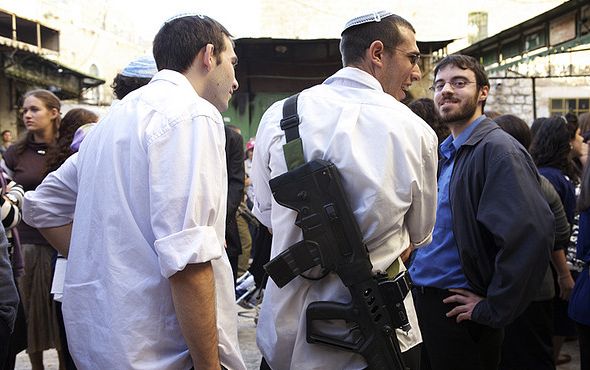
“They are now a real army in every sense of the word, with more than 500,000 automatic weapons at their disposal, on top of the basic protection by the [Israel Defense Forces],” the Hamas official said.

Al-Rashk also referred to the ongoing attempt to relaunch talks between Israel and the PA, saying they were noting more “than a media circus through which the U.S. administration wants to market its policy.”

Another Hamas official, Osama Hamdan, the organization’s Lebanon spokesperson, told the London-based newspaper that Palestinian President Mahmoud Abbas was willing to forfeit “99 percent of the Palestinians’ rights, saying negotiations were over before they even began.

Facebooktwittermail

CIA views Israeli intelligence service as worst US ally

In the Washington Post, Jeff Stein reports:

The CIA took an internal poll not long ago about friendly foreign intelligence agencies.

The question, mostly directed to employees of the clandestine service branch, was: Which are the best allies among friendly spy services, in terms of liaison with the CIA, and which are the worst? In other words, who acts like, well, friends?

“Israel came in dead last,” a recently retired CIA official told me the other day.

Not only that, he added, throwing up his hands and rising from his chair, “the Israelis are number three, with China number one and Russia number two,” in terms of how aggressive they are in their operations on U.S. soil.

Israel’s undercover operations here, including missions to steal U.S. secrets, are hardly a secret at the FBI, CIA and other U.S. intelligence agencies. From time to time, in fact, the FBI has called Israeli officials on the carpet to complain about a particularly brazen effort to collect classified or other sensitive information, in particular U.S. technical and industrial secrets.

Former CIA officer, Philip Giraldi, adds:

FBI sources indicate that the increase in Mossad activity is a major problem, particularly when Israelis are posing as U.S. government officials, but they also note that there is little they can do to stop it as the Justice Department refuses to initiate any punitive action or prosecutions of the Mossad officers who have been identified as involved in the illegal activity.

Giraldi also recounts a recent incident in which a man who identified himself as an Israeli government official, threatened a survivor of the USS Liberty attack, “saying that the people who had been killed on board had gotten what they deserved.”

Israel’s official line has always been that the incident in which 34 US servicemen were killed and 170 wounded during the Israeli attack on the clearly-flagged American naval vessel in 1967, was an accident.

Facebooktwittermail

Understanding the Taliban

Jonathan Steele notes that during almost a decade of war with the Taliban, none of their top leaders have been interviewed which leaves many important questions unanswered.

Have the Taliban changed in the decade since they lost office? Is there a neo-Taliban, as some suggest? What of the younger generation of field commanders who lead today’s resistance to the Americans and British? Are they in regular touch with Mullah Omar and do they answer to him in any practical sense, either in military strategy or in their political objectives? Above all, is there room for compromise between the Taliban, President Karzai and the Tajik and Uzbek leaders who surround him in Kabul so that, if the US withdraws in the next few years, a power-sharing government can have a chance of lasting?

Some evidence that the Taliban have moved on since they were in power is provided by Antonio Giustozzi, a scholar at the Crisis States Research Centre at the London School of Economics, who has edited a collection of essays entitled Decoding the New Taliban. For one thing, the technology has changed. Men who used to reject television now put out propaganda DVDs and run a website of news and opinion, complete with pictures. More important, their social attitudes have shifted. Giustozzi argues that the Taliban realise their old position on education was self-defeating and lost them support, and the line is now being reversed. In Lashkar Gah, the capital of Helmand, according to Tom Coghlan, one of Giustozzi’s contributors, people in September 2008 ‘reported a strikingly less repressive interpretation of the Taliban’s social edicts.’ They no longer ban TV, music, dog-fighting and kite-flying; nor do they insist on the old rule that men grow beards long enough to be held in the fist.

Some analysts believe that US air strikes have been so effective in killing senior Taliban that the war is now being run by a new generation of men in their twenties and thirties, with no experience of the anti-Soviet struggle that schooled the mujahidin warlords as well as Mullah Omar and his Taliban colleagues. Whether this means they are more radical than the previous generation is unclear. Coghlan quotes a Taliban cleric near Lashkar Gah in Helmand in March 2008 as saying: ‘These new crazy guys are really emotional. They are war-addicted.’

Recent reports suggest that most Afghans, tired of the all-pervasive insecurity, want negotiations with the Taliban. A survey of 423 men in Helmand and Kandahar, carried out in May by the International Council on Security and Development, found that 74 per cent were in favour of negotiations. In Kabul in March, I interviewed several women professionals, the people who suffered most from the Taliban’s restrictions on girls’ education and women working outside the home. To varying degrees they all supported the idea of dialogue with the Taliban. They felt the top priority was to end what they saw as a civil war – not an insurgency, as Nato calls it. They saw the Taliban as authentic nationalists with legitimate grievances who needed to be brought back into the equation. Otherwise, Afghans would go on being used as proxies in a long battle between al-Qaida and the US. It was time to break free of both sets of foreigners, the global jihadis and the US empire. Shukria Barakzai, an MP and women’s rights campaigner, put it like this: ‘I changed my view three years ago when I realised Afghanistan is on its own. It’s not that the international community doesn’t support us. They just don’t understand us. The Taliban are part of our population. They have different ideas but as democrats we have to accept that.’

Facebooktwittermail

In asymmetric diplomacy the Palestinians are guaranteed to lose

Hussein Agha and Robert Malley write:

The status quo, though sub-optimal, presents no imminent danger to Israel. What Israelis want from an agreement is something they have learned either to live without (Palestinian recognition) or to provide for themselves (security). The demographic threat many invoke as a reason to act — the possibility that Arabs soon might outnumber Jews, forcing Israel to choose between remaining Jewish or democratic — is exaggerated. Israel already has separated itself from Gaza. In the future, it could unilaterally relinquish areas of the West Bank, further diminishing prospects of an eventual Arab majority. Because Israelis have a suitable alternative, they lack a sense of urgency. The Palestinians, by contrast, have limited options and desperately need an agreement.

In any event, Abbas will return to a fractured, fractious society. If he reaches a deal, many will ask in whose name he was bartering away Palestinian rights. If negotiations fail, most will accuse him of once more having been duped. If Netanyahu comes back with an accord, he will be hailed as a historic leader. His constituency will largely fall in line; the left will have no choice but to salute. If the talks collapse, his followers will thank him for standing firm, while his critics are likely in due course to blame the Palestinians. Abbas will be damned if he does and damned if he doesn’t. Netanyahu will thrive if he does and survive if he doesn’t. One loses even if he wins; the other wins even if he loses. There is no greater asymmetry than that.

The Ma’an news agency reports:

Videos of Palestinian leaders asking the Israeli public to join them as “partners for peace” were coordinated and co-implemented by the Palestinian arm of the Geneva Initiative, the organization’s director confirmed.

The first phase in a mass-media campaign – funded by USAID – “aims to counter the myth that there is no partner on the Palestinian side,” director of the Israeli branch Gadi Baltiansky explained.

Three clips were released on Israeli TV on Sunday featuring Palestinian members of the peace delegation to Washington, each declaring themselves a “partner for peace.”

“Shalom to you in Israel, I know we have disappointed you, I know we have been unable to deliver peace for the last 19 years,” chief PLO negotiator Saeb Erekat says in his short appearance, while Yasser Abed Rabbo warns of the “dangers for both of us” if talks fail.

Following attacks on Israeli settlers in the West Bank on Tuesday and Wednesday, the Wall Street Journal reported:

Mahmoud Ramahi, a Hamas lawmaker based in the West Bank, said he believes this week’s attacks were likely calculated to cause a rift between Palestinian Authority security forces and Israeli forces and show that Hamas is still a vibrant force on the ground that cannot be ignored.

“This proves that the only way to deal with Hamas is for the Palestinian Authority to sit with Hamas and make a reconciliation deal to build a common strategy. Hamas is a reality,” he said. “The United States and the Palestinian Authority have to sit and talk with it.”

Hamas’s political leaders, such as Mr. Ramahi, say they aren’t privy to discussions within the group’s military wing. That apparent division underscores the diffuse power structure the group cultivates. Hamas’s military wing claimed responsibility for both of this week’s attacks and on Thursday promised more.

The orders to carry out the attacks could have come from any number of different power centers. The group’s top leaders are based in Damascus. The leadership there tends to adopt a harder, more militant line. But it is also thought to be heavily influenced by Syria, which can, if it desires, rein the group in, according to analysts.

The group’s leadership in Gaza, which has to live with any retaliation from Israel, has tended to be more pragmatic and moderate. Just hours before Tuesday’s attack, Hamas authorities in Gaza arrested a group of militants from another faction inside the territory trying to fire rockets into Israel.

This week’s attacks could also have been ordered or carried out by a militant cell operating on its own initiative. Israeli security officials believe a small number of militants in the West Bank are directly controlled by Hezbollah or Iran. In the past, Hamas’s leadership has claimed responsibility for attacks carried out by other factions, said retired Brig. Gen. Shalom Harari, a former Israeli intelligence officer who has been studying Hamas for a quarter century.

“Hamas’s infrastructure in the West Bank has been very heavily hurt by ongoing operations by the Palestinian Authority and the Israeli army the last two or three years, and not many cells are left there that can operate,” said Gen. Harari. “If it’s really Hamas, then this is a sleeping cell that they kept for special occasions.”

Meanwhile, Reuters reported:

Hours before peace talks were set to begin in Washington, Jewish settlers defiantly announced plans on Thursday to launch new construction in their West Bank enclaves in a test of strength with Palestinian Islamists.

Naftali Bennett, director of the settlers’ YESHA council, told Reuters settlers would begin building homes and public structures in at least 80 settlements, breaking a partial government freeze on building that ends on September 26.

“The idea is that de facto it (the freeze) is over,” Bennett said, criticizing the U.S.-sponsored Israeli-Palestinian talks as aiming for a “phony peace” and rejecting Palestinian demands for a halt to settlement building on land they want for a state.

Facebooktwittermail

Hamas: “Anyone who is awaiting change from the West today will not get any change”

On the eve of US-brokered Palestinian-Israeli peace talks which begin on Thursday, Sharmine Narwani went to Damascus to interview the Hamas political bureau chief, Khaled Meshaal.

Sharmine Narwani: There is debate about whether Hamas accepts the premise of a two-state solution — your language seems often vague and heavily nuanced. I want to ask if you could clarify, but I am also curious as to whether it is even worth accepting a two-state solution today when there has been so much land confiscation and settlement activity by Israel in the West Bank and East Jerusalem?

Khaled Meshaal: Hamas does accept a Palestinian state on the lines of 1967 — and does not accept the two-state solution.

SN: What is the difference between the two?

KM: There is big difference between these two. I am a Palestinian. I am a Palestinian leader. I am concerned with accomplishing what the Palestinian people are looking for — which is to get rid of the occupation, attain liberation and freedom, and establish the Palestinian state on the lines of 1967. Talking about Israel is not relevant to me — I am not concerned about it. It is an occupying state, and I am the victim. I am the victim of the occupation; I am not concerned with giving legitimacy to this occupying country. The international community can deal with this (Israeli) state; I am concerned with the Palestinian people. I am as a Palestinian concerned with establishing the Palestinian state only.

SN: Can you clarify further? As a Palestinian leader of the Resistance you have to give people an idea of what you aspire to — and how you expect to attain it?

KM: For us, the 20 years of experience with these peace negotiations — and the failure of it — very much convinces us today that the legitimate rights of Palestinians will be only be gained by snatching them, not by being gifted with them at the negotiating table. Neither Netanyahu nor any other Israeli leader will ever simply gift us a Palestinian state. The Palestinian Authority has watered down all its demands and is merely asking for a frame of reference to the 1967 borders in negotiations, but Netanyahu has repeatedly refused to accept even this most basic premise for peace. Nor will America or the international community gift us with a state — we have to depend on ourselves and help ourselves.

As a Palestinian leader, I tell my people that the Palestinian state and Palestinian rights will not be accomplished through this peace process — but it will be accomplished by force, and it will be accomplished by resistance. I tell them that through this bitter experience of long negotiations with the Israelis, we got nothing — we could not even get the 1967 solution. I tell them the only option in front of us today is to take this by force and by resistance. And the Palestinian people today realize this — yes, it has a steep price, but there is no other option for the Palestinian people. The Palestinian people tried the peace process option but the result was nothing.

Facebooktwittermail

A ruined country

Anthony Shadid reports on Iraq’s dead who still have no names.

In a pastel-colored room at the Baghdad morgue known simply as the Missing, where faces of the thousands of unidentified dead of this war are projected onto four screens, Hamid Jassem came on a Sunday searching for answers.

In a blue plastic chair, he sat under harsh fluorescent lights and a clock that read 8:58 and 44 seconds, no longer keeping time. With deference and patience, he stared at the screen, each corpse bearing four digits and the word “majhoul,” or unknown:

No. 5060 passed, with a bullet to the right temple; 5061, with a bruised and bloated face; 5062 bore a tattoo that read, “Mother, where is happiness?” The eyes of 5071 were open, as if remembering what had happened to him.

“Go back,” Hamid asked the projectionist. No. 5061 returned to the screen. “That’s him,” he said, nodding grimly.

His mother followed him into the room, her weathered face framed in a black veil. “Show me my son!” she cried.

Behind her, Hamid pleaded silently. He waved his hands at the projectionist, begging him to spare her. In vain, he shook his head and mouthed the word “no.”

“Don’t tell me he’s dead,” she shouted at the room. “It’s not him! It’s not him!”

No. 5061 returned to the screen.

She lurched forward, shaking her head in denial. Her eyes stared hard. And in seconds, her son’s 33 years of life seemed to pass before her eyes.

“Yes, yes, yes,” she finally sobbed, falling back in her chair.

Reflexively, her hands slapped her face. They clawed, until her nails drew blood. “If I had only known from the first day!” she cried.

The horror of this war is its numbers, frozen in the portraits at the morgue: an infant’s eyes sealed shut and a woman’s hair combed in blood and ash. “Files tossed on the shelves,” a policeman called the dead, and that very anonymity lends itself to the war’s name here — al-ahdath, or the events.

On the charts that the American military provides, those numbers are seen as success, from nearly 4,000 dead in one month in 2006 to the few hundred today. The Interior Ministry offers its own toll of war — 72,124 since 2003, a number too precise to be true. At the morgue, more than 20,000 of the dead, which even sober estimates suggest total 100,000 or more, are still unidentified.

The Los Angeles Times says:

U.S. military and civilian officials have hailed Iraq’s step back from the abyss since 2008 and the tentative return of normality, with a capable army and police force and a major drop in violence.

But as the U.S. ends combat operations in the country and politicians seem unable to break a deadlock over forming a new government nearly six months after national elections, every attack rattles the general population and fans the panic that the “bad men,” the “terrorists,” are back.

Dozens of security officers, ministry officials, judges and clerics have been killed or wounded this year. From March through the end of June, at least 354 people across Iraq died from explosives planted on their cars.

“2010 is worse than 2008 and 2009. We hope and pray to God that security will improve,” said Ghazi Abdul Aziz Essa, director-general of Baghdad’s main power plant.

He bristles at the notion that he and others in his ministry aren’t in danger. “Of course there is a threat,” he said, adding he has again taken to switching cars to throw off would-be hit men.

Some Iraqis whisper that anyone can be killed now because no one is in charge, no questions will be asked, the evidence will be long gone by the time a government is finally in place. People can use the cover of political deadlock to make power plays and settle personal scores.

“Of course this situation is because the government has not been formed,” said Kamil Kanjar, head of the local council in Baghdad’s Sadr City district. “Probably the security forces are not obeying instructions and orders in a proper way because they feel there is no government.”

Time magazine reports:

… the rosy “rebranding” of the conflict, as some have called it, is hardly playing well in the bazaars of Baghdad and other embattled cities and towns where Iraqis of all stripes are scratching their heads over how charting their own course can possibly be a good thing. After all, a snapshot of today’s Iraq is grim, and perceptions of an American retreat have the Iraqi streets rippling with anger and incredulity.

“What have the Americans accomplished for this country that they can now decide to just leave?” asks Hasnaa Ali, 42, a Baghdad schoolteacher who is heading home with a bag of groceries to prepare her family’s iftar meal — the daily breaking of the fast during the holy month of Ramadan. “We don’t have clean water or electricity. Prices for everything are very high. There is no security, no jobs, no housing.” She adds, “If their goal in coming here was to grant us freedom and democracy, how can they leave us when we are sunk in blood and trash?”

Facebooktwittermail

Treatment for PTSD may be killing veterans

Associated Press reports:

Andrew White returned from a nine-month tour in Iraq beset with signs of post-traumatic stress disorder: insomnia, nightmares, constant restlessness. Doctors tried to ease his symptoms using three psychiatric drugs, including a potent anti-psychotic called Seroquel.

Thousands of soldiers suffering from PTSD have received the same medication over the last nine years, helping to make Seroquel one of the Veteran Affairs Department’s top drug expenditures and the No. 5 best-selling drug in the nation.

Several soldiers and veterans have died while taking the pills, raising concerns among some military families that the government is not being up front about the drug’s risks. They want Congress to investigate.

In White’s case, the nightmares persisted. So doctors recommended progressively larger doses of Seroquel. At one point, the 23-year-old Marine corporal was prescribed more than 1,600 milligrams per day — more than double the maximum dose recommended for schizophrenia patients.

A short time later, White died in his sleep.

“He was told if he had trouble sleeping he could take another (Seroquel) pill,” said his father, Stan White, a retired high school principal.

Activist, Vince Boehm, communicated with the Whites and told Beyond Meds:

Stan and Shirley White lost two sons to war. Robert White, a staff sergeant, was killed in Afghanistan in 2005, when his Humvee was hit by a rocket-propelled grenade. But the death of Robert’s younger brother Andrew, who survived Iraq only to succumb to a different battle, is in some ways “harder to accept” says his father.

Struggling with PTSD compounded by grief over the death of his brother, Andrew sought help from VA doctors. Their first line of defense was to prescribe him 20 mg of Paxil, 4 mg of Klonopin and 50 mg of Seroquel. These medications helped at first, but later proved ineffective. Instead of changing the course of treatment, the doctors responded by continually increasing his dosage until the Seroquel alone reached a whopping 1600 mg per day. Within weeks of Andrew’s death, three more young West Virginia veterans died while being treated for PTSD with the same drugs, prompting Stan and Shirley White to begin a mission to find out what the deaths have in common.

Earlier this year, Martha Rosenberg reported on the same deadly cocktail being used to treat PTSD:

Sgt. Eric Layne’s death was not pretty.

A few months after starting a drug regimen combining the antidepressant Paxil, the mood stabilizer Klonopin and a controversial anti-psychotic drug manufactured by pharmaceutical giant AstraZeneca, Seroquel, the Iraq war veteran was “suffering from incontinence, severe depression [and] continuous headaches,” according to his widow, Janette Layne.

Soon he had tremors. ” … [H]is breathing was labored [and] he had developed sleep apnea,” Layne said.

Janette Layne, who served in the National Guard during Operation Iraqi Freedom along with her husband, told the story of his decline last year, at official FDA hearings on new approvals for Seroquel. On the last day of his life, she testified, Eric stayed in the bathroom nearly all night battling acute urinary retention (an inability to urinate). He died while his family slept.

Sgt. Layne had just returned from a seven-week inpatient program at the VA Medical Center in Cincinnati where he was being treated for post-traumatic stress disorder (PTSD). A video shot during that time, played by his wife at the FDA hearings, shows a dangerously sedated figure barely able to talk.

Sgt. Layne was not the first veteran to die after being prescribed medical cocktails including Seroquel for PTSD.

In the last two years, Pfc. Derek Johnson, 22, of Hurricane, West Virginia; Cpl. Andrew White, 23, of Cross Lanes, West Virginia; Cpl. Chad Oligschlaeger, 21, of Roundrock, Texas; Cpl. Nicholas Endicott, 24, of Pecks Mill, West Virginia; and Spc. Ken Jacobs, 21, of Walworth, New York have all died suddenly while taking Seroquel cocktails.

Facebooktwittermail

Mosque opponents help the Taliban

Newsweek reports:

Taliban officials know it’s sacrilegious to hope a mosque will not be built, but that’s exactly what they’re wishing for: the success of the fiery campaign to block the proposed Islamic cultural center and prayer room near the site of the Twin Towers in lower Manhattan. “By preventing this mosque from being built, America is doing us a big favor,” Taliban operative Zabihullah tells Newsweek. (Like many Afghans, he uses a single name.) “It’s providing us with more recruits, donations, and popular support.”

America’s enemies in Afghanistan are delighted by the vehement public opposition to the proposed “Ground Zero mosque.” The backlash against the project has drawn the heaviest e-mail response ever on jihadi Web sites, Zabihullah claims — far bigger even than France’s ban on burqas earlier this year. (That was big, he recalls: “We received many e-mails asking for advice on how Muslims should react to the hijab ban, and how they can punish France.”) This time the target is America itself. “We are getting even more messages of support and solidarity on the mosque issue and questions about how to fight back against this outrage.”

Zabihullah also claims that the issue is such a propaganda windfall — so tailor-made to show how “anti-Islamic” America is — that it now heads the list of talking points in Taliban meetings with fighters, villagers, and potential recruits. “We talk about how America tortures with waterboarding, about the cruel confinement of Muslims in wire cages in Guantánamo, about the killing of innocent women and children in air attacks — and now America gives us another gift with its street protests to prevent a mosque from being built in New York,” Zabihullah says. “Showing reality always makes the best propaganda.”

Meanwhile, at Salon, Justin Elliot reports:

A bigoted pastor who has assailed gays and Muslims is launching the “9-11 Christian Center at Ground Zero” a mere two blocks from the World Trade Center site this Sunday, but so far the project hasn’t drawn a peep of protest from those who are outraged by the “ground zero mosque.”

Pastor Bill Keller of Florida said today he will begin preaching Sunday at the Marriott at 85 West Street (see proximity to ground zero here). A weekly service is planned at the hotel until the $8 million 9/11 Christian Center finds a permanent space. (Fundraising is going well, Keller told Salon today.)

To get a sense of where Keller is coming from, consider his project’s website, which calls Islam a religion of “hate and death” whose adherents will go to hell.

Facebooktwittermail