Author Archives: News Sources

Climate change forced over 1 million Africans from their homes in 2015

ThinkProgress reports: At least 12 million people lived in ongoing displacement caused by conflict, violence, and other disasters across the African continent in 2015. And in the future, climate change may be the lead driver of even greater displacement.

In the Africa Report on Internal Displacement  — a new report by the Internal Displacement Monitoring Centre that focused on internal displacement across the entire African continent  — researchers found that “disasters triggered by rapid-onset natural hazards” forced 1.1 million people from their homes across 33 African countries last year. What’s more, disaster-induced displacement makes people more vulnerable from one year to the next and more susceptible to food insecurity since planting and harvesting become disrupted when farmers are absent.

“The figure of 12.4 million internally displaced people (IDPs) is more than double Africa’s 5.4 million refugee population across the continent, and is a reminder of the protracted nature of many conflicts in Africa,” Alexandra Bilak, the director of the Internal Displacement Monitoring Centre (IDMC), said in a statement. “But it still underestimates the full scale of Africa’s internal displacement crisis because data over time is not available for the millions more who become trapped in displacement as a result of disasters and development projects.” [Continue reading…]


Facebooktwittermail

Aleppo exiles face perilous path to an uncertain future

The Guardian reports: The last fighters and civilians who were holding out in Aleppo are finally trickling towards the Turkish border, where a central plank of Ankara’s policy throughout the nearly six-year war is about to be put to the test.

Those collected from the ruins are being taken to a point north of the city, in a deal brokered by Turkey and Russia, which will supposedly provide them refuge away from the ongoing fighting.

The development is meant to lead to the type of safe haven sanctuary Turkey has regularly pushed for as a means of protecting civilians. But Ankara’s idea of what would eventually emerge from the war has changed dramatically over the past eight months. Enthusiastic backing for the anti-Assad rebels has given way to direct moves to help end the war, rather than keep it rumbling on. [Continue reading…]

Facebooktwittermail

Russia threatens to veto French draft resolution on UN observers in Aleppo

France 24 reports: Russia is prepared to use its veto to block a French-drafted resolution on sending UN observers to Aleppo to monitor evacuations and help protect civilians, Moscow’s envoy to the UN said Sunday, as evacuations resumed following a new deal.

Speaking to reporters in New York Sunday, Russian Ambassador to the UN Vitaly Churkin said Moscow would veto the French draft resolution, “because this is a disaster”. He did however say: “There could be another thing which could be adopted today by the Security Council, which would accomplish the same goals.”

Russia then circulated its own draft resolution calling on the UN to make “arrangements” to “monitor the condition of civilians remaining in Aleppo”. But it did not mention the deployment of observers, according to diplomats.

The UN Security Council was set to meet for closed-door consultations Sunday followed by a vote on the proposals.

France circulated a draft text late Friday stating that the council is “alarmed” by the worsening humanitarian crisis in Aleppo and by the fact that “tens of thousands of besieged Aleppo inhabitants” are in need of aid and evacuation.

Russia has vetoed six resolutions on Syria since the uprising against President Bashar al-Assad’s regime began in March 2011. [Continue reading…]

Facebooktwittermail

McCain calls for committee to investigate Russia hacking: ‘There’s no doubt’ of interference

The Washington Post reports: Sen. John McCain (R-Ariz.) on Sunday again decried Russia’s alleged interference in the 2016 presidential race and called for a select Senate committee to investigate the country’s cyber activities during the election.

On CNN’s “State of the Union,” McCain told host Jake Tapper that there was “no doubt” Russia interfered with the election.

“We need to get to the bottom of this,” he said. “There’s no doubt they were interfering. There’s no doubt. The question is now, how much and what damage? And what should the United States of America do?” [Continue reading…]


The Guardian reports: The former CIA director and defense secretary Robert Gates has criticised the Obama administration and congressional leaders of both parties for a “somewhat laid back” response to the discovery of Russian interference in the US presidential election.

Speaking to NBC’s Meet the Press on Sunday, Gates said a “thinly disguised” operation by Russia had aimed to undermine the credibility of the American election and was to weaken Hillary Clinton.

“Given the unprecedented nature of it and the magnitude of the effort, I think people seem to have been somewhat laid back about it,” he said. [Continue reading…]

Facebooktwittermail

Leak reveals Rex Tillerson is director of Bahamas-based U.S.-Russian oil company

The Guardian reports: Rex Tillerson, the businessman nominated by Donald Trump to be the next US secretary of state, is the long-time director of a US-Russian oil firm based in the tax haven of the Bahamas, leaked documents show.

Tillerson – the chief executive of ExxonMobil – has been a director of the oil company’s Russian subsidiary, Exxon Neftegas, since 1998. His name – RW Tillerson – appears next to other officers who are based at Houston, Texas; Moscow; and Sakhalin, in Russia’s far east.

The leaked 2001 document comes from the corporate registry in the Bahamas. It was one of 1.3m files given to the Germany newspaper Süddeutsche Zeitung by an anonymous source. The registry is public but details of individual directors are typically incomplete or missing entirely.

Though there is nothing untoward about this directorship, it has not been reported before and is likely to raise fresh questions over Tillerson’s relationship with Russia ahead of a potentially stormy confirmation hearing by the US senate foreign relations committee.

ExxonMobil’s use of offshore regimes – while legal – may also jar with Trump’s avowal to put “America first”.

Tillerson’s critics say he is too close to the Russian president, Vladimir Putin, and that his appointment could raise potential conflicts of interest. [Continue reading…]

Facebooktwittermail

I’m a scientist who has gotten death threats. I fear what may happen under Trump

Michael E. Mann writes: My Penn State colleagues looked with horror at the police tape across my office door.

I had been opening mail at my desk that afternoon in August 2010 when a dusting of white powder fell from the folds of a letter. I dropped the letter, held my breath and slipped out the door as swiftly as I could, shutting it behind me. First I went to the bathroom to scrub my hands. Then I called the police.

It turned out to be cornstarch, not anthrax. And it was just one in a long series of threats I’ve received since the late 1990s, when my research illustrated the unprecedented nature of global warming, producing an upward-trending temperature curve whose shape has been likened to a hockey stick.

I’ve faced hostile investigations by politicians, demands for me to be fired from my job, threats against my life and even threats against my family. Those threats have diminished in recent years, as man-made climate change has become recognized as the overwhelming scientific consensus and as climate science has received the support of the federal government. But with the coming Trump administration, my colleagues and I are steeling ourselves for a renewed onslaught of intimidation, from inside and outside government. It would be bad for our work and bad for our planet. [Continue reading…]

Facebooktwittermail

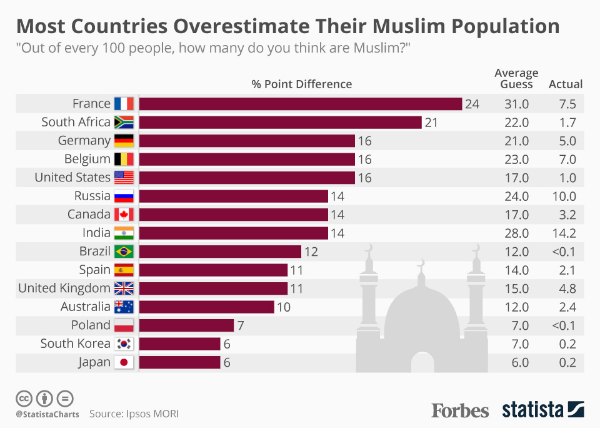
Americans believe there are 54 million Muslims in America. In fact, there are only 3 million

Huffington Post reports: Americans and Europeans drastically overestimate their Muslim populations, a new international survey shows, a misperception many say is driven by Islamophobia and growing anti-Muslim sentiment.

Americans think 17 out of every 100 people in the U.S. are Muslim, according to the survey from Ipsos Mori, a U.K. research company. But, according to the nonpartisan Pew Research Center, Muslims account for only 1 out of every 100 people in the U.S.

That works out to Americans thinking there are about 54 million Muslims in the U.S., when in fact the Muslim population is about 3 million.

This wide disparity between public perception and reality is even more pronounced in Europe. The French, for example, think Muslims make up 31 percent of the French population, when only 7.5 percent of that country is Muslim. [Continue reading…]

Facebooktwittermail

The American leader in ISIS

Graeme Wood writes: One of the first hits on Google for John Georgelas was an August 15, 2006, press release from the Department of Justice. “Supporter of Pro-Jihad Website Sentenced to 34 Months,” it crowed. At the time of his conviction, he lived in North Texas, near Plano, 20 minutes’ drive from the house where I grew up.

Plano is a short drive from downtown Dallas, toward the Oklahoma border, a flatland sprouting subdivisions watered by money from the region’s burgeoning tech sector. Shortly after his probation expired, John Georgelas had posted a résumé online listing as his address an elegant brick house with white Doric columns, a small portico, and a circular driveway. In August 2015, when I first drove up, I could hear the happiness of children. I saw a boy, who looked about 10, bouncing a basketball in the driveway and two others playing nearby; they were the same ages as the kids in the Facebook photos. As I approached the front door, I spied a yellow-ribbon decal (“We support our troops”) in the window, and behind it a foyer, tidy and richly decorated, and a piano festooned with family photos.

The man who answered the door was Timothy Georgelas, John’s father and the owner (with his wife, John’s mother, Martha) of the house. Both parents are Americans of Greek ancestry.

Tim is a West Point graduate and a physician. He has a full head of gray hair and soft features that betray no sign of the stress of having raised an Islamic State terrorist. He has, however, no illusions about the life his son has chosen. “He and John are enemies,” I was told by someone who knows them both — “until the Day of Judgment.”

Tim wore shorts and a T-shirt, and a crisp draft of air conditioning escaped as he said good morning. When I told him I had come to ask about John, he stepped outside and shut the door as if to seal off the house from his son’s name. He slumped in a white wicker chair by the front door, and with a reluctant gesture, he invited me to sit across from him.

He stared at the magnolia tree in the front yard and said nothing. I told him what I knew — that his son, John, was Yahya [Abu Hassan — his nom de guerre]. Tim sat, lips pursed, and with a shake of his head began to speak. “Every step of his life he’s made the wrong decisions, from high school onward,” Tim told me. “It is beyond me to understand why he threw what he had away.” Yahya’s two sisters have both earned advanced degrees, he added, as if to demonstrate that it wasn’t failed parenting that led his only son to drop out of school, wage holy war, and plot mass murder. [Continue reading…]

Facebooktwittermail

China’s great leap backward

James Fallows writes: In both word and deed, U.S. presidents from Nixon onward have emphasized support for China’s continued economic emergence, on the theory that a getting-richer China is better for all concerned than a staying-poor one, even if this means that the center of the world economy will move toward China. In one of his conversations with The Atlantic’s Jeffrey Goldberg, Barack Obama said, “I’ve been very explicit in saying that we have more to fear from a weakened, threatened China than a successful, rising China.”

Underlying this strategic assessment was an assumption about the likely direction of China’s development. This was not the simplistic faith that if China became richer, it would turn into a liberal democracy. No one knows whether or when that might occur — or whether China will in fact keep prospering. Instead the assumption was that year by year, the distance between practices in China and those in other developed countries would shrink, and China would become easier rather than harder to deal with. More of its travelers and students and investors and families would have direct connections with the rest of the world. More of its people would have vacationed in France, studied in California, or used the internet outside China, and would come to expect similar latitude of choice at home. Time would be on the world’s side in deepening ties with Chinese institutions.

For a long period, the assumption held. Despite the ups and downs, the China of 2010 was undeniably richer and freer than the China of 2005, which was richer and freer than the China of 2000, and so on.

But that’s no longer true. Here are the areas that together indicate a turn: [Continue reading…]

Facebooktwittermail

Barack Obama’s presidency will be defined by his failure to face down Assad

Muhammad Idrees Ahmad writes: In an interview with Jeffrey Goldberg of the Atlantic magazine earlier this year, President Obama said he was “very proud” of the moment in 2013 when, against the “overwhelming weight of conventional wisdom”, he decided not to honour his own “red line”, allowing Assad to escape accountability for a chemical attack that had killed more than 1,400 civilians.

Obama may be alone in this judgment. A year earlier, seemingly on a whim, he had set a red line on the use of chemical weapons at a time when none were being used. The red line was, in effect, a green light to conventional killing. But the regime called Obama’s bluff – and, predictably, he backed down. No longer fearing punishment, the regime escalated its tactics.

Nearly four times as many people were killed in the two years after the chemical attack as had died in the two years before. Obama’s abandonment discredited Syria’s nationalist opposition and empowered the Islamists. It helped Isis emerge from the shadows to establish itself as a major force. Together, these developments triggered a mass exodus that would displace over half the country’s population. And as the overflow from this deluge started trickling into Europe, it sparked a xenophobic backlash that has empowered the far right across the west.

These, however, weren’t the only consequences of Obama’s retreat. The inaction also created a vacuum that was filled by Iran and Russia. Emboldened by his unopposed advances into Ukraine and Syria, Putin has been probing weaknesses in the west’s military and political resolve – from provocative flights by Bear bombers along the Cornwall coast to direct interference in the US elections. [Continue reading…]

Facebooktwittermail

Are the United States and China destined for war?

Ali Wyne writes: Concern about an armed confrontation between the United States and China is growing.

U.S. President-elect Donald Trump has stated that the United States should not be bound by the “One China” policy unless as part of a grand bargain of sorts, whereby China reduces taxes on U.S. exports, stops construction in the South China Sea, and cooperates more closely to counter North Korea’s nuclear and missile threats. Chinese Foreign Ministry Spokesman Geng Shuang has warned that if that policy “is compromised or disrupted, the sound and steady growth of the China-U.S. relationship as well as bilateral cooperation in major fields would be out of the question.” China recently flew a conventional bomber over the South China Sea to reinforce its claim to the “nine-dash line,” a demarcation that the United States claims is in violation of international maritime law
Growing strategic tensions offer a useful occasion to revisit well-trodden terrain: are the United States and China fated to repeat the mistakes Britain and Germany made a century earlier? Given that the two countries account for roughly a third of the world’s output, a fifth of its trade, and a quarter of its people, observers cannot pose the question enough.

No matter how forcefully the United States and China may avow that they will devise an enlightened model of interaction, they, too, are subject to structural dynamics dating back to ancient Greece. Political scientist Graham Allison has encapsulated those dynamics with his famous term “Thucydides’s trap,” which journalist David Sanger defines as “that deadly combination of calculation and emotion that…can turn healthy rivalry into antagonism or worse.” [Continue reading…]

Facebooktwittermail

Donald Trump raises the specter of treason

John Shattuck, a former assistant secretary of state for democracy, writes: A specter of treason hovers over Donald Trump. He has brought it on himself by dismissing a bipartisan call for an investigation of Russia’s hacking of the Democratic National Committee as a “ridiculous” political attack on the legitimacy of his election as president.

Seventeen US national intelligence agencies have unanimously concluded that Russia engaged in cyberwarfare against the US presidential campaign. The lead agency, the CIA, has reached the further conclusion that Russia’s hacking was intended to influence the election in favor of Trump.

Admiral Michael Rogers, director of the National Security Agency and commander of the US Cyber Command, has stated, “This was not something that was done casually, this was not something that was done by chance. This was not a target that was selected purely arbitrarily. This was a conscious effort by a nation state to attempt to achieve a specific effect.” On Thursday, a senior intelligence official disclosed that there is substantial evidence that Russian President Vladimir Putin himself authorized the cyberattack.

Why does Trump publicly reject these intelligence agency conclusions and the bipartisan proposal for a congressional investigation? As president-elect, he should have a strong interest in presenting a united front against Russia’s interference with the electoral process at the core of American democracy. [Continue reading…]

Facebooktwittermail

How a Putin fan overseas pushed pro-Trump propaganda to Americans

The New York Times reports: The Patriot News Agency website popped up in July, soon after it became clear that Donald J. Trump would win the Republican presidential nomination, bearing a logo of a red, white and blue eagle and the motto “Built by patriots, for patriots.”

Tucked away on a corner of the site, next to links for Twitter and YouTube, is a link to another social media platform that most Americans have never heard of: VKontakte, the Russian equivalent of Facebook. It is a clue that Patriot News, like many sites that appeared out of nowhere and pumped out pro-Trump hoaxes tying his opponent Hillary Clinton to Satanism, pedophilia and other conspiracies, is actually run by foreigners based overseas.

But while most of those others seem be the work of young, apolitical opportunists cashing in on a conservative appetite for viral nonsense, operators of Patriot News had an explicitly partisan motivation: getting Mr. Trump elected. [Continue reading…]

Facebooktwittermail

Donald Trump’s pick for ambassador to Israel opens a world of unknowns

Karl Vick writes: Don’t even try thinking of Donald Trump’s choice for ambassador to Israel as a diplomat. David M. Friedman is far from that. But he serves very well as a reply in kind, an answer in human form.

It’s like this: For the last three years Prime Minister Benjamin Netanyahu, the man who leads Israel, has sent signal after signal that he’s done with peace talks, or ever pulling Israeli troops out of the West Bank. Sometimes these signals were verbal — in the 2015 election campaign, Netanyahu declared flat out that there would be no Palestinian state. More recently the signals arrived in the form of diplomats — men who, like Friedman, had no prior experience in the subtle arts of statecraft, but whose biographies and attitudes said a great deal. In August, Dani Dayan became Israel’s Consul General in New York. To get his stuff, the moving van had to leave Israel and drive across the Green Line into Palestinian territory, where Dayan lived. He is a settler, a Jewish Israeli who moved to the West Bank in order to stake a claim to rocky hills that are also home to some two million Palestinians. In fact, for six years, Dayan headed the settlers’ primary organization, the Yesha Council. Earlier in the year, Brazil rejected his appointment as Israel’s ambassador to Brasilia, citing his settler background.

In New York, Dayan joined a man with a similar name — Danny Danon, the new Israeli ambassador to the United Nations. Danon was Netanyahu’s remarkable choice for the international body where the topic of Israel’s 50-year occupation of Palestinian territory is a chronic one. The new ambassador had written wrote a book suggesting that Israel simply annex the West Bank, perhaps leaving the Palestinians some urban areas. His rhetoric is famously scalding; after Israeli Defense Forces commandos killed nine Turks on a relief boat headed to the Gaza Strip, Danon wrote to Turkey’s prime minister saying “We are sorry that due to the IDF’s over-cautious behavior, only nine terrorists were killed…” Danon’s appointment to Israel’s premiere diplomatic post — like Dayan’s as envoy to the largest concentration of American Jews — was as far as you can get from business as usual in Israeli diplomacy. For more than a generation, it at least nodded to the idea of a Palestinian state. That’s no longer the case. Not even from the next U.S. ambassador — a bankruptcy lawyer who has represented Trump’s casinos.

“There has never been a two-state solution,” Friedman wrote in August, “only a two-state narrative.” And if it was that was a narrative in which moderate Palestinians invested pretty much everything, a story in which almost the entire world continues to believe, the crystalline signal from both Trump Tower and Jerusalem is that it’s all over now. [Continue reading…]

Facebooktwittermail

To combat Trump, Democrats ready a GOP tactic: lawsuits

The New York Times reports: One attorney general, Eric T. Schneiderman, is already investigating Donald J. Trump over possible violations of New York State law at his charity foundation.

Another, Maura Healey of Massachusetts, has joined Mr. Schneiderman in an investigation into whether Exxon Mobil — whose chief executive, Rex W. Tillerson, is Mr. Trump’s choice for secretary of state — lied to investors and the public about the threat of climate change.

Ms. Healey also has a new fund-raising pitch: “I won’t hesitate to take Donald Trump to court if he carries out his unconstitutional campaign promises,” she recently wrote to supporters.

A third, Representative Xavier Becerra, who was chosen this month to become California’s attorney general, has dared the Trump administration to “come at us” over issues including immigration, climate change and health care.

As Democrats steel themselves for the day next month when the White House door will slam on their backs, some of the country’s more liberal state attorneys general have vowed to use their power to check and balance Mr. Trump’s Washington. [Continue reading…]

Facebooktwittermail

Nine ways to oppose Donald Trump

John Cassidy writes: er the past few weeks, a number of anguished friends and acquaintances, and even some strangers, have got in touch with me to ask what they might do to oppose Donald Trump. Being a fellow sufferer from OATS — Obsessing About Trump Syndrome — my first instinct has been to tell people to get off social media and take a long walk. It won’t do anybody much good, except possibly Trump, if large numbers of people who voted against him send themselves mad by constantly reading about him, cursing him, and recirculating his latest outrages.

But, of course, taking a mental-health break is only a first step toward preserving the Republic. As a daily columnist, I see my role as trying to analyze and critique the Trump program, while also trying to understand some of the phenomena that allowed him to blag his way to the verge of the White House. But for those who want to take a more direct approach, here are some suggestions, starting with something you can do immediately:

1. Go to change.org and join the 4.9 million people who have signed a petition calling on members of the Electoral College to reject Trump. Then contact the electors for your state directly and tell them your concerns. On Monday, the five hundred and thirty eight electors will choose a new President. According to the Harvard law professor Lawrence Lessig, between twenty and thirty Republican electors are ready to vote against Trump. To deny him a majority, the number would need to reach thirty-seven. Most observers think that won’t happen, and, even if it did, the task of electing a President would pass to the Republican-dominated House of Representatives, which would almost certainly vote for Trump. But a big protest vote in the Electoral College could still have great deal of symbolic importance. [Continue reading…]

Facebooktwittermail

Trump’s swaggering sparks war talk from China

Newsweek reports: In mid-summer 2015, the Pentagon deployed a vast fleet to the Western Pacific with an invasion force of 33,000 troops. The little reported exercise was supported by warplanes and attack helicopters, along with 21 ships, including the aircraft carrier George Washington and three nuclear missile-bearing submarines.

It was only a game, the Navy said. But it looked very much like practice for the real thing on or near Chinese shores. On the night of July 4 — Independence Day in the U.S. — Operation Talisman Saber kicked off with U.S. high-altitude paratroopers dropping from the sky near Fog Bay, in Australia’s Northern Territory. Naval artillery boomed. Tanks rolled ashore. The invasion was on.

A U.S. Navy press release made it sound routine, an “exercise [that] illustrates the closeness of the Australian and U.S. alliance…” But Military Times, a close observer of the Defense Department, put its finger on what it was really about: “Talisman Sabre: Trying to Deter China,” its headline said. [Continue reading…]

Facebooktwittermail

Russia’s fear of Hillary Clinton eclipsed any affection for Donald Trump

Max Fisher writes: Russia’s unprecedented intervention in the United States election came amid more than United States-Russia tension and Donald J. Trump’s praise of Vladimir V. Putin, the Russian president. It also coincided with a growing belief, in Moscow, that Russia faced an imminent threat in Hillary Clinton’s candidacy.

Mrs. Clinton is viewed in Moscow as innately hostile to Russia. Widely held conspiracy theories portray her as seeking to foment unrest that will return Russia to the chaos and depression of the 1990s. Even many government technocrats view her with suspicion that at times verges on paranoia.

She referred to these views at an event on Thursday, telling donors that Mr. Putin’s “personal beef” with her had driven Russia’s intervention in the American election.

Mark Galeotti, a Russia expert at the Institute of International Relations, based in Prague, said the Kremlin was consumed by something more urgent than petty revenge: self-preservation.

“It’s not just they didn’t like Clinton, but they actually thought that she represented a threat,” he said, describing Russia’s actions as a matter of “policy, not pique.”

No one factor can fully explain Russia’s decision to hack and pass on Democratic emails, analysts say, and intelligence agencies appear divided on assessing Russian motives. But, in Moscow, fear of Mrs. Clinton has loomed as large or larger than any warmth for Mr. Trump. [Continue reading…]

Facebooktwittermail