Author Archives: News Sources

U.S. Special Operations troops aiding Libyan forces in major battle against ISIS

The Washington Post reports: U.S. Special Operations forces are providing direct, on-the-ground support for the first time to fighters battling the Islamic State in Libya, U.S. and Libyan officials said, coordinating American airstrikes and providing intelligence information in an effort to oust the group from a militant stronghold.

The positioning of a small number of elite U.S. personnel, operating alongside British troops, in the coastal city of Sirte deepens the involvement of Western nations against the Islamic State’s most powerful affiliate.

U.S. officials, who spoke on the condition of anonymity to discuss a mission that has not been announced publicly, said the American troops were operating out of a joint operations center on the city’s outskirts and that their role was limited to supporting forces loyal to the country’s fragile unity government. [Continue reading…]

Facebooktwittermail

Norway may block UK return to European Free Trade Association

The Guardian reports: Norway could block any UK attempt to rejoin the European Free Trade Association, the small club of nations that has access to the European single market without being part of the EU.

Senior Norwegian government members are to hold talks with David Davis, the Brexit minister, in the next few weeks.

Some Brexit supporters have suggested that Efta would be one way of retaining access to the single market while honouring the referendum mandate to leave the EU.

Norway is not a member of the EU, but it has access to the single market from its membership of the European Economic Area (EEA), which groups all EU members and three of the four Efta members: Norway, Iceland and Liechtenstein, but not Switzerland.

Norway’s European affairs minister, Elisabeth Vik Aspaker, reflecting a growing debate in the country following the Brexit vote in the UK, told the Aftenposten newspaper: “It’s not certain that it would be a good idea to let a big country into this organisation. It would shift the balance, which is not necessarily in Norway’s interests.”

She also confirmed that the UK could only join if there were unanimous agreement, thereby providing Norway with a veto. Aspaker said she did not know the UK’s plans.

EEA membership requires the four EU freedoms: free movement of persons, services, goods and capital. Norway, in need of extra labour, does not oppose free movement, though the issue of asylum seekers and refugees is controversial.

An EU special summit in Bratislava in September and the Conservative party conference in October may provide greater clarity on the British government’s thinking, Aspaker said.

One concern is that Norway, through Efta, has signed trade agreements with 38 countries, including Mexico, Canada, Colombia, Morocco, Kuwait and Qatar. If the UK joined, those trade agreements might have to be renegotiated and future trade deals would become more complex. [Continue reading…]

Facebooktwittermail

Pity Aleppo as Putin drops his bombs to salvage Russia’s pride

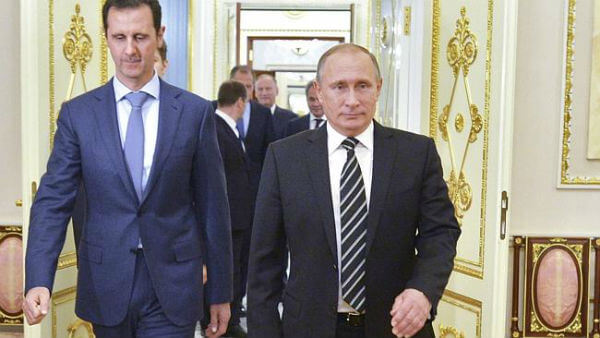
assad-putin

Natalie Nougayrède writes: A few days after Russia launched its military intervention in Syria in September 2015, Barack Obama said it would “get stuck in a quagmire and it won’t work”. Ten months on, that has yet to come to pass. As Russia helps its ally Bashar al-Assad try to retake Aleppo, the last strategic urban stronghold of the Syrian opposition, there aren’t many signs of the Kremlin’s war machine being either hamstrung or stuck. Indeed Russia seems to have registered more victories than setbacks in Syria. Hardly anyone remembers that, just last March, Vladimir Putin had announced he would begin withdrawing his forces. The withdrawal turned out to be as theoretical as Obama’s quagmire.

Most attempts to explain Putin’s military operation in Syria have focused on the following: 1) allergic to popular uprisings, he wants to prevent regime change in Damascus of the sort that happened in 2011 in Tunisia, Egypt and Libya; 2) he wants to secure Russia’s last foothold in the Arab world; 3) he wants to demonstrate Russia will do what it takes to defend an ally; 4) he wishes to divert attention from Ukraine as well as extract western concessions such as the easing of sanctions; 5) he is opportunistic and has capitalised on American unwillingness to get further involved in the Middle East; 6) he believes that by creating chaos, even if there is no clear endgame, Russia shows it can overturn western plans ; 7) it’s all about Russian domestic politics: nationalism and military assertiveness go hand in hand with Putin’s need to safeguard his own power structure.

There is probably truth to all of the above. But as Russia’s bombers hammer Aleppo’s besieged population in what could be the most decisive battle of Syria’s civil war, consider this as another piece to the puzzle of Putin’s mind: Syria is where Russia wants to erase the humiliation of the Soviet Union’s defeat in Afghanistan in the 1980s. [Continue reading…]

Facebooktwittermail

Fears of full-scale war return as casualties mount in Ukraine

RFE/RL reports: Framed by a tiny cutout in the fortified bunker, this particular piece of no-man’s land is tinted a blood-reddish orange by the setting summer sun.

It’s hot as hell, and it’s about to get hotter. When the sun goes down, the guns start blazing. And all that separates the men at their triggers is a grassy patch of land the size of a soccer field that is heavily mined. If you’re a Ukrainian soldier here, you don’t need binoculars to observe the enemy — you just look in his direction.

It starts with a single shot from a Kalashnikov: Ziiip. Then another: Ziiip. And three more: Ziiip. Ziiip. Ziiip. Each shot whizzes dangerously closer. In the time it takes to boil an egg, the situation escalates as the rifles are joined by .50-caliber machine guns, mortars, and rocket-propelled grenades that explode with hollow thuds against the earth or cottages where the soldiers eat and sleep, showering everything with shrapnel. Within an hour, shells from howitzers and tanks — and eventually surface-to-surface Grad missiles, whose name is Russian for “hail” — begin pummeling the scarred steppe.

The “disco,” as the soldiers and the few residents left in this forsaken town call it, is in full effect. The relative calm that dawn brings seems a lifetime away. All are at the mercy of the darkness.

This is eastern Ukraine 28 months after the start of a conflict that once seemed unthinkable, and a year and a half after the signing of a second cease-fire deal, known as Minsk 2, that was supposed to bring lasting peace to this war-torn edge of Europe and reintegrate it with the rest of Ukraine.

But the armistice is unraveling fast as fighting between Ukrainian government forces and Russia-backed separatists has escalated to levels not seen since more furious phases of the conflict in the Donbas — where the separatists hold parts of the Donetsk and Luhansk regions — in 2014 and 2015. Casualties, both civilian and military, are mounting. [Continue reading…]

Facebooktwittermail

The world loves refugees, when they’re Olympians

Roger Cohen writes: The world is moved by Team Refugees at the Olympics in Rio. They are greeted with a standing ovation at the opening ceremony. Ban Ki-moon, the United Nations secretary general, not a man given to extravagant displays of emotion, is all smiles.

President Obama tweets support for these 10 athletes who “prove that you can succeed no matter where you’re from.” Samantha Power, the United States ambassador to the United Nations, posts a video on Facebook in which she speaks of the world’s 65 million displaced people — the largest number since World War II — and says they “are dreaming bigger because you’re doing what you’re doing.”

Who could fail to be moved? These are brave people. They have fled anguish in search not of a better life, but of life itself. In general, you do not choose to become a refugee because you have a choice, but because you have no choice. Like Yusra Mardini, the 18-year-old Syrian refugee from a Damascus suburb, who left a country that now exists only in name, and reached Germany only after the small boat bringing her from Turkey to Greece started taking on water in heavy seas. She and her sister Sarah dived into the water and for more than three hours pushed until it reached the island of Lesbos.

In Rio, Mardini won her heat of the 100-meter butterfly, but did not advance due to her inferior time. Still, hers is a remarkable achievement.

Yes, the world is moved by Team Refugees. Yet, it is unmoved by refugees. [Continue reading…]

Facebooktwittermail

50 GOP national security officials warn Trump ‘would be the most reckless president in American history’

The New York Times reports: Fifty of the nation’s most senior Republican national security officials, many of them former top aides or cabinet members for President George W. Bush, have signed a letter declaring that Donald J. Trump “lacks the character, values and experience” to be president and “would put at risk our country’s national security and well-being.”

Mr. Trump, the officials warn, “would be the most reckless president in American history.”

The letter says Mr. Trump would weaken the United States’ moral authority and questions his knowledge of and belief in the Constitution. It says he has “demonstrated repeatedly that he has little understanding” of the nation’s “vital national interests, its complex diplomatic challenges, its indispensable alliances and the democratic values” on which American policy should be based. And it laments that “Mr. Trump has shown no interest in educating himself.”

“None of us will vote for Donald Trump,” the letter states, though it notes later that many Americans “have doubts about Hillary Clinton, as do many of us.”

Among the most prominent signatories are Michael V. Hayden, a former director of both the C.I.A. and the National Security Agency; John D. Negroponte, who served as the first director of national intelligence and then deputy secretary of state; and Robert B. Zoellick, another former deputy secretary of state, United States trade representive and, until 2012, president of the World Bank. Two former secretaries of homeland security, Tom Ridge and Michael Chertoff, also signed, as did Eric S. Edelman, who served as Vice President Dick Cheney’s national security adviser and as a top aide to Robert M. Gates when he was secretary of defense. [Continue reading…]

Facebooktwittermail

Radicalisation in Bosnia: Old wounds reopened by an emerging problem

By Louis Monroy Santander, University of Birmingham

Bosnia experienced a difficult reconstruction process after its 1992–1995 war. Now its ongoing political and economic crisis is making it harder to respond to a growing global problem – radicalisation.

According to recent reports, Bosnians have been travelling to Syria to fight for radical Islamist groups in increasing numbers since 2012. They now constitute one of the largest European foreign fighter contingents as a proportion of national population. Figures from 2015 suggest there are more than 300 Bosnians in Syria.

There have also been a number of low-level incidents of terrorist violence in Bosnia. In April 2015, for example, a 24-year-old man from an area near the town of Zvornik drove into a police station and opened fire. He killed one officer and injured two others before being shot dead.

This has prompted heated debates about how to handle the problem without feeding into the tensions that pervade in Bosnian politics. Of particular concern is the possibility that decisions about security will be coloured by ethno-politics.

Continue reading

Facebooktwittermail

Former ISIS members open up to German investigators

Der Spiegel reports: Prior to his field trip into the realm of the murderous IS band, Nils D. had been a good-for-nothing. He would sleep until mid-day, then surf the Internet and meet up with his buddies in a café, where they took drugs, drank booze and played cards. They didn’t have any hobbies and they lacked any enthusiasm. The company that had provided him with vocational training fired him because he wasn’t attending the vocational school courses that were part of the program. Afterward, the most he found were temporary jobs. “I was a pothead,” Nils D. says. “I didn’t feel like doing anything.”

This continued for years. Then D. discovered Islam through his cousin Philip B. and became a Salafist. He was still serving a sentence for grand theft when his cousin and the other guys went to Syria to fight. Then, during the autumn of 2013, D. also traveled to the “caliphate.”

During his trial in the dock of the Higher Regional Court in Düsseldorf, Nils D. said “he wanted to see things for himself.” He then quickly became part of the murderous system. In Manbij, he joined a special IS unit. The force’s task was to capture suspected traitors, spies or deserters. D. is believed to have taken part in up to 15 missions.

He also knew what happened to the men he had helped to capture. The former pothead from Dinslaken knew about the wooden crates they would be placed in. There were large ones in which they could stand, sandwiched. And there were small ones in which the prisoners could only crouch — sometimes for days at a time.

Nils D. sported a typical Islamist beard. Whenever he went out, it was always dressed in black and with his face covered. He attended five executions as a spectator. “I had goosebumps all over,” D. would later tell investigators with the State Office of Criminal Investigation in Düsseldorf. “But after a while it bounces off you.” [Continue reading…]

Facebooktwittermail

Battles rage across Aleppo as Assad regime fights to quell rebels

The Guardian reports: Rebels in Syria’s second largest city were on Monday coming under intense aerial bombardment from forces loyal to the Syrian president, Bashar al-Assad, less than two days after they fought through regime lines to break the siege of rebel-held east Aleppo.

Activists say intense airstrikes have continued unabated after rebels seized Ramouseh, a district in south-west Aleppo, allowing them to open a corridor into the besieged areas.

“We are in our trenches but there are insane airstrikes of unprecedented ferociousness,” a commander in the rebel coalition told Reuters. “The regime is using cluster and vacuum bombs.”

Over the weekend, rebels in a coalition known as Jaish al-Fatah launched a lightning advance that sealed the conquest of Ramouseh, a key district through which supplies flow to government forces in west Aleppo. The advance followed a rare show of unity among the opposition, which began a campaign a week ago involving thousands of fighters working to break the siege. [Continue reading…]

Facebooktwittermail

British special forces operating inside Syria


BBC News reports: The BBC has obtained exclusive pictures showing for the first time British special forces operating on the ground in Syria.

It is the vehicles that first stand out. The open air, Thalab long range patrol vehicles are built for harsh terrain and are favoured by special forces.

In this case it is British special forces, seen for the first time on the ground, inside Syria, in photographs obtained by the BBC.

The pictures, which date from June, follow an attack by the so-called Islamic State (IS) on the moderate rebel New Syrian Army base of Al Tanaf on the Syria-Iraq border. The British soldiers appear to be securing the base’s perimeter.

According to eyewitnesses, they were there in a defensive role. But they are carrying an arsenal of equipment including sniper rifles, heavy machine guns and anti-tank missiles. [Continue reading…]

Facebooktwittermail

U.S. military intelligence contractors being hired to operate in Syria

The Daily Beast reports: Every day at 5 p.m., the Pentagon releases a list of that day’s contracts worth more than $7 million. On July 27, buried in the daily email was an eye-catching detail: Military contractors would be working inside Syria alongside the roughly 300 U.S. troops already deployed there.

This appears to be the first time the Pentagon has publicly acknowledged that private contractors are also playing a role in the fight against the so-called Islamic State inside Syria, and it’s one more signal that the U.S. military is deepening its involvement in the fate of the country.

The contract announcement said Six3 Intelligence Solutions — a private intelligence company recently acquired by CACI International — won a $10 million no-bid Army contract to provide “intelligence analysis services.” According to the Pentagon, the work will be completed over the next year in Germany, Italy and, most notably, Syria. [Continue reading…]

Facebooktwittermail

The Middle East needs help with its long game: education and jobs for the young

By Zahir Irani, Brunel University London

The future for many young people across the Middle East and North Africa looks bleak. The World Bank records that 54% of the working age population in the Middle East and North Africa is unemployed with little prospect of any positive immediate change. An average of 28.7% of 15 to 24-year-olds in the Middle East and 30.6% of those in North Africa are unemployed according to the International Labour Organisation.

Much of the world’s response to this chronic problem has been to intervene financially: in the form of aid or debt restructuring. But through supporting economic recovery by giving generations of young people new skills and new opportunities to improve themselves, the world can help Middle Eastern societies in a more sustainable and thoughtful way.

Reliance on public sector jobs

One of the biggest challenges the World Bank identifies in this broad region is that unemployment rates are the highest among the educated, with university graduates making up 30% of the region’s unemployed. They are slowly losing optimism and hope for a better life and future.

This is largely attributed to a reliance on the public sector to provide jobs that come with steady albeit low salaries but high degrees of job security. In many North African countries or those Middle Eastern ones with high populations, other than wait in line for a public sector job, there are few other alternatives. At one end of the spectrum there’s the misery of violence and refugee camps in Jordan, Syria, Iraq and Lebanon, and the other – even if you’ve excelled – a flat and static job market for the best and brightest. No wonder so many highly-skilled people are fleeing to Europe in search of stability and new opportunities.

Continue reading

Facebooktwittermail

The woman pushing women into Tunisia’s politics

Sharmilla Ganesan writes: When the Tunisian revolution of 2011 opened a path toward democracy, the activist Ikram Ben Said saw an opportunity to include women’s voices in the country’s emerging political landscape. At 30, Ben Said was already a vocal advocate for social causes. She was a senior program manager with a peacekeeping organization called Search for Common Ground, and volunteered with several nonprofits that worked with single mothers and abandoned children.

Shaped by these experiences, she founded the organization Aswat Nissa (“Voices of Women”), an effort to cut across Tunisia’s political party lines to unite women in seeking equal political and government participation. In Tunisia, men are still considered the legal head of a family, and until last November, a woman could not legally travel abroad with her minor-aged children without permission from her husband. It is in this context that Aswat Nissa is trying to get women both the opportunity and the confidence to take part in the political process. At the moment, roughly a third of Tunisia’s parliament is made up of women.

Aswat Nissa trains female candidates to stand for election and organizes widespread programs around the country to encourage women to vote, reaching beyond activists to ordinary citizens. In 2014, Aswat Nissa was awarded the Madeleine K. Albright Award for its efforts.

Ben Said is no longer president of Aswat Nissa, but she continues to be involved as a member and voluntary adviser. For the past year, she has been a Hubert H. Humphrey Fellow at the University of Minnesota’s Humphrey School of Public Affairs, focusing on public-policy analysis as well as women, peace, and security.

I recently spoke to her about her life, her work, and how women in her country are making their way into positions of leadership. [Continue reading…]

Facebooktwittermail

If Trump wins, what happens to U.S. relations with its traditional allies?

Politico reports: It was a strange day for Estonia when the tiny Baltic nation became the focus of intense debate in the U.S. presidential campaign.

At issue: Would the United States honor its NATO obligation to defend Estonia in the event of an attack by Russia? Donald Trump, who has repeatedly criticized small NATO members for “taking advantage” of the United States, hedged his answer. “Have they fulfilled their obligations to us?” he told the New York Times. “If they fulfill their obligations to us, the answer is yes.”

Hours later, Trump backer Newt Gingrich doubled down on the Republican candidate’s skepticism toward NATO duties, saying: “Estonia is in the suburbs of [the Russian city of] St. Petersburg … I’m not sure I would risk nuclear war over the suburbs of St. Petersburg.”

For Estonians, and all other NATO members in the region, that was a chilling message. “All of a sudden the issue closest to our skin — the defense of Estonia, of all things — becomes an issue in this campaign,” Jüri Luik, former Estonian ambassador to Russia, said. “It’s a totally unexpected development, and a gloomy situation for all of Eastern Europe.”

“NATO’s deterrent power depends in large part on the U.S. president’s position. If he is unsure … that weakens the deterrent immensely.”

Beyond regional security, the Estonian episode raised a bigger, more troubling question for Europeans watching the U.S. presidential campaign: If Trump wins, will he feel any obligation to uphold his country’s historical role as defender and guarantor of the West? [Continue reading…]

Facebooktwittermail

New Clinton ad insinuates Trump won’t put America first


The Washington Post reports: Insinuations, accusations and speculations have been a staple of Donald Trump’s presidential campaign. Now Hillary Clinton is using the Republican nominee’s own methods against him.

In a new online advertisement, her campaign makes a few factual statements about Trump’s Russian sympathies, stretches the truth in a couple of ways and then invites readers to draw their own conclusions.

It is exactly the technique that Trump has used repeatedly throughout the campaign to feed conspiracy theories, said Joseph Uscinski, a political scientist at the University of Miami who studies conspiracy theories. The advertisement, which is titled “What Is Donald Trump’s Connection to Vladimir Putin?” and appeared online Friday, insinuates that Trump has some kind of business or political alliance with Russia’s president, Uscinski said.

“We don’t know what’s going on here, and Donald won’t tell us,” the spot concludes. “We’ll let you guess.”

To be sure, a victory for Trump would augur a radical shift in U.S. foreign policy toward Russia. The United States would be much friendlier toward Putin and much more accommodating of his international agenda.

Trump has surrounded himself with people who are sympathetic to Putin. Paul Manafort, the chairman of Trump’s campaign, also advised former Ukranian president Viktor Yanukovych, who was aligned with Putin. Carter Page, one of Trump’s advisers on foreign affairs, has openly praised Putin and criticized Western sanctions on Russian officials.

Trump himself has praised Putin, as well, and has also called for the United States to retreat from its responsibilities in NATO — which would probably increase Putin’s influence in the region.

At this point, however, there is no evidence that anyone in the Trump campaign has a direct connection with the Kremlin, as Clinton’s spot insinuated. [Continue reading…]

Facebooktwittermail

Donald Trump is wrong. Rigging an election is almost impossible

Ari Berman writes: In a span of two weeks, federal courts have struck down Republican-backed voting restrictions in six states, including laws that required strict forms of government-issued ID in order to cast a ballot, cut back on early-voting days and made it harder to register. The rulings found that the laws — in Texas, North Carolina, Michigan, North Dakota, Kansas and Wisconsin — violated the Voting Rights Act by discriminating against people of color, sometimes “with almost surgical precision.”

Rather than seeing these rulings as a victory for democracy, Donald Trump says they will lead to a record number of fraudulent votes for Hillary Clinton in November. “The voter-ID situation has turned out to be a very unfair development,” Trump told The Washington Post. “We may have people vote 10 times. . . . Why not? If you don’t have voter ID, you can just keep voting and voting and voting.”

Just how easy would it be to rig a Presidential election, as Trump suggests Democrats are preparing to do? How many people would it require, what tactics would they have to use, and how many votes would they need to flip a major contest or state? [Continue reading…]

Facebooktwittermail

Trump win would offer ‘real opportunity’ for white nationalists says American Nazi Party chairman

Buzzfeed reports: The chairman of the American Nazi Party, Rocky Suhayda, declared on his radio program last month that a Donald Trump victory would present a great opportunity for white nationalists to build pro-white coalitions.

“I’m gonna project, that I believe that Trump is going to win the election this November, for various reasons which I don’t want to go into again,” Suhayda said on his radio program’s July broadcast. “I think it’s gonna surprise the enemy, because, I think that they feel that the white working class, especially the male portion of the working class, and with him his female counterparts have basically thrown in the towel. Given up hope of any politician again standing up for their interests.”

“Now, if Trump does win, okay, it’s going to be a real opportunity for people like white nationalists, acting intelligently to build upon that, and to go and start – you know how you have the black political caucus and what not in Congress, and, everything, to start building on something like that, okay,” continued the American Nazi. “It doesn’t have to be anti, like the movement’s been for decades, so much as it has to be pro-white. It’s kinda hard to go and call us bigots, if we don’t go around and act like a bigot. That’s what the movement should contemplate. Alright.” [Continue reading…]

Facebooktwittermail

Why Vladimir Putin might want to interfere in the U.S. presidential elections

Fiona Hill writes: Whatever his personal preferences, … Putin cannot reasonably expect to influence the outcome of the US presidential election. The best he can hope for is to reduce the ability of whoever comes into the Oval Office to pursue policies that are detrimental to Putin’s and Russia’s interests.

Right now, Putin wants the US to remove sanctions imposed on Russia after its annexation of Crimea in March 2014. Perhaps even more importantly, Russia has parliamentary elections this September, and presidential elections again in 2018, when Putin is expected to run for a fourth term. The Kremlin does not want a repeat of the protests of 2011-’12, and certainly no pronouncements from the US about whether the elections are free and fair or whether Putin has a genuine popular mandate for his next presidency.

Against this backdrop, the information from the DNC files underscores for the Russian public, and the outside world, that US party politics is just as dirty as in Russia or anywhere else. The US looks a lot less credible as the moral authority on the conduct of elections.

Irrespective of whether Donald Trump or Hillary Clinton is elected, from Moscow’s perspective, at the end of this ruinous political campaign, the new US president will look as wounded as Putin did when he took office again in 2012. A US president who is elected amid controversy and recrimination, reviled by a large segment of the electorate, and mired in domestic crises will be hard-pressed to forge a coherent foreign policy and challenge Russia. [Continue reading…]

Facebooktwittermail