Author Archives: News Sources

The Israeli Right’s historic ties to European fascism

Noam Rotem writes: The heads of the Freedom Party of Austria, an extremist, far-right political party, are currently visiting Israel following a formal invitation from the ruling Likud party.

This isn’t the first time top right-wing Israeli politicians have supported the Freedom Party of Austria, which was established by high-ranking members of the Nazi regime and SS officers. They themselves are deemed “Nazis” by Austrian politicians, publish anti-Semitic propaganda, and promote an Islamophobic, racist agenda. Deputy Minister of Regional Cooperation Ayoob Kara (Likud), for instance, participated in a 2010 ceremony alongside members of the party, while head of the Shomron Regional Authority in the West Bank, Gershon Mesika, took part in a conference organized by right-wing organizations, which included the Freedom Party of Austria.

However the ties between the Jewish-Israeli right and racist European movements goes back many years. [Continue reading…]

Facebooktwittermail

Microsoft sues Justice Department to challenge electronic gag order statute

The New York Times reports: Big technology companies have usually played a defensive game with government prosecutors in their legal fight over customer information, fighting or bowing to requests for information one case at a time.

But now, in a move that could broaden the debate over the balance between customer privacy and law enforcement needs, Microsoft is going on the offense.

The software giant is suing the Justice Department, challenging its frequent use of secrecy orders that prevent Microsoft from telling people when the government obtains a warrant to read their emails.

In its suit, filed Thursday morning in Federal District Court in Seattle, Microsoft’s home turf, the company asserts that the gag order statute in the Electronic Communications Privacy Act of 1986 — as employed today by federal prosecutors and the courts — is unconstitutional. [Continue reading…]

Facebooktwittermail

Angela Merkel, accused of betraying core values, faces a balancing act with Turkey

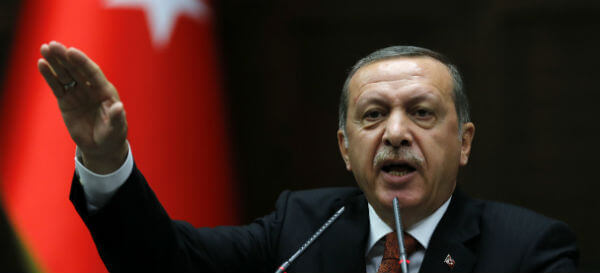
erdogan

The New York Times reports: Last September, Chancellor Angela Merkel was widely seen as an idealist, charitably welcoming hundreds of thousands of refugees to Germany in the face of stiff opposition at home and from European allies. But the influx swiftly became too much to handle.

Fast forward, and this year it is a rather different Angela Merkel at the helm, with an approach toughened by experience. This is the pragmatic Angela Merkel, who entered a calculated deal with an increasingly authoritarian President Recep Tayyip Erdogan of Turkey to try to stanch the migrant flow.

Ms. Merkel now stands accused by a new chorus of critics of not only betraying her ideals on immigration but also of jeopardizing core European values, as the costs of doing business with Mr. Erdogan become painfully clearer by the week.

Mr. Erdogan, who has stifled the news media at home and shown little tolerance for criticism, has used his new leverage in Europe to extend his brand of censorship to Germany, employing diplomatic threats, and now a private lawsuit, to try to silence a German comedian who skewered him.

The satirist, Jan Böhmermann, had earned plaudits but also criticism when, on his TV show two weeks ago, he read a crude poem, which he himself labeled “abusive criticism,” and accused Mr. Erdogan of lewd behavior and fierce political repression.

That case has now become Exhibit A in the unpalatable bargains Ms. Merkel has made in pursuit of security and political survival, or what might be known as realpolitik version 2016. [Continue reading…]

The New York Times reports: Chancellor Angela Merkel, caught in a bind by Turkey’s bid to silence a German satirist who lampooned President Recep Tayyip Erdogan, said on Friday that her government would allow the case to go forward, but that the outdated law that permits it would be repealed with effect from 2018.

Announcing the decision to allow the court case against Jan Böhmermann, the comic, to proceed, Ms. Merkel repeatedly insisted that Germany backs the freedom of press, opinion and culture and believes in the rule of law. “Not the government, but the courts and the legal system will have the last word,” she said.

Pointedly referring to Turkey as a partner and a NATO ally, Ms. Merkel said that Germany expects the government in Ankara to heed democratic norms and that Berlin has observed attempts to restrict freedom of media and the justice system in Turkey “with great concern.” [Continue reading…]

Anna Sauerbrey writes: Though it’s a fact often overlooked by the rest of the world, Germany is a funny place — seriously. Long before Jon Stewart and Samantha Bee redefined topical American humor, comedians here perfected the art of sharp political satire.

For the most part, German politicians get the joke. But now politics and comedy are colliding in a new way — a collision that exposes the tragicomedy of modern European politics in a way that no late-night monologue ever could. [Continue reading…]

Facebooktwittermail

Britain’s covert war in Yemen

Vice News reports: In a rural valley in southern Yemen lies Wadi Rafad, a collection of farms 50 miles from the provincial capital of Ataq. Amid an arid landscape dotted with lemon orchards and cornfields, villagers were used to the peace being disturbed by the buzzing of US drones flying overhead. But on the afternoon of May 6, 2012, something changed.

Around 4.30pm an aircraft came into view, its white fuselage clearly visible against the stark blue sky. Rather than overfly the valley, the CIA drone fired Hellfire missiles straight at Fahd al-Quso, who was working his land. He was killed instantly — but shrapnel from the blast also engulfed Nasser Salim Lakdim, a 19-year-old student who had just returned home to tend his family’s plantation. Nasser’s father came rushing back to the farm to find his son in pieces. “It was horrifying, I can barely describe it,” he told VICE News.

The strike was among the foremost successes of the US counterterrorism effort in Yemen. Al-Quso, its target, was a senior field commander in al-Qaeda in the Arabian Peninsula (AQAP). He had participated in the bombing of the USS Cole in 2000 and had threatened to attack American embassies.

It was also an example of successful cooperation between British and American intelligence agencies. The US had hunted al-Quso for half a decade, and the intelligence that led to this strike came from a British agent working for the UK’s Secret Intelligence Service (SIS) — commonly known as MI6 — who had infiltrated AQAP.

Far from being a one-off tip, a VICE News investigation can exclusively reveal that this was a high point in systemic collaboration between SIS and the CIA to degrade AQAP through a combination of special forces operations and drone strikes.

A former senior CIA official responsible for operations in Yemen told VICE News that “the most important contribution” to the intelligence for the strike came from “a very important British capability.” The UK agent provided the CIA with al-Quso’s position, allowing a drone to track his car. “That was quite unique,” the former official explained, “it was something we didn’t have.”

The use of drones in Yemen has long been characterized as a unilateral US policy. In response to a 2014 parliamentary question on Britain’s role in the US drone program, UK Minister of State for Foreign Affairs Hugh Robertson said: “Drone strikes against terrorist targets in Yemen are a matter for the Yemeni and US governments.”

However, following interviews with more than two dozen current and former British, American, and Yemeni officials, VICE News can reveal that the UK played a crucial and sustained role with the CIA in finding and fixing targets, assessing the effect of strikes, and training Yemeni intelligence agencies to locate and identify targets for the US drone program. The US-led covert war in Yemen, now in its 15th year, has killed up to 1,651 people, including up to 261 civilians, according to The Bureau of Investigative Journalism. [Continue reading…]

Facebooktwittermail

Cash, candy, and ‘collateral damage’: An anatomy of a CIA-MI6 drone assassination

Vice News reports: “I was on my way to play football with my friends when the airstrike hit,” Amin Ali al-Wisabi told VICE News, recounting the day when a CIA drone struck his hometown of Azzan in Yemen. “We had stopped to sit down and plan the match when all of a sudden an explosion hit a passing al-Qaeda car.”

Recovering from his shock, 13-year-old Amin realized he had been hit by shrapnel. “Blood was pouring from my leg.”

Next to Amin, his friend Hamza Khaled Baziyad lay unconscious. In total, five children aged between 10 and 14 were injured as they gathered close to the local mosque.

Though the number of people injured in covert US strikes is not officially recorded, they play a crucial role in the struggle for hearts and minds across Yemen’s southern hinterland. Bystanders and family rushed the children to a local clinic, where Hamza awoke while shrapnel was extracted from his chest. All of the children survived. [Continue reading…]

Facebooktwittermail

Thousands of refugees flee for Turkish border after surprise ISIS attack

The Guardian reports: A new wave of refugees has fled northern Syria for the Turkish border after Islamic State opened fire on communities that had sheltered them, killing at least three people and uprooting thousands more.

The killings came as the terror group pushed back Syrian opposition forces who had edged to within five miles of Dabiq, a highly symbolic village that the group’s leaders believe is the pre-ordained epicentre of a clash that will herald an apocalyptic showdown.

The Isis advance appeared to catch the opposition off guard after 12 days of gains in the same area, which had seen it move closer to Dabiq than at any time in the past three years. [Continue reading…]

Facebooktwittermail

ISIS and Nusra put Yarmouk civilians in line of fire

Al Jazeera reports: Deadly fighting between the Islamic State of Iraq and the Levant (ISIL) and the al-Nusra Front has put civilians, mostly Palestinian refugees, in danger yet again in the Yarmouk refugee camp in southern Damascus.

Issam, a 54-year-old resident of Yarmouk, said that civilians have called for a temporary humanitarian ceasefire from the armed groups but have yet to receive a response.

“There is not a piece of bread left in this camp,” he told Al Jazeera by telephone while the sound of gunfire rang out behind him. “There isn’t medicine or water for drinking.” [Continue reading…]

Facebooktwittermail

Ordinary Syrians are risking their lives to protect their cultural heritage

By Emma Cunliffe, University of Oxford

I have spent years documenting damage to Syria’s amazing cultural heritage. I have recorded sites ploughed away by farming, built over by housing, robbed for stone, dug by looters, shelled in fighting, demolished by extremists … the list goes on. As the conflict grew, I was repeatedly asked how I could worry about stones when people were dying. Perhaps as many as 470,000 people have been killed, and millions have lost their homes and been forced to flee. And besides, I’ve been told, Syrians don’t care about their heritage. They didn’t before the conflict, and now they’ve got more important things to think about.

Given the list of damage to the country’s ancient remains, you might agree. But you’d be wrong.

The depth of Syria’s history is stunning. The country boasts some of the earliest writing and cities, including biblical Christian and Jewish sites that were still in use before the current war. There are also mosques founded at sites visited by the Prophet Mohammed, Crusader castles, and six UNESCO World Heritage Sites (to name just a few).

Continue reading

Facebooktwittermail

U.S. corporations have $1.4tn hidden in tax havens, claims Oxfam report

The Guardian reports: US corporate giants such as Apple, Walmart and General Electric have stashed $1.4tn (£980bn) in tax havens, despite receiving trillions of dollars in taxpayer support, according to a report by anti-poverty charity Oxfam.

The sum, larger than the economic output of Russia, South Korea and Spain, is held in an “opaque and secretive network” of 1,608 subsidiaries based offshore, said Oxfam.

The charity’s analysis of the financial affairs of the 50 biggest US corporations comes amid intense scrutiny of tax havens following the leak of the Panama Papers.

And the charity said its report, entitled Broken at the Top was a further illustration of “massive systematic abuse” of the global tax system.

Technology giant Apple, the world’s second biggest company, topped Oxfam’s league table, with some $181bn held offshore in three subsidiaries. [Continue reading…]

Facebooktwittermail

Does it take 8 years to decide whether to declassify 28-pages of 9/11 report?

The Daily Beast reports: By the end of President Obama’s term in office, the administration hopes to decide whether to declassify a controversial portion of Congress’ investigation into the 9/11 attacks, the White House said Tuesday. The so-called “28 pages,” which have never been publicly released, are said to implicate Saudi government officials and civilians in the deadliest act of terrorism on U.S. soil.

The administration had directed a “declassification review” of the material from the Joint Congressional Inquiry into the terrorist attacks in 2014. Former lawmakers who have read the classified pages say they describe a financial and logistical support network for the 19 hijackers, most of them Saudi citizens, while they were in the U.S. The report was released in December 2002.

“That review process remains underway, but every effort is being taken to complete it before the end of the Administration,” Ned Price, the spokesperson for the National Security Council, told The Daily Beast in a statement. [Continue reading…]

Facebooktwittermail

Islamist radicals are a threat. But do you need to attack their religion?

Ishaan Tharoor writes: Islam is not a monolithic thing. It’s embraced by multitudes that speak different languages, think different thoughts and grapple with different challenges every day. It has no central, governing institution and no shortage of internal debates and schisms.

Some analysts point out that the attacks on Islam aren’t really about religion, per se. “Their ‘cultural racism’ portrays Muslims as an irremediable, jihadist fifth column,” writes journalist and critic Adam Shatz in an incisive essay about the Charlie Hebdo editorial and its boosters. “Their fear of Islam has less to do with the religion than with the people who practice it.”

That was very much on show in the face of Europe’s migrant crisis, when fears of a “jihadist fifth column” consumed a segment of the Western public and shaped the response to what aid groups and the United Nations desperately plead is, first and foremost, a humanitarian tragedy in the Middle East.

Given the violence in Brussels and Paris, these fears are understandable. But it’s a case of seeing a vast forest when there are only a few trees.

“Claiming that Europe faces a Muslim invasion has become standard fare for a range of politicians and political parties in Europe,” noted Nate Schenkkan, the project director behind a recent Freedom House report on the rise of illiberal politics in parts of the continent. “This kind of speech undermines democracy by rejecting one of its fundamental principles — equality before the law. There is a danger that this kind of hateful, paranoid speech will lead to violence against minorities and refugees.”

This “hateful, paranoid speech” has its obvious political uses, though. Fiery populists on both sides of the pond have pointed to the threat of Islam when campaigning, often with success, in recent local elections.

The trouble is that pinning the radicalization and criminality of a small minority on whole communities — a whole religion, even — obscures more than it reveals. It reduces to abstraction what are far more complicated and important problems to consider, such as lapses in security and intelligence as well as troubles over assimilation and integration.

And, as myriad experts on counterterrorism policy and the Middle East have argued, it trades in the same logic that is employed by Islamist organizations.

“Promoting a clash of civilizations and destroying the reality of productive coexistence between Muslims and non-Muslims was always at the heart of al-Qaeda’s strategy. The Islamic State has avowed the same goal of eliminating the ‘gray zones’ of toleration,” writes Marc Lynch, professor of international affairs at George Washington University. “With American political discourse these days, the prospects for escaping the iron logic of this strategy have never looked more dismal.” [Continue reading…]

Facebooktwittermail

The strange history of secularism twists debate about British Muslim attitudes

By Humeira Iqtidar, King’s College London

Governments in Britain have tended to treat Muslim citizens much like colonial administrations treated their subjects. Intermediaries – tribal leaders or religious figures – are found to establish communication between the empire and its people. One positive thing about a recent ICM poll of British muslims is that it offers an alternative. The survey, carried out for a Channel 4 documentary, was never going to be able to reflect the complexity of British Muslim life accurately, but it does signal a shift by engaging directly with Muslim citizens.

How poll data is used is one way to test how colonialism’s legacy might linger on. The Daily Mail chose for its headline the quote: “Muslims are not like us and we should just accept that they will not integrate …” while Sky News highlighted that: “Half of British Muslims want homosexuality banned.”

Few media outlets rushed to use the headline that “86% of Muslims feel strong affiliation with UK, higher than the national average”, although this too is one of the findings from the survey. It is an “us and them” framework that fails to spark debate about who “we” might be and why “they”, with all their differences, might need greater integration with us, as the report has suggested.

We don’t have space here to discuss how the category Muslim may be broken up across class, regional or ethnic background. Nor will we get into comparisons with others: whether, for instance, British Catholics, or for that matter, members of the Conservative Party, might have similar sentiments towards homosexuality.

Continue reading

Facebooktwittermail

Iraqi leaders bicker and brawl in parliament as political crisis grows

The Washington Post reports: Schoolyard-style chaos descended on Iraq’s parliament Wednesday as lawmakers scuffled and threw water bottles at one another amid a political crisis that is destabilizing the country.

In a day of bickering and brawls in Baghdad, more than 100 members of parliament signed a petition calling for the resignations of Prime Minister Haider al-Abadi, President Fouad Massoum and the speaker of parliament, Salim al-Jubouri, lawmakers said. About the same number are staging a sit-in in the parliament building.

In reaction, Jubouri said he was looking to dissolve the assembly, raising the prospect of early elections. The move would give a “new generation” of lawmakers the ability to bring about reform, his spokesman said. [Continue reading…]

Facebooktwittermail

Syrian refugees in Lebanon are falling into slavery and exploitation

By Katharine Jones, Coventry University

Five years after the beginning of the Syrian conflict, Syrians now make up the largest refugee population in the world. Of the 5m women, men and children who fled Syria, more than 1m sought protection in Syria’s neighbour and former “colony”, Lebanon. But safety eludes them: hundreds of thousands of refugees who’ve fled to Lebanon now face abject poverty, living in precarious and often unsafe accommodation, and scraping by with the barest of means.

A new report from the Centre for Trust, Peace and Social Relations at Coventry University, supported by the Freedom Fund, has also found that more and more refugees in Lebanon are falling prey to slavery and exploitation.

One of the biggest problems is child labour. We estimate that 60-70% of Syrian refugee children (those under 18) in Lebanon are working. Rates are even higher in the Beqaa Valley in the east of the country, where children aged as young as five pick beans, figs and potatoes. In towns and cities, Syrian children work on the streets, begging, selling flowers or tissues, shining shoes, and cleaning car windscreens. Children also work in markets, factories, auto repair shops, aluminium factories, grocery and coffee shops, in construction and running deliveries.

Syrian families in Lebanon are increasingly marrying their young teenage daughters to older Syrian men, usually aged in their twenties and thirties. While we did not find evidence of child trafficking as has been reported in the refugee camps of Jordan, girls often do not consent to these marriages, and they cannot realistically choose to leave their husbands. Once married, they very probably have no choice about whether or when to have sex, and are likely to face domestic violence.

Beyond child marriage, sexual exploitation is a growing issue for female refugees in Lebanon. Humanitarian organisations in Lebanon often talk about “survival sex” among refugee populations – for example, sex as a form of payment to people smugglers.

Continue reading

Facebooktwittermail

Boko Haram kidnapped 276 girls two years ago. What happened to them?

The Washington Post reports: Two years ago Thursday, just before midnight on a sweltering night in a town in northeastern Nigeria, men carrying AK-47s stormed into the Chibok Government Secondary School.

What happened next would bring global attention to the Islamist group Boko Haram, which had been haunting Nigeria for years. It would unite activists around the world, including first lady Michelle Obama, around the hashtag #BringBackOurGirls. It would prompt the United States to dispatch surveillance drones and military trainers to West Africa.

The militants kidnapped 276 schoolgirls. Several dozen of them were able to escape. But two years later, even as the Nigerian, Cameroonian and Chadian militaries have pushed Boko Haram out of many of its former strongholds, 219 of the girls remain missing.

On Wednesday, CNN released an apparent proof of life video of fifteen of the girls, reportedly filmed last December. They wore flowing headscarves and stated their names. “We are all well,” one of them said.

It was a rare window into their condition, but it raised as many questions it answered. The video alluded to a possible negotiation with the Nigerian government, but those details remain unclear. And many Nigerians wondered why it took so long for even the parents of the girls to see a video confirming they were still alive. [Continue reading…]

Facebooktwittermail

Sex slave legacy: The children of ISIS

Der Spiegel reports: At night, when Khaula lies in bed and finally falls asleep, she often dreams of her child. Each time, the same images appear before her: She sees her hands clasped together in front of her chest, forming a hollow. When she lifts her upper hand, a bird is sitting beneath it. She sees its body and its feathers, but the bird doesn’t look at her, and there is no song to be heard from its throat. Its tiny head is missing.

“Every time I have this dream, I can’t move for a time,” says Khaula. After eight months as an Islamic State (IS) captive, she gave birth to a baby girl. The child’s father had been her tormentor, an Iraqi IS fighter from Mosul. He had plenty of daughters already and had wanted Khaula, a Yazidi woman kidnapped by IS, to give him a son.

That was 12 months ago. Khaula is now living in Germany, without her child. She’s sitting in the side room of a café in the German state of Baden-Württemberg, where she has come to share her story. She’s a quiet woman of 23 with black curls and enjoys wearing Kurdish garments.

Khaula shares a dormitory with other women who have been freed. The location must be kept secret, and the name “Khaula” is an alias. With IS sympathizers in Germany as well, the women are endangered here too.

The state of Baden-Württemberg has taken in around 1,000 women and children from Iraq to help them come to terms with that happened to them. Psychologist and trauma specialist Jan Ilhan Kizilhan, of the Baden-Württemberg Cooperative State University in Villingen-Schwenningen, selected those most in need of help in Iraq, where he has traveled a dozen times. In the past, he has worked with rape victims in Rwanda and Bosnia.

“Only the most seriously traumatized women were allowed to come to Germany,” Kizilhan says. They include women like a Yazidi whose child was locked in a metal box by an IS fighter and set in the direct sun in front of her until it died. Another woman’s infant was beaten to death by an IS man who broke its spine.

In August 2014, Islamic State invaded northern Iraq’s Sinjar region, murdering and kidnapping thousands of women and girls who then became sex slaves for its fighters. Hundreds of women who managed to escape their tormenters returned pregnant. The children of IS fighters can be found today in Syria, in Iraq, in Germany — and possibly even in Turkey, Lebanon and other countries where refugees have sought safe haven. The number is believed to be in the hundreds. In the Kurdish-controlled region of Iraq alone, doctors estimate that figure to be somewhere between 40 and 100 infants. Given the sheer number of women who have been kidnapped in the region, that figure appears to be low. [Continue reading…]

Facebooktwittermail

In photos, ISIS shows how Brussels terror originated in Syria

The New York Times reports: Somewhere, there is a digital archive containing the portraits of the Islamic State’s network of fighters in Europe. The image of each fighter was stored in this database months before last year’s attacks in Paris, and after each new terror strike, the group has reached into it and released the photographs. So it was on Wednesday.

The latest issue of Dabiq, the Islamic State’s slick online magazine, includes an image of Najim Laachraoui, the 24-year-old former Catholic school pupil who was last seen wheeling a suitcase bomb into the Brussels airport. He is wearing military fatigues and sadistically winking at the camera. Next to him is a man with a bloody knife, suggesting they had just beheaded a captive.

It is worth noting that the two men’s uniforms exactly match those worn by the Paris attackers last year, as shown in another set of photographs and an accompanying video, also pulled from the archive. Those were shot somewhere in Syria or Iraq before the attacks, and made public soon after. They have the same desert camouflage pattern, the same tan cap and tactical vest, the same cutoff gloves and grotesque scene of bloodshed.

Before returning to Europe, both the Brussels bomber and the Paris plotters posed for carefully choreographed scenes, showing the atrocities they committed in Syria and Iraq. The purpose is clear: to show the West that the attackers really were sent from the heart of the group’s terror machinery. [Continue reading…]

Facebooktwittermail

FBI used hacking software decade before iPhone fight

The New York Times reports: In early 2003, F.B.I. agents hit a roadblock in a secret investigation, called Operation Trail Mix. For months, agents had been intercepting phone calls and emails belonging to members of an animal welfare group that was believed to be sabotaging operations of a company that was using animals to test drugs. But encryption software had made the emails unreadable.

So investigators tried something new. They persuaded a judge to let them remotely, and secretly, install software on the group’s computers to help get around the encryption.

That effort, revealed in newly declassified and released records, shows in new detail how F.B.I. hackers worked to defeat encryption more than a decade before the agency’s recent fight with Apple over access to a locked iPhone. The Trail Mix case was, in some ways, a precursor to the Apple dispute. In both cases, the agents could not decode the data themselves, but found a clever workaround.

The Trail Mix records also reveal what is believed to be the first example of the F.B.I. remotely installing surveillance software, known as spyware or malware, as part of a criminal wiretap.

“This was the first time that the Department of Justice had ever approved such an intercept of this type,” an F.B.I. agent wrote in a 2005 document summing up the case.

The next year, six activists were convicted of conspiracy to violate the Animal Enterprise Protection Act in the case. An appeals court upheld the convictions in 2009, and said that the use of encryption, among other things, was “circumstantial evidence of their agreement to participate in illegal activity.”

Ryan Shapiro, a national security researcher and animal welfare advocate, provided the documents in the case to The New York Times after obtaining them in a Freedom of Information Act lawsuit. Several important details remain secret, including whether the tactic worked. The wiretap was disclosed at trial but the software hacking was not, said Lauren Gazzola, one of the defendants, who now works for the Center for Constitutional Rights. [Continue reading…]

Facebooktwittermail