Idrees Ahmad writes: On Sunday, when one of Hollywood’s most politically active and humane figures weighed in to condemn the media for “misleading the public on Syria”, one could only welcome the intervention.
Except, Mark Ruffalo, the Oscar-nominated star of Spotlight, was not indicting the media for failing the people of Syria; he was condemning it for being insufficiently sympathetic to the regime and Russia. He was recommending to his 2.23 million Twitter followers an article by Boston Globe columnist Stephen Kinzer in which he alleges that the “American press is reporting the opposite of what is actually happening”; that it unfairly describes everything Russia and Iran do as “negative and destabilizing”; and it fails to report that in the Assad regime and Russia’s assault on Aleppo, its inhabitants are “finally see[ing] glimmers of hope”. Kinzer’s basis for these claims? A comment “on social media” and the opinion of a “Beirut-based analyst” (in reality a pro-Hizbullah activist who is a contributor to the Russian news outlet RT and the Iranian supreme leader’s personal news site).
To compensate for its fact deficit, Kinzer liberally sprinkles his article with straw men. He claims that journalists are misleading the public by describing Jabhat al-Nusra, as “moderates,” not as “the local al-Qaeda franchise”. As a matter of fact, no one refers to Nusra as “moderates”, and a Nexis search of major newspapers reveals virtually no article that doesn’t refer to it without mentioning its al-Qaeda affiliation.
This article was a sequel to another, published three days after Russia started a series of attacks on MSF-run hospitals, which was boldly titled: “On Syria: Thank you, Russia!” In it Kinzer prescribed that “Russia’s policy should be ours: prevent the fall of Bashar al-Assad’s government, craft a new regime that would include Assad or his supporters, and then work for a cease-fire.” However, to accede to the opposition’s demand for a cease-fire, he insisted, would be to “guarantee continued war”. In a subsequent TV interview, Kinzer lauded the foreign policy wisdom of Donald Trump. (Similar sentiments have also been expressed by his Irish counterpart, Patrick Cockburn of The Independent).
Ruffalo wasn’t the only one promoting this nonsense. Beyond the agoraphobic netherworld of internet conspiracists, it was also warmly received by bestselling authors, Daily Show producers, liberal academics, Pulitzer Prize-winners, and think-tankers.
Why do bien pensant liberals like Ruffalo fall for such dross? Ideological blinkers? Or has dissent become all about aesthetics? It seems at any given moment maintaining an adversarial posture is more important than substantive engagement with an issue. Why bother with details when one can derive them from general principles? And if the reality of an issue contradicts one’s preconceived notions, then reality itself must be brought into question. Shooting the messenger is always a reliable option. But dressed up as criticism of “the mainstream media”, “the establishment”, or “Washington”, even a full-throated defence of fascism acquires the sheen of fearless truth-telling.
There are few things more commonplace than an Oedipal disdain for one’s own government. In this solipsistic worldview, one has no need to understand the dynamics of a foreign crisis; they can be deduced remotely. If you hate your own government then, by virtue of being in its bad books, a Putin or an Assad becomes an ally. [Continue reading…]
Author Archives: News Sources
Air strikes hit six towns in Syria’s Aleppo day after truce, monitor
Reuters reports: War planes attacked six towns in Syria’s northern Aleppo province early on Sunday, the Syrian Observatory for Human Rights said, a day after a cessation of hostilities agreement took effect.
Syrian insurgents said the air strikes were carried out by Russian war planes in support of Syria’s government, but the Observatory which monitors the conflict said the identity of the jets was not clear.
“We do not know which planes carried out the strikes and also we are not sure if this is considered a breach to the truce because it is not clear if these towns are included in the truce,” the Observatory’s director Rami Abdulrahman said.
Syria’s state media did not mention the strikes. Russia’s defense ministry declined to comment. [Continue reading…]
Russians resume air strikes nr Bab al Hawa in continuation of offensive begun Thursday — an area where Nusra not a player — multisources
— Roy Gutman (@Roy_Gutman) February 28, 2016
Huffington Post asked Joshua Landis: Could this limited ceasefire be a first step towards a future peace deal?
I doubt it. Russia and Syria are committed to reconquering all of Syria. So far Putin doesn’t seem to show any signs of losing interest in Syria or getting stuck in a quagmire.
I think this momentary pause is first and foremost to demonstrate that America is doing something. There’s tremendous pressure on the United States. This is both for humanitarian reasons — as Russia bombs hospitals and a tide of humanity pushes up against the Turkish border — and because [President Barack] Obama needs to do something to smooth the feathers of our traditional allies, like Turkey and Saudi Arabia, who are apoplectic and accuse the U.S. of abandoning them.
I think Obama told the Russians: Give us a ceasefire, even if it’s a limited one for short duration, because I’ve got to take something home. And this is what the Russians have come up with. But obviously Assad is very interested in pressing his advantage right now — he has the rebels on the run. The Syrian regime’s objective is to shut off the rebels’ supply chain to the Turkish border, and the more truces they sign, the longer they have to linger and wait. [Continue reading…]
Track ceasefire violations at Syria Ceasefire Monitor.
The Arab world and the West: A shared destiny
Jean-Pierre Filiu discusses his book, Les Arabes, leur destin et le nôtre, which aims to shed light on struggles in the Arab World today by exploring the entwined histories of the Arab World and the West, starting with Bonaparte’s expedition to Egypt in 1798, through military expeditions and brutal colonial regimes, broken promises and diplomatic maneuvers, support for dictatorial regimes, and the discovery of oil riches. He also discusses the “Arab Enlightenment” of the 19th Century and the history of democratic struggles and social revolts in the Arab world, often repressed.
Filiu is also the author of From Deep State to Islamic State: The Arab Counter-Revolution and its Jihadi Legacy, “an invaluable contribution to understanding the murky world of the Arab security regimes.”
Brexit has the potential to destroy the EU
Wolfgang Münchau writes: There is now a real possibility that the EU system for border and immigration controls will break down in about 10 days. On March 7, EU leaders will hold a summit in Brussels with Ahmet Davutoglu, the Turkish prime minister.
The idea is to persuade Ankara to do what Greece failed to do: protect the EU’s south-eastern border and halt the flow of immigrants. There is a lot of behind-the-scenes diplomacy going on between Germany and Turkey. The mood in Berlin, however, is not good.
The action taken by Austria, Hungary and other countries to protect their national borders has shut the western Balkan route along which migrants had made their way to Germany.
Refugees now find themselves trapped in Greece. Some may leave for Italy by boat. When those who survive the journey arrive there, I would expect Slovenia, Switzerland and France to close their borders. At that point, we should no longer assume that the European Council of heads of government is a functioning political body.
A refugee crisis that spins out of control could tilt the vote in the British referendum. There is no way the EU will be able to deal with two simultaneous shocks of such size. Coming at a time like this, Brexit has the potential to destroy the EU.
I do not expect such a doomsday scenario, but it is not implausible either. The EU is about to face one of the most difficult moments in its history. Member states have lost the will to find joint solutions for problems that they could solve at the level of the EU but not on their own. The EU’s population of more than 500m can easily absorb 1m refugees a year. No member state can do this alone, even Germany. [Continue reading…]
World economy stands on the cusp of another crash, warns former Bank of England governor
The Telegraph reports: Former Bank of England Governor Lord Mervyn King has warned that the world is on the cusp of another crash because regulators’ have failed in their attempts to reform the financial system in the wake of the last crisis.
“Another crisis is certain, and the failure…to tackle the disequilibrium in the world economy makes it likely that it will come sooner rather than later,” Lord King says in his new book, the exclusive serialisation of which starts in The Telegraph this weekend.
Since the last crisis, “governments and regulators have been hyperactive at the national and international level” but “bankers and regulators have colluded in a self-defeating spiral of complexity”, he claims. [Continue reading…]
Iran’s pragmatic Rouhani wins strong vote of confidence in elections
Reuters reports: Iranian President Hassan Rouhani won a strong vote of confidence and reformist partners secured surprise gains in parliament in early results from elections that could speed up the Islamic Republic’s emergence from years of isolation.
While gains by moderates and reformists in Friday’s polls were most evident in the capital, where they won all Tehran’s 30 seats according to early results, the sheer scale of the advances there suggests a legislature more friendly to the pragmatist Rouhani has emerged as a distinct possibility.
A loosening of control by the anti-Western hardliners who currently dominate the 290-seat parliament could strengthen his hand to open Iran further to foreign trade and investment following last year’s breakthrough nuclear deal.
A reformist-backed list of candidates aligned with Rouhani was on course to win all 30 parliamentary seats in Tehran, initial results released on Sunday showed. Top conservative candidate Gholamali Haddad Adel was set to lose his seat. [Continue reading…]
After elections, Iranian women’s demands are forgotten
Massoumeh Torfeh writes: Iran’s parliamentary elections this year included the highest number ever of women candidates from the combined reformist-moderate camp. Supporters of President Hassan Rouhani joined forces with the reformists presenting a combined list of 30 candidates for Tehran, eight – less than one-third – of which are women.
More or less, the same pattern was seen across the country. Photos of women candidates were branded around on campaign posters and the reformist media hailed this as a major success.
Despite persistent attempts by women to find a voice in the politics of the Islamic Republic, their presence has been minimal and, for the most part, cosmetic. It is now almost the norm that at important historical junctures, the male-dominated conservative establishment calls upon women to perform their “Islamic duty” and participate in elections. Once the elections are over, however, women’s demands are forgotten.
The encouragement to participate in this year’s elections came first from the spiritual leader Ayatollah Ali Khamenei. [Continue reading…]
Iran ahead on the hejab front: Newly-elected female MP already speaking in terms of a future Iran where women not forced to wear it.
— Tehran Bureau (@TehranBureau) February 28, 2016
Iran executed all adult men in one village for drug offences, official reveals
The Guardian reports: The entire adult male population of a village in southern Iran has been executed for drug offences, according to Iran’s vice-president for women and family affairs.
The matter came to light earlier this week after Shahindokht Molaverdi revealed it during an interview with the semi-official Mehr news agency in rare comments from a senior government official highlighting the country’s high rate of executions of drug traffickers.
“We have a village in Sistan and Baluchestan province where every single man has been executed,” she said, without naming the place or clarifying whether the executions took place at the same time or over a longer period. “Their children are potential drug traffickers as they would want to seek revenge and provide money for their families. There is no support for these people.” [Continue reading…]
Moktada al-Sadr reemerges at the center of Iraqi politics
The New York Times reports: Once an open client of Iran, Mr. Sadr has in recent years gone his own way, and is widely seen these days as an Iraq-first advocate of cross-sectarian unity. His militia, reconstituted after the extremists of the Islamic State captured Mosul in the summer of 2014, was renamed the Peace Brigades.
Today, as he seeks to redefine himself once again, Mr. Sadr, now 42, has positioned himself as a backer of Mr. Abadi, who is seen as increasingly weak in the face of the growing influence of Iran. Tehran supports Mr. Abadi’s political rivals, who command militias.
“Abadi, as a person, is kindhearted,” said Saad Thamer, 37, a supporter of Mr. Sadr’s who attended the rally. “But he is very weak.”
The militias have become exceedingly popular among the Shiite public, challenging Mr. Abadi’s authority, because they are seen as the protectors of the Shiite majority against the Sunni extremists of the Islamic State.
It has also been a challenge to Mr. Sadr, who has lost of some of his support at the grass-roots level as young men flock to other militias seen as more powerful. His embrace of the Iraqi state has also sometimes worked against him by contradicting his image as a populist figure.
“From an anti-establishment young leader, he compromised his stance by working more with the Iraqi political establishment, which cost him a loss of some popularity among his followers,” said Maria Fantappie, the Iraq analyst for the International Crisis Group.
Iraq is a place where everyone has his enemies, and Mr. Sadr has his share. One of his chief critics is former Prime Minister Nuri Kamal al-Maliki, who once counted on Mr. Sadr’s support to secure a second term after national elections in 2010. [Continue reading…]
What the CIA knew about the 9/11 hijackers — before 9/11 — and concealed from the FBI
This 2016 short documentary by Alex Gibney is based on a 2006 article, “The Agent,” by Lawrence Wright.
The face of American power remains white
The New York Times reports: We reviewed 503 of the most powerful people in American culture, government, education and business, and found that just 44 are minorities. Any list of the powerful is subjective, but the people here have an outsize influence on the nation’s rules and culture. [Continue reading…]
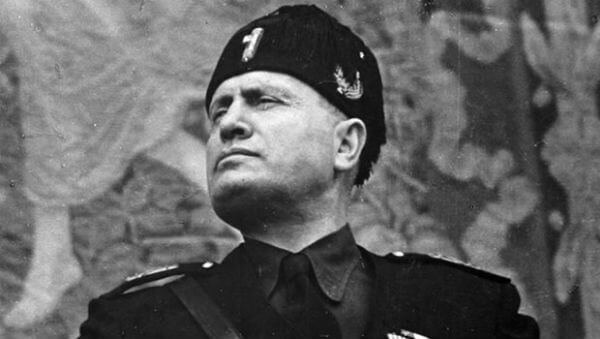
Trump inspired by Mussolini

.@realDonaldTrump retweeted a #Mussolini quote from @ilduce2016 whose account tweets out quotes as if said by Trump. pic.twitter.com/XDPAjwejgw
— Channel 4 News (@Channel4News) February 28, 2016
Jean-Marie Le Pen endorses Trump days after ex-KKK leader urges support
The Guardian reports: Donald Trump received a vote of confidence on Saturday from Jean-Marie Le Pen, the former leader of France’s Front National who in the past has said the Nazi occupation was not “particularly inhumane” and suggested Ebola could solve Europe’s “immigration problem”.
“If I were American, I would vote Donald Trump,” Le Pen tweeted on Saturday about the Republican frontrunner for president. “But may God protect him!”
Trump’s ascendance in American politics began with his promises to build a “big, beautiful wall” along the US-Mexican border, derogatory comments about Mexicans, and a promise to deport 11 million undocumented people.
Le Pen founded Front National, a far-right party that campaigns mostly on anti-immigration policies. [Continue reading…]
Donald Trump declines to disavow David Duke
The New York Times reports: Donald J. Trump declined on Sunday to disavow the support of David Duke, the white nationalist and ex-Ku Klux Klansman, who has called Mr. Trump “by far the best candidate.”
Mr. Duke, a former member of Congress who once ran for president, is famous for his white supremacist views and is generally considered a pariah in politics. In an interview with CNN, Mr. Trump pleaded ignorance about him.
“Well, just so you understand, I don’t know anything about David Duke,” Mr. Trump said. “I don’t know anything about what you’re even talking about with white supremacy or white supremacists.” [Continue reading…]
How the White House disregarded mounting evidence of an imminent Russian intervention in Syria
Reuters reports: Last July, Syrian President Bashar al-Assad seemed to be losing his battle against rebel forces. Speaking to supporters in Damascus, he acknowledged his army’s heavy losses.
Western officials said the Syrian leader’s days were numbered and predicted he would soon be forced to the negotiating table.
It did not turn out that way. Secret preparations were already underway for a major deployment of Russian and Iranian forces in support of Assad.
The military intervention, taking many in the West by surprise, would roll back rebel gains. It would also accelerate two shifts in U.S. diplomacy: Washington would welcome Iran to the negotiating table over Syria, and it would no longer insist that Assad step down immediately.
“That involved swallowing some pride, to be honest, in acknowledging that this process would go nowhere unless you got Russia and Iran at the table,” a U.S. official said.
At the heart of the diplomacy shift – which essentially brought Washington closer to Moscow’s position – was a slow-footed realization of the Russian military build-up in Syria and, ultimately, a refusal to intervene militarily.
Russia, Iran and Syria struck their agreement to deploy military forces in June, several weeks before Assad’s July 26 speech, according to a senior official in the Middle East who was familiar with the details.
And Russian sources say large amounts of equipment, and hundreds of troops, were being dispatched over a series of weeks, making it hard to hide the pending operation.
Yet a senior U.S. administration official said it took until mid-September for Western powers to fully recognise Russia’s intentions. One of the final pieces of the puzzle was when Moscow deployed aircraft flown only by the Russian military, eliminating the possibility they were intended for Assad, the official said. [Continue reading…]
Clear evidence that hospitals and medical workers are deliberate bombing targets in Syria

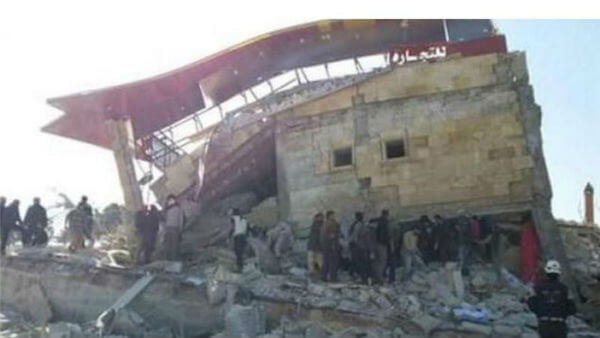
The New York Times reports: The hospital in the northern Syrian town of Maarat al-Noaman was not just grazed, or damaged, by the airstrikes last week. It was destroyed, taking a direct hit that pancaked its three stories into one, entombing and killing 25 people, including nine staff members.
It was struck at around 9:02 a.m., just as day-shift workers and patients were arriving; then again at around 9:05. As rescuers swarmed around, another explosion struck at 9:45, and another at 9:48. That same morning, two airstrikes hit the National Hospital on the other side of town, which was treating nurses injured in the attack on the first facility.
This detailed account, provided by the director of the hospital, which was supported by Doctors Without Borders, is one example of why many Syrian medical workers in insurgent-held areas and human rights groups believe medical facilities are not just being hit by stray bombs or indiscriminate attacks, but have long been deliberately targeted by the Syrian government and its Russian allies. It is a measure of the deep mistrust that gravely challenges prospects for a truce set to begin Saturday.
“I had the feeling they were trying to kill me,” said the director, Dr. Mazen al-Saoud, 55, in a telephone interview from Maarat al-Noaman, his hometown. “Wherever I went, there was bombing.”
According to Doctors Without Borders, there were 94 attacks last year alone on 67 hospitals and clinics the group supports in insurgent-held areas from northern to southern Syria, destroying 12 facilities and killing 23 staff members. In 2016, there have already been 17 attacks on health facilities, including six assisted by the group. [Continue reading…]
UN agency’s hiring of wife of top regime official draws criticism
The New York Times reports: When the World Health Organization wanted to know how the war in Syria was affecting the mental health of those forced to flee their homes, the agency hired someone known less for her expertise than for her connections: The consultant, Shukria Mekdad, is the wife of Faisal Mekdad, the deputy foreign minister of Syria and a powerful defender of the government’s war effort.
Her appointment has led critics to question the aid agency’s impartiality.
Jennifer Leaning, a professor at the Harvard T. H. Chan School of Public Health, questioned what she called the “optics” of hiring a senior Syrian government official’s wife as a consultant on something as sensitive as mental health. Not least, Ms. Leaning said, it would call into question any data Mrs. Mekdad gathers on the mental health of Syrians displaced by a war her husband has helped prosecute.
“At this point it reflects a degree of tone-deafness that is not appropriate,” Ms. Leaning said. [Continue reading…]
Syrian rebel factions say they will respect two-week truce
The Guardian reports: The main umbrella organisation for Syrian opposition groups backed by the west and Saudi Arabia has said armed groups fighting President Bashar al-Assad will respect a two-week truce beginning at midnight local time (10pm GMT).
The high negotiations committee (HNC) said nearly 100 rebel factions had agreed to the ceasefire, adding that the Syrian government and its allies must not launch attacks on the pretext of fighting terrorism.
The Russian president, Vladimir Putin, welcomed the announcement, saying that though the planned ceasefire was complex, there was no alternative.
Under the terms of the deal, armed groups had to confirm their commitment to the US or Russia no later than midday Damascus time. It was not immediately clear how many factions had refused to join the ceasefire or their military significance.[Continue reading…]