Author Archives: News Sources

America divided

John Brockman asked contributors to The Edge: what do you consider the most interesting recent scientific news? Jonathan Haidt responded: If you were on a selection committee tasked with choosing someone to hire (or to admit to your university, or to receive a prize in your field), and it came down to two candidates who were equally qualified on objective measures, which candidate would you be most likely to choose?

__A) The one who shared your race
__B) The one who shared your gender
__C) The one who shared your religion
__D) The one who shared your political party or ideology

The correct answer, for most Americans, is now D. It is surely good news that prejudice based on race, gender, and religion are way down in recent decades. But it is very bad news—for America, for the world, and for science—that cross-partisan hostility is way up.

My nomination for “news that will stay news” is a paper by political scientists Shanto Iyengar and Sean Westwood, titled “Fear and Loathing Across Party Lines: New Evidence on Group Polarization.” Iyengar and Westwood report four studies (all using nationally representative samples) in which they gave Americans various ways to reveal both cross-partisan and cross-racial prejudice, and in all cases cross-partisan prejudice was larger.

First they used a measure of implicit attitudes (the Implicit Association Test), which measures how quickly and easily people can pair words that are emotionally good versus bad with words and images associated with Blacks vs. Whites. They also ran a new version of the test that swapped in words and images related to Republicans vs. Democrats, instead of Blacks vs. Whites. The effect sizes for cross-partisan implicit attitudes were much larger than cross-race. If we focus just on White participants who identified with a party, the cross-partisan effect was about 50 percent larger than the cross-race effect. When Americans look at each other or try to listen to each other, their automatic associations are more negative for people from the “other side” than they are for people of a different race. [Continue reading…]


Facebooktwittermail

Donald Trump and the politics of disgust

decaycol

Alexander Hurst writes: In 2012, a team of academics from Europe and the U.S. — Yoel Inbar, David Pizarro, Ravi Iyer, and Jonathan Haidt — published a paper titled “Disgust Sensitivity, Political Conservatism, and Voting,” looking at the role disgust plays in political orientation. The researchers posited three different types of disgust: interpersonal disgust (i.e., the feeling produced by drinking from the same cup as someone else); core disgust (the response to maggots, vomit, dirty toilets, etc.); and animal-reminder disgust (how we react to corpses, blood, anything that evokes our animal nature).

Disgust, they write, “serves to discourage us from ingesting noxious or dangerous substances,” but also plays a role in moral and social judgments. Those who feel more disgusted by unpleasant images, smells, or tastes judge more harshly that which violates their subjective moral code.

The team had respondents position themselves on a political scale from conservative to liberal. The respondents then stated how strongly they agreed or disagreed with statements like “I never let any part of my body touch the toilet seat in a public washroom,” and rated other hypotheticals according to the level of disgust they generated. Even when controlling for age, education, geography, and religious belief, individuals with higher “disgust sensitivity” were found to be more likely to tolerate wealth inequality, view homosexuality negatively, and place more belief in authoritarian leaders and systems.

Most strikingly, interpersonal disgust was an important predictor of anti-immigrant attitudes.

Trump, of course, is a well-known, admitted germaphobe. “One of the curses of American society is the simple act of shaking hands,” he wrote in The Art of the Deal. “I happen to be a clean hands freak. I feel much better after I thoroughly wash my hands, which I do as much as possible.”

Trump even described shaking hands as “barbaric” in an interview with Dateline in 1999, saying, “They have medical reports all the time. Shaking hands, you catch colds, you catch the flu, you catch it, you catch all sorts of things. Who knows what you don’t catch?”

Beyond the aversion to hand-shaking, Trump used to pre-test his dates for AIDS, and reportedly avoids pushing elevator buttons.

The connection between modern xenophobia, disgust sensitivity, and the strength of Trump’s campaign is fairly easy to make. As Inbar, Pizarro, Iyer, and Haidt point out, “Disgust evolved not just to protect individuals form oral contamination by potential foods, but also from the possibility of contamination by contact with unfamiliar individuals or groups.” And after all, Trump’s success has come not from presenting voters with detailed policy proposals, but from connecting with them on a gut level. [Continue reading…]

Facebooktwittermail

A generation of failed politicians has trapped the West in a tawdry nightmare

decay

Pankaj Mishra writes: Racism, a beast cornered if not tamed after much struggle, has lumbered back to civil society in the solemn guise of “reforming” Islam. Tony Blair summons us to worldwide battle on behalf of western values while embodying, with his central Asian clients, their comprehensive negation. The handful of media institutions and individuals that are not obliged to flesh out Rupert Murdoch’s tweets on Muslims seem to be struggling to remain viable in an increasingly retrogressive political culture. Even the BBC seems determined not to stray far from the Daily Mail’s editorial line.

Unsurprisingly, we witness, as Judt pointed out, “no external inputs, no new kinds of people, only the political class breeding itself”. “The old ways of mass movements, communities organised around an ideology, even religious or political ideas, trade unions and political parties to leverage public opinion into political influence” have disappeared. Indeed, the slightest reminder of this democratic past incites the technocrats of politics, business and the media into paroxysms of scorn.

Having acted recklessly to create their own reality, they have managed to trap all of us in a tawdry nightmare – a male buddy film of singular fatuousness. At the same time, reality-making has ceased to be the prerogative of the American imperium or of the French and British chumocrats, who lost their empires long ago and are still trying to find a role for themselves.

Some random fanatic, it turns out, can make their reality far more quickly, coercing the world’s oldest democracies into endless war, racial-religious hatred and paranoia. Such is the great power surrendered by the crappy generation and its epigones. The generations to come will scarcely believe it. [Continue reading…]

Facebooktwittermail

Sheldon Adelson’s purchase of Las Vegas paper seen as a power play

The New York Times reports: Two days after Sheldon Adelson’s lawyers lost in their attempts to have a judge removed from a contentious lawsuit that threatens his gambling empire, a call went out to the publisher of this city’s most prominent newspaper.

Almost immediately, journalists were summoned to a meeting with the publisher and the general counsel and told they must monitor the courtroom actions of the judge and two others in the city. When the journalists protested, they were told that it was an instruction from above and that there was no choice in the matter.

It is unclear whether Mr. Adelson, who was then in talks to buy the newspaper, The Las Vegas Review-Journal, or his associates were behind the directive or even knew about it. But it was an ominous coincidence for many in the city who worry what will become of the paper now that it is owned by Mr. Adelson, a billionaire casino magnate and prominent Republican donor with a history of aggressively pursuing his interests.

Suspicions about his motives for paying a lavish $140 million for the newspaper last month are based on his reputation in Las Vegas as a figure comfortable with using his money in support of his numerous business and political concerns, said more than a dozen of the current and former Review-Journal staffers and local civic figures who have worked closely with him. [Continue reading…]

Facebooktwittermail

Marshes can rise to meet flood risks if we don’t disrupt mud flows

marshland

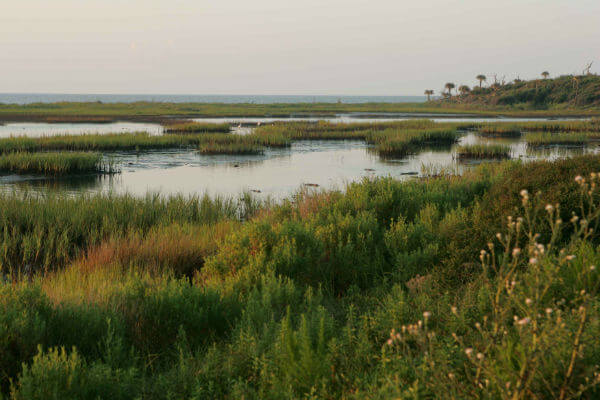
Climate Central reports: In the race to keep their verdure heads above rising seas, marshes that protect coastal regions from floods, storms and erosion harbor the botanical equivalents of nitro boosters: rapid growth fueled by climate-changing pollution.

The same greenhouse gas that’s doing most to warm the planet and uplift its seas can also work as a fertilizer. New research suggests that rising levels of heat-trapping carbon dioxide in the atmosphere could help communities of marsh plants grow quickly enough to keep up with changes that would otherwise inundate them.

“The fertilization effect from increased carbon dioxide in the atmosphere definitely enhances marsh-plant biomass functioning,” said Katherine Ratliff, a PhD candidate at Duke University who led modeling-based research published last month in Proceedings of the National Academy of Sciences.

The findings suggest that mud shortages — not growth rates — could be the greatest challenges for marshes as they strive to grow quickly enough to keep up with rising seas. Sea levels have risen 8 inches since the late 1800s, with several more feet expected this century. The fostering of coastal ecosystems is considered a key defense strategy against future flooding. [Continue reading…]

Facebooktwittermail

Electrifying India, with solar power and small loans

solar-india

The New York Times reports: A few years ago, the hundred or so residents of Paradeshappanamatha, a secluded hamlet in the southern Indian state of Karnataka, gathered along the central pathway between their 22 densely clustered homes, and watched as government workers hoisted a solar-powered streetlamp. As the first display of electricity in the town, it was an object of mild interest, but, being outside, the light didn’t help anyone cook or study, and only attracted moths.

Still, when B. Prasad arrived two years later to encourage people here to abandon kerosene lighting for solar-powered home systems, people had some idea what he was talking about. What sounded preposterous to the village residents was the price. Mr. Prasad, an agent for Solar Electric Light Company, or Selco, was selling a panel and battery that would power three lights and an attached socket for phone charging for approximately 12,800 rupees, or $192.

“There was no way we could afford that,” P. C. Kalayya remembers thinking. He and his neighbors rise early in the morning to walk miles along a nearly impassable dirt road to work on coffee, pepper and betel nut plantations. Mr. Kalayya earns $3 a day — he’d been earning $2.25 until a raise came through this year — and half his wage is withheld by his employer as repayment for various loans.

And yet, despite what seemed on its face an impossibly high cost, Selco agents succeeded in persuading Mr. Kalayya and 10 other village households to make the switch. Now, his wife can better see how much spice she is putting in as she cooks, and Pratima, their 18-year-old daughter, can study long after dark.

The idea behind Selco, and other companies like it, is to create a business model that will help some of the 1.2 billion people in the world who don’t have electricity to leapfrog the coal-dependent grid straight to renewable energy sources.

About a quarter of the world’s off-the-grid people, or 300 million or so, live in India, mostly in remote, rural communities like Paradeshappanamatha, or in informal urban settlements. Hundreds of millions more get electricity for only a few hours a day. Prime Minister Narendra Modi has pledged to achieve universal electrification in India by the end of 2022. His main effort is adding hundreds of new coal plants, which have contributed to near-apocalyptic pollution levels across large swaths of the country. [Continue reading…]

Facebooktwittermail

The war on freedom of expression across the Middle East

Rami G Khouri writes: It is useful to spot meaningful patterns that help us make sense of our bewildering world, and to acknowledge positive developments to be continued alongside negative ones to be avoided.

Applying this principle to the last year in the Middle East reveals several troubling trends that have made life difficult for hundreds of millions of people. One in particular stands out, and strikes me as a root cause of many other negative trends that plague our region. This is the tendency of governments to use increasingly harsh measures to restrict the freedoms of their citizens to express themselves and meaningfully to participate politically and hold power accountable.

Several aspects of this behavior make it especially onerous. It is practiced by all states in the region—Arab, Israeli, Iranian, and Turkish—leaving few people in this part of the world who can live as fully free and dignified human beings. It is justified on the basis of existing constitutional powers, so governments can jail tens of thousands of their citizens, rescind their nationality, or torture and kill them in the worst cases, simply because of the views they express, without any recourse to legal or political challenge. It shows no signs of abating, and indeed may be worsening in lands like Egypt, Turkey, and others. And, it is most often practiced as part of a “war on terror” that seeks to quell criminal terror attacks, but in practice achieves the opposite; the curtailment of citizen rights and freedoms exacerbates the indignities and humiliations that citizens feel against their government, which usually amplifies, rather than reduces, the threat of political violence. [Continue reading…]

Facebooktwittermail

War in Syria: Up to 40,000 civilians are starving in besieged Madaya, say campaigners

The Independent reports: Up to 40,000 civilians are slowly starving to death in the Syrian town of Madaya, activists have warned, after six months under a punishing siege.

Encircled by land mines and forces from the Lebanese militia Hezbollah, hundreds are suffering from malnutrition. With severe shortages of basic foodstuffs, many have resorted to eating wild plants, insects and even cats.

A media activist in the town, who used the pseudonym Nasir Ibrahim to protect his family, said that on New Year’s Eve he had managed to eat 50g of rice. Today, with snow covering the mountain-top town, he expected to go hungry. “The humanitarian situation is very dangerous,” he told The Independent. “Many have died starving and many more will follow them if no immediate aid is allowed in.”

In recent weeks, photographs of emaciated corpses have begun to emerge from the town, which is high in the mountains a few miles from the border with Lebanon. Around 20 men have so far perished from starvation, according to Mr Ibrahim. [Continue reading…]

Facebooktwittermail

On perilous refugee trail, women often become prey to sexual abuse

The New York Times reports: One Syrian woman who joined the stream of migrants to Germany was forced to pay down her husband’s debt to smugglers by making herself available for sex along the way. Another was beaten unconscious by a Hungarian prison guard after refusing his advances.

A third, a former makeup artist, dressed as a boy and stopped washing to ward off the men in her group of refugees. Now in an emergency shelter in Berlin, she still sleeps in her clothes and, like several women here, pushes a cupboard in front of her door at night.

“There is no lock or key or anything,” said Esraa al-Horani, the makeup artist and one of the few women here not afraid to give her name. She has been lucky, Ms. Horani said: “I’ve only been beaten and robbed.”

War and violence at home, exploitative smugglers and perilous seas along the way, an uncertain welcome and future on a foreign continent — these are some of the risks faced by tens of thousands of migrants who continue to make their way to Europe from the Middle East and beyond. But at each step of the way, the dangers are amplified for women.

Interviews with dozens of migrants, social workers and psychologists caring for traumatized new arrivals across Germany suggest that the current mass migration has been accompanied by a surge of violence against women. From forced marriages and sex trafficking to domestic abuse, women report violence from fellow refugees, smugglers, male family members and even European police officers. There are no reliable statistics for sexual and other abuse of female refugees. [Continue reading…]

Facebooktwittermail

Saudi mass execution driven by fear of Sunni militancy

Angus McDowall writes: The Al Saud ruling family regard the expansion of Shi’ite Iran’s influence in the Middle East as a threat to their security and to their ambition of playing the leading role among Arab states.

Inside the kingdom, however, it is the threat of a rebellion by the majority Sunnis that most alarms a dynasty whose rule is based on conservative support at home and an alliance with the West.

All past threats to the Al Saud, from a 1920s tribal rebellion to riots in the 1960s, a siege at Mecca’s Grand Mosque in 1979 and protests in the 1990s, were caused by conservative Sunni anger at modernisation or ties with the West.

That was why the al Qaeda uprising that began in 2003, and attacked the Al Saud by turning its own conservative Salafi brand of Sunni Islam against it, was such a danger. It is why the jihadist movement’s latest iteration, Islamic State, is also a problem.

While Islamic State seems to lack real support among Saudis, some may sympathise with its broader goals, approving of its rhetoric against Shi’ites and the West and its criticism of corruption among the Al Saud.

By executing al Qaeda ideologues and attackers, Riyadh was showing its determination to crush support for the militant cause. By also killing four Shi’ites, angering Iran in the process, it was telling conservative Sunnis it was still on their side. [Continue reading…]

Facebooktwittermail

Saudi execution: Call for West to condemn killing of Shia cleric

Martin Chulov reports: Shia Islamic leaders on Sunday stepped up their condemnation of the Saudi execution of the prominent Shia cleric Sheikh Nimr al-Nimr, urging a robust response from Riyadh’s western backers, who are yet to fully address the issue.

David Gauke, financial secretary to the Treasury, became the most senior UK figure to react to the execution, which has led to clashes in Tehran, and prompted widespread denunciation elsewhere. He said al-Nimr’s death was a “worrying development”. The US State Department had said earlier that the move risked “exacerbating sectarian tensions at a time when they urgently need to be reduced”.

Anger remained palpable on the streets of the Lebanese capital, and in Bahrain and Baghdad, hours after the Saudi embassy in Tehran was torched by protesters angered by the execution of a senior cleric who had been championed by Iranian leaders.

However, in what appeared to be a move to calm tensions, the Iranian president, Hassan Rouhani, said the attack on the embassy was unjustifiable, and urged that the perpetrators be dealt with.

“I have no doubt that the Saudi government has damaged its image, more than before, among the countries in the world – in particular (among) Islamic countries – by this un-Islamic act,” Rouhani said.

Taking a cautionary tone, he added: “We will not allow rogue elements” to use the incident and “carry out illegal actions that damage the dignity of the Islamic republic establishment”.

“I call on the interior minister to identify the perpetrators of this attack with firm determination and introduce them to the judiciary … so that there will be an end to such appalling actions once and for all.”

Iran’s supreme leader, Ayatollah Ali Khamenei, called on Saudi Arabia’s western backers to directly condemn the execution, which came three years after al-Nimr was arrested following his vocal support for anti-government protests in Bahrain and Riyadh.

“This oppressed cleric did not encourage people to join an armed movement, nor did he engage in secret plotting, and he only voiced public criticism … based on religious fervour,” said Khamenei, who criticised “the silence of the supposed backers of freedom, democracy and human rights” over the execution. [Continue reading…]

The New York Times reports: Sheikh Nimr, said to be in his mid-50s, was from Awamiyah, a poor town surrounded by palm groves in eastern Saudi Arabia and known for opposition to the monarchy.

He studied in Iran and Syria, but rose to prominence for fiery sermons after his return in which he criticized the ruling family and called for Shiite empowerment, even suggesting that Shiites could secede from the kingdom.

This gained him a following mostly among young Shiites who felt discriminated against by Persian Gulf governments. When these young people joined Arab Spring protests in Bahrain and eastern Saudi Arabia in 2011, Sheikh Nimr became a leading figure.

During a sermon in 2012, Sheikh Nimr mocked Prince Nayef bin Abdulaziz, who had been the Saudi interior minister and had recently died.

“He will be eaten by worms and suffer the torments of hell in the grave,” Sheikh Nimr said. “The man who made us live in fear and terror; shouldn’t we rejoice at his death?”

Prince Nayef’s son, Mohammed bin Nayef, is now the crown prince and runs the Interior Ministry, which carries out death sentences. [Continue reading…]

Facebooktwittermail

Saudi Arabia’s mounting security challenges

Bruce Riedel writes: The kingdom announced its new budget Dec. 28 with a record $87 billion deficit. Revenues are projected at $137 billion and spending at $224 billion.

Riyadh’s immediate priority is the war in Yemen. The war costs an estimated $200 million a day, or $6 billion a month. The Saudi coalition and the Houthi rebels both violated the last United Nations-sponsored cease-fire. The Saudis did gain control of the capital of Jawf province along the Saudi border during the supposed truce. The talks in Biel, Switzerland, did not produce a breakthrough, but are to resume Jan. 14.

The Houthis show no sign of giving up. Their leadership remains hard-line and defiant. The war appears to be a bloody stalemate that has catastrophic humanitarian costs for Yemenis. The outside world pays little if any attention. [Continue reading…]

Facebooktwittermail

Saudi execution of Shia cleric poses a direct challenge to Iran

Simon Tisdall writes: The consequences of Saudi Arabia’s mass execution of 47 people will be felt far beyond its Eastern Province, which was home to Nimr al-Nimr, the leading Shia Muslim cleric who was the most prominent figure among those to die.

Unlike many of the Sunni Muslims executed for alleged complicity in al-Qaida terrorism, Nimr was an advocate of non-violent resistance to the unelected Saudi regime. He was arrested in 2012 for criticising the royal family.

His plight reflected the trials and tribulations of Saudi Arabia’s Shia minority, which accounts for 15% of the country’s 29 million people and has suffered, historically, from institutionalised discrimination and periodic security crackdowns.

The al-Qatif governorate of Eastern Province, bordering the Gulf, has been the setting for anti-regime agitation since at least 1979, when Saudi Shias demonstrated in support of Ayatollah Ruhollah Khomeini, whose Islamic revolution in Iran that year toppled the shah. Trouble erupted again in 2011-13, triggered by the Arab Spring uprising of the Shia majority in nearby Bahrain and its subsequent brutal, Saudi-assisted suppression. [Continue reading…]

Mark Townsend adds: In October 2014, Saudi Arabia’s specialised criminal court sentenced Nimr to death for seeking ‘foreign meddling’ in the kingdom along with ‘disobeying’ its rulers and taking up arms against the security forces”. His brother, Mohammad al-Nimr, tweeted information about the death sentence and was promptly arrested on the same day.

As news of the sentence travelled, the head of Iran’s armed forces warned Saudi Arabia that it would “pay dearly” if it dared execute the cleric. Powerful and prominent in life, it is the nature of Nimr’s death that could shape his legacy. [Continue reading…]

Facebooktwittermail

Meltdowns, crises and ISIS: A terrible year in the Middle East

By Simon Mabon, Lancaster University

As we approach the fifth anniversary of the Arab Uprisings, it’s hard to remember the days of popular protests, of democratic revolutions and of dreams of a better future that rocked the Middle East in 2011. Nearly five years on, tensions between rulers and the ruled have exploded across the region – and the ensuing struggles for survival have continued to take all manner of ugly forms.

At the centre of things, the Syrian conflict has deepened – and while the brutality of Islamic State (IS) has been responsible for much of the recent chaos and tragedy across Syria, the regime of Bashar al-Assad has been responsible for seven times as many Syrian deaths as IS. Assad’s position was strengthened by continued support from Russia, Iran and Lebanon’s Hezbollah, antagonising powerful states in the West and the Gulf – particularly Saudi Arabia. The Gulf states also faced domestic threats from IS, with the group carrying out a number of attacks on Shia sites and communities across the region.

The Syrian conflict became ever more internationalised in 2015. The number of foreign fighters on the ground – on all sides – continued to grow, while on the diplomatic level, the Vienna talks tried to resolve the seemingly intractable conflict – though they have yet to yield any decisive action.

The task of dealing with IS was further complicated by a batch of new wilayats, groups who declared allegiance to IS. Wilayat Sinai in particular was purportedly responsible for a range of acts, allegedly including a massive bomb attack in Cairo and the downing of a Russian passenger jet over Egypt’s Sinai Peninsula.

Continue reading

Facebooktwittermail

U.S. and allies conduct 24 air strikes against ISIS targets in Iraq

Reuters reports: The US and its allies conducted 24 air strikes against Islamic State targets in Iraq on Thursday, the US military said on Friday.

It said in a statement the strikes targeted Isis positions in seven areas. Four strikes near the city of Ramadi, the centre of which fell to Iraqi forces this week, hit a large tactical unit and destroyed a vehicle-borne improvised explosive device facility, five militant fighting positions and two heavy machine guns.

Near Tal Afar, 11 strikes destroyed nine bunkers, five culverts and four bridges used by the militants. Near Mosul, three strikes struck a tactical unit and destroyed two heavy machine guns, six fighting positions, a weapons cache and a trench.

In Ramadi, terrified families waved white flags as they emerged from homes reduced to rubble. Government troops were still battling Isis fighters holed up on Friday, five days after the army recaptured the city centre. [Continue reading…]

Facebooktwittermail

Munich on high alert after New Year’s Eve terrorism threat

The New York Times reports: Hundreds of police officers remained on alert in Munich on Friday, after a threat of a suicide bombing attack by the Islamic State led the authorities to evacuate two train stations on New Year’s Eve.

The German authorities said on Friday that five to seven people may have been involved in the terrorist threat. The two stations, in the city center and in the Pasing district, were both reopened.

Officials defended their decision to close the two transit hubs hours before midnight and to flood the city with heavily armed officers — 550 as of Friday morning, including police officers from other parts of the southern state of Bavaria. They said they had received a “very concrete tip” around 7:40 p.m. from intelligence sources in France and the United States indicating that militants from Iraq and Syria were planning to carry out attacks. [Continue reading…]

Facebooktwittermail

Pegida leader criticised for linking Munich terror plot with city’s refugee intake

The Guardian reports: The leader of Germany’s anti-Islamic Pegida movement has caused indignation by linking a planned terrorist attack on Munich’s railway station with the tens of thousands of refugees who were applauded when they arrived there earlier this year.

In a tweet sent soon after police shut the station, Lutz Bachmann said that Germans who welcomed the refugees as they disembarked from trains should go back there and risk being blown up.

“All welcome-clappers should arrive immediately at Munich’s main train station,” Bachmann posted. He added the hashtag #RefugISISnotWelcome, a swipe at leftwing groups who have held counter-demonstrations at Pegida rallies using the slogan: “Refugees are welcome here.” [Continue reading…]

Facebooktwittermail

Monitoring of terrorism threats has risen, official says

The New York Times reports: A senior European counterterrorism official said on Thursday that spy services in several countries had increased their monitoring and surveillance, and governments had put heightened security measures in place, even before recent arrests in Belgium and Turkey.

Hours after the official spoke, the police in the southern German city of Munich evacuated two train stations and warned residents to avoid large groups of people, citing “concrete hints” of a possible terrorist attack amid New Year’s celebrations.

Joachim Herrmann, interior minister for the state of Bavaria, of which Munich is the capital, told reporters early Friday that the German authorities had been tipped by a foreign intelligence service that the Islamic State was linked to a plot to carry out attacks in Munich.

Hubertus Andrä, head of the Munich police, said officials suspected that several suicide bombers had planned to carry out the attacks. [Continue reading…]

Facebooktwittermail