
Author Archives: News Sources

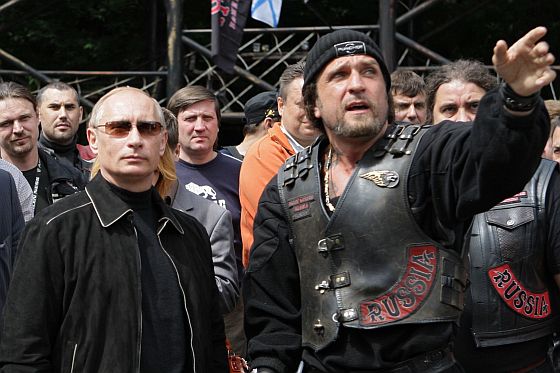
The Night Wolves — Putin’s biker friends — plan to descend on Berlin

night-wolves

The New York Times reports: Several hundred leather-clad motorcyclists from the Night Wolves, a club closely allied with President Vladimir V. Putin of Russia, plan to roar from Moscow to Berlin this month for the 70th anniversary of the Soviets’ victory over Nazi Germany.

Like the Red Army before them, the Night Wolves will have several countries to cross on the way, including Poland. And given the current tensions over Ukraine and widespread worries that Mr. Putin may have other aggressive designs on his neighbors, the prospect of hundreds of Russian bikers’ roaring across the Polish countryside — not to mention Slovakia, the Czech Republic, Austria or Germany — is not being greeted with joy in all quarters.

“I wish they would never come here,” said Monika Trzcinska, the mayor of Braniewo, a small Polish town a stone’s throw from the Russian border, which will be the first stop in Poland for some of the riders on April 25.

A Facebook page opposing the event had 11,000 likes by Wednesday afternoon with a logo featuring a Polish eagle with a lit match chasing a flaming wolf. Meanwhile, a petition calling for the motorcycle rally to be banned had attracted 4,000 signatures, and some Polish lawmakers were calling on their government to find some way to block the event.

Prime Minister Ewa Kopacz called the rally a “provocation” in an interview Tuesday on Polish radio, and said it would be up to Polish border guards to decide whether Russian bikers would be allowed into the country.

Some Polish biker groups said they intended to take to the highways to block the Russians, but others were more welcoming. [Continue reading…]


Facebooktwittermail

Turkey’s century of denial about the Armenian genocide

The New York Times reports: The crumbling stone monastery, built into the hillside, stands as a forlorn monument to an awful past. So, too, does the decaying church on the other side of this mountain village. Farther out, a crevice is sliced into the earth, so deep that peering into it, one sees only blackness. Haunting for its history, it was there that a century ago, an untold number of Armenians were tossed to their deaths.

“They threw them in that hole, all the men,” said Vahit Sahin, 78, sitting at a cafe in the center of the village, reciting the stories that have passed through generations.

Mr. Sahin turned in his chair and pointed toward the monastery. “That side was Armenian.” He turned back. “This side was Muslim. At first, they were really friendly with each other.”

A hundred years ago, amid the upheaval of World War I, this village and countless others across eastern Anatolia became killing fields as the desperate leadership of the Ottoman Empire, having lost the Balkans and facing the prospect of losing its Arab territories as well, saw a threat closer to home.

Worried that the Christian Armenian population was planning to align with Russia, a primary enemy of the Ottoman Turks, officials embarked on what historians have called the first genocide of the 20th century: Nearly 1.5 million Armenians were killed, some in massacres like the one here, others in forced marches to the Syrian desert that left them starved to death.

The genocide was the greatest atrocity of the Great War. It also remains that conflict’s most bitterly contested legacy, having been met by the Turkish authorities with 100 years of silence and denial. For surviving Armenians and their descendants, the genocide became a central marker of their identity, the psychic wounds passed through generations.

“Armenians have passed one whole century, screaming to the world that this happened,” said Gaffur Turkay, whose grandfather, as a young boy, survived the genocide and was taken in by a Muslim family. Mr. Turkay, in recent years, after discovering his heritage, began identifying as an Armenian and converted to Christianity. “We want to be part of this country with our original identities, just as we were a century ago,” he said.

The 100th anniversary will be commemorated on April 24, the date the Ottomans rounded up a group of Armenian notables in Istanbul in 1915 as the first step in what historians now agree was a wider plan of annihilation. Armenians from Turkey and the diaspora are preparing to gather in Istanbul’s central Taksim Square to honor the dead. They will also hold a concert featuring Armenian and Turkish musicians.

Similar ceremonies will be held in capitals around the world, including in Yerevan, the capital of Armenia, where Kim Kardashian, who is of Armenian descent, recently visited with her husband, the rapper Kanye West, to highlight the genocide.

The Turkish government acknowledges that atrocities were committed, but says they happened in wartime, when plenty of other people were dying. Officials stoutly deny there was ever any plan to systematically wipe out the Armenian population — the commonly accepted definition of genocide. [Continue reading…]

Facebooktwittermail

Turkish army clashes with PKK

Fehim Taştekin writes: Guns had fallen silent thanks to a de facto cease-fire and the peace process had been moving along, if not at desired pace. The country was preparing for general elections when clashes broke out between the Turkish Armed Forces (TSK) and the Kurdistan Workers Party (PKK) at Agri, a province near the border with Iran. Suddenly, Turkey found itself experiencing terror and chaos. The clashes in Agri followed warnings that the ruling Justice and Development Party (AKP) might resort to provocation as it tries to set up a presidential system and ensure that the pro-Kurdish People’s Democracy Party (HDP) does not cross the 10% electoral threshold.

Mayhem ensued. Even before the clashes ended, President Recep Tayyip Erdogan accused the HDP of politicking under the shadow of guns. HDP Co-chair Selahattin Demirtas accused the AKP of panicking over unfavorable opinion polls, saying, “What happened at Agri was a pre-planned provocation.”

What was the incident that amplified political tensions so much?

According to the government version, in the village of Yukaritufek of Diyadin township in Agri province, PKK members organized a spring festival. The government received intelligence that the terror outfit would use the occasion to spread propaganda and pressure people to vote for the HDP in coming elections. The governor of Agri instructed the provincial gendarmerie command to send a special forces detachment of 15 soldiers to the location. It was reported that terrorists opened rifle fire on soldiers deployed near the village. After 12 hours of combat, the TSK announced that four soldiers had been wounded, five PKK members had been killed and one had been captured. [Continue reading…]

Facebooktwittermail

Iranians cannot build democracy in the shadow of war

Akbar Ganji writes: The vast majority of the Iranian people aspire to have democracy and, thus, want to make a peaceful transition from an Islamic theocracy to a democratic state. They deserve to have democracy and no one should put obstacles in their way. The Iranians know that they must build democracy in Iran. They also know that they cannot walk on water, or create a peaceful democracy in the shadow and threat of war.

But there are western governments, as well as members of the Iranian opposition in diaspora that want Iranians to go through hellfire to achieve their aspirations. More Iranians reject this, because they have closely followed the experiences of other nations in their region over the past decade or so, and see that the Middle East is soaked with blood. They know the fates of Afghanistan, Iraq, Libya, Syria and Yemen – nations that were either invaded by the United States, bombed back to the Medieval age (Libya) or destroyed by a sectarian war instigated by US allies in the Middle East (Syria).

None of these nations has become a democratic state. The state of human rights in all of these nations is far worse than before their crippling wars. Their national security systems have collapsed and terrorism has spread. The only “fruits” of the military intervention in the Middle East and North Africa over the past 15 years have been civil wars, terrorism and disintegration of nation states. Since the attacks of 11 September 2001, at least 1.3 million people have been killed in Afghanistan, Iraq and Pakistan. Millions of people have either been injured or have become internal refugees within their own countries or abroad.

Iranian people want democracy, but they are keenly aware that security and peace are the prerequisites for building democracy and respect for human rights. Iranians rejoiced after the joint political statement by Iran and P5+1 was read in Lausanne, Switzerland by Federica Mogherini, the High Representative of the European Union for Foreign Affairs, outlining the framework of the agreement between the two sides over Iran’s nuclear programme.

Why were the Iranian people so happy and celebrating in the streets? Was the announcement a great victory for their nation? It surely was not politically, because Iran made many concessions, and received comparatively little in return.

But it was indeed a great victory for Iran and Iranians, if we look at it from a democracy angle. In the view of Iranians, the negotiations between Iran and P5+1 was a “wrestling match” between war and peace. War was defeated by peace, and its threat was destroyed. It was a hopeful sign for Iranians everywhere.

When a nation such as Iran is threatened by the US and Israel for over two decades, and suffers from the most crippling economic sanctions in history, democracy becomes an impossible dream for its people, who live instead in terror and fear of war. Even now, after the announcement of the Lausanne agreement, Israeli leaders continue to threaten Iran with military attacks. [Continue reading…]

Facebooktwittermail

Iranian president: We are in talks with ‘the major powers,’ not the U.S. Congress

The Washington Post reports: Iranian President Hassan Rouhani said Wednesday that Tehran was negotiating a comprehensive nuclear deal with world powers, not the U.S. Congress, and called a Senate committee’s vote to give Congress the power to review any potential deal a domestic U.S. matter.

The Iranian leader, speaking in a televised speech in the northern Iranian city of Rasht, also repeated earlier statements that his country will not accept any comprehensive nuclear deal with world powers unless all sanctions imposed against it are lifted.

“We are in talks with the major powers and not with the Congress,” Rouhani said, Iranian state television reported. Rouhani said the U.S. Congress’ power to review a nuclear deal with Iran was a domestic U.S. matter, the Reuters news agency reported.

He said Iran wanted to end its isolation from the world by constructing “constructive interaction with the world and not confrontation.”

Rouhani’s comments came one day after a Senate committee voted unanimously to give Congress the power to review a potential Iran nuclear deal after a June 30 negotiating deadline, in a compromise with the White House that allows President Obama to avoid possible legislative disapproval of the pact before it can be completed. [Continue reading…]

Facebooktwittermail

Hamas warily eyes proposals for long-term truce with Israel

Adnan Abu Amer reports that international envoys visiting Gaza are in discussions with Hamas: The increased tempo of international proposals to extend the truce is coinciding with mounting warnings about a conflagration in Gaza caused by the continued siege, the lack of progress in reconciling with Fatah and the similarity in the security and on-the-ground conditions today, compared with those that preceded the last war in July 2014. Taher al-Nunu, Hamas’ media adviser, told Al-Monitor, “The proposals currently considered complement efforts to bolster the cease-fire with Israel. Hamas will present those proposals to all remaining factions, with whom we shall consult to adopt a unified stance.”

Israeli media outlets published details about the truce proposals on March 11, reporting that Israel and Hamas were considering achieving a 15-year cease-fire, during the first five years of which both sides would undertake to cease all military operations in exchange for lifting the siege and building sea and air ports in Gaza.

But Gaza’s Deputy Foreign Minister Ghazi Hamad, one of Hamas’ most prominent negotiators with international envoys, told Al-Monitor, “No practical progress has been achieved with Western diplomatic sources visiting Gaza in relation to the sea and air ports dossier; because Israel refuses to hand Hamas a victory after the last battle.” [Continue reading…]

Facebooktwittermail

We must talk to terrorists to restore their humanity — and ours

By Simon McMahon, Coventry University; Heaven Crawley, Coventry University, and Math Noortman, Coventry University

The twin towers, Madrid, July 7, Charlie Hebdo… the list of terrorist political acts and their victims feels endless. When people are killed and lives threatened for political motivations, demands for immediate reprisals and military counter-measures usually follow suit.

Military force and policing is our default tactic – and talking to terrorists, by contrast, feels counter-intuitive. After all, surely talking to murderers, criminals and fanatics will only legitimise their aims and tactics.

And yet, from Nelson Mandela’s African National Congress to Gerry Adams’ Sinn Fein to Yasser Arafat’s Palestinian Liberation Organisation, history shows that talking with terrorists has often been a prerequisite for peace.

A recent debate organised by Coventry University’s Centre for Trust, Peace and Social Relations brought together a former terrorist, the daughter of a victim of a terrorist bomb attack and experts on extreme violence to discuss whether we should in fact talk to terrorists.

The resounding conclusion was that there is no choice other than to talk to terrorists to bring their violence to an end. But, for genuine dialogue which addresses root causes as well as violent symptoms we need to shift our own ways of thinking too. We need to talk with those who are defined or labelled as terrorists, not simply to or at them.

Continue reading

Facebooktwittermail

U.N. confirms new push for Syria talks, Iran to be invited

Reuters: The United Nations said on Tuesday that its Syria envoy Staffan de Mistura planned to consult Syrian factions and interested countries on a new round of peace talks, confirming a Reuters report.

“Starting in May … de Mistura will proceed with a series of in-depth, separate consultations with the Syrian stakeholders and regional/international actors to take stock of their views as of today,” U.N. spokesman Stephane Dujarric said.

A U.N. spokesman in Geneva, Ahmad Fawzi, said de Mistura was “heavily engaged” in discussions on the process, which would be based on the Geneva communiqué, the June 2012 document that set out a path to peace and political transition but left unresolved the future role of Syrian President Bashar al-Assad.

Facebooktwittermail

Inside Yarmouk refugee camp

The Daily Beast reports: Bombs and shells from all sides continue to rain down on Yarmouk, the Palestinian refugee camp on the outskirts of Damascus, as residents say the so-called Islamic States is taking ever-greater control. The jihadist assault that started April 1 has left residents trapped amid the rubble without medical aid or food while street fighting and heavy shelling by ISIS has overwhelmed Palestinian and Free Syrian Army forces trying to protect the camp. And to make matters works, the Syrian regime has been dropping barrel bombs and intensifying its own artillery barrages, raising fears it will invade with ground forces.

“It’s an absolute horror and I’m terrified,” says 27-year-old Tarek over Skype from near ISIS’s front lines. He is a longtime camp resident who became an activist in 2011 with the anti-regime protest movement. A human-rights organization put The Daily Beast in contact with him and he asked to be quoted only by a pseudonym for obvious security reasons.

Tarek worries that a regime ground invasion could trigger wide-scale massacres committed by the troops of President Bashar al Assad along with jihadist reprisal killings. He describes a situation of chaos in a camp — really a densely populated urban neighborhood — that has been increasingly crippled by the regime’s siege and bombardment since Free Syrian Army forces and Palestinian rebels rose up in December 2012.

“The streets are abandoned and filled with rubble as people hide in their homes,” Tarek says. Many residents have run out of food and water. There are desperate scenes as some of those come out to scour the area under sniper fire and shelling and look for wells. [Continue reading…]

Facebooktwittermail

Soleimani: No more selfies

Arash Karami writes: When the fighters of the Islamic State (IS) took over large parts of western Iraq in the summer of 2014, Iran did not hesitate to assist both Iraqi and Kurdish forces in pushing back against the advance of the terrorist group. Iran’s geopolitical decision was also accompanied by what seemed an unofficial media decision: to promote the status of Quds Force Cmdr. Qasem Soleimani in the fight against IS.

Pictures of Soleimani at the front line among Iraqi forces surfaced on social media overnight. The various Facebook, Twitter and Instagram pages dedicated to Soleimani had begun to act as his unofficial media arm, and his popularity has soared online. Often he could be seen looking at the camera, making no attempt to conceal that Iran had sent its commander in charge of regional policy to Iraq.

But now it seems that Soleimani has had enough. In an April 11 open letter to an Iranian filmmaker requesting that he cease producing a film about him, Soleimani also denied some of the things said about him on social media and asked officials to control the rumors. [Continue reading…]

Facebooktwittermail

Libya migrants: Hundreds feared drowned in Mediterranean

BBC News: About 400 migrants are feared drowned after their boat capsized off Libya, survivors have told Save the Children.

The Italian coast guard rescued 144 people from the boat on Monday and launched an air and sea search operation in hopes of saving others.

Hundreds more migrants rescued from boats in the Mediterranean are due to arrive in Sicily during the day.

More than 8,000 migrants have been picked up since Friday, and more boats are heading for the Italian coast.

Facebooktwittermail

Is Turkey heading towards one-man rule?

The Daily Beast reports: Is NATO ally Turkey on track to become a country under one-man rule?

With parliamentary elections scheduled for June 7, President Recep Tayyip Erdogan is trying to cement his all-powerful role in Turkish politics by sending his son-in-law to parliament. Berat Albayrak, 42, a former executive turned newspaper columnist — who is married to Erdogan’s older daughter, Esra — is running for a seat for Erdogan’s ruling Justice and Development Party (AKP) in Istanbul. Some media reports suggest Albayrak could be promoted to a ministerial post after the vote.

Other Erdogan confidants on the AKP ticket, which was published this past week, include Mucahit Arslan, an adviser, Aydin Unal, a former speechwriter, and Ali Ozkaya, Erdogan’s lawyer.

Although the constitution says the president has to be above politics, Erdogan, who was elected president last August, continues to control the ruling party and to direct the government of his successor as prime minister, Ahmet Davutoglu. Erdogan has chaired two cabinet meetings as president this year. The president has also openly campaigned for the AKP ahead of the June elections. In a speech on Wednesday, he accused opposition parties and media of supporting terrorism.

Erdogan, 61, aims for a big win for the APK in June to push through constitutional changes to change Turkey’s system of government, moving it from a parliamentary to a presidential one — with himself at the top, of course. He says he wants 400 out of 550 seats in the new parliament filled with deputies who support the switch to the presidential system. [Continue reading…]

Facebooktwittermail

Playing for Palestine

Ismail Khalidi writes: As you enter through its main gate under a pair of fluttering Palestinian flags, the Cisterna municipal stadium looks like any run-down soccer field in the West Bank or the Jordan Valley. The parking lot is unpaved and the cars entering for the afternoon game send up yellow clouds of dust. The stadium itself is simple and small, an outdated concrete bowl that officially holds 12,000 people (though, according to statistics, rarely more than a few thousand), most of whom sit on concrete bleachers that encircle the pitch. The concentric rows of stone bleachers even seem to conjure the ancient terraced slopes of Palestine, where for millennia farmers have sculpted the hillsides to cultivate olive trees and other sturdy crops in the dry Mediterranean climate. Here and there sprigs of grass inch through cracks in the dilapidated concrete and stone as a couple hundred of us settle in to brave two hours of scorching heat for the afternoon match.

The team that calls Cisterna home takes the field in uniforms adorned with the Palestinian flag (and its colors of red, black, green and white) and a prominent gold map of historic Palestine emblazoned across the front of their jerseys. The players, for their part, look like your average Palestinians, as do the fans, some of whom are already taunting the opposing team’s players with witty asides and double entendres before the opening whistle. Cigarette smoke, a given at any Palestinian gathering, lingers over certain sections as vendors walk back and forth hawking Palestine-themed paraphernalia. Meanwhile, a group of five young kids plays soccer along the aisles, using an empty plastic bottle as their ball. At half-time Arabic music blares through a tinny PA system. Taking it all in, one could perhaps take comfort in the fact that, despite the hardships of living under military occupation, it’s apparently still possible for Palestinians to find a modicum of normality, if only for 90 minutes of soccer.

But Cisterna municipal stadium is not in Nablus, Gaza, Jericho or Jerusalem, but in Santiago de Chile, roughly 8,000 miles away from Palestine/Israel. And the home team, Club Deportivo Palestino, is in the Chilean premiere league. The opposing team on this day, Huachipato, hails from the Southern Coastal city of Talcahuano. [Continue reading…]

Facebooktwittermail

American academia — liberal in name but conservative in practice

The Daily Beast: The academy might seem like a bastion of American liberalism but an extensive database of faculty salaries compiled by The Chronicle of Higher Education paints a damning picture of gender inequality at U.S. colleges and universities.

Not only does the data reveal a substantial gender pay gap at both private and public schools, it also shows that male-dominated college faculties disproportionately rely on the labor of women in instructor and lecturer positions.

Women may keep our colleges running but the American university is still an old boys’ club.

The Chronicle of Higher Education’s new tool displays faculty and staff salary data from over 4,700 colleges and universities stretching from 2003 to 2013. The federal data powering the database isn’t brand new but it provides the starkest and most accessible visualization yet of the gendered distribution of labor in the American academy.

Facebooktwittermail

Netanyahu told cabinet: Our biggest fear is that Iran will honor nuclear deal

Haaretz reports: Prime Minister Benjamin Netanyahu said at a recent meeting of the security cabinet that if a comprehensive nuclear agreement between Iran and the six world powers is indeed signed by the June 30 deadline, the greatest concern is that Tehran will fully implement it without violations, two senior Israeli officials said.

The meeting of the security cabinet was called on short notice on April 3, a few hours before the Passover seder. The evening before, Iran and the six powers had announced at Lausanne, Switzerland that they had reached a framework agreement on Iran’s nuclear program and that negotiations over a comprehensive agreement would continue until June 30.

The security cabinet meeting was called after a harsh phone call between Netanyahu and U.S. President Barack Obama over the agreement with Tehran.

The two senior Israeli officials, who are familiar with the details of the meeting but asked to remain anonymous, said a good deal of the three-hour meeting was spent on ministers “letting off steam” over the nuclear deal and the way that the U.S. conducted itself in the negotiations with Iran.

According to the two senior officials, Netanyahu said during the meeting that he feared that the “Iranians will keep to every letter in the agreement if indeed one is signed at the end of June.”

One official said: “Netanyahu said at the meeting that it would be impossible to catch the Iranians cheating simply because they will not break the agreement.” [Continue reading…]

Facebooktwittermail

Is Iran outmaneuvering Saudi Arabia in Yemen?

Mohammad Ali Shabani writes: The war in Yemen is increasingly being construed as a Saudi contest with Iran. To ascertain the veracity of this oft-repeated conception, two things need to be clarified: whether the conflict is driven by sectarian dynamics and what Iran seeks in Yemen.

Yemen has long been the Afghanistan of the Arab world. Most Yemenis live below the poverty rate. The country sits on multiple fault lines, in addition to a long-running border dispute with Saudi Arabia. Following Arab Spring protests, Abed Rabbo Mansour Hadi came to power through a Gulf Cooperation Council-brokered one-man election, as opposition groups seized on power vacuums. The Houthis have in past months seized major urban centers in collaboration with their old foe (and Hadi’s predecessor) Ali Abdullah Saleh.

Experts on Yemen contend that the Houthis emerged as a Zaydi revivalist movement in response to Saudi-funded Salafist proselytizing in the 1990s. Claims that the group is sectarian and linked to Iran are long-running. Robert Worth, a fellow at the Wilson Center and former New York Times Middle East correspondent, told Al-Monitor, “The Houthis have been accused of being Iranian stooges almost since they were first founded.” However, these accusations have not attracted much credence. Worth, who has been on the ground in Yemen and is working on a book on the legacy of the Arab uprisings, said, “When I started reporting on them in 2007, this accusation was ridiculed by almost everyone — even by Yemeni officials, off the record.” [Continue reading…]

Facebooktwittermail

Is there any hope left for Yemen?

Bushra al-Maqtari writes: There is no shortage of people to blame for Yemen’s catastrophe: the sectarian, tribalist Houthis, who seized the capital in January; Mr. Hadi, who led an incompetent government and is now supporting our northern neighbor’s effort to turn us into a Saudi protectorate; and his vindictive, irrational predecessor, Ali Abdullah Saleh, who was forced from power in 2011 but refuses to step aside.

These culprits have effectively made Yemen the battleground between two great external powers, Shiite Iran and Sunni Saudi Arabia. Yemenis today are more divided than they ever have been.

The pro-intervention side claims that the legitimacy of Mr. Hadi’s government must be upheld, and that the Houthi assault on the government must be stopped. The other side presents itself as the defender of national autonomy, even though it was the Houthis who sought Iran’s military and financial help and thereby helped to turn Yemen into a proxy for a regional struggle against Saudi Arabia.

Like other democratic activists, I am in a third group — one that has been rendered nearly invisible. We reject external military intervention absolutely. We also reject the Houthis’ coup and their vengeful campaign against Yemenis in the north and the south. Our brief hope for a peaceful democratic transition, after Mr. Saleh officially ceded power more than three years ago, has given way to despair. [Continue reading…]

Facebooktwittermail

My missing family in Syria: Naming and shaming in Yarmouk

Ramzy Baroud writes: Members of my family in Syria’s Yarmouk went missing many months ago. We have no idea who is dead and who is alive. Unlike my other uncle and his children in Libya, who fled the NATO war and turned up alive but hiding in some desert a few months later, my uncle’s family in Syria disappeared completely as if ingested by a black hole, to a whole different dimension.

I chose the “black hole” analogy, as opposed to the one used by UN Secretary-General Ban Ki-moon – “the deepest circle of hell” – which he recently uttered in reference to the plight of Palestinians in Yarmouk following the advances made by the notorious Islamic State (IS) militias in early April. If there is any justice in the hereafter, no Palestinian refugee – even those who failed to pray five times a day or go to church every Sunday – deserves to be in any “circle of hell”, deep or shallow. The suffering they have endured in this world since the founding of Israel atop their towns and villages in Palestine some 66 years ago is enough to redeem their collective sins, past and present.

For now, however, justice remains elusive. The refugees of Yarmouk – whose population once exceeded 250,000, dwindling throughout the Syrian civil war to 18,000 – is a microcosm of the story of a whole nation, whose perpetual pain shames us all, none excluded.

Palestinian refugees (some displaced several times) who escaped the Syrian war to Lebanon, Jordan or are displaced within Syria itself, are experiencing the cruel reality under the harsh and inhospitable terrains of war and Arab regimes. Many of those who remained in Yarmouk were torn to shreds by the barrel bombs of the Syrian army, or victimised – and now beheaded – by the malicious, violent groupings that control the camp, including the al-Nusra Front, and as of late, IS. [Continue reading…]

Facebooktwittermail