Author Archives: News Sources

Hackers sell exploits for Bitcoins in underground market

n13-iconBloomberg reports: Hackers from the U.S., Russia and Ukraine hawk computer exploits for as much as $300,000 on an underground market fueled by digital currencies like Bitcoin, a report by RAND Corp. and Juniper Networks Inc. shows.

The thriving trade in software, data or commands that takes advantage of computer bugs and glitches generates billions of dollars using digital storefronts that connect sellers with buyers or where mercenaries can be hired to do the job, according to the report released today.

“Anyone with an Internet connection can get involved,” Lillian Ablon, an information systems analyst at RAND and the study’s lead author, said in a phone interview. “If you can’t do something, you can find someone else to do it for you.”

One of the first comprehensive efforts to map out how criminal hackers operate using anonymous networks, encrypted communications and digital currencies, the 83-page report comes amid warnings by U.S. government and industry officials that digital attacks are becoming more sophisticated and dangerous. [Continue reading…]

Facebooktwittermail

American Jewish financial support for Israel

f13-iconThe Forward reports: The American Jewish community’s network of charity organizations is a font of Jewish power, a source of communal pride and a huge mystery.

We know that the network exists. We know that its federations, social service groups and advocacy organizations influence America’s domestic and foreign policy, care for the old, educate the young and send more than a billion dollars a year to Israel.

Yet until now we’ve had no idea what the network looks like.

Individual organizations file tax returns. Some umbrella groups offer information on their members’ work. But no one has measured the network as a whole: how much it spends, how much it raises, how it prioritizes causes, how much it gets from the government.

Now, the Forward has identified and reviewed tax documents filed by more than 3,600 Jewish organizations in the most comprehensive survey ever of the financial workings of this Jewish tax-exempt ecosystem. And the results are striking.

The Forward’s investigation has uncovered a tax-exempt Jewish communal apparatus that operates on the scale of a Fortune 500 company and focuses the largest share of its donor dollars on Israel.

This analysis doesn’t include synagogues and other groups that avoid revealing their financial information by claiming a religious exemption. But even without this substantial sector, the Jewish community’s federations, schools, health care and social service organizations, Israel aid groups, cultural and communal organizations, and advocacy groups report net assets of $26 billion.

That’s more than the Las Vegas Sands Corp., which owns casinos all over the world. It’s about the same as the CBS Corp. which owns 29 TV stations, 126 radio stations, the CBS Television Network and Simon & Schuster. The Jewish communal network of tax-exempt groups employs as many people as the Ford Motor Co.

And its $12 billion to $14 billion in annual revenue is more than the federal government’s 2014 appropriation to the U.S. Department of the Interior, which manages a fifth of all the land in the United States, runs the Bureau of Indian Affairs and the national parks, and administers Guam, American Samoa and the U.S. Virgin Islands. [Continue reading…]

Facebooktwittermail

Russia warned U.S. about Tsarnaev, but he slipped through immigration thanks to a spelling error

n13-iconNBC News reports: The Russian government warned U.S. authorities that Boston Marathon bomber Tamerlan Tsarnaev was a violent radical Islamist more than a year and a half before the April 2013 bombing, but authorities missed multiple chances to detain Tsarnaev when he was traveling to and from Dagestan for terror training, according to a soon-to-be released Congressional report.

In one instance, according to the report prepared by investigators for the House Homeland Security Committee and copies of documents reviewed by NBC News, Tsarnaev was supposed to be pulled aside for questioning at JFK airport because he was considered potentially armed and dangerous, but he slipped through undetected because someone had misspelled his last name in a security database.

“This sounds like a huge hole and an opportunity missed,” said Ed Davis, who was Boston’s chief of police at the time of the Marathon bombing.

Facebooktwittermail

How Dick Cheney remade our world

f13-iconMark Danner writes: Almost exactly a decade ago, Vice President Dick Cheney greeted President George W. Bush one morning in the Oval Office with the news that his administration was about to implode. Or not quite: Cheney let the president know that something was deeply wrong, though it would take Bush two more days of increasingly surprising revelations, and the near mass resignation of his senior Justice Department and law enforcement officials, to figure out exactly what it was. “On the morning of March 10, 2004,” as the former president recounts the story in his memoirs,

Dick Cheney and Andy Card greeted me with a startling announcement: The Terrorist Surveillance Program would expire at the end of the day.

“How can it possibly end?” I asked. “It’s vital to protecting the country.”

The Terrorist Surveillance Program, then known to the handful who were aware of it only as “the Program” or by its code name, “Stellar Wind,” was a highly secret National Security Agency effort — eventually revealed by The New York Times in December 2005 and then in much greater detail by former NSA contractor Edward Snowden last June. Among other things, Stellar Wind empowered the agency to assemble a vast collection of “metadata,” including on the telephone calls and e-mails of millions of Americans, that its analysts could search and “mine” for information.

Though the program would appear on its face to violate the Fourth Amendment and the Foreign Intelligence Surveillance Act of 1978, President Bush had approved it three weeks after the September 11 attacks, securing the signature of Attorney General John Ashcroft after the fact. To remain in force the program had to be recertified by the president and the attorney general every forty-five days.

And now, two and a half years later, Cheney and White House chief of staff Andrew Card told Bush, Justice Department lawyers “had raised a legal objection to one component of the program.” Unless that “component” — apparently, the sweeping up of Internet metadata — was eliminated or modified, they told the president, the lawyers would refuse to certify that the program was legal. [Continue reading…]

Facebooktwittermail

Egyptian television celebrates mass death sentence

n13-iconMada Masr: While the decision to hand the death sentence to 529 members of the Muslim Brotherhood on charges of storming and burning a Minya police station was met with condemnation from local and international rights watchdogs, Egyptian television had a different story to tell.

Most Egyptian satellite television channels, increasingly a mouthpiece for state institutions — particularly following the ouster of the Brotherhood from power last summer — celebrated the judiciary for the move.

Ahmed Moussa, who presents a show titled “Ala Masou’ouleyati” (On my Responsibility) at privately owned Sada al-Balad channel, opened his show with a salute to the Egyptian judiciary.

“I salute the fairness and justice of our judiciary in defiance of those killers, and all those who attack it. Egypt’s judiciary is clean and fair,” he said.

Moussa slammed human rights organizations for attacking the judiciary, saying that their job is to defend the human rights of the Muslim Brotherhood while they forget about the people.

Responding to criticism of the death sentence being handed to hundreds in one go, he said, “May they be 10,000, 20,000, not 500. We are not sad, we are happy.” [Continue reading…]

Facebooktwittermail

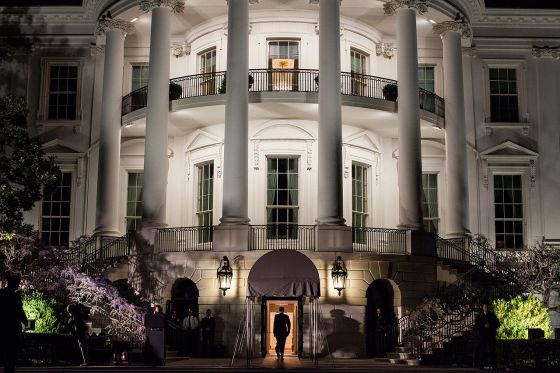
Pierre and Pamela Omidyar’s cozy ties with the White House

white-house

Paul Carr writes: Last month, Pando’s Mark Ames reported that Omidyar Networks, the philanthropic organization operated by eBay founder Pierre Omidyar and his wife Pamela, had co-invested with the US government in opposition groups that played a key role in organizing Ukraine’s recent revolution.

Unsurprisingly, given Omidyar is now running First Look Media, a journalistic enterprise dedicated to exposing US government wrongdoing around the world, some FLM staffers and supporters rushed to cry foul over our report.

USA Today’s Rem Rieder argued that Omidyar Network’s investments were a non-issue as they had been disclosed years earlier. Other supporters pointed out that, just because the Omidyars co-invested with the US Agency for International Development (USAID) and the National Endowment for Democracy (NED), and appeared to share their policy on regime change in Ukraine, didn’t mean that they had actively collaborated with the government on investment strategy.

This narrative of Pierre Omidyar being politically and financially separate from the Obama White House is a vitally important one. In recent weeks, the site’s reporters have taken their fight right to the President’s doorstep with headlines like “The White House Has Been Covering Up the Presidency’s Role in Torture for Years,” claiming that the administration has deliberately withheld thousands of documents relating to the CIA’s role in detention and interrogation of prisoners. Any sniff that First Look’s owner, publisher and chief editorial recruiter has close ties to the White House could undermine the whole premise of the organization.

Speaking to the Daily Beast, documentary maker Jeremy Scahill mentioned his boss explicitly when comparing the cozy relationship between other news organizations and the White House. First Look, he insisted, would be different…

I think that the White House, whether it is under Republican or Democrat, they pretty much now [sic] who they are dealing with. There are outlets like The Daily Beast, or The Huffington Post that have risen up in the past decade, but they are very quickly just becoming part of the broader mainstream media, and with people that have spent their careers working for magazines or newspapers or what have you, and the White House believes they all speak the language on these things. With us, because we want to be adversarial, they won’t know what bat phone to call. They know who to call at The Times, they know who to call at The Post. With us, who are they going to call? Pierre? Glenn?”

Scahill’s question is a good one — and it’s also very easy to answer: If the White House has a problem with First Look, it’s a pretty safe bet they’ll pick up the phone and call Pierre Omidyar. [Continue reading…]

Facebooktwittermail

Obama needs to end of laws of the spies, by the spies and for the spies

o13-iconJameel Jaffer writes: To anyone who criticized the National Security Agency’s phone-records dragnet over the last nine months or so, the American intelligence community had this stock response: all three branches of government signed off on it.

The intelligence community was right, at least in a sense, but what it presented as a defense of the surveillance program was actually an indictment of our oversight system. What it presented as a defense of the program was actually a scandal.

In today’s New York Times, Charlie Savage reports that the administration has come to the belated realization that its intelligence interests can be accommodated without placing hundreds of millions of people under permanent surveillance. This is to the good, of course. But if the administration is right that the dragnet was unnecessary, we should ask how all three branches of government got it so wrong.

The answer, in a word, is secrecy. When intelligence officials proposed the dragnet, there was no one on the other side to explain that the government’s goals could be achieved with less-intrusive means. There was no one there to mention that the law the government was invoking couldn’t lawfully be used to collect call-records. There was no one there to mention that the bulk collection of call records was unconstitutional. [Continue reading…]

Facebooktwittermail

After reports on NSA, China urges end to spying

n13-iconThe New York Times reports: The Chinese government called on the United States on Monday to explain its actions and halt the practice of cyberespionage after news reports said that the National Security Agency had hacked its way into the computer systems of China’s largest telecommunications company.

The reports, based on documents provided by the former security contractor Edward J. Snowden, related how the spy agency penetrated servers owned by the company, Huawei, and monitored communications by its senior executives in an effort to discover whether the executives had links to the Chinese military. The operation also sought to exploit the company’s technology and gain access to the communications of customers who use Huawei cellphones, fiber optic cables and network hubs.

American officials have been working to block Huawei from entering the American telecommunications market because of concerns that its equipment could provide Chinese hackers with a “back door” for stealing American corporate and government secrets.[Continue reading…]

Facebooktwittermail

The House’s NSA bill could allow more spying than ever. You call this reform?

o13-iconTrevor Timm writes: The White House and the House Intelligence Committee leaked dueling proposals last night that are supposedly aimed at ending the mass collection of all Americans’ phone records. But the devil is in the details, and when it comes to the National Security Agency’s unique ability to twist and distort the English language, the devil tends to wrap his horns around every word.

The House proposal, to be unveiled this morning by Reps Mike Rogers and Dutch Ruppersberger, is the more worrying of the two. Rogers has been the NSA’s most ardent defender in Congress and has a long history of distorting the truth and practicing in outright fabrication, whether in touting his committee’s alleged “oversight” or by way of his attempts to impugn the motives of the once again vindicated whistleblower who started this whole reform debate, former NSA contractor Edward Snowden.

As a general rule, whenever Mike Rogers (not to be confused with incoming NSA director Michael Rogers) claims a bill does something particular – like, say, protect your privacy – it’s actually a fairly safe assumption that the opposite will end up true. His new bill seems to have the goal of trading government bulk collection for even more NSA power to search Americans’ data while it sits in the hands of the phone companies. [Continue reading…]

Facebooktwittermail

Obama just opened the door for Snowden’s immunity

o13-iconMichael Maiello writes: Today, Charlie Savage at The New York Times reports that the Obama administration will propose the end of the NSA’s bulk data collection program, replacing it with a more targeted, more thoroughly court supervised alternative. It is an imperfect solution for those who suspect that the FISA court is too eager to grant such requests but Marc Rotenberg, executive director of the Electronic Privacy Information Center, told the paper that this was “a sensible outcome.”

As we are a good way through Obama’s second term as president, I think it’s more than fair to say that we would not be here, at the cusp of sensibility, without the actions of Edward J. Snowden, the former NSA contractor who now lives in Russia under the protection of Vladimir Putin. Snowden took and released an uncounted number of sensitive documents from his employers and is responsible for disclosing the breadth and scope of the NSA’s global telecommunications surveillance program. Had the details of this program remained rumor and whisper as they were for the bulk of Obama’s tenure, it’s a fair bet that nothing would be changing now. [Continue reading…]

Facebooktwittermail

Doubts surface on Gaza destination of rockets seized by Israel

n13-iconReuters reports: Some U.S. intelligence analysts and Middle East security officials believe that a rocket shipment seized by the Israeli navy in the Red Sea this month was destined for the Egyptian Sinai and not for the Gaza Strip, as Israel says.

A U.S. official and two non-Israeli regional sources said Israel appeared to be insisting on the Gaza destination in order to spare the military-backed interim Egyptian administration embarrassment as it struggles to impose order in the Sinai.

Israel has little compunction about drawing scrutiny to the rocket arsenals of Gaza’s governing Hamas Islamists and other armed Palestinian factions, with whom it has regularly clashed.

“Were the Israelis to say the rockets were going to Sinai, then they would also have had to say who in Sinai was going to receive the rockets,” one source told Reuters, adding that such a statement would draw attention to the insurgents resisting Egypt’s security sweeps in northern Sinai. [Continue reading…]

Facebooktwittermail

NYT’s James Risen: Obama administration is this generation’s ‘greatest enemy of press freedom’

n13-iconPoynter: “It won’t take me long to alienate everyone in the room,” Jeffrey Toobin told an audience in New York Friday. “For better or worse, it has been clear there is no journalistic privilege under the First Amendment.”

The New Yorker staff writer and CNN commentator was appearing on a panel as part of a conference called Sources and Secrets at the Times Center. A lot has already been written about the conference, so I’m going to pull out a theme that appears again and again in my notes: How much protection do reporters really have with regard to sources, and how much, if any, protection would a federal shield law give them?

New York Times reporter James Risen, who is fighting an order that he testify in the trial of Jeffrey Sterling, a former CIA officer accused of leaking information to him, opened the conference earlier by saying the Obama administration is “the greatest enemy of press freedom that we have encountered in at least a generation.” The administration wants to “narrow the field of national security reporting,” Risen said, to “create a path for accepted reporting.” Anyone journalist who exceeds those parameters, Risen said, “will be punished.”

The administration’s aggressive prosecutions have created “a de facto Official Secrets Act,” Risen said, and the media has been “too timid” in responding. [Continue reading…]

Facebooktwittermail

U.S. notified 3,000 companies in 2013 about cyberattacks

n13-iconThe Washington Post reports: Federal agents notified more than 3,000 U.S. companies last year that their computer systems had been hacked, White House officials have told industry executives, marking the first time the government has revealed how often it tipped off the private sector to cyberintrusions.

The alerts went to firms large and small, from local banks to major defense contractors to national retailers such as Target, which suffered a breach last fall that led to the theft of tens of millions of Americans’ credit card and personal data, according to government and industry officials.

“Three thousand companies is astounding,” said James A. Lewis, a senior fellow and cyberpolicy expert at the Center for Strategic and International Studies. “The problem is as big or bigger than we thought.”

The number reflects only a fraction of the true scale of cyberintrusions into the private sector by criminal groups and foreign governments and their proxies, particularly in China and Eastern Europe. The estimated cost to U.S. companies and consumers is up to $100 billion annually, analysts say. [Continue reading…]

Facebooktwittermail

The partition of Ukraine

a13-iconAt Open Democracy, Svitlana Kobzar wites: The argument for splitting Ukraine is that this would merely establish de jure a situation that already exists de facto, because Ukraine is deeply divided by its cultural identity/language differences. It would also supposedly settle tensions between the West and Russia because Moscow would get what it wanted and would not venture further. With Ukraine split into two, its western part could eventually move closer towards Europe while its Russian-speaking East and South would establish a state allied closely with Russia. This solution, the argument goes, would best reflect the preferences of the local population. Moreover, letting parts of the South and East go might also be sensible for economic reasons. The only problem with this proposal is that none of the arguments bear close scrutiny.

Ukraine’s linguistic divisions are real. The majority of the country’s Russian-speaking population lives in the East and South; most of those who speak Ukrainian live in the centre and the West, which has traditionally been more integrated with the rest of Europe for reasons of both geography and history. But is one’s mother tongue the strongest factor influencing one’s political choices? When sociologists pose questions relating to their respondents’ identity, history or preference for a pro-EU or a pro-Russian foreign policy, the result is indeed a political map of Ukraine where the western and central regions exhibit very different preferences from those in the East and South.

But as Ukrainian political scientist Yevhen Hlibovytsky argues, research suggests that for ordinary Ukrainians there are other issues which are far more important for their political choices than language. These are mostly associated with their own security: economic security, rule of law, education or human security. When sociologists ask questions about these issues, the result is a map of political preferences which does not reflect geographical or linguistic divisions – it presents a picture of a relatively united country.

While there is some correlation between predominantly Russian-speaking parts of Ukraine and pro-Russian foreign policy preferences, language is not, in fact, the most important predictor of separatist sentiments. As American historian Timothy Snyder argues, ‘It is true that Ukrainians speak Russian, but that does not make them Russian, any more than my writing in English makes me English.’ Many Ukrainians are bilingual and speaking Russian is not the main indicator of their choices. [Continue reading…]

Facebooktwittermail

Russian professor fired over criticism of actions in Ukraine

n13-iconReuters reports: A Russian philosophy professor at a prestigious state university has been sacked after comparing Moscow’s actions in Ukraine with Nazi Germany’s annexation of Austria in 1938, the school said on Monday.

In an op-ed earlier this month on the day Russian lawmakers voted to give President Vladimir Putin permission to send troops into Ukraine, Andrei Zubov warned against war, saying: “We must not behave the way Germans once behaved, based on the promises of Goebbels and Hitler.”

The Moscow State Institute of International Relations (MGIMO), a diplomatic school with ties to the foreign ministry where Zubov has worked since 2001, said it had dismissed him for criticising Russia’s foreign policy. [Continue reading…]

Facebooktwittermail

Egyptian judge gives death sentence to 529 Morsi supporters for murdering one policeman

n13-iconThe Guardian reports: A judge in southern Egypt has taken just two court sessions to sentence to death 529 supporters of Mohamed Morsi for the murder of a single police officer.

Sixteen people were acquitted after lawyers said they had not been allowed to present a proper defence before the judgment was made.

The defendants were arrested last August during a wave of unrest in which supporters of the former president react violently to the clearance of a pro-Morsi sit-in in Cairoduring which more than 900 people were killed. In addition to the murder, the 529 were accused of attempting to kill two other police officers and attacking a police station.

The death sentences are not final and appeals are likely; similar sentences have often been commuted in Egypt. But families of the accused and rights lawyers described the process as a miscarriage of justice.

Waleed Sultan, whose father was among those sentenced to death, said: “Nothing can describe this scandal. This is not a judicial sentence, this is thuggery.”

He added: “The session last[ed] for five minutes, [and] during those five minutes none of the lawyers or the defendants were listened to – not even the prosecution. The judge just came in to acquit [the 16] and sentence to death the others.” [Continue reading…]

Facebooktwittermail

Is a real revolution possible in the Arab world?

f13-iconLouis Proyect writes: At first blush, the term “Arab Winter” makes sense given the restoration of military rule in Egypt, Syria’s descent into sectarian chaos, and Libya’s coming apart at the seams. Can a case be made for guarded optimism, however? If so, then there is probably nobody more qualified to make it than Gilbert Achcar, the preeminent Marxist scholar of the region whose 2013 study The People Want attempts to get beneath surface impressions, especially those based on changing seasons. If Marxism seems deeply troubled as a political movement and lacks a sizable contingent in the Middle East and North Africa (MENA), it still has a use as an analytical tool. Owing much to its Hegelian roots, the dialectical method at the heart of Marxism is ideally suited to resolving contradictions. And no other region in the world is more riven with contradictions than MENA, arguably the source of its failure as of yet to deliver on the promises of 2011.

In a September 4, 2013 article for Guernica titled “What is a Revolution”, Tariq Ali adopted a rather frosty tone in sizing up the undelivered promises of the region, described mostly as a failure to qualify as a genuine revolution. He wrote that only “a transfer of power from one social class (or even a layer) to another that leads to fundamental change” could qualify as a revolution. Now, of course, there was a time in which Tariq Ali would have been more generous with movements that were so lacking, including many of the national liberation movements he embraced as a young radical. Using his yardstick, Vietnam had no revolution when it drove out the American imperialists. Just look at the millionaires in Vietnam today, profiting off of sweatshops. But that is no argument for not protesting against B-52 bombing raids and Operation Phoenix. If Ali was referring to the classical socialist revolution that have been far and few between since 1917, rarer in some ways than the Ivory-Billed Woodpecker that was supposedly last spotted in Arkansas back in 2005, he certainly had a point even if it did not do justice to the social realities of Egypt, Syria, or Libya.

Perhaps another term might be more useful when trying to understand the process that began in 2011—one that Achcar argues was already in progress for some years due to unresolved social, political and economic contradictions. In his introduction he makes the case for recognizing the struggle as a thawra, the Arab term for revolt, a word that might be more useful since it is both less restrictive than Ali’s parameters as well as leaving open the possibility that what we are seeing is a protracted and long-term revolutionary process. Considering Ho Chi Minh’s long struggle to break colonial control over his nation, this gives you some sense of the historic mission facing revolutionaries in the region.

Departing from the “game of nations” framework that is used by most commentators on MENA as a way of reducing everything to a battle between the US and an “anti-imperialist” bloc led by Vladimir Putin, Achcar’s analysis is grounded in the class relations that exist within nations like Egypt, Libya, Syria et al. Based on the statistics he amasses in chapter one (“Fettered Development”), one can only wonder why it took so long for revolts to break out. [Continue reading…]

Facebooktwittermail

13 of 14 warmest years on record occurred in 21st century

The Guardian reports: 13 of the 14 warmest years on record occurred this century, according to the UN.

Publishing its annual climate report, the UN’s World Meteorological Organisation said that last year continued a long-term warming trend, with the hottest year ever in Australia and floods, droughts and extreme weather elsewhere around the world.

Michel Jarraud, the WMO’s secretary-general, also said there had been no ‘pause’ in global warming, as has been alleged by climate change sceptics. “There is no standstill in global warming,” Jarraud said.

2001-2010 was the warmest decade on record, the WMO noted, and added that the last three decades had been warmer than the previous one. [Continue reading…]

Facebooktwittermail