F. Stephen Larrabee writes: Last week, Abdullah Ocalan, the leader of the Kurdistan Workers’ Party (PKK), declared a cease-fire in his party’s nearly three-decade-long struggle with the Turkish state. Before then, the insurgency — which had claimed some 40,000 lives — had seemed intractable. Ankara’s attempts to put it down had only inflamed Kurdish nationalism and made the PKK stronger. But with Ocalan now apparently ready to try to resolve differences peacefully, the prospects that the uprising will come to an end have improved.
Ocalan’s announcement came at an opportune time. Several factors had already made the moment ripe for peace. First, the ruling Justice and Development Party (AKP) and the broader Turkish public had come to recognize that trying to end the insurgency with force was a dead end and that the government would have to make a more determined effort to find a political solution to the Kurdish conflict.
Second, the Kurdish issue is closely linked to Prime Minister Recep Tayyip Erdogan’s political ambitions. Under AKP bylaws, Erdogan cannot run for another term as prime minister when his second term ends next year. Instead, he is widely expected to try to run for president. If he wins, he will be the first popularly elected president in Turkish history, capping his political career and giving him the chance to shape Turkish politics until 2023, the hundredth anniversary of the founding of the Turkish Republic. [Continue reading…]
Author Archives: News Sources
For the media, soda matters more than civil rights in New York City
Blake Zeff writes: In New York City, Mayor Michael Bloomberg’s NYPD is stopping large numbers of innocent people walking down the street each day — questioning them as to their whereabouts and invasively frisking their bodies in a hunt for weapons and drugs. The stops are almost entirely (nearly nine in ten) targeting young black and Latino men. The overwhelming majority of those stopped are doing nothing wrong (just 6 percent of stops lead to arrests, and a small fraction of those are ever prosecuted). And it’s having a deleterious effect on the psyche of the targets (as well as community relations with police).
How disconcerting is the program’s execution — which currently allows officers to stop anyone committing a “furtive” movement (whatever that is)? This past week, a federal judge in Manhattan, Shira Scheindlin, heard arguments as to whether the stops — whose numbers have soared to roughly 700,000 per year, according to the force’s own estimates — are actually even constitutional. During the course of the proceedings, it was revealed that NYPD engaged in an illegal quota system and that officers were intentionally targeting young black men.
Of course, if you watched any number of interviews with Mayor Bloomberg on national TV this past week or two, you’d have no idea of any of this. [Continue reading…]
Sweden: More than ever, the land of internet freedom
Nouvel Observateur/Worldcrunch: “This is happening right now in Homs, Syria…” Hans Eriksson shows a shaky video of column of smoke just after a bombing from Bashar al-Assad’s troops.
Bambuser is the name of the service launched by this 44-year-old Swede, which allows any smartphone user to broadcast live what’s happening in front of him – without any censorship. The service is a precious resource for Arab Spring protesters.
“In these countries where information is – or was – under heavy surveillance, it is crucial to be able to show the details of the repression. The world needs to know,” says Eriksson. His service is used by CNN, the BBC and Al-Jazeera.
From 5,000 to 10,000 raw, unedited videos are uploaded every day by this 12-person start-up. Bambuser is the latest symbol of Sweden’s fight for freedom of speech on the Internet.
Three years ago, the country decided to take a stand for the promotion of freedom on the Internet. Minister for Foreign Affairs Carl Bildt launched a dialogue with companies on Internet freedom. He was soon followed by Hillary Clinton, who made an acclaimed speech on Internet freedom in 2010.
“Freedom of expression has always been a cornerstone of the Swedish government, we just extended it to the Internet,” says Ministry of Foreign Affairs Special Adviser Johan Hallenborg. “The freedom to say what we want on the Internet or anywhere else is a human right.” [Continue reading…]
Aleppo: a city abandoned by the world
Channel 4 News: Twelve-year-old Mohamed Asaf’s days are filled treating Aleppo’s war wounded. He starts work at 8am and usually gets to bed by 11pm.
When filmmaker Marcel Mettelsiefen meets him in the city’s Dar al-Shifa clinic, Mohamed is battling to save a young girl’s life.
After months bearing witness to the human tragedy of Syria’s civil war, he has become desensitised to the horrors: “With time it has become easy: blood has become like water to me,” he says.
In an interview, Mettelsiefen describes the logic of the Assad regime which targets civilians while avoiding striking the al-Nusra Front’s command in Aleppo. The desired effect is to radicalize the population, swell al-Nusra’s ranks and thereby heighten Western fears about the fall of the regime. In effect, al-Nusra has become Assad’s insurance against intervention.
Drone war: Out of sight, out of mind
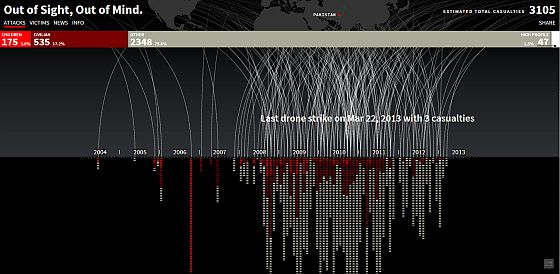
Click on the image above to view the “Out of Sight, Out of Mind” interactive graphic on the drone war in which an estimated 3,105 people have been killed in Pakistan of whom only 47 were so-called “high value” suspected terrorists.
A note on the producer of this interactive graphic: It comes from Pitch Interactive, an information visualization studio based in Berkeley, California. Their clients range from AT&T to Google to Fortune Magazine.
“The primary data used in this visualization comes from a dataset maintained by the Bureau of Investigative Journalism (BIJ)” — which is good because BIJ has compiled more information than anyone else has on the results of America’s drone war.
“This project helps to bring light on the topic of drones. Not to speak for or against, but to inform and to allow you to see for yourself whether you can support drone usage or not.”
Wes Grubbs, the studio’s founder, tweets: “We made this because it had to be made”.
McChrystal: America’s drone war risks provoking another attack on New York City
Retired General Stanley McChrystal: Anywhere you have undergoverned or ungoverned areas, organizations like al Qaeda have a tremendous opportunity to get a foothold. And when they can get a foothold, they can start to operate and spread from there.
Foreign Affairs: So what do you do with places like Mali and Yemen?
Well, you can’t solve all of them. You certainly don’t want to put Western forces in all of these countries. The initial reaction that says, “We will simply operate by drone strikes” is also problematic, because the inhabitants of that area and the world have significant problems watching Western forces, particularly Americans, conduct drone strikes inside the terrain of another country. So that’s got to be done very carefully, on occasion. It’s not a strategy in itself; it’s a short-term tactic.
It seems like the methods you pioneered in Iraq have been embraced by the U.S. government and the American public as a general approach to managing small-scale irregular warfare, and doing so in a way short of putting lots of boots on the ground or walking away entirely. Some would argue that this is the true legacy of Stan McChrystal — the creation of an approach to counterterrorism that is halfway between war and peace, at such a low cost and with such a light footprint that it’s politically viable for the long term in a way that war and disengagement are not. Do you disagree?
I question its universal validity. If you go back to the British tactics on the North-West Frontier, the “butcher and bolt” tactics, where they would burn an area and punish the people and say, “Don’t do that anymore,” and simultaneously offer a stipend to the leader while saying, “If you will remain friendly for a period of time, we’ll pay you” — that approach worked for a fair amount of time. It managed problems on their periphery. But it certainly didn’t solve the problems.
The tactics that we developed do work, but they don’t produce decisive effects absent other, complementary activities. We did an awful lot of capturing and killing in Iraq for several years before it started to have a real effect, and that came only when we were partnered with an effective counterinsurgency approach. Just the strike part of it can never do more than keep an enemy at bay. And although to the United States, a drone strike seems to have very little risk and very little pain, at the receiving end, it feels like war.
Americans have got to understand that. If we were to use our technological capabilities carelessly — I don’t think we do, but there’s always the danger that you will — then we should not be upset when someone responds with their equivalent, which is a suicide bomb in Central Park, because that’s what they can respond with.
Most Americans think ‘innocent until proven guilty’ only applies to Americans
Gallup poll: Nearly two-thirds of Americans (65%) think the U.S. government should use drones to launch airstrikes in other countries against suspected terrorists. Americans are, however, much less likely to say the U.S. should use drones to launch airstrikes in other countries against U.S. citizens living abroad who are suspected terrorists (41%); to launch airstrikes in the U.S. against suspected terrorists living here (25%); and to launch airstrikes in the U.S. against U.S. citizens living here who are suspected terrorists (13%).
What Al Qaeda couldn’t defeat: The military-political bureaucracy
Andrew Cohen writes: “It’s a very tricky theme to play out politically,” law professor and longtime Obama devotee Geoffrey Stone is quoted saying without a trace of irony or regret near the end of The Terror Courts: Rough Justice at Guantanamo Bay, Jess Bravin’s excellent new book. The book focuses on the epic and continuing failure of America’s military tribunals to process suspects following the terrorist attacks of September 11, 2001. “You are asking people to be better than they have to be.”
It’s a quote that could be the epitaph for the whole disgraceful affair. At nearly every step of the way, for more than 11 years, our elected officials, military leaders, and judges have failed or refused to be “better than they have to be” when it comes to the treatment of the detainees. “You’ve got to be kidding me,” then-Attorney General John Ashcroft says prophetically, early in Bravin’s book. When Ashcroft comes off as a Wise Man you know something is terribly amiss.
Indeed, over and over, when faced with a moral or legal choice as to how to proceed, our government officials chose poorly– violating foreign and domestic law, precluding civilian trials, sabotaging our own national security, stifling internal dissent, confounding our allies, rewarding bureaucratic mindlessness, and setting up the vaunted military tribunals to fail in a hundred different ways which, of course, they have in the 4,212 days since the Twin Towers fell.
Which is why you should read this book now, while the hunger strike at Guantanamo Bay is growing. You should read it now, while there is a pending request by the Pentagon to spend another $49 million for a new prison on Cuba. You should read it now, while John Yoo is still the go-to guy for quotes about interrogations, and while Senators John McCain and Lindsey Graham, crows on a wire, are still offering up terrible advice about prosecuting detainees. [Continue reading…]
The Guantánamo hunger strike
McClatchy reports: It’s lunchtime on the communal cellblocks for cooperative captives, and detainees dressed in tan and white camp uniforms are steadfastly refusing the guards’ offer to wheel in food carts.
Only if a prisoner pulls shut a gate to a chute called a sally port can a soldier lock it remotely and send in the meals. And one by one, every block but Delta Block refuses. Some captives call out that they don’t want the food.
Over at Charlie Block, an angular looking detainee is stubbornly ignoring his guards, sitting at an empty, stainless-steel picnic table, watching footage from Mecca on Saudi TV.
Within an hour, the guards systematically trash a lunch that looks like it could feed 100. Unopened juice bottles go in the garbage first, then Styrofoam boxes of pita bread and special dietary meals. Buffet tins of stewed tomatoes, rice and sweet-and-sour stir-fried beef follow.
It’s hunger-strike time at Guantánamo. And while the military and their captives dispute when it started and how widespread it is, it was clear from a three-day visit to the prison-camp compound this past week that the guard force is confronted with its most complex challenge in years. [Continue reading…]
Obama’s foggy red line on use of chemical weapons in Syria
The Washington Post reports: The suspicious attack that killed 26 people in northern Syria last week exposed the difficulty of determining whether the Syrian regime has resorted to using chemical weapons as well as the lingering uncertainty over how President Obama would respond if what he has called a “red line” is crossed.
Current and former U.S. officials acknowledged that confirming a small-scale chemical weapons attack poses technical challenges that have been compounded by limitations on the ability of U.S. spy agencies to gather reliable intelligence, let alone air or soil samples, inside Syria.
The two factors are why U.S. intelligence analysts are still working to determine whether the attack near Aleppo last Tuesday involved the use of chemical compounds. The Syrian government and rebels have accused each other of unleashing chemical weapons.
The course Obama intends to take if confronted with proof of a chemical attack is equally unclear. The Pentagon has prepared calibrated options, ranging from airstrikes to sending troops to seize weapons sites. But officials said they haven’t taken the advance steps necessary to carry out such orders because planning has been hobbled by concerns about the political backlash to a potential U.S. intervention as well as struggles to coordinate with regional allies.
“If we had to go in tomorrow, I’d say we aren’t ready,” said an Obama administration official involved in preparations for securing Syria’s chemical weapons. “One thing we want to avoid is having one group securing the sites and another group bombing them.”
The level of uncertainty surrounding U.S. contingency planning two years into a conflict that has killed more than 70,000 people contrasts with the clarity of Obama’s repeated admonitions to the government of President Bashar al-Assad. [Continue reading…]
Rebel Free Syrian Army founder loses leg in Syria blast
Reuters reports: Colonel Riad al-Asaad, founder of the rebel Free Syrian Army (FSA), lost a leg in an explosion in Syria overnight and is in Turkey for treatment, a Turkish official said on Monday.
Asaad, who established the FSA in 2011 to fight for the overthrow of President Bashar al-Assad, was one of the first senior officers to defect from the Syrian military.
The Turkish official, who asked not to be identified, said Asaad’s wounds were not life-threatening.
Syrian opposition sources said Asaad had been hit by a car bomb in the city of al-Mayadin, south of Deir al-Zor in eastern Syria. These accounts could not immediately be confirmed.
In stern warning, Egypt’s president says he may take measures to protect the nation
The Associated Press reports: Egypt’s president delivered a stern warning to his opponents on Sunday, saying he may be close to taking unspecified measures to “protect this nation” two days after supporters of his Muslim Brotherhood and opposition protesters fought street battles in the worst bout of political violence in three months.
Nearly 200 people were injured in Friday’s violence, some seriously, outside the headquarters of the Brotherhood, Egypt’s dominant political group.
“If I have to do what is necessary to protect this nation I will, and I am afraid that I may be close to doing so,” a visibly angry Morsi said in an animated speech to the opening session of a conference on women’s rights.
“I will do so very, very soon. Sooner than those trying to shake the image of this nation think,” said the Islamist leader who took office in June as the country’s first freely elected president.
“Let us not be dragged into an area where I will take a harsh decision,” he warned.
While not naming any one opposition group or critic in particular, his comments were the strongest hint to date that he believes the parties and politicians grouped in the National Salvation Front, the main opposition coalition, were directly behind the violence.
His comments were initially released in a series of tweets on his account but state television later aired extensive excerpts from the address.
He also warned that “appropriate measures” would be taken against politicians found to be behind Friday’s violence, regardless of their seniority. Anyone found to be using the media to “incite violence” will also be held accountable, he added. His comments came just hours after dozens of Islamists staged a protest outside studios belonging to independent TV networks that are critical of the Egyptian leader.
Egypt’s Muslim Brotherhood has reneged on promises to Palestine
Amira Howeidy writes: The euphoria that erupted in Gaza minutes after Hosni Mubarak stepped down on 11 February 2011 probably came second only to Egypt’s. The ousted dictator was Israel’s “strategic asset” for good reason. He secured the blockade of the Gaza Strip from the Egyptian side, sided against Hamas and proved a reliable ally.
Even during the 22-day Israeli war on Gaza at the end of 2008, Mubarak kept the Rafah border crossing firmly shut, in violation of the Fourth Geneva Convention which binds Egypt, as a signatory, to protect civilians during times of war and foreign occupation.
Egypt’s dictator was removed but his legacy continues to influence realities on the ground in Gaza and around the Palestinian question in general. It does not help that his successor, the Muslim Brotherhood’s Muhammad Morsi, has done little to prove — thus far — that his policies will change course. Of course nothing is that simple. Morsi, willingly, inherited a difficult legacy of a mammoth, corrupt bureaucracy and questionable sovereignty after decades of subservience to the United States.
But judging from their discourse and performance during the past year, it’s evident that the Brotherhood — including their Freedom and Justice Party and the president — are too eager to prove their power-worthiness by demonstrating “pragmatism” and flexibility to the international community. [Continue reading…]
The death of the two-state solution
Andrew O’Hehir writes: Let’s give Mitt Romney some credit for candor on the Middle East, if for almost nothing else. President Obama’s soaring rhetoric in his campaign-style speech this week in Jerusalem, when he urged the Israeli public to “create the change that you want to see” and laid out a moral and philosophical case for a two-state solution to the Israeli-Palestinian problem, showed us the leader of the free world at the top of his oratorical game. But Obama didn’t go to Israel with any concrete plan to restart negotiations between Israeli Prime Minister Benjamin Netanyahu and Palestinian Authority president Mahmoud Abbas, a pair of weakened politicians who lack clear mandates from their own people. Despite vague promises to send Secretary of State John Kerry into the breach in coming weeks, it’s by no means clear that he has one.
In contrast, Romney’s infamous private summary of his Middle East policy – “we kick the ball down the field and hope that, ultimately, somehow, something will happen and resolve it” (he never used the phrase “kick the can down the road,” although that’s how it has entered the popular discourse) – has the unmistakable tang of realpolitik rather than wishful thinking. Given the long history of failure by all sides in this arena, it’s not even cynical to suggest that this is precisely Obama’s strategy: Try to soften attitudes on the ground a little, win over a few hearts and minds on both sides, and then gratefully hand over the problem to another hopelessly conflicted president in 2017.
What we can also detect in Romney’s remark and, a little deeper below the surface, in Obama’s Jerusalem speech is the growing sense in many quarters that the two-state solution is dead – that it’s no longer practical or possible to establish an independent Palestinian nation alongside the Jewish state of Israel, if it ever was. While the “one-state solution,” however conceived, remains a semi-forbidden zone in mainstream international policy discourse, it keeps cropping up all over the place on both the right and the left. Within a few weeks last summer, leading Israeli settler activist Dani Dayan published an Op-Ed in the New York Times urging the international community to give up “its vain attempts to attain the unattainable two-state solution,” while radical journalists Antony Loewenstein and Ahmed Moor published an anthology of writing by academics and activists entitled “After Zionism: One State for Israel and Palestine.”
Less than a month later came the English translation of eminent Israeli sociologist Yehouda Shenhav’s explosive essay, “Beyond the Two-State Solution,” which imagines a bi-national, bilingual federal democracy of Jews and Arabs that would encompass the entire territory of present-day Israel, Gaza and the West Bank. Shenhav, Dayan, Loewenstein, Moor and the leadership of Israel’s staunch enemies Hamas and Hezbollah might agree about nothing else, including which day follows Tuesday and whether the sky is blue. But they’d all agree that a negotiated two-state solution won’t work. Indeed, Israeli film director Dror Moreh, who made the Oscar-nominated documentary “The Gatekeepers” and falls somewhere toward the pragmatic center of Israeli politics, recently told me the same thing. He sounded rueful about holding that opinion and thinks it’s still worth trying but suspects it’s simply too late. [Continue reading…]
Hope in Hebron
David Shulman writes: On March 16, I joined some twenty-five children, aged about eight to thirteen, who had gathered with Palestinian peace activists in a house in Hebron city to write letters to President Obama on the eve of his visit to Jerusalem. March 16 was the start of the third Selma-to-Montgomery march, led by Martin Luther King, in 1965, a defining moment in the history of the American civil rights movement, and the children—Palestinians who were mostly from the H2 area of Hebron under direct Israeli military control—had come to learn about Martin Luther King and nonviolent resistance.
Most of the letters began by begging the US president: “Open Shuhada Street”—once the main thoroughfare of central Hebron, now almost completely barred to Palestinians, its shops bolted, the doors of its houses welded shut by the Israeli army. Others said simply: “Enough Occupation” or “Free Palestine” or “Down with the Wall.” One slightly older boy quoted a line of poetry: “Either we live, all of us, or we die together.” Some drew pictures: a soldier in khaki uniform standing with his rifle under an olive tree; a child’s map of Hebron, encircled, closed, with its deserted main street, in blue, cutting through to the city center.
A visit to Hebron eats into one’s soul. As of last week, Israel has a new government which, like the previous one, is in the hands of the settlers. Their parties have control of the Housing Ministry and the crucial Finance Committee of the Knesset, among other plums. Their not-so-secret plan is to put a million Jews in the West Bank, and they now have the political means to carry it out. There will be a surge of construction in the West Bank settlements, and new “illegal outposts” will mushroom on the hills. No one should expect the so-called centrists, or moderates, in the coalition to hold back the extremists.
Yair Lapid’s party, optimistically named “There is a Future,” came in second in the elections. But like most of the Israeli mainstream, Lapid seems all too ready to go along with the extreme program of the right. Tzipi Livni, former head of the opposition, ran on a platform demanding that Israel re-open negotiations with the Palestinians; she has been given the Ministry of Justice, but she is entirely unequal to the task of pleading the cause of peace—and in any case, Netanyahu is committed to blocking any progress in that area. For his part, Barack Obama, on his belated first visit to Israel as president, has articulated the hope for peace and the urgent need for a free Palestinian state with a directness and clarity perhaps never heard before in Jerusalem. Netanyahu responded with his usual niggardly, narrow-hearted non-vision. [Continue reading…]
America’s gun junkies

Most Americans don’t own a gun, so if gun ownership is fundamental to the American way of life, does that mean most people living in America aren’t real Americans?
Probably not. Why? Because the people who feel the greatest need to buy guns are people who already own guns. And since guns tend to be extremely durable items — most are designed well enough to outlive their owners — the need to buy guns, seems very much like the need to buy heroin. No one needs it until they start using it, but once they start using, it becomes increasingly difficult to get enough.
James Werrell writes: You’d think, reading news reports about people rushing out to buy assault rifles and stock up on ammo, that gun ownership is on the rise. But according to at least one survey, just the opposite is true.
If the survey is accurate – and the National Rifle Association is skeptical – it offers a fascinating contrast between reality and perception. Instead of a citizen militia busily stockpiling firearms, we may be a nation in which a large majority of people don’t have a single gun in the house.
According to data from the General Social Survey, a public opinion survey conducted every two years by a research center at the University of Chicago, the household gun ownership rate has fallen from an average of 50 percent in the 1970s to 49 percent in the 1980s, 43 percent in the 1990s and 35 percent in the 2000s. Consider that, only about a third of U.S. households have guns.
And, equally surprisingly, the decline has occurred across the board. The rate has dropped in big cities and small towns, suburbs and rural areas, and in all regions of the country – including the gun-loving South and West.
Gun ownership is down among households with children and those without children. It’s down among rich and poor. It’s down among churchgoers and non-worshippers alike.
Those who doubt the validity of the survey point to anecdotal evidence of increased gun sales, a rise in the number of background checks and long waits for gun-safety classes. But the researchers who conducted the survey have an answer for that: The people buying guns are the people who already have guns.
That category could include everyone from collectors to survivalists. Apparently, though, most Americans aren’t interested in assembling an arsenal in their homes. [Continue reading…]
Video: The politics of gun control
A public indictment could shed light on CIA’s secret program
By Cora Currier, ProPublica, March 22, 2013
Federal prosecutors in Brooklyn unsealed an indictment Wednesday charging Ibrahim Suleiman Adnan Adam Harun with six terrorism-related counts.
The announcement that Harun is in U.S. custody in New York may also shed light on a small part one of the most secretive aspects of U.S. counterterrorism operations during the Bush administration: What became of terror suspects held by the CIA in its network of “black-site” prisons around the world? Or disappeared into foreign cells in extraordinary renditions?
With their indictment of Harun, prosecutors offered a basic account of how the 43-year-old Nigerian 2013 described as “a prototype Al Qaeda Operative” 2013 spent the last decade. He fought U.S. forces in Afghanistan, prosecutors said, before leaving for Africa, where he allegedly conspired to bomb U.S. diplomatic facilities. Harun, also known by his alias Spin Ghul, eventually wound up in Libyan prison for six years before he was released amid the turmoil of the uprising against Muammar Qaddafi.
Did the U.S. know that he was in Libya, and did they play a role in his detention? Did the CIA work with the Libyans to then obtain information from him?
Testimony from an alleged former CIA detainee, a leaked document from the military prison at Guantanamo Bay, and evidence from cases of others rendered to Libya suggest that might be so.