Author Archives: News Sources

FBI pursuing real-time Gmail spying powers as “top priority” for 2013

Slate: Despite the pervasiveness of law enforcement surveillance of digital communication, the FBI still has a difficult time monitoring Gmail, Google Voice, and Dropbox in real time. But that may change soon, because the bureau says it has made gaining more powers to wiretap all forms of Internet conversation and cloud storage a “top priority” this year.

Last week, during a talk for the American Bar Association in Washington, D.C., FBI general counsel Andrew Weissmann discussed some of the pressing surveillance and national security issues facing the bureau. He gave a few updates on the FBI’s efforts to address what it calls the “going dark” problem — how the rise in popularity of email and social networks has stifled its ability to monitor communications as they are being transmitted. It’s no secret that under the Electronic Communications Privacy Act, the feds can easily obtain archive copies of emails. When it comes to spying on emails or Gchat in real time, however, it’s a different story.

That’s because a 1994 surveillance law called the Communications Assistance for Law Enforcement Act only allows the government to force Internet providers and phone companies to install surveillance equipment within their networks. But it doesn’t cover email, cloud services, or online chat providers like Skype. Weissmann said that the FBI wants the power to mandate real-time surveillance of everything from Dropbox and online games (“the chat feature in Scrabble”) to Gmail and Google Voice. “Those communications are being used for criminal conversations,” he said. [Continue reading…]

Facebooktwittermail

Portugal’s humanistic and pragmatic approach to drug use

Der Spiegel reports: Twelve years ago, Portugal eliminated criminal penalties for drug users. Since then, those caught with small amounts of marijuana, cocaine or heroin go unindicted and possession is a misdemeanor on par with illegal parking. Experts are pleased with the results.

Before he got involved in the global war on drugs, João Goulão was a family physician with his own practice in Faro, on Portugal’s Algarve coast. Arriving in his small office in Lisbon, the 58-year-old tosses his jacket aside, leaving his shirt collar crooked. He looks a little tired from the many trips he’s taken lately — the world wants to know exactly how the experiment in Portugal is going. Goulão is no longer able to accept all the invitations he receives. He adds his latest piece of mail to the mountain of papers on his desk.

From this office, where the air conditioning stopped working this morning, Goulão keeps watch over one of the world’s largest experiments in drug policy.

One gram of heroin, two grams of cocaine, 25 grams of marijuana leaves or five grams of hashish: These are the drug quantities one can legally purchase and possess in Portugal, carrying them through the streets of Lisbon in a pants pocket, say, without fear of repercussion. MDMA — the active ingredient in ecstasy — and amphetamines — including speed and meth — can also be possessed in amounts up to one gram. That’s roughly enough of each of these drugs to last 10 days.

These are the amounts listed in a table appended to Portugal’s Law 30/2000. Goulão participated in creating this law, which has put his country at the forefront of experimental approaches to drug control. Portugal paved a new path when it decided to decriminalize drugs of all kinds.

“We figured perhaps this way we would be better able get things under control,” Goulão explains. “Criminalization certainly wasn’t working all that well.”

As part of its war on drugs, Portugal has stopped prosecuting users. The substances listed in the Law 30/2000 table are still illegal in Portugal — “Otherwise we would have gotten into trouble with the UN,” Goulão explains — but using these drugs is nothing more than a misdemeanor, much the same as a parking violation. [Continue reading…]

Facebooktwittermail

EPA report: More than half nation’s rivers in poor shape

The Associated Press reports: More than half of the country’s rivers and streams are in poor biological health, unable to support healthy populations of aquatic insects and other creatures, according to a nationwide survey released Tuesday.

The Environmental Protection Agency sampled nearly 2,000 locations in 2008 and 2009 — from rivers as large as the Mississippi River to streams small enough for wading. The study found more than 55 percent of them in poor condition, 23 percent in fair shape, and 21 percent in good biological health.

The most widespread problem was high levels of nutrient pollution, caused by phosphorus and nitrogen washing into rivers and streams from farms, cities and sewers. High levels of phosphorus — a common ingredient in detergents and fertilizers — were found in 40 percent of rivers and streams.

Facebooktwittermail

Once again, Abbas settles for nothing

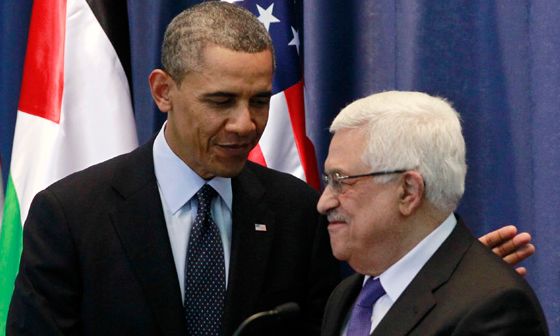
President Obama in Ramallah giving Mahmoud Abbas a pat on the back.

Nadia Hijab writes: The dust is settling after US President Barack Obama’s visit to Israel, the occupied Palestinian territory and Jordan, and it is now easier to see the extent of the debris he has left behind. It is perhaps at the geopolitical level that Obama has done the most damage – and that to the weakest party, the Palestinian authority, he met. The surprise reconciliation he engineered between Israel and Turkey has reversed the only regional realignment in the Palestinians’ favour for years.

Turkish Prime Minister Recep Tayyip Erdogan clearly hopes to soften the blow of restoring normal relations with Israel, badly damaged after Israel’s lethal attack on the Mavi Marmara, by promising a solidarity visit to Gaza. Erdogan is also claiming, in the face of repeated Israeli denials, that he has secured an end to the siege of Gaza.

However, the fact remains that Turkey, Israel and the US have all made concrete political and economic gains while Palestinians gained some empty gestures. [Continue reading…]

Facebooktwittermail

Saudi Arabia: The internet’s enemy cracks down on Skype, Whatsapp, and Viber

Daily Beast: Skype, Whatsapp and Viber are subject to a ban in Saudi Arabia, as it demands the rights to monitor all communications via these web-based communications apps.

Despite a medley of applications now available to help Internet users avert such a ban, the kingdom declared that it would block the services within its borders unless the operators grant the government surveillance rights. The companies have until Saturday—the start of the Saudi workweek— to respond to Saudi Arabia’s Communications and Information Technology Commission (CITC), local news reports said.

While Saudi Arabia is infamous for taking authoritarian measures to crack down on perceived security threats, it has increasingly shifted its attention toward the telecommunications sector in recent months. The CITC announced in September that all pre-paid SIM card users must enter a personal identification number when recharging their accounts and the number must match the one registered with their mobile operator when the SIM is purchased. The country’s second-largest telecom company, known as Mobily, was temporarily banned from selling its pay-as-you-go SIM cards after it failed to comply with the new regulations. [Continue reading…]

Facebooktwittermail

Going nowhere in Aleppo

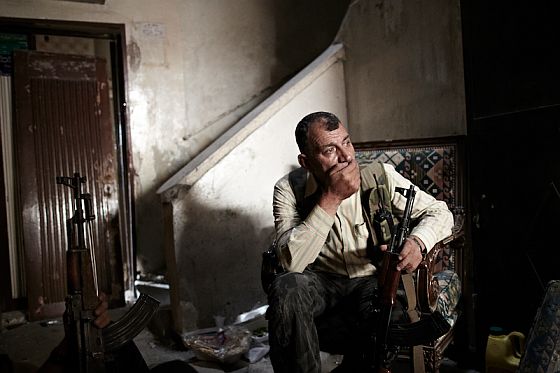
Matthieu Aikins reports: Syria’s largest city sits in a valley down from a hill with an old citadel. Over the centuries, the massive stone fortress has hosted Romans, Mongols and Ottomans; these days, it’s home to the soldiers of President Bashar al-Assad. The rebels occupy the eastern portion of the old city, a maze of alleyways and courtyards down below. It’s an ideal terrain for urban guerrilla: Tanks cannot enter the narrow passages, and the thick stone walls act as shields against artillery and air strikes.

On Monday, in the northern side of the old city, I watched a group that calls itself Ahrar as Suria (The Freemen of Syria) try to take over a building occupied by government soldiers; the rebels used a slingshot one meter tall to lob homemade grenades across enemy lines. By late afternoon, they had made little progress. They seemed content to throw grenades and fire off their weapons around corners instead of pressing a more serious and risky assault. How long had they been in this position? “Three months,” said a rebel who went by the name of Abu Zakaria. [Continue reading…]

Facebooktwittermail

This is how corporate ‘democracy’ works

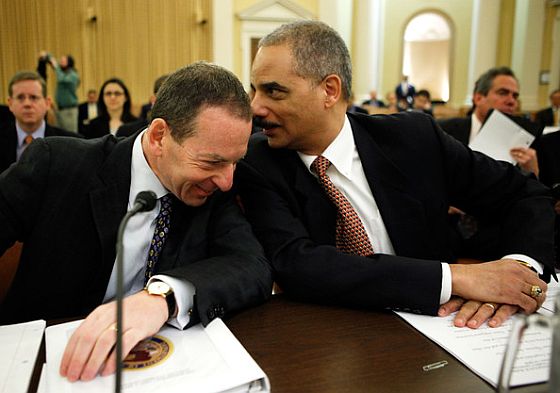
Covington & Burling lawyers Lanny Breuer and Eric Holder on federal sabbatical.

The New York Times reports: Coming off a grueling four-year stint at the Justice Department, Lanny A. Breuer is poised to make a soft landing in the private sector.

Covington & Burling, a prominent law firm, plans to announce on Thursday that Mr. Breuer will be its vice chairman. The firm created the role especially for Mr. Breuer, a Washington insider who most recently led the Justice Department’s investigation into the financial crisis.

For Mr. Breuer, who will now shift to defending large corporations, Covington is familiar turf. He previously spent nearly two decades there.

“There’s a strong emotional pull to the firm,” Mr. Breuer, who departed as the Justice Department’s criminal division chief on March 1, said in an interview. “It’s my professional home.”

Mr. Breuer is expected to earn about $4 million in his first year at Covington. In addition to representing clients, he will serve as an ambassador of sorts for the firm as it seeks to grow overseas.

The move is his latest turn through Washington’s revolving door, the symbolic portal connecting government service and private practice. Mr. Breuer, who began his career as an assistant district attorney in Manhattan and later represented President Bill Clinton during his impeachment hearings, is joining Covington for the third time.

Like Mr. Breuer, Covington operates at the nexus of Washington and Wall Street. It has represented several financial clients facing federal scrutiny, including the New York Stock Exchange, JPMorgan Chase and the former chief executive of IndyMac.

And perhaps when Breuer’s former boss Attorney General Eric Holder steps down, he too will return to his former employer, Covington, and there, along with servicing the interests of Wall Street, they can assist the law firm’s other famous clients like Xe Services (Blackwater), Phillip Morris, and Halliburton.

If you’re not familiar with Breuer, watch The Untouchables to learn about his role in letting Wall Street off the hook following the 2008 financial crisis.

Facebooktwittermail

Guantanamo hunger striker: ‘We all died when Obama indefinitely detained us’

RT.com interviewed federal public defender Carlos Warner who read a statement from one of the prisoners, Faiz al-Kandari.

CW: He said:

“I scare myself when I look in the mirror. Let them kill us as we have nothing to lose. We died when Obama indefinitely detained us. Respect us or kill us. It is your choice. The US must take off its mask and kill us.”

That was his statement as of today. I saw him last week. I have many clients there but I did see him last week and it was a shock to see what I saw. He was a man who was down more than 30 pounds less than a month ago. He refused all nourishment. His cheeks were sunk in. He was exhausted, weak, he could not stand. It was a scary, scary meeting for me.

RT: And his message is respect us or kill us. Will his wish come true or will he now be prepared to die?

CW: Well, I think many of the men, the ones that are indefinitely detained have zero hope. They have no hope because of the administration. I think many of them are ready die. The question is how and when will they die? They have no hope of being released from that place and unless a human being has some hope, it is very difficult to live. And many of them are prepared to die.

RT: Has this man been cleared for release years ago, and if so why hasn’t he been released?

CW: Faiz is not on the list of 86 innocent men who are cleared for release and those 86 men, it was unanimous decision by the US government, our government to release them. But Faiz is not on that list. But let’s be clear, everyone in Guantanamo is indefinitely detained. No one is being released – cleared for release or not.

Facebooktwittermail

Europe’s south rises up against those who act as sadistic colonial masters

Costas Douzinas writes: The “new world order” announced at the end of the 1980s was the shortest in history. Protest, riots and uprisings erupted all over the world after the 2008 crisis, leading to the Arab spring, the Indignados and Occupy. A former director of operations at MI6, quoted by Paul Mason, called it “a revolutionary wave, like 1848“. Mason agreed: “There are strong parallels – above all with 1848, and with the wave of discontent that preceded 1914.”

Many on the left have been more circumspect. The philosopher Alain Badiou welcomed the Arab spring but did not think it would lead to a “rebirth of history”. For Slavoj Žižek, 2011 was the “year of dreaming dangerously”. A melancholy of the left descended as the protest wave started receding. But on this occasion the pessimism was premature. Resistance against austerity and injustice is again in the air. In Bulgaria and Slovenia, protesters unseated the government. In Italy, the overwhelming anti-austerity vote has shaken the parties committed to the Berlin orthodoxy. Large marches and rallies in Portugal and Spain have undermined governments and policies and a new push for anti-austerity unity is emerging in Britain. In Greece, the parties that brought the country to its knees and are now administering policies causing the well-documented humanitarian catastrophe and rise of fascism are on the brink of exit.

Finally, the Cypriot government agreed the unprecedented haircut of bank savings but was forced to renege after MPs of all parties under pressure from the public voted against it and ruling party MPs had to abstain. This was the first formal rebuff of austerity, something that the obedient governments of southern Europe had not dared. When the government finally accepted the European blackmail, it presented it as unavoidable and, under instruction from Germany’s foreign minister, Wolfgang Schäuble, refrained from putting it to parliament or the people. The words “democracy” and “referendum” create panic in the corridors of Brussels. But the symbolic value of a small nation rejecting the initial troika blackmail and protecting the savings of ordinary people is immense. The European debate has concentrated on the protection of savings. The protection of our democracy is perhaps more important. [Continue reading…]

Facebooktwittermail

No, Islamists will not dominate in Syria

Rami G Khouri writes: The fast pace of developments in and around Syria in the past week has pushed the country more quickly toward the end of Bashar Assad’s regime, a situation many of us thought was imminent last autumn. He did not fall then for reasons that are evident today. The first is that Assad’s strategy from the start of the uprising against his rule two years ago this month turned out to be that he would, first, bludgeon into submission civilians who demonstrated against him (as his father had done in Hama 30 years earlier). And when that failed he would cede territory to them, but continue to hit their areas hard using air power and missiles. The Syrian government that ruled nationally has disappeared, to be replaced by fortified military bases tightly controlled by Assad loyalists, cousins and desperado fellow Alawites who are prepared to destroy Syria to save themselves.

The second is that this is a losing strategy, because the regime’s circling of its wagons in a few areas makes it more vulnerable than ever to the continued successes of Islamist rebels and the enhanced strengthening of the secular rebels (thanks to aid and training from Arab and foreign powers). As both prongs of the armed opposition advance on the regime’s isolated strongholds, and rockets fall in the center of Damascus, Assad’s constricted bases will panic, and ultimately collapse.

Third is the evident turmoil within the Syrian opposition coalition, coupled with this week’s bomb attack against the head of the Free Syrian Army. Unable to close ranks and work methodically to replace Assad, the weak Syrian opposition continues to flounder, despite considerable domestic and international support. It is worth remembering and repeating: A credible national opposition movement cannot be created and funded by Arab Gulf and Western powers. Rather, it must emanate solely from the legitimacy bestowed by those millions of brave Syrians who continue to fight on the ground inside their country.

Fourth, the opposition’s weaknesses underlie the major developments that now shape the situation: The anti-Assad uprising has turned into an armed conflict; Islamist opposition groups (including many non-Syrian nationals) have earned leading positions in the uprising, due mainly to their military successes; and regional and foreign actors such as Saudi Arabia, Qatar, Turkey, the United States, Jordan and others are increasingly assisting all the armed opposition groups. Consequently, Syria has become the latest front in a regional struggle for control of Arab governments between secular nationalists and pan-Islamists. The Islamists seem to be doing well now, for the reasons mentioned above, but I suspect the secular nationalists will triumph in the end. [Continue reading…]

Facebooktwittermail

In Syria, the rebels have begun to fight among themselves

Rania Abouzeid reports: The day started like a regular Sunday for Mohammad al-Daher, better known as Abu Azzam, the commander of the rebel Farouq Brigades in the vast swath of eastern Syria called the Jazira, a region that stretches from the Turkish border to the Iraqi frontier and encompasses the three provinces of Raqqa, Hasaka and Deir ez-Zor. He had a series of meetings in the morning in a number of locations in the bustling town of Tal Abyad on Syria’s border with Turkey as well as in the partially destroyed former police station that is the Farouq’s headquarters. And he was going to visit his mother.

By late afternoon, however, the burly 34-year-old Raqqa native would be lying in a hospital bed — wounded by members of the ultraconservative Islamist group Jabhat al-Nusra (which the U.S considers a terrorist organization with links to al-Qaeda). Abu Azzam’s targeting has blown open a sharp rift and long-brewing conflict between the more secular nationwide Farouq brigades and the Jabhat. The two groups are among the most effective, best organized and most well-known of the many military outfits aligned against Syrian President Bashar Assad — and the fight between them is just beginning.

Farouq has the upper hand in Tal Abyad, which lies opposite the Turkish city of Akcakale. It snatched the border crossing from Assad’s forces on Sept. 19, much to the chagrin of a number of other rebel groups — both secular units under the loose banner of the Free Syrian Army (FSA), as well as Islamist groups operating independently. It’s not the only border post controlled by the Farouq. The gateway to Idlib province, Bab al-Hawa, near the Turkish city of Reyhanli, is also in their hands. The Jabhat, on the other hand, were at the forefront of taking Raqqa city, farther to the south, the first provincial capital to fall to any rebel force.

By mid-afternoon, Abu Azzam stopped in to see his mother, Em Mohammad, in her modest first-floor apartment a short walk from the Farouq base. The young man stooped to kiss her right hand, he put his forehead to it before kissing her cheeks and embracing her warmly. “Finally, I see you!” she told him, gently scolding her son as he sat beside her. “You know the last time I saw him he was like this,” Em Mohammad said, picking up Abu Azzam’s two cell phones, holding one to each ear and pretending to issue orders into them, interspersing the talk of weapons and requests for battle updates with “Hi, mother, how are you, how is your health?” The half a dozen men in the room all laughed. “I’m sorry,” Abu Azzam told his mother, “but what can I do?”

Turkish coffee was served in delicate, thin-handled china cups. On this day Abu Azzam wasn’t in his unit’s military uniform. He was dressed in indigo jeans, a dark green crew-neck sweater, a black leather jacket and navy boat shoes. He has a Salafi-style black beard (without a mustache) that he frequently tugs at and a smile so broad and disarming that it seems like it takes up his whole face.

He reached for his pack of Winston Silver cigarettes before turning to his mother, a feisty, friendly woman in a long black dress and powder blue headscarf whom he bore a striking resemblance to. “Just so you don’t hear it elsewhere, they planted an [improvised explosive] device in my car yesterday,” he told her. Em Mohammad put her hand up to her mouth. She had lost Abu Hussein, the second of her three sons, on Feb. 20 in the battles for Raqqa province. He was also a member of the Farouq, a father of two little girls, and now her eldest son was telling her he had been targeted. “May God protect you,” she told him.

“Nobody dies before his time,” Abu Azzam said, repeating a common Arabic phrase. In a chilling premonition of what would happen just a few hours later, he said: “I know that I am going to be killed either by the regime or by the Jabhat. There is no difference, they are both dirty.” [Continue reading…]

Facebooktwittermail

Obama’s Syria policy in shambles as Assad opposition squabbles

McClatchy reports: The Obama administration’s Syria policy was unraveling Monday after weekend developments left the Syrian Opposition Coalition and its military command in turmoil, with the status of its leader uncertain and its newly selected prime minister rejected by the group’s military wing.

State Department officials said they still planned to work with the coalition, to which the United States has pledged $60 million, but analysts said the developments were one more sign that the Obama administration and its European allies had no workable Syria policy.

The opposition coalition, already in its second incarnation, has proved to be as beset by factionalism as its predecessor, the Syrian National Council, exacerbated this time by the meddling of foreign donors, analysts said. But, the analysts added, the United States has no other entity to back in a war that pits the regime of President Bashar Assad against a jihadist-dominated rebel movement.

“This is it. The U.S. can’t reboot it a third time. If they can’t make this work, they’ve got nothing,” said Joshua Landis, the director of the Center for Middle East Studies at the University of Oklahoma and the author of the blog Syria Comment. [Continue reading…]

Facebooktwittermail

The real story behind Israel’s ‘Prisoner X’

An investigation by Der Spiegel reveals that Ben Zygier aka “Prisoner X”, who committed suicide while being held in solitary confinement in December 2010, had divulged to Hezbollah the identities of Mossad’s top two informants in Lebanon. As a field agent Zygier had been “neither especially good nor especially bad, just mediocre,” and was thus assigned to a desk job. The story is complicated, but this is what landed the Australian in jail:

Zygier, frustrated by the setbacks and what he felt was a demotion, tried to find new sources — presumably in an effort to rehabilitate himself and prove how valuable he was. According to the investigation, Zygier admitted during several interrogations that, prior to his departure for Australia, he had without authorization met with a Hezbollah associate in Eastern Europe to recruit him as a source.

What Zygier didn’t know: The Hezbollah associate reported the meeting to Beirut and began playing a double game. He persuaded Zygier that he was interested in working with him, but he coordinated every step he took with the Hezbollah intelligence service. Even [Hezbollah’s chief, Hassan] Nasrallah himself was informed.

The contact between Zygier and Hezbollah went on for months, and at some point it was no longer clear who was managing whom as a source. The Lebanese official lured Zygier, and he asked for proof that the Australian was indeed working for the Mossad. The investigation report indicates that Zygier began supplying the Lebanese with intelligence information from Tel Aviv, including information relating to the spy ring of Ziad al-Homsi and Mustafa Ali Awadeh, the Mossad’s two top informants in Lebanon, who were exposed as a result.

When he was arrested, the agents found a CD with additional classified information that was apparently from the Tsomet department [which manages sources and analyses information], say Israeli officials with access to the investigation. Zygier never managed to deliver the CD.

Tel Aviv, early March 2013. “Zygier wanted to achieve something that he didn’t end up getting,” says a senior government official who is familiar with the investigation. “And then he ended up on a precipitous path. He crossed paths with someone who was much more professional than he was.” At some point, says the Israeli, Zygier crossed a red line and went to the dark side.

The Australian government also launched an investigation. If it was true that Zygier had used his passport “for the work of the Israeli intelligence service,” it would raise “significant questions,” a report by the Australian Foreign Ministry reads.

Israeli informants have certainly changed sides in the past. But a regular Mossad employee has never done what Zygier did. It is a bitter defeat for Israel, but for Hezbollah it is one of the rare instances in which an Arab intelligence service prevailed over its Jewish counterpart. Zygier’s betrayal is also a heavy blow to the Mossad because it raises doubts as to the integrity of the agency’s own people — and the manner in which it recruits employees.

Facebooktwittermail

Technology without borders

The Washington Post reports: Measured in millimeters, the tiny device was designed to allow drones, missiles and rockets to hit targets without satellite guidance. An advanced version was being developed secretly for the U.S. military by a small company and L-3 Communications, a major defense contractor.

On Monday, Sixing Liu, a Chinese citizen who worked at L-3’s space and navigation division, was sentenced in federal court here to five years and 10 months for taking thousands of files about the device, called a disk resonator gyroscope, and other defense systems to China in violation of a U.S. arms embargo.

The case illustrates what the FBI calls a growing “insider threat” that hasn’t drawn as much attention as Chinese cyber operations. But U.S. authorities warned that this type of espionage can be just as damaging to national security and American business.

“The reason this technology is on the State Department munitions list, and controlled . . . is it can navigate, control and position missiles, aircraft, drones, bombs, lasers and targets very accurately,” said David Smukowski, president of Sensors in Motion, the small company in Bellvue, Wash., developing the technology with L-3. “While it saves lives, it can also be very strategic. It is rocket science.”

Smukowski estimated that the loss of this tiny piece of technology alone could ultimately cost the U.S. military hundreds of millions of dollars. [Continue reading…]

Facebooktwittermail

Spies and big business fight cyberattacks

International Herald Tribune: Britain’s intelligence services, working alongside security experts from private companies, are setting up a secret control center in London to combat what the head of the country’s domestic spy agency has described as “astonishing” levels of cyberattacks.

The existence of the so-called Fusion Cell was due to be confirmed on Wednesday in a statement on the government’s strategy to boost information sharing in an expanding cyberwar against online attackers.

A team of security analysts at an undisclosed location will monitor attacks on large screens and provide details in real-time of who is being targeted, according to the BBC.

The British initiative, which also includes the creation of a social network-style web portal to facilitate information exchange, is the latest in a series of international measures to combat what is seen as the growing threat of cyberattacks to both business and government networks.

President Obama last month signed an executive order to increase information sharing about cyberthreats between the government and private companies.

“We have seen a steady ramping up of cybersecurity threats,” Mr. Obama said in a recent interview. “Some are state sponsored, some are just sponsored by criminals.”

Jonathan Evans, the outgoing head of MI5, Britain’s domestic intelligence agency, made a similar point ahead of last year’s London Olympic Games.

“Vulnerabilities in the internet are being exploited aggressively not just by criminals but also by states,” he said in a rare interview. “The extent of what is going on is astonishing.”

The victims are said to include big companies. The BBC said one major London listed company had lost the equivalent of $1.2 billion as a result of a cyberattack from a hostile state. [Continue reading…]

Facebooktwittermail

Sanctions may be speeding Iran’s nuclear advancement

Christian Science Monitor reports: Even Iranian officials now admit that the US-led sanctions regime against Iran is damaging its economy.

But the pressure has failed in its primary aim: to slow Iran’s nuclear progress. That has become obvious to the US and European officials imposing crippling sanctions, as has the fact that sanctions may have even sped up Iran’s nuclear advancement.

A report released today – based on 30 in-depth interviews with Iranian officials, analysts, and businessmen – explains that dilemma and Iran’s determined defiance to Western policymakers, who will conduct a fifth round of nuclear negotiations with Iran in Kazakhstan next week.

The report’s conclusions provide a rare glimpse from high levels in Iran of how sanctions have and have not worked, which could directly affect decisions by Western nuclear negotiators, and a US Congress keen on adding more sanctions, but reluctant to offer enough sanctions relief to convince Iran to stop its most sensitive nuclear work. [Continue reading…]

Facebooktwittermail

Anthony Lewis saw how Israelis destroyed Palestine’s ‘Biblical appearance’

Raja Shehadeh writes: In 1991 I went for a hike in the hills north of Ramallah with the journalist Anthony Lewis, who passed away on Monday. He was in his early 60s at the time and was not in the best of shape, but he was game, as always.

We scrambled down unmarked stony paths toward Wadi Matar, a valley that meanders between undulating hills. Tony looked around with wonder at the surrounding slopes, the drapes of grapevines and the dots of olive trees. When we got to the wadi we heard a pack of wild dogs barking. They were coming toward us. I pulled out a “dog stop,” one of those small tubes that, when pressed, emits a sound humans cannot hear but that is designed to scatter dogs. Or so I was told by that shopkeeper in London who had sold it to me. I hadn’t tried the gadget before, and when I heard the dogs coming our way, I pressed down on the tube as hard as I could. It let out an unearthly screech, and Tony fell to the ground. The dogs were never seen.

Two years later he was back in Ramallah, and ever the good sport, he agreed to walk through that valley with me again. The Oslo Accords had been signed in the meantime, and I showed him the illegal road that some Jewish settlers had built through the valley to connect two of their settlements, Dolev and Beit El. His face assumed a pained expression. He wrote about that valley and its transformation in his 2002 introduction to my memoir “Strangers in the House”: “It has been destroyed by Jewish settlements and the bypass roads that connect them to Israel. The story is the same in much of the West Bank. The occupiers’ bulldozers have carved up the hills that gave the West Bank what visitors thought of as its Biblical appearance.” Tony could wield a pen to poignant effect, especially in the service of justice and the rule of law. [Continue reading…]

Facebooktwittermail

Hamas reacts to Israeli apology to Turkey

Al Monitor: Following US mediation, personally led by President Barack Obama during his visit to the region, Israel and Turkey have finally renormalized their diplomatic relations.

This new Israeli-Turkish agreement brought to mind the Israeli attack on the Freedom Flotilla, where nine Turkish activists on board were killed on May 31, 2010. This attack was what pushed Israel to ease its blockade of the Hamas-controlled Gaza Strip. Hamas welcomed Israel’s apology, in the hope that Turkey would continue with its pressure to further ease the blockade.

The head of Hamas’ foreign relations department, Bassem Naim, said in an interview with Al-Monitor, that “this apology represents a major milestone in the history of the Israeli-Arab conflict in the region, since it is the first time Israel has offered an apology of this kind.

“Israel’s crimes against humanity can no longer be overlooked in light of the emergence of a powerful and respectable state such as Turkey, whose new diplomacy is based on solid ground,” he added.

Turkey had imposed three conditions on Israel as a prerequisite to exchanging ambassadors and normalizing relations between the countries. First, Israel must offer an apology, compensate the victims’ families and lift the blockade on the Gaza Strip.

It should be noted that Israel has maintained economic constraints on the Gaza Strip by shutting the commercial crossing of Karam Abu Salem (Kerem Shalom), after militants in Gaza recently fired rockets at Israeli towns. Israel has also restricted fishing areas in the Mediterranean, violating the stipulations of the Oslo Accords in this regard. Additionally, movement through the Erez crossing has been limited.

According to Naim, Israel will try to evade Turkey’s condition of lifting the blockade on Gaza by misleading the public and Turkey, claiming that it has [already] been allowing goods to enter the area freely.

Facebooktwittermail