Author Archives: News Sources

Afghanistan: The way to peace

Anatol Lieven writes: A very strange idea has spread in the Western media concerning Afghanistan: that the US military is withdrawing from the country next year, and that the present Afghan war has therefore entered into an “endgame.” The use of these phrases reflects a degree of unconscious wishful thinking that amounts to collective self-delusion.

In fact, according a treaty signed by the United States and the Karzai administration, US military bases, aircraft, special forces, and advisers will remain in Afghanistan at least until the treaty expires in 2024. These US forces will be tasked with targeting remaining elements of al-Qaeda and other international terrorist groups operating from Afghanistan and Pakistan; but equally importantly, they will be there to prop up the existing Afghan state against overthrow by the Taliban. The advisers will continue to train the Afghan security forces. So whatever happens in Afghanistan after next year, the United States military will be in the middle of it—unless of course it is forced to evacuate in a hurry.

As to the use of the word “endgame,” this might be appropriate if next year, upon the departure of US ground forces, the entire Afghan population, overcome with sorrow at the loss of their beloved allies, rolls over and dies on the spot. The struggle for power in Afghanistan will not “end” and US policymakers should not, as in the past, hop away from a swamp they’ve done much to create.

Two major new books, together with a number of lesser works, are crucial to an understanding of Afghanistan, the flaws of the Western project there, the enemies that we are facing, and therefore of possible future policies. Barnett Rubin, senior adviser to the US special representative for Pakistan and Afghanistan in the first Obama term, has been consistently among the wisest and most sensible of US expert voices on Afghanistan. His book Afghanistan from the Cold War Through the War on Terror is a compilation of his essays and briefing papers over the years, framed by passages looking back at the sweep of Afghan history and the US involvement there since 1979.

Peter Bergen is a former journalist and long-standing commentator and writer on the region now working at the New America Foundation in Washington, D.C.1 He has edited and introduces Talibanistan, a frequently brilliant collection of essays by different experts on the Taliban in Afghanistan and Pakistan, including an analysis of the extent to which their past links with al-Qaeda represent an enduring threat to the West, and of how far a peace settlement with them may be possible. Rubin’s and Bergen’s works should be read in conjunction with a fascinatingly detailed new book by Vahid Brown and Don Rassler on the Haqqani network, the insurgent group led by Mawlawi Jalaluddin Haqqani and his son, which operates on both sides of the Afghan–Pakistani border. Its title, Fountainhead of Jihad, is the name of a magazine published by the Haqqanis. [Continue reading…]


Facebooktwittermail

Silencing English-language media in Egypt

Dina K. Hussein writes: “It is always the fixer who dies,” is the title of a seminal article by George Packer that appeared in The New Yorker in 2009 to mourn the death of Sultan Munadi, a local fixer who lost his life in a commando raid in Afghanistan. The raid that ended Munadi’s life took place in order to free foreign journalists who were captivated by the Taliban. The foreign correspondent was freed, the fixer died, and the operation was deemed a success. This tragedy and Packer’s dramatic title are fitting curtain raisers to the struggle of local English-language media in Egypt.

For decades, local journalists who had the necessary language skills helped foreign correspondents working for Western news organizations to tell Egypt’s story to the world. Yet, as Packer remarks, this fixer-foreign correspondent relationship has always been tense, punctuated by a power imbalance. This imbalance in the journalistic establishment pays homage to the classical inequalities of power that dictate who gets to produce knowledge. A plain analysis of this condition speaks of a Western journalistic establishment that possess the power and money to send its correspondents to gaze at the troubled Middle East and provide the world with the knowledge base of this part of the world through narrating the story of the locals.

The local English-language media, however, have played a vital role in partially mending this power imbalance by allowing Egyptian journalists to tell Egypt’s story to the world, not as fixers who might or might not get their due credit, but as primary storytellers.

Local independent English-language media outlets, such as Cairo Times, Daily News Egypt, and Egypt Independent have provided local journalists with an opportunity to tell their country’s narrative in their own voice. Additionally, these media outlets have created a unique space for local and foreign journalists, editors and translators to interact and work together to report critically and with integrity, breaking away from the rigidity of foreign/local dichotomies and the associated power imbalance.

In the process, these outlets became a go-to source for international media organizations interested in covering Egypt, mediating complex realities about the country to the world. Often, they acted as transitional platforms for young foreign journalists hoping to better understand the story ahead of getting opportunities in international outlets. But more importantly, they produced a journalism that informs media practice in Egypt in the way stories are covered and issues are represented.

These local English-language outlets, however, have faced numerous challenges over the years. While many of those challenges are financial in nature and pertain to the viability of their business models, there have also been critical political restrictions.

Independent journalists in general have long struggled against the Egyptian state’s oppression. Even though English-language publications have enjoyed a higher ceiling of freedom compared to Arabic media outlets, they have often been intimidated by censors. Cairo Times, the leading English-language paper in the late 1990s and early 2000s, was a pioneer in criticizing Hosni Mubarak’s regime and often grappled with the censors physically removing the paper from the market in heightened points of confrontation. One of the legacies of Cairo Times is that it groomed many of the leading journalists and media experts on the Middle East today. But its unfortunate closure due to financial hardships is not a distant memory since the state’s stifling of freedom of expression has not subsided with the revolution. [Continue reading…]

Facebooktwittermail

Kurdish rebels declare formal ceasefire with Turkey

Reuters reports: The Kurdistan Workers Party (PKK) militant group declared a “formal and clear ceasefire” with Turkey on Saturday after the rebels’ jailed leader this week ordered a halt to the decades-long armed campaign for autonomy.

“Since March 21 and from now on, we as a movement, as the PKK … officially and clearly declare a ceasefire,” said Murat Karayilan, the PKK’s field commander, in a video message apparently taped at a rebel holdout in northern Iraq.

His comments were translated from Kurdish in the video posted on Firat News, a website with links to the militants.

Abdullah Ocalan, held in an island prison since his 1999 conviction for treason, called on the PKK to cease fire and withdraw from Turkey in a letter read to hundreds of thousands of supporters in the main Kurdish city of Diyarbakir on March 21, the Kurds’ traditional new year holiday.

Facebooktwittermail

Obama’s choice: Real diplomacy (or war) with Iran

Hillary Mann Leverett and Flynt Leverett write: Contrary to conventional wishful thinking in American policy circles, developments in the nuclear talks between Iran and the P5+1 and the Iran-related messages coming out of President Obama’s trip to Israel strongly suggest that the risk of a US-initiated military confrontation with Tehran during Obama’s second term are rising, not falling. This is because Obama’s administration has made an ill-considered wager that it can “diplomatically” coerce Iran’s abandonment of indigenous nuclear fuel cycle capabilities. This is dangerous, for it will become clear over the next year or so – the timeframe Obama himself has set before he would consider Iran able to build nuclear weapons – that the bet has failed. If the administration does not change course and accept Iran’s strategic independence and rising regional influence – including accepting the principle and reality of internationally-safeguarded uranium enrichment in Iran, it will eventually be left with no fallback from which to resist pressure from Israel and its friends in Washington for military strikes, at least against Iranian nuclear facilities.

The just-concluded technical discussions in Istanbul between Iran and the P5+1 should dispel triumphalist optimism about the prospects for progress in nuclear diplomacy with Tehran. After higher-level political talks in Kazakhstan last month, some prominent Iran experts declared that US-instigated sanctions had gotten the Iranians back to the table, perhaps ready to make a deal along lines dictated by the Obama administration.

But a sober reading of the Istanbul meeting says otherwise: Iran has not been “softened up” by sanctions (based on our observations in Iran, only those who haven’t been there recently could possibly think that sanctions are “working” to bring Iran’s population to its knees and change official decision-making). Tehran’s conditions for a long-term deal remain fundamentally what they have been for years – above all, US acceptance of Iran’s revolution and its independence, including its right to enrich under international safeguards. Just as importantly, the Obama administration is no more prepared than prior administrations to accept the Islamic Republic and put forward a proposal that might actually interest Tehran. And Obama’s ability to modify sanctions in the course of negotiations – or lift them as part of a deal – is tightly circumscribed by laws that he himself signed, belying the argument that sanctions are somehow a constructive diplomatic tool. [Continue reading…]

Facebooktwittermail

Sector404 and Anonymous join forces to attack Mossad

TechFleece: Anonymous has joined forces with Sector404 in its latest attacks against Israeli forces resulting in the disclosure of over 30,000 records related to Mossad agents.

The operation with was carried out earlier today under the banner #OpIsrael and was initiated by Sector404 who began a DDoS (Distributed Denial of Service) attack, which then allowed Anonymous to hack the weakened Mossad website (www.mossad.gov.il) accessing the personal information which allegedly corresponds to Israeli politicians, IDF officers, and even Mossad agents.

In total, there are 34,161 records (separated into sections of 5,000 via 2 databases) containing the ID numbers, email addresses and geographic information linking various people from within Israeli security. The data that was obtained was released via the hacking team RedHack (@TheRedHack) via multiple social networks and outlets including Google Docs. #OpIsreal is an operation involving various groups and individuals which is set take place on the 7th April 2013, meaning that today’s breach could just be the tip of the iceberg….

Facebooktwittermail

How Obama revealed himself to be an anti-Semite of the kind Zionists favor

David Bromwich writes: Compare what Barack Obama said in Jerusalem on March 21 with what he said in Cairo on June 4, 2009 and you find many similarities. Both were greetings by a recently-elected American president to a people who had come to doubt the worth of such a communication. In both cities, the improbable event was made credible by words expressing the most generous good intentions, and concluding with a proclamation of large hopes.

The Cairo speech carried two announcements with practical implications. First, “the United States does not accept the legitimacy of continued Israeli settlements.” Second, the president assured his Muslim audience that they would soon see evidence of his determination not to be at war with Islam. The first promise he failed to keep. On the second, the returns are not all in: the Iraq war is over but drone assassinations, favored by this president, have built up a new kind of war by the U.S. in the Arab world, and Obama’s presidency has done more to increase the likelihood of war than to improve the chances of negotiation with Iran.

Obama’s Middle East speeches of 2009 and 2013 were equally flattering to his audience on the chosen occasion. The ground of his respect for Muslims in Cairo was the authenticity of their religious faith and tribal roots. The ground of his respect for Israeli Jews was their religious and tribal roots and their national success. In the past, American presidents would have made this a secondary concern. The usual point of such a visiting speech is to admire the presence of liberty and basic political rights in the host nation (to the extent that these exist) and to ask the leaders and the people to advance the cause. Obama, in a cultural emphasis that was new, admired the Muslims in Cairo for being Muslim. Four years later, he admired the Israeli Jews in Jerusalem for being Jewish.

In fact, Obama went further in the case of Israel. He said in his speech of March 21: “while Jews achieved extraordinary success in many parts of the world, the dream of true freedom finally found its full expression in the Zionist idea.” Many apparently free but—-as our president has now judged—-actually not truly free American Jews will wonder what could have been in his mind when he committed himself to this straightforward endorsement of the Zionist idea. Can we imagine the president of the secular United States saying anything comparable about an Islamic nation? Pragmatic considerations aside, what prevents him from saying that “Shiite Islam found extraordinary success in many parts of the world but its dream of national realization has attained its full expression in Iran”? [Continue reading…]

Facebooktwittermail

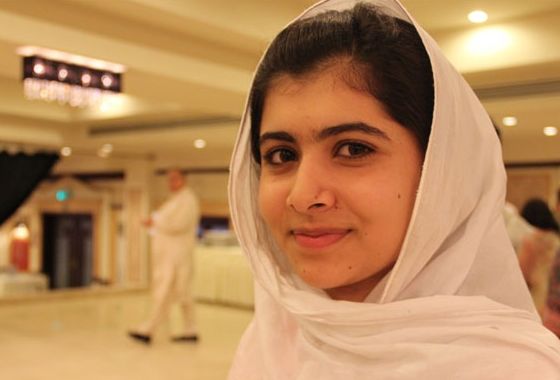
Malala Yousafzai: The fifteen-year-old Pakistani girl who wanted more from her country

Malala Yousafzai

Marie Brenner writes: One day in November 2007, on an editing console in the Dawn television news bureau in Peshawar, Pakistan, the bright brown eyes of a young girl popped from the computer screen. Just three hours to the northeast, in the Swat Valley, the mountain town of Mingora was under siege. Walking by the desk of the bureau chief, a reporter named Syed Irfan Ashraf stopped to take a look at the edit, which was being translated into English for that night’s news, and heard the girl’s voice. “I’m very frightened,” she said crisply. “Earlier, the situation was quite peaceful in Swat, but now it has worsened. Nowadays explosions are increasing We can’t sleep. Our siblings are terrified, and we cannot come to school.” She spoke an Urdu of startling refinement for a rural child. “Who is that girl?,” Ashraf asked the bureau chief. The answer came in Pashto, the local language: “Takra jenai,” which means “a shining young lady.” He added, “I think her name is Malala.”

The bureau chief had driven to Mingora to interview a local activist, the owner of the Khushal Girls High School & College. On the roads, Taliban soldiers in black turbans pulled drivers out of cars at checkpoints, searching for DVDs, alcohol, and anything else in violation of Shari’a, or strict Islamic law. In a lane near the market, a low wall protected the two-story private school. Inside, the bureau chief visited a fourth-grade class, where several girls shot up their hands when asked if they wanted to be interviewed. Seeing girls speak out in public was very unusual, even in the Swat Valley, a cultivated, 3,500-square-mile Shangri-la with 1.5 million inhabitants. That night, the brown-eyed girl’s sound bite led the news.

Later that evening the bureau chief ran into the school’s owner, Ziauddin Yousafzai, who said, “The girl who spoke on your broadcast. That Malala is my daughter.” The highly educated Yousafzai clearly understood that in the rigid class system of Pakistan he was an invisible member of the rural underclass, unseen by the elite of Lahore and Karachi. For his family, a moment on national news was huge. Like his daughter, Ziauddin spoke excellent English. Ashraf, who had been a professor at the University of Peshawar, could not get the image of Malala’s piercing gaze out of his mind. “She was an ordinary girl, but on-camera extraordinary,” he said. His beat at Dawn television included covering the bombings that were devastating remote villages all through Swat, and he determined to meet Malala and her father the next time he was on assignment in Mingora.

Last autumn, I contacted Ashraf at a computer lab in Carbondale, Illinois, where he is studying for a doctorate in media studies at Southern Illinois University. On October 9, he had seen in a news flash the horrifying image of Malala Yousafzai lying bandaged on a stretcher, after having been shot by an unknown extremist on her school bus. For the next three days, Ashraf did not leave his cubicle as the world grieved for this teenager who had stood up to the Taliban. Then he wrote an anguished column in Dawn, Pakistan’s most widely read English-language newspaper, which seemed like a profound mea culpa. Ashraf was savage regarding his role in Malala’s tragedy. “Hype is created with the help of the media while the people wait for the dénouement,” he wrote. He decried “the media’s role in dragging bright young people into dirty wars with horrible consequences for the innocent.” On the telephone he told me, “I was in shock. I could not call anyone.” He described his mute agony watching the TV coverage. “It is criminal what I did,” he said in an apoplectic tone. “I lured in a child of 11.” [Continue reading…]

Facebooktwittermail

U.S. cyber plan calls for private-sector scans of Net

Reuters reports: The U.S. government is expanding a cybersecurity program that scans Internet traffic headed into and out of defense contractors to include far more of the country’s private, civilian-run infrastructure.

As a result, more private sector employees than ever before, including those at big banks, utilities and key transportation companies, will have their emails and Web surfing scanned as a precaution against cyber attacks.

Under last month’s White House executive order on cybersecurity, the scans will be driven by classified information provided by U.S. intelligence agencies – including data from the National Security Agency (NSA) – on new or especially serious espionage threats and other hacking attempts. U.S. spy chiefs said on March 12 that cyber attacks have supplanted terrorism as the top threat to the country.

The Department of Homeland Security will gather the secret data and pass it to a small group of telecommunication companies and cybersecurity providers that have employees holding security clearances, government and industry officials said. Those companies will then offer to process email and other Internet transmissions for critical infrastructure customers that choose to participate in the program.

Facebooktwittermail

The systematic obliteration of Islam’s cultural heritage

The Independent reports: The authorities in Saudi Arabia have begun dismantling some of the oldest sections of Islam’s most important mosque as part of a highly controversial multi-billion pound expansion.

Photographs obtained by The Independent reveal how workers with drills and mechanical diggers have started demolishing some Ottoman and Abbasid sections on the eastern side of the Masjid al-Haram in Mecca.

The building, which is also known as the Grand Mosque, is the holiest site in Islam because it contains the Kaaba – the point to which all Muslims face when praying. The columns are the last remaining sections of the mosque which date back more than a few hundred years and form the inner perimeter on the outskirts of the white marble floor surrounding the Kaaba.

The new photos, taken over the last few weeks, have caused alarm among archaeologists and come as Prince Charles – a long-term supporter of preserving architectural heritage – flew into Saudi Arabia yesterday for a visit with the Duchess of Cornwall. The timing of his tour has been criticised by human rights campaigners after the Saudis shot seven men in public earlier this week despite major concerns about their trial and the fact that some of the men were juveniles at the time of their alleged crimes.

Many of the Ottoman and Abbasid columns in Mecca were inscribed with intricate Arabic calligraphy marking the names of the Prophet Muhammad’s companions and key moments in his life. One column which is believed to have been ripped down is supposed to mark the spot where Muslims believe Muhammad began his heavenly journey on a winged horse, which took him to Jerusalem and heaven in a single night.

Ghaffar Hussain writes: The holy cities of Mecca and Medina are increasingly beginning to resemble Chicago and Las Vegas rather than quaint Arab towns in which one can envisage what life was like in the times of the Prophet of Islam. Cultural heritage sites are being bulldozed in order to make way for glitzy shopping centres, 5 star hotels, trendy apartment blocks and bland sky scrapers. In fact, when I was last in Medina, the place was starting to resemble Milton Keynes

The Saudi regime benefits enormously from the millions of Muslim pilgrims that descend upon the holy cities each year. Visitor numbers are increasing year on year and expected to rise to 20 million a year in 2020. From a business point of view this is a dream come true. Increasingly wealthy visitors from neighbouring Gulf States have the potential to transform the holy cities into a gold mine, but that is only half the good news.

The business community has found allies in the conservative Wahabi religious establishment that is keen to obliterate historical sites and cultural artefacts and, thus, pave the way for unfettered development. In Wahabi theology, cultural heritage is not only deemed valueless, it is also deemed dangerous. Wahabis are strictly against forms of Islam in which holy relics or buildings are given reverence; they are also determined to enforce this view on others, stamping out more tolerant strands of Islam in the process.

Facebooktwittermail

Dying Iraq war veteran Tomas Young explains decision to end his life

A Message to George W. Bush and Dick Cheney From a Dying Veteran

To: George W. Bush and Dick Cheney
From: Tomas Young

I write this letter on the 10th anniversary of the Iraq War on behalf of my fellow Iraq War veterans. I write this letter on behalf of the 4,488 soldiers and Marines who died in Iraq. I write this letter on behalf of the hundreds of thousands of veterans who have been wounded and on behalf of those whose wounds, physical and psychological, have destroyed their lives. I am one of those gravely wounded. I was paralyzed in an insurgent ambush in 2004 in Sadr City. My life is coming to an end. I am living under hospice care.

I write this letter on behalf of husbands and wives who have lost spouses, on behalf of children who have lost a parent, on behalf of the fathers and mothers who have lost sons and daughters and on behalf of those who care for the many thousands of my fellow veterans who have brain injuries. I write this letter on behalf of those veterans whose trauma and self-revulsion for what they have witnessed, endured and done in Iraq have led to suicide and on behalf of the active-duty soldiers and Marines who commit, on average, a suicide a day. I write this letter on behalf of the some 1 million Iraqi dead and on behalf of the countless Iraqi wounded. I write this letter on behalf of us all—the human detritus your war has left behind, those who will spend their lives in unending pain and grief.

I write this letter, my last letter, to you, Mr. Bush and Mr. Cheney. I write not because I think you grasp the terrible human and moral consequences of your lies, manipulation and thirst for wealth and power. I write this letter because, before my own death, I want to make it clear that I, and hundreds of thousands of my fellow veterans, along with millions of my fellow citizens, along with hundreds of millions more in Iraq and the Middle East, know fully who you are and what you have done. You may evade justice but in our eyes you are each guilty of egregious war crimes, of plunder and, finally, of murder, including the murder of thousands of young Americans—my fellow veterans—whose future you stole. [Continue reading…]

Facebooktwittermail

Pentagon wants $49 million to build new prison at Guantánamo

The New York Times reports: The United States Southern Command has requested $49 million to build a new prison building at Guantánamo Bay, Cuba, for “special” detainees on top of other renovations it says are necessary since Congress has decided to keep it open indefinitely. That brings the potential taxpayer bill for upgrading the deteriorating facilities to an estimated $195.7 million, the military said on Thursday.

That overall price tag is significantly higher than the estimate of $150 million to $170 million that General John F. Kelly, the Southcom commander, gave in Congressional testimony on Wednesday. The special detainee facility was not included on the list of requested construction projects released by Southcom on Wednesday when reporters asked for details.

The project appears to be a proposed replacement for Camp 7, where so-called high-value detainees who were formerly held by the Central Intelligence Agency – like Khalid Shaikh Mohammed, the self-described architect of the terrorist attacks of Sept. 11, 2001 – are housed. While the existence of Camp 7 is widely known, the military generally refuses to discuss it. [Continue reading…]

Facebooktwittermail

Defensive jihad in Syria

Aymenn Jawad Al-Tamimi asks: How do the jihadist rebels generally conceive of jihad in the Syrian civil war?

One useful way to look into this question is to examine the Qur’anic verses pertaining to warfare cited in propaganda statements. In this context, one recurring verse is 22:39, which runs as follows: ‘Permission [to fight] has been granted to those who are being fought, because they have been wronged. And verily is God able to grant them victory.’

For example, at the start of the final rebel offensive on Raqqah at the beginning of this month that successfully took the city out of the hands of Assad’s forces, a video emerged on Youtube entitled ‘Statement from Jabhat al-Nusrah [JAN] on the beginning of the battle to liberate Raqqah.’ In this video, one can see three fighters from JAN – the al-Qa’ida-aligned jihadist group. The speaker begins the statement with citation of 22:39.

In a similar vein, at the end of last year, a battalion calling itself ‘The Free Men of the Euphrates Battalion’ invoked 22:39 at the opening of the announcement of its formation. In January of this year, a claimed police defector in Hama highlighted 22:39 in announcing his defection to Ahrar al-Sham, which has since merged with numerous other battalions to form a broad jihadist umbrella group that played a key role in the capture of Raqqah.

To be sure, 22:39 is also cited beyond jihadist circles, for it was notably invoked by the prominent Islamic scholar Mohammed Ali al-Sabouni — head of the Association of Syrian Scholars and a member of the Syrian National Coalition (opposition coalition-in-exile) — as a justification for taking up arms against the Assad regime.

Coming back to JAN (on whom I focus since it is considered the most hardline jihadist group), another Qur’anic quotation cited in their propaganda is 9:39, which states: ‘Fight the polytheists altogether just as they fight you altogether.’ This verse appeared at the beginning of a video released through the group’s official channel, called ‘The White Minaret.’

JAN’s channel also released a video that begins with quotation from 4:75, which speaks of the need to fight in the cause of God for the oppressed who cry out for aid: a theme emphasized in the same video.

One could go on, but the point is that by citing all these verses, even JAN places an emphasis on what might be termed ‘defensive jihad’: that is, fighting in self-defense and in defense of one’s fellow Muslim brethren in the face of a regime seen as waging war on Islam.

Indeed, the doctrine contrasts with ‘offensive jihad’, which is a concept that normally relies on a verse of the Qur’an quite different from the ones cited above: namely, 9:29. Modern al-Qa’ida theorists use this verse to argue that Muslims must conquer the world for Islam. Osama bin Laden himself made this aggressive approach clear in an essay stating that non-Muslims had three choices: conversion, subjugation, or death. [Continue reading…]

Facebooktwittermail

Zionism has become an obstacle to Jewish welfare and security

Ian S. Lustick asks: How close is Israel to pariah status? Quite close. Americans know that ratings for Congress are now in the single digits: below traffic jams, colonoscopies and cockroaches, though still above North Korea and telemarketers. If Israel were included in that survey it would of course do better than Congress — among Americans. But not in the world at large.

In a 2003 European Union-sponsored poll, Israel was seen as more dangerous to world peace than any other country. In 2006, an Israeli government poll conducted in 35 countries found Israel had the worst public image in every category it tested. In 2012, the BBC reported that 50% of 24,090 people polled worldwide thought Israel had a “mostly negative” impact on the world, tied with North Korea and exceeded only by Pakistan and Iran.

Worried about “delegitimization” as an “existential threat,” the Israeli government and its U.S. friends have funded a host of rebranding PR efforts. But Israel’s image has suffered more from repeated outrages to the world’s sense of fairness than from bad public relations.

Israeli leaders have repeatedly threatened to attack Iran, a signatory to the nuclear nonproliferation treaty, for developing nuclear technology with weapons potential, even as they refuse to join the NPT or acknowledge Israel’s own immense nuclear force. Israeli governments have launched several onslaughts against the Gaza Strip and Lebanon, inflicting collateral damage to innocents that has hugely exceeded Israeli casualties. In response to the United Nation’s decision to recognize Palestine as an observer state, the Israeli government announced radical expansion of Jewish settlement in sensitive areas of Jerusalem and the West Bank. Jews living in Palestine thousands of years ago are cited to justify a right of 21st century Jews to “return,” while Palestinian demands to return after 65 years of exile are deemed absurd.

Such policies and actions have shaped the international image of the Jewish state as defiant rather than courageous, belligerent rather than reasonable, dangerous rather than reliable.

Netanyahu and his allies can be blamed for many of Israel’s current excesses. But there are much deeper forces at work. One of them is the still-unrecognized reality of post-Zionism. Israel’s founding ideology has not adapted gradually to a changing world, and the American colossus has protected it from the consequences. When adaptation cannot occur gradually, it occurs suddenly. It is wrenching and disorienting. This is the sort of change in store for Israel. [Continue reading…]

Facebooktwittermail

Turkey, Israel make U.S.-brokered peace after Mavi Marmara apology

Today’s Zaman reports: Israeli Prime Minister Benjamin Netanyahu offered an apology to Turkey for a 2010 raid on an aid flotilla that resulted in the deaths of eight Turks and a Turkish American, ending a deep crisis in ties between the two former allies.

In a statement carried by Reuters, Netanyahu said he “expressed apology” to the Turkish people for any error that could have led to loss of life in the flotilla incident. He also said Israel has agreed to pay compensation to the families of the victims and that Israel and Turkey agree to work together to improve the humanitarian situation in the Palestinian territories.

A Turkish official in Ankara confirmed the apology, telling Today’s Zaman that Netanyahu called Erdoğan to offer an apology and that Erdoğan accepted it.

Facebooktwittermail

Obama’s expanding empire of drone bases advances across Africa

The Washington Post reports: The newest outpost in the U.S. government’s empire of drone bases sits behind a razor-wire-topped wall outside this West African capital, blasted by 110-degree heat and the occasional sandstorm blowing from the Sahara.

The U.S. Air Force began flying a handful of unarmed Predator drones from here last month. The gray, mosquito-shaped aircraft emerge sporadically from a borrowed hangar and soar north in search of al-Qaeda fighters and guerrillas from other groups hiding in the region’s untamed deserts and hills.

The harsh terrain of North and West Africa is rapidly emerging as yet another front in the United States’ long-running war against terrorist networks, a conflict that has fueled a revolution in drone warfare.

Since taking office in 2009, President Obama has relied heavily on drones for operations, both declared and covert, in Afghanistan, Iraq, Pakistan, Yemen, Libya and Somalia. U.S. drones also fly from allied bases in Turkey, Italy, Saudi Arabia, Qatar, the United Arab Emirates and the Philippines.

Now, they are becoming a fixture in Africa. The U.S. military has built a major drone hub in Djibouti, on the Horn of Africa, and flies unarmed Reaper drones from Ethiopia. Until recently, it conducted reconnaissance flights over East Africa from the island nation of the Seychelles. [Continue reading…]

Facebooktwittermail

Kirkuk: the time-bomb that didn’t explode

Der Spiegel reports: Kirkuk is a multiethnic city thousands of years old and claimed by Kurds, Arabs and Turkmen alike. American occupiers already viewed it as the predetermined breaking point of the new Iraq. They predicted that the various groups in the “Mesopotamian Jerusalem” would begin attacking each other after US troops had withdrawn.

The first oil in Iraq was discovered in Kirkuk in 1927. Since the 1930s, gas flares have been burning day and night on the city’s outskirts, serving as a reminder of the riches that whoever controls the region has access to. An American colonel once said that this city could plunge the entire country into ruin.

It’s looking that way at the moment, but not, as was once predicted, because of the city’s residents. In Kirkuk, where the local television station broadcasts in four languages, Muslims and Christians, Kurds, Arabs and Turkmen coexist more peacefully than they did years ago.

Although the parties are still at odds over voter registration problems, residents are increasingly indifferent to the issue. “We just want to live normally,” says Murah Salah, a Turkmen mechanic. “We want to have jobs, electricity, security, a functioning garbage-collection service and,” he adds with a smile, “to be able to drive out to barbecues on the weekend!”

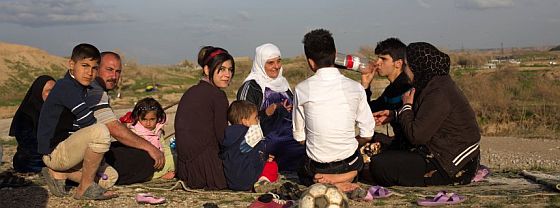
He is referring to the sort of outing that’s taking place on a large meadow outside the city today. Mohammed Hilmi and his family are picnicking directly next to the Salah family. Yes, things have improved, he says. “In the past, people sat on their blankets, far apart from each other, and no one spoke with anyone else. Those days are now gone.”

Delwar Abdul Aziz, a Kurdish pharmacist, says: “After Saddam, we just needed time to become normal again. There was deep-seated fear and mistrust. Now people trust each other again. The attacks are certainly a problem, but the terrorists are definitely not from here.”

Defusing Kirkuk ‘s Conflict

Neither Kurds nor Arabs nor Turkmen alone control Kirkuk and its population of 900,000. But that circumstance has probably kept things relatively stable in the city, which has put coexistence to the test for centuries, and which, in addition to the three main ethnic groups, is home to religious groups like the Yazidis, Kakai and Assyrian Christians. Jews are the only religious group to have left Kirkuk, in the 1950s.

When competing groups are forced to hammer out compromises, the result is checks and balances. Perhaps another reason for the city’s stability is that the Kirkukis got rid of their corrupt governor two years ago and elected a new one, whose nickname is the “Bulldozer.”

Najmuddin Karim, a Kurdish neurosurgeon who lived in the United States for 35 years, has fired corrupt officials, built roads, bridges and a new market, and created a few thousand temporary administrative jobs. Now that Karim is in office, electricity is available for 20 instead of four hours a day, and there are even streetlights, in Kurdish, Arab and Turkmen neighborhoods alike.

Although Karim hasn’t managed to end the conflict over Kirkuk, he has defused it. “We must treat everyone as a citizen, something we failed to do in the past,” says Karim, who is in his mid-60s. “Of course I would like to see Kirkuk become part of the Kurdish region. But it won’t work if the Sunnis and Turkmen don’t agree!” [Continue reading…]

Facebooktwittermail