Author Archives: News Sources

Rethinking Israel-Palestine: Beyond bantustans, beyond reservations

Noura Erakat writes: Due to the insistence upon maintaining a Jewish demographic majority, Israel’s establishment and maintenance has necessitated the ongoing forced displacement of Muslim and Christian Palestinians. Well before Israel’s establishment, David Ben-Gurion, Israel’s chief architect and two-time prime minister, said that in order to be successful, Jews must comprise 80 percent of the population, hardly a plausible ratio in light of a vibrant Palestinian society in 1948. As put by the Israeli historian Benny Morris during an interview discussing his book, The Birth of the Palestinian Refugee Problem Revisited,

Ben Gurion…understood that there could be no Jewish state with a large and hostile Arab minority in its midst…that has to be clear, it’s impossible to evade it. Without the uprooting of the Palestinians, a Jewish state would not have arisen there.

And so based on that vision, Zionists demolished 531 Arab villages and expelled some 700,000 Palestinians from what is today Israel proper. The “problem,” so to speak, is that Zionist forces did not expel all Palestinians. Instead, the 100,000 Palestinians remaining within Israel at the conclusion of the 1948 war today constitute a 1.2 million-person population, approximately 20 percent of Israel’s total population.

Had Israel declared its borders along the 1949 armistice line, maintaining an 80 percent demographic balance may have been possible. Israel, however, has never declared any borders and, in accordance with a plan first elaborated by Deputy Prime Minister Yigal Allon immediately after the 1967 war, it has steadily expanded into the rest of Mandate Palestine, home now to 4 million Palestinians.

As of October 2012, the balance of Jews to non-Jews throughout Israel and the OPT was approximately 5.9 million Jewish Israelis, including the settler population, and 6.1 million Palestinians.

At this juncture, Israel could abandon its commitment to a Jewish demographic majority and establish a state for all its citizens without distinction to religion. Its leaders and supporters reject this pluralistic, democratic option outright and equate it with the destruction of Israel. [Continue reading…]

Facebooktwittermail

Weapons experts raise doubts about Israel’s Iron Dome antimissile system

The New York Times reports: After President Obama arrived in Israel, his first stop on Wednesday was to inspect an installation of Iron Dome, the antimissile system hailed as a resounding success in the Gaza conflict in November. The photo op, celebrating a technological wonder built with the help of American dollars, came with considerable symbolism as Mr. Obama sought to showcase support for Israel after years of tensions over Jewish settlements and how to curb Iran’s nuclear ambitions.

Unstated amid the good will, though, was an intensifying debate over whether Iron Dome’s feats of warhead destruction were more illusory than real.

Israeli officials initially claimed success rates of up to 90 percent. Michael Oren, Israel’s ambassador to the United States, hailed the antimissile system as the first to succeed in combat. Congress recently called the system “very effective” and pledged an additional $680 million for deployments through 2015.

But a growing chorus of weapons experts in the United States and in Israel say their studies — based largely on analyses of hits and misses captured on video — suggest that Iron Dome destroyed no more than 40 percent of incoming warheads and perhaps far fewer. Many rockets, they argue, were simply crippled or deflected — failures that often let intact or dying rockets fall on populated areas.

“They’re smart people,” Richard M. Lloyd, a weapons expert who has written a critique of Iron Dome for engineers and weapons designers, said of the system’s makers in an interview. “But the problems go on and on.”

Behind that skepticism lie the messy realities of combat, as well as a half-century of global antimissile failures. “No military system is 90 percent effective,” said Philip E. Coyle III, who once ran the Pentagon’s weapons-testing program and recently left a White House security post.

For Iron Dome, the performance issue is important, in part, because defense bears strongly on offense. Israel’s decision on whether to bomb Iran’s nuclear sites — as it has repeatedly threatened to do — could hinge on its estimate of the retaliatory costs, including damage inflicted by rockets fired from southern Lebanon and the Gaza Strip. [Continue reading…]

Facebooktwittermail

Obama whispers sweet nothings while heading for the exit

In Haaretz, Aluf Benn writes: U.S. President Barack Obama said Wednesday his visit to Israel was meant to be a reassuring one. He is here to make it clear to Israelis that America stands behind them and will ensure their security, even though the neighborhood has become tougher.

What President Shimon Peres and Prime Minister Benjamin Netanyahu wanted to hear was Obama making a firm commitment to prevent Iran from acquiring nuclear weapons and to cushion the shock waves that could result from Syria’s disintegration.

It is premature to assess whether Peres and Netanyahu were satisfied by the promises made by the visitor, who asked for time for diplomatic negotiations with Iran and demanded that Syrian President Bashar Assad guard his chemical weapons.

The visit comes at a time when the United States is withdrawing from its deep involvement in the Middle East, amid the growing fear of Israel and other regional allies that America will abandon them to radical Islamic forces.

America entered the region with all its might, as its dependence on oil imports increased. But following the development of new oil and natural gas production methods in North America, the United States is gradually freeing itself of reliance on external energy sources.

In a few years it will become an oil exporter. The Middle East is still important, but it is less vital than it was a decade or two ago.

America has tired of the wars in the Middle East that consumed its resources and robbed its attention in the past decade, without resulting in a decisive victory. Obama has already pulled the U.S. Army out of Iraq, and will take it out of Afghanistan this term. The old regional order, with its reliance on secular military dictatorships and pro-American monarchies, has collapsed under the revolutions of the Arab Spring and the strengthening of the region’s Islamic movements.

The United States has discovered it cannot control these upheavals, and it doesn’t want to get involved in civil wars like the one in Syria. It prefers to stand by and see who wins.

Under these circumstances, pressure on Israel will increase. Until now, Israel has benefited from American safeguards in the region that have bolstered its deterrence capability, helped to safeguard the peace accords with Egypt and Jordan, and protected it from distant regional powers like Iran and Iraq. And when Israel is worried, or when it feels that its security concerns are not being given the attention they deserve in Washington, it has a tendency to take risks and use military force to perpetuate the strategic status quo.

Obama is projecting very different images domestically and overseas: He is trying to draw his country inward while telling his allies in the Middle East that, despite what they may be witnessing, the United States is just as committed to them as ever.

This attitude is reminiscent of Richard Nixon. In 1969 Nixon laid out the American foreign policy strategy that came to be known as the Guam Doctrine or the Nixon Doctrine, which made it clear that Washington would no longer undertake the defense of the free nations of the world. That was the first step toward an eventual American withdrawal from Vietnam, and Nixon, who had to sell the idea to his allies in Asia, assured them that everything would be fine.

The best way for Israel to ensure that the Americans remain committed is to threaten some unilateral action that would drag in the United States. That’s exactly what Netanyahu did Wednesday in his public appearances with Obama. He kept on talking about Israel’s right to defend itself. In rough translation from diplo-speak, that means, “If you don’t take action to get Iran to thwart its nuclear project, we will be forced to act alone − and you’ll suffer the consequences as much as we will.”

In the meantime, Obama has no clear-cut solution to the Iranian problem, or to the disintegration of Syria. He’s also finding it hard to bring his influence to bear on the political crisis in Egypt and to assuage Israeli concerns that the Muslim Brotherhood is planning to annul the Israel-Egypt peace treaty. So he’s playing for time by reassuring Israel, by whispering sweet nothings of unconditional love and support into the ears of the Israeli people, and by publicly referring to the prime minister by his nickname.

And there’s a good chance it will work. With every passing day, Israel becomes less capable of taking out Iran’s nuclear facilities by itself, while its dependence on the United States for military superiority just keeps growing.

Facebooktwittermail

The U.S. invasion of Iraq was a crime and its perpetrators are murderers

Paul Savoy writes: Ten years after the invasion of Iraq, it is astonishing in a nation dedicated to the rule of law that every aspect of the war has been debated except the relevant law.

To be sure, a vast array of articles, books and films have documented how pre-war intelligence was “manipulated” or “misrepresented” or “twisted” or “cherry-picked” or “fixed around the policy,” and how the Bush Administration’s inadequate planning produced a “fiasco,” a “blunder,” and a “disaster” — terms used to convey the sinister nature and catastrophic effect of White House miscalculations without actually accusing anyone of anything so incriminating as a felony.

Two notable exceptions are former Los Angeles prosecutor Vincent Bugliosi’s book, “The Prosecution of George W. Bush for Murder,” which encountered a virtual boycott by the major news media when published in 2008, and “United States v. George W. Bush et al.,” by Elizabeth de la Vega, a former Assistant U.S Attorney who meticulously presents the case for criminal fraud under a little-known federal statute that does not require monetary loss by the victim as a condition for conviction. Both books rest their case on proof of deliberate deception by the President and members of his war cabinet — not an easy hurdle to overcome in a criminal trial, which requires proof beyond a reasonable doubt.

Contrary to common belief, however, an American president can be found guilty of criminal conduct without proof of the corrupt state of mind of the deliberate liar or the malignant motives of Nazis on trial at Nuremberg. The criminal mind also encompasses the all-too-common consciousness of human beings acting carelessly in deciding to kill other human beings, however justified their conduct may seem in their own eyes.

On the tenth anniversary of the invasion, the only truly serious question about the war is whether President George W. Bush and those who participated in the decision to invade Iraq did anything illegal or unconstitutional or criminal.

To raise such a question about a war initiated by own’s own country is always “a vocation of agony,” as Martin Luther King, Jr. said of the war in Vietnam when he finally chose in 1967 to break his silence about the conflict. Whatever the reasons for avoiding the Iraq question, whether it is President Obama’s understandable fear of further polarizing a sorely divided nation, or out of respect for the 4,422 Americans who gave their lives fighting for what they believed was a just cause, or because the legal issues are too big or too difficult, we must finally say about Iraq what Dr. King said about Vietnam. “We must speak with all the humility that is appropriate to our limited vision, but we must speak.” [Continue reading…]

Facebooktwittermail

Margaret Sullivan: An NYT ombud who dares to challenge her paper’s cozy relationship with the government

Greg Mitchell writes: With criticism and debate over the Obama administration’s deadly drone policy at a high level, it’s easy to forget that this was not the case until very recently. What set off the uproar was NBC’s decision in early February to publish a Justice Department white paper on rules governing US drone strikes aimed at American citizens abroad. This led to an examination of the entire program by the media and some in Congress, and put John Brennan on the spot during his congressional confirmation hearings for director of the Central Intelligence Agency.

Although the White House has drawn criticism, less has been said about the media’s failure to probe the drone program, and the way they knuckled under to government requests to withhold secrets. One of the few prominent critics of this journalistic “cover-up” was Margaret Sullivan, who happened to be working at the nation’s most influential media outlet, The New York Times. Her main target was… The New York Times.

Sullivan, the former editor of Warren Buffett’s Buffalo News, became the latest person appointed to the paper’s rotating post of public editor (a variety of ombudsman) last September. On October 13, she took the Times to task, charging that “its reporting has not aggressively challenged the administration’s description of those killed as ‘militants’ — itself an undefined term. And it has been criticized for giving administration officials the cover of anonymity when they suggest that critics of drones are terrorist sympathizers…. With its vast talent and resources, The Times has a responsibility to lead the way in covering this topic as aggressively and as forcefully as possible, and to keep pushing for transparency so that Americans can understand just what their government is doing.”

This earned her the praise of others who have criticized previous public editors at the Times for their soft critiques of the paper. “On drones and the Times’s withdrawal from the ‘informal arrangement’ not to disclose the Saudi Arabia base, she was right,” Erik Wemple, a Washington Post media critic, told me. “Right and quick, too. I was pursuing interviews with the paper that morning, and she beat me to the punch, scoring a bunch of insightful material from [managing editor] Dean Baquet.”

When I recently asked Sullivan for an update on her current concerns, she replied, “This is a subject that is very important to me, and I’m sure I will keep paying close attention to it. I did see after I wrote about it in October that there was a slightly different and more precise use of the language in stories, and I was heartened by that. The key is not just the language but the whole question of secrecy around the program and how the newspaper interacts with the government.”

But the drone column and later posts on this subject were hardly exceptions to Sullivan’s crisp reviewing. Among other issues she has raised that drew wide coverage and might even have sparked changes: the policy of the Times, and many other outlets, of granting quote approval to their sources; the perils of “false equivalency” in covering hot-button issues; social media posts by Jodi Rudoren, the newspaper’s Jerusalem bureau chief, that appeared to reveal bias against Palestinians in Gaza; the paper’s failure to send a reporter to cover Pfc. Bradley Manning’s first day of testimony at his trial for passing documents to WikiLeaks; the paper’s decision in early March to shut down its popular “Green” blog on environmental issues; and many more. [Continue reading…]

Facebooktwittermail

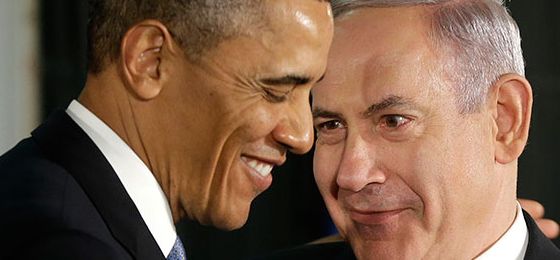
A Bibi-Barack love affair

Karl Vick reports: If there was any question about why President Obama came to Israel on the first overseas trip of his second term – and the question has come up – it vanished into the brilliant blue sky above Ben Gurion Airport when he reached the end of the red carpet and the microphone waiting there. The leader of the free world had come to issue a correction. Four years ago, delivering an address to the Muslim people in Cairo, Obama had irked Israeli Jews by citing the Holocaust as the justification for the 1948 founding of modern Israel. Israelis prefer to reach a bit further back — they find their deed to the land in the Bible – and the misapprehension was aggravated by what Obama did when he left Cairo: Fly past Israel to pay a call at Buchenwald, the World War II concentration camp.

There was none of that Wednesday. “More than 3,000 years ago, the Jewish people lived here, tended the land here, prayed to God here,” Obama began, getting right to it on the tarmac. “And after centuries of exile and persecution, unparalleled in the history of man, the founding of the Jewish State of Israel was a rebirth, a redemption unlike any in history. Today, the sons of Abraham and the daughters of Sarah are fulfilling the dream of the ages — to be ‘masters of their own fate’ in ‘their own sovereign state.’”

Benjamin Netanyahu looked on beaming. “I thought that was a wonderful line that I will cherish because it really gets down to the essence of what this state is about,” the prime minister said a few hours later, as the two leaders took questions at his Jerusalem residence. On the same page at last – somewhere in Psalms, just going by the praise-singing – the famously frosty pair appeared determined to project a budding buddydom. At the airport, when Obama shrugged off his suit jacket and flicked it over his shoulder, Netanyahu glanced over and, after first hitching up his pants, did the same, like a little kid imitating an older one. When they reached the display of Israel’s anti-missile systems, including Iron Dome, Netanyahu directed his guest through the exhibit by the colors painted on the tarmac: “Follow the red line.” Obama quipped: “He’s always talking to me about red lines.” An Iran joke. They can laugh about it now.

Obama kept calling Netanyahu “Bibi,” and choked both of them up a moment reading from the published letters of his brother Yonatan Netanyahu, who was killed leading the raid to rescue Israeli hostages at Entebbe. Netanyahu kept looking at Obama the way he spoke of him: approvingly. The handshakes were vigorous, the thanks effusive, and though they continue to differ on when it might be necessary to go military against Iran, the differences are no longer emphasized publicly. [Continue reading…]

Facebooktwittermail

What Obama won’t witness: apartheid in Hebron

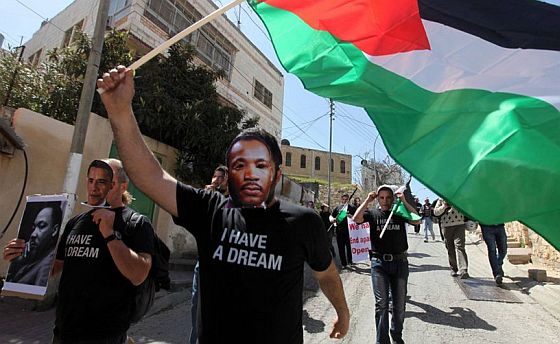
Ali Gharib reports: Call it a welcoming committee. Around noon here, just as Barack Obama’s plane was slated to touch down in Israel, a group of Palestinians donned masks bearing the American president’s likeness and took to Shuhada Street in Hebron, in the southern West Bank. Joined by international and Israeli activists, all wearing tee-shirts that read “I have a dream,” they caught the army unawares. Within minutes, five Israeli soldiers swarmed the group of just over 20 protesters, detaining seven or eight of them (reports remain unconfirmed), including the two Palestinians leading the protests. Their crime? Walking down the street.

“Obama, come here to Hebron,” shouted Issa Amro, a local protest leader, in English, just as a scrum formed between the demonstrators and a handful of soldiers, who rushed to the scene. “I am Obama,” he added as a young settler, perhaps 12-years-old, snatched the cardboard Obama mask from his face, crumpling it into his back pocket. Within minutes, Amro was shoved to the street. He rose briefly only to be knocked down again, before being dragged off into detention.

Segregation is too light a word to describe what happens in Hebron, a city of less than 200,000 that feels like ground zero of the Israeli occupation. Home to Jewish holy site, the Tomb of the Patriarchs, Israeli settlers began arriving in droves after Israel’s takeover of the West Bank in 1967 (joining a small, longtime community that coexisted peacefully here for more than a century). The city is now dotted by small settlements, each home no matter how remote guarded by a soldier from the Israeli army. Now, several hundred settlers live in directly in the city. Eventually, settlers seized Shuhada Street, narrow road that used to house a local market. Eventually, in perhaps the starkest act of discrimination here, much of the road was closed to Palestinians altogether in 1994. Palestinian life in the area has suffered dramatically since.

The protesters had marched down from a local house, joining a cadre of others and walking with Palestinian flags and a banner reading, “We have a dream/ Apartheid in Hebron/ Open Shuhada Street.” Other demonstrators held up photos of Martin Luther King, Jr.—some wore masks of his likeness, too—and Frederick Douglas. The protests took on King’s spirit of non-violence: no demonstrator hurled so much as an insult, let alone a rock. Just as they passed into the section where the road becomes “sterile”—meaning Palestinians are not allowed to walk—a group of five soldiers confronted them, attempting to form a barricade. A settler emerged from a nearby building and moved a white Volkswagen panel van across the street, bottlenecking the pedestrian traffic. But a few of the protesters broke through, only to be stopped a few meters down the road. [Continue reading…]

Facebooktwittermail

Obama must embrace Israel’s tribal politics

Daniel Levy writes: It was not always thus.

Despite the characteristic sense of entitlement conveyed by many in the Israeli elite in advance of Barack Obama’s first presidential visit: “You finally made it, what took you so long?” the must-go-to-Israel clause in the U.S. presidential contract is of surprisingly recent vintage.

Next week marks the ninth visit by a sitting U.S .President. But half of those previous eight trips were notched-up by Bill Clinton alone, and another two by George W. Bush in his very last year in office (yes, he waited eight years to say “Hi” in person). The nature of this Obama visit, most closely resembling the second Bush trip of May 2008, should tell us something about the changing contours of the U.S.-Israel relationship.

The first two presidential visits were in the 1970’s. Nixon came in 1974 (a quarter-century after Israel’s creation) and Carter in 1979, both unequivocally focused on advancing Israeli – Egyptian deals that served American regional interests: First, the post-1973 war separation of forces agreement, and later the Israel-Egypt peace treaty. Another fifteen years and two Presidents elapsed before Clinton became such a regular on these shores in the 1990s. All four of his trips were unmistakably dedicated to the peace process of the time – attending the Israel-Jordan peace agreement signing in 1994, Yitzhak Rabin’s funeral in 1995 (it would be absurd to de-link that occasion from the Israeli – Palestinian process), the post-bus-bombings and pre-election 1996 stop-over designed to save the peace process by hugging Shimon Peres (standing for election against Netanyahu), and finally a December 1998 visit to push the implementation of the Wye River Agreement, including an historic stop in Gaza (again, in part, a political visit to challenge Netanyahu). Even President Bush’s January 2008 jaunt was about pushing the Annapolis peace talks, however misguided and flawed those were.

So for thirty-plus years the ostensible driving factor for Presidential visits has been to align America’s Israel relationship with its national security interest, by promoting peace between Israel and its neighbors.

The second Bush visit in June 2008 broke that trend, dedicated as it was to celebrating Israel’s 60 anniversary and marking the primacy of the bilateral and political in defining American-Israeli interaction. The timing and anticipated content of the Obama visit would appear to continue that new orientation. It is again mostly about politics (U.S. domestic politics) and the bilateral relationship. The Palestinians will be mentioned and feature as part of the visit, yet expectations of a new Israel- Palestine initiative are low for good reasons. Obama is coming first and foremost to make a statement about the U.S.-Israel bond, not the illegal occupation, the unresolved conflict or American interests. [Continue reading…]

Facebooktwittermail

CIA poised to hand over drone operations to Pentagon

Daily Beast: At a time when controversy over the Obama administration’s drone program seems to be cresting, the CIA is close to taking a major step toward getting out of the targeted killing business. Three senior U.S. officials tell The Daily Beast that the White House is poised to sign off on a plan to shift the CIA’s lethal targeting program to the Defense Department.

The move could potentially toughen the criteria for drone strikes, strengthen the program’s accountability, and increase transparency. Currently, the government maintains parallel drone programs, one housed in the CIA and the other run by DOD. The proposed plan would unify the command and control structure of targeted killings, and create a uniform set of rules and procedures. The CIA would maintain a role, but the military would have operational control over targeting. Lethal missions would take place under Title 10 of the U.S. Code, which governs military operations, rather than Title 50, which sets out the legal authorities for intelligence activities and covert operations. “This is a big deal,” says one senior administration official who has been briefed on the plan. “It would be a pretty strong statement.”

Officials anticipate a phased-in transition in which the CIA’s drone operations would be gradually shifted over to the military, a process that could take as little as a year. Others say it might take longer but would occur during President Obama’s second term. “You can’t just flip a switch, but it’s on a reasonably fast track,” says one U.S. official. During that time, CIA and DOD operators would begin to work more closely together to ensure a smooth hand-off. The CIA would remain involved in lethal targeting, at least on the intelligence side, but would not actually control the unmanned aerial vehicles. Officials told The Daily Beast that a potential downside of the Agency relinquishing control of the program was the loss of a decade of expertise that the CIA has developed since it has been prosecuting its war in Pakistan and beyond. At least for a period of transition, CIA operators would likely work alongside their military counterparts to target suspected terrorists. [Continue reading…]

Facebooktwittermail

The god that failed: Evgeny Morozov’s ‘To Save Everything, Click Here’

Los Angeles Review of Books: Evgeny Morozov is done with the Internet. In his latest book, To Save Everything, Click Here: The Folly of Technological Solutionism, Morozov dismantles the myth that the Internet is inherently a force for social change; it can no more fix higher education, save the economy, or topple a dictator than it can make us stupid, lonely, or shallow. “The Internet” (Morozov wraps the term in quotation marks for most of the book) is not a naturally occurring phenomenon or a living thing, but a socially constructed myth that “effortlessly fills minds, pockets, coffers, and even the most glaring narrative gaps.” “The myth of the Internet,” he argues, “tells us nothing about how the world works and even less about how it should.” In fact, at one point, he questions whether the Internet even exists.

Morozov is best known for the colorful hyperbole of his polemical criticism in The New Republic and elsewhere (his book reviews are often described as “devastating”), but the most compelling passages in To Save Everything follow a more measured tack, building bridges among the academic and popular literatures on technology in society. To understand the limitations of technocratic approaches to social problems, he reads in communication studies and political philosophy. To provide a context for his interpretation of the dominant Internet myth, Morozov draws on key works in the history, sociology, and anthropology of science and technology. The bibliography is diverse, ranging from the canonical debate between John Dewey and Walter Lippman on the role of expertise in democracy, to Bruno Latour’s more recent invitation to consider the agency of “non-human” actors. This type of synthetic work is all too rare in cultural criticism, and there is an excellent reading list embedded in the endnotes of To Save Everything, Click Here. If Morozov’s argument rings true — and, for the most part, it does — it is due to the strong philosophical foundation on which he stands.

To Save Everything is animated by a thoroughgoing critique of two central ideas that Morozov terms “solutionism” and “Internet-centrism.” The first describes an instrumental engagement with public life that regards all social and political issues as problems to be solved. The second refers to a fascination with the Internet as a wholly novel sociotechnical phenomenon (which Morozov first diagnosed in his 2011 book The Net Delusion). Solutionism and Internet-centrism are both worldviews infused with the technocratic values of efficiency, cleanliness, and productivity, values that are poorly suited, in Morozov’s view, to life in a pluralistic liberal democracy. [Continue reading…]

Facebooktwittermail

An open letter to Paul Wolfowitz

Andrew Bacevich writes: [Albert] Wohlstetter’s perspective (which became yours) emphasized five distinct propositions. Call them the Wohlstetter Precepts.

First, liberal internationalism, with its optimistic expectation that the world will embrace a set of common norms to achieve peace, is an illusion. Of course virtually every president since Franklin Roosevelt has paid lip service to that illusion, and doing so during the Cold War may even have served a certain purpose. But to indulge it further constitutes sheer folly.

Second, the system that replaces liberal internationalism must address the ever-present (and growing) danger posed by catastrophic surprise. Remember Pearl Harbor. Now imagine something orders of magnitude worse — for instance, a nuclear attack from out of the blue.

Third, the key to averting or at least minimizing surprise is to act preventively. If shrewdly conceived and skillfully executed, action holds some possibility of safety, whereas inaction reduces that possibility to near zero. Eliminate the threat before it materializes. In statecraft, that defines the standard of excellence.

Fourth, the ultimate in preventive action is dominion. The best insurance against unpleasant surprises is to achieve unquestioned supremacy.

Lastly, by transforming the very nature of war, information technology — an arena in which the United States has historically enjoyed a clear edge — brings outright supremacy within reach. Of all the products of Albert Wohlstetter’s fertile brain, this one impressed you most. The potential implications were dazzling. According to Mao, political power grows out of the barrel of a gun. Wohlstetter went further. Given the right sort of gun — preferably one that fires very fast and very accurately — so, too, does world order.

With the passing of the Cold War, global hegemony seemed America’s for the taking. What others saw as an option you, Paul, saw as something much more: an obligation that the nation needed to seize, for its own good as well as for the world’s. Not long before we both showed up at SAIS, your first effort to codify supremacy and preventive action as a basis for strategy had ended in embarrassing failure. I refer here to the famous (or infamous) Defense Planning Guidance of 1992, drafted in the aftermath of Operation Desert Storm by the Pentagon policy shop you then directed. Before this classified document was fully vetted by the White House, it was leaked to the New York Times, which made it front-page news. The draft DPG announced that it had become the “first objective” of U.S. policy “to prevent the re-emergence of a new rival.” With an eye toward “deterring potential competitors from even aspiring to a larger regional or global role,” the United States would maintain unquestioned military superiority and, if necessary, employ force unilaterally. As window dressing, allies might be nice, but the United States no longer considered them necessary.

Unfortunately, you and the team assigned to draft the DPG had miscalculated the administration’s support for your thinking. This was not the moment to be unfurling grandiose ambitions expressed in indelicate language. In the ensuing hue and cry, President George H. W. Bush disavowed the document. Your reputation took a hit. But you were undeterred.

The election of George W. Bush as president permitted you to escape from academe. You’d done yeoman work tutoring candidate Bush in how the world works, and he repaid the debt by appointing you to serve as Donald Rumsfeld’s deputy atop the Pentagon hierarchy. You took office as Osama bin Laden was conspiring to attack. Alas, neither Rumsfeld nor you nor anyone else in a position of real authority anticipated what was to occur. America’s vaunted defense establishment had left the country defenseless. Yet instead of seeing this as evidence of gross incompetence requiring the officials responsible to resign, you took it as an affirmation. For proof that averting surprise through preventive military action was now priority number one, Americans needed to look no further than the damage inflicted by nineteen thugs armed with box cutters.

You immediately saw the events of 9/11 as a second and more promising opening to assert U.S. supremacy. When riding high a decade earlier, many Americans had thought it either unseemly or unnecessary to lord it over others. Now, with the populace angry and frightened, the idea was likely to prove an easier sell. Although none of the hijackers were Iraqi, within days of 9/11 you were promoting military action against Iraq. Critics have chalked this up to your supposed obsession with Saddam. The criticism is misplaced. The scale of your ambitions was vastly greater.

In an instant, you grasped that the attacks provided a fresh opportunity to implement Wohlstetter’s Precepts, and Iraq offered a made-to-order venue. “We cannot wait to act until the threat is imminent,” you said in 2002. Toppling Saddam Hussein would validate the alternative to waiting. In Iraq the United States would demonstrate the efficacy of preventive war. [Continue reading…]

Facebooktwittermail

In the war on the poor, Pope Francis is on the wrong side

George Monbiot writes: ‘When I give food to the poor, they call me a saint. When I ask why they are poor, they call me a communist.” So said the Brazilian archbishop Dom Hélder Câmara. His adage exposes one of the great fissures in the Catholic church, and the emptiness of the new pope’s claim to be on the side of the poor.

The bravest people I have met are all Catholic priests. Working in West Papua and then in Brazil, I met men who were prepared repeatedly to risk death for the sake of others. When I first knocked on the door of the friary in Bacabal, in the Brazilian state of Maranhão, the priest who opened it thought I had been sent to kill him. That morning he had received the latest in a series of death threats from the local ranchers’ union. Yet still he opened the door.

Inside the friary was a group of peasants – some crying and trembling – whose bodies were covered in bruises made by rifle butts, and whose wrists bore the marks of rope burns. They were among thousands of people the priests were trying to protect, as expansionist landlords – supported by police, local politicians and a corrupt judiciary – burned their houses, drove them off their land, and tortured or killed those who resisted.

I learned something of the fear in which the priests lived when I was beaten and nearly shot by the military police. But unlike them, I could move on. They stayed to defend people whose struggles to keep their land were often a matter of life or death: expulsion meant malnutrition, disease and murder in the slums or the goldmines.

The priests belonged to a movement that had swept across Latin America, after the publication of A Theology of Liberation by Gustavo Gutiérrez in 1971. Liberation theologists not only put themselves between the poor and the killers, they also mobilised their flocks to resist dispossession, learn their rights and see their struggle as part of a long history of resistance, beginning with the flight of the Israelites from Egypt.

By the time I joined them, in 1989, seven Brazilian priests had been murdered; many others across the continent had been arrested, tortured and killed; Óscar Romero, the archbishop of San Salvador, had been shot dead. But dictators, landlords, police and gunmen were not their only enemies. Seven years after I first worked in Bacabal, I returned and met the priest who had opened the door. He couldn’t talk to me. He had been silenced, as part of the church’s great purge of dissenting voices. The lions of God were led by donkeys. The peasants had lost their protection. [Continue reading…]

Facebooktwittermail

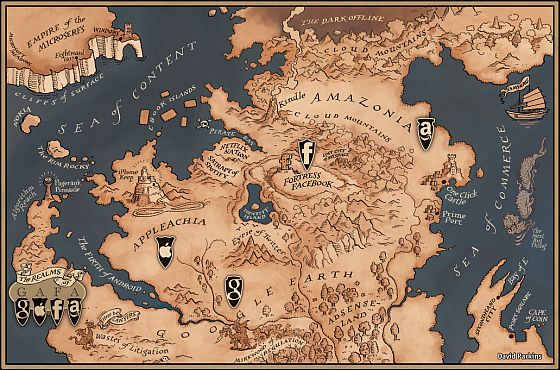
Jaron Lanier asks whether we have given up too much power to the big digital corporations

The Guardian: Jaron Lanier, groundbreaking computer scientist and infectious optimist, is concerned that we are not making the most of ourselves. In Who Owns the Future? he tellingly questions the trajectory of economic value in the information age, and argues that there has been a fundamental misstep in how capitalism has gone digital. For Lanier, late capitalism is not so much exhausted as humiliating: in an automated world, information is more important to the economy than manual labour, and yet we are expected to surrender information generated by or about ourselves – a valuable resource – for free.

Information here is a broad term for any conscious intellectual, artistic, or pragmatic contribution to the production of goods, services and cultural output, but it also includes the data that we unconsciously radiate simply by exhibiting certain behavioural and consumer traits. Lanier’s project is to foresee how livelihoods might be better sustained in a world in which information is king.

In his view, disproportionate economic power now accumulates around companies who “own the fastest computers with the most access to everyone’s information”. We donate extremely lucrative information – our interests, demographic predilections, buying habits, cyber-movements – in exchange for “free” admission into social media networks. (Digitisation has also allowed banks to repackage the “information” of a mortgage debt and sell it on as increasingly complex financial products, while excluding the indebted home-owner from a percentage of the profits.) Lanier argues that the early internet years have fetishised open access and knowledge-sharing in a way that has distracted people from demanding fairness and job security in an economy predicated on data flow. [Continue reading…]

Facebooktwittermail

The Free Syrian Army does exist and is growing stronger by the day

Koert Debeuf writes: When I read the piece of Aron Lund, ‘the FSA doesn’t exist’, I was utterly surprised. Of course the FSA does exist. And it is changing rapidly.Over the last few months, the FSA has transformed itself from a loose structure into a functioning organization. In fact, what Lund describes is an era of the FSA that no longer exists. It ignores the developments of the last several months and the present reality on the ground.

Last month, I visited Northern Syria three times with the Free Syrian 
Army (FSA). I spoke to many generals who had defected from the Syrian Army, to commanders on
 the ground,to people in the headquarters of the FSA and
 to military-civilian organizers of humanitarian aid of all parts of
 Syria. I also spent many hours with Dr. Brigadier General Salim 
Idriss, Chief of Staff of the FSA; I was in the middle of a battle 
at Quweris airport, then one of the main front lines.

Many points Lund is making, were correct three months ago. But not now. Col. Riaad Assad for example is completely out of the picture, whatever he himself might say. Another example is Qasem Saadeddin. He did indeed try to create some unity in Homs and had difficulties in doing so. But that too is history. Today he is a Commander of one of the five fronts under the umbrella of the FSA and he is working very closely with Chief of Staff Salim Idriss. It is also not true that Idriss would not use the ‘brand’ FSA. One example is the fact that he recently started his own twitter and Facebook account as well as one for the headquarters, using @FSAHQ. [Continue reading…]

Beneath Debeuf’s post is a response by Lund.

Facebooktwittermail

Mr. President, don’t forget the Nakba

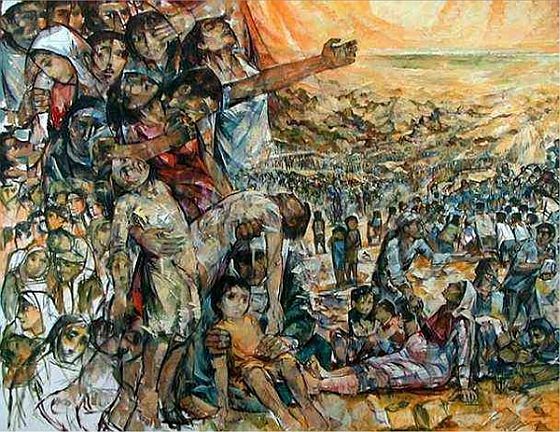
The Road to Nowhere by Ismail Shammout

Yousef Munayyer writes: Tomorrow, Air Force One will land in my hometown. Lydda, a historic Palestinian city, is where the airport is (not Tel Aviv). Just like the Palestinians, the airport was there before the state of Israel. It was only named after Israel’s first Prime Minister, David Ben Gurion, in 1973.

Unbeknownst to most observers, President Barack Obama is actually traveling to the region on the anniversary of a pivotal day in the history of Palestine. Sixty-five years ago, in a township called Lake Success, NY, a chain of events would be set into motion that would lead to disaster for Palestinians.

Lake Success, a township on Long Island, was home to the United Nations long before it moved to its iconic eastside headquarters. There, on March 19, 1948, ambassadors and delegates were gathered to discuss the implementation of the 1947 Partition plan for Palestine. The British mandate was drawing to a close within weeks. Many people know that the U.N. passed a general assembly resolution in favor of partitioning Palestine in November 1947. Few people know, however, that on this day, the United States — which had originally voted for partition — withdrew its support for the plan and favored instead something closer to a one-state outcome.

For the Zionists, this was a blow to their political scheme. They had worked on their colonial project for decades, and now after a partition plan had been announced and just as the British Mandatory forces were beginning to withdraw, the United States, the most important player on the international scene after WWII, was backing out. The Zionists were so close to establishing their goal only to see it stymied by diplomats in New York.

There was another plan, of course. It was called Plan Dalet. The military plan for the conquest of Palestine was adopted by the Zionists days earlier. Ben Gurion, in response to America’s withdrawal of support for partition, was defiant. He declared that “the tactical establishment of the Jewish state depends on Jewish strength. It is by our power, mobilized to the utmost, that the state will arise.”

If the international community wasn’t going to give the Zionists a state of their own in Palestine at the expense of the natives, the Zionists were determined to take it by force. [Continue reading…]

Facebooktwittermail

The shame of America’s gulag

Chris Hedges writes: If, as Fyodor Dostoevsky wrote, “the degree of civilization in a society can be judged by entering its prisons” then we are a nation of barbarians. Our vast network of federal and state prisons, with some 2.3 million inmates, rivals the gulags of totalitarian states. Once you disappear behind prison walls you become prey. Rape. Torture. Beatings. Prolonged isolation. Sensory deprivation. Racial profiling. Chain gangs. Forced labor. Rancid food. Children imprisoned as adults. Prisoners forced to take medications to induce lethargy. Inadequate heating and ventilation. Poor health care. Draconian sentences for nonviolent crimes. Endemic violence.

Bonnie Kerness and Ojore Lutalo, both of whom I met in Newark, N.J., a few days ago at the office of American Friends Service Committee Prison Watch, have fought longer and harder than perhaps any others in the country against the expanding abuse of prisoners, especially the use of solitary confinement. Lutalo, once a member of the Black Liberation Army, an offshoot of the Black Panthers, first wrote Kerness in 1986 while he was a prisoner at Trenton State Prison, now called New Jersey State Prison. He described to her the bleak and degrading world of solitary confinement, the world of the prisoners like him held in the so-called management control unit, which he called “a prison within a prison.” Before being released in 2009, Lutalo was in the management control unit for 22 of the 28 years he served for the second of two convictions—the first for a bank robbery and the second for a gun battle with a drug dealer. He kept his sanity, he told me, by following a strict regime of exercising in his tiny cell, writing, meditating and tearing up newspapers to make collages that portrayed his prison conditions.

“The guards in riot gear would suddenly wake you up at 1 a.m., force you to strip and make you grab all your things and move you to another cell just to harass you,” he said when we spoke in Newark. “They had attack dogs with them that were trained to go for your genitals. You spent 24 hours alone one day in your cell and 22 the next. If you do not have a strong sense of purpose you don’t survive psychologically. Isolation is designed to defeat prisoners mentally, and I saw a lot of prisoners defeated.” [Continue reading…]

Facebooktwittermail