Jack L. Amoureux writes: Whether or not drones should be employed in the United States is the wrong question. Americans should be asking, “Is it ethical to use drones anywhere?”
Recently, concerns about how the U.S. government manages and deploys its fleet of around 7,000 drones have become especially prominent. Just last year President Obama, under mounting pressure, acknowledged the systematic use of drones in Iraq, Afghanistan, and elsewhere after a U.S. citizen was killed by a drone strike in Yemen.
Senate hearings on whether to confirm a key architect of the drone program, John Brennan, as director of the CIA underscore the increasingly urgent questions being asked of the administration. As part of the confirmation process, several senators insisted that the president share secret memoranda about drones, and Senator Rand Paul, R-Ky., mounted a 13-hour filibuster on the Senate floor over the administration’s refusal to rule out the possibility of a drone strike against a U.S. citizen on domestic soil.
But drones have become a hot button issue for a surprisingly diverse set of political actors only as armed drones flying over our heads have become more of a reality. Opposition has coalesced around the constitutional rights of U.S. citizens and a call for greater transparency and regulation of domestic drones. There is, however, a worrisome void in this debate about U.S. drone policy and practice — the lack of focus on the ethics of drones, whether used domestically or abroad. This neglect puts the United States out of step with the debates that are happening in the areas of the world most affected by drones. [Continue reading…]
Author Archives: News Sources
Video: Greece could be the spark for defeating austerity across Europe
Alexis Tsipras, the radical left party Syriza which is leading in the Greek polls, interviewed by Seumas Milne:
Video: The rise of the global South
Why the ‘color revolutions’ failed
Melinda Haring and Michael Cecire write: The fate of the “color revolutions” — the symbolically-named series of peaceful uprisings in the former Soviet Union — have been terribly disappointing. In Georgia (“Rose,” 2003), Ukraine (“Orange,” 2004), and Kyrgyzstan (“Tulip,” 2005), popular uprisings against entrenched leaders brought to power reform-minded politicians who pledged to transform post-Soviet dens of corruption into modern states. But in all three places, those promises of far-reaching change never really materialized. Yet scholars and democracy promotion organizations continue to mine them for lessons that might apply to the Arab Spring transitions. Here’s why that’s a mistake.
In Georgia, where the endlessly energetic Mikheil Saakashvili embraced the West and free-market reforms with apparent gusto, elite corruption still continued apace. In Ukraine, Viktor Yushchenko’s public spats with one-time ally Yulia Tymoshenko were so vicious that Viktor Yanukovych — the villain of the Orange Revolution — managed to return to office as prime minister in 2006, and won election as president four short years later. In Kyrgyzstan, Tulip Revolution leader Kurmanbek Bakiyev quickly established himself as a political strongman and informally put his son Maksim in charge of all business transactions. After bloodshed erupted in 2010, when citizens refused to sit idly by, after a winter of power shortages and intense price shocks while the first family enriched itself, President Bakiyev fled to Minsk.
So much for the vaunted color revolutions, not one of which has produced a consolidated democracy.
Why did they fail? Quite simply, the rule of law never took root. Too often, the color revolution governments acted above or with little regard to the democratic legal standard to which they held their predecessors. For example, Georgia’s record of protecting property rights was abysmal, Ukraine was inescapably seized by vendetta politics, and Bakiyev presided over Kyrgyzstan as though it were his personal fiefdom. Though the governments all professed a commitment to democracy and the rule of law, the maladies that typified the preceding regimes quickly came to describe the new governments. Supporters made a key mistake: They took the revolutions themselves as the apogee of democracy rather than focusing on the hard, grinding work of institution-building. [Continue reading…]
Syrian exile opposition pick U.S. citizen to lead interim government

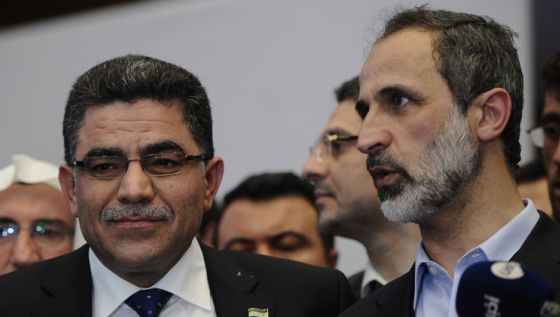
Ghassan Hitto (left) alongside Moaz al-Khatib, president of the Syrian National Coalition.
The Associated Press reports: Syria’s rebel coalition has elected as its prime minister Ghassan Hitto, a little-known American-educated IT manager and Islamic activist who will head an interim government to administer the areas seized by opposition forces from the regime troops of President Bashar Assad.
Hitto received 35 votes out of 48 ballots cast by the opposition Syrian National Coalition’s 63 active members during a meeting in Istanbul. The results were read aloud by coalition member Hisham Marwa to applause from a few dozen of his colleagues who had waited until after 1am to hear the results.
“I miss my wife and children and I look forward to seeing them soon,” said Hitto, who has lived in the United States for decades and recently moved from Texas to Turkey to help co-ordinate aid to rebel-held areas.
When asked what his interim government’s first priority would be, Hitto said he planned to give a speech later on Tuesday outlining his plans.
Hitto did not receive a resounding mandate from the coalition, of which he is not a member. Of the group’s 63 active members only 48 voted. Four cast blank ballots and Hitto received 35 of the remaining votes.
Hitto was born in Damascus, the Syrian capital, in 1963, according to his official resumé provided by the coalition. Little known in Syria, Hitto has lived in the United States for more than two decades, most recently in Texas. He has academic degrees from Purdue University in Indiana and Indiana Wesleyan University.
He worked for a number of different technology companies and helped run a Muslim private school called the Brighter Horizons Academy. He is also a founding member of the Muslim Legal Fund of America, which was founded to give legal aid to Muslims following the 9/11 terrorist attacks. He is married with four children.
Coalition members hope the new government will unite the rebels fighting Assad’s forces on the ground and provide services to Syrians living in rebel-held areas, many of which have been battered by the country’s civil war and suffer acute shortages of food, electricity and medical services.
But the new government faces huge challenges, starting with its ability to gain recognition from rebel factions on the ground.
Is the new pope stained by Argentina’s bloody past?
Christopher Dickey reports: The so-called “Dirty War” in Argentina ended 30 years ago. But the trials of the Argentine military men accused of monstrous crimes during that time go on. On Thursday, a woman who had been tortured and raped in one of their concentration camps looked at the 44 men in the dock and named the sadists she remembered—the one who liked to burn breasts with cigarettes; the one who tied her to a cot—pointing her finger as she spoke. And as the spectators in the court looked at the accused, they saw every one of the 44 was wearing a curious badge: white and yellow ribbons, the colors of the Vatican, to honor the Argentine Cardinal Jorge Mario Bergoglio who had been named Pope Francis I the night before.
They weren’t doing the new pontiff any favors. Suspicions have surfaced many times over the years that when Bergoglio was the young head of the Jesuit order in Argentina during the late 1970s he took no effective stand against the systematic terror waged by the military, and may indeed have been complicit.
Today, the Dirty War stories are entirely at odds with the image of the humble, kindly old man who appeared on the balcony of St. Peter’s – a man of the people, a man who cares deeply about the poor. So the Vatican spin machine has gone into high gear. And on Friday, Vatican spokesman Federico Lombardi issued a statement claiming that the attacks on Bergoglio’s reputation were the work of “left-wing anticlerical elements” who are always attacking the Church.
Lombardi also noted that a Jesuit who was abducted and tortured by the Argentine military in 1976, and who reportedly blamed Bergoglio for failing to protect him and possibly implicating him, had issued a statement saying they had been “reconciled” long ago.
But the language of that statement was very careful. It was even, one might say, Jesuitical. The priest in question is the Hungarian-born Father Franz Jalics, who is now in his mid-80s and living in a German monastery. As we have reported, Jalics wrote eloquently in 1994 about his horrific experiences in captivity in Argentina and the many years of prayer and contemplation that it took before he could forgive the man he blamed for what happened to him—a man he let others identify as Bergoglio.
The statement issued in Jalics’s name by the Jesuits in Germany today does nothing to clear up the facts of what happened in Buenos Aires in 1976. It only shows, once again, that Jalics has indeed decided to forgive Bergoglio for whatever he did and that he wants to move on.
“I cannot comment on the role of Fr Bergoglio during that period,” Jalics says in the statement. He notes that he celebrated mass with him years later, and “as far as I am concerned the case is closed.” He then wishes Pope Francis “God’s rich blessings for his office.”
Meanwhile, testimony at the ongoing trial of the 44 men charged with crimes against humanity in Argentina continues to raise new questions about Bergoglio’s performance amid the horrors of the past. [Continue reading…]
Video: Overtreatment — American health under commercial assault
The flavorful chemicals inside America’s flavorless foods
Pandora’s Lunchbox: How Processed Food Took Over the American Meal: Of the roughly five thousand additives allowed into food, over half are flavorings. These thousands of taste molecules serve not only as window-dressing designed to make food hyperappealing, but often as the very foundation of the house itself. Consider KFC’s gravy, a product with at least seven flavoring ingredients, or nearly a third of the total:
Food Starch-Modified, Maltodextrin, Enriched Wheat Flour (Niacin, Reduced Iron, Thiamine Mononitrate, Riboflavin, Folic Acid), Chicken Fat, Wheat Flour, Salt, Partially Hydrogenated Soybean Oil, Monosodium Glutamate, Dextrose, Palm and Canola Oils, Mono- and Diglycerides, Hydrolyzed Soy Protein, Natural and Artificial Flavor (with Hydrolyzed Corn Protein, Milk), Caramel Color (Treated with Sulfiting Agents), Onion Powder, Disodium Inosinate, Disodium Guanylate, Spice, Spice Extractives, with Not More Than 2% Silicon Dioxide Added as an Anticaking Agent.
This is an unusual example in the sense that you can identify most of the flavorings. More often than not, you can’t. They are tucked into the opaque designations natural flavors and artificial flavors, which include things you can taste — fruits; spicy notes; savory, salty and tangy flavors like lemon or vinegar — and substances you can’t, because they’re being used to cover up unwanted flavor. Many ingredients that go into processed food don’t actually taste very good and need to be masked. In addition to soy protein, there’s the bitter taste of most artificial sweeteners and preservatives like sodium benzoate and potassium sorbate, which impart what’s known as “preservation burn.” The German company Wild has a product to modify the taste of stevia. “It has this horrible liquorice flavor that lingers,” noted Marie Wright, chief flavorist at the company. Added vitamins taste, unsurprisingly, vitamin-y. B1, in particular, can have a rotten-egg aroma.
A chef would make a gravy using poultry fat and stock, along with butter, onions, flour, cream, salt, pepper and maybe white wine, but industrial processors, for the most part, don’t have this luxury. Using real ingredients is not only more expensive, it’s often ineffective, since Mother Nature’s volatile and fragile flavors often don’t fare well during journeys through the assembly line. The potions produced by Wild; International Flavors and Fragrances (IFF); Gividuan, the world’s largest flavor company; the Swiss company Firmenich; the German outfit Symrise; Sensient, which is based in Cincinnati; and a handful of others are much more sturdy.
“If you take a fresh strawberry after processing, it’s nothing. It tastes like nothing,” said Wright, as a way of explaining why the food industry is so reliant on the $12 billion global flavoring industry. [Continue reading…]
The U.S. shouldn’t squander an opportunity to strike a deal with Iran
Vali Nasr writes: For the first time since 2009, there may be signs of a break in the deadlock over Iran’s nuclear program. Iran entered the latest talks with a slightly softened position. That is good news, but the United States will have to change its negotiating strategy to take advantage of it.
Economic sanctions are biting hard in Iran. Meanwhile, its strategic position is crumbling because of the turmoil in its ally Syria and the rise of militant Sunni Islamism throughout the Arab Middle East. Together, these forces seem to have forced Iran to reconsider its own bargaining position.
So rather than strengthen sanctions another notch, America should give Iran a little tit for tat: begin negotiating directly, and put on the table the prospect of lifting sanctions, one by one, as bargaining chips.
The United States should shift from trying to further intimidate Iran to trying to clinch an agreement. The sanctions have given America leverage, and we should use it to seek a deal that would finally restrict Iran’s ability to make bomb fuel, rather than ratchet up the pressure in the hopes of getting either a broader deal now or a total surrender later.
The problem with just standing tough is that it is likely to backfire; Iran is understandably nervous, and if it thinks America is intransigent, it might double down on its nuclear program, speeding it up past a point of no return. [Continue reading…]
Never forget: Our invasion of Iraq was a breach of trust
Richard Clarke writes: On Tuesday, at this 10th anniversary of the American Invasion of Iraq, we would do well to remind ourselves about some painful facts.
Keeping those facts in our collective memory may make it easier for us as a nation to prevent future mistakes. So, let us recall five unfortunate facts about the U.S. invasion of Iraq.
First, the leaders of the Bush administration were intent on invading from the beginning of their time in the White House. When the 9-11 attacks occurred, Bush Cabinet members immediately discussed how that tragedy could be used to justify an invasion.
Bush himself asked me to try to pin the blame for 9-11 on Iraq. Vice President Dick Cheney propagated a myth that a hijacker had met with Iraqi intelligence officials in Prague, even though we knew at the time Cheney said it that the report was false and that the hijacker was in Virginia at the time of the alleged meeting.
Second, the Bush-Cheney team settled on the excuse for invading that Iraq was making weapons of mass destruction. They trotted out to Congress, the American people and the United Nations a series of fabricated intelligence reports.
Iraq was allegedly buying “yellow cake” uranium from Niger. The documentary proof used turns out to have been a forgery. Iraq had mobile biological-weapons labs. The eyewitness has been shown to be a liar. Iraq was allegedly training al-Qaida. The only evidence of that were the ravings of a terrorist under extreme torture.
The proof that these and other fabricated intelligence reports were erroneous was available well before we invaded.
Third, the mismanagement of the war cost thousands of American lives and more than 100,000 Iraqi lives and disfigured, dismembered or traumatized tens of thousands of Americans. The financial and human cost of those casualties will be felt for decades. [Continue reading…]
Time is right for Gulf states to rethink approach to Iraq
Hassan Hassan writes: For the Arab Gulf states, the war that began in 2003 was the herald of a new relationship with Iraq, a country that had long been ruled by a hostile regime, threatened its neighbours and had briefly subjugated one of them – Kuwait.
But 10 years after the US-led invasion, the picture in Baghdad looks extremely bleak from this side of the Gulf. An Iraq dominated by the pro-Iranian Shia is seen as just as threatening as an Iraq led by the Sunni Saddam Hussein.The mantra in the Gulf is that Baghdad has been handed over to the Iranians on a golden plate. Some even perceive Baghdad’s special relationship with Iran as part of a US grand strategy to pit the countries of the region against each other. Such self-defeating thinking is one reason why Baghdad has been drifting towards Tehran. It is time for the Gulf states to revisit their approach to Iraq.
Gulf states do not welcome the fact that Baghdad will probably always be dominated by Shia politicians. For them, the question is how to subdue Iraq, rather than how to work with it. They also tend to view Iraq’s relationship with Iran through a zero-sum mindset: Baghdad can either be an ally against Iran, or it can be an enemy.
Riyadh does not have meaningful diplomatic representation in Baghdad, despite repeated Iraqi attempts to improve relations with Saudi Arabia and the Gulf at large. For example, at the beginning of trouble in Syria, Iraq supported almost all Gulf-led Arab resolutions against the Syrian regime; it began to show opposition after the Arab Summit in Baghdad in March of last year, to which few Gulf states sent high-level representation. Saudi Arabia and Kuwait have not tried hard enough to resolve outstanding disputes with Iraq, involving borders and prisoners. The Arar border crossing between Saudi Arabia and Iraq is still closed, although Riyadh promised last year to open it for trade.
The key to better relationships is, counterintuitively, a stronger and more stable Iraq. Saudi Arabia, in particular, has long sought to weaken Iraq to ensure its own regional standing. Since the Iraq war, Riyadh’s policy has evolved into attempts to contain Baghdad and push it away from Tehran. [Continue reading…]
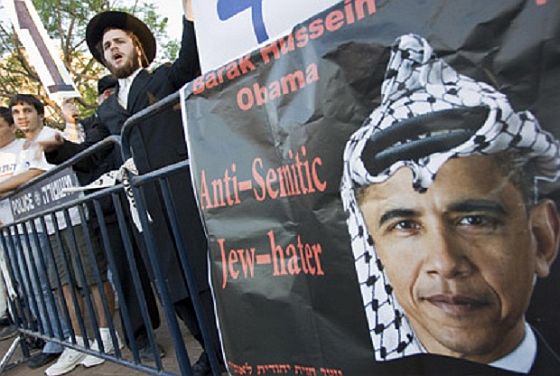
Has Obama forgotten everything?

Gideon Levy writes: Barack Obama has decided to punish the Israelis: He is talking to them as if they were ignoramuses. The U.S. president has also decided to punish himself: He is betraying his principles, those that have won him international acclaim and the Nobel Peace Prize.
There’s no other way to understand what he said in his interview with Channel 2 on the eve of his visit here. The flattery he heaped on Israel’s leader considerably exceeded diplomatic protocol and even phony American manners. His denial of his values deviated even from the opportunism one might expect from a politician. Obama said he wants to “connect to the Israeli people.” This he actually did well; he told Israelis what they wanted to hear.
But from Obama we could have expected a lot more. When Obama said he admires Israel’s “core values,” which values was he talking about? The dehumanization of the Palestinians? The attitude toward African migrants? The arrogance, racism and nationalism? Is this what he admires? Don’t separate buses for Palestinians remind him of something? Doesn’t two communities living on the same land, one with full rights and the other with no rights, “ring a bell,” as they say in America?
To admire “core values” while knowing we’re talking about one of the most racist countries there is, with a separation wall and apartheid-like policies, means betraying the core values of the American civil rights movement that made the Obama miracle possible. Too bad he can’t fulfill his fantasy of wearing a fake mustache and wandering around to have conversations with Israelis; he would hear how they talk about blacks like him. Too bad he can’t sit in a cafe and “just hang out,” as he’d like. He’d hear which “core values” really move Israelis.
Obama wants to lower expectations of his visit. Well, they can’t get any lower. [Continue reading…]
Obama’s secrecy fixation
Glenn Greenwald writes: When Barack Obama ran for president in 2008, his pledges of openness and transparency were not ancillary to his campaign but central to it. He repeatedly denounced the Bush administration as “one of the most secretive administrations in our nation’s history”, saying that “it is no coincidence” that such a secrecy-obsessed presidency “has favored special interests and pursued policies that could not stand up to the sunlight.” He vowed: “as president, I’m going to change that.” In a widely heralded 2007 speech on transparency, he actually claimed that this value shaped his life purpose:
“The American people want to trust in our government again – we just need a government that will trust in us. And making government accountable to the people isn’t just a cause of this campaign – it’s been a cause of my life for two decades.”
His campaign specifically vowed to protect whistleblowers, hailing them as “the best source of information about waste, fraud, and abuse in government” and saying that “such acts of courage and patriotism. . . should be encouraged rather than stifled.” Transparency groups were completely mesmerized by these ringing commitments. “We have a president-elect that really gets it,” gushed Charles Davis, executive director of the National Freedom of Information Coalition, in late 2008; “the openness community will expect a complete repudiation of the Ashcroft doctrine.” Here’s just one of countless representative examples of Obama bashing Bush for excessive secrecy – including in the realm of national security and intelligence – and vowing a fundamentally different course:
Literally moments after he was inaugurated, the White House declared that “President Obama has committed to making his administration the most open and transparent in history”. [Continue reading…]
Federal judge finds national security letters unconstitutional, bans them
Wired: Ultra-secret national security letters that come with a gag order on the recipient are an unconstitutional impingement on free speech, a federal judge in California ruled in a decision released Friday.
U.S. District Judge Susan Illston ordered the government to stop issuing so-called NSLs across the board, in a stunning defeat for the Obama administration’s surveillance practices. She also ordered the government to cease enforcing the gag provision in any other cases. However, she stayed her order for 90 days to give the government a chance to appeal to the Ninth Circuit Court of Appeals.
“We are very pleased that the Court recognized the fatal constitutional shortcomings of the NSL statute,” said Matt Zimmerman, senior staff attorney for the Electronic Frontier Foundation, which filed a challenge to NSLs on behalf of an unknown telecom that received an NSL in 2011. “The government’s gags have truncated the public debate on these controversial surveillance tools. Our client looks forward to the day when it can publicly discuss its experience.”
The telecommunications company received the ultra-secret demand letter in 2011 from the FBI seeking information about a customer or customers. The company took the extraordinary and rare step of challenging the underlying authority of the National Security Letter, as well as the legitimacy of the gag order that came with it.
The Free Syrian Army doesn’t exist

Aron Lund writes: Is the FSA losing influence in Syria? How many people are in the FSA? Is the FSA receiving enough guns from the West, or too many? Will the FSA participate in elections after the fall of Bahar el-Assad? What is the ideology of the FSA? What’s the FSA’s view of Israel? Is Jabhat el-Nosra now bigger than the FSA? What does the FSA think about the Kurds? Who is the leader of the FSA? How much control does the central command of the FSA really have over their fighters?
All these and similar questions keep popping up in news articles and op-ed chinstrokers in the Western media, and in much of the Arabic media too.
They all deal with important issues, but they disregard an important fact: the FSA doesn’t really exist.
The FSA was created by Col. Riad el-Asaad and a few other Syrian military defectors in July 2011, in what may or may not have been a Turkish intelligence operation. To be clear, there’s no doubting the sincerity of the first batch of fighters, or suggest that they would have acted otherwise without foreign support. But these original FSA commanders were confined to the closely guarded Apaydın camp in Turkey, and kept separate from civilian Syrian refugees. Turkish authorities are known to have screened visitors and journalists before deciding whether they could talk to the officers. While this is not in itself evidence of a Turkish intelligence connection, it does suggest that this original FSA faction could not, how shall we say, operate with full autonomy from its political environment.
From summer onwards, new rebel factions started popping up in hundreds of little villages and city neighborhoods inside Syria, as an ever-growing number of local demonstrators were provoked into self-defense. The most important recruiting tool for this nascent insurgency was not the FSA and its trickle of videotaped communiqués on YouTube. Rather, it was Bashar el-Assad’s decision to send his army on a psychotic rampage through the Syrian Sunni Arab countryside. As the corpses piled up, more and more civilians started looking for guns and ammo, and the rebel movement took off with a vengeance.
While the new groups almost invariably grew out of a local context, and organized entirely on their own, most of them also declared themselves to be part of the FSA. They adopted its logotype, and would often publicly pledge allegiance to Col. Riad el-Asaad. As a branding operation, the FSA was a extraordinary success – but in most cases, the new ”FSA brigades” had no connection whatsoever to their purported supreme commander in Turkey. In reality, what was emerging was a sprawling leaderless resistance of local fighters who shared only some common goals and an assemblage of FSA-inspired symbols. [Continue reading…]
Video: Where is the Syrian conflict heading?
Muslim Brotherhood and Egypt’s military: On collision course?
Al Ahram: The possibility of armed militias and vigilante groups run by the Muslim Brotherhood and other hard-line Islamist groups has raised the spectre of a possible confrontation between such militias and the military.
Already the “power-of-attorney” drive calling on the army to replace the Muslim Brotherhood government, conductedagainst a backdrop of sharply escalating political tension, police strikes, rioting and angry protest demonstrations in many cities, fuel shortages, rising prices and the clear inability of the current government to cope with on-going crises have caused strains between the army and Islamist groups.
As the Minister of Defence headed to the podium to deliver a speech during Military Academy graduation ceremonies several days ago he was visibly surprised by the number of bearded faces and niqabs in the audience. Perhaps this is what prompted General Abdel Fattah El-Sisi to speak at length on how difficult it would be to “Brotherhoodise” the military and insist that anyone who entered military service best forget any allegiances they may have other than their primary allegiance to the nation. Conveying a similar message, other military sources insisted that the chances of ideological infiltration are minimal. [Continue reading…]
Egypt vigilantes hang two thieves in public
The Associated Press reports: Egyptian vigilantes beat two men accused of stealing a rickshaw, then stripped them half-naked and hung them from a tree in a bus station in a small Nile Delta town on Sunday, according to security officials who said both men died.
The killings came a week after the attorney general’s office encouraged civilians to arrest lawbreakers and hand them over to police.
It was one of the most extreme cases of vigilantism in two years of sharp deterioration in security following Egypt’s 2011 uprising. The worsening security coupled with a police strike prompted the attorney general’s call for citizen arrests last week.
The state-run newspaper Ahram reported on its website that the two were dragged in the street after being caught “red-handed” trying to steal a rickshaw. It said they were beaten but alive before they were hung.