Amir-Hussein Firouz Radjy writes: With the New Year came and passed the forgotten anniversary of a seminal event in Iranian and Asian history: the anniversary of Iran’s first revolution and Asia’s oldest parliament, whose centenary came and passed some years ago without a murmur. Remembering that event today would do much to elucidate Iran’s present situation, as well as the vexed relations of Iranians with both their government and the outside world.
The zero hour was late on the night of December 30, 1906, when the dying emperor of Iran, Muzaffar al-Din Shah Qajar, signed into law the country’s first constitution, launching a brave experiment in liberal and parliamentary government. Iran, which for the past century had been a plaything in the contest between the British and Russian empires known as the Great Game, shone as a beacon of hope for an Asia drowning in the high-tide of European imperialism.
The struggle for democracy in Iran – or more accurately, for responsible, progressive and independent leadership – is over one hundred years old and did not begin with the Green Movement in 2009, nor with the Islamic Revolution of 1979 or the 1950s nationalist movement under Musaddiq. These historical events marked not the birth, but the continuation of the Iranian people’s struggle for democracy that had begun in 1906. [Continue reading…]
Author Archives: News Sources
Time to ditch the 9/11 legal pretext for perpetual war
In an editorial, the New York Times says: Three days after the Sept. 11, 2001, terrorist attacks, Congress approved the Authorization for Use of Military Force. It was enacted with good intentions — to give President George W. Bush the authority to invade Afghanistan and go after Al Qaeda and the Taliban rulers who sheltered and aided the terrorists who had attacked the United States.
But over time, that resolution became warped into something else: the basis for a vast overreaching of power by one president, Mr. Bush, and less outrageous but still dangerous policies by another, Barack Obama.
Mr. Bush used the authorization law as an excuse to kidnap hundreds of people — guilty and blameless people alike — and throw them into secret prisons where many were tortured. He used it as a pretext to open the Guantánamo Bay camp and to eavesdrop on Americans without bothering to obtain a warrant. He claimed it as justification for the invasion of Iraq, twisting intelligence to fabricate a connection between Saddam Hussein and the 9/11 attacks.
Unlike Mr. Bush, Mr. Obama does not go as far as to claim that the Constitution gives him the inherent power to do all those things. But he has relied on the 2001 authorization to use drones to kill terrorists far from the Afghan battlefield, and to claim an unconstitutional power to kill American citizens in other countries based only on suspicion that they are or might become terrorist threats, without judicial review.
The concern that many, including this page, expressed about the authorization is coming true: that it could become the basis for a perpetual, ever-expanding war that undermined the traditional constraints on government power. The result is an unintelligible policy without express limits or protective walls.
Last Wednesday, Attorney General Eric Holder said the president would soon shed more light on his “targeted killing” policy. Mr. Obama needs to. In the last few weeks, confusion over these issues has been vividly on display. On one hand, the administration has said it would use lethal force only when capturing a terrorist was impossible, and it did arrest Sulaiman Abu Ghaith, a son-in-law of Osama bin Laden who once served as a spokesman for Al Qaeda, and arraigned him on Friday in federal court in Manhattan. The Washington Post reported last week that counterterrorism officials considered using the authorization law as the basis for the government’s authority to kill Mokhtar Belmokhtar, a militant leader in Algeria and Mali, but decided it did not apply because he was not part of Al Qaeda or an associated group.
But the administration still has not fully disclosed to Congress the legal documents on which the targeted killing program is based. And in that same article, The Post said the administration was debating whether it could stretch the law to make it apply to groups that had no connection, or only slight ones, to Al Qaeda and the 9/11 attacks.
A big part of the problem is that the authorization to use military force is too vague. It gives the president the power to attack “nations, organizations or persons he determines planned, authorized, committed or aided the terrorist attacks that occurred on Sept. 11, 2001, or harbored such organizations or persons, in order to prevent any future acts of international terrorism against the United States by such nations, organizations or persons.”
Making the law more specific, however, would only further enshrine the notion of a war without end. And, as Jeh Johnson, then counsel to the defense secretary, said in a speech last November, “War must be regarded as a finite, extraordinary and unnatural state of affairs.”
The right solution is for Congress to repeal the 2001 authorization. It could wait to do that until American soldiers have left Afghanistan, which is scheduled, too slowly, for the end of 2014. Better yet, Congress could repeal it now, effective upon withdrawal.

The neighbors most of America chooses to ignore

There is a sense in which America conjures a metaphysical absolute space — a space in which an infinite distance separates this country from everything and everyone outside its borders.
Ciudad Juárez — which is literally a stone’s throw from El Paso in Texas — could be as far away as North Waziristan.
So long as fences — both physical and cognitive — can be raised high enough, no one need concern themselves with what happens on the outside.
Jeremy Relph writes: The interior of the school bus is awash in blue light, lumbering through the Villa Esperanza neighborhood on the outskirts of Ciudad Juárez, Mexico, on a chilly November evening. Tinny rap music in Spanish plays on a cell phone. The kids ride the bus in their uniforms: white polo shirts with green collars and khakis. The guys favor lots of gel; the girls, ponytails. Most students will have walked home from school in the dark, which is often when things go wrong. We are in Km 29, which is Artistas Asesinos territory, a street gang aligned with the Sinaloa Cartel.
The bus leaves the paved highway and rumbles over hard dirt roads in the desert. It’s a slow ride. A girl gets off the bus and picks her way over the uneven dirt beside the road. The bus driver turns off the lights, plunging the landscape into darkness but for the glow of Juárez. When he turns the lights back on, she is running.
You accept the evil here in faith. Faith, after all, is belief in the unseen. It’s the opposite of hope but the same muscle. You don’t see it, but you know it’s there. We eat tacos al pastor later that evening, back in the city. We hear war stories. A friend mimics the bang bang of shooting, making a rifle with his hands. A patron behind me, waiting for his takeout, wears a gun on his hip. The restaurant is half full, and our waiter becomes inattentive, hurrying to another table. Our friend realizes that seated at the table behind us are members of a local cartel comprising dirty cops, La Linea. The patron waiting on his takeout is a state cop. In the Juárez of yesterday, this might have lead to a restaurant littered with dead bodies. Cuidad Juárez is changing.
The drug war in Juárez saw some 10,000 men, women, and children die since 2007 — 359 homicides reported in October 2010 alone — a disproportionate chunk of the nearly 60,000 reported for the rest of the country. At stake: access to the American market, worth close to $40 billion. That money, and the violence that inevitably comes with it, moves beyond class boundaries — society itself fell apart over the past six years here. Extreme violence became totally normal, a fact of everyday life.
Throughout the war, cartels actively recruited young people. Teenagers — Los Ninis (ni estudian ni trabajan, neither work nor study) — were the most vulnerable, some drawn to quick money and status. And now it’s considered done. Some credit could go to former President Felipe Calderón’s Todos Somos Juárez’s program (We Are All Juárez), introduced in 2010. The federal government invested $263 million in 2010 and $138 in 2011. Security ate up 18% of the money, the rest being pushed to other areas like health, education, and social development. The results, on paper, are impressive, though flawed. Some feel the cessation of violence has more to do with the Sinaloa cartel winning the war or the combatants merely taking a breather. Regardless, as of last year, Juárez is no longer the world’s murder capital, a distinction passed on to San Pedro Sula, Honduras; now it’s No. 19.
Juárez struggles to provide for its 1.5 million residents, and nowhere will its failings be more evident in the future than in schools and the next generation of young people, who came of age during the drug wars and don’t know much else. The system meant to look out for them is broken, but, amazingly, they — and the adults charged with looking after them — are not. [Continue reading…]
Global temperature rise is fastest in at least 11,000 years, study says
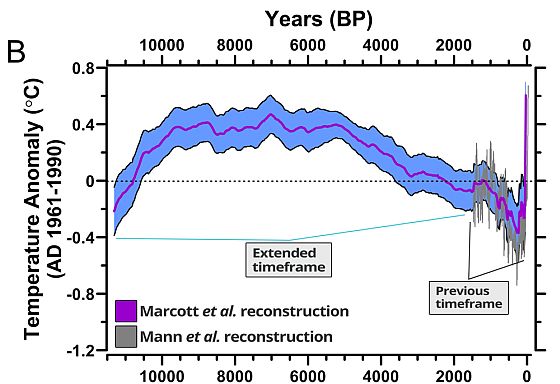
Christian Science Monitor reports: Over the past century, global average temperatures appear to have risen faster than at any time since the end of the last ice age 11,300 years ago, and perhaps longer. Meanwhile, the magnitude of the increase has been unmatched in at least the past 4,000 years.
Researchers say those are the implications of a new study that uses natural stand-ins for thermometers to trace temperature trends back to the beginning of the current warm, interglacial period. Significantly, the study’s findings suggest the current warming trend cannot be explained by some forms of naturally occurring temperature variability, a lingering issue in the debate over the impact of human activity on global warming.
The main trigger for the current warming trend, especially since the middle of the last century, has been rising emissions of heat-trapping carbon dioxide as people burn fossil fuels and change land-use patterns, researchers say.
Although other so-called paleoclimate records reach farther back into geological time, the team focused on the Holocene epoch, in which human civilizations emerged and evolved.
“To our knowledge, based on this reconstruction, the rate of change today is unprecedented” in the Holocene, says Shaun Marcott, an atmospheric scientist at Oregon State University who led a team formally reporting the results in Friday’s issue of the journal Science. Indeed, it may be unprecedented in the past 22,000 years, he adds, when previous paleoclimate research he and his colleagues have conducted is taken into account.

Higgs ‘God’ particle a big let-down say physicists

Reuters reports: Scientists’ hopes that last summer’s triumphant trapping of the particle that shaped the post-Big Bang universe would quickly open the way into exotic new realms of physics like string theory and new dimensions have faded this past week.
Five days of presentations on the particle, the Higgs boson, at a scientific conference high in the Italian Alps point to it being the last missing piece in a 30-year-old cosmic blueprint and nothing more, physicists following the event say.
“The chances are getting slimmer and slimmer that we are going to see something else exciting anytime soon,” said physicist Pauline Gagnon from CERN near Geneva in whose Large Hadron Collider (LHC) the long-sought particle was found.
And U.S. scientist Peter Woit said in his blog that the particle was looking “very much like a garden variety SM (Standard Model) Higgs”, discouraging for researchers who were hoping for glimpses of breathtaking vistas beyond.
That conclusion, shared among analysts of vast volumes of data gathered in the LHC over the past three years, would push to well beyond 2015 any chance of sighting exotica like dark matter or super symmetric particles in the giant machine.
That is when the LHC, where particles are smashed together at light speed to create billions of mini-Big Bangs that are traced in vast detectors, resumes operation with its power doubled after a two-year shutdown from last month.
The Higgs – still not claimed as a scientific discovery because its exact nature has yet to be established – was postulated in the early 1960s as the element that gave mass to flying matter after the Big Bang 13.7 billion years ago.
It was incorporated tentatively into the Standard Model when that was compiled in the 1980s, and its discovery in the LHC effectively completed that blueprint. But there are mysteries of the universe, like gravity, that remain outside it.
Some physicists have been hoping that the particle as finally found would be something beyond a “Standard Model Higgs” – offering a passage onwards into a science fiction world of “New Physics” and a zoo of new particles.
The drone question Obama hasn’t answered
Ryan Goodman writes: The Senate confirmed John O. Brennan as director of the Central Intelligence Agency on Thursday after a nearly 13-hour filibuster by the libertarian senator Rand Paul, who before the vote received a somewhat odd letter from the attorney general.
“It has come to my attention that you have now asked an additional question: ‘Does the President have the authority to use a weaponized drone to kill an American not engaged in combat on American soil?’ ” the attorney general, Eric H. Holder Jr., wrote to Mr. Paul. “The answer to that question is no.”
The senator, whose filibuster had become a social-media sensation, elating Tea Party members, human-rights groups and pacifists alike, said he was “quite happy with the answer.” But Mr. Holder’s letter raises more questions than it answers — and, indeed, more important and more serious questions than the senator posed.
What, exactly, does the Obama administration mean by “engaged in combat”? The extraordinary secrecy of this White House makes the answer difficult to know. We have some clues, and they are troubling.
If you put together the pieces of publicly available information, it seems that the Obama administration, like the Bush administration before it, has acted with an overly broad definition of what it means to be engaged in combat. [Continue reading…]
Video: The case of the U.S. vs Bradley Manning
Jabhat al-Nusra and Hezbollah in first confrontation
Al Monitor reports: While the Iraq-Syria border was witnessing the first armed confrontation pitting Sunni jihadists against Iraqi and Syrian soldiers, leaving scores of people dead, a wide stretch of border between Lebanon and Syria was the scene of direct and unprecedented contact between Shiite Hezbollah militants and Sunni jihadists belonging to Jabhat al-Nusra. This new and serious development is likely to have serious repercussions in the coming weeks. There are several theories about how this situation came to pass.
One week prior, amid sporadic clashes on both sides of the northeastern border of Lebanon and Syria, regular Syrian army forces had redeployed in al-Nabk, near the Lebanese border. Official Lebanese sources confirmed the event. On first glance, the redeployment would appear to be unremarkable given the movement of Syrian army units since the beginning of the civil war almost two years ago, but upon closer inspection, the seriousness of the maneuver becomes apparent.
The al-Nabk area stretches more than 45 kilometers along the border region. It starts to the west at the Jabal Akrum area of Akkar, north of Lebanon, and extends to Arsal, in the Bekaa to the east, along a strip of rugged mountainous land where the Lebanese state — including administrative authorities as well as security forces — has not had a presence for decades. What is more important about this strip from which the Syrian army withdrew is that it is now almost completely controlled by the jihadists of Jabhat al-Nusra, the Syrian offshoot of al-Qaeda and rebel fighting force. In addition, the adjacent Lebanese territory is inhabited by an overwhelmingly Shiite population, which points to Hezbollah having a dominant presence there.
Thus, after nearly two years of recurring tensions and sporadic clashes between conflicting and volatile components on both sides of the border, Shiite Hezbollah and Sunni Jabhat al-Nusra today stand face to face along a significant length of the Lebanese-Syrian border in the absence of a restrictive or deterrent force in the form of the Lebanese or Syrian state. Remarkably, this development resulted from a sudden redeployment by the Syrian army.
The army still has an effective presence west of al-Nabk, whose inhabitants are, demographically speaking, predominantly Sunni, rather than Shiite, Lebanese. It responds almost daily to incidents of infiltration by fundamentalist Sunni insurgents from Lebanon. The situation is similar further to the east in the central Bekaa, where the regular Syrian army is still deployed in the face of a Sunni Lebanese demographic, no more than 30 kilometers from the center Damascus. In short, the Syrian army remains deployed in areas adjacent to Sunni regions, but has strategically withdrawn from Lebanese Shiite villages, paving the way for Jabhat al-Nusra to fill the vacuum, putting it in direct conflict with Hezbollah members. [Continue reading…]
Video: On the road to Israeli apartheid
The man who could be U.K.’s first Jewish PM reluctant to call himself a Zionist
The headline in Haaretz says: “The man who could be U.K.’s first Jewish PM says he is a Zionist.” But that’s not exactly how the report under the headline reads.
At an event in central London on Thursday, organized by the Board of Deputies of British Jews and the London Jewish News, Labour Party leader Ed Miliband used the opportunity to establish his pro-Israel credentials.
The moment that made it for the audience was when he emphatically answered the question of whether he is a Zionist by saying: “Yes, I consider myself a supporter of Israel.” Nevertheless, some in the audience lamented that he was careful not to voice the sound bite – I am a Zionist.
The United States has a non-Jewish vice president who calls himself a Zionist, but Miliband calls himself a supporter of Israel.
That sounds to me like a man who’s going through the motions, saying what he thinks he needs to say. He could have said “I am a Zionist.” He declined to utter those words.
Sephardic Jews invited back to Spain after 500 years
BBC News reports: More than 500 years ago, tens of thousands of Jews fled Spain because of persecution. Now their descendants are being invited to return.
Before the infamous Spanish Inquisition of the 15th Century, some 300,000 Jews lived in Spain. It was one of the largest communities of Jews in the world.
Today, there are about 40,000 or 50,000 – but that number could be about to swell dramatically.
In November, Spain’s justice minister Alberto Ruiz-Gallardon announced a plan to give descendants of Spain’s original Jewish community – known as Sephardic Jews – a fast-track to a Spanish passport and Spanish citizenship.
“In the long journey Spain has undertaken to rediscover a part of itself, few occasions are as moving as today,” he said.
Anyone who could prove their Spanish Jewish origins, he said, would be given Spanish nationality. [Continue reading…]
‘Fight terror with terror’ — the U.S. role in creating Iraq’s death squads

James Steele helped oversee police commandos who ran a network of torture centers in Iraq.
Petraeus linked to Iraqi torture centers
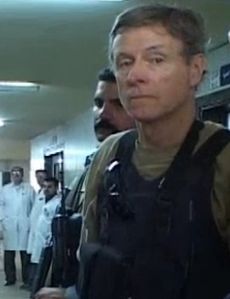
The Guardian reports: The Pentagon sent a US veteran of the “dirty wars” in Central America to oversee sectarian police commando units in Iraq that set up secret detention and torture centres to get information from insurgents. These units conducted some of the worst acts of torture during the US occupation and accelerated the country’s descent into full-scale civil war.James Steele
Colonel James Steele was a 58-year-old retired special forces veteran when he was nominated by Donald Rumsfeld to help organise the paramilitaries in an attempt to quell a Sunni insurgency, an investigation by the Guardian and BBC Arabic shows.
After the Pentagon lifted a ban on Shia militias joining the security forces, the special police commando (SPC) membership was increasingly drawn from violent Shia groups such as the Badr brigades.
A second special adviser, retired Colonel James H Coffman, worked alongside Steele in detention centres that were set up with millions of dollars of US funding.
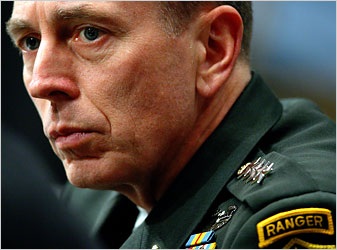
Coffman reported directly to General David Petraeus, sent to Iraq in June 2004 to organise and train the new Iraqi security forces. Steele, who was in Iraq from 2003 to 2005, and returned to the country in 2006, reported directly to Rumsfeld.
The allegations, made by US and Iraqi witnesses in the Guardian/BBC documentary, implicate US advisers for the first time in the human rights abuses committed by the commandos. It is also the first time that Petraeus – who last November was forced to resign as director of the CIA after a sex scandal – has been linked through an adviser to this abuse.
Coffman reported to Petraeus and described himself in an interview with the US military newspaper Stars and Stripes as Petraeus’s “eyes and ears out on the ground” in Iraq. [Continue reading…]
How the EU subsidises Israel’s military-industrial complex
Ben Hayes writes: Regardless of where you stand on Israel-Palestine, things have surely gone awry in Brussels for the EU to be providing generous R&D (research and development) subsidies to Israel Aerospace Industries (IAI), the state-owned manufacturer of Israeli ‘drones’ and other ‘battlefield solutions’. Some of the grants are for IAI to adapt its killer robots for use within the EU. It’s a wonder David Cameron didn’t mention it in his crusade against the EU budget. Perhaps not: but how does EU tax-payers hard-earned cash end up in the hands of the Israeli war machine?
The EU’s framework research programme is the biggest single R&D budget in the world. The current “FP7” programme (2007-2013) has a budget of €51 billion; the next programme, “Horizon 2020” (2014-2020), will have somewhere between €70 and €80 billion. Israel joined the European Research Area in 1995 under the terms of a remarkably generous EC “association agreement” and participates in the framework programmes on the same footing as EU member states. This means it puts up some of the money (each participating state pays a proportion based on its GDP) and is eligible to apply for the funds on offer. With its buoyant R&D sector, few states have been as successful in landing EU grants as Israel (which is thus a net recipient of EU research funds) and the EU is now second only to the Israeli Science Foundation in Jerusalem as a source of domestic research funding.
Israel Aerospace Industries has been a principle beneficiary of the EU’s largesse. Established in 1957 upon recommendation of Shimon Perez, then Director-General of the Israeli Ministry of Defence, IAI is now a world leader in the booming drone market, producing the Heron, Hunter and Ghost, among many others – in 2010 its total annual revenues topped the $3 billion mark. Since Israel joined the European Research Area, IAI has landed at least 69 EU research grants. Because the European Commission is ostensibly prohibited from funding military R&D, most of these grants have come from the transport and aerospace budgets, where military and defence contractors play a leading role in developing new materials for aircraft and more efficient engines as part of the EU’s “clean skies” programme. The EU has also ploughed money into unmanned aerial vehicles (UAVs/drones), which it wants to see introduced into commercial airspace as soon as practicably possible. [Continue reading…]
Aleppo at war: Everyday life in the death zone
Kurt Pelda reports: In Aleppo, every footstep is a crunch. The streets are strewn with rubble and broken glass from destroyed buildings and shattered windows. It’s a sound that distinguishes a walk around this war-torn Syrian town from any other city in the world.
Abu Jamal is a young fighter from Brigade North Storm, a unit of the Syrian resistance. His comrades just call him “the sniper” because he spends his days creeping over rubble and broken glass from one building to the next in search of a firing position.
Abu Jamal is stationed in Bustan al-Basha, a district devastated by bombs and shells. Hardly any civilians live here anymore. A few fighters invite him to take tea with them in front of an office building that used to house a bank. I too sit on a stool on the sidewalk. Abu Jamal warns me. “That’s not a good place to sit,” he says, pointing to a big window on the first floor. “The shockwave of explosions can burst the window pane. The falling bits of glass could kill you.” Sure enough, when we pass the same spot the next day, the window is broken, its glass strewn across the sidewalk and the street.
There are rusting bits of metal everywhere. The shrapnel comes from exploding artillery shells and aerial bombs whose sole purpose is to kill. The explosions send them hurtling through the air. They tear people to pieces and slice gaping holes in skulls. The shrapnel doesn’t distinguish between fighters and civilians, men and women, old people and children. After impact with the ground, the pieces, often twisted into bizarre shapes, are red hot. You can burn your fingers on them — Aleppo’s children have learned that lesson.
If you want to survive in this city gone mad you watch out for flying metal and rubble. If an aerial bomb explodes in the area, people stay under shelter for at least 10 seconds afterwards — that’s how long it takes for the debris hurled into the air from the crater to come raining down, often over a distance of hundreds of meters, with deadly force. [Continue reading…]
UN peacekeepers abducted by Syrian rebels safe and sound, videos suggest
The Associated Press reports: Several UN peacekeepers from the Philippines who were abducted by Syrian rebels said in videos posted online on Thursday that they were safe and sound, even as activists reported clashes and shelling in the area where UN troops were being held.
Opposition fighters detained 21 Filipino peacekeepers near the village of Jamlah in the Golan Heights on Wednesday. The abduction marked the first time since UN troops began patrolling an Israeli-Syrian armistice line in the Golan Heights nearly 40 years ago that they had encountered trouble, said Timor Goksel, a Beirut-based former UN official in the region.
One of the videos posted online shows three men dressed in camouflage and blue bulletproof vests marked “UN” and “Philippines”.
“We, the UN personnel here, are safe, and the Free Syrian Army are treating us good,” one of them says in English. “We cannot go home because the government of Assad do not stop the bombing. To our family, we hope to see you soon and we are OK here.”
The second video shows six peacekeepers sitting in a room. An officer, who identifies himself as a captain, says that as their convoy came under shelling on Wednesday, “we stopped and civilian people helped us for our safety and distributed us in different places to keep us safe”.
A spokesman for the Martyrs of Yarmouk Brigades, who are holding the peacekeepers, told Associated Press via Skype that all the 21 peacekeepers were ‘fine and in good health”.
“We consider them guests,” he added.
The missing history of America’s third war
Micah Zenko writes: Since 11:47 on Wednesday morning, the beginning of a Senate filibuster to delay a vote on John Brennan’s nomination to head the CIA, “Rand Paul,” “drones,” and “John Brennan” have intermittently been trending on Twitter. This attention-grabbing focus on targeted killings — which will last only until Paul runs out of steam — is representative of the sporadic attention that the controversial tactic has received from policymakers and the public.
With each supposed revelation — the “kill list,” “signature strikes,” “disposition matrix,” and the leaking of a Department of Justice white paper providing the legal justification for killing American citizens — there is a frenzy of interest in drone strikes. Analysts (myself included) are repeatedly asked, “Where is this all heading in five or ten years?” In other words: What additional lethal missions will U.S. armed drones execute, and where will they occur? What other states will seek to develop this military capability?
But, in general, there is relative indifference to the history of America’s Third War — the 10-year campaign of over 400 targeted killings in non-battlefield settings that have killed an estimated 3,500 to 4,700 people. And that is puzzling, particularly since they have become a defining feature of post-9/11 U.S. foreign policy.
Over the past few months, many stakeholders in and out of government have offered recommendations about how the Obama administration should change, limit, end, or enhance its targeted killing policies. However, there have been no calls for an official government study into the history and evolution of non-battlefield targeted killings. This is essential, since reforms must first be informed by an accurate accounting of how the policies were originally conceived, how they were implemented and altered based on updated information, whether they succeeded or failed at achieving their objectives, and what their intended and unintended effects have been. [Continue reading…]
Barack Obama ‘has authority to use drone strikes to kill Americans on U.S. soil’
The Telegraph reports: President Barack Obama has the authority to use an unmanned drone strike to kill US citizens on American soil, his attorney general has said.
Eric Holder argued that using lethal military force against an American in his home country would be legal and justified in an “extraordinary circumstance” comparable to the September 11 terrorist attacks.
“The president could conceivably have no choice but to authorise the military to use such force if necessary to protect the homeland,” Mr Holder said.
His statement was described as “more than frightening” by Senator Rand Paul, a Republican from Kentucky, who had demanded to know the Obama administration’s position on the subject.


Coffman reported directly to General David Petraeus, sent to Iraq in June 2004 to organise and train the new Iraqi security forces. Steele, who was in Iraq from 2003 to 2005, and returned to the country in 2006, reported directly to Rumsfeld.