




Ars Technica reports: The Universe is incredibly regular. The variation of the cosmos’ temperature across the entire sky is tiny: a few millionths of a degree, no matter which direction you look. Yet the same light from the very early cosmos that reveals the Universe’s evenness also tells astronomers a great deal about the conditions that gave rise to irregularities like stars, galaxies, and (incidentally) us.
That light is the cosmic microwave background, and it provides some of the best knowledge we have about the structure, content, and history of the Universe. But it also contains a few mysteries: on very large scales, the cosmos seems to have a certain lopsidedness. That slight asymmetry is reflected in temperature fluctuations much larger than any galaxy, aligned on the sky in a pattern facetiously dubbed “the axis of evil.”
The lopsidedness is real, but cosmologists are divided over whether it reveals anything meaningful about the fundamental laws of physics. The fluctuations are sufficiently small that they could arise from random chance. We have just one observable Universe, but nobody sensible believes we can see all of it. With a sufficiently large cosmos beyond the reach of our telescopes, the rest of the Universe may balance the oddity that we can see, making it a minor, local variation.
However, if the asymmetry can’t be explained away so simply, it could indicate that some new physical mechanisms were at work in the early history of the Universe. As Amanda Yoho, a graduate student in cosmology at Case Western Reserve University, told Ars, “I think the alignments, in conjunction with all of the other large angle anomalies, must point to something we don’t know, whether that be new fundamental physics, unknown astrophysical or cosmological sources, or something else.” [Continue reading…]

 Mycologist, Paul Stamets, discusses the important role mushrooms play in the survival and health of the earth and human species.


The European barberry or simply Barberry (Berberis vulgaris) is a species of shrub distributed throughout Europe. It is related to the Oregon grape (Mahonia aquifolium) that is native to North America and that has been spreading through Europe for years. Scientists compared both species to find a marked difference in parasite infestation: “a highly specialized species of tephritid fruit fly, whose larvae actually feed on the seeds of the native Barberry, was found to have a tenfold higher population density on its new host plant, the Oregon grape”, reports Dr. Harald Auge, a biologist at the UFZ.
This led scientists to examine the seeds of the Barberry more closely. Approximately 2000 berries were collected from different regions of Germany, examined for signs of piercing and then cut open to examine any infestation by the larvae of the tephritid fruit fly (Rhagoletis meigenii). This parasite punctures the berries in order to lay its eggs inside them. If the larva is able to develop, it will often feed on all of the seeds in the berry. A special characteristic of the Barberry is that each berry usually has two seeds and that the plant is able to stop the development of its seeds in order to save its resources. This mechanism is also employed to defend it from the tephritid fruit fly. If a seed is infested with the parasite, later on the developing larva will feed on both seeds. If however the plant aborts the infested seed, then the parasite in that seed will also die and the second seed in the berry is saved. Continue reading


Nicholas Epley writes: One of the most amazing court cases you probably have never heard of had come down to this. Standing Bear, the reluctant chief of the Ponca tribe, rose on May 2, 1879, to address a packed audience in a Nebraska courtroom. At issue was the existence of a mind that many were unable to see.
Standing Bear’s journey to this courtroom had been excruciating. The U.S. government had decided several years earlier to force the 752 Ponca Native Americans off their lands along the fertile Niobrara River and move them to the desolate Indian Territory, in what is now northern Oklahoma. Standing Bear surrendered everything he owned, assembled his tribe, and began marching a six-hundred-mile “trail of tears.” If the walk didn’t kill them (as it did Standing Bear’s daughter), then the parched Indian Territory would. Left with meager provisions and fields of parched rock to farm, nearly a third of the Poncas died within the first year. This included Standing Bear’s son. As his son lay dying, Standing Bear promised to return his son’s bones to the tribe’s burial grounds so that his son could walk the afterlife with his ancestors, according to their religion. Desperate, Standing Bear decided to go home.
Carrying his son’s bones in a bag clutched to his chest, Standing Bear and twenty-seven others began their return in the dead of winter. Word spread of the group’s travel as they approached the Omaha Indian reservation, midway through their journey. The Omahas welcomed them with open arms, but U.S. officials welcomed them with open handcuffs. General George Crook was ordered by government officials to return the beleaguered Poncas to the Indian Territory.
Crook couldn’t bear the thought. “I’ve been forced many times by orders from Washington to do most inhuman things in dealings with the Indians,” he said, “but now I’m ordered to do a more cruel thing than ever before.” Crook was an honorable man who could no more disobey direct orders than he could fly, so instead he stalled, encouraging a newspaper editor from Omaha to enlist lawyers who would then sue General Crook (as the U.S. government’s representative) on Standing Bear’s behalf. The suit? To have the U.S. government recognize Standing Bear as a person, as a human being. [Continue reading…]

University of New England, Australia: We humans like to think of ourselves as unique for many reasons, not least of which being our ability to communicate with words. But ground-breaking research by an expert from the University of New England shows that our ‘misunderstood cousins,’ the Neanderthals, may well have spoken in languages not dissimilar to the ones we use today.
Pinpointing the origin and evolution of speech and human language is one of the longest running and most hotly debated topics in the scientific world. It has long been believed that other beings, including the Neanderthals with whom our ancestors shared the Earth for thousands of years, simply lacked the necessary cognitive capacity and vocal hardware for speech.
Associate Professor Stephen Wroe, a zoologist and palaeontologist from UNE, along with an international team of scientists and the use of 3D x-ray imaging technology, made the revolutionary discovery challenging this notion based on a 60,000 year-old Neanderthal hyoid bone discovered in Israel in 1989.
“To many, the Neanderthal hyoid discovered was surprising because its shape was very different to that of our closest living relatives, the chimpanzee and the bonobo. However, it was virtually indistinguishable from that of our own species. This led to some people arguing that this Neanderthal could speak,” A/Professor Wroe said.
“The obvious counterargument to this assertion was that the fact that hyoids of Neanderthals were the same shape as modern humans doesn’t necessarily mean that they were used in the same way. With the technology of the time, it was hard to verify the argument one way or the other.”
However advances in 3D imaging and computer modelling allowed A/Professor Wroe’s team to revisit the question.
“By analysing the mechanical behaviour of the fossilised bone with micro x-ray imaging, we were able to build models of the hyoid that included the intricate internal structure of the bone. We then compared them to models of modern humans. Our comparisons showed that in terms of mechanical behaviour, the Neanderthal hyoid was basically indistinguishable from our own, strongly suggesting that this key part of the vocal tract was used in the same way.
“From this research, we can conclude that it’s likely that the origins of speech and language are far, far older than once thought.”


Newly published research suggests this problem is actually worse than we thought. It finds that even when people use an evaluation strategy they concede is biased, they continue to insist their judgments are objective.
“Recognizing one’s bias is a critical first step in trying to correct for it,” writes a research team led by Emily Pronin and Katherine Hansen of Princeton University. “These experiments make clear how difficult that first step can be to reach.”
Although their findings have clear implications regarding political opinions, the researchers avoided such fraught topics and focused on art. In two experiments, participants (74 Princeton undergraduates in the first, 85 adults recruited online in the second) looked at a series of 80 paintings and rated the artistic merit of each on a one-to-nine scale. [Continue reading…]


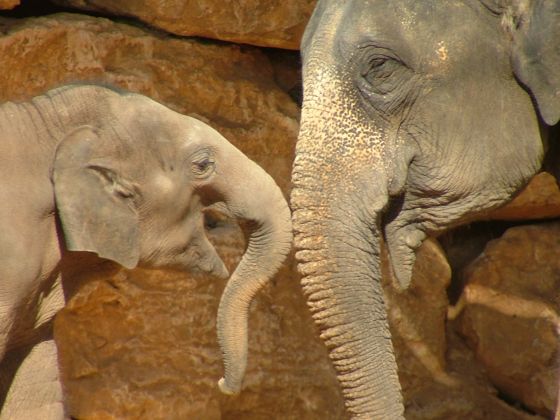
Ferris Jabr writes: Many years ago, while wandering through Amboseli National Park in Kenya, an elephant matriarch named Echo came upon the bones of her former companion Emily. Echo and her family slowed down and began to inspect the remains. They stroked Emily’s skull with their trunks, investigating every crevice; they touched her skeleton gingerly with their padded hind feet; they carried around her tusks. Elephants consistently react this way to other dead elephants, but do not show much interest in deceased rhinos, buffalo or other species. Sometimes elephants will even cover their dead with soil and leaves.
What is going through an elephant’s mind in these moments? We cannot explain their behavior as an instinctual and immediate reaction to a dying or recently perished compatriot. Rather, they seem to understand—even years and years after a friend or relative’s death—that an irreversible change has taken place, that, here on the ground, is an elephant who used to be alive, but no longer is. In other words, elephants grieve.
Such grief is but one of many indications that elephants are exceptionally intelligent, social and empathic creatures. After decades of observing wild elephants—and a series of carefully controlled experiments in the last eight years—scientists now agree that elephants form lifelong kinships, talk to one another with a large vocabulary of rumbles and trumpets and make group decisions; elephants play, mimic their parents and cooperate to solve problems; they use tools, console one another when distressed, and probably have a sense of self (See: The Science Is In: Elephants Are Even Smarter Than We Realized)
All this intellect must emerge, in one way or another, from the elephant brain—the largest of any land animal, three times as big as the human brain with individual neurons that seem to be three to five times the size of human brain cells. [Continue reading…]


Timoteo “Dino” Saluzzi was born in 1935 in Campo Santo, a small village in the north of Argentina noted primarily for its sugar cane refining factory, around which local life revolved. Despite the absence of records, radio and indeed electricity in the Saluzzi household there was always music. His father played guitar, mandolin and bandoneon and taught Dino the rudiments of the latter instrument at seven. On this popular German import, the diatonic variety of the accordion developed by Heinrich Band, the young Dino at first played folk music. An uncle who had traveled in Europe added some of his acquired musical knowledge and, by the time he was 14, Dino knew enough to play in the Trio Carnaval, his first band. He began to play professionally while studying in Buenos Aires and was soon a member of the symphonic Orquesta Estable at Radio El Mundo, Argentinia’s first radio station. It was in Buenos Aires, too, that he met Astor Piazolla, as the term “tango nuevo” began to be aired. Though Piazolla and Saluzzi always respected each other’s work, Dino has never cared to put a label on his own music. In numerous interviews, however, he has stressed that it is neither an “art music” nor an “intellectual music” but rather a music of the emotions and one that attempts to express the widest range of feelings.
Quitting his radio orchestra job in 1956, Saluzzi returned to the district of Salta to develop his compositions, now consciously incorporating folk music elements. From this point onward, however, he was concerned that his music would not “fall into the common eclecticism” that had already diluted several variants of Latin American music. He sought a flexible form that was “vital and real beyond the conventions”: this has proved to be a life’s work. In the early 70s Dino was briefly associated with Gato Barbieri, helping the saxophonist towards a rediscovery of his own roots on, for example, the album Chapter One: Latin America. With Mariano Mores he undertook numerous South American tours, playing concerts in Bolivia, Peru, Columbia and Venezuela. He also worked as arranger and soloist for Enrique Mario Francini’s Sinfonica de Tango which brought him to Japan in 1977. In 1979 he launched the first Cuarteto Dino Saluzzi, whose early European appearances made headlines, and also co-founded the experimental chamber ensemble Música Creativa.
Saluzzi’s ECM discography was launched with the solo album Kultrum, spontaneously created in the studio and an enduring example of the bandoneonist’s art as “storyteller.” Dino described the music as “an imaginary return” to the little towns and villages of his childhood. The vividness of his musical sketches was not lost on reviewers: “Reworking elements of tango, South American Indian music, backwater folk tunes, and other root sounds, his breadth of feeling makes for remarkable listening” – Down Beat. A second solo album Andina, prompted America’s Fanfare to write that “Dino Saluzzi is probably the greatest living master of the bandoneon”, concluding that the recording was “a stunning portrait of an amazing musical talent.” [Continue reading…]

Dino Saluzzi, the Argentine bandoneón player and composer, one of the world’s greatest living musicians, deserves an introduction:
Cité de la Musique: