A U.S. citizen pleaded guilty earlier this year to attempting to kill American soldiers overseas and providing material support to al Qaeda, including information about the New York transit system, according to court documents unsealed Wednesday in Brooklyn federal court.
Bryant Neal Vinas, 26 years old, born in the New York borough of Queens, became an al Qaeda militant after receiving training from the terrorist organization outside the U.S., according to criminal charges brought by Benton J. Campbell, the U.S. attorney in Brooklyn.
Mr. Vinas is cooperating with authorities and provided them with information about possible terror plots on rail targets in New York, according to a person familiar with the matter. Also, an affidavit Mr. Vinas has provided is expected to be entered in court in Belgium as part of a different terrorism case. [continued…]
America’s wars By David Bromwich, TomDispatch, July 21, 2009
On July 16, in a speech to the Economic Club of Chicago, Secretary of Defense Robert Gates said that the “central question” for the defense of the United States was how the military should be “organized, equipped — and funded — in the years ahead, to win the wars we are in while being prepared for threats on or beyond the horizon.” The phrase beyond the horizon ought to sound ominous. Was Gates telling his audience of civic-minded business leaders to spend more money on defense in order to counter threats whose very existence no one could answer for? Given the public acceptance of American militarism, he could speak in the knowledge that the awkward challenge would never be posed.
We have begun to talk casually about our wars; and this should be surprising for several reasons. To begin with, in the history of the United States war has never been considered the normal state of things. For two centuries, Americans were taught to think war itself an aberration, and “wars” in the plural could only have seemed doubly aberrant. Younger generations of Americans, however, are now being taught to expect no end of war — and no end of wars. [continued…]
Iran’s president, under attack by reformists after his disputed election victory last month, on Tuesday openly defied his most powerful backer, refusing an order by supreme leader Ayatollah Ali Khamenei to dump a newly chosen vice president who is despised by hard-liners for insisting last year that Iranians had no quarrel with the Israeli people.
President Mahmoud Ahmadinejad finds himself under increasing pressure from Iranian hard-liners who appear eager to reap political rewards after leading a weeks-long crackdown on supporters of opposition figure Mir-Hossein Mousavi, who say vote fraud was responsible for Ahmadinejad’s victory.
The leader of a hard-line scholars group linked to the Basiji militia said his organization would propose its own “desired Cabinet lineup” to the president.
“Our organization intends to become the government’s think tank,” said Lotfali Bakh- tiari, leader of the group, in an interview published by Khabar newspaper. “We want to introduce our elite into the government to serve the country. No obstacle is on our way, even the current climate of mistrust.”
Ahmadinejad surprised many observers by defending the vice president, Esfandiar Rahim Mashaei, an in-law, in the face of a torrent of criticism from his hard-line allies.
News agencies confirmed Tuesday that Khamenei sent a letter to Ahmadinejad on Monday asking for the removal of Mashaei. [continued…]
Secretary of State Hillary Clinton warned Iran Wednesday that the United States would extend a “defense umbrella” over its allies in the Persian Gulf if the Islamic Republic obtains a nuclear weapons capability.
Appearing on a Thai TV program, Clinton said the U.S. would also take steps to “upgrade the defense” of America’s Gulf allies in such an event, a reference to stepped-up military aid to those countries.
Clinton’s reference to a U.S. “defense umbrella” over the Persian Gulf represented a potentially significant evolution in America’s global defense posture. Washington already explicitly maintains a “nuclear umbrella” over Asian allies like Japan and South Korea, but seldom, if ever, has any senior U.S. official publicly discussed the concept in relation to the Gulf. [continued…]
Prime Minister Benjamin Netanyahu said Wednesday that Israel has no intention of dismantling the West Bank separation fence, which he called “a critical component of Israel’s security.”
“The separation fence will remain in place and will not be dismantled,” Netanyahu told Knesset members.
Media reports in Israel on Wednesday indicated that the Palestinian Authority had relayed to U.S. President Barack Obama a demand that the fence be removed since the security situation in the West Bank had improved. [continued…]
Hamas political bureau chief Khaled Meshal told a Russian diplomat a few days ago that his group would not stand in the way of a peace deal brokered between Palestinian Authority President Mahmoud Abbas and Israel. Meshal reportedly told Russian Deputy Foreign Minister Alexander Saltanov in Damascus that if Abbas comes to an agreement on a final settlement of the conflict with Israel, and if the agreement is approved in a Palestinian referendum, Hamas would not try to derail such an accord.
After the talks, Saltanov traveled to Israel, where he had two days of meetings with senior Israeli officials. Saltanov told his Israeli hosts that Meshal’s comments were positive in nature and should be given the attention they deserve.
Israel, for its part, has been unhappy about Russian contacts with high-ranking Hamas officials in the Syrian capital, and Israeli officials have expressed skepticism about Meshal’s reported comments. [continued…]
Israel will remove from school textbooks an Arabic term that describes its creation in 1948 as a “catastrophe”, the Education Ministry said on Wednesday.
Prime Minister Benjamin Netanyahu said when he was opposition leader two years ago the word “nakba” in Israeli Arab schools was tantamount to spreading propaganda against Israel.
The term, which is not part of the curriculum in schools in Jewish communities, was introduced into a book for use in Arab schools in 2007 when the Education Ministry was run by Yuli Tamir of the center-left Labor party. [continued…]
Tensions between ultra-Orthodox and secular Jews in Jerusalem have been mounting for months. November’s municipal election replaced the affable ultra-Orthodox mayor, Uri Lupolianski, with Barkat, a combative, secular high-tech millionaire. In the spring, Barkat ordered that a municipal parking lot not far from the Old City be opened for business on Saturday, the Jewish Sabbath, inflaming some ultra-Orthodox leaders who saw it as a violation of the “status quo,” or long-standing modus vivendi concerning religious observance in the city. Protests, sometimes more peaceful, sometimes less, have materialized each Saturday since, as the new mayor-tried to negotiate a compromise involving opening a different lot, farther from the likely path of any ultra-Orthodox Jews. Then in June, Jerusalem hosted its largest ever gay pride march, which further angered rabbis and their flocks. Seen against this backdrop, last week’s riots were about much more than one case of putative child abuse; the starved kid, it becomes clear, only turned a longer-simmering potion of frustration and anger into a boiling rage. [continued…]
Sowing security fears less than a month before presidential elections, a wave of gunmen and suicide bombers staged coordinated attacks in two eastern cities Tuesday that killed at least six Afghan security officers and eight of the insurgents during hours of chaotic fighting.
The commando-style assaults in the provincial capitals of Jalalabad and Gardez, targeting a U.S. military base and several Afghan government compounds, demonstrated the insurgents’ ability to mount sophisticated, multi-pronged attacks over a wide geographical area. The Taliban claimed responsibility for the attacks, which began moments apart in midmorning. [continued…]
Pakistan is objecting to expanded American combat operations in neighboring Afghanistan, creating new fissures in the alliance with Washington at a critical juncture when thousands of new American forces are arriving in the region.
Pakistani officials have told the Obama administration that the Marines fighting the Taliban in southern Afghanistan will force militants across the border into Pakistan, with the potential to further inflame the troubled province of Baluchistan, according to Pakistani intelligence officials.
Pakistan does not have enough troops to deploy to Baluchistan to take on the Taliban without denuding its border with its archenemy, India, the officials said. Dialogue with the Taliban, not more fighting, is in Pakistan’s national interest, they said. [continued…]
Iraqi Prime Minister Nouri al-Maliki, reluctantly thrust three years ago into a job few expected him to hold onto, arrives in Washington this week as a transformed leader — with widening popularity among Iraqis, grudging respect of some political foes and a more even footing with his U.S. hosts.
The quiet former Arabic-literature scholar has demonstrated surprising resilience, establishing himself as Iraq’s first national leader since Saddam Hussein. His three years of consistent leadership, a prospect that initially seemed remote, augurs more stability for Iraq as U.S. involvement diminishes.
Though he still faces formidable problems at home, Mr. Maliki is positioning himself as the person capable of moving Iraq beyond the security concerns that have consumed the country since the U.S.-led invasion in 2003. In meetings Wednesday with President Barack Obama and other officials, he will seek foreign investment and stronger ties to the U.S. in education, culture and trade. [continued…]
When American troops pulled out of Iraqi cities this month they did not realise quite how final their departure would be. The Iraqi military has since barred them from re-entering areas they previously controlled and all but locked them out of towns and cities.
US convoys can no longer pass through checkpoints in Baghdad without prior approval and an Iraqi escort. American night-time raids in pursuit of insurgents have also been curtailed by Iraqi officials who gained the right to veto all such missions on July 1.
In several cases, the Iraqis took action themselves; in others the suspected insurgents slipped away. [continued…]
The human rights group Amnesty International accused Saudi Arabia on Wednesday of using its campaign against terrorism as a facade for “a sustained assault on human rights” and said the rest of the world had failed to hold the authorities to account for “gross violations.”
Its report said thousands of people had been arrested and detained in virtual secrecy “while others have been killed in uncertain circumstances.” It accused the Saudi authorities of using torture to extract confessions and of using their “powerful international clout to get away with it.”
Rich in oil, Saudi Arabia is an important Western ally, both as a bulwark against Iran and as a wealthy and influential player in the Middle East crisis. But it has been under Western pressure to combat terrorism since 15 of the 19 hijackers in the Sept. 11, 2001, attacks were found to be Saudi citizens. [continued…]
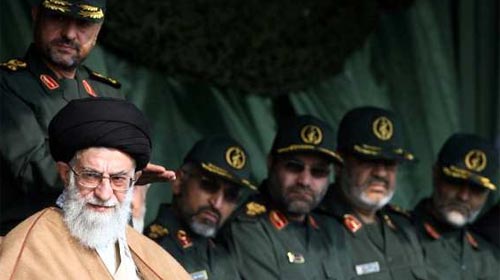
Revolutionary Guards Corps extends grip over a splintered Iran By Michael Slackman, New York Times, July 21, 2009 As Iran’s political elite and clerical establishment splinter over the election crisis, the nation’s most powerful economic, social and political institution — the Islamic Revolutionary Guards Corps — has emerged as a driving force behind efforts to crush a still-defiant opposition movement.
From its origin 30 years ago as an ideologically driven militia force serving Islamic revolutionary leaders, the corps has grown to assume an increasingly assertive role in virtually every aspect of Iranian society.
And its aggressive drive to silence dissenting views has led many political analysts to describe the events surrounding the June 12 presidential election as a military coup.
“It is not a theocracy anymore,” said Rasool Nafisi, an expert in Iranian affairs and a co-author of an exhaustive study of the corps for the RAND Corporation. “It is a regular military security government with a facade of a Shiite clerical system.” [continued…]
Ayatollah Ali Khamenei, Iran’s supreme leader, warned the country’s opposition leaders on Monday that they faced “collapse” if they continued to incite protests over the disputed presidential election.
The warning came amid an unprecedented war of words between the regime’s senior leaders and looked like a retort to Akbar Hashemi-Rafsanjani, the influential former president who has backed the opposition. Mr Rafsanjani said on Friday the country was in “crisis” and the regime had to regain people’s trust. [continued…]
Mir-Hossein Mousavi, Iran’s opposition leader, has warned the country’s rulers that an “awakened” nation is “determined” to defend its rights.
Mr Mousavi, the presidential candidate, said it was “insulting” to suggest that foreigners had organised mass demonstrations against the outcome of last month’s election and demanded the release of all political prisoners.
His words showed that President Mahmoud Ahmadinejad, whose bitterly controversial re-election sparked the crisis, has failed to suppress the popular challenge to his rule. Mr Mousavi’s latest intervention also amounts to open defiance of Ayatollah Ali Khamenei, the Supreme Leader, and shows the deep divisions within the regime.
Mr Mousavi met the families of people who have been arrested for protesting against Mr Ahmadinejad’s alleged victory in a poll that many regard as rigged. “You are facing something new: an awakened nation, a nation that has been born again and is here to defend its achievements,” he told Iran’s rulers. [continued…]
What president would celebrate a “victory” by two-thirds of the vote with a clampdown resembling a putsch? What self-respecting nation would attribute the appearance in the streets of three million protesters convinced their votes were stolen to Zionists, “evil” media and British agents?
(The former British ambassador to Iran told me with a smile last January that Tehran was an interesting place to serve “because it’s one of the very few places left on earth where people still believe we have some influence!”)
What sort of country invites hundreds of journalists to witness an election only to throw them all out? What kind of revolutionary authority invokes “ethics” and “religious democracy” as it allows plain-clothes thugs to beat women?
What is to be thought of a supreme leader who calls an election result divine, then says there are some questions that need resolution by an oversight council, and then tells that council what the result of its recount is before it’s over? [continued…]
The reform movement and its allies among pragmatic conservatives have developed a narrative about Khomeinist Iran. They allege that it is ultimately democratic, and that the will of the people is paramount. It is popular sovereignty that authorizes political change and greater political and cultural openness. Precisely because democracy and popular sovereignty are the key values for this movement, the alleged stealing of the June 12 presidential elections by Supreme Leader Ali Khamenei for his candidate, Mahmoud Ahmadinejad, is intolerable. A crime has been committed, in their eyes. A social contract has been violated. The will of the people has been thwarted.
The hard liners hold a competing and incompatible view of the meaning of Khomeini’s 1979 revolution. They discount the element of elections, democracy and popular sovereignty. They view these procedures and institutions as little more than window-dressing. True power and authority lies with the Supreme Leader and ultimately all important decisions are made by him. Ayatollah Mohammad Taqi Misbah-Yazdi is an important exponent of this authoritarian view of the Islamic Republic. The Leader in this view is a kind of philosopher-king, who can overrule the people at will. The hard liners do not believe that the election was stolen. But they probably cannot get very excited about the election in the first place. Khamenei and his power and his appointments and his ability to intervene to disqualify candidates, close newspapers, and overrule parliament are what is important. From a hard line point of view, the election is what Khamenei says it is and therefore cannot be stolen. [continued…]
Every week since the founding of the Islamic Republic of Iran in 1979, the country’s public television has broadcast the Friday prayers at the University of Tehran, at which powerful clerics outline the state’s position and criticize its enemies.
Not last Friday. As former president Ali Akbar Hashemi Rafsanjani was leading prayers, televisions were showing old footage of current President Mahmoud Ahmadinejad selecting his cabinet. [continued…]
There was no hint of reconciliation, or any mediation “message” for Iran’s supreme leader in the sermon delivered by Akbar Hashemi Rafsanjani last Friday. For a mild-mannered political player, Rafsanjani looked angry and confrontational. As the second most powerful man in the political structure of the Islamic Republic, he challenged the supremacy of the supreme leader.
More than that, by associating himself with founder of the revolution, Ayatollah Khomeini, he undermined the position of Khamenei. So much so that commentators in pro-government press in Iran have complained. Mojtaba Shakeri, of the ultra-conservative Devotees of Islamic Revolution, said Rafsanjani “should at least have made some respectful reference to the supreme leader. I did not hear one word about him.”
Rafsanjani’s entire speech sounded as if he was speaking from a position of strength. He demanded debate and discussion about the elections, thereby rejecting the supreme leader’s approval of the results. He questioned how Iran could have got into this deep crisis and why officials were not listening to people. He stressed it had caused serious tension and distrust among the population and this “had to be put right”. [continued…]
The political turmoil that has shaken Iran following its disputed presidential election last month is being keenly observed by Lebanon’s militant Shiite Hezbollah, which takes many of its cues – earthly and spiritual – from the Islamic Republic.
Hezbollah is the only organization outside Iran that subscribes to that nation’s ideology of theocratic leadership. The group was founded with Iranian help, still receives Iranian funding, and has at times turned to Iran’s supreme leader for guidance on major political issues. Therefore, the outcome of current debates there over the way theocratic authority is wielded and the secular question of how Iran should manage its external relations is sure to reverberate inside Lebanon.
“Those who argue that this is only a disagreement between revolutionary elites are patently wrong,” says Karim Sadjadpour, an Iran specialist at the Carnegie Endowment for International Peace. “Even … a former senior Revolutionary Guard commander claimed that over 3 million people demonstrated in Tehran.” [continued…]
The government is considering confiscating privately-owned Palestinian land near the West Bank settlement of Ofra, contrary to Prime Minister Benjamin Netanyahu’s pledge during his Bar-Ilan speech not to take such actions.
This announcement was made by the state prosecutor, in response to a High Court petition filed by a resident of the West Bank town Ein Yabrud and the human rights association Yesh Din. [continued…]
Settlers cut down and torched some 15 trees near the West Bank Palestinian village of Burin on Tuesday, in what IDF forces believe was part of the extreme Right’s “price tag” policy, which seeks to make the Palestinian civilian population pay for the evacuation of outposts.
Meanwhile, rightists distributed a leaflet in the West Bank signed by “the residents of Judea and Samaria” with the title “Learn from the haredim, win the battle,” claiming that “only those who upturn tables win.”
The leaflet’s authors claimed that force must be used in order to achieve their objectives. “This is what the Arabs did in the intifada, and they received their Terror Authoirty on a silver platter. This is what the Druze did in Pekiin, and no one bothers them.
“This is what the haredim in Mea Shearim did, and the police folded. The time has come for us to internalize and understand this. You don’t win with love. A battle fought with hugs doesn’t achieve anything. Only with force will we prevail.” [continued…]
Prime Minister Benjamin Netanyahu claimed this week that Jerusalem is an “open city” that permits all its inhabitants, Jewish and Palestinian, to purchase homes in both its eastern and western parts.
“Our policy is that Jerusalem residents can purchase apartments anywhere in the city. There is no ban on Arabs buying apartments in the west of the city, and there is no ban on Jews building or buying in the city’s east,” Netanyahu said in response to the U.S. request to halt a Jewish construction project in East Jerusalem.
An examination by Haaretz, however, presented a rather different situation on the ground. According to Israel Lands Administration rules, residents of East Jerusalem cannot take ownership of the vast majority of Jerusalem homes. When an Israeli citizen purchases an apartment or house, ownership of the land remains with the ILA, which leases it to the purchaser for a period of 49 years, enabling the registration of the home (“tabu”). Article 19 of the ILA lease specifies that a foreign national cannot lease – much less own – ILA land. [continued…]
Last week witnessed a concerted attack against the credibility of the NGO Human Rights Watch (HRW), seeking to link supposed fundraising activities in Saudi Arabia with that organization’s criticism (“bias”, according to its detractors) of Israeli practices in the occupied territories, also claiming HRW is soft peddling on Saudi violations. It started in a Wall Street Journal piece, the Israeli prime minister’s office and spokespeople weighed in, and then AIPAC and the rightwing blogosphere got onboard. The attack on HRW has now been ratcheted up according to last week’s Jerusalem Post.
The former right-wing Israeli Government Minister, Natan Sharansky (also an ex-refusenik, President George W. Bush’s favorite author and occupation apologist) claims that HRW “has become a tool in the hands of dictatorial regimes to fight against democracies.” Ron Dermer, director of policy planning in the Israeli Prime Minister’s Office adds: “We are going to dedicate time and manpower to combating these groups; we are not going to be sitting ducks in a pond for the human rights groups to shoot at us with impunity”.
The apparent trigger for this assault on a group that represents the global gold standard in human rights monitoring, analysis, and advocacy, was a visit by HRW’s Middle East-North Africa director, Sarah Lee Whitson, to the Saudi kingdom. I happened to find myself on a panel at The Century Foundation discussing the Middle East with Whitson just days before this storm broke — I went back and watched tapes of that panel discussion. To accuse Whitson of being soft on the Saudis or somehow singling out Israel for criticism is quite astonishing as I’m sure you’ll agree if you take ten minutes to listen to her presentation — of that, more in a moment. [continued…]
An Obama administration task force set up to develop a plan for the closure of the U.S. detention facility at Guantánamo Bay will miss its first deadline this week—and put off a key report—amid continued divisions over how to resolve one of the president’s thorniest policy dilemmas.
The task force, set up on Obama’s second day in office, was charged with preparing a report to the president by Tuesday, July 21, outlining a long-term detention plan for detainees captured in counterterrorism operations after Sept. 11. But continued debate within the task force over the legal basis for holding detainees who are not charged with any crimes—and where to house them once they are moved from Guantánamo—has forced the task force to postpone its report by a “few months,” a senior administration official told Newsweek.
A separate task-force report on interrogations—also due this week—is being put off as well, said the official, who, like others quoted in this article, asked not to be named talking about private deliberations. [continued…]
The United States views East Jerusalem as no different than an illegal West Bank outpost with regard to its demand for a freeze on settlement construction, American sources have informed both Israel and the Palestinian Authority.
This clarification came in the context of a growing crisis in U.S.-Israel relations over the planned construction of some 20 apartments for Jews in the Shepherd Hotel, in East Jerusalem’s Sheikh Jarrah neighborhood. The U.S. has demanded that the project be halted, but Prime Minister Benjamin Netanyahu told the cabinet meeting Sunday that “Israel will not agree to edicts of this kind in East Jerusalem.” [continued…]
Prime Minister Benjamin Netanyahu’s scheduled meeting with US Mideast envoy George Mitchell has been postponed at least until the end of the month.
Another meeting between the two, which was set to take place in Paris last month, was also cancelled.
Mitchell was originally scheduled to arrive in Israel on Sunday and later hold meetings with senior Palestinian officials in Ramallah. Jerusalem did not state the official reason for the delay, but some officials suspect it relates to the fact that the Netanyahu and Obama administrations have yet to resolve their differences on the issue of settlement expansion in the West Bank, among other things. [continued…]
Who is to blame for the latest dispute with the United States over the new neighborhood going up in Jerusalem’s Sheikh Jarrah area? Mayor Nir Barkat? Certainly not. Prime Minister Benjamin Netanyahu, who stood behind him? Ridiculous. Any child knows that everything is the fault of other Jews: Rahm Emanuel and David Axelrod, two American administration officials who are inciting President Barack Obama against their own people.
This is not the first time that “self-hating Jews” have given us trouble. In negotiations over the separation of forces agreement in the 1970s, U.S. secretary of state Henry Kissinger, the scion of a family of Jewish refugees who had escaped from Nazi Germany, earned the anti-Semitic epithet “Jewboy” in Israel. At the end of the 1980s, when president George H.W. Bush dared to argue that the peace process does not jibe with settlement expansion, the Shamir government instigated a campaign against “the ‘Jewboy’ trio”: Dennis Ross, Aaron Miller and Dan Kurtzer. Now it is the turn of Obama’s Jewish confidantes to be the scapegoats.
It is easy to imagine what an uproar there would be in Jerusalem if an Arab leader or newspaper dared to claim that an American president was favorable to Israel because of the influence of a Jewish adviser. Netanyahu, who spent many years in the United States, knows very well the extent to which Jewish administration officials in key positions are sensitive to the slightest hint of dual loyalty – to their birthplace and their historic homeland. It turns out that for him, politics bends the iron-clad rule that “all Jews are responsible for one another.” [continued…]
In a hilltop suburb South of Jerusalem called Efrat, Sharon Katz serves a neat plate of sliced cake inside her five-bedroom house, surrounded by pomegranate, olive and citrus trees that she planted herself. She glances out the window at the hills where, she believes, David and Abraham once walked. “We are living in the biblical heartland,” she sighs.
It is a heartland the prophets would not recognize, replete as it is with pizza parlor, jazz nights at the coffee shop, grocery store and yellow electronic gate with machine-gun-wielding guards. Efrat is one of 17 settlements that make up a bloc called Gush Etzion, located not in Israel but in the occupied West Bank. The Katzes (Sharon, husband Israel and five children) consider themselves law-abiding citizens. They publish a small community magazine and take part in civic projects. Sharon raises money for charity by putting on tap-dancing and theater shows. And yet to much of the outside world, the Katzes are participating in an illegal land grab forbidden by the Geneva Conventions, which prohibit an occupying power from settling its own civilians on militarily controlled land. Some Israelis have admitted as much. While Benjamin Netanyahu, then as now Prime Minister, was negotiating with Palestinian leader Yasser Arafat in 1998, Foreign Minister Ariel Sharon got on Israeli radio and urged Israelis to settle more land fast. “Grab the hilltops, and stake your claim,” he said. “Everything we don’t grab will go to them.” [continued…]
The Pope and the cardinals of the Vatican help organize tours of Auschwitz for Hezbollah members to teach them how to wipe out Jews, according to a booklet being distributed to Israel Defense Forces soldiers.
Officials encouraging the booklet’s distribution include senior officers, such as Lt. Col. Tamir Shalom, the commander of the Nahshon Battalion of the Kfir Brigade. [continued…]
Iran’s reformist former president Mohammad Khatami called Sunday for a referendum on the legitimacy of the government in the wake of last month’s disputed presidential election, Iranian Web sites reported.
Mr. Khatami’s comments amounted to a bold challenge to Iran’s supreme leader, Ayatollah Ali Khamenei, who has dismissed the opposition’s claims that President Mahmoud Ahmadinejad’s landslide victory on June 12 was rigged, and has ordered protesters to accept it.
It is unlikely that Iran’s hard-line leaders will accept the referendum proposal. But the fact that Mr. Khatami proposed it at all suggests a renewed confidence within the opposition movement. [continued…]
Mir Hossein Mousavi, the defeated reformist candidate in Iran’s presidential election, has demanded the release of scores of protesters detained following the poll, which he insists was rigged.
Speaking to the families of some of the activists and protesters held since the June 12 poll, Mousavi said that detaining people would not resolve the dispute over its outcome, reformist websites reported on Monday.
“Who believes these people, many of them prominent figures, would work with the foreigners and to endanger their country’s interests?” he was quoted as saying. [continued…]
Iran’s supreme leader told politicians Monday not to disturb the country’s security in a strong warning to the opposition to back down after one of its top figures called for a referendum on the government.
Supreme Leader Ayatollah Ali Khamenei addressed “Iran’s elite” and warned them to be cautious in the positions they take on the turmoil that has shaken the country since the disputed presidential election on June 12.
He said that hurting Iran’s security was “the biggest vice,” adding that “anybody who drives the society toward insecurity and disorder is a hated person in the view of the Iranian nation, whoever he is.” [continued…]
An entry on the website of Iran’s newly appointed vice-president Monday denied a local television report about his resignation.
Esfandiar Rahim-Mashaie’s website categorically denied Sunday’s resignation reports as a lie by enemies aimed at tarnishing the new government’s image.
He was appointed by President Mahmoud Ahmadinejad last Thursday as first vice- and de facto acting president. [continued…]
A sweeping United States military review calls for overhauling the troubled American-run prison here as well as the entire Afghan jail and judicial systems, a reaction to worries that abuses and militant recruiting within the prisons are helping to strengthen the Taliban.
In a further sign of high-level concern over detention practices, Adm. Mike Mullen, the chairman of the Joint Chiefs of Staff, sent a confidential message last week to all of the military service chiefs and senior field commanders asking them to redouble their efforts to alert troops to the importance of treating detainees properly.
The prison at this air base north of Kabul has become an ominous symbol for Afghans — a place where harsh interrogation methods and sleep deprivation were used routinely in its early years, and where two Afghan detainees died in 2002 after being beaten by American soldiers and hung by their arms from the ceiling of isolation cells. [continued…]
Whenever he’s asked about the scandals of America’s war on terror — the torture, the wrongful detentions, the legal corners cut — President Obama has responded with some version of this statement: “We have to focus on getting things right in the future as opposed to looking at what we got wrong in the past.”
But that approach can’t work. The unanswered questions are too many, the lawsuits too numerous, the fundamental questions of accountability too nagging. We need a public reckoning — and, much as they might like to avoid the distraction, Obama and his people must know it.
The latest controversy was the disclosure last week that the CIA had launched a program to track down and kill Al Qaeda leaders without informing Congress. The CIA withheld the information, according to Director Leon Panetta, on orders from then-Vice President Dick Cheney. [continued…]
During his decades in Iranian politics, Ali Akbar Hashemi Rafsanjani has been praised as a pragmatist, criticized as spineless, accused of corruption and dismissed as a has-been.
Now, in assailing the government’s handling of last month’s disputed presidential election, Mr. Rafsanjani, a 75-year-old cleric and former president, has cast himself in a new light: as a player with the authority to interpret the ideals of Iran’s 30-year-old Islamic republic.
Using his perch as a designated prayer leader on Friday to deliver the speech of a lifetime, Mr. Rafsanjani abandoned his customary caution to demand that the government release those arrested in recent weeks, ease restrictions on the media and eradicate the “doubt” the Iranian people have about the election result. And he implicitly challenged the authority of the country’s supreme leader, Ayatollah Ali Khamenei, to make decisions without seeking consensus. [continued…]
Iranian President Mahmoud Ahmadinejad’s choice of vice president has met with a hail of criticism, provoking calls from his Principlist supporters for the resignation of the newly appointed veep.
As part of anticipated changes in the structure of his new government, President Ahmadinejad appointed his close confidant Esfandiar Rahim-Mashaei to the post of vice president Thursday night.
Rahim-Mashaei, who has served as the head of the Cultural Heritage, Handicrafts and Tourism Organization, will replace the incumbent first vice president Parviz Davoudi.
New first vice president Rahim-Mashaie stirred up fierce controversy after saying earlier in 2008 that despite the conflict between governments, Iranians are friends with the Israeli people. [continued…]
President Mahmoud Ahmadinejad Friday announced the appointment of Salehi, Iran’s former envoy to the International Atomic Energy Agency, replacing the former chief of 12 years, Gholam Reza Aghazadeh.
Salehi is known as an open minded administrator and he was the one who signed the protocol with the IAEA in December 2003 which gave the UN agency a freer hand in inspecting Iran’s nuclear sites.
Ahmadinejad’s present government stopped applying that protocol, linked to the nuclear Non-Proliferation Treaty, in February 2006 shortly after Iran’s nuclear programme was referred to the UN Security Council. [continued…]
… a prominent cleric who is a member of the electoral watchdog, the Guardians Council, which upheld the poll result, rebuked Rafsanjani for his focus on popular legitimacy.
“The legitimacy of the government is given by God,” the ISNA news agency quoted Ayatollah Mohammad Yazdi as saying.
“Acceptance by the people doesn’t bring legitimacy to (an Islamic) government. Mr Hashemi Rafsanjani ignored this important Islamic point and talked in both parts of his sermon yesterday as if governments are assigned only by the people.” [continued…]
Prime Minister Benjamin Netanyahu said Sunday that Israel’s sovereignty over Jerusalem was not a matter up for discussion. The prime minister’s comments came after the U.S. State Department told Israeli envoy Michael Oren that Israel must halt a construction project in East Jerusalem.
Netanyahu told ministers at the weekly cabinet meeting that Jerusalem is the united capital of Israel and that all citizens are allowed to purchase property in any part of the city they choose. [continued…]
The United States has told Israel it must halt an East Jerusalem construction project in accordance with the Obama administration’s demands for a complete freeze on settlement building, Israeli radio stations reported on Sunday.
The State Department summoned Israeli Ambassador Michael Oren over the weekend to advise him that the project developed by American millionaire Irving Moskowitz should not go ahead, according to both Israel Radio and Army Radio.
Moskowitz, an influential supporter of Israeli settlement in East Jerusalem, purchased the Shepherd Hotel in 1985 and plans to tear it down and build housing units in its place. The hotel is located near a government compound that includes several government ministries and the national police headquarters. [continued…]
In April 2002, as the terrorism suspect known as Abu Zubaida lay in a Bangkok hospital bed, top U.S. counterterrorism officials gathered at CIA headquarters in Langley, Va., for a series of meetings on an urgent problem: how to get him to talk.
Put him in a cell filled with cadavers, was one suggestion, according to a former U.S. official with knowledge of the brainstorming sessions. Surround him with naked women, was another. Jolt him with electric shocks to the teeth, was a third.
One man’s certitude lanced through the debate, according to a participant in one of the meetings. James E. Mitchell, a retired clinical psychologist for the Air Force, had studied al-Qaeda resistance techniques.
“The thing that will make him talk,” the participant recalled Mitchell saying, “is fear.” [continued…]
Dostum asserts that “it is impossible that Taliban or Al-Qaeda prisoners could have been abused.” In fact, preliminary investigations carried out shortly after the alleged killings by highly experienced and respected forensic analysts from Physicians for Human Rights established the presence of recently deceased human remains at Dasht-e Leili and suggested that they were the victims of homicide.
I was a human rights investigator in northwestern Afghanistan in February 2002. At the time, numerous witnesses spoke of seeing several trucks dumping what appeared to be human remains in Dasht-e Leili, while others told of detainees being held for days in overcrowded shipping containers without food, water, or medical care, and, in some instances, being shot while inside the containers. [continued…]