Author Archives: Paul Woodward

EDITORIAL: The missing Mandela

The missing Mandela

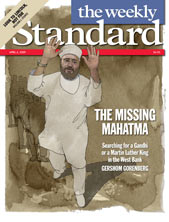
When the long sought solution to the Israeli-Palestinian conflict is being trumpeted from the cover of The Weekly Standard there’s every reason to scoff. Middle East peace has thus far not appeared high up on the neoconservative agenda and I really doubt that Bill Kristol and his cronies suddenly had some extraordinary change of heart.

What’s sad is that Gershom Gorenberg, who is clearly a man of integrity, chose to lend his support to the Israel apologists who happily massage their consciences by pretending that Palestinian violence is the one insurmountable obstacle to ending the conflict.

In a celebration of Israeli impotence we are presented with a mirage of peace in the form of an unfound Palestinian Mahatma. If only a Palestinian Gandhi emerged, anything would be possible.

It’s not that the appeal of a saintly leader of a non-violent resistance movement is lost on me, but the parallels between British India and Israel are beyond tenuous.

Gandhi’s resistance to British rule galvanized the support of a massive population governed by a tiny colonial elite who never had the pretense that Britain was reclaiming a long-lost homeland. To the British, India was a land brimming with resources that could be shipped back to the actual homeland and traded for handsome profits. By the end of World War Two, Britain was bankrupt and in a rush to free itself of what had become its colonial burdens. With or without a gentle shove from the Mahatma, the sun had already set on the British Empire.

As for Gandhi’s nominal success in non-violently waving goodbye to colonial rule, we should not forget that it was accompanied by the horrific failure of partition and a bloodbath in which as many as a million people died.

Another model of non-violent leadership that Gorenberg could have considered is that of the Dalai Lama.

After fifty years of principled resistance to Chinese rule, Tibetans are still no closer to winning autonomy. Thus far, the majority of the Dalai Lama’s followers remain loyal to the religious values that he practices and advocates, yet many are starting to wonder whether it is their pacifism that enables China to retain its firm grip on Tibet.

Of course the most obvious model of political leadership that Gorenberg should have mentioned is that of Nelson Mandela.

The problem is — at least from Gorenberg and The Weekly Standard‘s point of view — Mandela resolutely refused to renounce armed resistance. Apartheid didn’t end because its opponents adopted a spiritually enlightened non-violent perspective. It ended because white South Africans were forced to recognize they were clinging on to a politically unsustainable system.

Israelis still cling on to a politically unsustainable situation, but unlike white South Africans, they are still able to hold on to a security blanket stitched together by American military and economic aid and political protection.

President Obama might say that for Palestinians and Israelis “the status quo is unsustainable”, but unless the US takes away the security blanket, Israel will remain in its manipulatively infantile condition: vacillating between a manicured helplessness that occasionally gets punctuated by a violent tantrum.

Must Israel and its friends wait in frustration for an elusive Palestinian Mahatma or instead might an earnest search for an Israeli FW de Klerk be long overdue?

Facebooktwittermail

NEWS & VIEWS ROUNDUP & EDITOR’S COMMENT: March 29

Israeli drones destroy rocket-smuggling convoys in Sudan

Israel used unmanned drones to attack secret Iranian convoys in Sudan that were trying to smuggle rockets into Gaza. The missiles have the range to strike Tel Aviv and Israel’s nuclear reactor at Dimona, defence sources said.

The unmanned aerial vehicles (UAVs) attacked two convoys, killing at least 50 smugglers and their Iranian escorts. All the lorries carrying the long-range rockets were destroyed. Had the rockets been delivered to Hamas, the militant Islamic group that controls Gaza, they would have dramatically raised the stakes in the conflict, enabling Palestinians to wreak terror on Tel Aviv.

According to western diplomats, Israel attacked the Iranian convoys at the end of January and in the first week of February in the remote Sudan desert, just outside Port Sudan. The convoys had been tracked down by agents from Mossad, Israel’s overseas intelligence agency.

The raids were carried out by Hermes 450 drones. One source claimed they were accompanied by giant Eitan UAVs, which have a 110ft wingspan, similar to that of a Boeing 737. The drones, controlled via satellite, can hover over a target for 24 hours. The Hermes 450 squadron is based at the Palmahim air base, south of Tel Aviv, but it remains unclear from which airfield they took off. [continued…]

Editor’s Comment — If this report is accurate (not that it’s coming from a particularly reliable source), the Sudan attack would appear to say nothing about Israel’s capacity to strike Iran. UAVs can’t carry the weaponry for attacking nuclear installations.

So, disregard suggestions by other unreliable sources (like me) that this attack necessarily had huge strategic significance. Far-reaching unmanned aerial attacks are changing the nature of warfare in disturbing ways as the physical and psychological gap between killers and the killed gets wider and wider, but I don’t think the Israeli air strikes in Sudan necessarily brought war with Iran any closer.

The Obama Administration’s chance to engage in a Middle East peace

When the Israelis’ controversial twenty-two-day military campaign in Gaza ended, on January 18th, it also seemed to end the promising peace talks between Israel and Syria. The two countries had been engaged for almost a year in negotiations through intermediaries in Istanbul. Many complicated technical matters had been resolved, and there were agreements in principle on the normalization of diplomatic relations. The consensus, as an ambassador now serving in Tel Aviv put it, was that the two sides had been “a lot closer than you might think.”

At an Arab summit in Qatar in mid-January, however, Bashar Assad, the President of Syria, angrily declared that Israel’s bombing of Gaza and the resulting civilian deaths showed that the Israelis spoke only “the language of blood.” He called on the Arab world to boycott Israel, close any Israeli embassies in the region, and sever all “direct or indirect ties with Israel.” Syria, Assad said, had ended its talks over the Golan Heights.

Nonetheless, a few days after the Israeli ceasefire in Gaza, Assad said in an e-mail to me that although Israel was “doing everything possible to undermine the prospects for peace,” he was still very interested in closing the deal. “We have to wait a little while to see how things will evolve and how the situation will change,” Assad said. “We still believe that we need to conclude a serious dialogue to lead us to peace.” [continued…]

From Obama, a guide for avoiding defeat in Afghanistan

The keyword of US President Barack Obama’s new Afghanistan plan didn’t make it into the text of the speech in which he announced it on Friday. That would be “exit strategy”. This was how Obama, in a TV interview a week earlier, had defined his administration’s goal in rethinking Washington’s approach to Afghanistan and western Pakistan.

The US is in no position to leave Afghanistan any time soon, but nor is it likely in the same time frame to achieve its original objective of stabilising a pro-western democratic government. Obama may be reluctant to face the US electorate three years from now with an open-ended commitment of blood and treasure to Afghanistan, but his immediate problem is not that progress there is slow; it’s that the situation is quickly deteriorating. [continued…]

Some strategists cast doubt on Afghan war rationale

The argument for deeper U.S. military commitment to the Afghan War invoked by President Barack Obama in his first major policy statement on Afghanistan and Pakistan Friday – that al Qaeda must be denied a safe haven in Afghanistan – has been not been subjected to public debate in Washington.

A few influential strategists here have been arguing, however, that this official rationale misstates the al Qaeda problem and ignores the serious risk that an escalating U.S. war poses to Pakistan.

Those strategists doubt that al Qaeda would seek to move into Afghanistan as long as they are ensconced in Pakistan and argue that escalating U.S. drone airstrikes or Special Operations raids on Taliban targets in Pakistan will actually strengthen radical jihadi groups in the country and weaken the Pakistani government’s ability to resist them. [continued…]

Detainee’s harsh treatment foiled no plots

When CIA officials subjected their first high-value captive, Abu Zubaida, to waterboarding and other harsh interrogation methods, they were convinced that they had in their custody an al-Qaeda leader who knew details of operations yet to be unleashed, and they were facing increasing pressure from the White House to get those secrets out of him.

The methods succeeded in breaking him, and the stories he told of al-Qaeda terrorism plots sent CIA officers around the globe chasing leads.

In the end, though, not a single significant plot was foiled as a result of Abu Zubaida’s tortured confessions, according to former senior government officials who closely followed the interrogations. Nearly all of the leads attained through the harsh measures quickly evaporated, while most of the useful information from Abu Zubaida — chiefly names of al-Qaeda members and associates — was obtained before waterboarding was introduced, they said. [continued…]

Spanish court weighs inquiry on torture for 6 Bush-era officials

A Spanish court has taken the first steps toward opening a criminal investigation into allegations that six former high-level Bush administration officials violated international law by providing the legal framework to justify the torture of prisoners at Guantánamo Bay, Cuba, an official close to the case said.

The case, against former Attorney General Alberto R. Gonzales and others, was sent to the prosecutor’s office for review by Baltasar Garzón, the crusading investigative judge who ordered the arrest of the former Chilean dictator Augusto Pinochet. The official said that it was “highly probable” that the case would go forward and that it could lead to arrest warrants.

The move represents a step toward ascertaining the legal accountability of top Bush administration officials for allegations of torture and mistreatment of prisoners in the campaign against terrorism. But some American experts said that even if warrants were issued their significance could be more symbolic than practical, and that it was a near certainty that the warrants would not lead to arrests if the officials did not leave the United States. [continued…]

You can’t go home (to Yemen) again

Omar Fawza can’t find a wife. The 20-something Yemeni reveals his bachelor status with a sigh that suggests it’s the most painful experience of his life — worse even than the five years he spent in U.S. captivity at Guantánamo Bay and in Afghanistan, where he says he was treated “like a dog.”

For Fawza, thwarted marital bliss has become the symbol of his rotten existence since U.S. forces scooped him up in Pakistan shortly after the Sept. 11 attacks. Fawza, who had gone to Afghanistan to fight with the Taliban against their domestic rivals long before 9/11 but never saw combat, was locked up by the Americans as part of “the worst of the worst,” and then abruptly sent back to Yemen in 2006. Like most of the 14 Yemenis shipped home from Guantánamo so far, he’s been stigmatized in his own country as a terrorist ever since, though he was never charged with a crime.

“Guantánamo has destroyed a big part of my life,” he told me in a soft voice over cups of syrupy tea in an office in Yemen. (I have given Fawza a pseudonym and kept our exact meeting place secret to spare him additional grief.) “But I have done nothing wrong.” [continued…]

Obama’s Nobel headache

Traditionally, punditry in Washington has been a cozy business. To get the inside scoop, big-time columnists sometimes befriend top policymakers and offer informal advice over lunch or drinks. Naturally, lines can blur. The most noted pundit of mid-20th-century Washington, Walter Lippmann, was known to help a president write a speech—and then to write a newspaper column praising the speech.

Paul Krugman has all the credentials of a ranking member of the East Coast liberal establishment: a column in The New York Times, a professorship at Princeton, a Nobel Prize in economics. He is the type you might expect to find holding forth at a Georgetown cocktail party or chumming around in the White House Mess of a Democratic administration. But in his published opinions, and perhaps in his very being, he is anti-establishment. Though he was a scourge of the Bush administration, he has been critical, if not hostile, to the Obama White House.

In his twice-a-week column and his blog, Conscience of a Liberal, he criticizes the Obamaites for trying to prop up a financial system that he regards as essentially a dead man walking. In conversation, he portrays Treasury Secretary Tim Geithner and other top officials as, in effect, tools of Wall Street (a ridiculous charge, say Geithner defenders). These men and women have “no venality,” Krugman hastened to say in an interview with NEWSWEEK. But they are suffering from “osmosis,” from simply spending too much time around investment bankers and the like. In his Times column the day Geithner announced the details of the administration’s bank-rescue plan, Krugman described his “despair” that Obama “has apparently settled on a financial plan that, in essence, assumes that banks are fundamentally sound and that bankers know what they’re doing. It’s as if the president were determined to confirm the growing perception that he and his economic team are out of touch, that their economic vision is clouded by excessively close ties to Wall Street.”

If you are of the establishment persuasion (and I am), reading Krugman makes you uneasy. You hope he’s wrong, and you sense he’s being a little harsh (especially about Geithner), but you have a creeping feeling that he knows something that others cannot, or will not, see. By definition, establishments believe in propping up the existing order. Members of the ruling class have a vested interest in keeping things pretty much the way they are. Safeguarding the status quo, protecting traditional institutions, can be healthy and useful, stabilizing and reassuring. But sometimes, beneath the pleasant murmur and tinkle of cocktails, the old guard cannot hear the sound of ice cracking. [continued…]

Facebooktwittermail

Israel targets Sudan — and Tehran or Washington?

Three Israeli airstrikes against Sudan

Israel has conducted three military strikes against targets in Sudan since January in an effort to prevent what were believed to be Iranian weapons shipments from reaching Hamas in the Gaza Strip, ABC News has learned.

Earlier this week, CBSNews.com was the first to report that Israel had conducted an airstrike in January against a convoy carrying weapons north into Egypt to be smuggled into the Hamas-controlled Gaza Strip.

But actually, since January, Israel has conducted a total of three military strikes against smugglers transporting what were believed to be Iranian weapons shipments destined for Gaza, a U.S. official told ABC News. [continued…]

Israel carried out 3 attacks on Sudan arms smugglers

Ehud Olmert hinted on Thursday at Israel’s suspected role in the reported air-strike.

“We operate everywhere where we can hit terror infrastructure – in close places, in places further away, everywhere where we can hit terror infrastructure, we hit them and we hit them in a way that increases deterrence,” said Olmert, speaking at a conference in Herzliya.

“It was true in the north in a series of incidents and it was true in the south, in a series of incidents,” he added. “There is no point in going into detail, and everybody can use their imagination. Those who need to know, know. And those who need to know, know that there is no place where Israel cannot operate. There is no such place.” [continued…]

Military clash with Iran

Iran is in fact forcing a direct military confrontation upon Israel. We are not only talking about President Mahmoud Ahmadinejad’s exaggerated verbal passion or the Iranian nuclear project.

Thus far, Iran conducted a war of attrition against Israel via its emissaries: Hizbullah, Hamas, and other Palestinian groups. At this time, the war is reaching new peaks; it will be impossible to continue ignoring them while only engaging with the emissaries.

Based on foreign reports, the Air Force bombed about two months ago, in Sudan, a shipment of medium-range rockets with a range of 70 kilometers (roughly 40 miles,) apparently the Fajar 3 model.

This is not a small missile. In fact, it is a missile that the Iranians are manufacturing especially for the Gaza Strip, so that it can be dismantled to several pieces and smuggled in through the Gaza tunnels. This is also the way they produced the special Grad rockets for Gaza: Disassembled models, made in Iran, and designated for smuggling. [continued…]

Editor’s Comment — I’m in no position to judge the credibility of the claims being made about an arms smuggling route through Sudan or the type of rockets said to be destined for Gaza. However, these air strikes do seem to signal a strategic escalation in hostilities between Israel and Iran.

Israeli commentator, Alex Fishman says:

    The “tight grip theory,” namely, clasping the State of Israel from both the north and south, turns Iran into a concrete enemy, rather than a theoretical one.

This is a significant shift in Israeli rhetoric. Instead of hyperventilating about the threat that Iran will pose if it acquires the ability to construct nuclear weapons, the Iranian threat is now being shunted into the present with the effect that intelligence assessments about Iran’s nuclear status become irrelevant.

Iran is being cast as posing a clear and present danger to Israel. In other words, for those who hold this position, nothing more needs to happen for Israel to justify an attack on Iran.

The question, as always, is this: where is Israel more intent on exerting pressure? In Tehran or Washington?

Is this about threatening Iran, or is it about undermining US-Iranian diplomacy?

An open hand and a fist

We should not underestimate the courage and self-confidence it took for Obama to make several gestures toward Iran since taking office. He reflects real strength, political realism and much humility in being able to reverse many aspects of the belligerent Bush approach.

Yet the flaw in the Obama approach is a lingering streak of arrogance that is reflected in both the tone and the substance of his messages.

This is most obvious in his insistence — after telling the Iranians that they are a great culture with proud traditions, which presumably they already knew — on lecturing Iran about the responsibilities that come with the right to assume its place in the “community of nations,” and then linking Iran’s behavior with “terror of arms” and a “capacity to destroy.”

It is difficult to see how Washington feels the positive gestures of reaching out can be reconciled with an irrepressible need to lecture others about the rules of righteous nationhood. [continued…]

Facebooktwittermail

Is it too late for peace?

The fierce urgency of peace

Pressure on President Obama to recast the failed American approach to Israel-Palestine is building from former senior officials whose counsel he respects.

Following up on a letter dated Nov. 6, 2008, that was handed to Obama late last year by Paul Volcker, now a senior economic adviser to the president, these foreign policy mandarins have concluded a “Bipartisan Statement on U.S. Middle East Peacemaking” [PDF] that should become an essential template.

Deploring “seven years of absenteeism” under the Bush administration, they call for intense American mediation in pursuit of a two-state solution, “a more pragmatic approach toward Hamas,” and eventual U.S. leadership of a multinational force to police transitional security between Israel and Palestine. [continued…]

Israel’s step back from peace

Emphasizing diplomacy and engagement over isolation and confrontation, President Obama has spoken eloquently of a new era of American leadership. Of the changes he has promised, the most important to Palestinians is his commitment to reinvigorating the Middle East peace process.

Resolving the Palestinian-Israeli conflict remains crucial to achieving stability and peace in the Middle East as well as to advancing vital U.S. interests. The Obama administration clearly understands this, prioritizing the peace process as part of a more integrated approach to U.S. policy in the region. America’s renewed commitment to brokering a just and lasting peace between Palestinians and Israelis offers a measure of hope to Palestinians living under the weight of occupation. But it also comes at a time when Israel’s own commitment to peace is in doubt after the formation of a right-wing coalition government.

Peace is not a word that sits comfortably with the Israeli right, which will dominate Israel’s new government, even with Labor’s decision this week to join it. Among its ranks are those who have long opposed peace with Palestinians, no matter the cost; who use the cover of religion to advocate extremist views; and who have supported the expulsion of Palestinians or now devise loyalty tests designed to achieve the same result. [continued…]

A tax break fuels Middle East friction

For many years, the United States has had a policy against spending aid money to fund Israeli settlements in the West Bank, which successive administrations have regarded as an obstacle to peace. Yet private organizations in the United States continue to raise tax-exempt contributions for the very activities that the government opposes.

There’s nothing illegal about the charitable contributions to pro-settlement organizations, which are documented in filings with the Internal Revenue Service. They’re similar to tax-exempt donations made to thousands of foreign organizations around the world through groups that are often described as “American friends of” the recipient.

But critics of Israeli settlements question why American taxpayers are supporting indirectly, through the exempt contributions, a process that the government condemns. A search of IRS records identified 28 U.S. charitable groups that made a total of $33.4 million in tax-exempt contributions to settlements and related organizations between 2004 and 2007. [continued…]

Facebooktwittermail

Re-dismantling the terrorist infrastructure again

White House debate led to plan to widen Afghan effort

President Obama’s plan to widen United States involvement in Afghanistan came after an internal debate in which Vice President Joseph R. Biden Jr. warned against getting into a political and military quagmire, while military advisers argued that the Afghanistan war effort could be imperiled without even more troops.

All of the president’s advisers agreed that the primary goal in the region should be narrow — taking aim at Al Qaeda, as opposed to the vast attempt at nation-building the Bush administration had sought in Iraq. The question was how to get there. [continued…]

Obama outlines Afghan strategy

President Obama introduced his new strategy for Afghanistan and Pakistan yesterday with a threat assessment familiar from the Bush administration. “The terrorists who planned and supported the 9/11 attacks,” he said, are continuing to devise plots designed to “kill as many of our people as they possibly can.”

Elements of the Obama plan to “disrupt, dismantle and defeat” al-Qaeda in Pakistan and vanquish its Taliban allies in Afghanistan also struck notes from the past. More U.S. troops, civilian officials and money will be needed, he said. Allies will be asked for additional help, and local forces will be trained to eventually take over the fight. Benchmarks will be set to measure progress. [continued…]

Editor’s Comment — By basing a war strategy on the objective of disrupting, dismantling and defeating al Qaeda, Obama is resting on solid political ground.

The question that everyone resolutely refuses to address is this: where’s the evidence that al Qaeda’s capacity to operate is bound together with its ability to maintain some sort of infrastructure in north western Pakistan? Why should we not assume that if another 9/11 type attack is being planned that it may well emanate from a location far removed from al Qaeda’s historical base? In terms of the threat of attacks on the US, what’s happening in some discreet enclave in Karachi or Manila or Melbourne or Toronto or London or even New York may matter much more than the tribal territories.

At the same time, what happens to Pakistan and Afghanistan will certainly be affected by the extent to which the West provides jihadists, insurgents and tribal fighters the foundation for coming together to combat a common enemy.

Pakistan and Afghan Taliban close ranks

After agreeing to bury their differences and unite forces, Taliban leaders based in Pakistan have closed ranks with their Afghan comrades to ready a new offensive in Afghanistan as the United States prepares to send 17,000 more troops there this year.

In interviews, several Taliban fighters based in the border region said preparations for the anticipated influx of American troops were already being made. A number of new, younger commanders have been preparing to step up a campaign of roadside bombings and suicide attacks to greet the Americans, the fighters said.

The refortified alliance was forged after the reclusive Afghan Taliban leader, Mullah Muhammad Omar, sent emissaries to persuade Pakistani Taliban leaders to join forces and turn their attention to Afghanistan, Pakistani officials and Taliban members said. [continued…]

Afghan strikes by Taliban get Pakistan help, U.S. aides say

The Taliban’s widening campaign in southern Afghanistan is made possible in part by direct support from operatives in Pakistan’s military intelligence agency, despite Pakistani government promises to sever ties to militant groups fighting in Afghanistan, according to American government officials.

The support consists of money, military supplies and strategic planning guidance to Taliban commanders who are gearing up to confront the international force in Afghanistan that will soon include some 17,000 American reinforcements.

Support for the Taliban, as well as other militant groups, is coordinated by operatives inside the shadowy S Wing of Pakistan’s spy service, the Directorate for Inter-Services Intelligence, the officials said. There is even evidence that ISI operatives meet regularly with Taliban commanders to discuss whether to intensify or scale back violence before the Afghan elections. [continued…]

White House won’t rule out troops for Pakistan war

President Obama has just laid out his new war strategy. And he’s made it clear that the fight is both in Afghanistan and Pakistan. So I asked Dennis McDonough, with the National Security Council: Does that mean U.S. ground forces in Pakistan? Or more drone attacks? “I’m not going to comment on the notions you laid out there,” he answered, during a White House conference call with bloggers.

But during a separate press conference, Bruce Reidel, who recently completed a strategy review of the region for the White House, offered some hints. “Thus far, our policy sees Afghanistan and Pakistan as two countries, but one theater of operations for our diplomacy, and one challenge for our overall policy,” he said. “We have very concrete proposals for increasing economic assistance to Pakistan, proposals that have already been put forward by the Congress. We’re also looking at what we can do on the military side.” [continued…]

Bomber strikes in Pakistani mosque, killing dozens during prayers

A suicide bomber attacked a crowded mosque in northwest Pakistan on Friday, setting off explosives as a cleric intoned the holy prayers, bringing the roof crashing down and killing scores of people in what was the bloodiest attack this year.

The attack was unleashed in an area where there has been intense activity by Pakistani security forces aimed at protecting the critical Khyber Pass supply route for American forces in Afghanistan. Occurring only hours before President Obama unveiled a new strategy against militants in Afghanistan and Pakistan, it raised questions about Pakistan’s ability to counter the threat from Al Qaeda and the Taliban. [continued…]

The Accidental Guerrilla: Fighting Small Wars in the Midst of a Big One by David Kilcullen

An American patrol ambushed by the Taliban in Uruzgan province on May 19, 2006 found its foes growing in number as the firefight continued. Local farmers working in nearby fields rushed home to get their weapons and join in. In Afghanistan, young men like doing that sort of thing.

The episode exemplifies David Kilcullen’s thesis: that many Muslims who take up arms against the West in Iraq, Afghanistan and indeed Europe are not committed ideologues. Instead, they are young men alienated variously by foreign intrusion, corrupt government, local factionalism and grievances, bitterness about globalisation; or simply enthused by a belief in the dignity of combat.

At the heart of this significant book is the author’s declaration that terrorism cannot be addressed by military means alone; that for American or British soldiers merely to kill insurgents is meaningless. He urges policies based upon securing and succouring populations, not on enemy body counts. [continued…]

A conversation with David Kilcullen

Pakistan is 173 million people, 100 nuclear weapons, an army bigger than the U.S. Army, and al-Qaeda headquarters sitting right there in the two-thirds of the country that the government doesn’t control. The Pakistani military and police and intelligence service don’t follow the civilian government; they are essentially a rogue state within a state. We’re now reaching the point where within one to six months we could see the collapse of the Pakistani state, also because of the global financial crisis, which just exacerbates all these problems. . . . The collapse of Pakistan, al-Qaeda acquiring nuclear weapons, an extremist takeover — that would dwarf everything we’ve seen in the war on terror today. [continued…]

Facebooktwittermail

Britain’s police state

Police identify 200 children as potential terrorists

Two hundred schoolchildren in Britain, some as young as 13, have been identified as potential terrorists by a police scheme that aims to spot youngsters who are “vulnerable” to Islamic radicalisation.

The number was revealed to The Independent by Sir Norman Bettison, the chief constable of West Yorkshire Police and Britain’s most senior officer in charge of terror prevention.

He said the “Channel project” had intervened in the cases of at least 200 children who were thought to be at risk of extremism, since it began 18 months ago. The number has leapt from 10 children identified by June 2008. [continued…]

London cops reach new heights of anti-terror poster stupidity

The London police have bested their own impressive record for insane and stupid anti-terrorism posters with a new range of signs advising Londoners to go through each others’ trash-bins looking for “suspicious” chemical bottles, and to report on one another for “studying CCTV cameras.”

It’s hard to imagine a worse, more socially corrosive campaign. Telling people to rummage in one another’s trash and report on anything they don’t understand is a recipe for flooding the police with bad reports from ignorant people who end up bringing down anti-terror cops on their neighbors who keep tropical fish, paint in oils, are amateur chemists, or who just do something outside of the narrow experience of the least adventurous person on their street. Essentially, this redefines “suspicious” as anything outside of the direct experience of the most frightened, ignorant and foolish people in any neighborhood. [continued…]

Facebooktwittermail

EDITORIAL: The rise of Israeli extremism

The rise of Israeli extremism

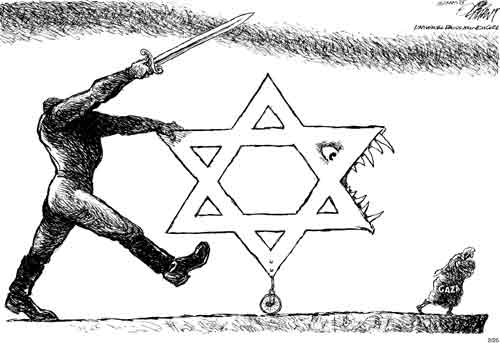
The cartoonist, Pat Oliphant, caused a stir this week with a cartoon (below) which Anti-Defamation League director, Abraham Foxman, said: “employs Nazi imagery by portraying Israel as a jack-booted, goose-stepping headless apparition. The implication is of an Israeli policy without a head or a heart.”

Did Oliphant go too far? Or was he merely using incendiary symbolism to draw attention to the ruthlessness of the Zionist war machine?

The role of the Israeli Defense Forces chief rabbi in portraying the war on Gaza as a religious war has been widely reported. Brig Gen Avichai Rontzki used a line from a classical Hebrew text and turned it into a war slogan: “He who is merciful to the cruel will end up being cruel to the merciful.”

Another rabbi, David Bar Hayim, conveyed a similar message in a broadcast on Israel National News TV where he cited scriptural authority when saying: “In a time of war, one does not distinguish between the different individuals on the enemy side of the fence, of the conflict. One has to fight the enemy … without any thought for such distinctions.” (A statement interestingly reminiscent of the Bush doctrine.) The rabbi also said: “I don’t believe that there are any innocent [Palestinian] civilians in this situation.”

Christopher Hitchens observes:

Peering over the horrible pile of Palestinian civilian casualties that has immediately resulted, it’s fairly easy to see where this is going in the medium-to-longer term. The zealot settlers and their clerical accomplices are establishing an army within the army so that one day, if it is ever decided to disband or evacuate the colonial settlements, there will be enough officers and soldiers, stiffened by enough rabbis and enough extremist sermons, to refuse to obey the order. Torah verses will also be found that make it permissible to murder secular Jews as well as Arabs. The dress rehearsals for this have already taken place, with the religious excuses given for Baruch Goldstein’s rampage and the Talmudic evasions concerning the assassination of Yitzhak Rabin. Once considered highly extreme, such biblical exegeses are moving ever closer to the mainstream.

The extremists are already on the march — literally. And they are being provided with the full support of the state of Israel.

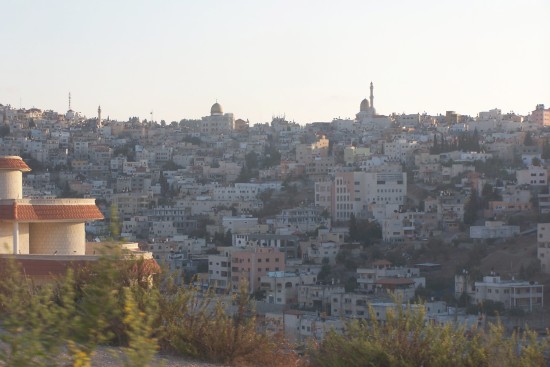
Earlier this week, supporters of Rabbi Meir Kahane descended on the Israeli-Palestinian town of Umm al-Fahm (which was established in 1265).

A hundred militant Zionists, each protected by 25 Israeli police officers, had a simple message for the residents.

“We are going to conquer back Umm al-Fahm” and tell its residents that it is part of Eretz Yisrael (Greater Israel) and that “we are the owners of Eretz Yisrael.”

Just to be clear: Umm al-Fahm is within the 1967 borders of Israel and is populated by Arab Israeli citizens.

The demonstration was also reported by Al Jazeera:

Ynet later reported:

After deeming the Umm al-Fahm march a success, Israel’s extreme right announced it plans to publish regular reports on activities in Arab towns and villages.

“We intend on forming a monitoring committee to counter any infringements of the law in the Arab sector. The committee will be headed by Knesset Member Michael Ben Ari (National Union) and other right-wing activists will serve as members as well,” a rightist source told Ynet Tuesday.

Radical right-wing activist Itamar Ben Gvir explained: “The committee will be made up of subsections, with each section in charge of different things, like building violations, affiliation with terror groups, and infringing on Jewish freedom of movement.” The Right, he added, is now contemplating holding processions in other Arab towns as well.

While the majority of Israelis might identify themselves as secular, with militant nationalism on the rise, religious zealotry and military power have become fused together in the conception of an embattled state that needs show little restraint in its efforts to defend itself.

The spirit of Israel’s indomitable military might is captured in the video below: “Don’t Mess With The IDF.”

It’s tone might seem adolescent, yet it is adolescents and young adults who fill the ranks of the IDF and who celebrated the war in Gaza by adorning themselves with T-shirts that advocate shooting pregnant Muslim women. (Anyone seeing this video who understands Hebrew is welcome to explain the lyrics in a comment. The passage in English comes from The Matrix: Reloaded, which an Israeli reviewer said: “intentionally or not, is the most powerful pro-Israel movie since Cast a Giant Shadow — the story of the Independence War — and Operation Thunderbolt — the story of the Entebbe rescue.”)

Update: The soundtrack for this video combines “The Last Zionist” by Israeli rappers Subliminal and Hazel, followed by “We Are Still Here” by the Dutch DJ Korsakoff.

Facebooktwittermail

NEWS & VIEWS ROUNDUP & EDITOR’S COMMENTS: March 25

The “war on terror”, RIP

Have you heard? The war is over! The “Global War on Terror,” that is. At least for speechwriters at the Defense Department:

    The end of the Global War on Terror — or at least the use of that phrase — has been codified at the Pentagon. Reports that the phrase was being retired have been circulating for some time amongst senior administration officials, and this morning speechwriters and other staff were notified via this e-mail to use “Overseas Contingency Operation” instead.

Continue reading

Facebooktwittermail

NEWS & VIEWS ROUNDUP & EDITOR’S COMMENT: March 24

Guardian investigation uncovers evidence of alleged Israeli war crimes in Gaza

The Guardian has compiled detailed evidence of alleged war crimes committed by Israel during the 23-day offensive in the Gaza Strip earlier this year, involving the use of Palestinian children as human shields and the targeting of medics and hospitals. Continue reading

Facebooktwittermail

GUEST CONTRIBUTOR – John Robertson: Obama’s outreach and the hierarchy of ‘enlightened nations’

Obama’s outreach and the hierarchy of ‘enlightened nations’

John Mearsheimer (of the University of Chicago, and co-author with Stephen Walt of the much-touted/much-reviled The Israel Lobby) has an important essay in the latest London Review of Books, in which he argues (as has Walt) that the Charles Freeman affair has exposed the Israel Lobby and created some new space for public debate about its excessive and harmful impact on the making of US foreign policy. Continue reading

Facebooktwittermail

NEWS & VIEWS ROUNDUP & EDITOR’S COMMENTS: The rise of Israeli religious nationalism

Worried about apartheid? Too late, Mr Olmert, it’s already here

In one of her last acts as US Secretary of State, Condoleezza Rice had Nelson Mandela’s name removed from America’s terrorist watch list. Many Americans were shocked to learn that their favourite former political prisoner had ever been deemed a terrorist. That is because they had forgotten, or were too young to know, that the US under Ronald Reagan – like Britain under Margaret Thatcher – had backed the apartheid regime in South Africa as a Cold War ally. Continue reading

Facebooktwittermail

EDITORIAL: YouTube diplomacy

YouTube diplomacy

President Obama in an historic address reaches out to Iran. It has to be a good thing. Right? I’m far from sure.

This is what Obama said in his Nowruz (new year) address:

Obama said: “The United States wants the Islamic Republic of Iran to take its rightful place in the community of nations.”

Oh, and here comes Israeli President Shimon Peres with a similar message: “On the eve of the new year, I appeal to the noble Iranian people on behalf of the ancient Jewish people and urge them to reclaim their worthy place among the nations of the enlightened world.”

So, it turns out that the Iranian people and their leaders are being targeted by a joint US-Israeli appeal. How’s that going to go down?

Let’s see. Israel’s prime minister to-be Benjamin Netanyahu has likened Iran to Germany in 1938, meaning Mahmoud Ahmadinejad is like Hitler and Iran is on a path aimed at global domination.

Does the US really want to be perceived as making its diplomatic moves towards Iran as a coordinated US-Israeli effort? That might please the Israelis but it doesn’t seem like a smart way of advancing America’s diplomatic interests.

The fundamental problem with turning diplomacy into this kind of public spectacle is that it can promote more confusion than clarity. Before the message can be articulated, every target audience has to be taken into consideration. In this case it means that the White House needed tailor the words, the tone, and the medium of delivery so that something approximating the desired response could be registered in the following audiences (and I won’t even attempt to guess the order):

  • Iran’s leaders
  • the Iranian people
  • Israel’s leaders
  • the Israeli people
  • the Israel lobby
  • the EU
  • Russia
  • China
  • US Gulf allies
  • Congress
  • commentators who are promoting engagement
  • commentators who warn about “appeasement”
  • Democrats
  • Republicans
  • the Iraqi government
  • Muslims
  • Iranian expatriates
  • Syria
  • Iranian non-state allies

OK. If anyone in the White House is reading this, they’re probably thinking “if only we could be that thorough. We actually only ran it by Hillary, Dennis and Rahm and they seemed to like it.”

Still, I’m really just trying to make a point. That is, when you’re crafting a message and trying to find a way of making it play with a multitude of audiences who have conflicting agendas, it’s really difficult to say anything with substance. It ends up coming out like… a presidential statement.

What will the outcome be? Maybe we can expect an Ahadinejad YouTube in the next few weeks.

Is this what we really need — more YouTube diplomacy? Or is it time for serious, substantive talks behind closed doors where the focus is on results — not public diplomatic flourishes.

And let’s not forget that it was only two weeks ago that Obama’s secretary of state was reported as saying that she was “very doubtful” that a US diplomatic overture would be successful in persuading Iran to give up its nuclear ambitions.

Who are the Iranians supposed to be paying attention to? The US president or his chief diplomat?

(And another reminder: Iranians are quite used to serenades from American presidents: “We respect your country. We admire your rich history, your vibrant culture and your many contributions to civilization.” That was George Bush in 2006.)

Facebooktwittermail

Israel’s cloak of democracy is falling away

An Israeli foreign minister who won’t wear velvet gloves

Lieberman is not a passing phenomenon. He represents the integration into Israeli politics of the million immigrants from the former Soviet Union. These new immigrants have displaced the old Labour party, once the elite of the country and the so-called party of peace. In every Labour voter there was a sepia-tinted memory of a kibbutznik taking his horse to be shod in an Arab village. If this fantasy of Jewish-Arab co-operation was ever true, it stopped being so in the 1920s. But the Labour party has always felt that somehow the Arabs can be forced to love, or just get along with, Zionism – a viewpoint which used to sell easily in Europe and the US, even if it never corresponded with facts on the ground. Continue reading

Facebooktwittermail

Israel’s moral autocracy

After Gaza, Israel grapples with crisis of isolation

Israel, whose founding idea was branded as racism by the United Nations General Assembly in 1975 and which faced an Arab boycott for decades, is no stranger to isolation. But in the weeks since its Gaza war, and as it prepares to inaugurate a hawkish right-wing government, it is facing its worst diplomatic crisis in two decades. Continue reading

Facebooktwittermail

EDITORIAL: We want the land, not the people

Uzi Arad: “It is territory we want to preserve, but populations we want to rid ourselves of”

When Hillary Clinton met Benjamin Netanyahu in Jerusalem during her recent visit to Israel, her party was dismayed to see Uzi Arad at the next Israeli prime minister’s side. Arad’s involvement in the “AIPAC case” has resulted in him being barred from entry into the US. Joseph Fitsanakis continues the story:

As soon as Secretary Clinton and her advisers realized Arad was standing next to Netanyahu in the meeting room, they tried to discreetly avoid diplomatic complications by requesting that “only three participants from each side stay in the meeting”. It was an indirect way of requesting that Mr Arad leave the room. But the US delegation was stunned when Israel’s Prime Minister-Designate kept the former Mosad agent present, choosing instead to kick out Israel’s Ambassador to the United States, Sallai Meridor. Clinton’s delegation did not say a word about the Netanyahu’s diplomatic slap-in-the-face, hoping the incident would not make headlines. Ambassador Meridor was not so sensitive about the affair. He was so put off that he announced his resignation soon afterwards.

Netanyahu’s office later explained that Arad’s presence was required in the meeting “because of the Iranian issue.”

Arad is an advocate of “maximum deterrence” towards Iran and has said Israel should threaten to strike ‘everything and anything of value.’ He has said Israel should threaten to hit the Iranian leadership and their holiest sites and that they should hit everything together. This comes from the man tipped to become Netanyahu’s national security adviser.

Arad also recently made the following remarks about the Palestinians. During an interview on Israel National News TV (Arutz Sheva is a media network based in the West Bank and is seen as the voice of the Jewish settler movement), Arad was asked whether the time has come to abandon the two-state solution. This is how he responded:

I don’t think that one has to go that far because at the end of the day, I don’t think the majority of Israelis want to see themselves responsible for the Palestinians. We do not want to control the Palestinian population. It’s unnecessary. What we do want is to care for our borders, for the Jewish settlements and for areas which are unpopulated and to have our security interests served well. But also to take under our responsibility these populations which, believe me, are not the most productive on earth, would become a burden. We want to relieve ourselves of the burden of the Palestinian populations – not territories. It is territory we want to preserve, but populations we want to rid ourselves of.

Facebooktwittermail

EDITORIAL: Is Obama willing to defend US sovereignty?

Is Obama willing to defend US sovereignty?

Benjamin Netanyahu is set to select Avigdor Lieberman as his foreign minister. Lieberman might not be barred from entering the United States but I doubt that he’ll be honored with photo-ops getting a warm greeting from President Obama. As for Netanyahu’s national security adviser, Uzi Arad, he’s unlikely to enjoy much face-to-face contact with his American counterparts since at this time the former director of research for Mossad can’t visit the US. He’s currently barred from entering the country through the use of a statute that prevents entry to people who may seek “to violate any law of the United States relating to espionage or sabotage.”

Meanwhile, Israel Defense Forces Chief of Staff Gabi Ashkenazi during a visit to the US took the opportunity to reiterate that the IDF must prepare itself for a military attack on Iran.

If the IDF follows Arad’s advice, given two years ago, this is what UPI reported we can expect:

Israel should threaten to strike “everything and anything of value,” he said.

Should Israel threaten to hit their leadership? Yes. Their holiest sites? Yes. Everything together? Yes, Arad recommended.

Obama and Secretary Clinton (and her sidekick Dennis Ross) can reiterate the obligatory “all diplomatic avenues must be pursued,” but there’s one diplomatic weapon they need to wield soon — before it’s too late: they need to make explicit the position of the United States in the event that Israel decides to act unilaterally.

Would Israeli officials make reckless threats if they didn’t feel assured that in the event of a military engagement between Israel and Iran the US would resolutely stand next to its ally — even if the Jewish state had chosen to act unilaterally?

Their bluster surely rests on their confidence that no administration in Washington has the guts to ever tell them their on their own.

Unless Obama changes that perception, there is a real danger that the US will be dragged into another war, against the will of the American people and its government.

The Israelis need to be shown a red line. If that doesn’t happen, the gravest national security decision to impact the United States will be one in which the US government chose to have no voice.

Facebooktwittermail