Author Archives: Paul Woodward

OPINION: A ‘challenge’ worth challenging

A ‘challenge’ worth challenging

The boilerplate in a candidate’s speeches gets little attention because words used over and over never constitute “news.”

But one of John McCain’s favorite lines — his declaration that “the transcendent challenge of the 21st century is radical Islamic extremists,” or, as he sometimes says, “extremism” — could define the 2008 election.

Whether McCain is right or wrong matters to everything the United States will do in the coming years. It is incumbent upon McCain to explain what he really means by “transcendent challenge.”

Presumably, he’s saying that Islamic extremism is more important than everything else — the rise of China and India as global powers, growing resistance to American influence in Europe, the weakening of America’s global economic position, the disorder and poverty in large parts of Africa, the alienation of significant parts of Latin America from the United States. Is it in our national interest for all these issues to take a back seat to terrorism?

McCain makes his claim even stronger when he uses the phrase “21st century.” Does he mean that in the year 2100, Americans will look back and say that everything else that happened in the century paled in comparison with the war against terrorism?

But such a debate won’t happen unless Barack Obama and Hillary Clinton challenge McCain’s assertion directly and offer an alternative vision. There is reason to suspect they might fear doing so. They shouldn’t. [complete article]

Facebooktwittermail

NEWS: Unilateral strike called a model for U.S. operations in Pakistan

Unilateral strike called a model for U.S. operations in Pakistan

In the predawn hours of Jan. 29, a CIA Predator aircraft flew in a slow arc above the Pakistani town of Mir Ali. The drone’s operator, relying on information secretly passed to the CIA by local informants, clicked a computer mouse and sent the first of two Hellfire missiles hurtling toward a cluster of mud-brick buildings a few miles from the town center.

The missiles killed Abu Laith al-Libi, a senior al-Qaeda commander and a man who had repeatedly eluded the CIA’s dragnet. It was the first successful strike against al-Qaeda’s core leadership in two years, and it involved, U.S. officials say, an unusual degree of autonomy by the CIA inside Pakistan.

Having requested the Pakistani government’s official permission for such strikes on previous occasions, only to be put off or turned down, this time the U.S. spy agency did not seek approval. The government of Pakistani President Pervez Musharraf was notified only as the operation was underway, according to the officials, who insisted on anonymity because of diplomatic sensitivities. [complete article]

Facebooktwittermail

NEWS: The end of Musharraf?

The end of Musharraf?

Pakistani voters dealt President Pervez Musharraf and his Pakistan Muslim League-Q a humiliating defeat in Monday’s general elections. The opposition Pakistan People’s Party of the late former prime minister Benazir Bhutto, and the Pakistan Muslim League-N of former prime minister Nawaz Sharif trounced Musharraf’s forces. A sizable victory will allow these two moderate, mainstream parties to combine with several other smaller allies and form a government with a two-thirds majority in the National Assembly. To make matters worse for Musharraf and his allies, the PPP has won control of the provincial assembly in the key southern province of Sindh, and Sharif’s PML-N of the provincial assembly in Punjab, the country’s richest, largest and most influential region. “It’s amazing what has happened to Pakistan,” says retired Pakistani Army Lt. Gen. Talat Masood. “The people have strongly spoken in favor of democracy, moderate forces, the rule of law—and against Musharraf.” [complete article]

Facebooktwittermail

NEWS: German intellectuals: Israel’s creation made Palestinians victims of Holocaust

German intellectuals: Israel’s creation made Palestinians victims of Holocaust

A group of visiting German intellectuals called on Berlin on Monday to change what they termed its Holocaust-rooted blind support of Israel, saying the creation of the State of Israel turned Palestinians into victims of the Nazi Holocaust as well.

The four, Dr. Reiner Steinweg, Prof. Gert Krell, Prof. Georg Meggle, and Jorg Becker, took part in a debate Monday evening at the Netanya Academic College on the future of German-Israeli relations. They were among 25 signatories to a petition on the issue that was circulated in the German media following the Second Lebanon War.

According to the manifesto, German responsibility toward the Palestinians is “one side of the consequences of the Holocaust which receives far too little attention.” The paper goes on to argue that it was the Holocaust which Germany perpetrated that brought about “the suffering that has persisted [in the Middle East] for the last six decades and has at present become unbearable.” This, according to the manifesto titled “Friendship and Criticism,” is because “without the Holocaust of the Jews, Israeli policy would not see itself as entitled – or forced to ride over the human rights of the Palestinians and the inhabitants of Lebanon.” [complete article]

Facebooktwittermail

OPINION, ANALYSIS & EDITOR’S COMMENT: The breadth of Obama’s support

Forget the Kool-Aid: Obama’s support is real

While it’s certainly true that his speeches represent sweeping statements of vision—and not, until recently, laundry lists of policy proposals—he has also presented original and specific ideas about what he would do as President.

It could be argued, for instance, that Obama’s pledge to sit down face-to-face with Iran’s Mahmoud Ahmadinejad is the most substantively meaningful plank in any candidate’s platform in 2008, a wholesale departure from the past 28 years of U.S. policy toward the Islamic Republic—and from the cautiously conventional approach articulated by Hillary Clinton, who memorably branded Obama’s posture “naïve.”

And when he talks about “ending the mind-set that got us into war,” Obama raises the possibility of an administration whose global vision would not be shaped by the stale, nonpartisan national security establishment that has infected the thinking of both political parties for decades—and that helped convince an overwhelming bipartisan Congressional majority (Clinton included) to choose war in 2002.

But the real problem with sneering at the fervor that Obama has stirred is that it ignores how elections are won and how governing coalitions are built. The truth is that even voters who aren’t moved by Obama’s substantive appeal are still, by and large, favorably impressed by him and willing to at least consider voting for him. [complete article]

Editor’s Comment — Cynicism that parades itself as worldly wisdom is generally no such thing. Most often it is the psychological armor through which we protect ourselves from disappointment. It insulates us from the vulnerability of being wrong. It provides us with justifications for shying away from risks without revealing our fears.

Obama must tame America for the continent of his ancestors

Barack Obama, now leading Hillary Clinton in the Democratic Party presidential primaries ahead of key battles in Texas, has come like rain on American politics.

His campaign theme – ‘the source of new hope on a parched land’ is a cleansing agent in a land weighed down by crusted blood of Iraqis murdered in their own territory by Americans who came to save them from “weapons of mass destruction”.

Obama has come as rain from a Kenyan cloud that seeded in the plains of Iowa and fell in Hawaii, but refuses to be tied down as just another “black candidate” pushing primarily for the restoration of justice for African-Americans by reminding white America of its guilt.

Instead, he insists on the freedom of a collective American Messiah who has come to mobilise all disillusioned children of American democracy to open up a new frontier in politics. This is Obama’s venture of building hope using the power of hope. [complete article]

Facebooktwittermail

OPINION & FEATURE: American torture past and present

Debating torture and counterinsurgency — a century ago

Many Americans were puzzled by the news, in 1902, that United States soldiers were torturing Filipinos with water. The United States, throughout its emergence as a world power, had spoken the language of liberation, rescue, and freedom. This was the language that, when coupled with expanding military and commercial ambitions, had helped launch two very different wars. The first had been in 1898, against Spain, whose remaining empire was crumbling in the face of popular revolts in two of its colonies, Cuba and the Philippines. The brief campaign was pitched to the American public in terms of freedom and national honor (the U.S.S. Maine had blown up mysteriously in Havana Harbor), rather than of sugar and naval bases, and resulted in a formally independent Cuba.

The Americans were not done liberating. Rising trade in East Asia suggested to imperialists that the Philippines, Spain’s largest colony, might serve as an effective “stepping stone” to China’s markets. U.S. naval plans included provisions for an attack on the Spanish Navy in the event of war, and led to a decisive victory against the Spanish fleet at Manila Bay in May, 1898. Shortly afterward, Commodore George Dewey returned the exiled Filipino revolutionary Emilio Aguinaldo to the islands. Aguinaldo defeated Spanish forces on land, declared the Philippines independent in June, and organized a government led by the Philippine élite.

During the next half year, it became clear that American and Filipino visions for the islands’ future were at odds. U.S. forces seized Manila from Spain—keeping the army of their ostensible ally Aguinaldo from entering the city—and President William McKinley refused to recognize Filipino claims to independence, pushing his negotiators to demand that Spain cede sovereignty over the islands to the United States, while talking about Filipinos’ need for “benevolent assimilation.” Aguinaldo and some of his advisers, who had been inspired by the United States as a model republic and had greeted its soldiers as liberators, became increasingly suspicious of American motivations. When, after a period of mounting tensions, a U.S. sentry fired on Filipino soldiers outside Manila in February, 1899, the second war erupted, just days before the Senate ratified a treaty with Spain securing American sovereignty over the islands in exchange for twenty million dollars. In the next three years, U.S. troops waged a war to “free” the islands’ population from the regime that Aguinaldo had established. The conflict cost the lives of hundreds of thousands of Filipinos and about four thousand U.S. soldiers.

Within the first year of the war, news of atrocities by U.S. forces—the torching of villages, the killing of prisoners—began to appear in American newspapers. Although the U.S. military censored outgoing cables, stories crossed the Pacific through the mail, which wasn’t censored. Soldiers, in their letters home, wrote about extreme violence against Filipinos, alongside complaints about the weather, the food, and their officers; and some of these letters were published in home-town newspapers. A letter by A. F. Miller, of the 32nd Volunteer Infantry Regiment, published in the Omaha World-Herald in May, 1900, told of how Miller’s unit uncovered hidden weapons by subjecting a prisoner to what he and others called the “water cure.” “Now, this is the way we give them the water cure,” he explained. “Lay them on their backs, a man standing on each hand and each foot, then put a round stick in the mouth and pour a pail of water in the mouth and nose, and if they don’t give up pour in another pail. They swell up like toads. I’ll tell you it is a terrible torture.” [complete article]

The timing of the Guantanamo trials is not an accident

During the course of my career as a defense lawyer in the military, I’ve shrugged off many government conspiracy theories. Each time I heard one, I’d smile and say that one should never attribute to a vast government conspiracy acts that can be as readily attributed to mere government incompetence or accident. So, I did not initially assume any concerted plan or purpose behind recent activities at Guantanamo Bay.

But the government’s latest moves in the ongoing battle over the legality of its detention policies are anything but incompetent, and they’ve forced me to reassess my initial conclusion: The decision to try six Guantanamo detainees using military commissions is very clearly part of a concerted effort to use the Guantanamo commissions to subvert the goals of justice and to maintain a veil of secrecy around its questionable interrogation policies. [complete article]

Facebooktwittermail

NEWS & OPINION: After the siege of Gaza

Hamas doesn’t want a separate Gaza

Many Western observers, politicians and journalists considered the recent breach of the Rafah crossing between Gaza and Egypt a victory for the Hamas movement. Some viewed it as the beginning of the end of the siege imposed on the Palestinian people. The statement by Luisa Morgantini, the vice president of the European Parliament, was an example of this. The breach in the wall and the thousands of Palestinians crossing the border, she said, “are all true acts of resistance and an affirmation of the freedom of that people.”

The purpose of crossing the frontier was not to embarrass Egypt, challenge its sovereignty or threaten its security. It was a message to the forces of the Israeli occupation and the international community that the pressure to bring down the government of Premier Ismail Haniyya by starving the people of Gaza to death will not succeed and will not break the steadfastness and determination of the Palestinian people or end their legitimate resistance. [complete article]

Officials: Gaza op will bring int’l troops

Israel is considering a large-scale incursion into the Gaza Strip during which it would present an ultimatum to the international community for the deployment of a multinational force as the only condition under which it would withdraw, defense officials have told The Jerusalem Post.
[…]
“We are talking about the Second Lebanon War model,” a defense official said. “To go to war and tell the world that if they want a cease-fire and for us to leave then they will need to send a force to replace us.” [complete article]

Facebooktwittermail

NEWS & OPINION: Faith in elimination

Israel’s self-defeating ‘liquidation’

If a person in the street were asked to name the area of enterprise in which we Israelis excel, his answer would probably be: Hi-Tech. And indeed, in this area we have recorded some impressive achievements. It seems as if hardly a day passes without an Israeli start-up company that was born in a garage being sold for hundreds of millions. Little Israel is one of the major hi-tech powers in the world. But the profession in which Israel is not only one of the biggest, but the unchallenged Numero Uno is: liquidations.

This week this was proven once again. The Hebrew verb “lekhassel” – liquidate – in all its grammatical forms, currently dominates our public discourse. Respected professors debate with academic solemnity when to “liquidate” and whom. Used generals discuss with professional zeal the technicalities of “liquidation”, its rules and methods. Shrewd politicians compete with each other about the number and status of the candidates for “liquidation”.

Indeed, for a long time now there has not been such an orgy of jubilation and self-congratulation in the Israeli media as there was this week. Every reporter, every commentator, every political hack, every transient celeb interviewed on TV, on the radio and in the newspapers, was radiant with pride. We have done it! We have succeeded! We have “liquidated” Imad Mughniyeh! [complete article]

Israel kills terror chief with headrest bomb

At 10.35pm he decided to go home. Having exchanged customary kisses with his host, Hojatoleslam Ahmad Musavi, the newly appointed Iranian ambassador, Mughniyeh stepped into the night.

Minutes later he was seated in his silver Mitsubishi Pajero in a nearby street when a deafening blast ripped the car apart and killed him instantly.

According to Israeli intelligence sources, someone had replaced the headrest of the driver’s seat with another containing a small high-explosive charge. Israel welcomed his death but the prime minister’s office denied responsibility. Hezbollah accused the “Zionist Israelis” of killing its “brother commander” but believed the explosive had been detonated in another car by satellite.
[…]
Informed Israeli sources said that at the time of his death Mughniyeh was working for the Syrians on a terrorist attack against Israeli targets. This was to avenge Israel’s airstrike on what was believed to be a secret nuclear site in Syria last year. [complete article]

Israel’s ‘non-denial denial’ in Hezbollah death

Did they or didn’t they?

The question is still rippling across the world today. Did Israel have a hand in Tuesday’s assassination of one of its most despised enemies, the Hezbollah commander Imad Mughniyeh?

The answer remains unclear, but one thing is absolutely, positively certain: Israel has not denied it.

Several international news outlets continue today to mistakenly report that Israel has denied killing Mughniyeh. But Israel has done nothing of the sort. [complete article]

Facebooktwittermail

OPINION & REVIEW: A nation of dunces

The dumbing of America

“The mind of this country, taught to aim at low objects, eats upon itself.” Ralph Waldo Emerson offered that observation in 1837, but his words echo with painful prescience in today’s very different United States. Americans are in serious intellectual trouble — in danger of losing our hard-won cultural capital to a virulent mixture of anti-intellectualism, anti-rationalism and low expectations.

This is the last subject that any candidate would dare raise on the long and winding road to the White House. It is almost impossible to talk about the manner in which public ignorance contributes to grave national problems without being labeled an “elitist,” one of the most powerful pejoratives that can be applied to anyone aspiring to high office. Instead, our politicians repeatedly assure Americans that they are just “folks,” a patronizing term that you will search for in vain in important presidential speeches before 1980. (Just imagine: “We here highly resolve that these dead shall not have died in vain . . . and that government of the folks, by the folks, for the folks, shall not perish from the earth.”) Such exaltations of ordinariness are among the distinguishing traits of anti-intellectualism in any era.

The classic work on this subject by Columbia University historian Richard Hofstadter, “Anti-Intellectualism in American Life,” was published in early 1963, between the anti-communist crusades of the McCarthy era and the social convulsions of the late 1960s. Hofstadter saw American anti-intellectualism as a basically cyclical phenomenon that often manifested itself as the dark side of the country’s democratic impulses in religion and education. But today’s brand of anti-intellectualism is less a cycle than a flood. If Hofstadter (who died of leukemia in 1970 at age 54) had lived long enough to write a modern-day sequel, he would have found that our era of 24/7 infotainment has outstripped his most apocalyptic predictions about the future of American culture. [complete article]

Dumb and dumber: Are Americans hostile to knowledge?

The author of seven other books, [Susan Jacoby] was a fellow at the [New York Public] library when she first got the idea for this book [“The Age of American Unreason”] back in 2001, on 9/11.

Walking home to her Upper East Side apartment, she said, overwhelmed and confused, she stopped at a bar. As she sipped her bloody mary, she quietly listened to two men, neatly dressed in suits. For a second she thought they were going to compare that day’s horrifying attack to the Japanese bombing in 1941 that blew America into World War II:

“This is just like Pearl Harbor,” one of the men said.

The other asked, “What is Pearl Harbor?”

“That was when the Vietnamese dropped bombs in a harbor, and it started the Vietnam War,” the first man replied.

At that moment, Ms. Jacoby said, “I decided to write this book.” [complete article]

A class of 300 million

Who will be ready for the presidency on Day One? Who is best qualified to be commander in chief? Who is tough enough, charismatic enough and competent enough to do the job?

These are all important questions, of course, but they ignore a crucial element of presidential leadership — the ability to educate the public about the preeminent issues of the day.

Our greatest presidents, in the judgment of historians and in popular memory — including Abraham Lincoln and Franklin D. Roosevelt — would never have succeeded as commanders in chief had they not first succeeded as teachers in chief. And two of the most conspicuous presidential failures in recent history — Bill Clinton’s healthcare reform plan and George W. Bush’s open-ended war in Iraq — can be traced, in part, to the inability or unwillingness of both men to educate the public about complex, long-term issues.

The duty of the president as public educator is not only more important than ever but, paradoxically, more difficult to carry out today than it was at a time when the attention of Americans was not fragmented by continuous access to infotainment. No 21st century president can count on what Roosevelt could — an audience of at least three-quarters of the American public every time he took to the radio for one of his “fireside chats.” And none of the 2008 presidential candidates is equipped with the experience of educating the public that Lincoln acquired during the famous debates he conducted about slavery with Stephen Douglas in the 1858 Illinois senatorial campaign. [complete article]

Facebooktwittermail

CAMPAIGN 08: Jewish functionaries stirring the Clinton-Obama race

Jewish functionaries stirring the Clinton-Obama race

Tensions in the race between Hillary Clinton and Barack Obama for the Democratic presidential nomination are mirrored in the American Jewish community. As the gap between the front-runners narrowed in the primaries, the clash between the two Jewish camps has become more heated.

Official Israel is making an effort to maintain a respectable neutrality. Has-beens are being called into the ring, like a former ambassador to Washington, Dan Ayalon, who jabbed Obama in a sensitive spot – the volume of his support for Israel. Ayalon is not alone. Jewish advisers and non-Jewish supporters are almost obsessively occupied with searching for skeletons in the black candidate’s past.

The Republican Party’s neoconservative clique is trawling archives for “anti-Israeli” essays by advisers who had been seen in Obama’s staff. Robert Malley, who was President Bill Clinton’s special assistant during the Camp David talks, joined Obama. The neoconservatives reached Malley’s father, a Jew of Egyptian descent, who, alas, kept childhood ties with Yasser Arafat. Malley junior is accused of publishing a joint article with an Oslo-supporting Palestinian, in which they dared to argue that Ehud Barak played a major role in the Camp David summit’s failure in July 2000. [complete article]

Facebooktwittermail

FEATURE: The economic drive to turn to Islam

Stifled, Egypt’s young turn to Islamic fervor

The concrete steps leading from Ahmed Muhammad Sayyid’s first-floor apartment sag in the middle, worn down over time, like Mr. Sayyid himself. Once, Mr. Sayyid had a decent job and a chance to marry. But his fiancée’s family canceled the engagement because after two years, he could not raise enough money to buy an apartment and furniture.

Mr. Sayyid spun into depression and lost nearly 40 pounds. For months, he sat at home and focused on one thing: reading the Koran. Now, at 28, with a diploma in tourism, he is living with his mother and working as a driver for less than $100 a month. With each of life’s disappointments and indignities, Mr. Sayyid has drawn religion closer.

Here in Egypt and across the Middle East, many young people are being forced to put off marriage, the gateway to independence, sexual activity and societal respect. Stymied by the government’s failure to provide adequate schooling and thwarted by an economy without jobs to match their abilities or aspirations, they are stuck in limbo between youth and adulthood.

“I can’t get a job, I have no money, I can’t get married, what can I say?” Mr. Sayyid said one day after becoming so overwhelmed that he refused to go to work, or to go home, and spent the day hiding at a friend’s apartment.

In their frustration, the young are turning to religion for solace and purpose, pulling their parents and their governments along with them.

With 60 percent of the region’s population under the age of 25, this youthful religious fervor has enormous implications for the Middle East. More than ever, Islam has become the cornerstone of identity, replacing other, failed ideologies: Arabism, socialism, nationalism.

The wave of religious identification has forced governments that are increasingly seen as corrupt or inept to seek their own public redemption through religion. In Egypt, Jordan, Syria, Morocco and Algeria, leaders who once headed secular states or played down religion have struggled to reposition themselves as the guardians of Islamic values. More and more parents are sending their children to religious schools, and some countries have infused more religious content into their state educational systems. [complete article]

Facebooktwittermail

NEWS: American lessons on torture

Justice official defends rough CIA interrogations

The Bush administration allowed CIA interrogators to use tactics that were “quite distressing, uncomfortable, even frightening,” as long as they did not cause enough severe and lasting pain to constitute illegal torture, a senior Justice Department official said last week.

In testimony before a House subcommittee, Steven G. Bradbury, the acting chief of the Justice Department’s Office of Legal Counsel, spelled out how the administration regulated the CIA’s use of rough tactics and offered new details of how simulated drowning was used to compel disclosures by prisoners suspected of being al-Qaeda members.

The method was not, he said, like the “water torture” used during the Spanish Inquisition and by autocratic governments into the 20th century, but was subject to “strict time limits, safeguards, restrictions.” He added, “The only thing in common is, I think, the use of water.”

Bradbury indicated that no water entered the lungs of the three prisoners who were subjected to the practice, lending credence to previous accounts that the noses and mouths of CIA captives were covered in cloth or cellophane. Cellophane could pose a serious asphyxiation risk, torture experts said.

Bradbury’s unusually frank testimony Thursday before the House Judiciary Committee subcommittee stunned many civil liberties advocates and outside legal scholars who have long criticized the Bush administration’s secretive and aggressive interrogation policies.

Martin S. Lederman, a former Office of Legal Counsel official who teaches law at Georgetown University, called Bradbury’s testimony “chilling.” In an online posting, Lederman said that “to say that this is not severe physical suffering — is not torture — is absurd. And to invoke the defense that what the Spanish Inquisition did was worse and that we use a more benign, non-torture form of waterboarding . . . is obscene.” [complete article]

Facebooktwittermail

NEWS: CIA’s ambitious post-9/11 spy plan crumbles

CIA’s ambitious post-9/11 spy plan crumbles

The CIA set up a network of front companies in Europe and elsewhere after the Sept. 11 attacks as part of a constellation of “black stations” for a new generation of spies, according to current and former agency officials.

But after spending hundreds of millions of dollars setting up as many as 12 of the companies, the agency shut down all but two after concluding they were ill-conceived and poorly positioned for gathering intelligence on the CIA’s principal targets: terrorist groups and unconventional weapons proliferation networks.

The closures were a blow to two of the CIA’s most pressing priorities after the 2001 terrorist attacks: expanding its overseas presence and changing the way it deploys spies.

The companies were the centerpiece of an ambitious plan to increase the number of case officers sent overseas under what is known as “nonofficial cover,” meaning they would pose as employees of investment banks, consulting firms or other fictitious enterprises with no apparent ties to the U.S. government. [complete article]

Facebooktwittermail

NEWS-VIEWS ROUNDUP: February 15

Is the US really bringing stability to Baghdad?

… any true assessment of the happiness or misery of Iraqis must use a less crude index than the number of dead and injured. It must ask if people have been driven from their houses, and if they can return. It must say whether they have a job and, if they do not, whether they stand a chance of getting one. It has to explain why so few of the 3.2 million people who are refugees in Syria and Jordan, or inside Iraq, are coming back.

In a first, Ahmadinejad to visit Iraq next month
Iranian President Mahmoud Ahmadinejad will travel to Iraq next month in the first such visit by a leader of the Islamic Republic, Iraqi officials said Thursday, adding that Iran had postponed a fourth round of talks with the United States to discuss Iraq’s security.

Invited by Iraqi President Jalal Talabani, Ahmadinejad is scheduled to arrive March 2 for a visit of two to three days to discuss bilateral relations, the officials said. He will also meet with Prime Minister Nouri al-Maliki.

The two neighbors fought an intense eight-year conflict in the 1980s during the rule of Saddam Hussein. But the ascent of a Shiite-dominated government in Iraq after the 2003 U.S.-led invasion ushered in a new era of friendship with overwhelmingly Shiite Iran.

The door to Iraq’s oil opens

The cynosure of Western eyes at the meeting of the Organization of Petroleum Exporting Countries, commonly known as OPEC, in Abu Dhabi, the United Arab Emirates, last December 5 was an unexpected personality – Iraqi Oil Minister Hussain al-Shahristani.
But that wasn’t a chance occurrence. By the time OPEC gathered in Vienna six weeks later, it was beyond doubt that Shahristani was on the way to becoming a celebrity in the West.

Shahristani is “a rare thing” in politics, to quote Toby Lodge, the well-known scholar on Iraq at the International Institute of Strategic Studies in London – “not too religious, not too political, not too secular, not too pro-American Shi’ite who [Grand Ayatollah Ali] Sistani would talk to”.

But for the ease with which Shahristani traversed in his later years the dividing line that separates religiosity and idealism from worldliness and pragmatism, Shahristani would have become a cult figure for human-rights activists, given his extraordinary background as a top nuclear scientist who turned a stubborn dissident, and then a reckless jail breaker from Saddam Hussein’s Abu Ghraib prison where he was tortured and tucked away in solitary confinement for an impossibly long 10 years till 1991.

Hezbollah chief warns Israel of wide war
Hezbollah’s leader threatened Thursday to strike Israel anywhere in the world in retaliation for what he said was its role in assassinating Imad Mughniyah, a Hezbollah commander blamed by the United States and Israel for killing hundreds in bombings, kidnappings and hijackings over a quarter-century.

In a video speech broadcast to thousands of mourners in a spare but sprawling tent in southern Beirut, Hasan Nasrallah said that because Israel had struck beyond what he called the “traditional battlefield” of Lebanon and Israel, it risked a borderless war with the Shiite Muslim group. Israel has denied involvement in the car bombing Tuesday that killed the 45-year-old Mughniyah in a tony neighborhood of Damascus, the Syrian capital.

“You have crossed the borders,” he said in the speech, which was vehement even by Nasrallah’s fiery standards. “Zionists, if you want this type of open war, then let it be, and let the whole world hear: We, like all other people, have a sacred right to defend ourselves, and everything we can do to defend ourselves, we will do.”

Top Pakistan lawyer in vote rigging tape row
Worries about vote rigging in Monday’s general election in Pakistan deepened yesterday when Human Rights Watch released an audio tape in which the government’s top lawyer allegedly predicts the vote will be “massively rigged”.

The recording, which was posted on the internet, features a voice identified as the attorney general, Abdul Malik Qayyum, advising a friend about which party to approach for a nomination in the parliamentary election.

“They will massively rig to get their own people to win. If you can get a ticket from these guys, take it,” he said in apparent reference to President Pervez Musharraf’s ruling party.

Where feudalism lives on

The main contest in the Pakistani general election on February 18 is seemingly between the Pakistan People’s Party (PPP), led by late Benazir Bhutto’s husband, Asif Zardari; the pro-Musharraf Pakistan Muslim League-Q (“Q” for “Qaid-e Azam”, the honorific for the state’s founder, Muhammad Ali Jinnah); and the opposition Pakistan Muslim League-N (“N” for Nawaz Sharif, former prime minister).

But no matter which party wins most seats and governs alone or in coalition, and which becomes the opposition, the privileges of feudal lords dominating the overwhelmingly rural society will remain intact.

The roots of feudal dominance lie in history. The Pakistan Muslim League, the parent of its present two versions, is the descendant of the All India Muslim League (AIML). Formed in 1906 to promote loyalty to the British Crown while advancing Muslim interests, the AIML was led by Muslim grandees and feudal lords. It was not until 1940 that it demanded partition of the Indian sub-continent, with Muslim majority areas constituting independent states. Unlike the anti-imperialist Indian National Congress, it lacked an economic programme favouring small and landless peasants, and trade unions for industrial workers.

How ‘inevitable’ got outmaneuvered

What happened to Hillary Clinton?

Last fall, she was the “inevitable” nominee whose “machine” would raise scads of cash and push her to an early victory. She demonstrated poise and knowledge in debates, and party leaders lined up behind her, fearful of missing her fast-moving train.

But this narrative was flawed from the beginning. Her campaign has suffered from profound organizational failures, small mistakes that took on larger import and miscalculations that have put her in a position where to survive, she must defeat Barack Obama in both Texas and Ohio next month.

McCain calls for Obama to use public financing
Hammering Senator Barack Obama for a fourth straight day, Senator John McCain said here on Friday that he expects Senator Obama to abide by his pledge use public financing for his general election if Mr. McCain does so as well.

“It was very clear to me that Senator Obama had agreed to having public financing of the general election campaign if I did the same thing,” he said after a town hall meeting here. “I made the commitment to the American people that if I was the nominee of my party, I would go the route of public financing. I expect Senator Obama to keep his word to the American people as well.”

Asked if he would use public financing even if Mr. Obama did not, he said: “If Senator Obama goes back on his commitment to the American people, then obviously we have to rethink our position. Our whole agreement was we would take public financing if he made that commitment as well. And he signed a piece of paper, I’m told, that made that commitment.”

Barack Obama’s secret weapon plots a new course for election victory
Steve Hildebrand describes himself as a “big fat goof” who is scared of flying. But, as the chief author of Barack Obama’s grassroots strategy, he is helping to rewrite America’s campaign rulebook.

While Hillary Clinton has won most of the key contests that she has made a priority, Mr Obama is leading the race for delegates because he has picked up most of the other states. “We have competed in large and small states — primaries and caucuses — and not let any state go by,” Mr Hildebrand explains in an interview with The Times. “It’s beyond me why the Clinton campaign did not do the same.”

Facebooktwittermail

NEWS-VIEWS ROUNDUP: February 14

When we torture

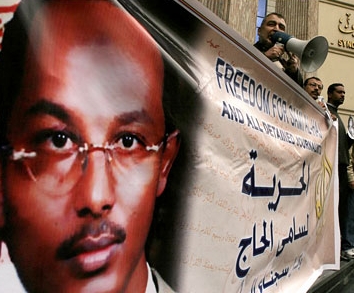
sami-al-hajj.jpgThe most famous journalist you may never have heard of is Sami al-Hajj, an Al Jazeera cameraman who is on a hunger strike to protest abuse during more than six years in a Kafkaesque prison system.
Mr. Hajj’s fortitude has turned him into a household name in the Arab world, and his story is sowing anger at the authorities holding him without trial.

That’s us. Mr. Hajj is one of our forgotten prisoners in Guantánamo Bay.

If the Bush administration appointed an Under Secretary of State for Antagonizing the Islamic World, with advice from a Blue Ribbon Commission for Sullying America’s Image, it couldn’t have done a more systematic job of discrediting our reputation around the globe. Instead of using American political capital to push for peace in the Middle East or Darfur, it is using it to force-feed Mr. Hajj.

US official admits waterboarding presently illegal
A senior official in the Bush justice department said for the first time today that the controversial interrogation tactic is currently illegal.

The waterboarding remarks by Stephen Bradbury, head of the justice department office of legal counsel, caused a stir in America because they go further than more uncertain opinions on the legality of the tactic voiced by the CIA director and attorney general.

London bombs justify ‘torture’, says Bush
President George Bush cited the London July 7 bombings in an interview broadcast last night to justify his support for waterboarding, an interrogation technique widely regarded as torture.

In an interview with the BBC he said information obtained from alleged terrorists helped save lives, and the families of the July 7 victims would understand that. Bush said waterboarding, which simulates drowning, was not torture and is threatening to veto a congressional bill that would ban it.

Duet in Damascus – is it déja vu?

Duet in Beirut by former Mossad operative Mishka Ben-David is a work of fiction, but owes its wealth of detail to the author’s intelligence experience. Published in Hebrew six years ago, it describes a Mossad hit team traveling to Beirut, stalking the head of Hizbullah’s foreign terror department and assassinating him in a car bombing. Perhaps unfortunately for Mughniyeh, it was not translated into Arabic; had he read it, he might have taken greater precautions.

Ben-David said Wednesday that he had modeled his terror overlord, “Abu Khaled,” on two men: Hamas political bureau head Khaled Mashaal, and Mughniyeh, long Hizbullah’s chief of foreign terror operations.

While Ben-David is careful to say that Israel may not have been behind Mughniyeh’s killing, he does detail several examples of how the planned killing of the fictional Abu Khaled might mirror the death of Mughniyeh.

Roiled Hezbollah chief throws down the gauntlet

When Hassan Nasrallah quotes David Ben-Gurion to emphasize to Israel that “if it loses one war, it will collapse,” or the Winograd report to impress his supporters with the fact that Israel lost the fight against several thousand Hezbollah fighters, we can once more be impressed that he and his advisers follow what is going on in Israeli society far more closely than Israel follows developments in Lebanon. But Nasrallah also knows that sharp rhetoric and expert usage of language are no substitute for a plan of action.

He presented his plan Thursday in his speech by setting the rules for war against Israel: “If you want an open-ended war, it will be an open-ended war,” and he also explained what this would entail. Because Hezbollah blames Israel for the assassination of Imad Mughniyah, which it claims occured “outside the natural arena of the war” (in other words Syria and not in Lebanon), the organization considers it legitimate to use the same method and target Israel outside the “natural arena”: not directly on Israeli territory but against Israeli targets abroad. Thus, Nasrallah absolved himself of the rules he followed for years, according to which he was conducting a war of Lebanese liberation against Israeli occupation. Henceforth, he is adopting a war on behalf of the organization, not in the name of Lebanon, against Israel’s existence.

Iraq successes hang in the balance

We have heard a lot in the past year about the Sunni Awakening movement in Al Anbar province in western Iraq, the development of a Concerned Local Citizens program (also known as the Sons of Iraq program) in Baghdad, and the unilateral cease-fire called by Moqtada al-Sadr’s Mahdi Army Shia militias. These three developments have not only been key to American military gains, but they also are central to the possibility of successful civil society and the prospects for transitioning from the military mission. [Deputy assistant secretary of defense for Middle East affairs, Mark] Kimmitt frankly calls all of these developments in 2007 a “surprise.” They are also factors most outside of U.S. control.

“The success of the surge was not pre-ordained nor has the surge succeeded according to plan,” Kimmitt says. “No one last December had any ideas that we would see a Sunni Awakening movement, nobody knew that the … [Mahdi Army] would declare a ceasefire …”

Bush’s Iraq calculus

The last thing the Bush White House would want, you might think, would be to make the 2008 presidential election a referendum on the unpopular war in Iraq. The 2006 congressional elections were such a referendum, and the Republicans got hammered.

But President Bush, newly confident that his troop-surge strategy is working, is taking steps that are likely to guarantee another Iraq-driven election. He favors keeping a big U.S. force in Iraq through the November elections, probably close to the pre-surge level of 130,000 troops. That large presence will draw Democratic fire — and it will make the presidential contest all the more a test between a pro-war Republican nominee and an antiwar Democrat.

Iran postpones talks with U.S. on Iraq
American officials ratcheted up the accusations against Iran today as Tehran postponed another round of negotiations with the United States over security in Iraq.

The development came as the Iraqi government announced that Iranian President Mahmoud Ahmadinejad would arrive March 2 for a two-day visit, the first such trip by an Iranian leader since the two countries fought a devastating war in the 1980s that killed or injured an estimated 1 million people.

The United States and Iran, already locked in a dispute over Tehran’s nuclear program, have long traded blame for the bloodshed in Iraq. But U.S. officials softened their tone late last year, backing away from sweeping accusations that Iran is orchestrating the funding, training and equipping of Shiite Muslim militants who have battled U.S. soldiers here.

In a reversal, U.S. agrees to produce data pointing to Iran’s nuclear ambitions
The Bush administration has agreed to turn over to international inspectors intelligence data it has collected that it says proves Iran worked on developing a nuclear weapon until a little more than four years ago, according to American and foreign diplomats.

The decision reverses the United States’ longstanding refusal to share the data, citing the need to protect intelligence sources.

The administration acted as the International Atomic Energy Agency is scheduled to issue a report as early as next week on Iran’s past nuclear activities. Administration officials hope that the nuclear inspectors can now confront Iran with what the Americans believe is the strongest evidence that the Iranians had a nuclear program.

Facebooktwittermail

NEWS-VIEWS ROUNDUP: February 13

Anguish of the Stolen Generations
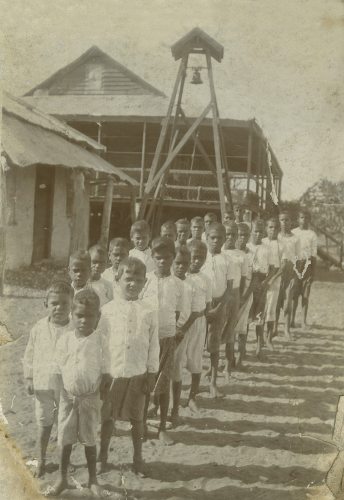
stolen-generation.jpgWith torment still in his voice, Frank Byrne recalls the day six decades ago when he was taken from his mother and their community in Christmas Creek, Western Australia.

He was just five at the time, and his mother, Maudie Yooringun, had long feared the day that the government would come to seize him – and he would be “stolen”.

“The government came to Christmas Creek where we had a mud house and told me I was been taken away,” he said.

“My mum was completely ignored. She was not a human. That’s what they thought in those days. The government fella said: ‘I am your total guardian’.”

“You could see the sorrow in my mother’s eye. I could see the tears rolling down as she was driven away. I was held there by a couple of blokes as the truck went away.”

A week later Frank saw his mother again. But that was to be the last time he ever saw her alive.

Australia apology to Aborigines
The Australian government has made a formal apology for the past wrongs caused by successive governments on the indigenous Aboriginal population.

Prime Minister Kevin Rudd apologised in parliament to all Aborigines for laws and policies that “inflicted profound grief, suffering and loss”.

He singled out the “Stolen Generations” of thousands of children forcibly removed from their families.

When words aren’t enough
National Aboriginal Alliance spokesman Les Malezer last weekend said the apology was “not enough”. But even the alliance is prepared to defer compensation.

From a strategic angle, these indigenous leaders are fooling themselves or their constituents. If they were serious about compensation, the time to address it is at the same time as the apology. Blackfellas will get the words, the whitefellas will keep the money. And by Thursday the Stolen Generations and their apology will be over as a political issue.

*

The war against tolerance
Walid Shoebat, Kamal Saleem and Zachariah Anani are the three stooges of the Christian right. These self-described former Muslim terrorists are regularly trotted out at Christian colleges—a few days ago they were at the Air Force Academy—to spew racist filth about Islam on behalf of groups such as Focus on the Family. It is a clever tactic. Curly, Larry and Mo, who all say they are born-again Christians, engage in hate speech and assure us it comes from personal experience. They tell their audiences that the only way to deal with one-fifth of the world’s population is by converting or eradicating all Muslims. Their cant is broadcast regularly on Fox News, including the Bill O’Reilly and Neil Cavuto shows, as well as on numerous Christian radio and television programs. Shoebat, who has written a book called “Why We Want to Kill You,” promises in his lectures to explain the numerous similarities between radical Muslims and the Nazis, how “Muslim terrorists” invaded America 30 years ago and how “perseverance, recruitment and hate” have fueled attacks by Muslims.

Israel embassies on high alert following Mughniyah killing
Israel’s security services have issued orders to its embassies and delegations abroad to be on high alert following the assassination of Hezbollah terror leader Imad Mughniyah on Wednesday, anticipating the possibility that Hezbollah will try to carry out a major attack against Israeli or Jewish targets worldwide in response to the killing.

Whoever killed Mughniyah showed impressive capabilities
In the case of the killing of Mughniyah we can draw two opposing conclusions. One is that the killing created shock and awe in Hezbollah and damaged its self-confidence. There is no doubt that the killing sent an unequivocal message to Nasrallah that maybe he should lower his profile of arrogance and self-confidence.
[…]
The second conclusion is that in the long run Hezbollah will clearly recover from the killing and return to functioning normally as a political movement with its own militia that has an organization for carrying out terror attacks.

Israel plans to build in East Jerusalem
Israel on Tuesday unveiled plans to build 1,120 apartments for Jews in East Jerusalem, a move Palestinians called a setback for U.S.-backed peace negotiations.

The announcement by Housing Minister Zeev Boim appeared to be aimed at placating the Shas religious party, which had vowed to quit the coalition government if it conceded anything to the Palestinians on Jerusalem.

Arab states plan TV crackdown
In a collective effort to curb satellite channels such as al-Jazeera, Arab states have adopted a charter that authorises individual countries to penalise media organisations deemed to have offended political and religious leaders or to have damaged social harmony and national unity.

Only Qatar, home to al-Jazeera, refused to endorse the document citing the need to study it further to ascertain that it did not ­conflict with its legislation.

Muqtada, the man who would be ayatollah
As a political and military force, Iraq’s Shi’ite Sadrist movement has undergone a number of radical transformations since 2003, when its leader Muqtada al-Sadr surprisingly emerged as a leading political figure. Muqtada’s recent decision to continue with his seminary studies and graduate as an ayatollah at the conservative seminary school of Najaf underpins a major change in the movement’s structure that could have serious repercussions for the future of Iraq.

Against the backdrop of changing political alliances between Kurds and Sunnis, Muqtada is transforming his movement into a new political phenomenon with implications for the country’s political structure and security dynamics. The consequences are also immense for Shi’ite Iraq, posing serious challenges to the conservative clerical establishment in Najaf.

Muqtada’s attempt to become an ayatollah follows his earlier call to suspend operations by his militia, the Jaish al-Mahdi (The Mahdi Army, or JaM) in the summer of 2007. Together with his decision to study in Najaf, this has marked a decisive new beginning in the organizational structure and leadership dynamics of the Mahdi militia.

McCain votes against waterboarding ban
Today, the Senate brought the Intelligence Authorization Bill to the floor, which contained a provision from Sen. Dianne Feinstein (D-CA) establishing one interrogation standard across the government. The bill requires the intelligence community to abide by the same standards as articulated in the Army Field Manual and bans waterboarding.

Just hours ago, the Senate voted in favor of the bill, 51-45.

Earlier today, ThinkProgress noted that Sen. John McCain (R-AZ), a former prisoner of war, has spoken strongly in favor of implementing the Army Field Manual standard. When confronted today with the decision of whether to stick with his conscience or cave to the right wing, McCain chose to ditch his principles and instead vote to preserve waterboarding.

Senate passes interrogation ban
The Senate voted 51 to 45 on Wednesday afternoon to ban waterboarding and other harsh interrogation methods used by the Central Intelligence Agency against high-level terrorism suspects.

Senate Republicans generally opposed the bill, but several of them also did not want to cast a vote that could be construed as supporting torture, and so were relying on President Bush to make good on a threat to veto legislation limiting C.I.A. interrogation techniques.

The prohibition of harsh interrogation techniques is part of a wider intelligence authorization bill and would restrict all American interrogators to techniques allowed in the Army Field Manual, which bars the use of physical force.

In tribal Pakistan, religious parties are foundering
Senator Asfandyar Wali, the leader of an opposition party, the Awami National Party, is campaigning for the elections next week from the safety of his bed, under a quilt and propped up on bolsters for his bad back at his country home outside Peshawar.

Ill health aside, Mr. Wali is staying home because suicide bombers are seeking to kill him, his party has been warned by high-level government officials. There have been two bomb attacks on his party’s election gatherings in the last week. Two candidates have been killed, one in a suicide bombing and one in a shooting in Karachi.

Yet despite the attacks and the limited campaigning, his party is expected to do well in the parliamentary elections on Monday. The religious parties that for the last five years have governed the North-West Frontier Province and Baluchistan Province, which border Afghanistan and the tribal areas, are foundering.

Facebooktwittermail

NEWS-VIEWS ROUNDUP: February 12

Senate passes bill to expand U.S. spying powers
After more than a year of heated political wrangling, the Senate handed the White House a major victory Tuesday by voting to broaden the government’s spy powers after giving legal protection to phone companies that cooperated in President Bush’s warrantless eavesdropping program.

Amnesty Day for Bush and lawbreaking telecoms
(Glenn Greenwald) — [The Senate bill] has two simple purposes: (1) to render retroactively legal the President’s illegal spying program by legalizing its crux: warrantless eavesdropping on Americans, and (2) to stifle forever the sole remaining avenue for finding out what the Government did and obtaining a judicial ruling as to its legality: namely, the lawsuits brought against the co-conspiring telecoms. In other words, the only steps taken by our political class upon exposure by the NYT of this profound lawbreaking is to endorse it all and then suppress any and all efforts to investigate it and subject it to the rule of law.

U.S. Jewish leader worried by thrust of White House campaigns
The head of the Conference of Presidents of Major American Jewish Organizations, Malcolm Hoenlein, expressed concern Tuesday regarding the atmosphere that has surrounded Democratic Senator Barack Obama’s campaign for president, while making it clear he has no problem with Obama himself.

“All the talk about change, but without defining what that change should be is an opening for all kind of mischief,” Hoenlein said at a press conference in Jerusalem. Obama has made change a central theme in his campaign.

The blind giant of the Middle East
(David Grossman) — More and more it looks as if the things that set Israel going at its birth have lost their potency — its concept and its daring, its confidence in its purpose and values, its desire to create a country that would not only be a refuge for the Jewish people, but that would also transform Jewish existence into a modern civil state. Now, 60 years after Israel was founded, it must find new substance that will fuel its way forward. Without re-creating itself, it will not be able to stay in motion. Too many things, outside and inside, will hinder it. The time will come when Israel will not have the strength to overcome them.

Palestinian revenge was inevitable
(Ahmed Yousef) — Last week’s bombing in Dimona was the first martyrdom operation committed by Hamas in more than five years. For some time, we have been warning the world that the relentless pressure on our people would eventually tell. In the last two months, more than a hundred people have been killed by the Israeli occupation forces in the Gaza Strip, including many civilians, women and children.

Thirty people have died in the last month for lack of medical care brought on by the embargo. Only two weeks ago, we saw the appalling sight of over 40 women and children seriously injured when an Israeli F-16 dropped an enormous bomb in the middle of the densely populated Gaza City, a few meters from a wedding party. This kind of atrocity, piled onto the daily death toll, has finally tested the patience of Palestinians, and after lengthy restraint, revenge was inevitable.

To many in Israel and the West, this act of resistance will be judged in isolation. They will no doubt say that it justifies the inhumane embargo on the people of Gaza and the arrests of more than 500 people and daily torture of innocents in the West Bank by both Israelis and the puppet government imposed on us by the U.S.. What they seem to forget is that just in the last two years, 2,000 Palestinians have been killed by Israeli military action and thousands more injured. The cold-blooded fact is that the ratio of Palestinian deaths to Israelis is now over 40 to 1.

Palestinian questions peace progress
The U.S.-backed Palestinian prime minister said Monday that time is running short to demonstrate progress in the Israeli-Palestinian peace talks President Bush launched to fanfare last fall.

“Unless there is tangible progress in the period immediately ahead” on a list of pledges made by Israel, “I think, honestly, it would require that we begin to really call this for what it is,” Palestinian Prime Minister Salam Fayyad said.

Focus of detainee trial is likely to suit Bush
Harsh interrogations and Guantánamo Bay, secret prisons and warrantless eavesdropping, the war against Al Qaeda and the one in Iraq. On issue after issue, President Bush has showed little indication that he will shrink from the most controversial decisions of his tenure.

With the decision to charge six Guantánamo detainees with the attacks of Sept. 11, 2001, and to seek the death penalty for the crimes, many of those issues will now be back in the spotlight. In an election year, that appears to be exactly where Mr. Bush wants the focus to be.

Asia’s hidden arms race
(John Feffer) — While in the news sunshine prevails, in the shadows an already massive regional arms race is threatening to shift into overdrive. Since the dawn of the twenty-first century, five of the six countries involved in the Six Party Talks have increased their military spending by 50% or more. The sixth, Japan, has maintained a steady, if sizeable military budget while nonetheless aspiring to keep pace. Every country in the region is now eagerly investing staggering amounts of money in new weapons systems and new offensive capabilities.

The arms race in Northeast Asia undercuts all talk of peace in the region. It also sustains a growing global military-industrial complex. Northeast Asia is where four of the world’s largest militaries — those of the United States, China, Russia, and Japan — confront each other. Together, the countries participating in the Six Party Talks account for approximately 65% of world military expenditures, with the United States responsible for roughly half the global total.

Here is the real news that should hit the front pages of papers today: Wars grip Iraq, Afghanistan, and large swathes of Africa, but the heart of the global military-industrial complex lies in Northeast Asia. Any attempt to drive a stake through this potentially destabilizing monster must start with the militaries that face one another there.

The law on the powers of governorates
(Reidar Visser) — Whenever Iraqi politics becomes difficult to classify according to the ethno-sectarian mindset preferred by most Western commentators, interest in what is going on in Baghdad seems to dwindle. Little wonder, then, that for the past few weeks, somewhat esoteric news items (like a visit to Iraq by Angelina Jolie) have dominated press reports from Iraq. The two truly significant developments during the past month have received less coverage: the attempts to agree on a general budget, as well as efforts to pass a law on the powers of governorates nor organised in a [federal] region.

America’s green policy vacuum
It’s been a year since Al Gore’s An Inconvenient Truth packed theaters and won an Oscar. And a good year it has been for the green movement. Venture capital firms poured a record $2.6 billion into clean tech startups in the first three quarters of 2007. Meanwhile, the green buzz has only grown louder. This year, green building construction starts are projected to reach $12 billion. And both Senator Hillary Clinton and Senator Barack Obama have made a greener economy a key plank in their Presidential campaigns.

It’s enough to make you believe an optimistic report that estimates the green economy could produce as many as 40 million jobs and $4.53 trillion in annual revenue by 2030. To put those numbers in perspective, consider this: In 2006, according to a November report commissioned by the American Solar Energy Society (hardly a disinterested body), companies in renewable energy and energy efficiency industries accounted for 8.5 million jobs and generated $970 billion in revenues. The report based that scenario on “aggressive, sustained public policies at the federal and state level during the next two decades.” (It also included growth scenarios based on current government spending levels and on a moderate increase.)

Despite the undeniable green momentum, a $4 trillion-plus U.S. green economy is far from likely—even in 22 years—because there simply is no “aggressive, sustained” federal policy. The federal government has failed to create and adequately fund the programs that would make the U.S. a world leader. And that’s what the government should be trying to do, for reasons that go far beyond rising carbon levels. The U.S. risks falling way behind other countries in the development of green technologies. On its current course, this country could trade oil dependence for reliance on alternative energy products built by other nations already far ahead of it.

Facebooktwittermail

CAMPAIGN 08 & EDITOR’S COMMENT: The Obama cult

And Obama wept

Inspiration is nice. But some folks seem to be getting out of hand.

It’s as if Tom Daschle descended from on high saying, “Be not afraid; for behold I bring you good tidings of great joy which shall be to all the people: for there is born to you this day in the city of Chicago a Savior, who is Barack the Democrat.”

Obama supporter Kathleen Geier writes that she’s “getting increasingly weirded out by some of Obama’s supporters. On listservs I’m on, some people who should know better – hard-bitten, not-so-young cynics, even – are gushing about Barack…

Describing various encounters with Obama supporters, she writes, “Excuse me, but this sounds more like a cult than a political campaign. The language used here is the language of evangelical Christianity – the Obama volunteers speak of ‘coming to Obama’ in the same way born-again Christians talk about ‘coming to Jesus.’…So I say, we should all get a grip, stop all this unseemly mooning over Barack, see him and the political landscape he is a part of in a cooler, clearer, and more realistic light, and get to work.” [complete article]

Editor’s Comment — Among independently minded people there’s a natural tendency when meeting the force of a crowd, to want to move the opposite way — or at least stand in place and not get swept along in the flow. Popularity so rarely seems to be an index of good judgment. Thus it’s easy to see why the Obama current provokes a measure of skepticism. Sure, I can see his charisma and I can hear his eloquence, says the skeptic, but give me the hard facts. I need some specifics. I need to know what this man will do if we put him in the White House.

It’s a curious form of realism this. It seems to say, I attach more significance to what a politician promises, than I do to what I can assess of his or her character. It seems to imply that a checklist of the correct policy positions is a reliable indicator of what might happen.

I’m inclined to believe that Obama is realistic enough to know that the time to make the boldest declarations and the time to act as a progressive leader comes after receiving a mandate. Seeking and receiving a mandate for change opens up a whole lot of possibilities.

Facebooktwittermail