Author Archives: Paul Woodward

Breivik’s sanity

To virtually any eye, it is a bizarre spectacle to witness the visible self-satisfaction radiating from the face of a man as he hears his sentence for mass murder. But since Anders Behring Breivik’s trial hinged on the question of his sanity — something about which he seemed to be in no doubt — his conviction is for him a perverse kind of vindication. It represents the failure of the prosecution’s effort to de-politicize Breivik’s crime.

Had the Norwegian been declared insane then his own explanation of the meaning and motivations for his actions would have been rendered meaningless. His theories about the effect of multiculturalism would simply be viewed as the products of a psychotic mind. His connection to polemicists, political activists, and bloggers who promote similar ideas would be treated as somewhat tenuous and their own disavowals would have been lent some extra strength.

But Breivik had an explicit and fully articulated political agenda. And his acts of terrorism were a means to an end: the promotion of his political views.

Paradoxically, counter-terrorism feeds terrorism through its effort to drain the political content from acts of violence.

Bombings and bloodbaths are the most extreme demand to be heard, yet those to whom such demands are directed often think that if the political content of terrorism is acknowledged then this would be a kind of capitulation. It would offer, so the argument goes, an incentive to others who thought that violence is an effective tool for making political demands.

The alternative is to open political debate and instead of trying to treat terrorists as purely criminal or insane, to show that their violence is not an extreme reaction to being silenced; their marginality is a product of their weak minds and the deficiency in their own powers of persuasion.

Breivik was not the victim of political oppression. The journey he traveled from an enthusiastic internet commenter to ruthless bomb-maker was not the result of being muzzled. It was a wild escalation in overstatement.

Facebooktwittermail

What Ryan represents

David Bromwich writes: On 11 August, Mitt Romney stirred excitement in a dull election by announcing that he would share the Republican ticket with Paul Ryan: a seven-term congressman, chairman of the House Budget Committee and intellectual guru of the congressional Tea Party. The choice was not altogether surprising. The moderate lawmakers whom Romney might have picked were without popular appeal, and it must have seemed possible that Ryan’s extreme proposals for federal budget-cutting and lowering taxes on the rich could be presented as evidence of a manly concern with principle which any impartial spectator ought to admire.

News presenters, keen on human interest, point out again and again that Ryan’s father died suddenly when he was 16. He learned independence the hard way, the story seems to say. In fact, Ryan grew up in Janesville, Wisconsin, close to grandparents and aunts and uncles who constituted an aristocracy in the town. The Ryans were numerous and they were rich. In time of trouble, Paul could always fall back on the network of a family that lived in concentric circles around him. His proposals to reduce the social ‘safety net’ for the unlucky may be seen as drawing a convenient but contortedly wrong lesson from his own life.

Ryan learned his anti-government ideology from an intoxicated early exposure to the writings of Ayn Rand.[*] It is now clear that Rand has been the most influential thinker in American politics of the last fifty years. Her novels The Fountainhead and Atlas Shrugged promote, as Rand put it, a ‘morality of rational self-interest – or of rational selfishness’. The central tenets of her politics, hatred of anything that could be construed as self-sacrifice and cruelty towards the helpless, are the exact inverse of the worship of collective sacrifice and blind solidarity that she detested in communism. For a lonely but well-fed achiever in Janesville, this doctrine was a gift – just as it had been once for Alan Greenspan, a young cultist before he became chairman of the Federal Reserve and presided over the bubble and collapse of the Clinton and Bush years.

What signal did Romney send by choosing Ryan? He is on the ticket to make sure that Romney will let Wall Street write its own rules. Free the dollar men, and free them not abashedly but proudly. The odd thing about the choice is that Ryan, though he is running for vice-president, was immediately taken to be the counter-Obama. At 42, he is young, as Obama was young in 2008. He, too, is an ‘idealist’. What the country has vaguely now been promised is an honourable contest of ideals. Yet it was natural for people to compare Ryan with Obama on other grounds. Both are handsome, athletic, comfortable with their early success, and irritating in no obvious way. Somewhere beneath the Obama presentation was always the message: ‘No one (ultimately) can resist my serious charm, and all problems (eventually) find solutions by listening to my voice.’ Ryan’s appeal is just as in-the-groove, but it takes the delivery to the edge of aggression: ‘I am clever and quick, I never lose my temper, and people can only pretend I didn’t win the argument if they ignore my facts and numbers.’

Where Obama projected the calm consciousness of a grave but unnamed mission, Ryan’s self-love is more recognisably American-boyish. He radiates ambition, healthy ambition, as if ambition were one of those permitted substances you could take at the gym to enhance performance. He has a lean and hungry look even when he smiles; and a relentless eagerness also, which will wear on people over time. His constant demeanour is cocksure; his face never registers reflection. Listening to other people is a formality, for Ryan, to be endured before he springs his answers. And how the answers pour out! There is an attractive, efficient speed in the way he works, but also a kind of deadness. And the deadness is there in his eyes – the hard eyes of the self-fulfilled and self-justified, clean of mind and clean of body, a whole mental mansion trip-wired against invasion by entities seeking pity and bearing excuses. [Continue reading…]

Since the beginning of the age of television, Americans have been deeply affected by the way candidates look and the deadness Bromwich rightly observes in Ryan’s eyes reminds me of my first response to the Romney-Ryan combination: these guys look like undertakers.

Romney offers the saccharin words of condolence, while Ryan gives a suitably concise presentation on the options for choosing a casket. And perhaps that’s fitting, now that the contrived hopes inspired during the last election have given way to a pervasive sense of cynicism and despair.

Facebooktwittermail

Congressional vacations-for-votes corruption exposed

Every once in a while most of us get offered a free vacation and most of us are smart enough to know that they are not free — there’s got to be some kind of quid pro quo. Corporate marketing departments simply don’t exist to give things away unless such “gifts” offer a reasonable rate of return.

When Rep. Kevin Yoder stripped off his clothes on the shores of the Sea of Galilee last summer, a few drinks might have helped him shed his inhibitions, or he might have momentarily forgotten he was a Republican, or he might have been thinking “Thank God I’m not in Kansas,” but whatever was going through his mind, it turns out that what got exposed wasn’t his genitals — let’s be honest, Yoder indiscretion hardly compares with Anthony Weiner’s — it was AIPAC: the night flower that thrives in darkness and can’t even tolerate moonlight.

The New York Times reports: The trip was much like any of the hundreds hosted in recent years by a nonprofit offshoot of the American Israel Public Affairs Committee, a powerful Washington lobby, and the purpose was much the same: to solidify the support of American lawmakers for Israel at a time of Middle East tumult.

For eight expense-paid days, House Republicans visited Israel’s holiest sites, talked foreign policy with its highest officials and dined at its most famous restaurants, including Decks, known for its grilled beef, stunning views of the Sea of Galilee, and now, for an impromptu swim party.

With hundreds of Washington lawmakers having gone to Israel courtesy of the program, the trips have a reputation as being the standard-bearer for foreign Congressional travel. “We call it the Jewish Disneyland trip,” said one pro-Israel advocate in Washington.

But for lawmakers, the attention surrounding last summer’s trip — thanks to reports of a skinny-dipping Kansas lawmaker who was part of the delegation — has cast an unwanted spotlight once again on the practice of private groups paying for foreign travel, a source of frequent criticism in the past.

One of the most famous travel boondoggles — a golf trip to Scotland for members of Congress and staff members, hosted by the lobbyist Jack Abramoff — led Congress in 2007 to tighten restrictions on who could sponsor trips and for how long. But despite the new restrictions, the number of Congressional trips paid for by outside groups has actually increased since 2007, to more than 1,600 from about 1,300, according to Legistorm, a research group that tracks Congressional data. To comply with the new restrictions, many political and lobbying groups have turned to nonprofit groups they set up and finance to host the Congressional trips.

Since 2000, the American Israel Education Foundation has been more prolific than any other in sponsoring overseas trips for members of Congress and their staffs, organizing 733 trips for both Republicans and Democrats at a cost of more than $7 million. Last year, it spent $2 million to sponsor 146 trips, far outpacing a Turkish coalition that ranked second, sponsoring 32 trips.

Last summer, there were so many members of Congress traveling — about 80 — that the education fund sponsored two separate trips. Israeli officials who met with the Congressional delegation that included the swim party said it seemed to include many first-time visitors, who knew little about Israel and appeared a bit naïve about its policies and traditions. Many of them were newcomers in Congress who were elected in 2010 with Tea Party support.

“What was remarkable about that group was most of them were freshmen; it was their first visit in Israel, and they did not know much, but they were very interested,” said one senior Israeli official who met with the delegation and spoke on the condition of anonymity. “I’m used to meeting members of Congress, and usually they’ve been here, we know them from the past.”

Among the donors who have helped to finance the trips is Sheldon Adelson, the casino magnate who is a strong Israel supporter and has pledged to spend as much as $100 million to defeat President Obama. A charitable trust operated by Mr. Adelson and his wife gave $1.2 million in 2006 to the American Israel Education Foundation, records show.

The mealy-mouthed New York Times might describe these trips as having the aim of solidifying support for Israel, but let’s be honest: we’re talking about bribery. It doesn’t involve unmarked bills in plain brown envelopes, but no one in Congress is in any doubt about how they are expected to show their thanks for a free vacation to Israel. Take vacations; pay with votes.

Facebooktwittermail

Life with Syria’s rebels in a ruthless war

C.J. Chivers reports: Abdul Hakim Yasin, the commander of a Syrian antigovernment fighting group, lurched his pickup truck to a stop inside the captured residential compound he uses as his guerrilla base.

His fighters had been waiting for orders for a predawn attack on an army checkpoint at the entrance to Aleppo, Syria’s largest city. The men had been issued ammunition and had said their prayers. Their truck bomb was almost prepared.

Now the commander had a surprise. Minutes earlier, his father, who had been arrested by the army at the same checkpoint in July, had called to say his jailers had released him. He needed a ride out of Aleppo, fast.

“God is great!” the men shouted. They climbed onto trucks, loaded weapons and accelerated away, barreling through darkness on nearly deserted roads toward a city under siege, to reclaim one of their own.

Mr. Yasin was pensive as he drove, worried that the call was a ploy to lure him and his fighters into a trap. “Often the government does this,” he said. “Usually it is an ambush.”

He had sent an empty freight truck ahead, he said, to check the way. But he never slowed down.

During five days last week, Mr. Yasin and his group, the Lions of Tawhid, allowed two journalists from The New York Times to live and travel beside them as they fought their part in the war to unseat President Bashar al-Assad.

This group falls under the command of Al Tawhid Brigade, a relatively new structure in Aleppo Province that has unified several groups and fights under the banner of the Free Syrian Army, the loose coalition of armed rebels.

While broad extrapolations are difficult to glean from one fighting group in a complex society, the activities and personal stories of these men, a mix of civilians who took up arms and dozens of army defectors who joined them, offers a fine-grained look of the uprising, and the momentum and guerrilla energy it has attained.

Mr. Yasin, 37, was a clean-shaven accountant before the war. He lived a quiet life with his wife and two young sons. Now thickly bearded and projecting a stoic calm under fire, he has been hardened by his war in ways he could not have foreseen. [Continue reading…]

And this is the point that everyone outside the war must remember, be they critics or supporters of the revolution: with our glib certainties we might imagine we know what course of action our political beliefs and moral values would dictate at a time of war, but we really don’t actually know what we would do if we found ourselves faced with the stark choices that now shape the lives of so many Syrians. Paradoxically, the ability to put ourselves in someone else’s shoes often depends on our ability to acknowledge how limited is the experience we share.

In this report and many others, the religiosity of the rebels is apparent and its mix with chilling violence will for many Western observers confirm their fears about the rise of Islamic extremism. But think about it. This doesn’t simply reflect the conservative religious trends that permeate the Middle East. Religiosity in this case is as much as anything reactive. It is in part a reaction to the fact that across the region, secularism, corruption, and dictatorship seem to have always ended up working together hand in hand. Thus those who are concerned that the fragile growth of democracy requires the protection that secularism might seem to offer must acknowledge that in the Middle East, secularism has too often been the vehicle of injustice. (I note this as an atheist.)

Facebooktwittermail

‘Samaritan attacks’ — the U.S. policy of killing people who help drone-strike victims

‘Samaritan attack’ is an expression unknown to most Americans. That’s hardly surprising given that the phrase has never appeared in U.S. media coverage of President Obama’s drone war in Pakistan, Yemen, and Somalia.

Rasul Mana, who comes from the village of Sirkut Burakhel Supulga in Waziristan, describes the experience of living under the constant threat of a drone strike and explains what ‘Samaritan attack’ means.

Every day we hear the voice of the drones at least six or seven times. We listen for the voice 24 hours a day. We are afraid at night as we lie in our beds.

The drones are going around and around over our heads. There may be four or five at any given time. They are normally very high, but sometimes they come down if there is a dust storm or it is cloudy. They also tend to come down lower to attack, which is when you get very scared.

When the missile is launched it makes a loud noise – zzhhooo – as it drops onto its target.

Many of the strikes are in the black of night. We run to where the attack has happened, we see people dead and crying in pain. No matter what time of night, the children will all be awake and crying. When we look for the injured, or pick up the pieces of the dead bodies, we know that the Americans may do another attack. It’s called a Good Samaritan attack, aimed at anyone who tries to help the injured, as they’re assumed to be friends of the original victims, who are themselves assumed to be militants.

Glenn Greenwald picks up the issue from his new perch at The Guardian.

The US government has long maintained, reasonably enough, that a defining tactic of terrorism is to launch a follow-up attack aimed at those who go to the scene of the original attack to rescue the wounded and remove the dead. Morally, such methods have also been widely condemned by the west as a hallmark of savagery. Yet, as was demonstrated yet again this weekend in Pakistan, this has become one of the favorite tactics of the very same US government.

A 2004 official alert from the FBI warned that “terrorists may use secondary explosive devices to kill and injure emergency personnel responding to an initial attack”; the bulletin advised that such terror devices “are generally detonated less than one hour after initial attack, targeting first responders as well as the general population”. Security experts have long noted that the evil of this tactic lies in its exploitation of the natural human tendency to go to the scene of an attack to provide aid to those who are injured, and is specifically potent for sowing terror by instilling in the population an expectation that attacks can, and likely will, occur again at any time and place:

“‘The problem is that once the initial explosion goes off, many people will believe that’s it, and will respond accordingly,’ [the Heritage Foundation’s Jack] Spencer said … The goal is to ‘incite more terror. If there’s an initial explosion and a second explosion, then we’re thinking about a third explosion,’ Spencer said.”

A 2007 report from the US department of homeland security christened the term “double tap” to refer to what it said was “a favorite tactic of Hamas: a device is set off, and when police and other first responders arrive, a second, larger device is set off to inflict more casualties and spread panic.” Similarly, the US justice department has highlighted this tactic in its prosecutions of some of the nation’s most notorious domestic terrorists. Eric Rudolph, convicted of bombing gay nightclubs and abortion clinics, was said to have “targeted federal agents by placing second bombs nearby set to detonate after police arrived to investigate the first explosion”.

In 2010, when WikiLeaks published a video of the incident in which an Apache helicopter in Baghdad killed two Reuters journalists, what sparked the greatest outrage was not the initial attack, which the US army claimed was aimed at armed insurgents, but rather the follow-up attack on those who arrived at the scene to rescue the wounded. [Continue reading…]

Facebooktwittermail

Why Israel shrugs at retaliation after attack on Iran

Daniel Nisman and Avi Nave write: Last week Iran sent a high-level envoy, Saeed Jalili, on a particularly controversial public-relations tour to Lebanon and Syria, the most explosive corner of the region. After ruffling feathers during a Beirut stopover, Mr. Jalili traveled to Damascus to meet with President Bashar al- Assad, where he declared the ties between Iran, Syria, and Hezbollah to be an “axis of resistance.”

Jalili is an iconic figure, whose position as the head of Iran’s Supreme National Security Council also affords him the role of chief negotiator for Iran’s contentious nuclear program. Amidst a deadlock in negotiations and a rehashing of threatening rhetoric, Jalili’s visit was meant to remind the Israelis that Iran’s proxies on Israel’s northern doorstep remain ready and willing to plunge the region into chaos if Israel strikes Iran’s nuclear facilities.

It appears however, that Iran’s allies in the eastern Mediterranean may not be as keen about going to war for the ayatollahs as Tehran would like – and the Israelis know it.

The threat of a simultaneous war with Hezbollah, Syria, and Gaza militants is the primary concern for the Israeli security establishment as it weighs a strike on Iran. Dubbed “the long arm of Iran” at the Israel Defense ForcesI headquarters, Hezbollah in Lebanon is said to possess more than 70,000 missiles that can strike as far south as Israel’s nuclear reactor near the city of Dimona – nearly 140 miles from the Lebanese border.

Combine this arsenal with the more than 10,000 rockets and missiles in the Gaza Strip and with Mr. Assad’s chemical weapons, and the threat to Israel’s home front is the most formidable since the 1973 Yom Kippur War when Egypt and Syria attacked Israel.

And yet, Israeli leaders seem content to shrug off this threat. On two recent occasions, Defense Minister Ehud Barak boldly estimated that Israel would sustain 300 to 500 casualties in a conflict with Iran and its proxies. Such an estimate suggests that Mr. Barak himself does not believe that Israeli cities will bear the full brunt of Iran’s “long arm” as a consequence to a strike.

Prime Minister Benjamin Netanyahu also dismissed the danger of regional conflict by stating that these threats to the home front are “dwarfed” by a nuclear Iran.

Judging from their statements, Hezbollah leaders aren’t so sure they want to enter into a conflict with Israel at Iran’s behest. In February 2012, Hezbollah leader Hassan Nasrallah said, “I tell you that the Iranian leadership will not ask Hezbollah to do anything. On that day, we will sit, think and decide what we will do.”

Mr. Nasrallah’s hesitation is understandable. Entering into broad conflict with Israel would result in even greater destruction to Lebanon than in the 2006 Lebanon war. This time, Hezbollah would be unable to replenish its stockpiles or rebuild destroyed villages so easily. Nasrallah’s guarantor in Damascus is on his last legs, while his primary bankrollers in Tehran have already cut funding to the group as a result of sanctions and diversion of resources to Syria.

Note that when Nasrallah issued a warning to Israel on Friday he described the devastating response Hezbollah would launch in response to an attack on Lebanon.

Speaking about Israel’s repeated threats to attack Iran’s nuclear facilities, Nasrallah said the Jewish state knows very well that Iran’s response would be devastating.

“Iran is a strong and courageous state … The Israelis, myself and everyone else know that Iran’s response would be great and shocking were it to be hit by Israel,” he said.

“If Israel attacked, it would give Iran the golden opportunity it has been waiting for,” Nasrallah added.

He added that Israel was afraid of Iran and that the former recognized that the cost of a strike on the Islamic Republic outweighs the benefits.

Reading between the lines, the Hezbollah leader seems to be indicating that like their counterparts in Gaza, Lebanon’s resistance fighters have the same preeminent concern: self defense. They are not mere proxies for Tehran and will ultimately act in whatever they perceive to be their own interests.

Facebooktwittermail

‘Fabricated’ Israeli threats provoke escalation in threats from Iran

(Update below)

After a week in which speculation about the chances of an imminent Israel attack on Iran have dominated the headlines in Israel, the Washington Post reports:

Israeli capabilities are at the heart of the debate over a military strike. Israeli leaders are concerned that Iran will use more time to move its critical nuclear facilities out of reach of Israel’s arsenal. That would leave only the United States with the unquestioned ability to destroy deeply buried Iranian facilities.

U.S. officials say Israeli leaders are sincere about the need to act quickly, but they said they do not think Netanyahu has made the decision to strike. Rather, the Israeli leader is trying to pressure the United States.

“They are deadly serious, as is the president, about the need to prevent Iran from getting a nuclear weapon,” a senior U.S. official said. “But there has been far too much talking — background leaks and fabrications — that hurt the cause.”

The anonymous official quoted here is most likely U.S. Defense Secretary Leon Panetta and when he speaks of ‘fabrications’ he is most likely referring to a fake document that was thrust into the public debate this week by an American blogger who seems to crave media attention at any cost. Indeed, the spectacle of massive destruction across Iran presented in this bogus war plan may well have contributed to further escalation in bellicose rhetoric from Iran.

The Associated Press reports:

A senior Iranian commander says a possible Israeli airstrike against his country’s nuclear facilities is “welcome” because it would give Iran a reason to retaliate and “get rid of” the Jewish state “forever.”

The remarks by Gen. Amir Ali Hajizadeh, head of the Revolutionary Guard’s air force, were reported Saturday by the official IRNA news agency.

Hajizadeh says in the event of an Israeli strike, Iran’s response would be “swift, decisive and destructive.” But he also claims Israeli threats of a strike are just part of a psychological war against Iran.

The effect of this psychological war is not only that both sides will further limit their options, eventually to a point at which war becomes unavoidable, but Israel’s threats function as blackmail on the U.S..

Israel is relying on one of its most loyal supporters to deliver their blackmail demands to Washington. Dennis Ross writes:

[S]enior American officials should ask Israeli leaders if there are military capabilities we could provide them with — like additional bunker-busting bombs, tankers for refueling aircraft and targeting information — that would extend the clock for them.

…[T]he White House should ask Mr. Netanyahu what sort of support he would need from the United States if he chose to use force — for example, resupply of weapons, munitions, spare parts, military and diplomatic backing, and help in terms of dealing with unexpected contingencies. The United States should be prepared to make firm commitments in all these areas now in return for Israel’s agreement to postpone any attack until next year…

In this context, an Israeli plan to attack Iran (even one that turns out to have been fabricated) can be understood as part of an ongoing campaign through which Israel continues to blackmail the U.S. government.

Update: It’s been pointed out to me that a much more likely explanation for the mention of ‘fabrications’ is that this referred to the suggestion that there is a new US National Intelligence Estimate supporting Israel’s claims about the level to which Iran’s nuclear program has advanced, alongside a number of other baseless claims that have emanated from Israeli officials. In other words, this official was not alluding to fake war plans that have been floating around in the blogosphere. I stand corrected.

Facebooktwittermail

Richard Silverstein exposed

In a post I published yesterday I described Richard Silverstein as a fool. It appears that I may have been treating him too kindly.

Richard Silverstein

Soon after Silverstein published a “document” which he described as “Bibi’s Secret War Plan” a number of Israeli readers were quick to note the glaring similarity between this “document” and a post on the Israeli social media site, Fresh.

Silverstein accounted for the similarities by saying this:

My original IDF source leaked the post to a Fresh member and me at the same time. That person published a small portion of the original memo at Fresh, embellishing it with much material that was meant to disguise what it was and where it came from. I can’t ascribe motives to whoever published it at Fresh, but much of it [is] fantasy and isn’t in the original document.

The operators of Fresh have now released the following statement which makes it clear that Silverstein’s “document” originated from the Fresh post itself. Whether it was Silverstein’s own plagiarism or someone else’s we don’t know, but his claim that this is an Israeli government document has now been shown to be false. Again, whether Silverstein was duped or was a knowing participant in this act of falsification, we don’t know.

I suggested yesterday that Silverstein has been given attention by the mainstream media that he doesn’t deserve, but I think the situation has now changed. The same reporters who were recently willing to turn to him for information about his latest dubious “scoop” should now be calling him to ask some tough questions.

Here’s the statement from Fresh:

Over the past two days, most of the people in Israel (ourselves included), have seen news reports all over the media, detailing the “Israeli Iran Attack Plan”, allegedly originating from one Richard Silverstein, an American Anti-Israeli blogger.

Silverstein, whose lack of integrity is shown by his claims to have never visited www.fresh.co.il though he has an active account, which he used to write 11 posts (the 12th was an attempt to publish classified information and resulted in deletion and a six month suspension of his account – suspension which was ended over a year ago), published yesterday a translation of what he claimed to have been a document obtained from “a high-level Israeli source who received it from an IDF officer”.

Since we can’t read minds, we can only guess whether Silverstein source actually exist, and whether the source was informed on this “attack plan”. What we don’t need to speculate about, is the fact the first publication of the said document (in a different version, which defined it as “an optimistic scenario for an attack in Iran” and clearly stated that it was based on foreign and non-classified sources and on the author’s own imagination) – was published four days before Silverstein’s publication, right here, on this website, in the Army and Security Forum, as a thread which was started by the forum’s moderator, Sirpad, on behalf of one of the forum’s most veteran and respected users, who was the original author of the document (yes, he and non-other).

Since we have no expectations that a man who dedicates his life to causing harm to the State of Israel and its citizens, will be honest enough to admit that his “scoop” is neither scoop nor his, we were hoping that at least the Israeli Media, which rushed to quote Silverstein, Will know to give Sirpad, the real author, and original place of publication, their due credit. Needless to say they we were disappointed. Since yesterday there were articles in NRG, YNET, Channel 2, Ma’ariv (whose printed version did point out that Silverstein wasn’t in fact the first publisher of the story, but failed to name Sirpad, The real author, or fresh.co.il and identified the true origin as “an Israeli Forum” ), Israel army radio and “Israel Hayom” – and none of them gave the credit which media outlets are supposed to give.

Worthy of a positive mention is Avri Gilad who named the true origin of the story both in his morning show in Channel 2 and in his radio show in the Army radio.

We understand there is great deal of embarrassment among the media, which had quoted a dubious and irresponsible blogger, but that shouldn’t, in our opinion, cause them to refrain from correcting their articles, now, when they know the truth. In fact the seriousness of a news publication can be measured in its willingness to admit its mistakes and to correct them.

We hope that media outlets, mentioned here, all of them among the most respected in Israel, will know to set things right, and clarify that the original publication was written by a veteran and well known member of the fresh.co.il community, and was published on his behalf by the Moderator of the Army and Security Forum, Sirpad. That is how a responsible media should act – and this how any news organization would expect other to treat him or its reporters were things different.

Sincerely,
Fresh.co.il team

Facebooktwittermail

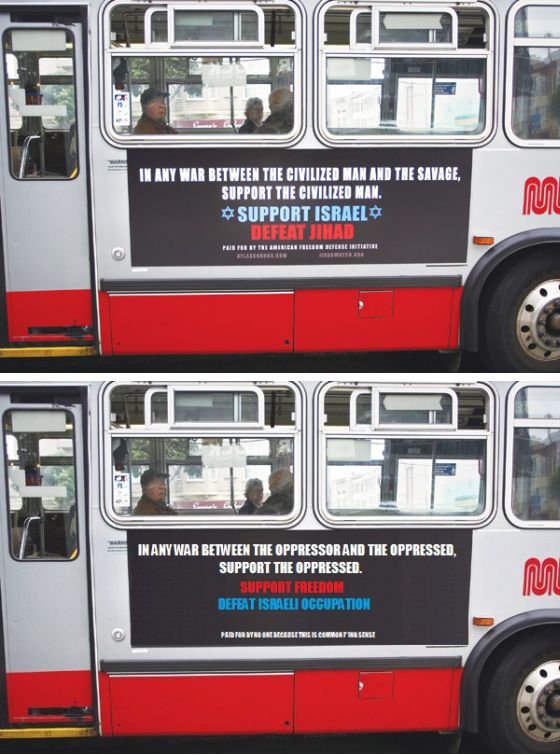
Who delivers the smart message?

This is the definition of ideological myopia: the ideologue can’t see beyond his or her own convictions and so is singularly lacking when it comes to the art of persuasion.

Pamela Geller thinks that a message plastered on the side of a bus is a good way of reaching a lot of people — especially in a city like San Francisco where there are lots of buses and lots of pedestrians. The problem for her is that the message she wants to spread is one that is likely to only appeal to Islamophobic bigots like her. It’s hateful tone simply won’t resonate with people who don’t already share her fears.

Yousef Munayyer has come up with a counter-message (which is thus far just a photoshop image) and since he doesn’t go for the jugular or push a slogan that merely appeals to pro-Palestinian activists, he’s crafted a message that does what every effective political message should do: attempt to engage people with open minds.

Facebooktwittermail

Richard Silverstein is a fool. Shame on the media for taking him seriously

There’s a form of laziness, opportunism, and cynicism that is far too common among mainstream journalists: the willingness to report on stories that news reporters themselves believe to be false.

Why would a journalist from the BBC or the New York Times or some other publication that purports to have a high regard for its own credibility treat as newsworthy something that even their own readers will quickly conclude deserves no attention?

For the simple reason that once something, however fanciful, enters the public domain thanks to the world of push-button publishing we now live in, it can be treated as a phenomenon in the news environment and thus traded as a piece of news. Its veracity can be treated as secondary to the fact that it has already become a subject of conversation. Most importantly, the journalist who chooses to breath life into such a worthless story can contrive a judicious distance from the story by attaching the necessary number of caveats that make it clear that he is doing nothing more than repeat someone else’s claims. Note that this kind of reporting will always repeatedly use the phrase “says” in order to underline that no factual claims are being made by the reporter. The reporter assumes a pretense of agnosticism.

In addition to employing fake naivety, the reporter will also fall back on the myth that journalists are mere observers — that they do not have an instrumental role in making news.

So, to turn to the specific case now at hand — Richard Silverstein’s latest episode of blogging buffoonery — the BBC‘s diplomatic correspondent Jonathan Marcus who interviewed Silverstein yesterday would no doubt explain his choice to do so by saying that the story — Silverstein’s promotion of a bogus war plan for an Israeli attack on Iran — is “out there.”

Marcus writes:

The leaked text may or may not be a precis of Israel’s battle plans.

But it is now an integral part of the increasingly feverish national debate and a debate that resonates well beyond Israel’s own borders.

But it’s only an integral part of that debate thanks to the BBC and others. Were it not for the attention that the press gives Silverstein, his blog would generally be ignored and he would not be flattered by being referred to as a journalist.

Silverstein’s latest antics began with a post titled “Bibi’s Secret War Plan“. The post includes a passage of text that Silverstein describes as a “document” and he claims that this is Benjamin Netanyahu’s “pitch for war” against Iran. He claims that this is an “Israeli government document” yet presents no evidence to back up this claim other than that his source’s source described it as such.

The one thing that seems clear about this “document” is that it was written by someone who knows Hebrew so I think one could strongly infer that means the author is in Israel. Having limited the number of possible authors to a few million Hebrew speakers, how are we going to radically narrow that range and determine this was written inside the Israeli government for consideration by its highest officials. That’s a tall claim and requires strong evidence.

Silverstein has no physical document and merely the claim from a purported former Israeli minister (not a rare species given the rapid turnover of Israeli governments and ministerial positions) that he received it from an IDF officer (and there are only a few tens of thousands of those).

Preempting reader doubts, Silverstein writes:

There will be those who will dispute the authenticity of this document. I’m convinced it is what my source claims, based on his prior track record and the level of specificity offered in the document. It references cities by name and the facilities they contain. It names new weapons systems including one Israel supposedly hasn’t even shared with the U.S.

Anyone who follows Silverstein’s “exclusives” should know that the credibility of his source(s) is highly debatable, but most importantly — and this is something Silverstein clearly does not understand — the authenticity of a document can rarely be established on the basis of its content. Content merely points to plausibility — or in this case implausibility. Referencing Iranian facilities and their locations can be accomplished by anyone with access to the internet. If these details carried any weight in authenticating the document they’d have to reveal vastly more — such as the naming of facilities whose existence is only known to Israeli intelligence. But even if that much was established it would still not take us that extra and all-important leap — to show that this is indeed a briefing document written for Netanyahu. Moreover, even if we were to cast an uncritical eye on the claim about the document’s authenticity, we are still left with the most problematic question: if this was being leaked from the prime minister’s office, why would it end up being passed on to a blogger, least of all one with such a dubious reputation?

Needless to say, none of this concerns Silverstein as he breathlessly declares:

This story is now a screaming headline in the Israeli media and at no point has anyone in the Israeli government maintained that this document is anything other than what I claim it to be. They know it is authentic. Anyone else who claims otherwise does so at the risk of their own credibility (if they have any).

Sorry, but the absence of a denial is not the proof of truth. And in this instance, when the Israeli prime minister and defense minister have already been working overtime raising to fever pitch the talk of war, Silverstein’s entry into the arena is no doubt welcomed as yet another element in the war-is-just-around-the-corner hysteria.

Beyond the implausibility of a war plan that makes grandiose claims about Israel’s ability to launch an attack on Iran that, as described, would militarily be more impressive than the U.S. invasion of Iraq, some observers were quick to note the Silverstein’s “secret document” was actually already in the public domain and had appeared as a post in a military and security forum on the Israeli social media site, Fresh.

Silverstein hit back:

Israelis are posting a claim that the document I published is identical to a post published by Fresh, an Israeli gossip/news portal, a few days ago. It is not. My original IDF source leaked the post to a Fresh member and me at the same time. That person published a small portion of the original memo at Fresh, embellishing it with much material that was meant to disguise what it was and where it came from. I can’t ascribe motives to whoever published it at Fresh, but much of it fantasy and isn’t in the original document.

And in a follow-up post he writes:

Contrary to claims made by many in the hasbarafia at sites like Harry’s Place and CIF Watch, anyone who actually reads the Fresh post and compares it to what I translated & published would see that there is very little overlap. Of the entire 500 word (in English translation) document, perhaps 100 words are in the Fresh post, which itself is quite long, probably over 1,000 words (I haven’t checked).

Let’s see how this assertion checks out by comparing the translation of the “document” Silverstein posted with a Google translation of the Hebrew post appearing at Fresh. (Bear with me. I don’t understand Hebrew and Google’s automated translation produces mangled English, but still, the correspondence between the two texts should be obvious.)

The Silverstein “document”:

The Israeli attack will open with a coordinated strike, including an unprecedented cyber-attack which will totally paralyze the Iranian regime and its ability to know what is happening within its borders. The internet, telephones, radio and television, communications satellites, and fiber optic cables leading to and from critical installations—including underground missile bases at Khorramabad and Isfahan—will be taken out of action. The electrical grid throughout Iran will be paralyzed and transformer stations will absorb severe damage from carbon fiber munitions which are finer than a human hair, causing electrical short circuits whose repair requires their complete removal. This would be a Sisyphean task in light of cluster munitions which would be dropped, some time-delayed and some remote-activated through the use of a satellite signal.

Fresh post:

Israel’s attack opens a combined action an unprecedented cyber attack, completely paralyzing the Iranian government ability to know what’s going on in his own country. Internet networks, telephone, radio and television, satellite communications and fiber optic and leading to important sites – including underground missile bases and Asfahn Bhorambad – find out of action. Years of careful planning, and intelligence assets landfill command day – worthwhile. Power grids across Iran are paralyzed, and hate sites (transformers of the power grid) suffer serious injuries of arms dissipating carbon fiber fish trough person – creating short in order to fix them requires removing the physical – a task Sisyphean light quenching area arming cluster shared a time delay and some remotely operated via satellite signal.

The Silverstein “document”:

A barrage of tens of ballistic missiles would be launched from Israel toward Iran. 300km ballistic missiles would be launched from Israeli submarines in the vicinity of the Persian Gulf. The missiles would not be armed with unconventional warheads [WMD], but rather with high-explosive ordnance equipped with reinforced tips designed specially to penetrate hardened targets.

Fresh post:

Barrage of dozens of ballistic missiles from Israel to Iran shot. Missiles are equipped with non-conventional warhead – but charged warheads and explosives specially ruggedized bow, designed to penetrate hardened targets deep in particular. […] Short Range Ballistic Missiles (300 km), shooting Israeli submarines.

The Silverstein “document”:

The missiles will strike their targets—some exploding above ground like those striking the nuclear reactor at Arak–which is intended to produce plutonium and tritium—and the nearby heavy water production facility; the nuclear fuel production facilities at Isfahan and facilities for enriching uranium-hexaflouride. Others would explode under-ground, as at the Fordo facility.

Fresh post:

Missiles hitting their target – some above ground, such as Arak nuclear reactor designed to produce plutonium and tritium, production facility next to the heavy water, the production facilities of nuclear fuel conversion facilities Baisfahn gas and uranium Hksaflurid.

The Silverstein “document”:

A barrage of hundreds of cruise missiles will pound command and control systems, research and development facilities, and the residences of senior personnel in the nuclear and missile development apparatus. Intelligence gathered over years will be utilized to completely decapitate Iran’s professional and command ranks in these fields.

Fresh post:

The hundreds of cruise missiles adequate command and control systems, facilities development and research institutes, and even in residential buildings and villas surrounded by lush greenery of senior officials in the nuclear and missile development of Iran. For years, collected intelligence manifested almost complete decapitation of professional ranks and command of Iran in these areas.

The Silverstein “document”:

After the first wave of attacks, which will be timed to the second, the “Blue and White” radar satellite, whose systems enable us to perform an evaluation of the level of damage done to the various targets, will pass over Iran. Only after rapidly decrypting the satellite’s data, will the information be transferred directly to war planes making their way covertly toward Iran. These IAF planes will be armed with electronic warfare gear previously unknown to the wider public, not even revealed to our U.S. ally. This equipment will render Israeli aircraft invisible. Those Israeli war planes which participate in the attack will damage a short-list of targets which require further assault.

Fresh post:

After the first assault wave, precise timing of seconds, flies over Iran satellite radar “Blue and White”. Its systems allow to evaluate the extent of damage caused purposes. Only after the fastest decryption of satellite data, data is transferred directly to the aircraft en route to the unknown paths towards Iran. these planes of the Israeli air force, equipped with electronic warfare suits that were brought to the attention of the general public, nor exposed to the Friends of Israel from the United States. Systems can then be puzzled by the weapons expert in the world – yes, they made the Israeli planes can be elusive. Air Force aircraft participating in the attack last – and affect only a small number of targets that require further injury – not detected at all by the discovery and tracking system of Iran. Air defense system will launch into the sky hundreds of anti-aircraft missiles – blindly – futile attempt to harm aircraft corps.

The Silverstein “document”:

Among the targets approved for attack—Shihab 3 and Sejil ballistic missile silos, storage tanks for chemical components of rocket fuel, industrial facilities for producing missile control systems, centrifuge production plants and more.

Fresh post:

Among the targets approved injury – storage sites such ballistic missile Shahab-3 and Sejil, reservoirs of chemicals used in rocket fuel materials, industrial facilities for the production control systems for missiles, the factories producing centrifuges, and more.

Let’s reconsider Silverstein’s claim: “anyone who actually reads the Fresh post and compares it to what I translated & published would see that there is very little overlap.”

OK. I think that most readers who have trudged through this tedious process this far will probably share my assessment. Richard Silverstein is a fool and it’s time the media stopped treating him like Julian Assange. He might share Assange’s hunger for media attention, but unlike Wikileaks which understands that the organization’s credibility will evaporate if it starts publishing bogus documents, for Silverstein getting his name in the newspaper appears to be the be all and end all of his operation.

Facebooktwittermail

U.S. special ops and intel launch attack on the White House

Reuters reports: A group of former U.S. intelligence and Special Forces operatives is set to launch a media campaign, including TV ads, that scolds President Barack Obama for taking credit for the killing of Osama bin Laden and argues that high-level leaks are endangering American lives.

Leaders of the group, the Special Operations OPSEC Education Fund Inc, say it is nonpartisan and unconnected to any political party or presidential campaign. It is registered as a so-called social welfare group, which means its primary purpose is to further the common good and its political activities should be secondary.

In the past, military exploits have been turned against presidential candidates by outside groups, most famously the Swift Boat ads in 2004 that questioned Democratic nominee John Kerry’s Vietnam War service.

The OPSEC group says it is not political and aims to save American lives. Its first public salvo is a 22-minute film that includes criticism of Obama and his administration. The film, to be released on Wednesday, was seen in advance by Reuters.


The OPSEC Team that created this video has on its website as a slogan part of the “Special Forces Creed” — “I serve quietly, not seeking recognition or accolades…”

It’s debatable whether launching a campaign like this during a presidential election campaign exemplifies the spirit of serving quietly. On the other hand, if it turns out that Obama fails to score as many political points as he hoped for being the Assassin-in-Chief, then maybe he can think a bit more deeply about what this country needs rather than imagining that his willingness to order people’s executions makes him look good.

Facebooktwittermail

Damascus ‘UN bombing’ narrative falls apart

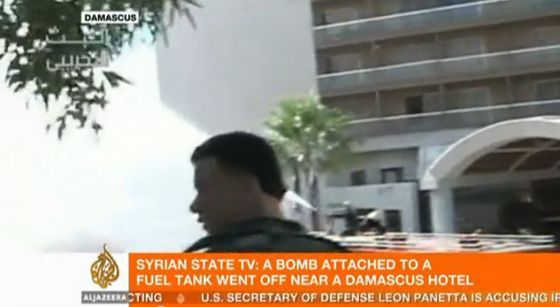
This is how state propaganda works. A bomb goes off in central Damascus, apparently targeting a meeting of top security officials, and the location of the attack is close to the Dama Rose Hotel which has been housing UN observers.

Another major breach of security threatens the Assad regime and so it attempts to obscure what has happened by claiming that rebels attacked the UN.

The slow-footed Western media with little else to rely on simply repeats the narrative pumped out by Syrian state media:

CBS/AP reports: A bomb attached to a fuel truck exploded Wednesday outside a Damascus hotel where U.N. observers are staying, wounding at least three people, Syria’s state TV reported.

The government controlled channel said the explosion took place near a parking lot used by the army command, which is about 300 yards away.

Syrian Deputy Foreign Minister Faisal Mekdad toured the area of the blast and said none of the U.N. staff was hurt. The explosion occurred as U.N. humanitarian chief Valerie Amos was in the Syrian capital but her team is believed to be staying at a different hotel.

CBS News’ George Baghdadi reports the area near the blast was quiet following the explosion. There had been reports of clashes after the blast, but Baghdadi saw no sign of violence.

Mekdad called the explosion a “terrorist act” meant to “destabilize” the country.

The lot where the explosion occurred is near the Dama Rose Hotel, popular with the U.N. observers in Syria.

Here’s a screenshot that shows a firetruck outside the entrance to the hotel with a soldier in the foreground watching a firefighter on top of the truck directing a water cannon to the left. The scene of the explosion is off to the left, correct?

Dama Rose Hotel, Damascus

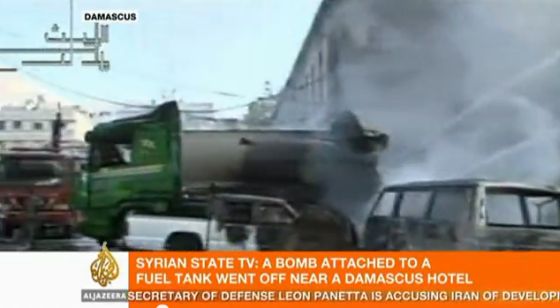
The camera pans to the left and we see the scene of the bombing:

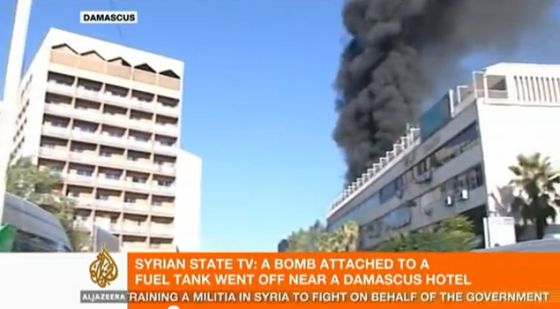
However, watch the video carefully and you will notice that the panning is actually the splicing together of two separate pieces of footage. In fact, the Syrian propaganda effort in its haste spin an implausible narrative (pause for a moment to consider: why would the FSA target the UN?) also included real evidence that the bomb did not target the Dama Rose Hotel but exploded several hundred meters away.

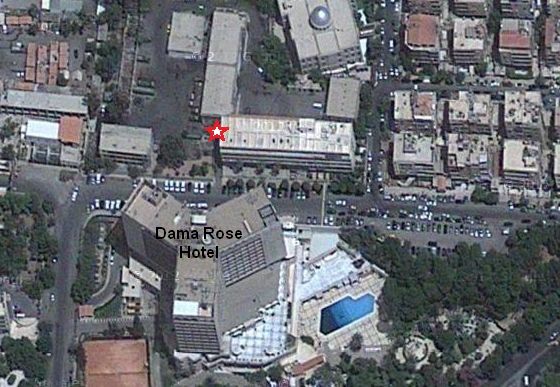
This screenshot from Syrian state TV images shows the Dama Rose Hotel to the left, and a thick plume of smoke rising beyond a building that separates the hotel from the site of the bombing:

Site of bombing some distance from Dama Rose Hotel

The actual location of the bombing is shown here:

Location of blast shown with a red star.

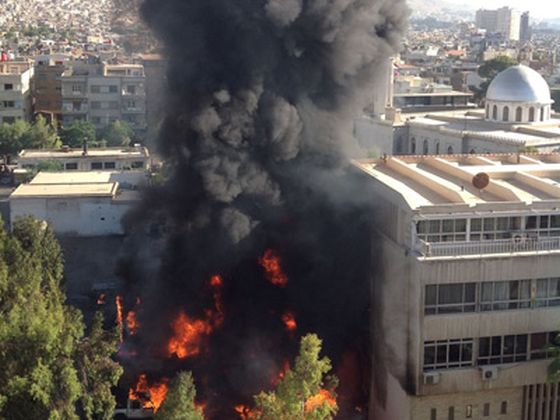
This is a photo of the bombing location in which the Al Hassan Mosque can be seen in the background.

Damascus bombing, August 15, 2012

Al Jazeera interviewed Abu Noor, a FSA spokesman who explains where the bomb was located and who it was targeting.

Facebooktwittermail

Syrian regime is on brink of collapse, says former PM Riyad Hijab

The Guardian reports: Syria’s former prime minister, Riyad Hijab, has claimed Bashar al-Asssad’s regime is on the point of collapse, having lost control of two-thirds of the country, as he called on other top officials to follow his example and defect.

In his first public appearance since he fled Damascus with his family a week ago, Hijab told a press conference in the Jordanian capital, Amman, the Syrian army needed to “take the side of the people”.

“I assure you, from my experience and former position, that the regime is collapsing, spiritually and financially, as it escalates militarily,” Hijab said. “It no longer controls more than 30% of Syrian territory.”

Hijab said that while he was prime minister he had been unable to stop the regime’s policy of using heavy artillery against Syrian cities considered by the regime as being opposition strongholds. He said he had felt “pain in my soul” of the shelling of civilian areas.

“I was powerless to stop the injustice,” he said, urging other senior figures to defect. “Syria is full of honourable officials and military leaders who are waiting for the chance to join the revolution. I urge the army to follow the example of Egypt’s and Tunisia’s armies take the side of people.”

Sounds like Hijab stopped following the news from Egypt as soon as Mubarak stepped down. Moreover, given the level of destruction the Syrian army has already inflicted on so many cities, the idea that they might now “take the side of [the] people” and stop slaughtering them sounds less like a vision of the future than the rhetoric of a man whose first priority is to reinvent himself.

Facebooktwittermail

Libyan fighters join Syrian revolt

From Beirut, Mariam Karouny reports: Veteran fighters of last year’s civil war in Libya have come to the front-line in Syria, helping to train and organize rebels under conditions far more dire than those in the battle against Muammar Gaddafi, a Libyan-Irish fighter has told Reuters.

Hussam Najjar hails from Dublin, has a Libyan father and Irish mother and goes by the name of Sam. A trained sniper, he was part of the rebel unit that stormed Gaddafi’s compound in Tripoli a year ago, led by Mahdi al-Harati, a powerful militia chief from Libya’s western mountains.

Harati now leads a unit in Syria, made up mainly of Syrians but also including some foreign fighters, including 20 senior members of his own Libyan rebel unit. He asked Najjar to join him from Dublin a few months ago, Najjar said.

The Libyans aiding the Syrian rebels include specialists in communications, logistics, humanitarian issues and heavy weapons, he said. They operate training bases, teaching fitness and battlefield tactics.

Najjar said he was surprised to find how poorly armed and disorganized the Syrian rebels were, describing Syria’s Sunni Muslim majority as far more repressed and downtrodden under Assad than Libyans were under Gaddafi.

“I was shocked. There is nothing you are told that can prepare you for what you see. The state of the Sunni Muslims there – their state of mind, their fate – all of those things have been slowly corroded over time by the regime.”

“I nearly cried for them when I saw the weapons. The guns are absolutely useless. We are being sold leftovers from the Iraqi war, leftovers from this and that,” he said. “Luckily these are things that we can do for them: we know how to fix weapons, how to maintain them, find problems and fix them.”

Strangely, Reuters bills this as an “exclusive” report. It would more accurately be described as a footnote for a much more detailed report that Mary Fitzgerald did for Foreign Policy and the Irish Times a few days ago. It would appear that Karouny didn’t bother asking how it was that Najjar came to be invited to travel from Dublin to Libya to fight under Mahdi al-Harati’s command. Apparently she doesn’t know that Harati himself also comes from Dublin and that Najjar is Harati’s brother-in-law. (If on the other hand she did establish these details, it seems strange to have left them out of her report.)

Facebooktwittermail

Video showing bodies being thrown off the roof of a post office in Al Bab, near Aleppo

If bodies are thrown off the rooftop of a post office, can we infer that because it was a post office the dead men must have been postal workers?

That logical leap is apparently not a leap too far for some observers of events in Syria — especially those who regard the Kremlin’s propaganda outlet, Russia Today, as a reliable news source. RT provided its audience with this usefully descriptive headline: “Syrian atrocity: Bodies of postal workers thrown from roof (GRAPHIC VIDEO)”

The RT report begins:

A horrific amateur video appeared on YouTube, apparently showing an atrocity against public service workers in Syria. The footage displays a crowd of people callously throwing the bodies of slain postal workers from a post office rooftop.

The report provides no explanation on how it could be determined that the bodies were those of postal workers. The video can be viewed here.

As with most videos coming out of Syria, it’s rarely possible to establish the facts about what the images reveal, but in this case we can make a number of fairly strong inferences and observations.

Most observers seem in agreement that the men being thrown off the roof were already dead. Although it’s possible that they could have been killed somewhere else in the building and then hauled to the rooftop, it seems more likely that the bodies were being cast down from relatively close to where they died.

The act of throwing bodies off a building and the way onlookers on the street respond, gives the impression that these were vengeance killings of some kind.

Was this vengeance against the willingness of many Syrians to be complicit in supporting the state by working as civil servants, or — and I think this seems somewhat more likely — does this have something to do with actions these individuals were engaged in immediately prior to their deaths?

Municipal buildings like post offices are generally in central locations providing easy access to the populations they serve. In the current conditions in Syria, the rooftops of such locations now also often serve as positions for government snipers.

What seems more likely? That the bodies in this video were postal workers, or that they were snipers?

It seems to me more likely that they were snipers.

Does that mean that their bodies deserved to be treated in this way? No.

Still, if the residents of a town have been unable to walk through their own streets without either getting shot or risking getting shot by a group of snipers, if the threat then gets eliminated it’s not hard to understand that there might be a brutal display of vengeance of the type this video appears to depict.

According to the following account, this is exactly what happened.

The Los Angeles Times reports: A Syrian media activist and member of the Al-Bab Coordinating Committee said via Skype that the incident occurred about three weeks ago as rebels battled government forces for control of the city.

“There were snipers on the roof of the post office,” said the activist, who asked to be identified as Barry for security’s sake. “Several of them surrendered and left the building. Five remained, killing at least seven fighters.

“There was a lot of anger,” he said. “Finally the rebels managed to storm the post office and threw explosive devices and the five snipers were killed. Then the rebels threw the bodies from the roof.”

“What happened was really bad. We should respect the dead even if they were our enemies,” he added, saying that later the bodies were buried according to Muslim customs.

In June 2007, during a U.S.-backed attempted coup aimed at toppling the Hamas-run government in Gaza, there were reports of both Hamas and Fatah engaging in violations of international law including throwing prisoners off high-rise buildings. Human Rights Watch described these actions as war crimes.

Did this lead Western pro-Palestinian activists to denounce the Palestinian cause? I don’t believe so.

The reality is that in armed conflicts, atrocities are committed. Should they be condemned? Of course. But even if these kinds of incident are shocking, they should not be surprising.

War unleashes the ugliest features of human behavior and the idea that those in the midst of the fighting will always conduct themselves in a dignified way is an illusion that can only be entertained by those able to observe from a comfortable distance.

Facebooktwittermail

Why do Israeli media keep predicting war with Iran?

Tony Karon writes: If the White House believes November will arrive without any nasty surprises in the Iran nuclear standoff, it is not taking seriously the feverish chatter throughout Israel‘s media positing an imminent Israeli attack on the Islamic Republic. The front pages of the four main Israeli dailies last Friday reflected what appeared to be a concerted campaign to create the impression that Israel is preparing itself to start a hot war with Iran sometime over the next 12 weeks, notwithstanding objections by the U.S. and other Western powers — and, indeed, by much of Israel’s security establishment. “[Benjamin] Netanyahu and [Ehud] Barak determined to strike Iran in the fall,” proclaimed Yedioth Ahronoth. Haaretz offered: “Senior Israeli official — The Iranian sword at our throat is sharper than the run-up to the war in 1967.” Maariv informed us in its banner headline that 37% of the Israeli public believes that “If Iran gets the bomb, it might result in a second Holocaust.” And Yisrael Hayom said: “Iran significantly speeds up its progress toward the bomb.” The following day, the latter paper included a headline claiming that, according to Israeli TV, a “Decision by Netanyahu and Barak to strike Iran is almost final.”

Haaretz seemed to suggest that part of the renewed urgency was a claim that new intelligence allegedly received by the U.S. ostensibly showed Iran making accelerated progress toward a capability to build nuclear warheads, although there was no U.S. confirmation of those claims. And others in the Israeli media were skeptical. One of Israel’s most senior columnists, Maariv’s Ben Caspit, sought to calm the media frenzy. “You can all relax,” wrote Caspit. “In the last two weeks, nothing new has happened with regards to an attack on Iran. The Cabinet hasn’t convened, the Defense Minister hasn’t summoned the IDF general staff, and no new information has been received. Everything that is known today was also known two weeks and two months ago.

Caspit suggested that the new “bomb Iran” talk wasn’t based on any qualitative shift in the nature of Iran’s nuclear work. The U.S. intelligence assessment until now has been that despite steadily accumulating the means to build nuclear weapons, Iran has not thus far moved to enrich uranium to weapons grade or to begin the process of actually building a bomb. Nor has it taken a strategic decision to do so as yet. The problem is that the “red lines” adopted by Israel and the U.S. for triggering a military response are different: President Obama has vowed to take military action to stop Iran from acquiring a nuclear weapon, whereas Israel has insisted that Iran can’t be allowed to maintain the capability to build such weapons — a technological capacity it essentially already has. [Continue reading…]

It’s not really correct to say that Israel insists Iran can’t “maintain” the capability to build nuclear weapons. In one of his most recent statements, Netanyahu said: “I think it’s important to do everything in our power to prevent the Ayatollahs from possessing that capability.” Clearly, that wouldn’t be possible if in his view Iran already possessed this capability.

The problem is, there is no consensus on what nuclear capability means. As Mark Donig Jaclyn Tandler write:

In reality, possessing a nuclear capability could mean anything from having the infrastructure and know-how of a civilian nuclear program (like Japan) to possessing a dedicated nuclear weapons program just short of testing a nuclear weapon (like Pakistan before 1998). “Capability” is a spectrum, not a clear line that is either crossed or not.

Indeed, capability is a rhetorical red line imposed by those who want to sound emphatic but prefer not to be clear about what they mean.

Facebooktwittermail

U.S. officials fling strong accusations against Hezbollah but offer no evidence

When Obama administration officials accuse Hezbollah of advising the Assad regime and the accusation is met with skepticism by Washington’s mainstream reporters, it’s pretty obvious that the U.S. has a credibility problem.

The latest U.S. attack on Hezbollah has the ring of pure political opportunism — a way of currying favor with the Israelis and of offering the Obama campaign some extra snippets of rhetoric that it can use to buttress the president’s tough-on-Iran, tough-on-terrorism posture.

The New York Times reports: The United States accused the Lebanese militant group Hezbollah on Friday of deep involvement in the Syrian government’s violent campaign to crush the uprising there, asserting that Hezbollah has trained and advised government forces inside Syria and has helped to expel opposition fighters from areas within the country.

The American accusations, which were contained in coordinated announcements by the Treasury and State Departments announcing new sanctions against Syria, also accused Hezbollah of assisting operatives of Iran’s Revolutionary Guards Quds Force in training Syrian forces inside Syria. A Treasury statement said the Hezbollah secretary general, Hassan Nasrallah, had overseen those activities, which it called part of the Syria government’s “increasingly ruthless efforts to fight against the opposition.”

The accusations, which went beyond previous American charges about Hezbollah support for Syria’s government, seemed intended to counter critics of the Obama administration who say that the White House is not doing enough to support the Syrian opposition now that diplomatic efforts to resolve the conflict are paralyzed.

Some Hezbollah experts expressed considerable skepticism, however, saying that the accusations should be approached with caution unless more evidence was presented.

The accusations were also part of an effort to further draw attention to the Hezbollah-Iran alliance, which American and Israeli intelligence officials have sought to portray as a subversive collaboration that has not only destabilized the Middle East but has been implicated in terrorist violence elsewhere, including a deadly bus bombing of Israeli tourists in Bulgaria last month.
[…]
American officials would not provide evidence for the new accusations against Hezbollah and avoided specifying whether its operatives were engaged in combat inside Syria, as some anti-Assad fighters have asserted. But the accusations appeared to open a new avenue of American pressure on Syria’s government and to be a way to embarrass Mr. Nasrallah, a powerful figure whose unwavering public support for Mr. Assad has created political strains in his home base of Lebanon.

Many Lebanese support the uprising against Mr. Assad and his ruling Alawite minority, and thousands of Syrian refugees from Mr. Assad’s crackdown have fled to Lebanon.

“Hezbollah is actively providing support to the Assad regime as it carries out its bloody campaign against the Syrian people,” David. S. Cohen, the Treasury’s under secretary for terrorism and financial intelligence, told reporters in a telephone conference call. He said the designation of Hezbollah in a Treasury Department sanction makes “clear to parties around the world — both domestically and internationally — the true nature of Hezbollah’s activities.”

The State Department’s coordinator for counterterrorism, Daniel Benjamin, who also participated in the call, said, “Hezbollah’s actions in Syria underscore its fears of a Syria without the Assad regime and the impact that this would have on the group’s capabilities and its strength over the long term.”

Despite repeated questioning, neither official would provide details to support the accusations, or specific evidence of how they had reached their conclusions. “This is not a matter of idle speculation or press reports,” Mr. Benjamin said. “This is based on a great deal of information-gathering that we have done and we’ve synthesized and we’ve put it together in an authoritative document, and we believe that it will be taken seriously by many around the world.”

An American official, who spoke on condition of anonymity, said Hezbollah was using “its specialized skill set and understanding of insurgencies” to aid Syria. “The group’s deep familiarity with the Syrian landscape makes it a nimble and effective military partner,” the official said.

Hassan Nasrallah has made it clear that Hezbollah fears the collapse of the Assad regime and the loss of Syria’s indispensable support, but it doesn’t follow from that that the Lebanese organization can actually do much to save its ally.

When the Syrian Army outnumbers the Free Syrian Army by an estimate of close to five to one, it seems reasonable to ask why the regime appears to have been unwilling to use this numerical advantage so that it can clear rebels out of their strongholds, street by street? Their preference is to opt for the far more destructive tactic of first pulverizing these neighborhoods with heavy weapons, causing the kind of wanton destruction usually inflicted on enemy states (i.e. destroying cities with the callous realism that it will be someone else’s miserable task to rebuild them).

The most plausible explanation I’ve heard is not that the regular forces lack skill in urban warfare (skill that Hezbollah could supposedly enhance) but that Syrian commanders are reluctant to send their troops into positions that make it much easier for them to switch sides.

Facebooktwittermail

In the shadow of Assad’s bombs — ‘death has become a part of our lives’

Some of those who need to read this note and the article that follows perhaps won’t because they are still too busily absorbed in the obscenely foolish idea that Syria is being destroyed not by its own rulers but by powers outside that blood-drenched country.

For many months the world has been witness to images of wholesale destruction — cities reduced to rubble — and yet even now, there are some observers who still find it difficult to unequivocally assign blame for this violence. Assad’s tanks, artillery, bombers, and helicopters pound Aleppo and other cities with shells, bombs, and missiles, and yet there are those who regard this as a legitimate yet regrettable response to provocation and foreign meddling.

Among the ranks of the overt or implicit apologists for Assad, the award for the supreme expression of idiocy probably deserves to go to Amal Saad-Ghorayeb for what she wrote in June:

The Palestinian cause has become deeply etched in the Arab collective subconscious and has even become an increasingly pervasive slogan in western liberal activist discourse. Now the real litmus of Arab intellectuals’ and activists’ commitment to the Palestinian cause is no longer their support for Palestinian rights, but rather, their support for the Assad leadership’s struggle against the imperialist-Zionist-Arab moderate axis’ onslaught against it. [My emphasis]

If to some degree that view resonates with your own, please spare me. I have no interest in your elaboration or in engaging in what would undoubtedly be a fruitless debate. There are other venues where such discussions take place.

That’s it for my little rant. Now read this. It’s a first-hand account by a writer who has an intimate knowledge of Syria because she comes from a prominent Alawite family who — except for her — have remained resolutely loyal supporters of President Bashar al Assad.

Samar Yazbek writes:

It was not yet 5 on Tuesday morning. I was lying on one side of the bed and the two little girls I was watching were on the other. None of us had slept a wink. Snipers’ gunfire rang out from time to time; bombs were crashing all around us. The girls’ frightened mother entered the room. “The bombing is getting worse,” she said.

We ran out, heading downstairs. Women and children and some men had gathered in the shelter. The children were now capable of distinguishing between the sound of bombs and gunfire, between distant and nearby shelling, and they could discern the direction from which it was all coming.

Ever since we had entered the country, running across the border late Sunday night, four young men had gone out of their way to protect me. They cut a hole in the barbed wire fence so that I could scramble through. A bomb fell very close to us as we sped away. Bombs were falling the whole way as the car zoomed along. As we passed through the town of Atarib in the dark, I understood what “extermination” meant. Atarib was a completely decimated city: the streets were cratered by bombs, doors were scorched, houses demolished, streets empty. At night not even the howling of dogs could be heard. It was a ghost town. No life whatsoever. Here and there, on one street or another, lay the charred remains of a government tank.

We should have gone to sleep after our long journey across the border from Turkey. We were exhausted. But in Saraqib, my host’s family had stayed up waiting for us, so we sat together into the wee hours of Monday morning as they told me about their neighbors who had been killed, about the young men who had been summarily executed in the town square.

Saraqib was one of the first towns to come out against the regime. The punishment was severe — siege, bombing, arrests and killing. Now it has five groups of Free Syrian Army battalions to protect it. Still, there are government snipers in the middle of town, with their headquarters inside the state radio and television building. There are nine in all; each works a four-hour shift in the building, which is protected by a tank that shells the town from time to time. Once, when the F.S.A. managed to take out a sniper, the government’s army responded by strafing the town with bombs. The townspeople say the snipers hunt people down and kill them at random.

A few days ago a sniper shot a 4-year-old girl, Diana, wounding her in the back, paralyzing her permanently. She was so small and frail that I couldn’t believe her body wasn’t totally pulverized by the impact of the bullet.

On Monday night, we went to meet a group of Free Syrian Army fighters in the town of Binnish. The oldest one was no more than 35. All were full of vitality and optimism, but also exhaustion. I shook hands with every man, except for one, who placed his hand on his heart and bowed respectfully.

They weren’t Islamic fundamentalists. I’ve encountered very few Islamist groups and have not observed any connection to Al Qaeda or Salafism, a movement based on a rigid, austere interpretation of Islam. The young men there told me that a few Salafi jihadis had started to appear recently, but that they did not constitute a significant number.

As we were sitting out on the balcony overlooking an olive orchard, the bombs started falling all around us. Nearby, the town of Taftanaz was being shelled; we could see it from the balcony. I asked the head of the division, who’d prepared dinner for us, “Aren’t you afraid that a bomb might fall on your heads right now?” He replied: “We aren’t afraid. Death has become a part of our lives.”

As we dined, the main topic of discussion was Aleppo, Syria’s most populous city. A number of the young men present were from the besieged neighborhood of Salaheddin and were getting ready to return. They refused to let me go with them for fear of the looming battle.

Samar Yazbek

I was the only woman among them, and the young F.S.A. men treated me like part of the group. During that meeting it became clear that it’s a mistake to consider the F.S.A. as a single bloc. It is a hodgepodge of battalions, including secularists, moderate Islamists and all-too-ordinary people who joined up to defend their lives and their families.

At the end of our journey back to Saraqib, the commander told me, “We are one people, we and the Alawites are brothers. We had never thought about the sort of things that the regime is trying to stir up.”

I was silent for a moment, until I realized what he was telling me, the daughter of a well-known Alawite family that supports President Bashar al-Assad unconditionally. Some of my relatives have publicly disowned me for turning my back on the regime as many others have, announcing on Facebook that I am no longer considered one of them.

I squeezed the commander’s hand. [Continue reading…]

Facebooktwittermail