Author Archives: Paul Woodward

Following the money in Baba Amr — back to Damascus?

Syrian authorities and state media have long insisted that rebels under assault in Homs have foreign backing. Now that the fighters have been forced to make what they described as a tactical retreat from Baba Amr, Syrian state television has stacks of money that supposedly got left behind — foreign money. Proof of foreign support?

Robert Mackey reports:

One of the last shots in the state television report showed a stack of foreign currency, apparently evidence discovered in Baba Amr proving that the rebels were paid agents. A closer examination of the money, however, reveals that all of the the bills are notes of very small denomination withdrawn from circulation years ago in Lebanon, Turkey, Israel and the Philippines.

After more footage of the foreign currency was broadcast on the Iranian government’s Arabic-language satellite channel, the Syrian activist and blogger Shakeeb Al-Jabri pointed out on Twitter that some of the bills described as “Israeli bank notes,” were, in fact, small denomination Lebanese liras that have not been in use since 1985 and an old type of Philippine peso that was replaced by a coin a decade ago.

So why exactly would Baba Amr’s fighters have been hording worthless out-of-circulation currency? Most likely this “evidence” didn’t show up until after the fighters had fled and rather than having come from outside the Syria it more likely came out of some dusty store room in the central bank in Damascus.

Facebooktwittermail

Israel Firsters run NYT ad attacking critics

In a January op-ed for the Tablet, Spencer Ackerman rebuked MJ Rosenberg at Media Matters and others for their use of the phrase Israel Firster:

“Israel Firster” has a nasty anti-Semitic pedigree, one that many Jews will intuitively understand without knowing its specific history. It turns out white supremacist Willis Carto was reportedly the first to use it, and David Duke popularized it through his propaganda network. And yet Rosenberg and others actually claim they’re using it to stimulate “debate,” rather than effectively mirroring the tactics of some of the people they criticize.

Philip Weiss then pointed out that Ackerman was wrong about the origin of the phrase. It had first been used by the late Abram Leon Sachar, the leading American historian of Jews and president of Brandeis University.

Sachar, like many other diaspora Jews, took offense at a view promoted by Israeli Zionists that a Jew can only live a fully Jewish life inside Israel. He referred to those imposing this restrictive view of Jewishness as Israel Firsters.

Language evolves and the phrase now has a more obvious meaning — obvious that is to those of us who do not closely follow the internal struggles of Jewish identity. Israel Firsters are primarily American Jews whose first concern is Israel. They put Israel first. It’s not an antisemitic slur. It’s a literal, plain-as-daylight, description.

The campaign to drag the United States into a war against Iran on behalf of Israel is an Israel Firster campaign. It sure as hell is not being promoted by people who put the interests of the United States first.

The Emergency Committee for Israel ran a full-page ad in the New York Times yesterday promoting their Israel Firster agenda in a thinly veiled attack on the Obama administration and those Democrats who have yet to offer full-blooded support for an attack on Iran. The explicit targets of the ad were the Center for American Progress and Media Matters, but timed to appear just before Benjamin Netanyahu’s arrival in Washington for this year’s AIPAC conference, ECI clearly wanted to give the White House a rap on the shins before the boss comes into town.

But as ThinkProgress notes, ECI has already been roundly condemned inside the American Jewish community.

Last September, the American Jewish Committee’s director David Harris slammed ECI for turning Israel into a partisan wedge issue and exhibiting behavior “counterproductive to its stated aim of supporting Israel.” The head of the National Jewish Democratic Council said, “ECI’s behavior made it crystal clear that the organization is nothing more than a Republican front group bent on turning Israel into a partisan wedge issue.” And today, the Jewish Daily Forward says of the ECI ad: “[It’s] one of the most virulent anti-Jewish advertisements I’ve ever seen. And it came from other Jews.”

While the ECI is quick to casually throw around divisive language, it is much slower to condemn its own ties to ethnic and religious intolerance. In October, ECI board member Rachel Abrams raised eyebrows for calling Palestinian militants “savages,” “unmanned animals,” and “food for sharks,” in a blog post.

What’s strange about most Israel Firsters is that while they do very little to conceal their primary allegiance, they refuse to actually declare that they put Israel first. For instance, a couple of years ago when Sheldon Adelson said, “the uniform that I wore in the military unfortunately was not an Israeli uniform, it was an American uniform,” I don’t think he was making a fashion statement. He was talking about the country dearest to his heart — the one he most passionately wants to defend. So why do he and others recoil when their affinity is given a name? Maybe Israel Firster needs an extra nuance added — in-the-closet Israel Firster is perhaps more accurate.

Facebooktwittermail

Netanyahu wants Obama to promise war

This is what blackmail looks like.

Israel will start a war with Iran and inevitably drag America into this war — unless President Obama makes a promise. He must promise that the United States will start the war at the time of Israel’s choosing.

Here’s how Amos Yadlin, a former chief of Israeli military intelligence and now director of Israel’s Institute for National Security Studies, presents the bargain, based on the premise that Israel’s window of opportunity for attacking Iran will shortly close:

On Monday, Mr. Obama and Prime Minister Benjamin Netanyahu of Israel are to meet in Washington. Of all their encounters, this could be the most critical. Asking Israel’s leaders to abide by America’s timetable, and hence allowing Israel’s window of opportunity to be closed, is to make Washington a de facto proxy for Israel’s security — a tremendous leap of faith for Israelis faced with a looming Iranian bomb. It doesn’t help when American officials warn Israel against acting without clarifying what America intends to do once its own red lines are crossed.

Mr. Obama will therefore have to shift the Israeli defense establishment’s thinking from a focus on the “zone of immunity” [the point at which Iran’s nuclear program is invulnerable to an Israeli attack] to a “zone of trust.” What is needed is an ironclad American assurance that if Israel refrains from acting in its own window of opportunity — and all other options have failed to halt Tehran’s nuclear quest — Washington will act to prevent a nuclear Iran while it is still within its power to do so.

I hope Mr. Obama will make this clear. If he does not, Israeli leaders may well choose to act while they still can.

So here we approach another war and whether the war comes sooner or later hinges on whether the Israelis have the courage to trust Obama and whether Obama is indeed worthy of such an enormous leap of faith.

In this drama the Israelis cast themselves with the nobility to exercise restraint, the daring to take on a challenge from which others might shrink, and the vision to foresee dangers about which the rest of us are less alert.

Can Obama and can the United States ascend to such moral heights? Tune into to next week’s AIPAC conference to find out.

But wait a minute. The red line that the Israelis want Obama to pledge his commitment is a red line that most observers say Iran has already crossed: acquiring nuclear weapons capability. It already has a stockpile of enriched uranium sufficient to make several weapons by most estimates.

So while Netanyahu badgers Obama to promise war, the question shouldn’t be whether at the appointed time this war kicks off; instead it should be — given that Iran has crossed the red line that Israel set — why has Israel not already launched an attack?

The truth is that is that this war that Israel insists must be fought is a war that Israel would much prefer the United States to fight and pay for on Israel’s behalf.

If Israel’s interests and those of the U.S. were truly the same when it comes to Iran, then neither should need to cajole the other into action. The current tension is instead a reflection of the fact that the two countries interests are not the same.

Indeed, the objective which at this point is still only gradually being wheeled into position is a goal utterly beyond Israel’s much vaunted military capabilities: regime change in Tehran.

And even though that goal has not explicitly been adopted by the Obama administration, Obama’s language already hints at capitulation to Israeli and rightwing pressure. His choice of metaphor for describing pressure on Iran is one which any political leadership would treat as a mortal threat.

A noose is never tightened in preparation for negotiations or compromises.

Facebooktwittermail

Israel increases pressure on U.S. to start a war against Iran

The Wall Street Journal reports: Complaints from Israel about the U.S.’s public engagement with Iran have pushed the White House to consider more forcefully outlining potential military actions, and the “red lines” Iran must not cross, as soon as this weekend, according to people familiar with the discussions.

President Barack Obama could use a speech on Sunday before a powerful pro-Israel lobby to more clearly define U.S. policy on military action against Iran in advance of his meeting on Monday with Israeli Prime Minister Benjamin Netanyahu, these people said.

Israeli officials have been fuming over what they perceive as deliberate attempts by the Obama administration to undermine the deterrent effect of the Jewish state’s threat to use force against Tehran by publicly questioning the utility and timing of such strikes.

The Israeli leader has told U.S. officials that he wants Mr. Obama to outline specifically what Washington views as the “red lines” that Iran cannot cross, something the administration is considering as it drafts the president’s speech at the American Israel Public Affairs Committee and sets the agenda for his meeting with Mr. Netanyahu.

Some administration officials said that if Mr. Obama decides to more clearly define his red lines, he is likely to do it in private with Mr. Netanyahu, rather than state it in his AIPAC speech.

Mr. Netanyahu and other top Israeli officials also are pressing for Mr. Obama to publicly clarify his insistence that “all options are on the table” in addressing the Iranian nuclear threat.

Mr. Netanyahu recently conveyed his displeasure with the administration in separate meetings in Jerusalem with National Security Adviser Tom Donilon and a group of U.S. senators, said people involved in the meetings.

He complained that comments by senior U.S. officials have cast Israel as the problem, not Iran, and only encouraged Tehran to press ahead with its nuclear program by casting doubt over the West’s willingness to use force.

Israeli officials were particularly alarmed when Gen. Martin Dempsey, chairman of the Joint Chiefs of Staff, described Iran as a “rational actor” in a CNN interview after a recent visit to Israel.

That General Dempsey calls Iran a rational actor certainly runs counter to the “mad mullahs” narrative that many warmongers favor — a narrative upon which many of the arguments in favor of war utterly depend.

If Israeli officials are alarmed about Iran being described in this way by America’s top military official this would either be because they believe Demspsey’s wrong, or, because they think that although his characterization is accurate it is tactically counterproductive to openly express this fact. Either way, this unwillingness to publicly acknowledge that Iran behaves rationally, shines light on Israel’s motives for pushing for Obama to set “red lines” that Iran must not be allowed to cross.

If Iran is a rational actor then such red lines could serve as a deterrent in persuading the Islamic republic not to move closer to the development of nuclear weapons. But if, as the Israelis apparently insist, Iran is not a rational actor then the red lines being sought are designed to have more effect on the Obama administration than Iran. In other words, Israel is intent on forcing the United States into a corner so that it becomes politically impossible for this or any other U.S. president to refuse to attack Iran.

Will Obama bow to such pressure? To judge by his performance so far, this is a president who has yet to face any pressure that he is willing to resist. And this is the experience that Netanyahu is relying on: push Obama hard enough and he will almost always yield.

Facebooktwittermail

Bloomberg says spying on Muslims is OK because ‘we go after the terrorists’

In a press conference earlier this week, when New York’s Mayor Michael Bloomberg took challenging questions from reporters on the NYPD’s Muslim surveillance program, Bloomberg seemed to think that those posing the questions must be taking their own freedom for granted.

Remind yourself when you turn off the light tonight, you have your job because there are young men and women who have been giving their lives overseas for the last 200 plus years so that we would have freedom of the press. And we go after the terrorists. We are going to continue to do that and the same thing is true for the people that work on the streets of our cities.

So those reporters who whine about getting arrested while trying to cover Occupy Wall Street, or who suspect that the NYPD might be infringing on the constitutional rights of American Muslims, need to shut the fuck up. They should understand that they wouldn’t have the freedom to be asking these questions if it wasn’t for the NYPD. Got that?!

The New Jersey Star-Ledger reports:

The report was stamped top secret.

Inside was a confidential dossier compiled by the New York Police Department documenting “locations of concern” in Newark – all of the city’s 44 mosques, Muslim-owned restaurants and businesses and Islamic religious schools.

In 2007, the NYPD began an undercover spy operation within New Jersey’s largest city to find and document areas where Muslims lived, worked and prayed.

Today, city officials and many of those targeted voiced anger at the disclosures, which came in the wake of an Associated Press report showing that a secret NYPD surveillance program aimed at Muslims had extended throughout the Northeast.

“I have deep concerns and I am very disturbed that this might have been surveillance that was based on no more than religious affiliation,” Mayor Cory Booker said.

Booker said he had been unaware of the undercover work and the Newark Police Department – which had been contacted by the NYPD early on – had not been involved in any joint operations.

“What we are discovering appears to be an NYPD operation in our city that involved the blanket surveillance of Newark residents and workers based solely on the religion of those individuals,” he said. “If this is indeed what transpired, it is, I believe, a clear infringement on the core liberties of our citizenry.”

Separately, the American Civil Liberties Union of New Jersey immediately demanded a further investigation by the state Attorney General.

“These actions represent a violation of the public trust and raise red flags about religious discrimination and targeting by law enforcement,” ACLU-NJ executive director Deborah Jacobs said in a statement.

Since the Sept. 11, 2001, terror attacks, the New York Police Department has been methodically compiling data on the region’s Muslim populations, infiltrating mosques and student groups and building profiles of local ethnic groups.

But new reports on the extent of that surveillance operation revealed the NYPD had been operating well outside its jurisdiction, cataloging Muslim communities on Long Island and elsewhere and monitoring Muslim college students across the region.

New York Mayor Michael Bloomberg has strongly defended his department.

“The police department goes where there are allegations. And they look to see whether those allegations are true,” he told reporters earlier this week. “That’s what you’d expect them to do. That’s what you’d want them to do. Remind yourself when you turn out the light tonight.”

In Newark, the NYPD apparently catalogued every mosque and Muslim-owned business in the city – from fried-chicken joints to houses of worship located in private homes.

Facebooktwittermail

Images from besieged Baba Amr

First we were warned to be suspicious about accounts of a revolution in Syria because the “citizen journalists” telling the story were supposedly either Islamist extremists, or agents of Western interests, or both. Then, as Western journalists with increasing frequency managed to sneak into Syria and file first-hand accounts of the struggle, we were told that they too were serving an anti-Assad foreign agenda.

After I posted “The horror of Homs, a city at war,” a report which aired on Britain’s Channel 4 News, one reader suggested that much of its content must have been staged for the cameraman and then sarcastically asked: “So who was the cameraman, a ‘citizen journalist’?”

He’s a French photojournalist who described his reporting to Channel 4’s Jonathan Miller. Robert Mackey writes:

The photographer, who uses the assumed name Mani to shield his identity and make it possible for him to return to Syria to work again, was present when the current assault on districts of Homs under rebel control began on Feb. 3.

Looking at some of the comments now coming in, I surmise that War in Context has been added to a list of sites that Assad’s shills are being sent to in order to “set the record straight.” Thanks.

Facebooktwittermail

The small overnight strike that’s so easy it hasn’t happened

Among the supporters of a strike on Iran the only two things that can reliably be said are that none believe in Murphy’s Law or the law of unintended consequences.

The New York Times reports:

The possible outlines of an Israeli attack have become a source of debate in Washington, where some analysts question whether Israel even has the military capacity to carry it off. One fear is that the United States would be sucked into finishing the job — a task that even with America’s far larger arsenal of aircraft and munitions could still take many weeks, defense analysts said. Another fear is of Iranian retaliation.

“I don’t think you’ll find anyone who’ll say, ‘Here’s how it’s going to be done — handful of planes, over an evening, in and out,’ ” said Andrew R. Hoehn, a former Pentagon official who is now director of the Rand Corporation’s Project Air Force, which does extensive research for the United States Air Force.

Enter, Edward Luttwak, champion of the “small, overnight strike.” He argues this is the only option worth considering and were it not for alarmists in the Pentagon, this is the option Obama could employ. Obama and Bush have been hamstrung by planners who only offer an air war rather than an air strike.

[T]his war planning denied to the president and American strategy the option of interrupting Iran’s nuclear efforts by a stealthy overnight attack against the handful of buildings that contain the least replaceable components of Iran’s uranium hexafluoride and centrifuge enrichment cycle — and which would rely on electronic countermeasures to protect aircraft instead of the massive bombardment of Iran’s air defenses.

That option was flatly ruled out as science fiction, while the claim that Iran’s rulers might be too embarrassed to react at all — they keep telling their people that Iran’s enemies are terrified by its immense might — was dismissed as political fiction.

Yet this kind of attack was carried out in September 2007, when the Israeli air force invisibly and inaudibly attacked the nuclear reactor that Syria’s Assad regime had imported from North Korea, wholly destroying it with no known casualties. To be sure, an equivalent attack on Iran’s critical nuclear nodes would have to be several times larger. But it could still be inaudible and invisible, start and end in one night, and kill very few on the ground.

The resulting humiliation of the regime might be worthwhile in itself — the real fantasy is a blindly nationalist reaction from a thoroughly disenchanted population. In fact, given the probability that an attack could only delay Iran’s nuclear efforts by several years, the only one worth considering at all is the small, overnight strike.

What’s curious about Luttwak’s argument is that he hangs short of advocating that Israel should overcome America’s trepidation. When he says that the overnight strike he envisions would need to be several times larger than Israel’s 2007 strike on Syria, he declines to specify whether this puts such an operation inside or outside Israel’s capacity. The implication seems to be that what Israel might choose to do it will only be forced to do because the U.S. failed to take on the responsibility.

Perhaps the most revealing element in Luttwak’s argument is his throwaway remark towards the end: that an attack on Iran’s key nuclear installations might be worth conducting if for no other reason than to humiliate the regime by showing that such an attack could not be prevented. Luttwak might not be an Israeli, but he thinks like an Israeli. This has less to do with protecting Israel from an existential threat and much more to do with asserting dominance.

Facebooktwittermail

USA Today founder says Iran’s nuclear plans are no big deal

Al Neuharth, founder of USA Today and former head of Gannett, says there’s no justification for so much alarm around Iran’s nuclear ambitions. (For the umpteenth time it should be noted that no one outside Iran actually knows for sure what those ambitions are. For that matter, the Iranians themselves may still remain undecided about their goals.) Neuharth says:

It’s so simple: Countries that have nuclear weapons and know when or how to use them — or more likely not use them — will be the survivors and leaders.

Those who misuse them will die as other countries with nuclear weapons retaliate.

It appears USA Today took some heat from those who think it’s the duty of every mainstream U.S. publication to join in the hysteria being fomented by Israel’s leaders and so Neuharth’s op-ed is now “balanced” by some feedback from one of Washington’s chief fear-mongers, Dennis Ross:

Iran with nukes means a nuclear war in the Middle East becomes far more likely. With no one able to strike second, everyone will be on a hair trigger in a region with lots of triggers for conflict.

There is a host of assumptions loaded into those two sentences.

Firstly, the catalyst for nuclear proliferation across the region would be the acquisition of nuclear weapons by Iran. Why so? Why wouldn’t the most obvious such catalyst be the first country to have introduced nuclear weapons into the Middle East, namely, Israel? Conversely, wouldn’t the most effective way of preventing a regional nuclear arms race be for the sole nuclear power to disarm before anyone else acquired nuclear weapons?

Secondly, even if as Ross implicitly predicts, Iran risks promoting a Middle East nuclear arms race, is it really true that within a densely clustered group of nuclear armed states, each state has a greater incentive to initiate a preemptive strike because no one will have a realistic second strike capability?

It seems like the opposite argument carries as much if not more weight. That is to say, the closer the proximity between nuclear adversaries, the less the risk that they will attack each other. Why? Fallout.

The only country in the Middle East that suffers less risk that radiation released by its own weapons might drift back towards its own territory is Israel. Moreover, Israel is surrounded and interlaced by a unique human shield: five million Palestinians.

A nuclear strike on Israel would put at risk the lives of every member of a population whose interests every political leader across the region has long declared as dear to their hearts. (This is not to deny that these pro-Palestinian sentiments have often been utterly cynical, but that cynicism notwithstanding, it’s hard to imagine how an Iranian leader or anyone else could justify the harm to Palestinians that would be caused by a nuclear strike on Israel.)

Does the fact that there are 25,000 Jews living in Tehran offer Iran a similar form of protection from an Israeli nuclear attack? I don’t think so.

General Martin Dempsey, chairman of the U.S. military’s Joint Chiefs of Staff, has said he believes the Iranian government is a “rational actor.”

The same should be said of Israel.

However passionately its leaders might express their fear of an “existential threat” posed by Iran, the Islamic republic’s acquisition of a few nuclear weapons would not threaten Israel’s existence while it maintains an arsenal of as many as 200 nuclear weapons. What it would do would not merely threaten but irrevocably alter the regional balance of power.

A Middle East in which Israel was no longer the sole nuclear power, would be a region in which Israel could no longer enjoy the same level of political impunity. The Jewish state would lose its swagger. The pressure for it to make peace with its neighbors and to recognize the political rights of the Palestinians would be stronger than ever. Iran, cast in its current role as a putatively genocidal arch-enemy, is merely a device used to forestall this political day of reckoning.

Facebooktwittermail

New NYT Jerusalem bureau chief guilty of not being a Zionist

Since the departing New York Times Jerusalem bureau chief Ethan Bronner clearly is a Zionist, I guess some observers thought that being a Zionist must have become a job requirement.

The Washington Free Beacon thus reports with deep concern:

The New York Times’ incoming Jerusalem bureau chief, Jodi Rudoren, won’t say if she is a Zionist.

“I’m going to punt on that question,” Rudoren, who is Jewish, told the Washington Free Beacon in an interview yesterday. “I’m not really interested in labels about who I am and what I think.”

Rudoren, formerly the paper’s education editor, has come under fire in recent days for sending out a series of sympathetic tweets to some of Israel’s fiercest non-terrorist critics. Some pro-Israel observers are questioning Rudoren’s ability to remain neutral, as well as her qualifications, as she covers one of the Middle East’s most volatile and fraught conflicts.

Asked point-blank if she considers herself a Zionist, Rudoren demurred.

“I describe myself as a journalist. I don’t describe myself in political terms on any subject,” she said. “I see my role in the world as an observer of what’s going on, so I don’t take on labels that have, sort of, ideological or just activist positions.”

Rudoren added: “I don’t know that I’ve ever described myself as a Zionist in the past. I certainly think that right now in my job, and where Zionism is a subject of discussion, I don’t have any interest in being one or not being one. I’m not a Zionist or anti-Zionist.”

For most observers, Rudoren’s declaration that she is neither a Zionist nor an anti-Zionist would put her in the perfect position of neutrality. But if pro-Israel observers claim to be questioning her neutrality, what they really seem to be expressing is their own inability to trust anyone who is not a Zionist.

In the eyes of the Zionists, Rudoren’s most egregious mistake in her new position was to exchange tweets with Ali Abunimah, one of the most prominent Palestinian activists in the U.S.. She also tweeted with Mondoweiss. There were clear signs that the sky might be about to fall.

Former AIPAC spokesman, Josh Block, told the Beacon:

“These are not people you engage like this, especially your first day as Jerusalem Bureau Chief for the paper of record. You really don’t even want to be seen in public with them — it’s just a mistake.”

The Washington Free Beacon might be a publication you’ve never heard of — I hadn’t. So you might wonder: why is it that they have such a keen interest in Rudoren’s tweets? Turns out it’s a project of Center for American Freedom which itself seems to be an offshoot of the neoconservative Weekly Standard. William Kristol is on its three-person board and Michael Goldfarb is its chairman.

So the Beacon’s interest in Rudoren should be viewed less as journalism and more as a kind of Zionist police action. Rudoren just got given a ticket — since she’s a Jew but not a card-carrying Zionist, does she, the police officer wonders, have any business reporting in Israel?

Facebooktwittermail

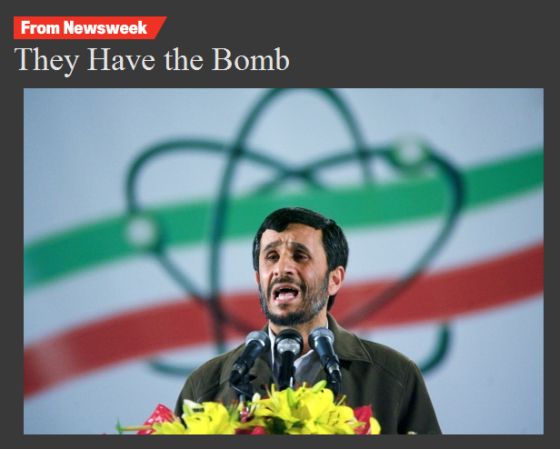
Iran already has the bomb — according to Newsweek — updated

That’s a misleading headline. And so is this:

This is the first image in a Newsweek/Daily Beast gallery on "Nations in the nuclear club".

The caption to the right of this photo of Iran’s President Mahmoud Ahmadinejad reads: “At left, the the [sic] reactor building of the Bushehr nuclear power plant in October 2010.” But in order to see the image of Bushehr, the reader needs to click to the next image and then click back to the previous. So, when readers click through to the gallery from the Newsweek feature article, “Obama’s Dangerous Game With Iran,” the first image they are presented with is Ahmadinejad under the headline, “They Have the Bomb.”

Update: Without any explanation for the earlier presence of the Ahmadinejad photo shown above, Newsweek now has Bushehr as the opening image in this gallery. Nevertheless, the headline, “They Have the Bomb,” and beneath that an image of an Iranian nuclear reactor, is still misleading.

Facebooktwittermail

Which way goes the Obama-Netanyahu ‘trust deficit’?

According to Newsweek’s Daniel Klaidman, Eli Lake, and Dan Ephron, Benjamin Netanyahu has a hard time trusting Barack Obama. They report that a key moment in the breakdown in trust came in late May last year.

From the get-go, Obama had a frosty relationship with Israeli Prime Minister Netanyahu. “There’s no question that tension grew between the two, because we felt like … they had a different estimation [of the timeline for Iran to get nuclear-weapons capability],” says the Pentagon source, “and we felt like some of their [kinetic] activities undermined what we were trying to do. Obama’s view was, why would you remove the opportunity for a diplomatic solution for something that was so incrementally significant [as killing a scientist]?”

That trust deficit was exacerbated in May of last year when Obama delivered a landmark speech outlining his wider Middle East policy. Netanyahu was preparing to fly to Washington at the time and was surprised when he heard the president state that the 1967 borders should be a basis for negotiating the final frontiers of a Palestinian state. Netanyahu believed he had an understanding with Obama that some Jewish settlements built in areas occupied by Israel in the 1967 war would remain inside Israel, a position detailed in a 2004 letter from President Bush to then-prime minister Ariel Sharon. When Netanyahu finally arrived at the Oval Office, he was furious. At a photo op with the two leaders, Netanyahu began to lecture the president on Israel’s security needs before the gathered journalists.

That incident was treated as a small blip in U.S.-Israel relations at the time. Obama soon clarified his position at the annual conference of the American Israel Public Affairs Committee, the most powerful pro-Israel lobby in Washington, stating that negotiated borders should be based on the 1967 lines “with mutually agreed swaps.” [My emphasis.] But resentment persisted. In June Israeli intelligence and military officers stopped discussing any details of their planning, analysis, and training cycles for a possible attack on Iran. Until then cooperation had been close: a regular video teleconference between U.S. and Israeli national-security advisers to discuss Iran was established during the first Netanyahu visit to Washington, in 2009. As one senior Israeli official puts it, “We … both wanted no surprises.”

But there’s a rather glaring problem with this account — a problem about which any journalist in Washington who had been half awake at the time would have been fully aware. Obama could hardly have later “clarified” his position by referring to “mutually agreed swaps.” Why? Because the very statement that had supposedly so enraged Netanyahu was this: “We believe the borders of Israel and Palestine should be based on the 1967 lines with mutually agreed swaps, so that secure and recognized borders are established for both states.” [My emphasis.] That’s what Obama said in his May 19 speech. But Netanyahu — and much of the Washington press corps that chooses to march in lockstep with Israel — chose to ignore Obama’s reference to mutually agreed territorial swaps.

Commenters, letter writers or someone must have brought this to the attention of Newsweek’s editors leading them to bury “correct” the “mistake.” In the online version of the article, this sentence:

Obama soon clarified his position at the annual conference of the American Israel Public Affairs Committee, the most powerful pro-Israel lobby in Washington, stating that negotiated borders should be based on the 1967 lines “with mutually agreed swaps.”

has been replaced with this:

Obama soon clarified his position at the annual conference of the American Israel Public Affairs Committee, the most powerful pro-Israel lobby in Washington, emphasizing that a negotiated border between Israel and a new Palestinian state would by definition be “different than the one that existed on June 4, 1967.”

This is what one might call a cover-your-ass correction. The article’s misrepresentation of the facts is no longer quite as glaring, yet the core accusation — that Obama had undermined Netanyahu’s confidence — remains. It remains, because the whole thrust of the article is about the degree to which Netanyahu has a hard time trusting Obama and that would be a hard argument to sustain if one of its key elements was bogus.

Netanyahu’s tantrum was not the result of a trust deficit. It was a piece of political theater from a man who knows how to push around American presidents. In 2001 he declared: “I know what America is. America is something that can easily be moved.”

Newsweek, instead of honestly portraying the duplicity of the Israeli prime minister, would rather have its readers believe that Netanyahu is burdened by the angst of wondering whether he can trust the White House.

Facebooktwittermail

The U.S.-Israeli don’t-ask-don’t-tell policy on murder

One man uses a bomb to kill another and he’s a terrorist. Another does the same and it’s a form of kinetic activity. I guess that makes the latter a kineticist. However, this kinetic activity is something that Americans are not allowed to engage in — because it’s illegal. It’s illegal because in the view of American law it’s not called kinetic activity; it’s called murder.

Newsweek reports: [W]hile the U.S. relationship with Israel is generally strong on security and intelligence matters, there is disagreement on both methods and strategy. Israel has no qualms about assassinating Iranians involved in nuclear research, for instance; U.S. law forbids it. (Drone strikes against jihadist leaders are considered acts of war.) “The Israelis handled everything that was kinetic, and we did the nonkinetic activities, sometimes along with the Israelis,” says a Pentagon source who was involved. A senior U.S. intelligence official says that both sides performed a kind of “Kabuki dance” on the assassinations and industrial “accidents” that have increased in Iran during the past year: “The Israelis don’t want to say and we don’t want to know.”

The United States, moreover, has conducted regular reviews of cooperation with Israel to make sure that American intelligence does not leak into operations that violate U.S. law. “We were always careful about what we said to the Israelis in meetings, and they knew why,” says the Pentagon source. “They knew that if we gave them certain kinds of information we’d run the risk of breaking the law. We often held things back from them—satellite imagery and other kinds of intelligence that could have helped them with their activities.”

From the get-go, Obama had a frosty relationship with Israeli Prime Minister Netanyahu. “There’s no question that tension grew between the two, because we felt like … they had a different estimation [of the timeline for Iran to get nuclear-weapons capability],” says the Pentagon source, “and we felt like some of their [kinetic] activities undermined what we were trying to do. Obama’s view was, why would you remove the opportunity for a diplomatic solution for something that was so incrementally significant [as killing a scientist]?”

Facebooktwittermail

Israeli intelligence chief: Iran wants Israeli leaders to ‘think twice before they order an attack on an Iranian scientist’

Less than two weeks ago, Yoram Cohen, the head of Shin Bet, Israel’s domestic intelligence service, warned that Iran would not allow assassinations of its nuclear scientists to continue without retaliation. Haaretz reported:

Lecturing at a closed forum in Tel Aviv, Cohen said that Iran believes Israel is behind the attacks on its nuclear experts, which have killed four scientists since November 2010. “It doesn’t matter if it’s true or not that Israel took out the nuclear scientists,” Cohen said. “A major, serious country like Iran cannot let this go on. They want to deter Israel and extract a price so that decision makers in Israel think twice before they order an attack on an Iranian scientist.”

Commenters at the Washington Post, this site, and elsewhere, have been quick to suggest that the bombing in India and attempted bombing in Georgia could have been false flag operations initiated by Israel. Iranian officials have likewise made the same accusation.

This possibility strikes me as wildly improbable for several reasons.

Firstly, Mossad — like any other intelligence service — relies on the support of Israel’s foreign service staff. As deeply committed Zionists as they all might be, for Mossad to injure or kill Israeli diplomats would be impossible to justify and breed massive distrust between two government agencies that depend on each other.

Secondly, Israel doesn’t have too many friends but it counts India as one of them. It’s an alliance that’s worth more to Israel than it is to India. Why put that in jeopardy for a stunt like this?

A much more obvious explanation for these attacks is the one ventured by the head of Shin Bet: Iran is telling the Israelis they can’t continue their campaign of assassinations with impunity. And beyond that there is probably a wider implicit warning: to those who claim that Israel could launch a military strike on Iran without suffering a significant reprisal — think again.

Luckily for Tal Yehoshua Koren, the wife of an Israeli Defense Ministry representative to India, who was injured in today’s attack, she seems to have learned from the example of Fereydoun Abbasi-Davani, head of Iran’s Atomic Energy Organization, who survived an assassination attempt in November 2010.

If you suspect someone has just attached a bomb to your car, jump out as fast as possible.

Update:

Haaretz adds: The bombings sparked the usual tough rhetoric from Israeli officials: Lieberman said Israel “would not overlook” the attacks, while Netanyahu vowed to “continue to act forcefully, systematically and patiently” against Iranian terror. Nevertheless, a harsh Israeli response is seen as unlikely.

One reason for this is that if, as is widely believed, Israel is behind a recent series of assassinations of Iranian nuclear scientists in Tehran, government officials presumably knew that Iranian revenge attacks were likely and took that possibility into account. Though an innocent diplomat’s wife cannot be compared to a scientist directly involved in Iran’s nuclear program, Monday’s attacks were still limited enough that they didn’t violate the “rules of the game.” Indeed, the modus operandi of the New Delhi bombing exactly mimicked that used to kill several of the Iranian scientists. Hence a direct Israeli military strike on either Hezbollah or Iran seems unlikely.

Facebooktwittermail

Iranian counter-terrorism?

Have we reached a quite predictable moment where counter-terrorism needs redefining? In other words, that when car bombings initiated by one state-sponsor of terrorism provoke a counter-attack of the same kind, that we should call such an attack an act of counter-terrorism?

Only last week there was confirmation from U.S. government officials that Israel is a state-sponsor of terrorism, having trained and deployed Iranian dissidents to conduct car bombings killing civilians in Iran. By internationally accepted definitions of terrorism and state-sponsored terrorism, there’s no question these were acts of terrorism and Israel’s role in instigating them makes it a state-sponsor of terrorism.

Now it would appear that Israel is reaping the reward for its own actions as Israeli diplomats have been targeted in India and Georgia. The attack in Delhi appears to have involved the use of the same method favored by Mossad — a magnetic bomb attached to the Israelis’ car by a passing motorcyclist.

We can now expect intellectual and moral acrobatics from Israel apologists who support the use of car bombs inside Iran but condemn their use anywhere else.

BBC News reports: Bombers have targeted staff at Israeli embassies in India and Georgia, officials say, with Israel accusing Iran of masterminding the attacks.

An explosion in Delhi injured one diplomat and three other people. Witnesses told local TV a motorcyclist had placed a device on the embassy’s car when it stopped in traffic.

A bomb underneath a diplomat’s car in Tbilisi was found and defused.

Israeli leader Benjamin Netanyahu said Iran was behind the two incidents.

“Today we witnessed two attempts of terrorism against innocent civilians,” he told a meeting of his Likud party MPs.

“Iran is behind these attacks and it is the largest terror exporter in the world.”

He also blamed Iran for recent plots to attack Israeli targets in Thailand and Azerbaijan that were prevented.

And he suggested that the militant Islamist Hezbollah movement was also involved.

Israel’s foreign ministry said that Israel had the ability to track down those who carried out the attacks.

The BBC’s Rupert Wingfield-Hayes, in Jerusalem, says security at Israeli embassies has been tightened in recent months following warnings of potential attacks, after Iran accused Israel of a series of attacks on its nuclear scientists.

Facebooktwittermail

Is this how Newsweek hopes to get raised from the dead?

Newsweek’s current cover looks like a promotion for a Glenn Beck special: The War on Christians. No doubt the magazine’s editors thought they could get away with such a provocative headline because the byline lends it a token of authority.

Were this declaration to come from Beck or anyone of his ilk, it would be dismissed by Newsweek’s editors and many of its readers as conservative hysteria, but spouted by a celebrity former Muslim it suddenly demands serious attention. There also comes a side benefit — “The War on Christians” is a conservative mantra, from their lips referring to a war supposedly being fought by President Obama against Christians, so perhaps Newsweek felt like it might be doing some useful and surreptitious rebranding, decoupling Obama from this slur.

At GetReligion.org, Terry Mattingly observes that Newsweek these days is short on news.

As a rule, under super-editor Tina Brown, it has been an at times lively but ultimately confusing mixture of commentary, commentary and more commentary…

And the NEWS in Newsweek? That’s the strange part. The goal of the magazine seems to be to handle serious news topics (mixed with entertainment topics, of course) but in a way that it is impossible to take seriously as journalism. Newsweek is becoming the land of the unattributed fact.

To see this process at work, please read the Ayaan Hirsi Ali cover story discussing “The War on Christians in the Muslim World.” In this case, the cover’s zinger quality is provided by the author’s identity as a Muslim apostate, atheist, militant secularist and defender of old-fashioned human rights — such as religious liberty and free speech. Ali is so liberal that she is now considered, by many, to be a conservative.

In an interview with MSNBC, Newsweek executive editor Justine Rosenthal draws on one of the unattributed “facts” provided by Hirsi Ali: “In Egypt, for example, 200,000 Coptic Christians have fled their homes and very little is being done to stop that sort of violence.”

On what does Hirsi Ali base her claim that 200,000 Copts have fled?

The only reference I can find to this number of Copts fleeing is a Washington Times report in October last year which said:

A report released last month by an Egyptian nongovernmental organization estimated that 93,000 Christians already had fled the country since March, a figure some are predicting could top 200,000 by the end of year.

It would appear that this prediction made by persons unknown got turned into a “fact” by Hirsi Ali and now Newsweek is happy to cite this as a piece of evidence upon which it wants to buttress its cover story.

As for the cover itself, no doubt the magazine’s editorial team found the blood-stained image of Christ an irresistible piece of iconography, but I wonder whether they delved at all into the story behind the photograph.

On New Year’s Day, 2011, the Coptic al-Qiddissin (Saints) Church in Alexandria, where the photo was taken, was the target of a bombing that killed 23 people, Christians and Muslims, while 97 more were injured. The attack was internationally condemned and widely perceived as evidence of sectarian tension. The Interior Ministry blamed “foreign elements,” and the Alexandria governor accused al Qaida of being responsible, yet in a foretaste of the nationwide protests that were to erupt three weeks later, Christians unleashed their rage not at their Muslim neighbors but at the authorities.

Former Interior Minister Habib el-Adly in the U.S.-backed Mubarak government was later accused of having instigated the bombing.

In the following days, fearing that Churches might face similar attacks, Muslims formed human shields in order to defend Copts going to worship.

There’s no question that in Egypt and elsewhere Christians have been the targets of sectarian violence, but what Newsweek is doing is shamelessly promoting the view that Christianity is under attack by Islam. We’re back in the territory of a clash of civilizations — but no mention of another phenomenon: the attacks upon Christians that occur daily in Israel.

How does Hirsi Ali want to see “Christophobia” addressed?

As for what the West can do to help religious minorities in Muslim-majority societies, my answer is that it needs to begin using the billions of dollars in aid it gives to the offending countries as leverage.

It might be hard for the U.S. to apply such leverage since there is only one country to which the U.S. actually gives billions of dollars of aid each year: Israel.

Facebooktwittermail

Righteous indignation rant of the day

Glenn Greenwald writes: During the Bush years, Guantanamo was the core symbol of right-wing radicalism and what was back then referred to as the “assault on American values and the shredding of our Constitution”: so much so then when Barack Obama ran for President, he featured these issues not as a secondary but as a central plank in his campaign. But now that there is a Democrat in office presiding over Guantanamo and these other polices — rather than a big, bad, scary Republican — all of that has changed, as a new Washington Post/ABC News poll today demonstrates:

The sharpest edges of President Obama’s counterterrorism policy, including the use of drone aircraft to kill suspected terrorists abroad and keeping open the military prison at Guantanamo Bay, Cuba, have broad public support, including from the left wing of the Democratic Party.

A new Washington Post-ABC News poll shows that Obama, who campaigned on a pledge to close the brig at Guantanamo Bay and to change national security policies he criticized as inconsistent with U.S. law and values, has little to fear politically for failing to live up to all of those promises.

The survey shows that 70 percent of respondents approve of Obama’s decision to keep open the prison at Guantanamo Bay. . . . The poll shows that 53 percent of self-identified liberal Democrats — and 67 percent of moderate or conservative Democrats — support keeping Guantanamo Bay open, even though it emerged as a symbol of the post-Sept. 11 national security policies of George W. Bush, which many liberals bitterly opposed.

Repulsive liberal hypocrisy extends far beyond the issue of Guantanamo. A core plank in the Democratic critique of the Bush/Cheney civil liberties assault was the notion that the President could do whatever he wants, in secret and with no checks, to anyone he accuses without trial of being a Terrorist – even including eavesdropping on their communications or detaining them without due process. But President Obama has not only done the same thing, but has gone much farther than mere eavesdropping or detention: he has asserted the power even to kill citizens without due process. As Bush’s own CIA and NSA chief Michael Hayden said this week about the Awlaki assassination: “We needed a court order to eavesdrop on him but we didn’t need a court order to kill him. Isn’t that something?” That is indeed “something,” as is the fact that Bush’s mere due-process-free eavesdropping on and detention of American citizens caused such liberal outrage, while Obama’s due-process-free execution of them has not.

Beyond that, Obama has used drones to kill Muslim children and innocent adults by the hundreds. He has refused to disclose his legal arguments for why he can do this or to justify the attacks in any way. He has even had rescuers and funeral mourners deliberately targeted. As Hayden said: ”Right now, there isn’t a government on the planet that agrees with our legal rationale for these operations, except for Afghanistan and maybe Israel.” But that is all perfectly fine with most American liberals now that their Party’s Leader is doing it:

Fully 77 percent of liberal Democrats endorse the use of drones, meaning that Obama is unlikely to suffer any political consequences as a result of his policy in this election year. Support for drone strikes against suspected terrorists stays high, dropping only somewhat when respondents are asked specifically about targeting American citizens living overseas, as was the case with Anwar al-Awlaki, the Yemeni American killed in September in a drone strike in northern Yemen.

The Post‘s Greg Sargent obtained the breakdown on these questions and wrote today:

The number of those who approve of the drone strikes drops nearly 20 percent when respondents are told that the targets are American citizens. But that 65 percent is still a very big number, given that these policies really should be controversial.

And get this: Depressingly, Democrats approve of the drone strikes on American citizens by 58-33, and even liberals approve of them, 55-35. Those numbers were provided to me by the Post polling team.

It’s hard to imagine that Dems and liberals would approve of such policies in quite these numbers if they had been authored by George W. Bush.

Indeed: is there even a single liberal pundit, blogger or commentator who would have defended George Bush and Dick Cheney if they (rather than Obama) had been secretly targeting American citizens for execution without due process, or slaughtering children, rescuers and funeral attendees with drones, or continuing indefinite detention even a full decade after 9/11? Please. How any of these people can even look in the mirror, behold the oozing, limitless intellectual dishonesty, and not want to smash what they see is truly mystifying to me.

As Greenwald’s regular readers know, he never holds back in screaming his indignation. It’s guaranteed to be a crowd please. But to go on a rant about the hypocrisy of Obama’s supporters and then stall by saying that it is mystifying, seems to me like a cop-out.

That critics of Bush’s counter-terrorism policies would refrain from criticizing Obama as he extends the reach of many of those policies is indeed hypocritical, but where does the hypocrisy come from?

From what I can tell, it is rooted in America’s collective response to 9/11. What the attacks demonstrated was the ease with which Americans can be terrorized. The willingness with which Americans of all political stripes swallowed the terrorism narrative from that day onwards was the license that guaranteed to whoever was in power, the ability to expand government power with minimal challenges so long as this was done in the name of combating terrorism.

Democrats have no more interest in questioning the imputed entities, terrorism and terrorists, than do their Republican counterparts. Why? Because to do so is to lower a barrier whose strength must be maintained if Americans want to persist in avoiding coming to terms with the humiliation of 9/11. Terrorism, we would rather believe, is a mighty force which must be boldly challenged.

The affront to American pride on that day came not from the force of the attacks but from the fact that this country could be brought to its knees by a small bunch of somewhat ordinary young men.

This is not to deny that what those young men did on that day was indeed terrible, inhumane and unjustifiable, but the massive overreaction they provoked revealed the political and social breadth and depth of American cowardice.

It is cowardice that sanctions wars, torture, assassinations, indefinite detention, and the suspension of civil liberties and that cowardice has never been less evident among Democrats than among Republicans.

But here’s one of the biggest ironies: the revival of the truism that one man’s terrorist is another man’s freedom fighter is now coming from Republicans.

After this week’s revelation that Israel is training and deploying terrorists from Mujahideen-e Khalq (MEK) in Iran, Commentary’s Jonathan Tobin responds:

The MEK are allies of convenience and, just like many wartime allies in other conflicts, share only a common enemy with Israel. But however nasty they may be, Israel need not blush about using them. For a democracy at war, the only truly immoral thing to do would be to let totalitarian Islamists like those in Tehran triumph.

Those who look favorably on this particular alliance of convenience also have a convenient solution for the political problem of being seen to support a designated terrorist organization — they argue the designation should simply be removed.

I would go one much larger and more radical step further and argue that the designation “terrorist” has no play in law.

The function of law is to regulate behavior — not ontological status. No one gets convicted of being a murderer. They can only be found guilty of murder, attempted murder, or conspiracy to commit murder. These are all actions — not mere thoughts, intentions, or affiliations.

It’s time that more individuals in this country stood up and expressed a truth that has long been widely understood: terrorism is nothing more than a political technique employed for a psychological effect. If we separate security from politics, all we do is ensure that the political causes for the use of violence will neither be thoroughly examined nor effectively addressed.

Facebooktwittermail

Israel-Firster Sheldon Adelson regrets serving in U.S. instead of Israeli military

NBC reports Newt Gingrich’s leading backer, Sheldon Adelson, speaking in Israel in 2010, said:

I am not Israeli, the uniform that I wore in the military unfortunately was not an Israeli uniform, it was an American uniform, although my wife was in the IDF, and one of my daughters was in the IDF, and my two little boys — our two little boys one of whom will be bar mitzvahed tomorrow… hopefully he’ll come back [to Israel], his hobby is shooting and he’ll come back and be a sniper for the IDF.

“All we care about is being good Zionists, being good citizens of Israel, because even though I am not Israeli born, Israel is in my heart,” he said toward the end of his talk.

Sig Rogich, a veteran Republican operative who serves as Adelson’s government affairs consultant, when asked about Adelson’s comments said: “No one could possibly ever think that he is anything but a loyal American. He’s shown that time and time again.”
(H/t Ali Abunimah)

Facebooktwittermail

Obama ready to signal U.S. may stay out of conflict if Israel launches unilateral strike on Iran

The Washington Post columnist, David Ignatius, often serves as an unofficial mouthpiece for the White House, CIA, State Department, or Pentagon. His column today should probably be read in this way.

While funneling the chatter that with increasing volume in recent weeks has suggested that an Israeli attack on Iran is imminent, Ignatius adds some important details on the way the Obama administration is responding.

The Obama administration is conducting intense discussions about what an Israeli attack would mean for the United States: whether Iran would target U.S. ships in the region or try to close the Strait of Hormuz, and what effect the conflict and a likely spike in oil prices would have on the fragile global economy.

The administration appears to favor a policy of staying out of the conflict, unless Iran hits U.S. assets, which would trigger a strong U.S. response.

This U.S. policy — signaling that Israel is acting on its own — might open a breach like the one in 1956, when President Eisenhower condemned an Israeli-European attack on the Suez Canal. Complicating matters is the 2012 presidential campaign, which has Republicans candidates clamoring for stronger U.S. support of Israel.

Administration officials caution that Tehran shouldn’t misunderstand: The United States has a 60-year commitment to Israeli security, and if Israel’s population centers were hit, the United States could feel obligated to come to Israel’s defense.

Israelis are said to believe that a military strike could be limited and contained. They would bomb the uranium-enrichment facility at Natanz and other targets; an attack on the buried enrichment facility at Qom would be harder from the air. Iranians would retaliate, but Israelis doubt the action would be an overwhelming barrage, with rockets from Hezbollah forces in Lebanon. One Israeli estimate is that the Jewish state might have to absorb 500 casualties.

Israelis point to Syria’s lack of response to an Israeli attack on a nuclear reactor there in 2007. Iranians might show similar restraint, because of fear the regime would be endangered by all-out war. Some Israelis have also likened a strike on Iran to the 1976 hostage-rescue raid on Entebbe, Uganda, which was followed by a change of regime in that country.

Israeli leaders are said to accept, and even welcome, the prospect of going it alone and demonstrating their resolve at a time when their security is undermined by the “Arab Spring.”

Assuming that Ignatius has not misconstrued the messaging from the administration, there are several ways in which it can be read:

  • That this is in effect, yet a further escalation in the war-making rhetoric — that Iran is being told that if the U.S ever had the capacity to restrain Israel, that capacity has been relinquished. Mad dog Israel is now being let off the leash;
  • or, that Israel is being warned that it may suffer the consequences of its own bravado and won’t get bailed out by the U.S. in the event that Iran strikes back in a proportionate and appropriate way — perhaps through missile attacks on the Dimona nuclear facility;
  • and that Washington wants Tehran to understand that the United States draws a clear distinction between its own interests and those of Israel and that the Iranians should keep this in mind when making their own strategic calculations.
Facebooktwittermail