Author Archives: Paul Woodward

Pro-Palestinian activists ‘at large’ inside Israel

In the days before hundreds of pro-Palestinian activists tried invade Israel on board an Air Flotilla, five managed to get past security and are on the loose inside Israel. The future of the Jewish state could be in jeopardy.

Noam Sheizaf reports:

Panic. There is no other way to describe the Israeli reaction to a plan organized by a few activists—no more than a thousand, according to the most generous estimates—to try and travel to the West Bank via Ben Gurion International Airport. A handful of those visitors arrived (five of them have already been deported), and it seems that the whole country has gone mad.

Haaretz has reported a special deployment of hundreds of police officers and special units both inside and outside the terminals, “in case one of the arrivals tries to set himself on fire.” The Petach Tikva court, in charge of the airport area, is to have more arrest judges on alert, and the minister for Hasbara (propaganda) Yuli Edelstein demanded that the government take no chances, “because we should remember what happened on 9/11.”

All this, lets not forget, in order to welcome between a few dozen to a few hundred Westerners (most of them quite old, according to reports), who would arrive on separate flights and on different hours, who went through extensive security checks before boarding their planes, and who openly declared their intentions to visit the Palestinian territories. This is the national threat that has captured all the headlines for some days now in a country armed with one of the strongest armies in the world as well as an extensive arsenal of nuclear bombs.

Gideon Levy writes:

The danger is tangible. It is approaching our shores at alarming speed. It is approaching us from the air, from the sea and from the land and nobody can stop it. Someone must do something, quickly. Warning, danger! Israel is losing its senses.

We had not yet finished celebrating our victories – killing those who sought to cross the border on Nakba Day, thwarting the flotilla to Gaza, not handing bodies over to the Palestinians and saving Amir Peretz from a British prison – when we were already forced to prepare for the next existential threat: activists flying in from Europe.

Here’s a safe bet: We’re going to win another sweeping victory. The public security minister said “hooligans,” the police commissioner promised that “we won’t treat them gently.” The prime minister held a special “security” consultation before taking off for Romania and hundreds of policemen and security guards, both uniformed and plainclothes, as well as Shin Bet and Mossad agents deployed in Ben-Gurion Airport.

Our next great victory is already assured. Early yesterday afternoon, our forces scored their first triumph on the battlefield: Five activists were expelled.

If it weren’t so sad, it would be funny. Israel is becoming grotesque. Nonviolent demonstrators, some of them well-wishers, who pose no threat to Israel’s security, wish to go to Gaza, some by sea and some by air. Yet they are being portrayed as enemies of the state and of the people, not to mention of all humanity. Israel is employing its entire arsenal of tricks to prevent them from carrying out their legitimate protest.

First Israel magnifies the danger, then it legitimizes all means against it. And finally, it glorifies the achievement of destroying it.

Meanwhile, a high profile panel of experts which recently met in Jerusalem debated whether President Obama is showing enough love for Israel.

Elliott Abrams, former senior White House adviser in the George W. Bush administration, asserted: “There is no great love in his heart for Israel.” At the same time, Abrams felt assured that America as a nation has enough love for Israel thanks to tens of millions of right-wing Christians who will only vote for pro-Israel candidates.

Members of the panel connected to the current administration countered that it too is overflowing with the devotion that Israelis have come to expect from Washington.

“The notion that Obama does not have the requisite love, or cares in his kishkas [guts], defies the facts,” said [former Florida Democratic Congressman Robert] Wexler, today the president of the S. Daniel Abraham Center for Middle East Peace in Washington.

Former IDF spokesman Ruth Yaron countered that even with all that, Israelis want to feel the love, not just hear that the president has done a great deal for security cooperation.

“I’m not questioning his love,” she said. “I would say please make sure this love is not only felt, but also seen by countries around us.”

Without feeling secure in this love and a feeling that Israel will never be left to “walk alone,” the country would be less willing to take risks, Yaron said.

This dimension of the Israeli psyche – of wanting to feel, and not only hear, about the love – was dismissed as “neurosis” by [Martin] Indyk, who today is vice president of the Brookings Institution.

Saying that Obama is not a “warm and cuddly guy,” and calling him “no drama Obama,” Indyk said that the only intimate relationship Obama has with any foreign leader is with Russian President Dmitry Medvedev.

Calling Yaron’s description of Israel’s psyche the picture of a “neurotic nation,” Indyk said, “It’s time to grow up. We should get over the question of whether he loves me or he loves me not, and focus on question of finding a solution to conflict with the Palestinians.

“When Israel decides by itself to solve that problem, it will have the overwhelmingly cuddly support of the US president.”


Facebooktwittermail

Hacking scandal rocks Murdoch empire

If there was any doubt that Rupert Murdoch realizes his media empire is under threat, his latest move at damage control is unprecedented: the News of the World is about to be shut down.

The News of the World, a British tabloid with which most Americans will be unfamiliar, is not as powerful as Fox News, but it is just as representative of Murdoch’s ruthless approach to media sensationalism and journalism as cut-throat commerce.

The latest phone hacking story that The Guardian broke on Monday revealed that there seem to be no ethical boundaries that News Corp is unwilling to cross.

After schoolgirl Milly Dowler went missing in March 2002, “News of the World journalists reacted by engaging in what was standard practice in their newsroom: they hired private investigators to get them a story.”

Scotland Yard is now investigating evidence that the paper hacked directly into the voicemail of the missing girl’s own phone. As her friends and parents called and left messages imploring Milly to get in touch with them, the News of the World was listening and recording their every private word.

But the journalists at the News of the World then encountered a problem. Milly’s voicemail box filled up and would accept no more messages. Apparently thirsty for more information from more voicemails, the paper intervened – and deleted the messages that had been left in the first few days after her disappearance. According to one source, this had a devastating effect: when her friends and family called again and discovered that her voicemail had been cleared, they concluded that this must have been done by Milly herself and, therefore, that she must still be alive. But she was not. The interference created false hope and extra agony for those who were misled by it.

The Dowler family then granted an exclusive interview to the News of the World in which they talked about their hope, quite unaware that it had been falsely kindled by the newspaper’s own intervention. Sally Dowler told the paper: “If Milly walked through the door, I don’t think we’d be able to speak. We’d just weep tears of joy and give her a great big hug.”

The deletion of the messages also caused difficulties for the police by confusing the picture when they had few leads to pursue. It also potentially destroyed valuable evidence.

Today, The Guardian reports:

The senior detective leading the phone hacking inquiry said on Thursday that there were 4,000 possible victims of phone hacking listed in the pages of private eye Glenn Muclaire’s notebooks and they were being contacted “as quickly as possible”.

Deputy assistant commissioner Sue Akers, who is running Operation Weeting, broke her silence to give more details on her operation as the number of victims being publicly identified continued to grow.

Her words are the first official confirmation of what the Guardian reported two years ago – that thousands of people were listed as possible victims in the notebooks of Mulcaire, who was hired by the News of the World. These individuals were not contacted by detectives investigating phone hacking in the first inquiry, known as the Goodman inquiry. The Guardian’s original story in 2009 suggested that between 2,000 and 3,000 individuals might have been the victims of phone hacking.

The fallout from the hacking scandal also extends to London’s police force:

Investigators inside Scotland Yard are trying to identify up to five officers who were paid between them a total of at least £100,000 in cash from the News of the World, the Guardian understands.

Documents sent to the police by News International did not name those involved but contained pseudonyms which investigators within the Yard are trying to match with individual officers.

The revelation comes a day after Sir Paul Stephenson, commissioner of the Metropolitan police, said that the amounts involved had been paid to a small number of officers.

News that officers were allegedly paid so much in bribes has caused shock and concern within Scotland Yard, where the directorate of professional standards is now investigating the matter. There have been calls for an external force to be brought in to investigate the scandal – Boris Johnson, the mayor of London, has said someone else should wash the Met’s dirty linen in public.

Facebooktwittermail

Obama plans re-election campaign visit to Israel

Why hasn’t President Obama visited Israel yet? Is his love of the Jewish state not deep enough? Does he not have a strong enough commitment to the unshakable relationship with America’s closest ally?

I guess no one need have worried over such troubling questions when the answer has long been obvious: Obama always intended to visit Israel when to do so would yield the maximum political profit, i.e. during the 2012 presidential campaign.

Of course his visit will be billed as part of his presidential rather than election campaign agenda, but have no doubt: it will be a campaign event.

James Cunningham, the outgoing U.S. ambassador to Israel, said Tuesday that U.S. President Barack Obama intends on visiting Israel.

Cunningham mentioned that Israel is on Obama’s agenda during a farewell meeting with Knesset Speaker Reuven Rivlin, who thanked Cunningham for his service as the two discussed the current state of U.S.-Israel relations.

In their discussion, Rivlin told Cunningham that many Israelis feel the mood in the White House has changed for the worse. “[They worry] Israel has become a burden rather than a strategic asset to the United States,” Rivlin said.

The same theme appears in this report:

Every year, a few days before the Fourth of July, the U.S. ambassador’s residence in Herzliya Pituach opens its gate to thousands of guests in a celebration of American independence. The usual ritual – lots of American kitsch, a notable presence of the business, political and military elite, McDonald’s and Pizza Hut stands and sappy speeches by the prime minister and the president.

Over the past three years, despite the growing tensions between Washington and Jerusalem, the event held last Thursday did not rock the boat. Prime Minister Benjamin Netanyahu played the role he was assigned. “When the American people celebrate their independence, the people in Israel celebrate with them, – because we know how blessed we are, how meaningful what happened on July 4, 1776 is for us,” he said. “Over the years we have had to defend ourselves again and again. Our freedom, our independence. This struggle was possible because of the U.S.’ support.”

Netanyahu kept congratulating and the audience kept cheering, yet beneath the surface it is clear that the relations between the U.S. and Israel are undergoing a crisis, and that both sides are re-examining those very relations. There is a reason that these days there is a cynical remark being uttered around Washington – “For the U.S., Israel has been turned lately from an asset to a pain in the ass-et.”

Facebooktwittermail

Jewish settlers rally in support of rabbis who back anti-Arab ‘King’s Torah’

While Benjamin Netanyahu treats non-violent international activists in the Freedom Flotilla as though they pose a dire threat to Israel, a much larger and truly violent threat is growing inside Israel and the occupied territories. Its members are fanatical xenophobic Jews.

Following the brief arrest of Rabbi Yaakov Yosef who was questioned over incitement to racism and violence because of his endorsement of the “The King’s Torah” — a book which advocates killing non-Jews, including children and babies — his supporters demonstrated in Jerusalem where Knesset member Yaakov Katz and others addressed the crowd:

MK Katz told the demonstrators that settlers are a threat to the state attorney, because they are strong and multiplying. He said that the day will come when the settlers will run the state, write the legislation, investigate and see who put rabbis on trial, and that they will take revenge.

According to Rabbi Melamed, “it is impossible to stop scholars from coming forward and speaking the teachings of the Torah.” He also spoke about the dream that one day the media and High Court of Justice will have observant Jews working for them, who will discuss the law of the Torah. “This is a development that will be impossible to stop,” he said.

Kiryat Arab Chief Rabbi Dov Lior was also detained earlier this week following his endorsement of the book on suspicion of incitement to violence and racism, after he refused to be questioned on the matter.

Following Yosef’s arrest, police stationed security forces throughout Jerusalem fearing disorderly conduct by protesters. Several demonstrators had burned tires on the Tel-Aviv-Jerusalem highway, and three youths were detained after they had tried to block the path of the Jerusalem light rail near Yosef’s home.

About 18 months ago, Yosef issued a written endorsement of the book Torat Hamelech (“The King’s Torah”). The book considers various situations in which killing non-Jews is permitted.

Last year, Haaretz reported:

The marble-patterned, hardcover book embossed with gold Hebrew letters looks like any other religious commentary you’d find in an Orthodox Judaica bookstore – but reads like a rabbinic instruction manual outlining acceptable scenarios for killing non-Jewish babies, children and adults.

The prohibition ‘Thou Shalt Not Murder’ applies only “to a Jew who kills a Jew,” write Rabbis Yitzhak Shapira and Yosef Elitzur of the West Bank settlement of Yitzhar. Non-Jews are “uncompassionate by nature” and attacks on them “curb their evil inclination,” while babies and children of Israel’s enemies may be killed since “it is clear that they will grow to harm us.”

“The King’s Torah (Torat Hamelech), Part One: Laws of Life and Death between Israel and the Nations,” a 230-page compendium of Halacha, or Jewish religious law, published by the Od Yosef Chai yeshiva in Yitzhar, garnered a front-page exposé in the Israeli tabloid Ma’ariv, which called it the stuff of “Jewish terror.”

Facebooktwittermail

Why every flotilla succeeds and the siege of Gaza will end

Is it possible to break the siege of Gaza if no one notices?

As an exercise in directing global attention to the plight of a population subject to collective punishment, the first flotilla in August 2008 was a bit of a flop — even though it reached Gaza.

In the Jerusalem Post, Herb Keinon cynically wrote at the time:

Ever since the Free Gaza Movement made known its intent a few weeks ago to set sail for the Gaza Strip to “break” the Israeli blockade, it was clear that the two boatfuls of professional left-wing demonstrators and tag-along journalists were after one thing: a huge media event.

Nothing, therefore, would have given them a greater media buzz than if a couple of Israel Navy boats stopped them on the high seas, arrested the protesters (hopefully, from the point of view of the organizers of the protest, with some gratuitous brutality), and dragged the Greek-registered vessels into the Ashdod port.

Imagine the footage, imagine the images, and imagine the public relations bonanza for those few “brave souls” on the sea-weary vessels. Israel would, undoubtedly, have faced a public relations drubbing. So by deciding to let the boats through, the government deprived the protesters of the huge media event they so obviously wanted.

Indeed, instead of footage of heavyhanded Israelis stopping boats carrying an 81-year-old American nun and the sister-in-law of former British prime minister Tony Blair leading the nightly news broadcasts in the West on Saturday night, the story of the boats’ arrival in Gaza barely made a blip on the CNN, Fox, or Sky news broadcasts. With the world’s eyes still glued to the Olympics in Beijing, and the media focusing on US presidential candidate Barack Obama’s choice of Joe Biden as his vice presidential nominee, the Gaza blockade-running story didn’t register in the electronic media.

And in the written press, the protesters didn’t fare that much better. The New York Times ran a small piece on page 16 on Sunday; The Washington Post on page 12; and The St. Louis Post-Dispatch relegated it to a three-paragraph brief. As media events go, this one was not particularly successful.

But — as Keinon also noted — the story was not over. Indeed.

What the flotilla organizers understood was that whatever the outcome, each challenge to the siege could in fact never fail. Ships could succeed by reaching Gaza, or succeed without reaching Gaza by exposing Israel to the eyes of the world as a cowardly bone-headed bully.

The only solution to Israel’s problem was and remains the one that it refuses to entertain: backing itself out of a dead-end policy that by any metric one wants to use, has been a demonstrable failure — a policy which hasn’t weakened Hamas; hasn’t turned Gaza’s population against its rulers; hasn’t made Israel safer; and above all has brought Israel’s global image to an all-time low while callously inflicting yet more suffering on the Palestinian people.

The Israeli columnist, Asaf Gefen, suggested this week:

If the Marmara that took part in the previous sail sought to present Israel’s brutality to the world (and managed to do so, thanks to our kind assistance,) it appears that the current flotilla was meant to present Israel’s stupidity.

At this time already, when it’s still unclear whether and when the ships shall arrive, it appears that this objective had also been fully achieved.

But now that the flotilla appears stuck in Greece, can’t Netanyahu claim victory? Some Israeli reporters seem to think so:

Prime Minister Benjamin Netanyahu sometimes seems almost too arrogant and self assured for his own good. However, unlike in most instances, this weekend he actually has justification for his haughtiness.

Really?

Look at The Audacity of Hope as it chugged out of a Greek harbor yesterday and ask yourself: what kind of prime minister and what kind of nation could feel threatened by this kind of challenge?

The need to subjugate others; the obsession with existential threats; the insatiable hunger for loving affirmations; and the fear of equality between Jews and non-Jews — all of this exposes Israel’s intrinsic weakness, a weakness that cannot be overcome by belligerence, isolation or warfare.

In truth, nothing threatens Israel more than its own fear of the world.

It’s time not just for Israel to end the siege of Gaza but for Zionists to break out of their own self-made prison.

Facebooktwittermail

Costs of war: 225,000 killed, $3.2-4 trillion

On September 14, 2001, when President Bush shouted through a bullhorn to rescue workers at the ruins of the World Trade Center, he said: “I can hear you! I can hear you! The rest of the world hears you! And the people — and the people who knocked these buildings down will hear all of us soon!”

In response the workers shouted: “U.S.A.! U.S.A.! U.S.A.! U.S.A.! U.S.A.! U.S.A.! U.S.A.! U.S.A.! ”

But suppose Bush had added this: “And for every innocent life lost here, we will kill a hundred more innocent people. And we will get our vengeance — even if it means driving the country into economic ruin.”

Would the crowd have then fallen silent? Would Americans, still in shock, have realized that their government was seeking support for what amounted to a collective act of insanity?

The “Costs of War” report from the Watson Institute for International Studies at Brown University says:

The President of the United States has told the American people and the rest of the world that even as the U.S. withdraws some troops from Afghanistan and continues to withdraw from Iraq, the wars will continue for some years. The debate over why each war was begun and whether either or both should have been fought continues.

What we do know, without debate, is that the wars begun ten years ago have been tremendously painful for millions of people in Afghanistan, Iraq, and Pakistan, and the United States, and economically costly as well. Each additional month and year of war will add to that toll. To date, however, there has been no comprehensive accounting of the costs of the United States’ wars in Afghanistan, Iraq, and Pakistan. The goal of the Costs of War project has been to outline a broad understanding of the domestic and international costs and consequences of those wars. The Eisenhower Research Project based at Brown University assembled a team that includes economists, anthropologists, political scientists, legal experts, and a physician to do this analysis.

We asked:

  • What have been the wars’ costs in human and economic terms?
  • How have these wars changed the social and political landscape of the United States and the countries where the wars have been waged?
  • What will be the long term legacy of these conflicts for veterans?
  • What is the long term economic effect of these wars likely to be?
  • Were and are there alternative less costly and more effective ways to prevent further terror attacks?

Some of the project’s findings:

  • While we know how many US soldiers have died in the wars (just over 6000), what is startling is what we don’t know about the levels of injury and illness in those who have returned from the wars. New disability claims continue to pour into the VA, with 550,000 just through last fall. Many deaths and injuries among US contractors have not been identified.
  • At least 137,000 civilians have died and more will die in Afghanistan, Iraq, and Pakistan as a result of the fighting at the hands of all parties to the conflict.
  • The armed conflict in Pakistan, which the U.S. helps the Pakistani military fight by funding, equipping and training them, has taken as many lives as the conflict in neighboring Afghanistan.
  • Putting together the conservative numbers of war dead, in uniform and out, brings the total to 225,000.
  • Millions of people have been displaced indefinitely and are living in grossly inadequate conditions. The current number of war refugees and displaced persons — 7,800,000 — is equivalent to all of the people of Connecticut and Kentucky fleeing their homes.
  • The wars have been accompanied by erosions in civil liberties at home and human rights violations abroad.
  • The human and economic costs of these wars will continue for decades, some costs not peaking until mid-century. Many of the wars’ costs are invisible to Americans, buried in a variety of budgets, and so have not been counted or assessed. For example, while most people think the Pentagon war appropriations are equivalent to the wars’ budgetary costs, the true numbers are twice that, and the full economic cost of the wars much larger yet. Conservatively estimated, the war bills already paid and obligated to be paid are $3.2 trillion in constant dollars. A more reasonable estimate puts the number at nearly $4 trillion.
  • As with former US wars, the costs of paying for veterans’ care into the future will be a sizable portion of the full costs of the war.
  • The ripple effects on the U.S. economy have also been significant, including job loss and interest rate increases, and those effects have been underappreciated.
  • While it was promised that the US invasions would bring democracy to both countries, Afghanistan and Iraq, both continue to rank low in global rankings of political freedom, with warlords continuing to hold power in Afghanistan with US support, and Iraqi communities more segregated today than before by gender and ethnicity as a result of the war.
  • Serious and compelling alternatives to war were scarcely considered in the aftermath of 9/11 or in the discussion about war against Iraq. Some of those alternatives are still available to the U.S.

There are many costs of these wars that we have not yet been able to quantify and assess. With our limited resources, we focused on U.S. spending, U.S. and allied deaths, and the human toll in the major war zones, Afghanistan, Iraq and Pakistan. There is still much more to know and understand about how all those affected by the wars have had their health, economies, and communities altered by the decade of war, and what solutions exist for the problems they face as a result of the wars’ destruction.

The Costs of War Since 2001: Iraq, Afghanistan, and Pakistan” (PDF)

Facebooktwittermail

Israel likes fake ‘gay activists’ — doesn’t welcome real gay immigrants

How do you spot an Israeli who’s pretending to support Palestinians? He expresses no sympathy with Palestinians — that’s a clue.

The New York Times reports:

A YouTube video featuring a man who presented himself as an American gay rights activist disillusioned with the latest Gaza flotilla campaign has been exposed as a hoax.

The man in the video, who introduced himself to viewers as Marc and claimed that the organizers of the latest flotilla of ships bound for Gaza had rejected his offer to mobilize a network of gay activists in support of their cause, was identified as Omer Gershon, a Tel Aviv actor involved in marketing, by the Electronic Intifada, a pro-Palestinian Web site.

As my colleague Ethan Bronner explains, pro-Palestinian activists, including the prominent American author Alice Walker, are planning to sail a flotilla of small ships from European ports toward Gaza to protest Israel’s naval blockade of the Palestinian territory.

Just hours after the supposedly homemade video was uploaded to YouTube on Thursday, Benjamin Doherty of the Electronic Intifada pointed out that it had suspiciously high production values — most obviously, lights and what is known as B-roll — and was attributed to an activist calling himself Marc Pax, who seemed to have no other online presence.

While it remains unclear who produced the video, and Mr. Gershon has not responded to a request for comment, bloggers were quick to point out that people in three different Israeli government offices promoted it on Twitter soon after it was posted online.

As the blogger Max Blumenthal reported on Friday, one of the first people to draw attention to the video was Guy Seemann, who is an intern in the office of Benjamin Netanyahu, the Israeli prime minister.

The same day, the Israeli government’s press office advised its Twitter followers to watch the video and follow Mr. Seemann’s feed.

Seeman has subsequently deleted his entire Twitter feed and refuses to reveal the identity of the “friend” who he claims informed him about the video.

Haaretz sent the prime minister’s office a series of questions inquiring whether the office was involved in the production of the video in any way. The premier’s office in response did not deny that that the government was involved in the video’s production, and admitted that government bodies had distributed the link.

“Various bodies dealing with international media campaigns continuously monitor and distribute internet content when they recognize content that can serve Israel’s campaigns,” the prime minister’s office said in a statement.

Omer Gershon was not available for comment on his Facebook account or on the phone.

Meanwhile, although the flotilla does actually include gay participants, Israeli gay hasbara sometimes clashes with reality.

The Interior Ministry is refusing citizenship and new immigrant status to a homosexual married to a Jewish new immigrant, despite the law’s stipulation that the child, grandchild and partner of a Jew are entitled to Jewish immigrant rights.

Joshua Goldberg and Bayardo Alvarez, both American citizens, immigrated to Israel two weeks ago. Goldberg, who is Jewish, received an Israeli identity card and immigrant certificate on arrival, under the Law of Return. Alvarez, despite exerting much pressure on the ministry, was granted only temporary residence.

The Law of Return stipulates: “A Jew’s rights and an immigrant’s rights … are also imparted to the child, grandchild and partner of a Jew, except in the case of a Jew who willingly converted to another religion.”

Attorney Nicky Maor, director of the Legal Aid Center for Olim, says if the couple were a man and woman, there is no doubt they would both have received Israeli citizenship.

“The only reason the Interior Ministry doesn’t know how to handle it is that they’re gay,” Maor said. “The Law of Return says ‘partner,’ not husband and wife. There is no definition preventing recognition of same-sex partners.”

Goldberg and Alvarez, from Baltimore, Maryland, have been living together for 11 years. At the end of 2007, they were married in Canada, where same-sex marriages have been legalized, even for non-Canadians. They started immigration procedures about six months ago, with the help of the Israel Religious Action Committee.

In 2006, the High Court of Justice instructed the Interior Ministry to register same-sex marriages of couples who were married outside Israel in the Population Registry. In the wake of this ruling, the Interior Ministry registered Goldberg and Alvarez as married when they came to Israel. But despite the implications, the ministry refused to give Alvarez citizenship and an immigrant’s certificate.

“We demanded an immigrant’s status for Alvarez before Passover,” says Maor. “Since then they’ve promised they are discussing it on all levels, and say they must discuss it with the State Prosecution department and formulate a stand.”

The ministry knows that if it refuses, the issue will be brought to the High Court of Justice. “They want the prosecution’s backing. They say this is holding things up,” Maor says.

Goldberg, 40, a publicist and PR agent, and Alvarez, 33, a flower arranger for weddings and events, both work as waiters in an Eilat hotel and are looking for work and housing in the central region.

Alvarez was granted temporary residence after the couple had been summoned six times to the Interior Ministry branch in Eilat, where they say they were treated in a hostile, humiliating way by the clerk. Goldberg claims it was clear they were looking for excuses not to grant him residence.

Facebooktwittermail

No effort being spared by Israel to sink the flotilla

“Dear IDF: If you end up shooting any Americans on the new Gaza flotilla — well, most Americans are cool with that. Including me” — a provocative tweet from Joshua Treviño, co-founder of the popular conservative blog RedState.

“How do you feel about the IDF shooting journalists on board the flotilla?” asks Joseph Dana (@ibnezra) who is reporting for The Nation.

“As you’ve fairly clearly aligned yourself with the flotilla’s goals, @ibnezra, I don’t care what happens to you,” comes the response.

There’s little doubt Treviño wants to bait supporters of the flotilla. The question is: are most Americans cool with the prospect of Israeli soldiers shooting unarmed American protesters?

That’s a loaded question, Treviño would no doubt retort: “the aim of the Flotilla is not humanitarian, but political: to open up supply lines to Hamas, so it can wreak further violence,” he claims.

The Obama administration could be perceived as sharing his view.

“We underscore that delivering or attempting or conspiring to deliver material support or other resources to or for the benefit of a designated foreign terrorist organization, such as Hamas, could violate U.S. civil and criminal statutes and could lead to fines and incarceration,” State Department spokeswoman Victoria Nuland warned on Friday.

What the State Department and others have failed to note is that the goal of The Audacity of Hope and the Americans on board, is to break the illegal Israeli blockade of Gaza simply by reaching the Palestinian enclave. The ship is not carrying any humanitarian aid.

The idea that the goal of the flotilla is to open up supply lines for Hamas is absurd for two reasons.

Firstly, throughout the duration of the blockade of Gaza, Hamas’ supply lines have never been severed. Thousands of tunnels have operated running under Gaza’s southern border throughout the siege.

Secondly, the borders that need opening are those controlled by Israel. Does anyone imagine that when this happens, the Israelis will be opening up new supply lines for Hamas?

Having flattened much of Gaza during Operation Cast Lead in late December 2008 and early January 2009, Israel has long argued that it cannot allow the free flow of construction materials into Gaza because they could be used by Hamas to construct bunkers and bombs.

But since the fall of Mubarak, such materials have been streaming into Gaza unimpeded by Egyptian authorities — a steady flow of 3,000 tons a day.

The New York Times reports on how these materials are being used:

Streets are being paved and buildings constructed.

“Mubarak was crushing us before,” said Mahmoud Mohammad, a subcontractor whose 10-man crew in Gaza City was unloading steel bars that were carried through the tunnels and were destined for a new restaurant. “Last year we were sitting at home. The contractor I work for has three major projects going.”

Nearby, Amer Selmi was supervising the building of a three-story, $2 million wedding hall. Most of his materials come from the tunnels.

Karim Gharbawi is an architect and building designer with 10 projects under way, all of them eight- and nine-story residential properties. He said there were some 130 engineering and design firms in Gaza. Two years ago, none were working. Today, he said, all of them are.

As Israel prepares for a showdown on the high seas and the potentially embarrassing prospect of detaining a shipload of mostly middle-aged American Jews, its latest threat has been directed at the press.

Israel’s Government Press Office issued a letter Sunday to foreign journalists, warning them that participating in the upcoming flotilla sailing to Gaza is illegal under Israeli law, and could result in anyone who joins the convoy being barred from Israel for up to 10 years.

The letter, signed by GPO director Oren Helman, states that the flotilla “is a dangerous provocation that is being organized by western and Islamic extremist elements to aid Hamas.”

Helman asks editors to inform journalists that the Israel Defense Forces have been ordered to stop the convoy of ships from reaching Gaza, given that “The flotilla intends to knowingly violate the blockade that has been declared legally and is in accordance with all treaties and international law.”

Furthermore, the letter says, “participation in the flotilla is an intentional violation of Israeli law and is liable to lead to participants being denied entry into the State of Israel for ten years, to the impoundment of their equipment and to additional sanctions.”

The Foreign Press Association today urged the Israeli government to reverse its threat to punish journalists covering the Gaza flotilla, saying that the move “sends a chilling message to the international media and raises serious questions about Israel’s commitment to freedom of the press.”

There are now suggestions that Israel’s hysterical fear of the flotilla has reached such heights that for the sake of avoiding another public relations debacle, Israel is willing to threaten the future of Greece.

A press release from US Boat to Gaza issued today says:

Passengers on the U.S. Boat to Gaza, The Audacity of Hope, are asking Greek government officials to clarify whether the boat they are leasing is being blocked from leaving Greece because of an anonymous request of a private citizen concerning the seaworthiness of the ship or whether a political decision has been made by the Greek government in response to U.S. and Israeli government pressure. They specifically want to know if the U.S. is using its leverage at the International Monetary Fund over the implementation of an ongoing bailout of European banks with massive Greek debts to compel the Greek government to block the U.S. Boat to Gaza from leaving Greece.

On the morning of June 23, the American passengers learned that a “private complaint” had been filed against the U.S. Boat to Gaza, which is part of an international flotilla scheduled to sail to Gaza in the next few days. This complaint, its origin still unknown to the Americans, claimed that the boat is “not seaworthy” and therefore requires a detailed inspection. On June 25 a police order declared that until the complaint is resolved the boat will not be permitted to leave.

The passengers are wondering if Israel, which has extensive economic trade and investments in Greece, is using its clout to pressure the Greek government. “Israel has said openly that it is pressuring governments to try to stop the flotilla, and clearly Greece is a key government since several of the boats plan to leave from Greece,” says passenger Medea Benajmin. “It is unconscionable that Israel would take advantage of the economic hardship the Greek people are experiencing to try to stop our boat or the flotilla.”

The Greek government is already fighting for its life in the face of widespread opposition to imposed austerity measures. It can hardly afford to be seen to be bowing to Israeli pressure.

Evangelos Pissias, one of the Greek members of the Flotilla II steering committee, says:

From our side, we are not aggressive. But we are a proud people. We have self-respect. We think that dignity is beyond everything. And the Israeli government hurts our dignity… We are sure that the Greek people will not accept any action that will put obstacles in the way of our project, because they supported our project. Our project is among the most grass-rooted of campaigns, regarding all the partners that worked together to build the Flotilla II. The Greek people will not accept any kind of interference, and they will not accept any subordination from our government.

Facebooktwittermail

Gaddafi losing friends and influence in Africa

Reuters reports:

Muammar Gaddafi is losing friends in Africa, the continent where his largesse once bought him the title “King of Kings” but which is now turning to other foreign allies to help shape its future.

Moves by countries including Senegal, Mauritania, Liberia, Chad and Gambia to distance themselves from Gaddafi are partly a gamble that NATO-backed rebels will finally succeed in ending his four decades of authoritarian and quixotic rule.

But they also show Gaddafi’s waning role in a region where foreign investor appetite, trade ties with Asia and a domestic yearning for democracy are all eclipsing the lure of Libyan petrodollars and weakening the old-boy networks they propped up.

“The rest of the continent has passed him by. The favors he can call in are few and far between,” said Tara O’Connor of London-based Africa Risk Consulting.

Meanwhile, Libyan rebels dismiss election offer from Gaddafi’s son:

Libya’s Muammar Gaddafi is willing to hold elections and step aside if he lost, his son said, an offer quickly dismissed Thursday by rebels and the United States.

Gaddafi’s son Saif al-Islam told Italian newspaper Corriere della Sera: “They (elections) could be held within three months. At the maximum by the end of the year, and the guarantee of transparency could be the presence of international observers.”

He said his father would be ready to step aside if he lost the election, though he would not go into exile.

Prime Minister Al-Baghdadi Ali Al-Mahmoudi later appeared to put the potential concession in question, telling reporters: “I would like to correct (that) and say that the leader of the revolution is not concerned by any referendum.”

He added that there was no reason for the Libyan leader to step down in any case, because he had not held any formal political or administrative post since 1977.

Facebooktwittermail

Will Obama once again cover up Bush’s crimes?

The New York Times reports:

A former senior C.I.A. official says that officials in the Bush White House sought damaging personal information on a prominent American critic of the Iraq war in order to discredit him.

Glenn L. Carle, a former Central Intelligence Agency officer who was a top counterterrorism official during the administration of President George W. Bush, said the White House at least twice asked intelligence officials to gather sensitive information on Juan Cole, a University of Michigan professor who writes an influential blog that criticized the war.

In an interview, Mr. Carle said his supervisor at the National Intelligence Council told him in 2005 that White House officials wanted “to get” Professor Cole, and made clear that he wanted Mr. Carle to collect information about him, an effort Mr. Carle rebuffed. Months later, Mr. Carle said, he confronted a C.I.A. official after learning of another attempt to collect information about Professor Cole. Mr. Carle said he contended at the time that such actions would have been unlawful.

It is not clear whether the White House received any damaging material about Professor Cole or whether the C.I.A. or other intelligence agencies ever provided any information or spied on him. Mr. Carle said that a memorandum written by his supervisor included derogatory details about Professor Cole, but that it may have been deleted before reaching the White House. Mr. Carle also said he did not know the origins of that information or who at the White House had requested it.

Intelligence officials disputed Mr. Carle’s account, saying that White House officials did ask about Professor Cole in 2006, but only to find out why he had been invited to C.I.A.-sponsored conferences on the Middle East. The officials said that the White House did not ask for sensitive personal information, and that the agency did not provide it.

“We’ve thoroughly researched our records, and any allegation that the C.I.A. provided private or derogatory information on Professor Cole to anyone is simply wrong,” said George Little, an agency spokesman.

In 2005, after a long career in the C.I.A.’s clandestine service, Mr. Carle was working as a counterterrorism expert at the National Intelligence Council, a small organization that drafts assessments of critical issues drawn from reports by analysts throughout the intelligence community. The council was overseen by the newly created Office of the Director of National Intelligence.

Mr. Carle said that sometime that year, he was approached by his supervisor, David Low, about Professor Cole. Mr. Low and Mr. Carle have starkly different recollections of what happened. According to Mr. Carle, Mr. Low returned from a White House meeting one day and inquired who Juan Cole was, making clear that he wanted Mr. Carle to gather information on him. Mr. Carle recalled his boss saying, “The White House wants to get him.”

“ ‘What do you think we might know about him, or could find out that could discredit him?’ ” Mr. Low continued, according to Mr. Carle.

Mr. Carle said that he warned that it would be illegal to spy on Americans and refused to get involved, but that Mr. Low seemed to ignore him.

“But what might we know about him?” he said Mr. Low asked. “Does he drink? What are his views? Is he married?”

Mr. Carle said that he responded, “We don’t do those sorts of things,” but that Mr. Low appeared undeterred. “I was intensely disturbed by this,” Mr. Carle said.

He immediately went to see David Gordon, then the acting director of the council. Mr. Carle said that after he recounted his exchange with Mr. Low, Mr. Gordon responded that he would “never, never be involved in anything like that.”

Mr. Low was not at work the next morning, Mr. Carle said. But on his way to a meeting in the C.I.A.’ s front office, a secretary asked if he would drop off a folder to be delivered by courier to the White House. Mr. Carle said he opened it and stopped cold. Inside, he recalled, was a memo from Mr. Low about Juan Cole that included a paragraph with “inappropriate, derogatory remarks” about his lifestyle. Mr. Carle said he could not recall those details nor the name of the White House addressee.

He took the document to Mr. Gordon right away, he said. The acting director scanned the memo, crossed out the personal data about Professor Cole with a red pen, and said he would handle it, Mr. Carle said. He added that he never talked to Mr. Low or Mr. Gordon about the memo again.

In an interview, Mr. Low took issue with Mr. Carle’s account, saying he would never have taken part in an effort to discredit a White House critic. “I have no recollection of that, and I certainly would not have been a party to something like that,” Mr. Low said. “That would have simply been out of bounds.”

So there we have two non-denial denials from George Little, a CIA spokesman, and David B Low, a key suspect in this dirty tricks operation.

Little says the records have been searched and nothing was found. And are we supposed to have forgotten that the CIA has a history of destroying damaging records?

As for Low — not only a former intelligence officer but also an attorney — he employs the standard line, “I have no recollection,” fully aware that some day a prosecutor might present him with a piece of evidence that miraculously jogs his memory.

(While Low is a decorated intelligence officer, his career development outside the intelligence community was focused on business. “In the private sector, Mr. Low was president of the largest US apartment company, was responsible for US corporate acquisitions for a British industrial company, and was general counsel for the investment advisors to the Imperial Government of Iran under the Shah. Mr. Low practiced corporate law on Wall Street at White & Case.”)

So what now? Juan Cole says: “I hope that the Senate and House Intelligence Committees will immediately launch an investigation of this clear violation of the law by the Bush White House and by the CIA officials concerned.”

But this isn’t just a matter for Congress; it should also involve the Justice Department.

And what are the chances of that happening? Not very good with an administration that is dedicated to “looking forward” rather being willing to expose the crimes of its predecessor.

Facebooktwittermail

CIA expanding its global assassination program

In the United States, “profiling” is a dirty word — and rightly so. It is one way in which state power transgresses civil rights with the consequence that individuals can be subject to unjustified questioning or detention. But when the US employs profiling overseas, the targets don’t just get arrested, they get killed — killed merely on the basis of suspicions about who they are and what they might be doing. An individual for whom an arrest warrant couldn’t be issued because investigators had not even been able to establish his name, can nevertheless be eliminated — no further questions asked. Whoever the US government calls a terrorist it also claims the right to kill.

The Wall Street Journal reports:

The Central Intelligence Agency is preparing to launch a secret program to kill al Qaeda militants in Yemen, where months of antigovernment protests, an armed revolt and the attempted assassination of the president have left a power vacuum, U.S. officials say.

The covert program that would give the U.S. greater latitude than the current military campaign is the latest step to combat the growing threat from al Qaeda’s outpost in Yemen, which has been the source of several attempted attacks on the U.S. and is home to an American-born cleric, Anwar al-Awlaki, who the U.S. sees as a significant militant threat.

The CIA program will be a major expansion of U.S. counterterrorism efforts in Yemen. Since December 2009, U.S. strikes in Yemen have been carried out by the U.S. military with intelligence support from CIA. Now, the spy agency will carry out aggressive drone strikes itself alongside the military campaign, which has been stepped up in recent weeks after a nearly yearlong hiatus.

The U.S. military strikes have been conducted with the permission of the Yemeni government. The CIA operates under different legal restrictions, giving the administration a freer hand to carry out strikes even if Yemeni President Ali Abdullah Saleh, now receiving medical treatment in Saudi Arabia, reverses his past approval of military strikes or cedes power to a government opposed to them.

The CIA has been ramping up its intelligence gathering efforts in Yemen in recent months in order to support a sustained campaign of drone strikes. The CIA coordinates closely with Saudi intelligence officers, who have an extensive network of on-the-ground informants, officials say.

The new CIA drone program will initially focus on collecting intelligence to share with the military, officials said. As the intelligence base for the program grows, it will expand into a targeted killing program like the current operation in Pakistan.

While the specific contours of the CIA program are still being decided, the current thinking is that when the CIA shifts the program from intelligence collection into a targeted killing program, it will select targets using the same broad criteria it uses in Pakistan. There, the agency selects targets by name or if their profile or “pattern of life”—analyzed through persistent surveillance—fits that of known al Qaeda or affiliated militants.

By using those broad criteria, the U.S. would likely conduct more strikes in Yemen, where the U.S. now only goes after known militants, not those who fit the right profile.

Facebooktwittermail

All Watched Over by Machines of Loving Grace — Part One

Adam Curtis‘ latest documentary, “All Watched Over by Machines of Loving Grace,” is well worth watching — all three hours — even if by its conclusion he has not neatly tied together all its disparate threads and even if his style of production has a frenetic choppiness — “I kept thinking the dog was sitting on the remote,” a reviewer joked about one of his previous pieces.

Curtis is perhaps best known as the creator of the BBC documentary series, “The Power of Nightmares,” which examined the politics of fear post-9/11.

His new documentary, just aired in the UK but presumably close to completion before the Arab uprisings began, nevertheless has relevance for every revolution across the region. The prospect of the end of dictatorial rule easily eclipses concern about what might follow — events of the present evoke a sense that the future can take care of itself. The leaderless movements currently reshaping the Arab world have organic features that sometimes seem to imply that social justice might just be a natural fruit.

But the history of self-organizing networks — a topic at the core of Curtis’ film — is that the egalitarian hopes these would-be post-political systems embody rest on an illusory foundation.

This is the story of how our modern scientific idea of nature, the self-regulating ecosystem, is actually a machine fantasy. It has little to do with the real complexity of nature. It is based on cybernetic ideas that were projected on to nature in the 1950s by ambitious scientists. A static machine theory of order that sees humans, and everything else on the planet, as components – cogs – in a system.

But in an age disillusioned with politics, the self-regulating ecosystem has become the model for utopian ideas of human ‘self-organizing networks’ – dreams of new ways of organising societies without leaders, as in the Facebook and Twitter revolutions, and in global visions of connectivity like the Gaia theory.

This powerful idea emerged out of the hippie communes in America in the 1960s, and from counterculture computer scientists who believed that global webs of computers could liberate the world.

But, at the very moment this was happening, the science of ecology discovered that the theory of the self-regulating ecosystem wasn’t true. Instead they found that nature was really dynamic and constantly changing in unpredictable ways. But the dream of the self-organizing network had by now captured our imaginations – because it offered an alternative to the dangerous and discredited ideas of politics. [Source: BBC]

Part One: Love and Power

(Watch Part Two here and Part Three here.)

Facebooktwittermail

Liberation technology or full-spectrum dominance?

To hear it from the New York Times (and Hillary Clinton), the US government’s latest efforts to support overseas dissidents are nothing more nor less than the noble expression of the American love of freedom. Perhaps that’s why this article makes no reference to Wikileaks (or Haystack) but does in part rely on information derived from classified diplomatic cables “obtained” by the paper. That presumably means classified information revealed by the administration to journalists who can be relied on to incorporate such information into a government-approved narrative.

The new initiatives have found a champion in Secretary of State Hillary Rodham Clinton, whose department is spearheading the American effort. “We see more and more people around the globe using the Internet, mobile phones and other technologies to make their voices heard as they protest against injustice and seek to realize their aspirations,” Mrs. Clinton said in an e-mail response to a query on the topic. “There is a historic opportunity to effect positive change, change America supports,” she said. “So we’re focused on helping them do that, on helping them talk to each other, to their communities, to their governments and to the world.”

This freedom-narrative gets a bit farcical, however, when we are told that an “independent” cellphone network is being constructed in Afghanistan using towers built inside US military bases. It’s only by paragraph 37 that we are reminded, “The United States is widely understood to use cellphone networks in Afghanistan, Iraq and other countries for intelligence gathering.” Indeed.

Which begs a question — a question that the New York Times reporters do not venture to ask: Do the administration’s efforts to provide global revolutionaries with better tools have more to do with enhancing the US government’s ability to monitor these rapidly evolving networks, than with advancing democracy?

The Obama administration is leading a global effort to deploy “shadow” Internet and mobile phone systems that dissidents can use to undermine repressive governments that seek to silence them by censoring or shutting down telecommunications networks.

The effort includes secretive projects to create independent cellphone networks inside foreign countries, as well as one operation out of a spy novel in a fifth-floor shop on L Street in Washington, where a group of young entrepreneurs who look as if they could be in a garage band are fitting deceptively innocent-looking hardware into a prototype “Internet in a suitcase.”

Financed with a $2 million State Department grant, the suitcase could be secreted across a border and quickly set up to allow wireless communication over a wide area with a link to the global Internet.

The American effort, revealed in dozens of interviews, planning documents and classified diplomatic cables obtained by The New York Times, ranges in scale, cost and sophistication.

Some projects involve technology that the United States is developing; others pull together tools that have already been created by hackers in a so-called liberation-technology movement sweeping the globe.

The State Department, for example, is financing the creation of stealth wireless networks that would enable activists to communicate outside the reach of governments in countries like Iran, Syria and Libya, according to participants in the projects.

In one of the most ambitious efforts, United States officials say, the State Department and Pentagon have spent at least $50 million to create an independent cellphone network in Afghanistan using towers on protected military bases inside the country. It is intended to offset the Taliban’s ability to shut down the official Afghan services, seemingly at will.

Facebooktwittermail

Prominent journalist Saleem Shahzad murdered after exposing ties between Pakistan’s navy and al Qaeda

Declan Walsh reports:

A prominent Pakistani journalist who investigated links between the military and al-Qaida has been found dead, triggering angry accusations against the powerful Inter-Services Intelligence spy agency.

Saleem Shahzad, Pakistan correspondent for a news service based in Hong Kong, disappeared on his way to a television interview in Islamabad on Sunday evening. On Tuesday, police said they found his body on a canal bank in Mandi Bahauddin, 80 miles south-east of the capital.

Shahzad’s abandoned car was found 25 miles away. Television images of his body showed heavy bruising to his face. Media reports said he had a serious trauma wound to the stomach.

Human Rights Watch had already raised the alarm over the disappearance of the 40-year-old father of three, citing a “reliable interlocutor” who said he had been abducted by ISI.

“This killing bears all the hallmarks of previous killings perpetrated by Pakistani intelligence agencies,” said a senior researcher for Human Rights Watch in south Asia, Ali Dayan Hasan. He called for a “transparent investigation and court proceedings”.

Other journalists reacted angrily, directly accusing ISI of responsibility on television and social media. “Any journalist here who doesn’t believe that it’s our intelligence agencies?” tweeted Mohammed Hanif, a bestselling author.

In his last published report, Shahzad wrote:

Al-Qaeda carried out the brazen attack on PNS Mehran naval air station in Karachi on May 22 after talks failed between the navy and al-Qaeda over the release of naval officials arrested on suspicion of al-Qaeda links, an Asia Times Online investigation reveals.

Pakistani security forces battled for 15 hours to clear the naval base after it had been stormed by a handful of well-armed militants.

At least 10 people were killed and two United States-made P3-C Orion surveillance and anti-submarine aircraft worth US$36 million each were destroyed before some of the attackers escaped through a cordon of thousands of armed forces.

An official statement placed the number of militants at six, with four killed and two escaping. Unofficial sources, though, claim there were 10 militants with six getting free. Asia Times Online contacts confirm that the attackers were from Ilyas Kashmiri’s 313 Brigade, the operational arm of al-Qaeda.

Three attacks on navy buses in which at least nine people were killed last month were warning shots for navy officials to accept al-Qaeda’s demands over the detained suspects.

The May 2 killing in Pakistan of Osama bin Laden spurred al-Qaeda groups into developing a consensus for the attack in Karachi, in part as revenge for the death of their leader and also to deal a blow to Pakistan’s surveillance capacity against the Indian navy.

The deeper underlying motive, though, was a reaction to massive internal crackdowns on al-Qaeda affiliates within the navy.

Several weeks ago, naval intelligence traced an al-Qaeda cell operating inside several navy bases in Karachi, the country’s largest city and key port.

“Islamic sentiments are common in the armed forces,” a senior navy official told Asia Times Online on the condition of anonymity as he is not authorized to speak to the media.

“We never felt threatened by that. All armed forces around the world, whether American, British or Indian, take some inspiration from religion to motivate their cadre against the enemy. Pakistan came into existence on the two-nation theory that Hindus and Muslims are two separate nations and therefore no one can separate Islam and Islamic sentiment from the armed forces of Pakistan,” the official said.

“Nonetheless, we observed an uneasy grouping on different naval bases in Karachi. While nobody can obstruct armed forces personnel for rendering religious rituals or studying Islam, the grouping [we observed] was against the discipline of the armed forces. That was the beginning of an intelligence operation in the navy to check for unscrupulous activities.”

The official explained the grouping was against the leadership of the armed forces and opposed to its nexus with the United States against Islamic militancy. When some messages were intercepted hinting at attacks on visiting American officials, intelligence had good reason to take action and after careful evaluation at least 10 people – mostly from the lower cadre – were arrested in a series of operations.

“That was the beginning of huge trouble,” the official said. [Continue reading…]

Pepe Escobar, a fellow correspondent for Asia Times, describes Shahzad as “a brother.”

In the aftermath of 9/11 we worked in tandem; he was in Karachi, I was in Islamabad/Peshawar. After the US ”victory” in Afghanistan I went to visit him at home. He plunged me into Karachi’s wild side – in this and other visits. During a night walk on the beach he confessed his dream; he wanted to be Pakistan bureau chief for Asia Times, which he regarded as the K2 of journalism. He got it.

And then, years before ”AfPak” was invented, he found his perfect beat – the intersection between the ISI, the myriad Taliban factions on both sides of AfPak, and all sorts of jihadi eruptions. That was his sterling beat; and no one could bring more hardcore news from the heart of hardcore than Saleem.

I had met some of his sources in Islamabad and Karachi – but over the years he kept excavating deeper and deeper into the shadows. Sometimes we seriously debated over e-mails – I feared some dodgy/devious ISI strands were playing him while he always vouched for his sources.

Cornered by the law of the jungle, no wonder most of my Pakistani friends, during the 2000s, became exiles in the United States or Canada. Saleem stayed – threats and all, the only concession relocating from Karachi to Islamabad.

Now they finally got him. Not an al-Qaeda or jihadi connection. Not a tribal or Taliban connection, be it Mullah Omar or Tehrik-i-Taliban Pakistan. It had to be the ISI – as he knew, and told us, all along.

Shahzad had just published a book, Inside Al-Qaeda and the Taliban: Beyond Bin Laden and 9/11.

In an interview on the Real News Network recorded a few days before his murder, Shahzad described the transformation of al Qaeda over the last decade and that while the group itself has shrunk, its ideology has spread horizontally by incorporation inside and beyond the new Taliban.

First you have to understand this fact, that there are 17 Arab-Afghan groups which are operating inside Pakistani tribal areas and in Afghanistan, and most of these groups and most of the groups are aligned with al Qaeda but they are not part of al Qaeda — number one. And the strength of those 17 Arab-Afghan groups is over 1,000 approximately.

Second, those who are the members of al Qaeda are hardly 100, not more than 100.

The third thing is — and this is the most important thing — and that is the phenomenon of new Taliban — the new generation of those Afghan fighters, of the Pakistani fighters, or the fighters coming from the Pakistani tribal areas who previously pledged their allegiance to Mullah Omar and the Taliban, but now they — in the last ten years — they completely absorbed al Qaeda’s ideology inside-out, and they are more loyal to al Qaeda than to Mullah Omar or to the al Qaeda leaders, or to their jihadi commanders.

So this is the new group, this is al Qaeda horizontally, not only in Pakistan, Afghanistan, and the tribal areas, but all across the globe, like in Yemen, in Somalia and other parts, even in Europe, even in America. So this is the new generation on which al Qaeda is heavily banking on. And not only those, but it also includes the new converts, white Caucasians which are living in North Waziristan and in South Waziristan. And many of them were sent back to their countries of origin in Europe, Canada and America, and different countries. So, this was a completely new phenomenon. Al Qaeda grew horizontally in different directions.

Watch Shahzad’s last interview (in two parts) with the Real News Network:

Facebooktwittermail

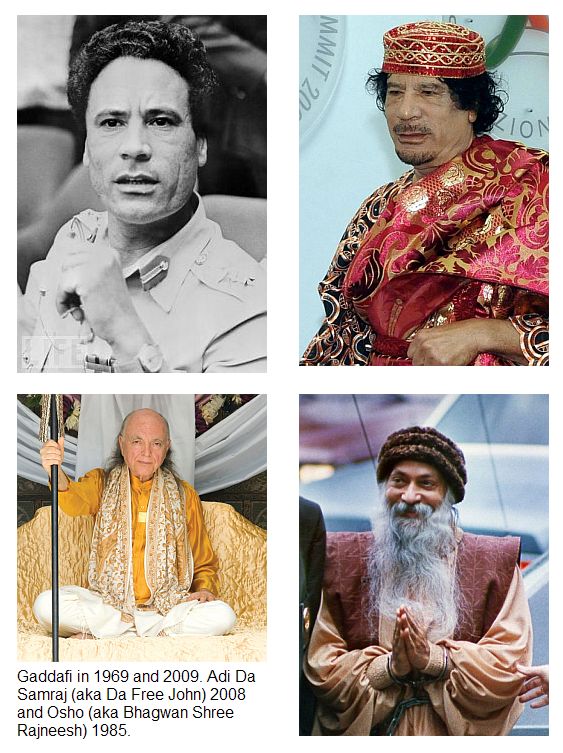
Why blindfolded people can’t walk straight and Gaddafi dresses funny

It is well-documented that when blindfolded, people find it impossible to walk (or drive) in a straight line.

Robert Krulwich explains:

It is also well-documented that as cult leaders amass larger followings they often cultivate an increasingly bizarre and grandiose persona, evident in their own unique attire — a blend of the imperial, exotic or even extra-terrestrial.

So how did Gaddafi go from being a dapper young army officer to a would-be pan-African emperor?

By wearing a blindfold, so to speak.

The self-tied blindfold that sends cult leaders along a spiral path of deviation is adulation and uncritical attention from their followers. There are no countervailing forces which might temper the leader’s expanding grandiosity. There are no independent voices to warn the emperor that his sense of style has drifted towards wild eccentricity. The mutually reinforcing power of group-think places both leader and followers in a bubble sealed off from reality.

Now here’s the interesting thing: this human inclination to physically or figuratively deviate from a straight course when the individual is deprived of corrective input from external and independent sources is an adaptive tendency.

How so? Unlike aircraft that can safely employ an autopilot in the relatively predictable environment of high altitude, we operate in highly unpredictable, rapidly changing surroundings. We need autopilots that have a built-in need to be overridden. The more comfortable we become in a blindfold, the more certain we will run into trouble.

Facebooktwittermail

How the Israel lobby chills Middle East debate

The Israel lobby is like the Mafia. It’s commonly understood how it works, who its leaders are, how they wield their power through intimidation, and to what effect. But there’s a big difference between knowing the identity of a Mafia boss and being able to throw him in jail. Usually an informant needs to be wired so that incriminating words can get caught on tape.

The following story recounted by MJ Rosenberg, who was himself once an AIPAC official, goes beyond the broad brushstrokes that are usually employed to describe the impact of the lobby on American politics. It is more akin to evidence from a wire — evidence that those who get on the wrong side of the lobby risk having their lives destroyed.

This week, following that tumultuous reception for Prime Minister Netanyahu at the congressional joint meeting, I want to share a personal recollection of how the Middle East status quo is preserved on Capitol Hill.

It was in 1988 and I was a foreign policy aide to Sen. Carl Levin (D-MI). One February day, Levin called me into his office to say that he was disturbed at a quote he saw in that day’s New York Times. An article quoted Israeli Prime Minister Yitzhak Shamir saying that he rejected the idea of withdrawing from any of the land Israel captured in the 1967 war:

Mr. Shamir said in a radio interview, ”It is clear that this expression of territory for peace is not accepted by me.”

Levin instantly understood what Shamir was saying. He was repudiating U.N. Security Council Resolutions 242 and 338 (which Israel had helped draft) which provided for “withdrawal of Israeli armed forces from territories occupied in the recent [1967] conflict” in exchange for peace and security. Those resolutions represented official U.S. and international policy then, and they still do.

But, in 1988, Shamir tried to declare them null and void.

Levin asked me to draft a letter to Secretary of State George Shultz stating that it was the view of the Senate that the U.N. Resolutions remained the policy of the U.S. whether Shamir liked it or not. Of course, the letter wasn’t written in that kind of language. It was more than polite. Additionally, Levin wanted it addressed to Shultz, not to Shamir, to avoid ruffling too many feathers in Israel.

I wrote the draft. Levin edited and re-edited it. Then he called in the head of AIPAC, Thomas A. Dine, to run the language past him. Tom said it was “great.” Levin told Dine that he would not embarass him by revealing that he had approved the letter.

Levin then asked me to deliver it to the Secretary of State but said that first he would try to round up a few other senators to join him in signing it. In an hour he had 30. He probably could have gotten three times as many but it was Friday afternoon and most of the senators had decamped.

I delivered the letter. Because Levin wanted to avoid a brouhaha, the Levin office did no press about it. It was essentially a secret initiative.

But then one of the senators who had the letter gave it to the New York Times. And within minutes the phones started ringing off the hook. Reporters and AIPAC donors (who had no idea Dine had signed off on the letter) were going crazy. Levin was asked to appear on all three Sunday morning talk shows. He declined. In fact, he took off for Moscow, on a long-planned trip. [Continue reading…]

Facebooktwittermail

‘AIPAC activists beat me’

Only a few months after Rae Abileah was among a group of young Jewish activists who found themselves the target of Jewish mob violence, she was attacked again yesterday, this time while exercising her right to free speech inside the US Congress.

Ynet reports:

Rae Abileah, a woman of Israeli descent who interrupted Prime Minister Benjamin Netanyahu’s speech before the US Congress Tuesday, claims she was beaten by AIPAC activists.

“I yelled ‘Stop the occupation’ and immediately they jumped on me,” she told Ynet.

Abileah, a 28-year old Jewish daughter of an Israeli, is a member of Code Pink, a pacifist organization. She told Ynet that she had disrupted another speech by Netanyahu at the Jewish Federations General Assembly in New Orleans in November.

“We are a young generation of Jews who don’t intend to sit by in silence and allow prime ministers who commit crimes against humanity speak,” she said. “As far as we’re concerned he can speak at the International Criminal Court in the Hague.”

Abileah says she used a card procured by a friend to sneak into the House of Representatives. “When Netanyahu began to speak about Israel and democracy a got up to speak against its anti-democratic operations,” she said.

“I yelled, ‘Stop the occupation, stop Israeli war crimes’ and I called out for equal rights for Palestinians.”

Facebooktwittermail

The greatest threat to the Jewish state

An external enemy is really the only thing that unites Israelis. For that reason, ultimately, nothing poses a greater existential threat to the Jewish state than peace. No wonder Israel’s leaders have such little interest in establishing permanent borders and good relations with their neighbors.

By 2028 an estimated 25 percent of children under 14 will be ultra-Orthodox Haredi Jews and currently 60 percent of Haredi men choose not to work. Even without the strains between Israel’s Jewish and non-Jewish populations, paradoxically, the greatest strain on the state is being imposed from within.

Daniel Levy writes:

One notable phenomenon in the past decade and a half has been the rapid expansion of the state-funded but independent education system established by the ultra-Orthodox Shas party. Shas is often a pivotal, if not decisive, player in Israel’s governing coalitions, which over the years has given it the power to direct state resources toward the Shas-run school system.

In many provincial Israeli towns and neighborhoods, Shas schools have come to trump the state-school system in the provision of certain services, such as transportation and hot meals (one benefit of the Shas budgetary bargaining power). Even many parents who are not ultra-Orthodox send their children to Shas schools. Over the past 20 years, the number of Jewish primary school students enrolled at ultra-Orthodox schools has grown from just over seven percent to more than 28 percent.

This trend has great implications for Israeli society and its economy: the Shas system and other ultra-Orthodox schools teach a narrowly religious curriculum that is less geared to providing pupils the skills necessary to compete in a modern economy. A combination of state policies and cultural norms has meant that both the Haredi and Palestinian-Arab communities have low rates of labor-force participation: for example, only 40 percent of Haredi men and 19 percent of Palestinian-Arab women work. To further compound the strain on Israel’s economy, Haredi men often spend a lifetime in state-subsidized religious education centers, or yeshivot. A 2009 report by the Metzilah Center, a think tank in Jerusalem, concluded that without a strong state effort to economically and socially integrate these populations, the “rapid growth of two economically weak population groups … Haredim and Muslims … may deal a blow to Israel’s future as a developed and prosperous state.”

Facebooktwittermail