#Netanyahu, who once blames the Holocaust on a Palestinian, defended Trump today on allegations of antisemitism. pic.twitter.com/XNsgbkiXT4 https://t.co/YVgmJmijNT
— Ahmed Shihab-Eldin (@ASE) February 15, 2017




#Netanyahu, who once blames the Holocaust on a Palestinian, defended Trump today on allegations of antisemitism. pic.twitter.com/XNsgbkiXT4 https://t.co/YVgmJmijNT
— Ahmed Shihab-Eldin (@ASE) February 15, 2017
David Frum writes: Stop talking about the Logan Act.
It was not the violation of this antique and ignored piece of anti-Jacobin legislation that has touched off the biggest foreign-policy scandal since Watergate.
Nobody would care if an incoming national security adviser had confidential conversations with an ambassador of a hostile foreign government before Inauguration Day, if it were believed that the conversations served a legitimate and disinterested public purpose.
But that is exactly what is doubted in this case.
To put the story in simplest terms:
1) Russian spies hacked Democratic Party communications in order to help elect Donald Trump.
2) Donald Trump welcomed the help, used it, publicly solicited more of it—and was then elected president of the United States.
3) President Obama sanctioned Russia for its pro-Trump espionage.
4) While Russia considered its response, its ambassador spoke with the national security adviser-designate about the sanctions
5) The adviser, Flynn, reportedly asked Russia not to overreact, signaling that the new administration would review the sanctions; Russia did not respond.
6) As president-elect and then president, Donald Trump has indicated that he seeks to lift precisely those sanctions caused by Russia’s espionage work on his behalf.
All of this takes place against the background of Donald Trump’s seeming determination to align U.S. foreign policy ever closer to Russia’s: endorsing the annexation of Crimea, supporting Russia’s war aims in Syria, casting doubt on the U.S. guarantee to NATO allies, cheering on the breakup of the European Union. [Continue reading…]
Ryan Goodman writes: In his debut on this past weekend’s Sunday morning shows, Stephen Miller, the President’s Senior Policy Advisor, repeated what to some was an alarming statement about the federal judiciary. Defending the White House’s immigration and refugee Executive Order against significant setbacks in federal court including a few days earlier the Appeals Court for the Ninth Circuit, Miller said on Meet the Press:
I also want to be clear we’ve heard a lot of talk about how all the branches of government are equal. That’s the point. They are equal. There’s no such thing as judicial supremacy. What the judges did, both at the ninth and at the district level was to take power for themselves that belongs squarely in the hands of the president of the United States.
I posed the following question to some of the most highly respected constitutional law experts across the country, excluding current members of Just Security’s Board of Editors. I separately sent each person excerpts (see here) of transcripts of Fox News Sunday and Meet the Press, and posed the following query:
Some worry that at some point our country may face a constitutional crisis in which President Trump does not comply with a decision of the Supreme Court, whether in the immigration context or some other case. In view of that concern, how do you view Miller’s statements? You might say, for example, whether you think his views are part of a mainstream school of thought in constitutional law, are potentially limited to the immigration context, or represent a view that would support the President’s disregarding judicial orders from the federal courts or the Supreme Court in particular. Please feel free to address any one of those dimensions or another that you think this issue raises.
Throughout the answers below, the emphasis in the text (in bold) is provided by me, not the author of the statement.
1. Strong Rejection of Miller’s Statements as Expression of Attitude or Ideology
Professor Laurence Tribe, Carl M. Loeb University Professor and Professor of Constitutional Law at Harvard:
We can try to interrogate what Miller said by recourse to different legal schools of thought and the like, but I want to focus on a different plane and the one in which I believe Miller attempted to register his claim. I am concerned that, well beyond a purely theoretical and ignorant account of the role of an independent judiciary, Miller appears to be channeling President Trump’s underlying attitude, one doubtless not formulated in theoretical terms but baked into his personality and his sense of what it means to be a strong president. In that respect, Miller seemed to be engaged in a performance to earn the praise of his boss. The performance was consistent with the attitude Mr. Trump expressed in disparaging the supposedly “Mexican judge” Curiel back during the campaign, in calling U.S. District Court Judge Robart a “so-called judge,” and in saying the remarkably thoughtful 9th Circuit oral argument was “disgraceful” and “political” when it was as far from either as a judicial exchange dealing with a politically explosive issue could be. It is this gestalt—rather than a well formulated theory of the judiciary’s role—that may someday threaten the foundations of our constitutional democracy if not in this litigation under the Trump administration than in another.
Reuters reports: As a teenager in the early 1970s retired U.S. Navy Vice Admiral Robert S. Harward played football and basketball, was popular with classmates and, like many American high school students, was known for partying.
But Harward, to whom President Donald Trump has offered the post of U.S. national security adviser, to succeed Michael Flynn, spent his teenage years not in his native Rhode Island, but in pre-revolutionary Iran, where his father, a Navy captain, advised the Iranian military.
During his teenage years, Harward lived in an Iranian neighborhood, attended school with Iranian-American students and played sports against Iranian teams. Those experiences gave him an unusual familiarity with Iran’s culture and people in the years before the 1979 Islamic revolution that ousted the pro-American Shah.
“During very formative years of his life, he was exposed to everything that was Iran,” said Joseph Condrill, who knew Harward, known by his classmates as Bobby, when they were students at the Tehran American School. “Iran was one of our homes, and we got to know the Iranian people very well, in a very intimate way.”
The Trump administration has offered Harward the job of national security adviser, two U.S. officials familiar with the matter said on Wednesday. It was not immediately clear if Harward had accepted, the sources said. [Continue reading…]
Thomas Ricks writes: Harward is, like the ousted Michael Flynn, a retired military flag officer. But I think he would be very different from Flynn.
Most importantly, he is not an ideologue, as Flynn seemed to have become in the last few years. Harward thinks of himself as a national security professional — and indeed once served on the NSC staff, during the Bush Administration. Before that, early in the Afghan war, he headed the Special Operations task force in Kandahar.
Harward also would work well with Defense Secretary James Mattis. When Mattis was chief of Central Command, Harward was his deputy. Mattis trusted him enough to put him in charge of planning for war with Iran. Mattis has urged Harward to take the NSA job.
If Harward becomes NSA, Mattis would emerge from the Flynn mess in a uniquely powerful position: He would have two of his former deputies at the table in some meetings. The other one is John Kelly, now secretary for Homeland Security, who was his number two when Mattis commanded a Marine division early in the invasion of Iraq in 2003.
At this point, Mattis has far greater influence over former military officers than the president does. His presence at the Pentagon is the sole reason some are considering climbing aboard Trump’s sinking ship. [Continue reading…]
Adam Goldberg writes: All U.S. attorneys general have the authority to appoint someone to conduct investigations, vesting investigative and prosecutorial powers in them. Wholly apart from the independent counsel law that expired in 1999, U.S. attorneys general have used this authority precisely at times like these when greater independence is necessary. Most recently, President Bush’s Department of Justice exercised this ability in 2003, when Attorney General Ashcroft recused himself from the investigation into the leaking of a CIA officer’s identity and Deputy Attorney General Comey appointed Patrick Fitzgerald as special counsel.
That we need a special counsel now is clear from three key facts. First, General Flynn discussed sanctions with the Russian ambassador before President Trump took office and lied about it. If, as some say, this could not possibly be a violation of the Logan Act — prohibiting private citizens from interfering with U.S. foreign policy — why lie about it? If General Flynn’s discussions were typical transition work, why deceive the country and the Vice President?
Second, in General Flynn’s resignation letter he stated that he gave “incomplete information” to the Vice President and others, but General Flynn notably omitted giving incomplete information to President Trump. Perhaps that is because he never discussed the issue with President Trump. It is at least as likely, however, that he did — that President Trump knew about the full content of General Flynn’s discussions and did so at the time General Flynn made them. Can we trust President Trump’s own Department of Justice to investigate him? [Continue reading…]
Peter Beinart writes: Nothing Donald Trump has done since becoming President is particularly surprising. The attacks on judges and the press, the clash of civilizations worldview, the ignorance of public policy, the blurring of government service and private gain, the endless lying, the incompetence, the chaos — all were vividly foreshadowed during the campaign. The Republican-led Congress’ refusal to challenge Trump was foreseeable too. The number of Republicans willing to oppose Trump’s agenda pretty much equals the number who refused to endorse him once he became the GOP nominee.
Less predictable has been the response of other elements of the American political system: The bureaucracy, the press, the judiciary and the public. Here, the news is good. So far, they’re not only pushing back, they’re having some success.
The latest example is the resignation of National Security Advisor Michael Flynn. Flynn’s resignation is a welcome development both because he held crudely bigoted views of Muslims and because he was unable to competently manage the foreign policy process. But that’s not why he lost his job. He lost his job because of an independent bureaucracy and a vigorous press.
CNN’s Brian Stelter has reconstructed the chain of events. On January 12, a “senior U.S. government official” told Washington Post columnist David Ignatius that, “Flynn phoned Russian Ambassador Sergey Kislyak several times on Dec. 29, the day the Obama administration announced the expulsion of 35 Russian officials as well as other measures in retaliation for the [Russian] hacking” of the presidential election. Three days later, CBS’ John Dickerson asked Vice President Mike Pence about the call, and Pence insisted that Flynn had not discussed “anything having to do with the United States’ decision to expel diplomats or impose censure against Russia.”
But the Washington Post followed up, citing “nine current and former officials” who claimed that Flynn had discussed exactly that. The New York Times reported that there was a transcript of the call. Eventually, it became impossible to deny that Flynn had lied, and caused Pence to lie. If the Trump administration had been able to deny reality, as it so often does, Flynn would likely still have his job. But good reporters, aided by government sources, made that impossible. As the Columbia Journalism Review notes, “it wasn’t the lying that got him [Flynn] fired; it’s that his lying leaked to the press.” [Continue reading…]
The Atlantic reports: Breitbart News has a target in its crosshairs following the departure of former National Security Adviser Mike Flynn from the White House in a cascade of scandal over his contacts with the Russian government: White House Chief of Staff Reince Priebus.
Targeting Priebus, who leads the faction of Trump aides that is composed of experienced establishment political hands, is really just a stand-in for a larger conflict about the future of Trumpism in the White House. Breitbart News is treating Flynn’s ouster as the first salvo in a war against those in the administration they deem insufficiently loyal to Trump. Backing up Breitbart are legions of other Trump loyalists in the right-wing media sphere. And their angry reaction to Flynn’s exit signals the unpopularity of the move with a vocal segment of Trump’s base.
Trump loyalists — meaning the true believers who supported Trump from the start, not Republican politicos who became attached later on — have been privately musing about getting rid of Priebus. Now, that musing is going public. “I think this is Pearl Harbor for the true Trump supporters, the Trump loyalists,” said Roger Stone, a former Trump campaign adviser and longtime Republican operative who still has a relationship with Trump. “I believe Reince Priebus moved on General Flynn and I think he intends to move on Steve Bannon and Stephen Miller next. He is not serving the president well. The people he hired are loyal to the Republican National Committee, not the President of the United States.” [Continue reading…]
Ishaan Tharoor writes: So far, the most meaningful role played by President Trump in the miserable conflict in Syria has been his relentless demonization of Syrian refugees.
But the war still smolders, and the White House will, sooner or later, have to reckon with its complexity. It may also need to confront the mounting evidence of atrocities committed by the regime of Syrian President Bashar al-Assad.
On Monday, Human Rights Watch issued a report on the regime’s alleged use of chlorine bombs during its successful campaign last year to reclaim the last rebel-held territory in the city of Aleppo. The rights group documented at least eight separate chlorine gas attacks before a cease-fire was signed on Dec. 13. “The attacks resulted in the deaths of nine civilians, including four children, and wounded roughly 200,” reported my colleague Thomas Gibbons-Neff. “If confirmed, the attacks would be a significant breach of the 1993 Chemical Weapons Convention that Syria signed in 2013.”[Continue reading…]
Brian Klaas writes: There is an enormous paradox at the heart of American democracy. Congress is deeply and stubbornly unpopular. On average, between 10 and 15 percent of Americans approve of Congress – on a par with public support for traffic jams and cockroaches. And yet, in the 2016 election, only eight incumbents – eight out of a body of 435 representatives – were defeated at the polls.
If there is one silver bullet that could fix American democracy, it’s getting rid of gerrymandering – the now commonplace practice of drawing electoral districts in a distorted way for partisan gain. It’s also one of a dwindling number of issues that principled citizens – Democrat and Republican – should be able to agree on. Indeed, polls confirm that an overwhelming majority of Americans of all stripes oppose gerrymandering.
In the 2016 elections for the House of Representatives, the average electoral margin of victory was 37.1 percent. That’s a figure you’d expect from North Korea, Russia or Zimbabwe – not the United States. But the shocking reality is that the typical race ended with a Democrat or a Republican winning nearly 70 percent of the vote, while their challenger won just 30 percent. [Continue reading…]
The Washington Post reports: The acting attorney general informed the Trump White House late last month that she believed Michael Flynn had misled senior administration officials about the nature of his communications with the Russian ambassador to the United States, and warned that the national security adviser was potentially vulnerable to Russian blackmail, current and former U.S. officials said.
The message, delivered by Sally Q. Yates and a senior career national security official to the White House counsel, was prompted by concerns that Flynn, when asked about his calls and texts with the Russian diplomat, had told Vice President-elect Mike Pence and others that he had not discussed the Obama administration sanctions on Russia for its interference in the 2016 election, the officials said. It is unclear what the White House counsel, Donald McGahn, did with the information.
Flynn resigned Monday night in the wake of revelations about his contacts with the Russian ambassador.
In the waning days of the Obama administration, James R. Clapper Jr., who was the director of national intelligence, and John Brennan, the CIA director at the time, shared Yates’s concerns and concurred with her recommendation to inform the Trump White House. They feared that “Flynn had put himself in a compromising position” and thought that Pence had a right to know that he had been misled, according to one of the officials, who, like others, spoke on the condition of anonymity to discuss intelligence matters.
A senior Trump administration official said before Flynn’s resignation that the White House was aware of the matter, adding that “we’ve been working on this for weeks.”
The current and former officials said that although they believed that Pence was misled about the contents of Flynn’s communications with the Russian ambassador, they couldn’t rule out that Flynn was acting with the knowledge of others in the transition. [Continue reading…]
Flynn's resignation is a good start, but to quote the Watergate hearings, "What did the president know, and when did he know it?"
— Garry Kasparov (@Kasparov63) February 14, 2017
The Washington Post reports: Michael Flynn set a record on Monday with his resignation as the White House national security adviser: No one in the 64-year history of the role had a shorter tenure than his, not by a long shot. [Continue reading…]
Politico reports: Counselor to the president Kellyanne Conway’s assertion that former national security adviser Michael Flynn enjoyed “the full confidence of the president” just hours before he offered his resignation is proof that President Donald Trump’s former campaign manager is “out of the loop” and acting recklessly, MSNBC host Joe Scarborough said Tuesday morning.
“She goes out and lies and you find out about those lies a couple hours later,” Scarborough said, addressing “Morning Joe” panelist Willie Geist. “Or if she’s not lying, Willie, she is – actually what I’ve heard she is – so out of the loop. She’s in none of the meetings and she just goes out without talking without having the facts.” [Continue reading…]
Which begs the question: Why is anyone interviewing her?
Ivan Krastev and Stephen Holmes write: There is no way of knowing if Russian interference contributed decisively to Trump’s upset victory. But it’s fair to say that the Kremlin viewed the outcome as a divine gift. Since at least 2011-2012, when Russia witnessed widespread popular protests, and particularly after the Ukrainian Maidan uprising — events that elicited heartfelt praise and encouragement from then-Secretary of State Hillary Clinton — Russia’s leadership had been convinced that her election would spell disaster for Russia and that it might even lead to war. So Russians did what they could to prevent Clinton from getting into the White House. But while they welcomed her defeat, they were wholly unprepared for the ensuing regime change in Washington.
Now that Trump is in power, political elites in Moscow have stopped cheering. They recognize that Russia’s position has become abruptly and agonizingly complex.
It’s true that Trump’s accession opens up the possibility of “normalizing” Russia’s relations with the West, beginning with a reduction or even elimination of sanctions. It also validates many of Russia’s ideological criticisms of the liberal order and may perhaps foreshadow policy reversals that Moscow has long hoped for: from Washington’s disengagement from the Ukraine crisis to its dissolution of the Cold War Western alliance. Russians also celebrate Trump’s unfiltered stream-of-consciousness diatribes as signaling a welcome end to America’s hypocrisy and condescension.
But Trump’s revolution is also ushering in a period of turmoil and uncertainty, including the likelihood of self-defeating trade wars. Still traumatized by the disintegration of the Soviet Union, Russia’s present leadership has no appetite for global instability.
With Trump in the White House, moreover, Putin has lost his monopoly over geopolitical unpredictability. The Kremlin’s ability to shock the world by taking the initiative and trashing ordinary international rules and customs has allowed Russia to play an oversized international role and to punch above its weight. Putin now has to share the capacity to keep the world off balance with a new American president vastly more powerful than himself. More world leaders are watching anxiously to discover what Trump will do next than are worrying about what Putin will do next. Meanwhile, using anti-Americanism as an ideological crutch has become much more dubious now that the American electorate has chosen as their president a man publicly derided as “Putin’s puppet.”
What the Kremlin fears most today is that Trump may be ousted or even killed. His ouster, Kremlin insiders argue, is bound to unleash a virulent and bipartisan anti-Russian campaign in Washington. Oddly, therefore, Putin has become a hostage to Trump’s survival and success. This has seriously restricted Russia’s geopolitical options. The Kremlin is perfectly aware that Democrats want to use Russia to discredit and possibly impeach Trump while Republican elites want to use Russia to deflate and discipline Trump. The Russian government fears not only Trump’s downfall, of course, but also the possibility that he could opportunistically switch to a tough anti-Moscow line in order to make peace with hawkish Republican leaders in Congress. [Continue reading…]
Ishaan Tharoor writes: Long gone are the days when Communist Moscow backed leftist movements around the world. Instead, Putin’s post-Soviet ideologues see Russia at the vanguard of global Christian nationalist conservatism. In this struggle, they’ve found common cause with Europe’s far-right parties as well as key figures within the Trump administration.
In 2014, current White House chief strategist Stephen K. Bannon told a gathering of European conservatives that “we, the Judeo-Christian West, really have to look at what [Putin]’s talking about as far as traditionalism goes — particularly the sense of where it supports the underpinnings of nationalism.” That same year, a group of fringe American white nationalists joined a conference in Hungary that featured Russian nationalist Alexander Dugin, a philosopher sometimes dubbed “Putin’s Rasputin.” Dugin hailed Trump as “the American Putin” last year.
American journalist Casey Michel has assiduously tracked the connections between right-wing American evangelicals and kindred spirits in Russia, who both champion anti-gay laws and the primacy of Christianity in the identity of Western nations.
“In the same sense that Russia’s [anti-LGBT] laws came about in 2013, we’ve seen similar sorts of laws proposed in Tennessee, for example,” said Cole Parke, an LGBT researcher with Political Research Associates, to Michel last week. “It’s difficult to say in a chicken-and-egg sort of way who’s inspiring whom, but there’s definitely a correlation between the two movements.”
Western “traditionalists,” whether in the U.S. or Europe, now style themselves as Putin’s fellow travelers.
“Putin may be seeing the future with more clarity than Americans still caught in a Cold War paradigm,” wrote Patrick Buchanan, the right-wing, ethno-nationalist American politician, in 2013. He went on to suggest that the new fault line in global politics would be between “conservatives and traditionalists in every country arrayed against the militant secularism of a multicultural and transnational elite.” [Continue reading…]
The Washington Post reports: With President Trump in his fourth full week in office, the upheaval inside the administration that West Wing officials had optimistically dismissed as growing pains is now cementing itself as standard operating procedure.
Trump — distracted by political brushfires often of his own making — has failed to fill such key posts as White House communications director, while sub-Cabinet positions across agencies and scores of ambassadorships around the globe still sit empty.
Upset about damaging leaks of his calls with world leaders and other national security information, Trump has ordered an internal investigation to find the leakers. Staffers, meanwhile, are so paranoid about being accused of talking to the media that some have resorted to a secret chat app — Confide — that erases messages as soon as they’re read.
The chaos and competing factions that were a Trump trademark in business and campaigning now are threatening to plague his presidency, according to interviews with a dozen White House officials as well as other Republicans. Most requested anonymity in order to candidly discuss internal White House dynamics and deliberations.
Some senior officials are worried about their own standing with the president, who through his casual conversations with friends and associates sometimes seems to hint that a shake-up could come at a moment’s notice. Aides said they strive to avoid appearing “weak” or “low-energy” — two of Trump’s least favorite attributes.[Continue reading…]
Congratulations Stephen Miller- on representing me this morning on the various Sunday morning shows. Great job!
— Donald J. Trump (@realDonaldTrump) February 12, 2017
At Santa Monica High School, while running for class pres Stephen Miller was boo'd off a stage by over 4000 students. I was one of them!
— Cody Decker (@Decker6) February 13, 2017
Univision News: Some of the students who knew Miller in high school said he had no interests other than radical politics, and that he always seemed unhappy.
“He had a lot of grudges. He didn’t go out of his way to go to dances or to have girlfriends,” de la Torre said. “I don’t remember ever seeing him smile.”
The Atlantic: “Miller had two very well earned reputations: as an aggressive self-promoter and as a bomb thrower,” said one friend of Miller’s from Duke who holds him in high regard and requested anonymity for professional reasons. “He was extremely effective at both. He sustained himself on liberal tears and hysteria. Some Duke [College Republicans] used to call him the ‘Miller Outrage Machine.’ You might say he was the Trump campaign 10 years before the Trump campaign.”
Dana Nuccitelli writes: Wikipedia editors recently voted to ban the Daily Mail tabloid as a source for their website after deeming it “generally unreliable.” To put the severity of this decision in context, Wikipedia still allows references to Russia Today and Fox News, both of which display a clear bias toward the ruling parties of their respective countries.
It thus may seem like a remarkable decision for Wikipedia to ban the Daily Mail, but fake news stories by David Rose in two consecutive editions of the Mail on Sunday – which echoed throughout the international conservative media – provide perfect examples of why the decision was justified and wise.
On February 5th, Rose ran a story alleging scandalous behavior by NOAA scientists in a 2015 paper. The story was based on an interview with retired NOAA scientist John Bates, who was not involved in the study. However, in follow-up interviews with real science journalists, Bates clarified that he was in no way disputing the quality or accuracy of the data, even going as far as to make this damning comment:
I knew people would misuse this. But you can’t control other people.
Most importantly, the scientific integrity of the NOAA data is indisputable. The organization’s global temperature data is nearly identical to that of other scientific groups like NASA, the Hadley Centre, and Berkeley Earth. [Continue reading…]
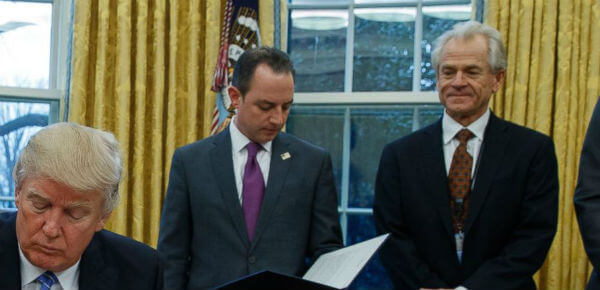
While considering the danger posed by the head of Trump’s National Trade Council, Jacob Heilbrunn writes: To counter the manifold economic and military threats the United States faces, Navarro recommends a sweeping revision of U.S. foreign policy. He wants high tariffs, the repudiation of trade pacts and, above all, a massive military buildup against China. One of Navarro’s aspirations is to beef up military ties with Taiwan, which Beijing considers part of China. Calling the Obama administration’s treatment of Taipei “egregious,” Navarro declared in Foreign Policy that it has been “repeatedly denied the type of comprehensive arms deal it needs to deter China’s covetous gaze.” At the same time, Navarro wants to end sequestration on defense and go on an all-out shipbuilding binge for the U.S. Navy. Nor does Navarro seem to see a bomber that he would not like to build.
The hysterical economic warnings, the scary prescriptions and the self-defeating proposals would simply be fanciful nonsense if Navarro weren’t whispering in the ear of the most powerful man in the world. The fact that he is makes them dangerous. Of course, where Trump will actually head still remains an open question. After his initial questioning of a “one China” policy, Trump, in a phone call with Chinese President Xi Jinping on Thursday, seems to have endorsed it. But at the same time, Trump is clearly seeking to use Japan to balance Chinese power, which is why he is hosting Japanese Prime Minister Shinzo Abe this weekend. On Friday, Abe even promised to invest in America and joked that he would help build a Maglev train that would convey the president within an hour from Washington to his Manhattan aerie.
Like not a few presidential advisers in history, Navarro may not be able to enact everything he proposes. Perhaps he will breathe fire about the perfidy of China and other countries but not decisively influence economic policy. In this scenario, Navarro would serve as a convenient release valve for ventilating frustration about the further loss of manufacturing jobs that is likely to continue under Trump, thanks mostly to the inexorable rise of artificial intelligence and automation. In the Washington Post, Ed Hess, a professor of business administration at the University of Virginia, predicts that tens of millions of jobs will be destroyed in the next five to 15 years by emerging technologies, and 47 percent wiped out over the next 10 to 15 years.
Another possibility is that Navarro doesn’t get free rein but has to jockey for power with the other economic players in the administration, including Steven Mnuchin at Treasury, a former Goldman Sachs executive who has no history of China antagonism. In this scenario, Trump doesn’t jettison NAFTA but rather accedes to some cosmetic changes that don’t fundamentally alter the pact. At the same time, he retreats from his bogus charge that Beijing is depressing its currency — it isn’t — and initiates trade talks with the Chinese while also working with them to corral North Korean nuclear ambitions.
But there’s a third possibility — one that we shouldn’t dismiss. In this scenario, the Navarro line prevails. Trump unilaterally slaps draconian tariffs on Mexico and China. In turn, the World Trade Organization says they’re illegal. Trump, never one to defer to the courts, pulls the U.S. out of the WTO, and the international economic order is upended. With tariffs high and Trump bailing out of international institutions, it doesn’t take long before we end up in a global depression. The last time something like this occurred it led directly to the rise of fascist regimes in Germany, Italy and Japan, with nationalist leaders promising that domestic repression and external expansion were a quick and easy remedy to their nation’s woes. [Continue reading…]

Bloomberg reports: Trump will be forced to deal with ongoing threats from North Korea as that country gains the ability to threaten the continental U.S. with a nuclear strike, an official said on Sunday, hours after Pyongyang fired a ballistic missile into nearby seas.
North Korea will probably develop its ballistic missile technology enough to pair with its nuclear weapons to reach the U.S. during Trump’s tenure, said Richard Haass, president of the Council on Foreign Relations.
Either the U.S. gets the Chinese to help increase pressure on North Korea through sanctions, or Trump will have “a truly consequential decision,” Haass said on CNN’s “Fareed Zakaria GPS” on Sunday.
“Trump is going to have to face a truly fateful decision about whether we’re prepared to live with that, a North Korea that has that capability against us, or we are going to use military force one way or another to destroy their nuclear missile capability,” Haass said. [Continue reading…]
The New York Times reports: South Korea’s Foreign Ministry said the test, the first by the North this year, demonstrated the “maniacal obsession” of the North Korean leader, Kim Jong-un, with developing a nuclear-tipped ballistic missile.
The test came less than two days after Mr. Trump said on Friday that defending against the nuclear and missile threats from North Korea was a “very, very high priority.” Mr. Trump made the comment at a news conference with Mr. Abe at the White House. In their joint statement, the two leaders had urged North Korea “to abandon its nuclear and ballistic missile programs and not to take any further provocative actions.” [Continue reading…]
David Wright writes: The missile was apparently launched eastward from the Panghyon air base near Kusong, northwest of Pyongyang and traveled 500 km, splashing down in the Sea of Japan. According to the South Korean military, it flew on a lofted trajectory, reaching an apogee of about 550 km.
A missile flown on this trajectory would have a range of 1,200-1,250 km if flown on a standard trajectory with the same payload.
That range is similar to that of the North Korean Nodong missile, which was first tested in the early 1990s and has been launched repeatedly since then. Another launch of the Nodong would not be particularly useful for advancing Pyongyang’s missile program, so if that was what was launched it would have had a political motivation.
However, as Jeffrey Lewis points out, the trajectory is very similar to the trajectory the submarine-launched KN-11 missile flew in its first successful test last August. While similar in range to the Nodong, the KN-11 has the advantage that it uses solid rather than liquid fuel, which means it would take less preparation time before a launch. The North is likely to be interested in developing and testing a land-based version of the missile.
If this is what was launched, it would represent a useful developmental step for North Korea, no matter what may have driven the timing of the launch. [Continue reading…]