Category Archives: Analysis

Steve Bannon will lead Trump’s White House

Ryan Lizza writes: “I’m a Leninist,” Steve Bannon told a writer for The Daily Beast, in early 2014. “Lenin wanted to destroy the state, and that’s my goal, too. I want to bring everything crashing down, and destroy all of today’s establishment.”

At the time, Bannon was the executive chairman of Breitbart News, the far-right news site. When he became the C.E.O. of Donald Trump’s campaign, in August, he told the writer that he had no recollection of the conversation. On Sunday, Trump, in his first personnel decisions as President-elect, named Bannon as his chief strategist and senior counselor and Reince Priebus, the Republican National Committee Chairman, his chief of staff.

The press release from the Trump transition staff said that Bannon and Priebus would be “equal partners.” This is a signal to Washington that Bannon will be the most powerful person in Trump’s White House. On November 6, 2008, the day after his election, Barack Obama made just one personnel announcement: that Congressman Rahm Emanuel would be his chief of staff. Every staff member in the Obama White House reported to Emanuel, including political advisers such as David Axelrod. Even in the George W. Bush White House, which at first had a weak chief of staff, Andy Card, and a powerful political adviser, Karl Rove, everyone, including Rove, formally reported to Card.

Trump has indicated that, in his White House, Bannon will be first among equals. [Continue reading…]

The Washington Post reports: neither Bannon nor staff members at Breitbart have spelled out what their relationship will be after candidate Trump becomes President Trump. But even if Bannon and the website sever all ties, they will face an unusual, and awkward, situation: Bannon would be the former executive of a media organization that openly supported his political patron who will serve the president in a senior capacity while his media organization continues to cover him and his new boss.

Breitbart will now go from being the propaganda arm of the Trump campaign to effectively becoming a state-run medium,” said Kurt Bardella, Breitbart’s former spokesman. “They will exist to tell the narrative of the Trump presidency to their audience to ensure their alternate reality they successfully ran on stays intact regardless of the situational reality and condition of this country. There is no separation between Breitbart and the Trump White House.” [Continue reading…]


Facebooktwittermail

Don’t call Clinton a weak candidate — it took decades of scheming to beat her

Rebecca Solnit writes: Sometimes I think I have never seen anything as strong as Hillary Clinton. That doesn’t mean that I like and admire everything about her. I’m not here to argue about who she is, just to note what she did. I watched her plow through opposition and attacks the like of which no other candidate has ever faced and still win the popular vote. To defeat her it took an unholy cabal far beyond what Barack Obama faced when he was the campaign of change, swimming with the tide of disgust about the Bush administration. As the New York Times reported, “By the time all the ballots are counted, she seems likely to be ahead by more than 2m votes and more than 1.5 percentage points. She will have won by a wider percentage margin than not only Al Gore in 2000 but also Richard Nixon in 1968 and John F Kennedy in 1960.”

You can flip that and see that Trump was such a weak candidate it took decades of scheming and an extraordinary international roster of powerful players to lay the groundwork that made his election possible. Defeating Clinton in the electoral college took the 2013 gutting of the Voting Rights Act by Republican appointees to the supreme court. It took vast Republican voter suppression laws and tactics set in place over many years. It took voter intimidation at many polling places. It took the long Republican campaign to blow up the boring bureaucratic irregularity of Clinton’s use of a private email server into a scandal that the media obediently picked up and reheated.

It took James Comey, the director of the FBI, using that faux-scandal and his power to stage a misleading smear attack on Clinton 11 days before the election in flagrant violation of the custom of avoiding such intervention for 60 days before an election. It took a compliant mainstream media running after his sabotage like a golden retriever chasing a tennis ball. It took decades of conservative attacks on the Clintons. Comey, incidentally, served as deputy GOP counsel to the Senate Whitewater committee, that fishing expedition that began with an investigation in a messy real estate deal in Arkansas before Bill Clinton’s presidency and ended with a campaign to impeach him on charges related to completely unrelated sexual activities during his second term.

It took a nearly decade-long reality TV show, The Apprentice, that deified Trump’s cruelty, sexism, racism and narcissism as essential to success and power. As the feminist media critic Jennifer Pozner points out: “Everything Trump said and did was framed in a way to flatter him, and more importantly, flatter his worldview.” The colossal infomercial fictionalized the blundering, cheating businessman as an unqualified success and gave him a kind of brand recognition no other candidate had.

It took the full support of Fox News, whose CEO, Roger Ailes, was so committed to him that after leaving the company following allegations of decades of sexual harassment of employees, he joined the Trump campaign. It took the withdrawal of too many Americans from even that calibre of journalism into the partisan unreliability of faux-news sites and confirmation-bias bubbles of social media. [Continue reading…]

Facebooktwittermail

Syrian rebels brace for a Trump cutoff, and look for a silver lining

The New York Times reports: The hours are ticking down to what the Syrian government and its main ally, Russia, say could be the most devastating aerial assault yet on besieged rebel-held districts in the Syrian city of Aleppo.

The Obama administration has offered no military lifeline even to rebel groups it has vetted and backed.

But Donald J. Trump, the American president-elect, has gone a step further, at least in his remarks, suggesting that he will end all support to rebels and perhaps even treat the Syrian and Russian governments as allies in the fight against the Islamic State.

Some rebels and civilian supporters say such a move might not make much practical difference, and would at least put the American position out in the open, instead of hiding it behind condemnations of Bashar al-Assad, the Syrian president.

Seeking a silver lining, some rebels express hope that American allies like Saudi Arabia and Turkey would then go it alone and defy United States orders not to provide more sophisticated weapons to rebels — though in the short term, such a cutoff could mean losing supplies of American antitank guided missiles. [Continue reading…]

Facebooktwittermail

U.S. fingerprints on attacks obliterating Yemen’s economy

The New York Times reports: For decades, Mustafa Elaghil’s family produced snack foods popular in Yemen, chips and corn curls in bright packaging decorated with the image of Ernie from “Sesame Street.”

But over the summer, a military coalition led by Saudi Arabia sent warplanes over Yemen and bombed the Elaghils’ factory. The explosion destroyed it, setting it ablaze and trapping the workers inside.

The attack killed 10 employees and wiped out a business that had employed dozens of families.

“It was everything for us,” Mr. Elaghil said.

The Saudi-led coalition has bombed Yemen for the last 19 months, trying to oust a rebel group aligned with Iran that took control of the capital, Sana, in 2014. The Saudis want to restore the country’s exiled president, Abdu Rabbu Mansour Hadi, who led an internationally recognized government more aligned with its interests.

But instead of defeating the rebels, the campaign has sunk into a grinding stalemate, systematically obliterating Yemen’s already bare-bones economy. The coalition has destroyed a wide variety of civilian targets that critics say have no clear link to the rebels.

It has hit hospitals and schools. It has destroyed bridges, power stations, poultry farms, a key seaport and factories that produce yogurt, tea, tissues, ceramics, Coca-Cola and potato chips. It has bombed weddings and a funeral.

The bombing campaign has exacerbated a humanitarian crisis in the Arab world’s poorest country, where cholera is spreading, millions of people are struggling to get enough food, and malnourished babies are overwhelming hospitals, according to the United Nations. Millions have been forced from their homes, and since August, the government has been unable to pay the salaries of most of the 1.2 million civil servants. [Continue reading…]

Facebooktwittermail

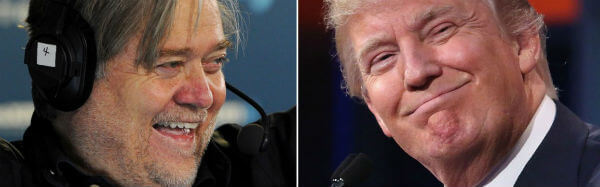
The global ambitions of Trump’s Goebbels-like chief strategist, Steve Bannon

bannon-trump

The Daily Beast reports: [On Sunday, Steve Bannon, publisher of Breitbart, was appointed by Donald Trump as his chief strategist.] Bannon’s support for European far-right parties runs far deeper than his interest in Marion Maréchal-Le Pen or the National Front. He brags about his international Breitbart operation as “the platform” for the American alt-right, and has for years been thinking globally, with an affinity for the United Kingdom Independence Party (UKIP), Alternative for Germany (AfD), and the Party for Freedom Party (PVV) in the Netherlands, all of which have earned glowing coverage on the pages of Breitbart.

But the election of Bannon’s man Donald Trump as president of the United States has made the globalization of Breitbart and its message infinitely more plausible than it ever was before, and politicians once considered Europe’s deplorables are now rushing to bask in the gilded glow of Trump and Bannon.

On Saturday, Britain’s Nigel Farage, whose blatant and acknowledged lies helped convince his countrymen to opt out of the European Union in the Brexit vote, visited the president-elect in his eponymous Fifth Avenue tower.

Farage emerged from the meeting looking like he’d just won the jackpot at one of the pre-bankruptcy Trump casinos, suggesting that the new president’s “inner team” was not too happy with Tory Prime Minister Theresa May, since she’d been skeptical of Brexit before the vote. Would that “inner team” be Bannon? In our post-factual world, maybe we can say, “People say…”

Breitbart, which currently has operations in London and Jerusalem, certainly has plans to expand in France and Germany with new bureaus to cultivate and promote the populist-nationalist lines there. [Continue reading…]

The Washington Post reports: The Southern Poverty Law Center, a hate-watch group, has accused Breitbart of explicitly embracing ethno-nationalism. After Bannon’s elevation was announced, the law center tweeted several controversial stories written by Breitbart under Bannon’s control, including a piece published two weeks after a mass killing at a black church in Charleston, S.C., last year: “Hoist it high and proud: the confederate flag proclaims a glorious heritage.”

“Stephen Bannon was the main driver behind Breitbart becoming a white ethno-nationalist propaganda mill,” the law center wrote via Twitter in its first statements on Bannon’s elevation. “Trump should rescind this hire. In his victory speech, Trump said he intended to be president for ‘all Americans.’ Bannon should go.” [Continue reading…]

Facebooktwittermail

Berenberg Bank: Politics right now ‘evokes memories of the dreadful 1930s’

Business Insider reports: German investment bank Berenberg believes that “some aspects of Donald Trump’s successful election campaign evoke memories of the dreadful 1930s.”

The bank’s chief economist Holger Schmieding says in a note sent out on Monday that: “After the Brexit vote and the triumph of Trump, the echo of the early 1930s sounds a little less faint than it did before.”

Schmieding highlights populism, rising protectionism and nationalism, isolationism, and the erosion of the political middle ground as key features of both the current political climate and the 1930s.

“Populist” leaders — often dictators such as Hitler and Mussolini — came to power across Europe in the 1930s with promises to restore glory and honour to their countries, often blaming foreign races and religions for the problems.

Both recent the Brexit and Trump campaigns blamed outsiders for problems at home (the EU, Mexicans, Muslims) and had strong nationalist streaks (Make America Great Again, Take Back Control).

International trade tailed off in the wake of the 1929 Wall Street Crash as the US turned inwards. Schmieding says: “Two major policy mistakes turned the financial crisis into a depression” — the US fed tightening monetary policy and the 1930 Smoot-Hawley tariff act, which enacted protectionist taxes on imports.

Both Trump and the current pro-Brexit UK government have promised to reverse the rising tide of globalism. Trump plans to do this by scrapping or significantly changing a trade deal with Mexico and putting tariffs on imports from China. UK Prime Minister Theresa May has promised to reign in globalisation.

Schmieding calls the 1930s “dreadful” because the Great Depression, triggered by policy mistakes, led to widespread poverty. The potent economic and political cocktail of depression and nationalism also led to World War II.

But Schmieding says that “the [current] situation is very different in at least three key respects.” These are:

  • Rising employment: “Despite widespread anger at the establishment, we are not quite living in pitchfork times again.”
  • Lack of ideology: “Trump and some other leading populists today come across as opportunistic self-promoters rather than incorrigible ideologues.”
  • International cooperation: “Institutions of international co-operation and the rule of law at home are much stronger in the developed world than they were in Europe in the 1930s.”

As a result, he does not think we are hurtling towards another major global conflict or serious economic crisis. Still, there are significant risks. [Continue reading…]

Facebooktwittermail

What could the rest of the world do if Trump pulls the U.S. out of the Paris Agreement on climate change?

By Henrik Selin, Boston University and Adil Najam, Boston University

Climate change negotiators from around the world – now meeting at the COP22 conference in Marrakech, Morocco – continue steadfastly with the task of putting meaning and action into the landmark 2015 Paris Agreement to bring down global greenhouse gas emissions.

Yet, the tone in Marrakech has suddenly become more subdued. While many conversations remain staunchly defiant, others have assumed a funeral-like quality, as national delegates and civil society representatives try to assess the ramifications of the U.S. presidential election.

Elections have consequences for global climate change negotiations and the future of the planet.

President-elect Donald Trump has repeatedly stated he does not believe in human-induced climate change. He has argued that climate change is an expensive hoax that was created by the Chinese to make U.S. manufacturing noncompetitive. He has also declared his intent to roll back federal climate change and renewable energy policy. Most poignantly for Marrakech, he has loudly declared an intention to “cancel the Paris climate agreement.

Some cling to the hope that President Trump will forget pronouncements made by Candidate Trump just as Candidate Trump had ignored the pontifications of Citizen Trump. An important indicator of why this may not be the case is the appointment of Myron Ebell as head of the transition team for the U.S. Environmental Protection Agency (EPA). Ebell, also a front-runner to be appointed as head of the EPA, is an outspoken climate change denier who flat out rejects the Paris Agreement as unconstitutional.

Continue reading

Facebooktwittermail

How Obama left the door open for Trump to resume torture

The New York Times reports: As a presidential candidate, Donald J. Trump vowed to refill the cells of the Guantánamo Bay prison and said American terrorism suspects should be sent there for military prosecution. He called for targeting mosques for surveillance, escalating airstrikes aimed at terrorists and taking out their civilian family members, and bringing back waterboarding and a “hell of a lot worse” — not only because “torture works,” but because even “if it doesn’t work, they deserve it anyway.”

It is hard to know how much of this stark vision for throwing off constraints on the exercise of national security power was merely tough campaign talk. But if the Trump administration follows through on such ideas, it will find some assistance in a surprising source: President Obama’s have-it-both-ways approach to curbing what he saw as overreaching in the war on terrorism.

Over and over, Mr. Obama has imposed limits on his use of such powers but has not closed the door on them — a flexible approach premised on the idea that he and his successors could be trusted to use them prudently. Mr. Trump can now sweep away those limits and open the throttle on policies that Mr. Obama endorsed as lawful and legitimate for sparing use, like targeted killings in drone strikes and the use of indefinite detention and military tribunals for terrorism suspects.

And even in areas where Mr. Obama tried to terminate policies from the George W. Bush era — like torture and the detention of Americans and other people arrested on domestic soil as “enemy combatants” — his administration fought in court to prevent any ruling that the defunct practices had been illegal. The absence of a definitive repudiation could make it easier for Trump administration lawyers to revive the policies by invoking the same sweeping theories of executive power that were the basis for them in the Bush years. [Continue reading…]

Facebooktwittermail

Is Trump reaching out to Europe’s far right before he talks with the heads of state?

The Washington Post reports: Marion Maréchal-Le Pen — a rising star in France’s far-right National Front and the niece of the party’s leader, Marine Le Pen — wrote on Twitter on Saturday that representatives of President-elect Donald Trump had invited her to “work together.”

Le Pen, 26, became the youngest member of France’s Parliament in 2012. She was elected to represent Vaucluse, a region in southern France with heavy ties to the National Front, a party founded by her grandfather, the 88-year-old Jean-Marie Le Pen. He once referred to the Nazi concentration camps as a “detail of history.”


“I answer yes to the invitation of Stephen Bannon, CEO of @realDonaldTrump presidential campaign, to work together,” Marion Maréchal-Le Pen tweeted.

Bannon — the former executive chairman of Breitbart News Network with ties to the so-called alt-right — is rumored to be among the possible candidates for Trump’s chief of staff. [On Sunday, Bannon was named as chief strategist and senior counselor to the president.]

Her tweet reflected a highly unusual phenomenon: an American president-elect seeking to forge relationships with ultranationalist and populist factions overseas that are often sharply critical of their countries’ governments. It also raised the question of whether Trump and his representatives have been reaching out to foreign populist parties before first reaching out to foreign heads of state. [Continue reading…]

Facebooktwittermail

Trump’s plans to deport millions of undocumented immigrants with criminal records

The Washington Post reports: In a “60 Minutes” interview scheduled to air Sunday, President-elect Donald Trump said he planned to immediately deport two to three million undocumented immigrants who “have criminal records” after his inauguration next January.

“What we are going to do is get the people that are criminal and have criminal records, gang members, drug dealers, where a lot of these people, probably 2 million, it could be even 3 million, we are getting them out of our country or we are going to incarcerate,” Trump told “60 Minutes” correspondent Lesley Stahl, according to a preview of the interview released by CBS. “But we’re getting them out of our country. They’re here illegally.”

Stahl had pressed Trump about his campaign pledge to deport “millions and millions of undocumented immigrants.” Trump told her that after securing the border, his administration would make a “determination” on the remaining undocumented immigrants in the country.

“After the border is secure and after everything gets normalized, we’re going to make a determination on the people that they’re talking about — who are terrific people. They’re terrific people, but we are gonna make a determination at that,” Trump said. “But before we make that determination…it’s very important, we are going to secure our border.” [Continue reading…]

Vox reports: Donald Trump doesn’t have to implement any unprecedented immigration policy to create an unprecedented immigration regime. He could just use the precedents the last two presidents created for him.

Both the George W. Bush and Barack Obama administrations created powerful tools for apprehending and deporting immigrants. It’s just that no one’s ever used them together.

The Obama administration was already more aggressive about immigration enforcement than many people realize. Obama set deportation records during his first term, deporting 400,000 people a year. Border Patrol and Immigration and Customs Enforcement agents had relatively free rein to catch and deport immigrants — and easy access to local jails to pick up immigrants who’d come in contact with local police. Many of those deported were labeled “criminals” because they’d been pulled over for broken taillights or arrested for minor offenses like selling illegal phone cards. [Continue reading…]

In August, ABC News reported: President Barack Obama has often been referred to by immigration groups as the “Deporter in Chief.”

Between 2009 and 2015 his administration has removed more than 2.5 million people through immigration orders, which doesn’t include the number of people who “self-deported” or were turned away and/or returned to their home country at the border by U.S. Customs and Border Protection (CBP).

According to governmental data, the Obama administration has deported more people than any other president’s administration in history.

In fact, they have deported more than the sum of all the presidents of the 20th century. [Continue reading…]

Facebooktwittermail

The media must confront President Trump on climate change

Oliver Milman writes: Imagine the world was facing upheaval on a scale not seen during modern civilization, a change that would imperil the world’s great cities by the rising seas and snuff out species at at the fastest rate since the dinosaurs disappeared. Then imagine you were a journalist, had repeated chances to ask the next president of the United States about this and decided to not do so.

The apparent failure of the media during the presidential election has been multifaceted and fiercely debated. But the absence of climate change as a leading topic in the election of Donald Trump is perhaps the single greatest rebuke to the idea that power should be held to account for the benefit of this and future generations.

This failure was most apparent during the presidential debates, where four-and-a-half hours of television saw not one moderator question pitched to Trump or Hillary Clinton on climate change. It was left to Ken Bone, he of the red sweater and brief internet fame, to come closest with a question about coal mining.

The mind-boggling consequences of unchecked climate change, which is essentially what Trump proposes by denying the problem exists, dwarfed every other issue – yes, including emails – discussed during the debates. And yet it wasn’t raised. It was the equivalent of getting an exclusive interview with Churchill and Roosevelt in 1942 and not asking them about the war. [Continue reading…]

Facebooktwittermail

Trump’s appointees will set course of his presidency

The New York Times reports: “Busy day planned in New York,” President-elect Donald J. Trump said on Twitter on Friday morning, two days after his astonishing victory. “Will soon be making some very important decisions on the people who will be running our government!”

If anything, that understates the gravity of the personnel choices Mr. Trump and his transition team are weighing.

Rarely in the history of the American presidency has the exercise of choosing people to fill jobs had such a far-reaching impact on the nature and priorities of an incoming administration. Unlike most new presidents, Mr. Trump comes into office with no elective-office experience, no coherent political agenda and no bulging binder of policy proposals. And he has left a trail of inflammatory, often contradictory, statements on issues from immigration and race to terrorism and geopolitics.

In such a chaotic environment, serving a president who is in many ways a tabula rasa, the appointees to key White House jobs like chief of staff and cabinet posts like secretary of state, defense secretary and Treasury secretary could wield outsize influence. Their selection will help determine whether the Trump administration governs like the firebrand Mr. Trump was on the campaign trail or the pragmatist he often appears to be behind closed doors. [Continue reading…]

Facebooktwittermail

General Services Administration, a federal agency doing business with Trump, is trying to avoid a massive conflict of interest

BuzzFeed reports: For the first time, federal officials have acknowledged a potential conflict of interest that faces incoming president Donald Trump over his high-profile hotel deal with the United States government. And the federal agency that’s involved wants to talk to Trump’s transition team about it before he takes the oath of office.

In 2012, the General Services Administration agreed to lease the Old Post Office Building — a landmark building just blocks from the White House — to Trump’s organization so that the mogul could turn it into a luxury hotel. In the complicated 109-page lease, Trump is required to pay the GSA $3 million a year plus a portion of his revenue, and he has to abide by a complex set of restrictions regarding what he can do and how he can build.

But once Trump becomes president, he will have authority over the GSA and will be able to fire its administrator at will, raising profound issues of a conflict.

Questioned about that conflict, a GSA spokesperson sent a statement to BuzzFeed News: “Prior to Mr. Trump taking the oath of office, GSA plans to coordinate with the President-elect’s transition team to allow a plan to be put in place to identify and address any potential conflict of interest relating to the Old Post Office building.”

Trump spokesperson Hope Hicks did not respond to emailed questions about the matter. [Continue reading…]

Facebooktwittermail

Sidney Blumenthal: Donald Trump won the election as a result of an FBI ‘coup d’état’

Sidney Blumenthal, former aide to President Bill Clinton and long-time confidant to Hillary Clinton, was interviewed on Friday on Nieuwsuur (News Hour) which is broadcast on Dutch public television. The introduction is in Dutch but the interview itself is in English.

Blumenthal says the decisive intervention in the election by FBI Director James Comey “was the result of a cabal of right-wing agents of the FBI in the New York office attached to Rudy Giuliani who was a member of Trump’s campaign and I think it’s not unfair to call it a ‘coup’.”


“Trump has positioned himself to be Vladimir Putin’s junior partner… His policy is consistently pro-Putin and I think that we will see, if his rhetoric is made into reality, that American foreign policy since the end of World War Two will be overthrown.”

The New York Times reports: Hillary Clinton on Saturday cast blame for her surprise election loss on the announcement by the F.B.I. director, James B. Comey, days before the election that he had revived the inquiry into her use of a private email server.

In her most extensive remarks since she conceded the race to Donald J. Trump early Wednesday, Mrs. Clinton told donors on a 30-minute conference call that Mr. Comey’s decision to send a letter to Congress about the inquiry 11 days before Election Day had thrust the controversy back into the news and had prevented her from ending the campaign with an optimistic closing argument.

“There are lots of reasons why an election like this is not successful,” Mrs. Clinton said, according to a donor who relayed the remarks. But, she added, “our analysis is that Comey’s letter raising doubts that were groundless, baseless, proven to be, stopped our momentum.” [Continue reading…]

Suppose the Clinton campaign had stayed on track and there had been no FBI intervention. It seems much more likely than not, that Clinton would have won.

That campaign would now be a subject of analysis in which pundits were describing the keys to its success, alongside the reasons Trump had failed.

In other words, it’s easy to picture two versions of the Clinton campaign that are virtually identical, the only significant difference being on whether the FBI had stepped in.

Even though it’s reasonable to point out that the FBI would never have got involved in the first place had it not been for Clinton’s ill-judged decision to set up a private email server, that mistake itself didn’t appear to be an obstacle to her election until the FBI willfully reawakened it as a campaign issue.

Facebooktwittermail

Bitter infighting could cripple Trump’s administration before it ever gets off the ground

Politico reports: The bitter infighting that plagued Donald Trump’s campaign during the Republican presidential primary is starting to spill over into his team’s efforts to establish an administration and political operation, according to more than half a dozen sources familiar with the planning efforts.

The tensions played a role in a Friday shakeup in which the president-elect replaced his transition team chief Chris Christie with his running mate Mike Pence. Sources familiar with the move say it was precipitated partly by clashes between Christie’s allies and rival factions on the transition team, as well as Trump’s influential son-in-law Jared Kushner.

Those rifts and others are complicating what was an already a herculean task for Trump’s team: building a massive new government for a man who has never held public office.

“It’s the same situation as in the primary – everyone has the knives out for each other,” said a Republican operative who worked with the campaign and is now advising people on the transition team.

Asked about the tensions, and about Kushner’s role in the leadership change at the transition team, Trump spokesman Jason Miller said, “Anybody seeing today’s news about the appointment of Vice President-elect Mike Pence to run the Presidential Transition Team realizes that President-elect Donald J. Trump is serious about changing Washington whether the town likes it or not. This might ruffle the delicate sensitivities of the well-heeled two-martini lunch set, but President-elect Trump isn’t fighting for them, he’s fighting for the hard-working men and women outside the Beltway who don’t care for insider bickering.”

It’s not uncommon for rivalries to emerge inside campaigns and administrations as advisers jockey to place allies in key roles and advance their policy priorities. But the level of internecine conflict during Trump’s drive toward the GOP nomination was so extreme that it sometimes resulted in conflicting directives for even simple hiring and spending decisions.

People who witnessed that infighting up close see signs of similar patterns emerging, with some of the same players involved. And they fear that the dynamic could cripple Trump’s operation before it ever gets off the ground, since launching an administration requires hiring thousands of employees and setting up far more intricate chains of command than those in place during Trump’s bare-bones presidential campaign. [Continue reading…]

Facebooktwittermail

Autocracy: Rules for survival

Masha Gessen writes: “Thank you, my friends. Thank you. Thank you. We have lost. We have lost, and this is the last day of my political career, so I will say what must be said. We are standing at the edge of the abyss. Our political system, our society, our country itself are in greater danger than at any time in the last century and a half. The president-elect has made his intentions clear, and it would be immoral to pretend otherwise. We must band together right now to defend the laws, the institutions, and the ideals on which our country is based.”

That, or something like that, is what Hillary Clinton should have said on Wednesday. Instead, she said, resignedly,

We must accept this result and then look to the future. Donald Trump is going to be our president. We owe him an open mind and the chance to lead. Our constitutional democracy enshrines the peaceful transfer of power. We don’t just respect that. We cherish it. It also enshrines the rule of law; the principle [that] we are all equal in rights and dignity; freedom of worship and expression. We respect and cherish these values, too, and we must defend them.

Hours later, President Barack Obama was even more conciliatory:

We are now all rooting for his success in uniting and leading the country. The peaceful transition of power is one of the hallmarks of our democracy. And over the next few months, we are going to show that to the world….We have to remember that we’re actually all on one team.

The president added, “The point, though, is that we all go forward with a presumption of good faith in our fellow citizens, because that presumption of good faith is essential to a vibrant and functioning democracy.” As if Donald Trump had not conned his way into hours of free press coverage, as though he had released (and paid) his taxes, or not brazenly denigrated our system of government, from the courts and Congress, to the election process itself — as if, in other words, he had not won the election precisely by acting in bad faith.

Similar refrains were heard from various members of the liberal commentariat, with Tom Friedman vowing, “I am not going to try to make my president fail,” to Nick Kristof calling on “the approximately 52 percent majority of voters who supported someone other than Donald Trump” to “give president Trump a chance.” Even the politicians who have in the past appealed to the less-establishment part of the Democratic electorate sounded the conciliatory note. Senator Elizabeth Warren promised to “put aside our differences.” Senator Bernie Sanders was only slightly more cautious, vowing to try to find the good in Trump: “To the degree that Mr. Trump is serious about pursuing policies that improve the lives of working families in this country, I and other progressives are prepared to work with him.”

However well-intentioned, this talk assumes that Trump is prepared to find common ground with his many opponents, respect the institutions of government, and repudiate almost everything he has stood for during the campaign. In short, it is treating him as a “normal” politician. There has until now been little evidence that he can be one. [Continue reading…]

Facebooktwittermail

After Trump win, parallel path is seen for Marine Le Pen of France’s far right

The New York Times reports: It was a moment of intense French patriotism on a sunny Friday, Armistice Day. A band blared “La Marseillaise,” the national anthem. Shouts of “Vive la France!” filled the chilly November air. And there, too, was Marine Le Pen, leader of the far-right National Front party, beaming.

Before Donald J. Trump’s presidential victory in the United States this week, Ms. Le Pen was considered a disruptive political force but far from a true threat to become president herself when France votes next spring. Not anymore.

Since Wednesday, French news outlets, along with Ms. Le Pen’s mainstream political rivals, have been repeating the same thing: It could happen here.

And Ms. Le Pen is not alone. From the Balkans to the Netherlands, politicians on the far right have greeted the election of Mr. Trump with unrestrained delight and as a radical reconfiguring of the political landscape — not just in the United States, but in Europe as well.

They are seeing it as a sign that their time has finally arrived, and that the politics of heightened nationalism, immigrant-bashing and anti-globalization have overturned the pro-globalization, pro-immigration consensus. [Continue reading…]

Facebooktwittermail

The alt-right supported Trump. Now its members want him to satisfy their demands

The Washington Post reports: Mike Adams, a conservative Texas blogger, greeted President-elect Donald Trump’s victory with this post: “The evil, demonic, mass murdering Hillary Clinton has been defeated. This is VICTORY for all Americans, even the uninformed, ignorant morons who voted for Hillary.”

But a few hours later, as the news sank in, Adams posted again with a more hopeful tone: “Today I declare ‘LOVE WINS’ because it is love for America that inspired us to collectively achieve this great victory.” He said he was going to send Trump a video with his suggestions about how to reform health care.

Adams and thousands of others on the furious far-right of American political discourse, who have railed for years against the “criminal” and “treasonous” excesses of the federal government under President Obama, woke up Wednesday to find themselves in the odd position of being, essentially, insiders.

Members of the so-called “alt-right,” who reject establishment conservatism and spread their far-right ideology online, were eagerly courted by candidate Trump. Now this vocal constituency feels emboldened by its new ally in the White House, presenting Trump with a major challenge to satisfy its pent-up demands while trying to unite a deeply divided nation.

Adams, who blogs about health, wellness and politics on a Facebook page that has 2 million “likes,” said he sees the Trump election as a long-awaited chance to be heard by the White House. In addition to sending Trump his health-care ideas, he is urging him to fight abortion and nominate Supreme Court justices who will protect his right to own a gun. [Continue reading…]

Facebooktwittermail