



In an editorial, the New York Times says: In his victory speech early Wednesday morning, Donald Trump pledged that he “will be president for all Americans,” and he asked those who did not support him “for your guidance and your help so that we can work together and unify our great country.”
Here’s some guidance right off the bat, Mr. President-elect: Those sentiments will have more force if you immediately and unequivocally repudiate the outpouring of racist, sexist, xenophobic, anti-Semitic and homophobic insults, threats and attacks being associated with your name. Do this in a personal plea to people who supported your candidacy. Tell them this is not what you stand for, nor is it what your new administration will tolerate.
Explicit expressions of bigotry and hatred by Trump supporters were common throughout the campaign, and they have become even more intense since his election. On a department-store window in Philadelphia, vandals spray-painted “Sieg Heil 2016” and Mr. Trump’s name written with a swastika. In a Minnesota high-school bathroom, vandals scrawled the Trump campaign slogan, “Make America Great Again,” and next to it, “Go back to Africa.” There are many more reports pouring in of verbal and physical harassment of Muslims, Latinos and other members of minorities. Though not all are verifiable, the atmosphere of intimidation and fear is unquestionably real and will keep growing. Mr. Trump may not be able to stop it by himself, but he must do everything he can.
The problem, of course, is that Mr. Trump’s campaign was based on appeals — some explicit, some coded — to racial and ethnic resentment and division. His followers heard it starting with his speech declaring his candidacy, warning of Mexican immigrant “rapists,” continuing to a rally last weekend where he promised to bar all Syrian refugees because they “will import generations of terrorism, extremism and radicalism into your schools and throughout your communities.” These statements emboldened and even encouraged those who have been looking for a license to lash out against immigrants, refugees, minorities and anyone else they find threatening. They take his victory as vindication of their feelings.
David Duke, the former Louisiana lawmaker and former imperial wizard of the Ku Klux Klan, tweeted that Mr. Trump’s victory was “one of the most exciting nights of my life,” and also, “Our people have played a HUGE role in electing Trump!” In another tweet, he wrote, “Anyone telling you this was a vote for ‘unity’ is a liar and they know it!”
As a candidate, Mr. Trump could get away with ignoring racist and sexist abuse by his supporters. But as the president-elect, he has the moral duty to reject it in the most aggressive terms. There should be no space in American political discourse for violent or abusive behavior. And that includes, of course, acts of vandalism and other violence by anti-Trump demonstrators.
In a little more than two months, Donald Trump will take charge of a country of more than 320 million people of all races, ethnicities and religions. Every one of them deserves to live in safety, with dignity. [Continue reading…]
Huffington Post reports: Leading climate scientists are reeling in the aftermath of Donald Trump’s victory over Hillary Clinton Tuesday, and scrambling to understand how his presidency will affect the struggle against climate change.
Trump has promised to be a fierce ally of the fossil fuel industry, has called climate change a Chinese hoax and has vowed to end federal spending on climate change initiatives and pull the U.S. out of the climate agreement reached in Paris last year.
While it would likely take more than a single term in the White House for Trump to withdraw from the Paris Agreement, the possibility has left climate scientists grasping for answers about what the future holds.
“I don’t think anyone knows what this means for U.S. policy on climate science or emissions reductions,” Andrew Dessler, a professor of atmospheric sciences at Texas A&M University, told Carbon Brief, a U.K. news site that interviewed 21 climate scientists about their reactions to Trump’s election.
“To quote James Hansen, I fear this may be game over for the climate,” said Dr. Michael E. Mann, a professor of atmospheric science at Pennsylvania State University. [Continue reading…]
The Daily Beast reports: For DREAMers, Trump’s presidency could be a nightmare.
Almost a million undocumented immigrants who were brought to the U.S. as children trusted the federal government with their personal information — including their home addresses — so they could gain temporary protection from deportation.
But under the Donald Trump administration, that could make them targets; in a brutal twist of irony, their faith in American institutions could actually increase their risk of being forcibly removed from the country.
DREAMers are the undocumented immigrants who came to the U.S. as minors, haven’t committed any crimes, and could get temporary work permits and protection from deportation through Obama’s Deferred Action for Childhood Arrivals program (known as DACA). Under the Obama presidency, DACA was a godsend; it meant DREAMers who built their entire lives in the U.S. could stay without fear. It made it easier for them to get jobs and plan their futures.
They trusted their government. And now, that government is about to change. [Continue reading…]
In an editorial, the New York Times says: Pakistan is turning them back. Thousands who spent their life savings on a bid to resettle in Europe are being told it’s time to head home. Inside Afghanistan, tens of thousands have become internally displaced in recent months as fighting between the Taliban and government security forces rages in several provinces. The refugee crisis could reach unprecedented numbers, with as many as 1.5 million returning home, many involuntarily, by the end of the year, according to humanitarian organizations.
Yet, there is no plan to adequately address this humanitarian emergency. Its scale and the international community’s dismissive attitude toward the plight of vulnerable Afghans is shameful. Pakistan, home to 1.3 million registered Afghan refugees and some 700,000 undocumented Afghans, has begun to crack down on those refugees living in the country without permission. By the end of this year, as many as 360,000 could be forced to return to Afghanistan, if current rates hold, according to the United Nations refugee agency. This year’s number of returnees is about four times higher than last year’s.
Among those caught in Pakistan’s toughening stance is Sharbat Gula, the subject of a famous photo that was published on a cover of National Geographic magazine in 1985. That photo was taken at a refugee camp in Pakistan when she was about 12. Ms. Gula, now in her 40s, was recently arrested and deported back to Afghanistan because she had been living in Pakistan without legitimate papers.
As Afghans become ever more hopeless about the future of their country, a rising number have set out on long and perilous journeys to Europe. Last year, 213,000 Afghans made it to Europe, where leaders have been grappling with the even larger influx of Syrians. While Syrians are not being forced to return home, European leaders last month struck a deal with the government of Afghanistan to establish a mechanism for the return of tens of thousands of Afghans who have failed to get asylum or legal residency in Europe. Under the deal, the Afghan government agreed to accept even citizens who fear for their safety if they were to return home.
Those who go back home, often having spent all their money on smugglers, face grinding poverty and violence. Within the country, about 221,000 Afghans fled their homes between January and August, according to the United Nations. For many, the only option is to pitch a tent in one of the country’s bulging and poorly serviced refugee camps.
The United Nations refugee agency has been making desperate pleas to donors for more assistance as winter approaches. Last month, it said it needed $181 million to cover basic operations in the months ahead. Fulfilling that need immediately is the least the international community can do. Beyond that, it will need to rethink its long-term approach to Afghan refugees and how to resettle more abroad in the years ahead. [Continue reading…]
Clemens Wergin writes: No one in Europe truly believed Americans would elect someone who seems so obviously unfit to lead the most powerful nation in the world. And yet, that is precisely what has happened, and now, across the Continent, people are trying to figure out what this will mean. Many fear that Donald J. Trump’s election might mean the end of the West as we know it.
To be fair, from Europe’s perspective, the West was already on shaky ground. Russia is barking at our borders. The war in Syria has unleashed a huge wave of migration that is challenging our identities and fueling a right-wing backlash. Britain has already voted to become the first country to leave the European Union, an institution that seems in danger of unraveling.
But Mr. Trump’s election poses a new systemic and strategic risk. For seven decades, a politically stable United States has been a beacon of democracy and a cornerstone of the liberal world order. When democracy was seriously threatened in Europe, the United States stepped in and stopped the tide of authoritarianism. But now the United States itself has elected a demagogue who seems to have authoritarian tendencies and whose proposals — if he follows through on them — will have huge and disastrous consequences from Lisbon to Kiev.
Chancellor Angela Merkel of Germany knows how grave the situation is. As she congratulated Mr. Trump on his victory on Wednesday, she also lectured him on the elements of liberal democracy that form the basis of the American-European relations. “Germany and America are bound by their values: democracy, freedom, the respect for the law and the dignity of human beings, independent of their origin, skin color, religion, gender, sexual orientation or political position,” Ms. Merkel said. “On the basis of these values I offer the future president of the United States, Donald Trump, close cooperation.” [Continue reading…]
Financial Times reports: A pro-Russian politician in Moldova who has threatened to derail co-operation with the EU is set to be elected president. Victory for Igor Dodon could strengthen Moscow’s hand in eastern Europe amid a surge in support for Eurosceptic and anti-establishment politicians across the continent.
Mr Dodon, who has also called for Crimea to be recognised as part of Russia, faces Maia Sandu, his pro-European rival, in the first direct presidential election in Moldova for 20 years. Sunday’s poll coincides with a presidential ballot in Bulgaria where the favourite has also called for closer ties with Moscow.
The polls come just days after Donald Trump’s election victory raised questions over continuing US support for countries in central and eastern Europe against pressure from Moscow. [Continue reading…]
The Daily Beast reports: Less than a month ago, Matteo Renzi was floating on air. Fresh off the pages of Vogue, and still glowing from the limelight for being honored at President Barack Obama’s last state dinner, the maverick Italian prime minister seemed to have the world at his feet. “This is my last visit and state dinner as president,” Obama said as he introduced Renzi. “We saved the best for last.”
And it couldn’t have come at a better time as Renzi prepares to lead his country forward in a crucial Dec. 4 reform referendum that is easily the make-or-break moment of his career. Having Obama throw him a party and endorse his cause was extremely useful back home.
“The upcoming referendum to modernize Italy’s political institutions is something the United States strongly supports because we believe that it will help accelerate Italy’s path toward a more vibrant, dynamic economy, as well as a more responsive political system,” Obama said at a joint press conference with a visibly delighted Renzi gushing enthusiasm. “And so I am rooting for success, but I think [Renzi] should hang around for awhile no matter what.”
Fast-forward to Nov. 8. All that fairy dust Obama sprinkled now surely feels a little bit like poison ivy. Renzi, like pretty much the rest of the world, was expecting Hillary Clinton to win the presidential race. But he was one of the few world leaders to say it out loud. “I’m rooting for Hillary,” he first said last February, adding that, despite his endorsement, he would work with whoever is inaugurated in January 2017. [Continue reading…]
The New York Times reports: More than two years ago, a Christian farmer in his 70s named Mosa Zachariah fled his village near Mosul with, as he put it, only the pants he was wearing. He left behind his house, “tons of wheat” and a BMW.
But now that his town, an early target of the Iraqi security forces as they advance on Mosul itself, has been cleared of the Islamic State forces, it is not jubilation he feels, but fear of what awaits him if he tries to return. He wistfully talked about his city’s diversity as something completely unattainable now. “In that time, the Muslims and Christians were like brothers,” he said.
Musab Juma, a Shiite who used to live in the Mosul area, said he would not be going back, either. He relocated to Najaf, in southern Iraq, where he has a food stall and has decorated his home with old photos and antiques from his hometown. Yazidis and Kurds and Shabaks, other minorities that were once vital pieces of Mosul’s human tapestry, have moved on, too. And many Sunni Arabs, who make up most of Mosul’s population, say they will never go home again, even if that is where their parents and grandparents are buried.
Before the Islamic State’s occupation began more than two years ago, Mosul was Iraq’s most diverse city. Its rich culture, stretching back to the ancient Assyrians, and reputation for tolerance made it a vital symbol of an Iraq that could at least aspire to being a unified and whole nation.
Now, as Mosul’s exiled civilians watch the battle for their city unfold, the only thing they seem to have in common is the belief that they once shared a special history that can never be reclaimed. [Continue reading…]
Reuters reports: Back in May, when Donald’s Trump’s victory in the U.S. presidential election seemed the remotest of possibilities, a senior European official took to Twitter before a G7 summit in Tokyo to warn of a “horror scenario”.
Imagine, mused the official, if instead of Barack Obama, Francois Hollande, David Cameron and Matteo Renzi, next year’s meeting of the club of rich nations included Trump, Marine Le Pen, Boris Johnson and Beppe Grillo.
A month after Martin Selmayr, the head of European Commission President Jean-Claude Juncker’s cabinet made the comment, Britain shocked the world by voting to leave the European Union. Cameron stepped down as prime minister and Johnson – the former London mayor who helped swing Britons behind Brexit – became foreign minister.
Now, with Trump’s triumph over his Democratic rival Hillary Clinton, the populist tsunami that seemed outlandish a few months ago is becoming reality, and the consequences for Europe’s own political landscape are potentially huge.
In 2017, voters in the Netherlands, France and Germany – and possibly in Italy and Britain too – will vote in elections that could be coloured by the triumphs of Trump and Brexit, and the toxic politics that drove those campaigns. [Continue reading…]
Christopher Dickey writes: The art of the deal is not especially useful when confronting fanatics inclined to behead or immolate anyone who fails to follow their rules. And Trump’s pronouncements during his campaign do not give him or us much insight into how he might construct an approach dramatically different from the faltering policies of the Obama administration.
The Daily Beast’s front line correspondent in the current offensive against ISIS in Mosul, Florian Neuhof, summed up the situation as he sees it:
“My hope is that many of Trump’s campaign statements are bluster designed to boost his strongman image,” writes Neuhof. “I don’t feel he in any way understands world politics, let alone the Middle East, and he has tried to appeal to uneducated, poor white voters who would fall for such nonsense tough talk.
“I have a feeling that whoever is in power in the U.S. will not change the dynamics in Iraq significantly. Iran’s creeping takeover of the country will not be contained by anything other than a huge re-engagement by the U.S., which I don’t believe Trump is up for.
“Trump’s anti-Tehran stance will be welcomed by Saudi Arabia and the other Gulf states, and could heighten the Sunni-Shia rift in the region to potentially catastrophic levels,” says Neuhof. “If Iran feels threatened by the U.S., it will double up on its efforts to strengthen its proxies, and more proxy wars could be the consequence.”
America’s new president has said repeatedly he wanted to join with Russia, which would mean joining with Syrian President Bashar Assad, to fight ISIS. But as Neuhof points out, “Ironically, U.S. support for the Assad regime would play right into the hands of Iran, which has a huge interest in keeping the dictator in place. Assad and Russia have systematically fought the more moderate elements of the rebels, while leaving ISIS largely unscathed, in order to present the world with the stark choice between a murderous regime in Damascus and a murderous regime in Raqqa. That Trump fails to see that speaks volumes about his grasp of world affairs.” [Continue reading…]
Ishaan Tharoor writes: Donald Trump’s presidential election victory has already been cheered by Russian President Vladimir Putin, a constellation of right-wing European populists, a former Ku Klux Klan leader and a Middle Eastern strongman. But there’s another curious constituency that seems to be happy about the new American president-elect.
Shortly after Trump was declared the victor, a number of prominent Salafist ideologues linked to jihadist outfits in the Middle East took to social media to cheer the prospect of a Trump presidency.
The remarks signaled the militants’ apparent belief that the victory of a candidate like Trump, who has suggested potentially unconstitutional blocks on Muslim immigration and advocated torture, undermines the United States’ moral standing in the world.
Social-media sites associated with both the Islamic State and al-Qaeda also hailed Trump’s success as the beginning of “dark times” for the United States, marked by domestic unrest and new foreign military campaigns that would sap the strength of the American superpower.
“Rejoice with support from Allah, and find glad tidings in the imminent demise of America at the hands of Trump,” said the Islamic State-affiliated al-Minbar Jihadi Media network, one of several jihadi forums to post commentaries on the results of the U.S. election. [Continue reading…]
Reuters reports: The Afghan Taliban on Wednesday called on U.S. president-elect Donald Trump to withdraw American troops from Afghanistan.
“Our message is that the Americans should draft a policy not to take away the independence and sovereignty of other nations. Most importantly they should withdraw all their troops from Afghanistan,” the Taliban said in a statement in reaction to Trump’s surprise election win.
The Guardian reports: The first voter I heard mention Donald Trump’s name was a mechanic in a small town near my upstate New York home. It was days after Trump announced his run, and I was at the start of a drive across the United States.
The man, like many Trump supporters then, didn’t want his name used or his picture taken. An outraged press was loudly mocking Trump and he was embarrassed. But he was clear why he would vote for Trump. “There’s no American dream for anyone who isn’t a lawyer or banker,” he said. “Everyone else, we are getting a raw deal. Immigrants are taking all our jobs.”
As I pressed on, putting over 100,000 miles on my car, I heard a steady and growing crescendo of support for Trump – one that changed from embarrassment to pride.
In the early days of the election, most were like Robert McAdams, 78, of Peru, Nebraska: older whites who had dedicated their lives working in the communities where they were born. He owned a gas station, and spun a long tale of opportunities lost and grievances mostly voiced at government, many of them arcane and petty.
He was obtuse about whom to blame, other than a vague “them”, but he was emphatic about the solution: “We need to get this country straight again.”
While I was hearing a rising euphoria for Trump from many white voters, I was also hearing an equally loud and growing disbelief from the media.
Most journalists ensconced in their New York or Washington offices refused to accept that someone as louche and crass as Trump could appeal to voters. Trump supporters, in many of their minds, were simply dumb or racist, overshadowing any notion that these voters might also have some valid concerns.
As Trump started winning primaries, the outrage and disbelieve increased. I continued my drives around the US and saw a feedback develop: the loud distaste voiced against Trump by who they saw as “the establishment” only added to his appeal. [Continue reading…]
US democracy in 50 years. From "Ask not my fellow Americans what your country can do for you" to "we're gonna build that wall". pic.twitter.com/38rrtpIyZT
— George Freeman MP (@Freeman_George) November 8, 2016
Jonathan Freedland writes: We thought the United States would step back from the abyss. We believed, and the polls led us to feel sure, that Americans would not, in the end, hand the most powerful office on earth to an unstable bigot, sexual predator and compulsive liar.
People all around the world had watched and waited, through the consecutive horrors of the 2016 election campaign, believing the Trump nightmare would eventually pass. But today the United States – the country that had, from its birth, seen itself as a beacon that would inspire the world, a society that praised itself as “the last best hope of earth”, the nation that had seemed to be bending the arc of history towards justice, as Barack Obama so memorably put it on this same morning eight years ago – has stepped into the abyss.
Today the United States stands not as a source of inspiration to the rest of the world but as a source of fear. Instead of hailing its first female president, it seems poised to hand the awesome power of its highest office to a man who revels in his own ignorance, racism and misogyny. One who knows him well describes him as a dangerous “sociopath”. [Continue reading…]
Larry Elliott writes: Same story. Different country. Much, much bigger implications. That’s the economic message from Donald Trump’s victory in the year of shocks. By comparison, Brexit was a sideshow.
If 1989 was the year that marked the beginning of the global age, 2016 has been the year when the basic tenets of globalisation have been challenged – first in the UK and now in the US. The wall came down in Berlin on a November night 27 years ago. The question now is whether they start going up again.
It’s not that there have not been beneficiaries from globalisation. The past quarter of a century has seen the development of a massive new middle class that has done well out of trade and the free movement of capital.
But that middle class has been in Shanghai and Mumbai. Working people in the north of England and the rust belt of America think they have had a raw deal from an economic system that has favoured the well educated and the better off. Just like Brexit, Trump’s victory is a rejection of the status quo – of multinational companies that don’t pay their taxes, of trade deals weighted in favour of the boardroom rather than the workers on the shop floor, of year after year of squeezed living standards, of rising inequality, of being ignored and patronised.
It is, of course, ironic that Americans have chosen a billionaire who doesn’t appear to have paid much tax for the past couple of decades to be the next occupant of the White House, but in this race Hillary Clinton was the candidate of the establishment – the choice of Goldman Sachs and the Washington elite. Trump marketed himself as the outsider.
So what are the implications of his victory? Financial markets seemed reassured by the president elect’s victory speech and the hope that Trump might not be as bad as feared meant the initial reaction on stock markets and on the foreign exchanges was muted. Perhaps unsurprisingly, given that Trump has threatened to build a wall across the Rio Grande and to tear up the North American Free Trade Agreement (Nafta), the biggest early casualty was the Mexican peso.
There are though potentially far-reaching medium and long-term implications of a Trump victory. [Continue reading…]
By Emilio Ferrara, University of Southern California
Key to democracy is public engagement – when people discuss the issues of the day with each other openly, honestly and without outside influence. But what happens when large numbers of participants in that conversation are biased robots created by unseen groups with unknown agendas? As my research has found, that’s what has happened this election season.
Since 2012, I have been studying how people discuss social, political, ideological and policy issues online. In particular, I have looked at how social media are abused for manipulative purposes.
It turns out that much of the political content Americans see on social media every day is not produced by human users. Rather, about one in every five election-related tweets from Sept. 16 to Oct. 21 was generated by computer software programs called “social bots.”
These artificial intelligence systems can be rather simple or very sophisticated, but they share a common trait: They are set to automatically produce content following a specific political agenda determined by their controllers, who are nearly impossible to identify. These bots have affected the online discussion around the presidential election, including leading topics and how online activity was perceived by the media and the public.

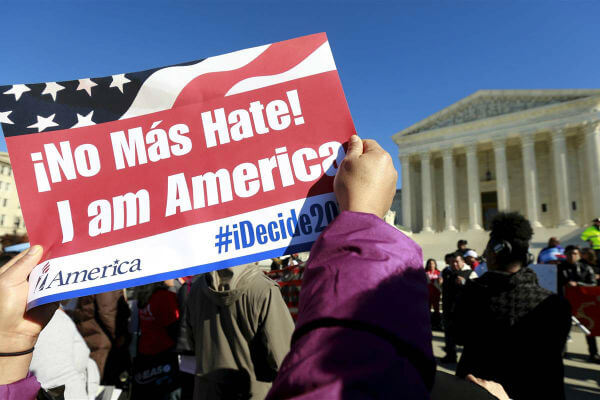
Benjamin Wallace-Wells writes: On Sunday, two days before the Presidential election, Donald Trump made five campaign stops, in five states: Iowa, Minnesota, Michigan, Pennsylvania, and Virginia. In Michigan, Ted Nugent served as the warmup act; in Virginia, it was Oliver North. At the end of Trump’s campaign, he has returned to the theme with which he began: the threat that immigrants pose to American society. In Minnesota, he told his supporters that “you’ve seen firsthand the problems caused with faulty refugee vetting, with very large numbers of Somali refugees coming into your state without your knowledge.” In Michigan, he blamed refugees for putting “your security at risk.” In Pennsylvania, he said, “You have people being brought into your community. Nobody knows who they are.” In Iowa, he described gruesome murders of Americans that were committed by immigrant killers. “The crime that’s been committed by these people is unbelievable.”
But the real news was about the electoral clout of “these people.” The background to those rallies was the accumulating evidence of a surge of Latino early voters, who may well change the course of this election. On Friday night, in Las Vegas, which has a large Latino population, the line to vote at a Cardenas supermarket was so long — at one point, more than a thousand people were waiting — that poll workers kept the site open until well after 10 p.m. The previous week, an A.P. photographer had captured a row of middle-aged women, most of them wearing casino housekeeper uniforms, standing in polling booths. The influential political analyst Jon Ralston wrote on Sunday that, in Las Vegas, Hillary Clinton’s early-voting lead may have put “a fitting final nail in Trump’s coffin.” In Florida, the line outside an Orlando library was ninety minutes long, and the political scientist Dan Smith noted the “explosive early voting turnout of Hispanics.” More than a third of those early voters did not vote in the last Presidential election. “The story of this election may be the mobilization of the Hispanic vote,” Senator Lindsey Graham, a Republican from South Carolina, and a vocal opponent of Trump, told the Times this weekend. [Continue reading…]

Barbara Kingsolver writes: When I was a girl of 11 I had an argument with my father that left my psyche maimed. It was about whether a woman could be the president of the US.
How did it even start? I was no feminist prodigy, just a shy kid who preferred reading to talking; politics weren’t my destiny. Probably, I was trying to work out what was possible for my category of person – legally, logistically – as one might ask which kinds of terrain are navigable for a newly purchased bicycle. Up until then, gender hadn’t darkened my mental doorway as I followed my older brother into our daily adventures wearing hand-me-down jeans.
But in adolescence it dawned on me I’d be spending my future as a woman, and when I looked around, alarm bells rang. My mother was a capable, intelligent, deeply unhappy woman who aspired to fulfilment as a housewife but clearly disliked the job. I saw most of my friends’ mothers packed into that same dreary boat. My father was a country physician, admired and rewarded for work he loved. In my primordial search for a life coach, he was the natural choice.
I probably started by asking him if girls could go to college, have jobs, be doctors, tentatively working my way up the ladder. His answers grew more equivocal until finally we faced off, Dad saying, “No” and me saying, “But why not?” A female president would be dangerous. His reasons vaguely referenced menstruation and emotional instability, innate female attraction to maternity and aversion to power, and a general implied ickyness that was beneath polite conversation.
I ended that evening curled in bed with my fingernails digging into my palms and a silent howl tearing through me that lasted hours and left me numb. [Continue reading…]