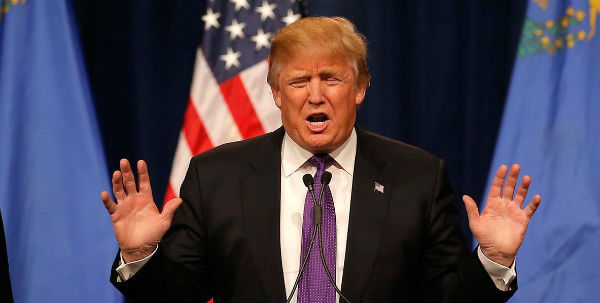
The New York Times reports: During major inflection points in Donald J. Trump’s campaign, the advisers, family members and friends who make up his kitchen cabinet burn up their email accounts and phone lines gaming out how to get his candidacy on track (and what counsel he might go along with).
But one person in the mix brings more than just his political advice. He also happens to control an hour of prime time on the Fox News Channel.
That person is Sean Hannity.
Mr. Hannity uses his show on the nation’s most-watched cable news network to blare Mr. Trump’s message relentlessly — giving Mr. Trump the kind of promotional television exposure even a billionaire can’t afford for long.
But Mr. Hannity is not only Mr. Trump’s biggest media booster; he also veers into the role of adviser. Several people I’ve spoken with over the last couple of weeks said Mr. Hannity had for months peppered Mr. Trump, his family members and advisers with suggestions on strategy and messaging.
So involved is Mr. Hannity that three separate denizens of the hall of mirrors that is Trump World told me they believed Mr. Hannity was behaving as if he wanted a role in a possible Trump administration — something he denied to me as laughable and contractually prohibitive in an interview on Friday.
But he did not dispute that he lends his thoughts to Mr. Trump and others in his close orbit whom Mr. Hannity has known for years.
“Do I talk to my friend who I’ve known for years and speak my mind? I can’t not speak my mind,’’ he said.
But, Mr. Hannity said, “I don’t say anything privately that I don’t say publicly.’’ And, he acknowledged, it’s unclear how far his advice goes with Mr. Trump, given that “nobody controls him.”
Mr. Hannity is unapologetic about his aim. “I’m not hiding the fact that I want Donald Trump to be the next president of the United States.” After all, he says, “I never claimed to be a journalist.” [Continue reading…]
Category Archives: Analysis
Uncovering the brutal truth about the British empire
Marc Parry writes: Help us sue the British government for torture. That was the request Caroline Elkins, a Harvard historian, received in 2008. The idea was both legally improbable and professionally risky. Improbable because the case, then being assembled by human rights lawyers in London, would attempt to hold Britain accountable for atrocities perpetrated 50 years earlier, in pre-independence Kenya. Risky because investigating those misdeeds had already earned Elkins heaps of abuse.
Elkins had come to prominence in 2005 with a book that exhumed one of the nastiest chapters of British imperial history: the suppression of Kenya’s Mau Mau rebellion. Her study, Britain’s Gulag, chronicled how the British had battled this anticolonial uprising by confining some 1.5 million Kenyans to a network of detention camps and heavily patrolled villages. It was a tale of systematic violence and high-level cover-ups.
It was also an unconventional first book for a junior scholar. Elkins framed the story as a personal journey of discovery. Her prose seethed with outrage. Britain’s Gulag, titled Imperial Reckoning in the US, earned Elkins a great deal of attention and a Pulitzer prize. But the book polarised scholars. Some praised Elkins for breaking the “code of silence” that had squelched discussion of British imperial violence. Others branded her a self-aggrandising crusader whose overstated findings had relied on sloppy methods and dubious oral testimonies.
By 2008, Elkins’s job was on the line. Her case for tenure, once on the fast track, had been delayed in response to criticism of her work. To secure a permanent position, she needed to make progress on her second book. This would be an ambitious study of violence at the end of the British empire, one that would take her far beyond the controversy that had engulfed her Mau Mau work.
That’s when the phone rang, pulling her back in. A London law firm was preparing to file a reparations claim on behalf of elderly Kenyans who had been tortured in detention camps during the Mau Mau revolt. Elkins’s research had made the suit possible. Now the lawyer running the case wanted her to sign on as an expert witness. Elkins was in the top-floor study of her home in Cambridge, Massachusetts, when the call came. She looked at the file boxes around her. “I was supposed to be working on this next book,” she says. “Keep my head down and be an academic. Don’t go out and be on the front page of the paper.”
She said yes. She wanted to rectify injustice. And she stood behind her work. “I was kind of like a dog with a bone,” she says. “I knew I was right.”
What she didn’t know was that the lawsuit would expose a secret: a vast colonial archive that had been hidden for half a century. The files within would be a reminder to historians of just how far a government would go to sanitise its past. And the story Elkins would tell about those papers would once again plunge her into controversy. [Continue reading…]
More than a third of all casualties in Aleppo are now children
Robin Wright writes: Last month, four newborns in incubators fought for their lives in a small hospital in Aleppo, the besieged Syrian city. Then a bomb hit the hospital and cut off power — and oxygen to the incubators. The babies suffocated. In a joint letter to President Obama this month, fifteen doctors described the infants’ deaths: “Gasping for air, their lives ended before they had really begun.” The doctors are among the last few in the eastern part of Aleppo, the historic former commercial center where a hundred thousand children are now trapped.
“Young children are sometimes brought into our emergency rooms so badly injured that we have to prioritize those with better chances, or simply don’t have the equipment to help them,” the doctors wrote. Only a trickle of food is making it through a land blockade imposed by the regime of President Bashar al-Assad. “Whether we live or die seems to be dependent on the ebbs and flows of the battlefield,” the doctors said. “For five years, we have faced death from above” — bombs — “on a daily basis. But we now face death from all around.”
More than a third of all casualties in Aleppo are now kids, according to Save the Children. Among them is Omran Daqneesh, the toddler with the moppish Beatles haircut whose picture captivated the world this week. He was shown covered with blood and dust after being dug from the debris of a bombing in Syria on Thursday. Rescuers placed him, alone, on an orange seat in an ambulance. His stunned, dazed expression mirrored the trauma of a war-ravaged generation. (On Saturday, we learned that Omran’s older brother Ali, who was ten, had died from wounds sustained in the attack.)[Continue reading…]
Trump’s empire: A maze of debts and opaque ties
The New York Times reports: On the campaign trail, Donald J. Trump, the Republican presidential nominee, has sold himself as a businessman who has made billions of dollars and is beholden to no one.
But an investigation by The New York Times into the financial maze of Mr. Trump’s real estate holdings in the United States reveals that companies he owns have at least $650 million in debt — twice the amount than can be gleaned from public filings he has made as part of his bid for the White House. The Times’s inquiry also found that Mr. Trump’s fortunes depend deeply on a wide array of financial backers, including one he has cited in attacks during his campaign.
For example, an office building on Avenue of the Americas in Manhattan, of which Mr. Trump is part owner, carries a $950 million loan. Among the lenders: the Bank of China, one of the largest banks in a country that Mr. Trump has railed against as an economic foe of the United States, and Goldman Sachs, a financial institution he has said controls Hillary Clinton, the Democratic nominee, after it paid her $675,000 in speaking fees.
Real estate projects often involve complex ownership and mortgage structures. And given Mr. Trump’s long real estate career in the United States and abroad, as well as his claim that his personal wealth exceeds $10 billion, it is safe to say that no previous major party presidential nominee has had finances nearly as complicated.
As president, Mr. Trump would have substantial sway over monetary and tax policy, as well as the power to make appointments that would directly affect his own financial empire. He would also wield influence over legislative issues that could have a significant impact on his net worth, and would have official dealings with countries in which he has business interests. [Continue reading…]
By masterfully playing the troll, Trump has placed himself within reach of the Oval Office
David Sax writes: According to Chuck Dueck, a senior vice-president at icuc.social, a company that manages the online presence for hundreds of companies and organizations, trolls fall into four different categories: those who deliberately practice harassment, those who enjoy being outrageous and causing havoc, those who love to argue, and those too stupid to know they are trolls. Dueck believes Trump is most like the second and third. “He has a long career of making outrageous statements designed to get attention,” Dueck says. “He now has the biggest stage to do it from. I believe he enjoys tossing out a statement and watching the reaction.”
Back in July, Trump tweeted out an image of Hilary Clinton’s face in front of a pile of cash, with the words “Most Corrupt Candidate Ever!” stamped on a red, six-pointed star. In response to the wave of accusations of anti-semitism, Trump didn’t apologize or attempt to put the event behind him. In true troll fashion, he chose to encourage the conflict instead of resolve it – first by saying it was a “sheriff’s star”, and then posting a photo of a six-sided star on a Frozen children’s book, asking whether this was also a Star of David.
Time and again, his outrageous comments and statements have seized the narrative away from his rivals, distracted the media with the antics of insults and bizarre statements, and steered the conversation away from substantive issues. Think back to the Republication primaries. Can you remember a single policy proposal debated by the candidates? Probably not. But who can forget Trump’s promise to build a giant wall with Mexico and block Muslim immigration, or his schoolyard nicknames for “Little Marco” and “Lyin’ Ted”? By playing the troll, Trump has masterfully dominated the news cycle and placed himself within reach of the Oval Office.
Trolling works for Trump because it is fundamentally a manipulation of our emotions. “Trolling is crafted by people who believe it is their job to figure out exactly what people’s buttons are, then press those buttons,” says Jessamyn West, a veteran community manager who now works at the Internet Open Archives Library.
Trump’s trolling is a high-impact, low-output strategy. A single tweet or comment can generate days worth of free publicity, and keep him the central character in the race. Like all skilled trolls, Trump has proven masterful at inspiring his followers to do the bulk of his dirty work. According to West, the best trolls enter a conversation, make a comment or two, set off a fight, and step back as other trolls emerge to sling punches. Trolls aren’t warriors, they’re instigators. They know how to imply something racist, hateful or misogynistic, blowing rhetorical dog whistles that bring out more blatantly offensive supporters while allowing themselves deniability. “There’s an art to this,” West says. “It’s like a flaming bag of dog shit on someone’s doorstep.” Even if you know who likely put it there, it’s not like you can dust it for prints. [Continue reading…]
Once again political murders are playing a prominent role in the Kremlin’s foreign policy
The New York Times reports: From a certain perspective, certainly the Kremlin’s, Vladimir Kara-Murza’s behavior in Washington could be seen as treasonous, a brazen betrayal of his homeland.
In a series of public meetings on Capitol Hill, Mr. Kara-Murza, a leader in the Russian opposition, urged American lawmakers to expand economic sanctions against the Russian government under a law known as the Magnitsky Act. That would hasten political change in Russia, he argued.
Back in Moscow a month later, in May 2015, the changes Mr. Kara-Murza detected were going on in his own body. Midway through a meeting with fellow dissidents, beads of sweat inexplicably dotted his forehead. His stomach churned.
“It all went so fast,” he recalled. “In the space of about 20 minutes, I went from feeling completely normal to having a rapid heart rate, really high blood pressure, to sweating and vomiting all over the place, and then I lost consciousness.” He had ingested a poison, doctors told him after he emerged from a weeklong coma, though they could find no identifiable trace of it.
While Mr. Kara-Murza survived, few others in his position have proved as lucky. He said he was certain he had been the target of a security service poisoning. Used extensively in the Soviet era, political murders are again playing a prominent role in the Kremlin’s foreign policy, the most brutal instrument in an expanding repertoire of intimidation tactics intended to silence or otherwise intimidate critics at home and abroad. [Continue reading…]
What is extremist belief? An answer from medieval Islamic philosophy
By Anthony Booth, University of Sussex
Every time we are shocked by a new terrorist atrocity, or when a surge in hate crimes takes hold in a country, we lament the malign grip of extremism. But what exactly do we mean when we say that someone holds extreme beliefs? And what exactly is wrong with extreme beliefs? Frankly, there has been little work in western philosophy to tackle these questions. Luckily, however, we can look to the work of a medieval Islamic philosopher – Abu Nasr al-Farabi – to help us find some answers.
Let’s consider two possible models for conceptualising extreme belief. One we might call the “defective belief model” which has become the tacit consensus view of the contemporary West. The other is the “over-belief model” favoured by al-Farabi, one of the great figures of the Islamic golden age of medieval philosophy, who lived in Baghdad in the 9th and 10th centuries. Al-Farabi is well known for his contributions to logic – his contemporaries gave him the moniker “the Second Master”, suggesting that only Aristotle surpassed his logical prowess. In Europe, he was better known as Alfarabius.
I want to make some conceptual points against the Western model of extremism and some in favour of al-Farabi’s.
Let’s begin by taking a look at the idea of defective belief. Under a version of this model, someone has extremist beliefs when they believe propositions that are morally bad to believe, such as that racism is permissible, or that it is permissible to target non-combatants during war.
Why has offshore wind technology been so slow to catch on in the United States?
Madeleine Thomas writes: The first offshore wind farm in the country, a $300 million project more than seven years in the making, will open this fall off the coast of Rhode Island.
Deepwater Wind, an offshore wind developer, is spearheading the five-turbine farm near Block Island, less than 20 miles south off the mainland. The facility will power most of the island, cut local electric rates by 40 percent, and reduce carbon dioxide emissions by 40,000 tons a year. The wind farm — — the first of its kind in United States waters — — could power as many as 17,000 homes.
“I look at Block Island as sort of the key to unlocking the code of how to do offshore wind in the U.S.,” Deepwater Wind CEO Jeffrey Grybowski told the Associated Press.
There may be merit to Grybowski’s claim, but, overall, offshore wind in the U.S. is slow-going. The Bureau of Ocean Energy Management has already approved 11 commercial wind leases throughout the Atlantic, but as the Associated Press reports, projects off the coasts of Cape Cod (which actually would have been the first in the country, if successful) and Long Island both stalled due to legal hurdles or delayed state votes. In Europe, offshore wind is a thriving industry, with more than 3,000 wind turbines installed across 11 countries. [Continue reading…]
Trump hands his campaign to the ‘alt-right’ movement

Christian Science Monitor reports: The appointment of Breitbart news chief Stephen Bannon to head Donald Trump’s presidential campaign this week marks the official entree of the so-called “alt-right” into the Republicans’ top campaign.
For the Trump campaign, Mr. Bannon is an experienced political street fighter who is well-versed in the sharp-edged, populist message that served the candidate well in the Republican primaries.
Mr. Trump’s tapping of the alt-right could help solidify his base by letting Trump be Trump, and potentially propel him to hit Hillary Clinton’s weak points harder.
But critics say that Bannon’s hiring resonates far beyond the Trump campaign in troubling ways. It marks a worrisome marriage of the Republican Party with an Internet culture that, they say, peddles in white identity, misogyny, anti-Semitism, and Clinton conspiracies.
In short, it doubles down on a largely white voting bloc that, in the words of Brendan O’Neill, a commentator for the conservative Spectator magazine in Britain, is “convinced the world is one big lefty, feminist plot to ruin your average white dude’s life.” [Continue reading…]
How immigrant athletes at the Olympics keep on beating Trumpism
Ben Geman writes: On Saturday night, the British distance runner Mo Farah will try and become the first athlete to sweep the 5,000- and 10,000-meter races at consecutive Olympics since Finland’s Lasse Viren won both in 1972 and 1976. Farah has already found a heart-stopping way to pay homage to the Finn, albeit accidentally. Viren famously fell mid-race during the 10,000-meter in 1972 but managed to get up and still win. Forty-four years later, in the middle of last Saturday’s 10,000 in Rio, Farah got tangled up with the American runner Galen Rupp, his friend and sometime training partner, and went crashing onto the track. It briefly looked as though Farah’s race was over. But he sprang up, rejoined the pack, and won in the same way he’s dominated the biggest international races for a half-decade: by separating himself from runners still in the mix and entering the final lap with a blistering closing kick.
Farah is tangled up with forces off the track too. He’s an immigrant who came to England from Somalia in order to escape conflict there at the age of eight. Time and again in recent years, the 33-year-old Farah, a devout Muslim, has prayed on the track and draped himself in the British flag after crossing the line for wins on the biggest stage, including at London’s 2012 games and then biennial World Championships in Russia and China in 2013 and 2015.
Still, Farah has faced claims that he’s not truly a British athlete throughout his career. In an ugly incident last year after Farah set the European record in the half-marathon, the man he took it from, Spain’s Fabian Roncero, dismissed the feat, reportedly claiming that an athlete “born in Somalia is Somali forever.” And this year’s Olympics are unfolding at a very different and even more fraught political moment than Farah’s earlier wins, arriving just weeks after anti-immigrant sentiment helped elicit Britain’s exit from the European Union. Across the Atlantic, Donald Trump has made condemning immigrants a pillar of his campaign to capture the GOP nomination and the White House. [Continue reading…]
Honor crimes in Pakistan: The price of forgiveness
Continued inaction in the face of an abomination shaped by Assad, Iran, and Russia is exacting too high a price
Fred Hof writes: No one in the history of the Syrian conflict has counseled Mr. Obama to invade and occupy Syria, fighting Iranian forces in the process. Fifty-one conscience-stricken State Department officers recently pressed upon him a variation of what others, in and out of government, have urged him for years to do: use limited military means to exact a price for mass homicide in an effort to deter it. For years the president has said no. The consequences for Syrians, their neighbors, and European allies have been staggering, as a country that began the war with 23 million people gradually empties itself. And ISIS — the author of heinous atrocities abroad — is in large measure a consequence of Assad regime mass homicide unchecked by the civilized world.
Yet whenever presented with modest proposals for measured pushback, Mr. Obama and his communications mavens deploy an army of straw men to counterattack. They have exploited the understandable, if misguided reluctance of Americans to do anything at all of a military nature in the Middle East after the experience of Iraq.
ISIS — partly the result of Assad-induced state failure in Syria — is the exception. But Assad himself — a protégé and employee of Iran — has been spared entirely, even though a straight line runs from his practice of mass homicide in Syria to the ‘Brexit’ vote in the United Kingdom and the rise of Vladimir Putin lookalikes in the politics of the West. Iran is the key to understanding why the Obama administration immolated its own reputation in the 2013 ‘red line’ fiasco, and why it continues to look the other way while Assad and his enablers enjoy an unrestrained crime spree. [Continue reading…]
Saudi Arabia kills civilians, the U.S. looks the other way
Samuel Oakford writes: In the span of four days earlier this month, the Saudi Arabia-led coalition in Yemen bombed a Doctors Without Borders-supported hospital, killing 19 people; a school, where 10 children, some as young as 8, died; and a vital bridge over which United Nations food supplies traveled, punishing millions.
In a war that has seen reports of human rights violations committed by every side, these three attacks stand out. But the Obama administration says these strikes, like previous ones that killed thousands of civilians since last March, will have no effect on the American support that is crucial for Saudi Arabia’s air war.
On the night of Aug. 11, coalition warplanes bombed the main bridge on the road from Hodeidah, along the Red Sea coast, to Sana, the capital. When it didn’t fully collapse, they returned the next day to destroy the bridge.
More than 14 million Yemenis suffer dangerous levels of food insecurity — a figure that dwarfs that of any other country in conflict, worsened by a Saudi-led and American-supported blockade. One in three children under the age of 5 reportedly suffers from acute malnutrition. An estimated 90 percent of food that the United Nation’s World Food Program transports to Sana traveled across the destroyed bridge. [Continue reading…]
To Syrians the world offers sympathy and little help
Uri Friedman writes: You can calculate the number of people who have died in a conflict, the relative strength of various factions, the amount of territory each holds. Hope is much harder to measure. But it’s no less a factor in the arithmetic of war. Hope is a bulwark of humanity. In many cases, hope is all that civilians beset by violence have left.
Consider the Syrian Civil War: Hope — for the most basic international action to ease the suffering of Syrians, let alone efforts to halt hostilities or end the war — is in especially short supply these days. The shortage is evident in the reaction this week to the images and video of a stunned, bloodied five-year-old boy being whisked from a bombed building to an ambulance. The visuals are being widely shared online, but often with dark resignation. There’s little expectation that world leaders will be moved to do what’s necessary to resolve the humanitarian catastrophe in Aleppo, which for months now has been starved of food, water, and medical supplies as Syrian government and rebel forces battle for control of the city.
“Watch this video from Aleppo tonight. And watch it again,” the Australian journalist Sophie McNeill tweeted on Wednesday, in reference to the footage of the Syrian child. “And remind yourself that with #Syria #WeCantSayWeDidntKnow.” This is less a call to action than a challenge to stare straight at collective inaction—and not turn away in disgust. McNeill’s message has been shared thousands of times.
The shortage of hope is also evident in a letter that 15 of the last doctors in rebel-controlled eastern Aleppo recently sent to Barack Obama. The physicians spoke of horrors that haven’t gone viral on the internet: attacks on medical facilities, often by suspected Russian or Syrian government warplanes, occurring roughly every 17 hours; four newborn babies suffocating to death after an explosion cut off oxygen to their incubators. The letter’s signatories urged the U.S. president to exert more pressure on the various parties in the conflict to protect civilians and lift the siege on the city. But a number of doctors declined to sign the letter, believing the plea for international support to be futile. And when the BBC asked one of the signatories about that decision by her colleagues, she admitted that she didn’t expect the United States to actually help either. [Continue reading…]
Liberal democracy is in the midst of an epic struggle for survival
Yascha Mounk writes: There are years, decades even, in which history slows to a crawl. Then there are weeks that are so eventful that they seem to mark the dissolution of a world order that had once seemed solid and to foretell the rise of one as yet unknowable.
The week of July 11, 2016, has every chance of being remembered as one of those rare flurries of jumbled, inchoate, concentrated significance. The centrifugal forces that are threatening to break political systems across the world may have started to register a decade ago; they may have picked up speed over the last 12 months; but never since the fall of the Berlin Wall have they wreaked havoc in so many places in so short a span of time—showcasing the failures of technocratic rule, the terrifying rise of populist strongmen, and the existential threat posed by Islamist terrorism, all in the span of seven short days.
At first glance, a political crisis in London; a terrorist attack in Nice, France; a failed putsch in Ankara, Turkey; and a bloviating orator on his way to becoming the Republican nominee for the presidency of the United States look like the dramatic apex of very different, barely connected screenplays. To my eye, they are garish panes of glass that add up to one unified, striking mosaic. Looked at from the right distance, they tell the story of a political system, liberal democracy, that has long dominated the world — and is now in the midst of an epic struggle for its own survival. [Continue reading…]
France’s ‘burkini’ bans are about more than religion or clothing
The New York Times reports: There is something inherently head-spinning about the so-called burkini bans that are popping up in coastal France. The obviousness of the contradiction — imposing rules on what women can wear on the grounds that it’s wrong for women to have to obey rules about what women can wear — makes it clear that there must be something deeper going on.
“Burkinis” are, essentially, full-body swimsuits that comply with Islamic modesty standards, and on Wednesday, Prime Minister Manuel Valls of France waded into the raging debate over the bans in some of the country’s beach towns, denouncing the rarely seen garb as part of the “enslavement of women.”
This, of course, is not really about swimwear. Social scientists say it is also not primarily about protecting Muslim women from patriarchy, but about protecting France’s non-Muslim majority from having to confront a changing world: one that requires them to widen their sense of identity when many would prefer to keep it as it was.
“These sorts of statements are a way to police what is French and what is not French,” said Terrence G. Peterson, a professor at Florida International University who studies France’s relationship with Muslim immigrants and the Muslim world.
While this battle over identity is rising now in the wake of terrorist attacks, it has been raging in one form or another in French society for decades, Professor Peterson said. What seems to be a struggle over the narrow issue of Islamic dress is really about what it means to be French. [Continue reading…]
This is what’s missing from journalism right now
Mother Jones reports: This June, we published a big story — Shane Bauer’s account of his four-month stint as a guard in a private prison. That’s “big,” as in XXL: 35,000 words long, or 5 to 10 times the length of a typical feature, plus charts, graphs, and companion pieces, not to mention six videos and a radio documentary.
It was also big in impact. More than a million people read it, defying everything we’re told about the attention span of online audiences; tens of thousands shared it on social media. The Washington Post, CNN, and NPR’s Weekend Edition picked it up. Montel Williams went on a Twitter tear that ended with him nominating Shane for a Pulitzer Prize (though that’s not quite how it works). People got in touch to tell us about their loved ones’ time in prison or their own experience working as guards. Lawmakers and regulators reached out. (UPDATE: And on August 18, the Justice Department announced that it will no longer contract with private prisons, which currently hold thousands of federal inmates — a massive policy shift.)
In the wake of our investigation, lots of people offered thoughts similar to this, from New Yorker TV critic Emily Nussbaum:
(Incidentally, that @shane_bauer @MotherJones undercover investigation is literally why journalism exists & why we have to pay for it.)
— emily nussbaum (@emilynussbaum) June 23, 2016
That’s a great sentiment, and we agree! But it also takes us to a deeper story about journalism and today’s media landscape. It starts with this: The most important ingredient in investigative reporting is not brilliance, writing flair, or deep familiarity with the subject (though those all help). It’s something much simpler — time. [Continue reading…]
Outcome of U.S. election seen as ‘question of national security for Russia’ says Kremlin watcher
NPR reports: Investigative journalist Andrei Soldatov says the [Democratic National Committee] hack wasn’t necessarily the work of Russian intelligence services.
“It’s much more complicated than that,” says Soldatov, co-author of The Red Web: The Struggle Between Russia’s Digital Dictators and the New Online Revolutionaries. “We have non-government actors, and they’re really adventurous, really fast and they’re really, really good.”
He says mercenary hackers give the government a way to deny involvement.
Once the material had been stolen, though, [Mark] Galeotti thinks the Kremlin took over.
“The actual leak — the point where they did something with the information they gathered — now there’s no question that that would be regarded as a strategic move, and would need to have had Kremlin sanction,” he says.
Russia’s foreign minister, Sergei Lavrov, repeated this week that Russia doesn’t interfere in the affairs of other countries. Recently he said, “We have witnessed a volley of Russophobic hysteria.”
He called the accusations “ploys to support one candidate and smear another.”
DNC staffers charged that the publication of the emails was a Russian ploy to support the candidacy of Donald Trump. But “I think it’s not about Trump,” says Soldatov. “It’s all about Hillary Clinton.”
What might Russia hope to gain from influencing the American vote?
Soldatov says President Vladimir Putin believes Clinton is a Russia-hater who was behind anti-government demonstrations that took place in Russia in 2011 and 2012.
And Soldatov says this U.S. election is important for Moscow because America’s next leader could determine whether economic sanctions against Russia will be lifted. “And everybody in the Kremlin believes that if Hillary Clinton in the White House, it will be absolutely impossible to get the sanctions against Russia lifted. So in a way, it’s a question of national security for Russia.”
Galeotti thinks the key purpose with the DNC leaks is to divide Clinton’s political base by showing that top party officials worked to freeze out her primary opponent, Bernie Sanders.
The Kremlin’s idea, he says, is to create the impression that politics in the U.S. is manipulated just as much as in Russia. [Continue reading…]